
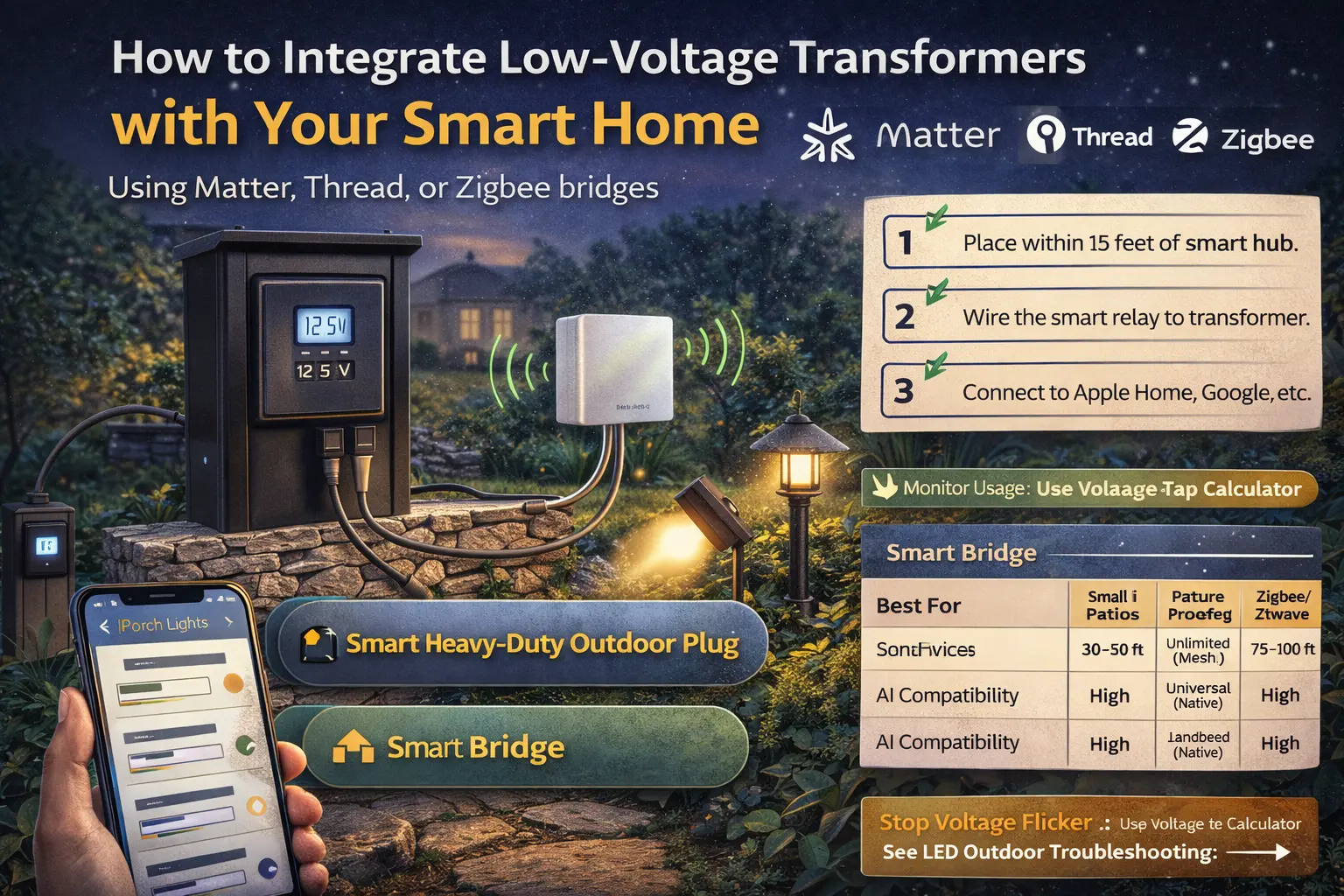
Quick Answer: How Do You Make Landscape Lighting Smart?
You can make landscape lighting smart by adding a control device between the transformer and power source. Most systems use either a heavy-duty smart outdoor plug or a properly rated relay to enable app control, scheduling, and automation.
- Small systems: Use a smart outdoor plug
- Larger transformers: Use a rated relay or switch
- Best reliability: Use mesh-based systems (Thread or Zigbee)
- Main goal: Replace outdated timers with smart scheduling
What a Smart Bridge Really Solves
Most homeowners are not trying to build a science project. They are trying to stop walking out to the garage, shed, or side wall every season to reprogram an aging transformer timer. A smart bridge solves that by adding a control layer between the transformer and the rest of the home.
In practical terms, that means your outdoor system can finally work with schedules, scenes, and remote access instead of being locked to whatever the old timer happens to do.
Can You Use a Smart Plug with a Landscape Lighting Transformer?
Yes, many landscape lighting systems can be controlled with a smart plug, but only if the plug is rated for the transformer load.
- Works well: Small electronic transformers
- Use caution: Larger magnetic transformers
- Common issue: Cheap plugs fail due to startup surge
If the system is large or older, a relay or switched circuit is usually more reliable.
If your system behaves inconsistently after adding smart control, the issue may be with the transformer itself. See Portfolio lighting transformer troubleshooting to check for overload, timer conflicts, or power issues before adjusting your setup.
If your transformer cannot handle modern control or is already failing, upgrading is often the best solution. Review Portfolio lighting transformer replacement to compare compatible options with better performance and reliability.
Smart landscape lighting bridges are designed to connect different systems, but true reliability comes from how the entire setup is planned. Mixing devices, control platforms, and outdoor lighting requires stable connectivity, proper power layout, and a clear control strategy. For a complete guide to building a system that works together without conflicts or dropouts, see the smart holiday lighting setup guide.
Matter vs. Thread vs. Zigbee vs. Wi-Fi
| Feature | Wi-Fi Bridge | Matter (over Thread) | Zigbee / Z-Wave |
|---|---|---|---|
| Best For | Small patios and short-range installs | Future-proof smart home integration | Larger properties with hub-based control |
| Signal Range | Usually limited by router distance | Mesh-style expansion through nearby devices | Strong yard coverage with proper repeaters |
| Reliability | Moderate outdoors | Very strong when mesh is built correctly | High with stable hub placement |
| Best Use Case | Basic scheduling and simple control | Long-term platform compatibility | Established smart-home ecosystems |
Best Smart Control Based on System Size
| System Type | Best Control Method | Why |
|---|---|---|
| Small yard (under 100W) | Smart outdoor plug | Simple and easy setup |
| Medium system (100–300W) | Heavy-duty smart plug or relay | Handles moderate load safely |
| Large system (300W+) | Dedicated relay or smart switch | Handles startup current and load spikes |
How to Choose the Right Smart Control Method
The quick fix: smart outdoor plug
For smaller transformers and lighter loads, a heavy-duty outdoor smart plug can be the easiest bridge. It is fast, simple, and often enough for homeowners who mainly want app control and scheduling.
The expert way: rated relay or smart switch
For larger systems, especially magnetic transformers, the better move is a properly rated smart relay or switch installed ahead of the transformer. This is where many cheap smart conversions go wrong. The control device has to handle the transformer’s startup behavior, not just the steady load.
Not all smart systems work the same outdoors. Use smart hub compatibility guide to compare which platforms work best with landscape lighting setups.
A smart lighting bridge should do more than connect devices together. Our AI circadian lighting automation resource explains how integrated schedules can dynamically adjust brightness, warmth, and pathway visibility based on time of night, seasonal sunset changes, and human visual comfort patterns instead of relying on static lighting scenes.
How to Retrofit a Dumb Transformer with a Smart Bridge
- Identify your transformer size and type before adding any smart control.
- Decide whether the system needs a smart plug, a relay, or a switched feed.
- Install the bridge or control device in a location with dependable signal and proper weather protection.
- Assign the new control to your smart-home platform and test on/off behavior, scheduling, and restart after power loss.
- Check fixture performance after the retrofit so the lights do not dim, flicker, or behave unevenly.
If you need to confirm transformer size first, start with the transformer wattage guide and the transformer sizing guide.
If you are adjusting your transformer to improve performance, use the voltage tap calculator to match your system layout to the correct output setting.
Signal Planning for Outdoor Smart Systems
Backyard smart lighting fails more often from bad signal planning than from bad fixtures. That is especially true when a system stretches from the house to distant beds, gates, or detached structures.
In real yards, you want to think in practical hops. If the signal has to cross masonry, metal enclosures, and distance all at once, reliability drops. This is why the protocol decision matters more outside than it does for indoor lamps.
To go deeper on that side of the build, see Matter and Thread connectivity and smart hub compatibility.
Why Do Smart Landscape Lights Flicker?
Flicker usually happens when the control device is not compatible with the transformer or load.
If your lights are dim or uneven after adding smart control, the issue may be voltage drop rather than the control device. Learn how to fix this in landscape lighting voltage drop before adjusting your automation setup.
- Transformer startup surge (inrush current)
- Underrated smart plug or relay
- Voltage drop on long runs
- Unstable wiring or loose connections
Troubleshooting Flicker in Smart LED Conversions
Flicker after a smart retrofit is one of the most common complaints, and it usually has a few predictable causes: poor compatibility, unstable voltage, bad load matching, or a control device that does not like the transformer it is switching.
- magnetic transformer startup behavior
- mismatched smart control hardware
- voltage drop on long runs
- existing system instability that the retrofit exposed
If your smart conversion introduced flicker, check Portfolio LED lights flickering and use the voltage tap calculator to make sure the issue is not power delivery at the fixture.
Before adding a bridge or smart controller to an existing landscape lighting system, check the smart transformer dimming and latency guide for cold-start delay, ghost power, buzzing, voltage drop, and connector compatibility issues.
Compatibility Checker
| Transformer Style | Best Starting Option | What to Watch For |
|---|---|---|
| Small residential transformer | Heavy-duty smart outdoor plug | Check plug rating and outdoor signal strength |
| Magnetic transformer | Properly rated relay or switch | Watch startup current and compatibility |
| Older legacy system | Smart retrofit with signal planning | Watch for timer conflicts and worn wiring |
| Large yard with multiple zones | Mesh-friendly smart protocol | Watch for coverage gaps and repeater placement |
Using Better Scheduling Instead of Old Timers
Fixed timers work until they do not. They drift, they get ignored, and they rarely match real sunset well through the seasons. A smarter bridge solves that by letting your system react to actual local sunset instead of whatever the dial was set to months ago.
If your goal is cleaner evening control, see circadian outdoor lighting, dark sky automation, and smart outdoor lighting controls.
Why This Matters for Load and Voltage
A bridge does not magically fix a poorly sized transformer or a bad run. It only improves control. If the system is already overloaded or losing too much voltage, smart scheduling will not solve the root problem by itself.
That is why this page ties directly into the voltage tap calculator, transformer wattage guide, and transformer sizing guide.
Wireless bridges and controllers can introduce startup lag between the command and the actual light response. The landscape lighting smart latency benchmark compares how different outdoor lighting ecosystems respond during activation.
Smart Landscape Lighting Bridge FAQ
What is a smart landscape lighting bridge?
It is the control layer that lets a standard low-voltage transformer work with a smart home platform for scheduling, remote control, and more advanced automation.
Can I use a smart plug with a landscape transformer?
In many smaller systems, yes. For larger transformers, especially magnetic ones, a properly rated relay or switch is often the safer and more reliable choice.
Which protocol is best outdoors?
For many outdoor layouts, mesh-friendly approaches are more dependable than plain Wi-Fi because they handle distance and coverage better across a property.
Why does flicker sometimes start after a smart conversion?
Because the new control device may not be fully compatible with the transformer, load, or startup characteristics of the system you are switching.
What Most People Get Wrong
- Using a cheap smart plug on a large transformer
- Ignoring transformer startup current
- Blaming flicker on bulbs instead of power control
- Expecting Wi-Fi to cover large outdoor areas
Final Thoughts
The best smart bridge setup is not the most complicated one. It is the one that matches your transformer, your yard size, and your control goals without introducing signal problems or electrical headaches.
Start with the right control method, make sure the transformer side is healthy, and build from there. Done right, an older low-voltage system can feel a lot more modern without replacing everything.
For more advanced setups, see AI automated landscape lighting to explore how automation can adapt to schedules, motion, and environmental conditions.
Smart landscape lighting bridges can reduce energy use when scenes dim after bedtime or turn off unused zones automatically. The smart outdoor lighting operating cost calculator helps estimate the savings from shorter schedules and lower fixture wattage.
Smart outdoor lighting systems can automate Halloween scenes, pathway timing, and synchronized color effects. The Halloween smart landscape lighting effects guide explains how to coordinate low-voltage fixtures, smart controls, and outdoor lighting zones for seasonal displays.