
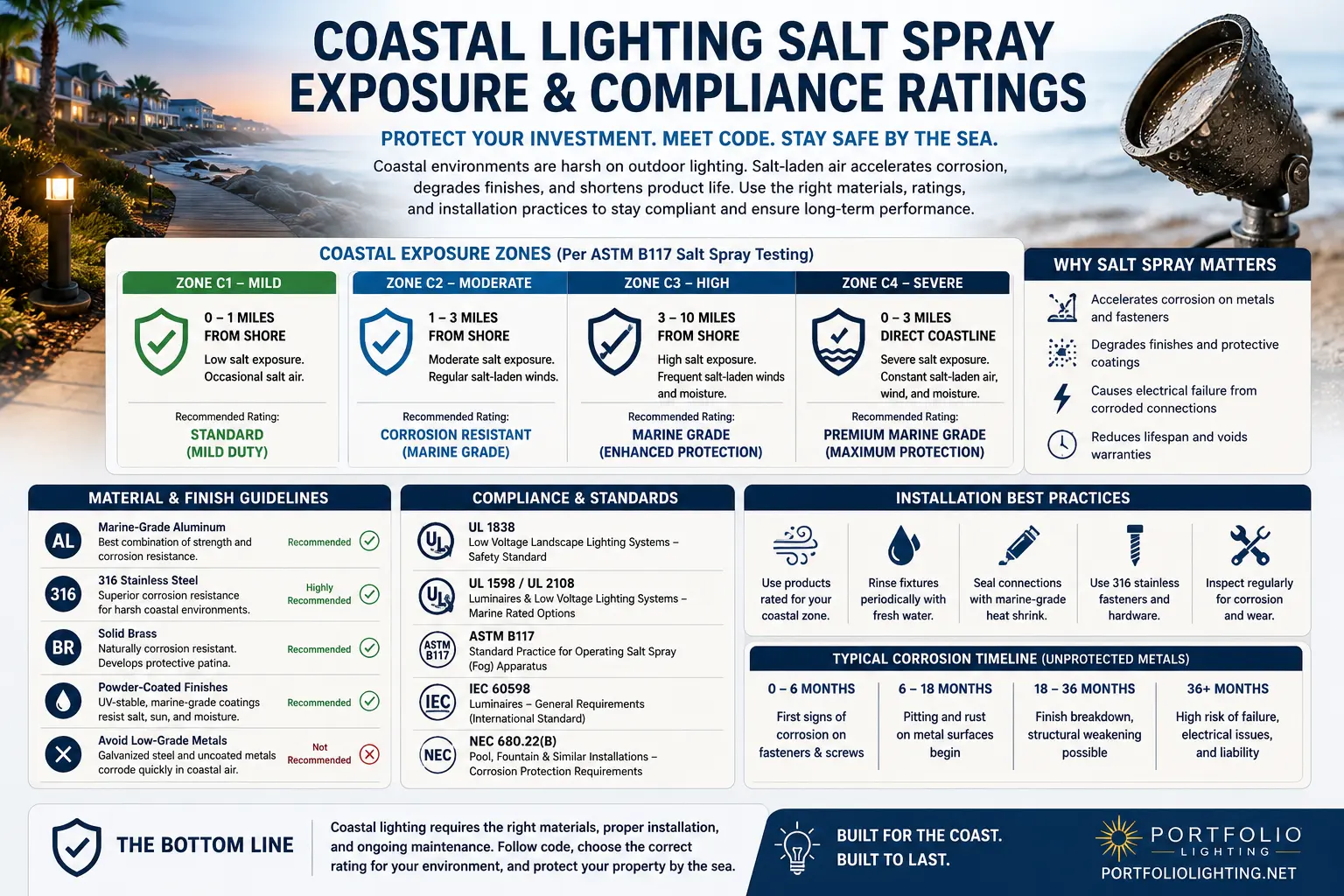
The IP Rating Myth: Why IP66 Is Not a Coastal Specification
Every week a contractor or property owner in a coastal market purchases outdoor lighting fixtures because they carry an IP66 or IP67 rating, installs them on a beachfront property, and watches them fail in 18–36 months. The IP rating was the specification they relied on. The IP rating didn't fail — it did exactly what it's designed to do. The problem is that water ingress protection and corrosion resistance are completely different properties, governed by completely different standards, and IP ratings address only the first of these two entirely separate threats.
What IP Ratings Actually Test
The IP (Ingress Protection) rating system is defined by IEC 60529 — an international standard developed by the International Electrotechnical Commission. The two digits in an IP rating encode two specific protection levels:
- First digit (solid protection): Protection against solid particle ingress — dust, sand, debris. "6" means the enclosure is fully dust-tight; no ingress of dust in any quantity. This is essential for coastal environments where salt crystals and sand particles are carried by wind.
- Second digit (liquid protection): Protection against liquid ingress — specifically, water under defined test conditions. IP66 means the enclosure withstands "powerful water jets" tested with 100 liters per minute at 100 kPa from 3 meters at any direction. IP67 adds 30-minute immersion at 1 meter depth. IP68 adds extended/deeper immersion.
What IEC 60529 explicitly does not test, measure, specify, or require: any resistance to corrosion, chemical attack, salt exposure, UV degradation, or any form of environmental deterioration that isn't a solid particle or liquid penetrating a seal. Per Hyperlite's documented analysis: "While an IP66 or IP67 rating is essential for preventing water and dust ingress, it is critical to understand that these certifications do not correlate with corrosion resistance. The IEC 60529 (IP Ratings) standard tests for the physical entry of water under pressure, but it does not simulate the chemical attack of sodium chloride over time."
An IP66 fixture made entirely from zinc-plated mild steel hardware, standard anodized 6061 aluminum housing, and silicone gaskets without UV stabilizers will pass IP66 testing and carry a valid IP66 label — and will corrode to the point of failure within 2–4 years in a beachfront installation. IP66 tells you that water cannot penetrate the sealed enclosure under the test conditions. It tells you nothing about whether the exterior of that enclosure — the housing, fasteners, mounting hardware, and cable entry points — will survive continuous salt air exposure. This is not a theoretical gap; it is the most common failure mode for coastal outdoor lighting installations that specify IP66 without additional corrosion resistance requirements.
The IP to Coastal Application Mapping
Within the scope of what IP actually tests, here is the correct mapping to coastal applications:
- IP64 or below: Not acceptable for coastal use. Insufficient dust protection (below IP6X) means salt crystals enter the housing and attack internal components directly.
- IP65: Dust-tight plus protection against water jets. Acceptable for incidental exposure at 5+ miles from shore in sheltered inland positions. Not acceptable for direct coastal use.
- IP66: Dust-tight plus protection against powerful water jets (the force of breaking waves and wind-driven salt spray). The minimum water ingress baseline for coastal landscape lighting — but inadequate specification on its own without corrosion resistance requirements.
- IP67: Adds 1-meter immersion protection. Required for in-grade and below-grade fixtures in coastal environments where flooding, tidal surge, or storm water inundation is possible. Per USkyLED's documented analysis: "Crucial Misconception: IP67 is not necessarily better than IP66. IP67 tests for static immersion, while IP66 tests for high-pressure kinetic force. A fixture in a typhoon-prone coastal area needs the force resistance of IP66, not just the immersion resistance of IP67." For coastal landscape lighting, specify both IP66 and IP67 for below-grade installations.
- IP68: Extended or continuous submersion. Required for underwater landscape fixtures in ponds and pools — not typically applicable to standard landscape lighting fixtures unless permanently submerged. See the pool lighting clearance guide.
NEMA 4X vs IP66: The Corrosion Testing Gap
NEMA 4X is the US standard that adds corrosion resistance to the water and dust protection that IP66 provides. Understanding what the "X" in NEMA 4X actually requires — and what test it cites — is the foundation of correct coastal lighting specification.
What the "X" in NEMA 4X Means
NEMA (National Electrical Manufacturers Association) Type 4 enclosures provide protection against windblown dust and rain, splashing water, hose-directed water, and ice formation — equivalent to IP66 for water and dust protection. NEMA Type 4X provides all the same protection as Type 4, plus one additional requirement: corrosion resistance. Per Industrial Monitor Direct: "NEMA 4X mandates corrosion resistance testing, typically using salt fog exposure per ASTM B117. Practical Implication: For marine, coastal, chemical processing, or outdoor applications where corrosion is a concern, specifying IP66 alone may result in premature enclosure failure. Choose NEMA 4X or ensure IP-rated enclosures specify corrosion-resistant materials."
Per Process Solutions' documented analysis: "The 'X' designation requires corrosion-resistant materials like stainless steel instead of carbon steel, plus 2,000 hours of corrosion testing." The specific materials and test requirements that NEMA 4X mandates — versus what IP66 leaves entirely unspecified — are where the practical difference lies for coastal landscape lighting.
The Practical Specification Rule: For coastal landscape lighting installation, specify NEMA 4X as the enclosure minimum — not IP66. IP66 is a water ingress test that the fixture must also pass, but it is not the corrosion resistance specification. NEMA 4X requires both. When NEMA 4X listed fixtures are not available for a specific application (certain specialty landscape fixtures, for example), specify IP66 or IP67 plus independent ASTM B117 corrosion test documentation from the manufacturer, verified by a third-party laboratory.
ASTM B117 Salt Fog Test: Methodology and Hour Thresholds for Coastal Lighting
ASTM B117 (identical to ISO 9227 internationally) is the Neutral Salt Spray (NSS) test — the primary standard method for evaluating the corrosion resistance of coatings and materials in the lighting industry. Understanding what the test actually does, what failure modes it detects, and what hour thresholds correspond to coastal proximity zones is the technical foundation for coastal fixture specification.
How the ASTM B117 Test Works
Hour Thresholds by Coastal Proximity Zone
| Proximity Zone | Distance from Shore | Minimum ASTM B117 Hours | Aluminum Coating | Fastener Material |
|---|---|---|---|---|
| Waterfront/Pier/Marina | 0–300 feet | 1,000+ hours NSS | AAMA 2605 (4,000 hr scored) | A4 / 316 stainless steel |
| High-Exposure Zone | 300 feet–1 mile | 1,000 hours NSS | AAMA 2604 min; 2605 preferred | 316 stainless steel |
| Coastal Buffer Zone | 1–5 miles | 500 hours NSS | AAMA 2604 (3,000 hr) | 316 SS preferred; 304 SS acceptable |
| Extended Coastal Zone | 5–10 miles | 96–500 hours NSS | AAMA 2603 or better | 304 stainless or hot-dip galvanized |
| Inland with Storm Exposure | 10–50 miles | 96 hours NSS | Standard anodized acceptable | Standard galvanized acceptable |
AAMA 2605: The Aluminum Coating Standard That Actually Matters for Coastal Fixtures
Most landscape lighting fixtures use aluminum housings — and aluminum's corrosion resistance in coastal environments depends entirely on the quality of its surface coating. AAMA 2605 is the standard that specifies what a high-performance coating for coastal aluminum must demonstrate, and it goes significantly beyond any IP rating requirement.
What AAMA 2605 Requires
The American Architectural Manufacturers Association (AAMA) publishes three performance levels for high-performance organic coatings on aluminum extrusions and panels, designated 2603, 2604, and 2605. Per DMF Lighting's documented analysis: "Lighting fixtures in coastal regions should comply with the AAMA 2605 standard for wear and corrosion resistance. AAMA 2605 sets some of the highest standards for protective metal coatings, which are most suitable for marine environments. Specifically, Section 7.8.2, Salt Spray Resistance, is crucial for marine-grade finishes. Test samples are scored to expose aluminum and subjected to a 4,000-hour, 5% salt solution spray test, as defined by ASTM B117."
The scored specimen requirement is the key differentiator. The specimen is deliberately scratched through the coating to bare metal before testing — this simulates the inevitable nicks, scratches, and abrasion that occur during installation and use in a coastal environment. A coating that passes only on unscratched specimens provides false assurance for real-world applications where any installation damage exposes the underlying metal.
The Three AAMA Coating Levels Compared
| Standard | Coating Type | Salt Spray (ASTM B117) | Humidity Resistance | Color Retention | Coastal Use |
|---|---|---|---|---|---|
| AAMA 2603 | Polyester | 500 hours | 1,500 hours | 5+ years | Not recommended 0–5 miles |
| AAMA 2604 | 50% PVDF | 3,000 hours | 3,000 hours | 10+ years | Acceptable 1–5 miles |
| AAMA 2605 | 70% PVDF Kynar | 4,000 hours (scored) | 4,000 hours | 20+ years | Required 0–1 mile; preferred 0–5 miles |
The Three Coastal Proximity Zones and Their Corrosion Rate Multipliers
The distance from the shoreline determines which specification tier applies — and by how much coastal exposure exceeds inland conditions. These zones are derived from documented corrosion science research, not intuition.
Wave action continuously aerosolizes salt water. Wind carries salt crystals at high concentration. Salt deposition rates 4 to 10 times higher than inland conditions. Standard outdoor fixtures fail in 1–3 years. HVAC units require specialized coil coating. Metal hardware on buildings shows visible corrosion within 6–18 months without protection.
Coastal science basis:mypdh.engineer IMOA 2009 research: "The amount of salt spray in the air is greatest near breaking waves and declines rapidly in the first 300 to 3,000 feet landward of the shoreline." Charleston Holy City HVAC: "Salt deposition rates are 4 to 10 times higher here than just a few miles inland. An unprotected unit might only last 5 to 7 years."
Minimum specification:- NEMA 4X required
- ASTM B117: 1,000-hour minimum
- AAMA 2605 aluminum coating
- 316 stainless fasteners throughout
- Conformal-coated PCB on LED driver
- 6kV surge protection minimum
Wind-borne salt aerosols readily penetrate 1–5 miles from shore. Corrosion rates 2 to 4 times inland conditions. Standard outdoor fixtures fail in 4–8 years. Hurricane and storm events significantly increase salt deposition temporarily.
Coastal science basis:Charleston Holy City HVAC: "This includes much of Mount Pleasant, Daniel Island, and James Island. While you don't get the direct sea spray, the wind carries salt aerosols easily. Corrosion is still 2 to 4 times faster than normal." DMF Lighting: "Accelerated corrosion can occur up to five to 10 miles inland."
Minimum specification:- NEMA 4X strongly preferred
- ASTM B117: 500-hour minimum
- AAMA 2604 aluminum coating
- 316 stainless preferred; 304 SS minimum
- Annual maintenance protocol
Measurable but reduced salt air concentration. Research shows accelerated corrosion at 5–10 miles. At 10–50 miles, onshore wind events and storms can deliver significant salt loads temporarily. Standard outdoor fixtures perform adequately with routine maintenance.
Coastal science basis:Hyperlite: "Research indicates that salt air can penetrate more than 50 miles inland, depending on prevailing wind patterns and local topography." IMOA: "Studies have shown accelerated corrosion rates as far inland as 5 to 10 miles. Farther landward, corrosion can be similar to the rates that occur in milder, inland conditions."
Minimum specification:- IP66 plus corrosion-resistant materials
- ASTM B117: 96–500 hours
- AAMA 2603 or better
- 304 stainless or hot-dip galvanized fasteners
- Standard biannual maintenance
How Salt Corrodes Landscape Lighting Fixtures: The Electrochemical Mechanism
Understanding the mechanism of salt corrosion explains why specific material choices make such large differences in fixture longevity — and why some failure modes are invisible until catastrophic failure occurs.
Crevice Corrosion and the Salt Crystal Electrolyte Cycle
The primary failure mechanism in coastal landscape fixtures is not immediate rust from saltwater contact — it is a slow electrochemical cycle that operates through the microscopic pores of standard protective coatings. Per Hyperlite's documented analysis: "The mechanism of failure is rarely a single catastrophic event. Instead, it is a process of 'crevice corrosion' and 'pitting.' Salt crystals accumulate in the microscopic pores of standard powder coatings. When evening humidity rises, these crystals rehydrate into a concentrated electrolyte solution that attacks the underlying metal substrate."
This cycle has three phases that repeat daily in coastal environments:
- Daytime deposition: Airborne salt crystals land on fixture surfaces and accumulate in microscopic surface irregularities — crevices around screws, coating pinholes, gasket edges, and any surface that traps and holds particles. Dry crystals cause no immediate damage.
- Evening rehydration: As temperature drops and relative humidity rises in the evening, the hygroscopic salt crystals absorb moisture from the atmosphere and dissolve into a concentrated saline solution. This solution is more concentrated than ocean water and becomes a highly conductive electrolyte bridging adjacent metal surfaces.
- Electrochemical attack: The concentrated electrolyte solution drives an electrochemical reaction that oxidizes the metal substrate beneath the coating. This happens most aggressively at crevice locations — fastener holes, joint edges, where different metals meet — because the geometry restricts oxygen access and allows concentration gradients to develop. The result is subsurface metal loss that isn't visible until the coating blisters and separates, revealing the corroded substrate underneath.
Galvanic Corrosion at Dissimilar Metal Junctions
A second mechanism — galvanic corrosion — occurs wherever two dissimilar metals are in electrical contact in the presence of the salt electrolyte. When metals with different electrochemical potentials are connected through a conductive electrolyte, current flows from the more anodic metal (the anode) to the more cathodic metal (the cathode). The anode corrodes; the cathode is protected.
For landscape lighting, the most common galvanic pairs:
- Aluminum housing + stainless steel fasteners: Aluminum is more anodic than stainless steel. In a salt electrolyte, aluminum corrodes preferentially around fastener penetrations — the bolt holes become the first failure points. Using 316 stainless fasteners accelerates this attack compared to aluminum or polymer fasteners because 316 SS is more cathodic.
- Copper wire + aluminum terminal connections: Copper is significantly more cathodic than aluminum. Salt-electrolyte at an aluminum terminal block with copper conductors drives rapid aluminum corrosion at the connection point — a hidden failure that first manifests as increased resistance and overheating before visible corrosion appears.
- Standard (304) SS hardware + 316 SS housing: Even within the stainless steel family, mixing grades creates a small galvanic cell. Always specify all stainless hardware in the same grade — typically 316 throughout for coastal Zone 1.
The LaQue Paradox: Why Sheltered Coastal Installations Fail Faster Than Exposed Ones
LaQue's corrosion research, documented by Marine Construction Magazine, established one of the most counterintuitive findings in coastal materials science — and one that directly applies to landscape lighting under decks, soffits, and piling-supported structures.
The Research Finding
Per Marine Construction Magazine's documentation: "LaQue found that the metals on the side of a building facing the ocean corrode much faster than those facing away from the ocean. Perhaps less obvious is LaQue's finding that partially sheltered exposures, such as areas under piling-supported buildings or under decks and walkways, can experience even greater corrosion than open exposures. Tests showed that portions of buildings exposed to rain may undergo lower corrosion rates than sheltered areas because rain can periodically wash away salt accumulation."
Why This Happens — The Salt Accumulation Mechanism
In an open coastal installation — a path light in a garden bed, a spotlight on a post — salt crystals accumulate during dry periods and salt deposition events. When rain comes, the rainfall dilutes and washes away accumulated salt before it can drive the full electrochemical attack cycle. The fixture gets periodically "reset" by precipitation.
In a sheltered installation — a fixture under a deck soffit, in a covered landscape wall niche, or under the overhang of a piling-supported structure — salt crystals accumulate and are never washed away. Rain doesn't reach the sheltered surfaces. The salt concentration builds over weeks and months. When humidity rises each evening, these concentrated salt deposits rehydrate with maximum effect. There is no dilution cycle, no washout mechanism — only continuous accumulation and nightly electrolyte cycles.
Practical Implications for Landscape Lighting Design
- Under-deck lighting in coastal Zone 1: Requires higher specification than equivalent open-air installations at the same distance from shore. The LaQue paradox means that "it's protected under the deck" is not a corrosion protection argument — it's the opposite. Apply Zone 1 specifications to any sheltered installation within 2 miles of shore.
- Enclosed column and wall fixtures: Landscape lighting installed in masonry columns, decorative housings, or architectural recesses at coastal properties accumulates salt in the enclosed space. These installations need drainage — sealed enclosures trap salt and moisture. Specify fixtures with weep holes at the lowest point of enclosed housings.
- Under-soffit installations: Soffit-mounted landscape lighting along coastal homes and structures is in a maximum-accumulation environment. Salt deposits on the warm soffit surface, the fixture accumulates salt in its crevices and mounting hardware, and no rain reaches it. Specify the most aggressive corrosion-resistant materials for these locations and plan for more frequent cleaning maintenance than open-air installations.
- The freshwater rinse as maintenance tool: The LaQue research implies the inverse fix: regular freshwater rinsing of sheltered installations recreates the rain-washout mechanism that open installations receive naturally. See the maintenance schedule section below for rinse frequency by zone and installation type.
I've replaced the same under-deck coastal lighting installation twice in 8 years on one oceanfront property. The first time, I specified IP66 fixtures that were sold as suitable for outdoor use — they corroded to the point of electrical failure in under 3 years. The second time, I specified NEMA 4X with ASTM B117 1,000-hour documentation and 316 SS hardware. Four years later, those fixtures show minimal corrosion. But what really made the difference: I added a freshwater rinse to the homeowner's quarterly maintenance checklist specifically for the under-deck fixtures. The open path lights in the garden beds look the same as the under-deck fixtures now — they always did, because they get rained on. The under-deck lights had been dying while the exposed lights survived because of that single difference: rain washing away accumulated salt.
Material Specification Matrix: What Actually Survives Coastal Conditions
The material choices for each component of a coastal landscape lighting installation — housing, fasteners, gaskets, electrical connections, and LED driver — determine longevity more than any other specification decision.
Housing Materials
| Material | Zone 1 (0–1 mi) | Zone 2 (1–5 mi) | Failure Mode | Cost Relative |
|---|---|---|---|---|
| 316 Stainless Steel | Excellent — contains molybdenum for chloride resistance | Excellent | Pitting at surface scratches if exposed for years | High (3–5× aluminum) |
| 304 Stainless Steel | Not recommended — lacks molybdenum; pits in chloride | Acceptable with protective coating | Chloride pitting within 2–5 years in Zone 1 | Moderate (2–3× aluminum) |
| Marine Aluminum (AAMA 2605) | Excellent when properly coated; lightweight | Excellent | Pitting at coating failures; galvanic at fasteners | Moderate |
| Standard Aluminum (AAMA 2603) | Not recommended — coating inadequate | Marginal — annual inspection required | Coating failure → rapid pitting in Zone 1 | Baseline |
| Brass / Bronze | Excellent — naturally corrosion-resistant in salt air | Excellent — develops protective patina | Selective leaching (dezincification) in brass if >15% Zn | Very high |
| Fiberglass-Reinforced Polymer | Excellent — immune to galvanic corrosion | Excellent | UV degradation without UV stabilizers | Moderate |
| Standard powder-coated steel | Fails within 1–3 years | Fails within 3–6 years | Rust blistering from beneath coating | Low |
Fasteners — The Most Commonly Under-Specified Component
Fasteners are the highest-failure-rate component in coastal landscape lighting installations. They are small, they are often specified by the installer rather than the manufacturer, and they create direct metal-to-metal contact with the housing at every mounting point. Per MaidaTech's coastal specification documentation: "316 stainless steel: Better resistance to chlorides and salt. Common in marine and some chemical environments... In coastal locations, the long-term cost of choosing 304 and watching it stain and pit can be much higher than the small extra cost of 316."
The galvanic protection strategy: specify polymer (nylon 66 or PPS) washers under every stainless fastener head that contacts an aluminum housing. This eliminates the galvanic cell at the highest-stress corrosion points and is the single most cost-effective upgrade for coastal fixture installation.
Gaskets and Seals
Standard silicone gaskets adequate for interior and mild outdoor use degrade in two specific ways in coastal environments: UV exposure causes surface hardening and eventual cracking; and ozone (which is present at higher concentrations near the ocean) causes progressive rubber deterioration. Per LED Light Expert: "Compression set failure is the single most common reason an IP66 fixture starts admitting water." For coastal Zone 1 installations: specify UV-stabilized silicone gaskets with ozone resistance testing documentation. Replacement of gaskets on a 3–5 year cycle is part of the maintenance plan regardless of visible condition.
LED Driver and Electronics
Per Hyperlite's coastal specification documentation: "Electronics: LED driver must be FCC Part 15 compliant with 6kV surge protection." The surge protection specification is related to coastal conditions: salt air is more electrically conductive than inland air, and lightning density near coastal water is typically higher than inland. Elevated surge protection (6kV vs the standard 4kV) is the appropriate specification for Zone 1 and Zone 2 coastal installations. Conformal coating — a thin protective coating applied to the PCB — protects electronic components from moisture vapor penetration even when the housing seal eventually ages. Specify "fully potted driver" or "conformal-coated PCB" for all Zone 1 coastal LED landscape fixtures.
NEC Requirements for Coastal Outdoor Lighting — What the Code Does and Doesn't Address
The NEC does not have a "coastal" or "salt spray" category for outdoor lighting — it works through its general framework of wet location listing, corrosion-resistant materials for raceways and enclosures, and special conditions. Understanding exactly what NEC requires and where it is silent tells you where the gap between code compliance and coastal durability lies.
NEC Wet Location Listing Requirement
NEC 410.10(A) requires that luminaires installed in wet locations be "marked wet location." The wet location listing is UL 1598, which requires that fixtures undergo standard outdoor exposure testing. However, UL 1598 wet location listing does not include salt spray testing as a standard requirement — it tests for rain ingress (equivalent to approximately IP44) and thermal shock, not for coastal corrosion resistance. A fixture can be UL 1598 wet location listed and be completely unsuitable for coastal use. See the wet location listing requirements guide for the complete framework.
NEC 300.6 — Protection Against Corrosion
NEC 300.6 addresses protection of raceways, boxes, and enclosures against corrosion. The specific provision: "Metal raceways, cable armor, boxes, cable sheathing, cabinets, elbows, couplings, nipples, fittings, supports, and support hardware shall be of materials suitable for the environment in which they are to be installed." For coastal environments, this means the inspector can require that raceway and enclosure materials demonstrate suitability for salt air exposure. In practice, the inspector's authority under NEC 90.4 gives them discretion to require NEMA 4X or equivalent corrosion-resistant materials where the installation environment clearly warrants it. See the inspector perspective guide for how inspectors apply this discretion.
NEC 300.6(A) — Steel Raceways
For coastal installations using any metallic raceway (EMT or RMC for primary-side connections), NEC 300.6(A) requires corrosion protection: "Ferrous metal raceways, cable armor, boxes, cable sheathing, cabinets, elbows, couplings, nipples, fittings, supports, and support hardware shall be suitably protected against corrosion inside and outside... by enamel, galvanizing, or equivalent coating." In coastal environments within the Zone 1 or Zone 2 proximity, galvanized or PVC-coated EMT/RMC may not provide adequate long-term corrosion protection — PVC Schedule 40 or 80 conduit is the appropriate choice for any underground conduit run in coastal areas. See the burial depth and conduit guide.
What the NEC Does Not Address — The Specification Gap
The NEC's general wet location and corrosion resistance provisions establish a minimum baseline, not a coastal-specific performance standard. The code does not:
- Define proximity zones for coastal corrosion exposure
- Specify ASTM B117 hour thresholds for any application
- Require NEMA 4X specifically for coastal use
- Address AAMA 2605 coating requirements
- Require 316 vs 304 stainless steel differentiation
The gap between NEC code compliance and durable coastal landscape lighting performance is filled by specification — the detailed materials and testing requirements written into the project documents. A code-compliant installation using standard wet-location fixtures with IP66 rating will pass inspection and fail within 3 years in Zone 1. A specification-driven installation using NEMA 4X, ASTM B117-tested fixtures, AAMA 2605 aluminum coatings, and 316 stainless hardware will also pass inspection and last 20+ years.
Florida HVHZ and Coastal Building Zone Requirements
Florida's coastal building requirements add regulatory layers beyond the NEC that directly affect landscape lighting specification, installation, and fixture selection — particularly in Miami-Dade and Broward counties.
High Velocity Hurricane Zone (HVHZ)
The Florida Building Code designates Miami-Dade and Broward counties as the High Velocity Hurricane Zone — the only two HVHZ-designated counties in Florida. Per documented FBC analysis: "HVHZ areas experience ultimate design wind speeds of 170–200+ mph (ASCE 7-22 Risk Category II), representing the highest hurricane exposure in the continental United States." For landscape lighting specifically, HVHZ implications include:
- Miami-Dade Notice of Acceptance (NOA): All building products installed in Miami-Dade County must have Miami-Dade NOA certification. This requirement applies to exterior fixtures, including landscape lighting, that are permanently attached to structures. Verify NOA requirements with the Miami-Dade product control division before specifying any fixture for structural attachment.
- Wind-borne debris impact: Fixtures in HVHZ areas must be designed for 175+ mph wind exposure. Standard landscape path lights staked into the ground may be specified as removable before storm events, but permanently mounted fixtures require wind-resistance verification.
- Salt spray amplification during hurricane events: Hurricane-force winds significantly increase salt spray deposition rates and extend the Zone 1 salt spray radius. A single major hurricane event can deposit salt loads equivalent to months of normal coastal exposure. This makes the post-hurricane freshwater rinse maintenance protocol especially critical for Zone 1 and Zone 2 coastal installations.
Florida Coastal Construction Control Line (CCCL)
The Florida DEP's Coastal Construction Control Line defines the seaward boundary within which coastal construction regulations apply. Properties within the CCCL require CCCL permits for any improvements and must comply with specific construction standards. Per Tri-Town Construction's documented coastal building zone analysis: "It regulates lighting near beaches: Low-impact, turtle-safe lighting is mandatory for beachfront properties." Turtle-safe lighting requirements significantly affect fixture selection for Zone 1 coastal landscape lighting on Florida's coasts — see the turtle-safe specification implications below.
Turtle-Safe Lighting Requirements
Florida Fish and Wildlife Commission (FWC) rules require that beachfront properties use turtle-safe lighting to prevent disorientation of nesting sea turtles and hatchlings. The FWC's three-element compliance framework:
- Shielded: Light directed downward and landward; no light visible from the beach
- Low-profile: Fixtures mounted as low as possible to reduce sky glow visible from the beach
- Long-wavelength (amber): Light source in the 580–620nm amber range that sea turtles respond to less than white or blue-white light. For coastal landscape lighting in Zone 1 Florida properties: specify amber LED sources (approximately 590nm) at low output levels for any fixture visible from or facing the beach.
The intersection of turtle-safe lighting requirements and salt spray corrosion requirements creates a specific specification challenge: amber LED sources are available in fewer models than white LED, and the subset of amber LED fixtures with NEMA 4X, ASTM B117 1,000-hour, and AAMA 2605 documentation is narrow. For Zone 1 Florida beachfront landscape lighting, engage a lighting designer experienced in FWC compliance and coastal materials before specifying fixtures. Access Fixtures documents: "Yes. Some marine grade LED fixtures are available in amber (590–595nm) to comply with wildlife regulations like FWC's turtle-safe lighting guidelines."
Coastal Landscape Lighting Specification Checklist
Use this checklist when specifying or reviewing landscape lighting for any coastal property. Items are organized by specification category.
Documentation Required from Manufacturer
- Third-party ASTM B117 test report — not a marketing claim; an actual test report from an accredited laboratory (TÜV, Intertek/ETL, SGS, or equivalent) showing hours tested, test conditions, acceptance criteria, and pass/fail determination
- NEMA 4X listing or equivalent corrosion documentation — if NEMA 4X listed, the UL listing number; if not listed but claiming equivalent performance, the test report under UL 50E or NEMA 250
- AAMA 2605 coating documentation for aluminum fixtures — the coating certification from the coating applicator, not just the fixture manufacturer's claim
- IP rating test report — third-party IP66 (or IP67 for below-grade) per IEC 60529, confirming the specific rating applies to the complete assembly in its installed configuration
- LED driver surge protection specification — 6kV minimum for Zone 1; conformal coating or potted driver specification
- Fastener material certification — 316 stainless steel (A4) for Zone 1; material mill certificate or equivalent documentation
- Gasket material specification — UV-stabilized silicone with ozone resistance rating; replacement interval per manufacturer
Installation-Level Checklist
- All above-grade conduit runs: PVC Schedule 40 or Schedule 80 (no EMT in Zone 1 or Zone 2)
- Conduit burial depth per NEC Table 300.5 with additional depth under driveways — see the burial depth code guide
- Direct-burial cable: specify direct-burial rated with sunlight-resistant jacket for any above-grade cable exposure
- Junction boxes: NEMA 4X rated; sealed with UV-stabilized gaskets; weep holes at lowest point for drainage
- Transformer: wall-mounted minimum 12 inches above grade; verify listing for coastal wet location; ground-fault protection at primary circuit; see the transformer mounting guide
- Grounding and bonding: all fixtures bonded to equipment grounding conductor; corrosion-resistant ground connections; see the grounding and bonding guide
- All dissimilar metal contacts: polymer isolators between stainless fasteners and aluminum housing
- Fixture mounting: no standing water accumulation around mounting base; drainage path available
Coastal Landscape Lighting Maintenance Schedule by Proximity Zone
Maintenance is not optional in coastal landscape lighting — it is part of the system's durability specification. The LaQue research shows that rain provides maintenance benefits for open installations that sheltered installations don't receive. The maintenance schedule replicates those benefits at the appropriate frequency.
Zone 1 Maintenance Protocol (0–1 Mile from Shore)
- Monthly freshwater rinse: Thorough rinse of all fixtures and mounting hardware with clean water. For sheltered installations (under decks, soffits, in recesses): monthly rinse is essential — these surfaces never receive natural rain washout.
- Quarterly inspection: Visual check of gaskets (compression, cracking, hardening), fastener condition (surface pitting or rust), and housing finish (blistering, delamination). Replace gaskets showing any hardening — compression set failure is the leading cause of ingress protection loss.
- Annual deep inspection: Open junction boxes and check wire terminations and connector conditions. Check ground connections for corrosion-induced resistance increase. Verify GFCI function per the GFCI requirements guide.
- Post-hurricane maintenance: Thorough freshwater rinse within 48 hours of any hurricane or major tropical storm event. Replace any gaskets compressed by wind pressure. Inspect for physical damage.
- 5-year fixture assessment: Evaluate all fixtures for housing condition. Fixtures showing significant coating failure should be replaced — not cleaned and patched — because the underlying corrosion continues even after surface restoration.
Zone 2 Maintenance Protocol (1–5 Miles from Shore)
- Quarterly freshwater rinse: Full fixture rinse. Sheltered locations may require monthly rinse per the LaQue paradox.
- Biannual inspection: Gaskets, fasteners, housing finish, connection integrity.
- Annual deep inspection: Junction boxes, ground connections, GFCI test.
Zone 3 Protocol (5+ Miles)
- Biannual rinse: Spring and fall freshwater rinse of all fixtures.
- Annual inspection: Standard maintenance inspection per the landscape lighting maintenance guide.
Coastal Lighting FAQ
I'm 3 miles from the ocean. Do I really need to specify NEMA 4X, or will IP66 fixtures be fine?
At 3 miles, you're in the coastal buffer zone (Zone 2) where salt deposition rates are 2 to 4 times inland conditions. Standard IP66 fixtures made from standard anodized aluminum with non-corrosion-tested hardware will show premature degradation in this zone — typically visible fixture housing deterioration within 4–6 years and fastener corrosion within 3–5 years. The correct specification for Zone 2 is IP66 plus corrosion-resistant materials with ASTM B117 500-hour documentation. NEMA 4X is the most straightforward way to ensure both requirements are met in a single rating, but an IP66 fixture with a third-party 500-hour ASTM B117 test report and 316 stainless hardware is also acceptable. The practical test: ask the manufacturer for the ASTM B117 test report. If they can't provide one, the fixture hasn't been tested for salt spray resistance. That doesn't mean it won't perform — but it means they don't know, and "don't know" isn't adequate specification for a coastal installation.
My existing coastal landscape lighting is only 2 years old and the fixtures are already showing surface rust. What's happening and is it a structural safety issue?
Two-year rust on outdoor fixtures in a Zone 1 coastal environment almost always points to one of three specification failures: (1) Standard aluminum housing with a coating below AAMA 2605 specification — the coating failed and salt is now attacking the substrate; (2) Carbon steel or 304 stainless hardware (fasteners, mounting brackets) that lacks molybdenum corrosion resistance and is pitting in the chloride environment; or (3) Standard powder coating without prior ASTM B117 testing that is delaminating from beneath. Surface corrosion on fixture housings is typically not an immediate electrical safety hazard — the NEC's wet location listing and IP seal protects the internal electrical components. However, corrosion of fasteners is a structural concern: corroded mounting hardware loses clamping force and the fixture can become mechanically unsecured. Corroded fasteners holding fixtures near the ground can fail and drop fixtures. Replace corroded fasteners with 316 stainless immediately. For cosmetic housing corrosion: evaluate whether coating failure is spreading (blistering is a leading indicator) — if blistering is present, replace the fixture before the underlying substrate corrosion progresses to wall-thickness failure. See the maintenance guide.
My installer is telling me that IP67 is better than IP66 for coastal use. Is this correct?
It depends on the installation type, and for most coastal landscape lighting applications, the IP66 specification is more relevant than IP67. Per USkyLED's documented analysis: "Crucial Misconception: IP67 is not necessarily better than IP66. IP67 tests for static immersion, while IP66 tests for high-pressure kinetic force. A fixture in a typhoon-prone coastal area needs the force resistance of IP66, not just the immersion resistance of IP67." For coastal landscape lighting exposed to wind-driven salt spray and storm waves: IP66 tests the relevant threat (powerful directional water jets and breaking wave splash). IP67 adds immersion protection (1 meter for 30 minutes) that is relevant only for in-grade and below-grade fixtures that might be inundated in flooding or storm surge. For above-grade coastal path lights, spotlights, and wall-mounted fixtures: IP66 is the correct baseline. For in-grade step lights, well lights, and below-grade installations near shore: specify both IP66 and IP67 to cover both directional water impact and potential immersion. And remember: neither IP66 nor IP67 addresses corrosion resistance — you need NEMA 4X or ASTM B117 documentation regardless of IP rating for any coastal Zone 1 or Zone 2 installation.
Related Code, Compliance & Specification Guides
- Electrical Code Safety Guide
- Wet Location Listing Requirements
- Dock & Pier Lighting — NEC 555
- Grounding & Bonding Guide
- Pool Lighting Clearance
- GFCI Requirements Guide
- Wire Burial Depth Code
- Transformer Mounting Code
- Splice Connection Code
- Landscape Lighting Maintenance Guide
- NEC Inspection Checklist
- Inspector Perspective Guide
- Permit Rejection Reasons
- State Permit Requirements
- Final Inspection Checklist
- Contractor Licensing Guide
- Insurance & Liability Guide
- Dark Sky Compliance Guide
- NEC 2026 Code Updates
- Landscape Lighting Guide