
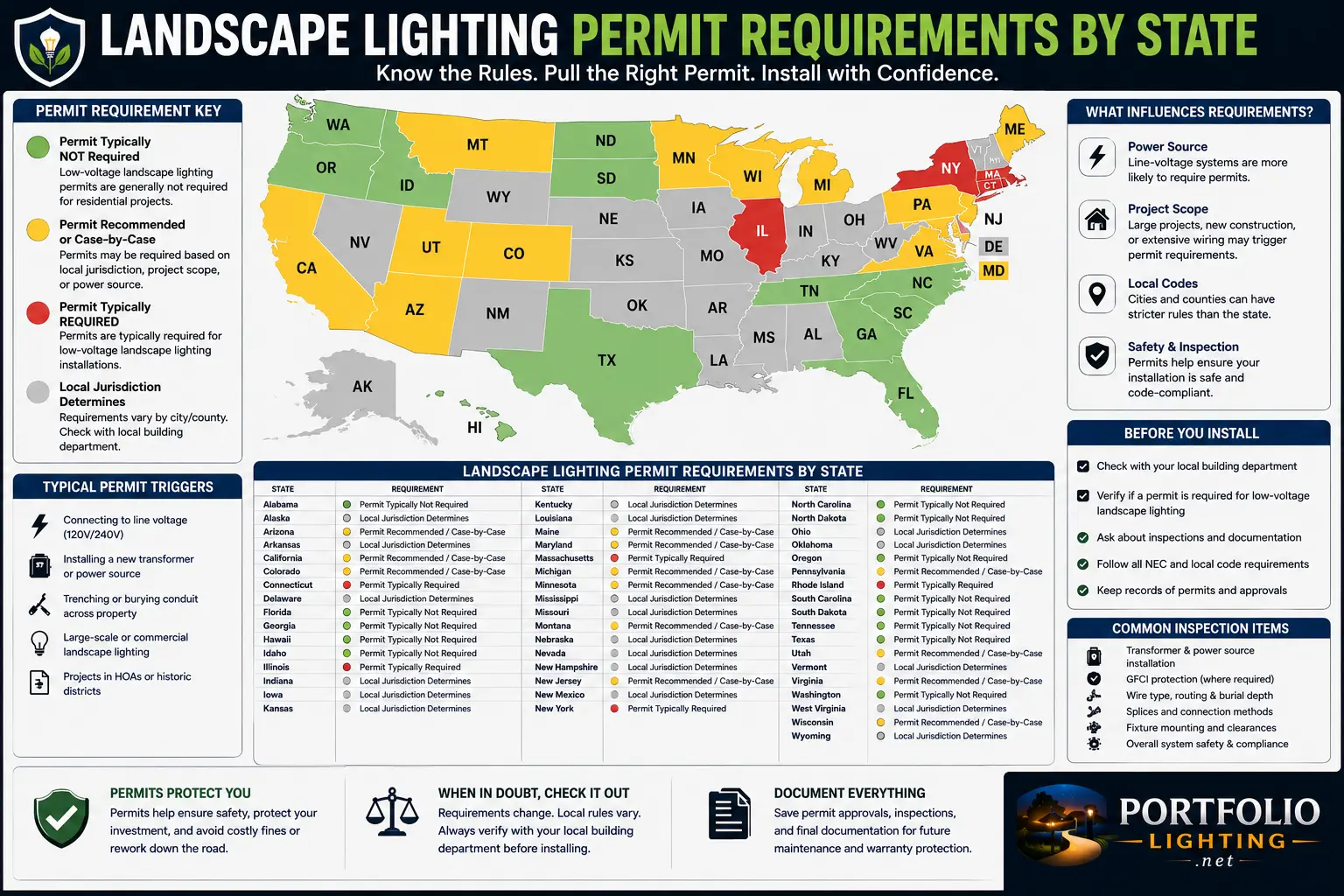
Permit vs License: Two Completely Different Requirements
The most common compliance mistake in landscape lighting is confusing these two requirements. They are issued by different authorities, cover different aspects of the work, and one can exist without the other.
What a Permit Is
A permit is an authorization from the local AHJ (Authority Having Jurisdiction — your city or county building department) to perform specific work at a specific location. The permit process requires: submittal of a project description or plans; review for code compliance; payment of a fee; performance of the work; and inspection to verify the work was done as permitted. Permits are issued per project, not per contractor. A homeowner can pull a permit for their own work in many jurisdictions.
For landscape lighting, a permit is required when: the project involves a new 120V circuit; the transformer is hardwired to a circuit rather than plugged in; the wire run crosses an easement or public right-of-way; proximity to a pool triggers NEC 680 requirements; or local ordinances require permits for all trenching or outdoor electrical work. The permit requirements guide covers the permit process in detail.
What a License Is
A contractor license is an authorization issued by a state or local licensing board for a contractor to perform a specific category of work for hire. The license certifies that the contractor has demonstrated competency (through experience requirements and examination) and carries required insurance. A license is required to be a contractor offering landscape lighting services to others — it is not typically required for a homeowner doing their own work.
Per the Lawn & Landscape magazine survey: "Of the 50 states, 24 (plus Washington, D.C.) require some form of licensing for low-voltage installation. Of these, 11 have a specialty license for low voltage. These specialty licenses require less training and experience than needed for a master or journeyman's license. The remaining 14 of these 24 states require an electrical contractor, journeyman or master electrician's license."
The Four Regulatory Tiers: How States Approach Low-Voltage Landscape Lighting
States fall into four broad regulatory tiers based on their approach to low-voltage landscape lighting contractor work. Your state's tier determines your starting point — but municipal overrides always apply on top of state tier.
No Statewide Requirement — Local Jurisdiction Only
No statewide license or permit requirement for low-voltage landscape lighting. All requirements are determined by individual cities and counties. A contractor in a rural area may face no requirements; the same contractor working in a major city may face full permit and licensing requirements. States: Kansas, Indiana, Missouri, Pennsylvania, portions of Illinois, portions of New York, Mississippi (local only), Nevada (adopted locally).
Statewide Framework with Significant Low-Voltage Exemptions
State has licensing or permit framework, but low-voltage work below a specific voltage or of specific types is explicitly exempted. Landscape lighting under the threshold can be performed without the full license. States include: Texas (TDLR exemption for Class 2/3 circuits and landscapers), Florida (plug-in transformer exemption), South Carolina (≤50V generally exempt), Iowa (Class 2/3 circuits exempt per Iowa Code 103.22(11)), Ohio (ORC 4740.13(D) exempts <50V systems), Wisconsin (≤50V generally exempt).
Low-Voltage Specialty License Available and Required for Contractors
State offers a specialty low-voltage contractor license (separate from a full electrician license) that is required for low-voltage work. These are more achievable than master electrician licenses but still require experience, examination, and bonding. States include: California (C-7), Nevada (C-2d), Georgia (LV-A/T/G/U), Minnesota (Power Limited Technician), Oregon (Limited Energy Technician), Maine (Limited Electrician-Low Energy), Connecticut (C-5 Limited), New Mexico (ES-3), North Carolina (SP-FA/LV), Utah, West Virginia.
Full Electrical Contractor License Required for Low-Voltage Work
State requires a full electrical contractor, journeyman, or master electrician license even for low-voltage landscape lighting work — no specialty low-voltage license pathway exists. This effectively restricts landscape lighting installation to licensed electricians. States include: Washington State (electrical contractor license required), Hawaii (Low Voltage Systems Contractor with 4 years experience), Alaska (electrical administrator license), Massachusetts (Systems Contractor Class C/D), Delaware, Rhode Island, Nebraska, Oklahoma, and others in the 14-state full-license category.
Six Triggers That Require a Permit Even in the Most Permissive States
Even in Tier 1 states with no statewide requirements, these six conditions commonly convert an exempt installation into one that requires a permit — often through NEC requirements that any adopted electrical code framework must enforce.
All 50 States: Quick Reference Table
This table provides the regulatory tier, NEC adoption status, low-voltage licensing requirement summary, and key notes for all 50 states. Sort by state, tier, or NEC edition. Data current as of July 2025. Always verify with your specific AHJ.
| State | Tier | NEC (as of Jul 2025) | LV License for Landscape Lighting | Homeowner DIY Exempt? | Key Notes |
|---|---|---|---|---|---|
| Alabama | Specialty | 2020 | Multiple: AECB (≥26V), Special Systems (≤50V) | Generally yes for own home | Low-voltage landscape lighting included in Special Systems scope |
| Alaska | Full Electrical | 2020 | Electrical administrator license for ≤48V controls | AS 08.40.190 exemptions apply | AS 08.40.190 provides specific exemptions; verify with Div. of Corporations |
| Arizona | Specialty | Local Only | ROC C-67/R-67/CR-67 for low voltage communications | Yes for own residence | No statewide NEC adoption; city-by-city. Phoenix, Tucson, Scottsdale each set own requirements |
| Arkansas | Specialty | 2020 | Electrical license for low-voltage work beyond alarm systems | Generally yes for own home | Act 393 of 2015 governs alarm systems; other low-voltage work under electrical license |
| California | Specialty | 2020 (via 2022 CEC) | C-7 Low Voltage Systems Contractor required for commercial work; homeowner exempt for own property | Yes — CSLB BPC §7044 homeowner exemption | C-7 explicitly names landscape lighting in CCR Title 16 §832.07. $500 minor work exemption for contractors. Title 24 energy compliance required for some attached lighting. See deep dive below. |
| Colorado | Local Only | 2023 | No statewide license; communication systems exempt at state level | Yes | Denver, Boulder, Colorado Springs each set own requirements. Some localities require permits for trenching near utilities. |
| Connecticut | Specialty | 2020 | C-5 Limited Electrical Contractor (≤48V/8A) or C-6/L-6 journeyperson | Limited — verify with local authority | Structured apprenticeship requirement. 48V/8A threshold covers standard 12V landscape lighting. |
| Delaware | Full Electrical | 2020 | Special Electrician license; contractor must employ Master Electrician | Generally yes for own home | Contractor requirements are strict; homeowner DIY typically exempt but verify locally |
| Florida | Exemption Available | 2020 (via 8th Ed. FBC) | Limited Energy Systems Specialty license required EXCEPT plug-in transformers per F.S. 489.503(24) | Single-family homeowner generally exempt | Critical exemption: F.S. 489.503(24) exempts "a person who installs low-voltage landscape lighting that contains a factory-installed electrical cord with plug." Any hardwired connection = license required. See deep dive below. |
| Georgia | Specialty | 2023 | 4 license classifications (LV-A/T/G/U) through GA Secretary of State; $25K bond required | Yes for own property | Comprehensive statewide licensing program. LV-A (alarm) LV-T (tech) LV-G (general) LV-U (unrestricted). Landscape lighting falls under LV-G or LV-U. |
| Hawaii | Full Electrical | 2023 | Low Voltage Systems Contractor or Specialty Electrician; 4 years experience required | Yes for own single-family home | One of the more restrictive states for contractors; significant experience requirement |
| Idaho | Specialty | 2023 | Limited Energy Electrical license for Class 2/3 systems | IC 54-1016 telecommunications exemptions; homeowner generally exempt | IC 54-1016 exemptions apply to specific system types; landscape lighting typically requires Limited Energy license for commercial installation |
| Illinois | Local Only | Local Only | No statewide license; municipal licensing required in most major cities | Yes at state level; check local | Chicago uses own 2017-based electrical code with strict permit requirements. Chicago requires permits for landscape lighting trenching. Suburban requirements vary by municipality. IDFPR alarm contractor license for alarm systems statewide. |
| Indiana | Local Only | 2017 | No statewide licensing; municipal/county jurisdiction system | Yes at state level | Indianapolis, Fort Wayne, South Bend each have own requirements. Lafayette Municipal Code 13.06.010 as an example of local oversight. Always check locally. |
| Iowa | Exemption Available | 2023 | Class 2/3 circuits exempt per Iowa Code §103.22(11); Special Electrician licenses available | Yes | Standard 12V landscape lighting falls under Class 2 circuit exemption. Low-voltage landscape systems generally permit-exempt at state level; check locally for Des Moines, Cedar Rapids. |
| Kansas | Local Only | Local Only | No statewide electrical licensing; all requirements by individual municipalities and counties | Yes at state level | Kansas City KS and Wichita have own permit requirements. Wichita requires permits for underground electrical work including low-voltage cable runs. |
| Kentucky | Exemption Available | 2023 | No statewide low-voltage specialty license; KRS §227A.030 telecommunications exemptions | Yes for own home | Local jurisdiction authority governs most landscape lighting; Louisville, Lexington have own permit requirements. Low-voltage landscape lighting at state level generally follows local rules. |
| Louisiana | Full Electrical | 2020 | Electrical contractor license required for projects over $10,000; telecommunications subclassification | Yes for own single-family home | RS 37:1664.5.1 Fire Marshal exemptions. Residential homeowner exempt but contractor threshold of $10K applies. New Orleans, Baton Rouge have own requirements. |
| Maine | Specialty | 2023 | Limited Electrician - Low Energy license; 98V limit; 270 hrs education + 4,000 hrs experience (2,000 low energy) | Generally yes for own home | Significant experience requirement for specialty license. Low Energy license covers landscape lighting within 98V threshold. Portland and other cities typically follow state requirements. |
| Maryland | Local Only | 2020 | No state-level low-voltage specialty license; 2021 legislation maintained "status quo" | Yes at state level | Montgomery County, Prince George's County, Baltimore City each have own requirements. DC suburbs typically more stringent. Montgomery County requires permits for landscape lighting trenching. |
| Massachusetts | Full Electrical | 2023 | Systems Contractor (Class C) / Systems Technician (Class D) dual license; 2025 online-only application changes | Limited; check with local inspector | One of the more strictly regulated states. 2025 application process updates. Boston requires permits for virtually all outdoor electrical work including low-voltage. Class C/D licenses specifically cover landscape lighting systems. |
| Michigan | Exemption Available | 2023 | No general low-voltage license; fire/security systems require specialized licensing per LARA | Yes for own home | Standard landscape lighting (not fire/security) has no specific statewide license requirement. Detroit, Grand Rapids each have local permit requirements. LARA oversees specific systems that don't include standard landscape lighting. |
| Minnesota | Specialty | 2023 | Power Limited Technician (PLT) license required for Class 2/3 circuits; 30V limit; 3 years experience; 16 CE hours | Yes for own single-family home | PLT license specifically covers landscape lighting systems under 30V. Minnesota Board of Electricity. Minneapolis, St. Paul generally follow state requirements with local permit additions. |
| Mississippi | Local Only | Local Only | Communication Systems/Low Voltage Electrical license required for commercial; $10K threshold | Yes for own home | No statewide NEC adoption. Jackson, Gulfport, Biloxi each set own requirements. NEC-based exams used for commercial licensing despite no statewide adoption. |
| Missouri | Local Only | Local Only | RSMo §324.915 exempts low-voltage work; optional statewide electrical license available | Yes | Kansas City MO and St. Louis each have own requirements. St. Louis City requires permits for all electrical work including low-voltage. RSMo §324.915 exemption covers landscape lighting at state level. |
| Montana | Exemption Available | 2020 | 90V exemption applies; fire alarm systems require separate license regardless | Yes for own home | Standard 12V landscape lighting falls comfortably below 90V exemption threshold. Billings, Missoula, Great Falls generally follow state framework. |
| Nebraska | Full Electrical | 2023 | Electrical contractor license generally required; fire alarm installer limited to ≤50V | Yes for own single-family home | Omaha has own licensing and permit requirements that may be stricter than state baseline. Lincoln follows state requirements with local additions. |
| Nevada | Specialty | Local Only | C-2d Low Voltage Systems license required (≤91V); no exemptions for electrical/alarm work; landscape lighting specifically included in C-2d scope | Limited — Nevada does not adopt or enforce building codes by state law | Nevada does not have statewide code adoption but C-2d license is statewide. Las Vegas and Clark County set own permit requirements. Nevada's C-2d explicitly includes landscape lighting per NSCA state licensing guide. |
| New Hampshire | Exemption Available | 2020 | No license for signaling circuits (fire alarms, security, telecom); "heat, light, power" requires license | Yes for own home | Standard landscape lighting's classification (light vs. signaling) determines whether license applies. Low-voltage pathway lights arguably fall under "light" category. Verify with NH Electricians' Licensing Board for clarity on landscape lighting specifically. |
| New Jersey | Full Electrical | 2020 | No general low-voltage license; electrical license required for ≥10V; separate fire/burglar alarm licenses | Limited for own home; significant local variation | The ≥10V electrical license trigger covers standard 12V landscape lighting. Residential homeowners can generally do own work; contractors need electrical license. NJ has one of the stricter frameworks for low-voltage work. |
| New Mexico | Specialty | 2020 | ES-3 Low Voltage Special Systems license required through CID (Construction Industries Division) | Yes for own home | Albuquerque, Santa Fe follow CID framework. ES-3 license covers landscape lighting within low-voltage special systems scope. |
| New York | Local Only | Local Only | State license for security/fire alarms only; complex local variations for landscape lighting | Yes at state level; NYC is exception | New York City uses 2008-based code, requires licensed master electrician for ALL electrical work including low-voltage. NYC Department of Buildings strictly enforces. Long Island (Nassau/Suffolk counties) have own licensing. Rest of state: local jurisdiction governs. NYC is the most restrictive jurisdiction in the US for landscape lighting. |
| North Carolina | Specialty | 2023 with amendments | Special Restricted Fire Alarm/Low Voltage (SP-FA/LV) license required by NCBEEC | Yes for own primary residence | NC Board of Examiners of Electrical Contractors issues SP-FA/LV. Charlotte, Raleigh, Durham generally follow state framework with local permit requirements added. |
| North Dakota | Full Electrical | 2023 | Power Limited Electrician license required; 6,000 hours experience needed | Yes for own home | Significant experience requirement for license. Fargo and Bismarck generally follow state framework. |
| Ohio | Exemption Available | 2023 | No statewide license required; ORC §4740.13(D) exempts <50V systems | Yes | Standard 12V landscape lighting is clearly below 50V threshold — state-level exemption is clean and broad. Columbus, Cleveland, Cincinnati each add local permit requirements. Check locally before assuming no permit needed. |
| Oklahoma | Full Electrical | 2023 (adopted Sept 2024) | Electrical contractor license required through CIB | Yes for own single-family home | Oklahoma City and Tulsa are the major markets with local permit requirements layered on top of state licensing. |
| Oregon | Specialty | 2020 | Limited Energy Technician license for <100 volt-amperes; Class A/B options | Limited — Oregon requires permits for most electrical work; homeowner permit available | Oregon Building Codes Division. Homeowners can pull own permits but must request inspection. Portland has own code overlay. Limited Energy Technician license is a reasonable path for landscape lighting contractors. |
| Pennsylvania | Local Only | 2020 | No statewide licensing; 2,562 municipalities each regulate independently | Yes at state level | Philadelphia has strict requirements similar to NYC — all electrical work requires licensed electrician and permit. Pittsburgh follows Allegheny County requirements. Most of PA's 2,562+ municipalities are lenient for residential landscape lighting but always verify locally. This is the most fragmented regulatory environment in the US. |
| Rhode Island | Full Electrical | 2020 | Electrical license required; telecommunications has separate licensing | Limited for own home | Small state with consistent requirements throughout. Providence, Warwick, Cranston follow state framework. |
| South Carolina | Exemption Available | 2020 | Work ≤50V generally exempt; project value thresholds apply | Yes for own home | Standard 12V landscape lighting below 50V threshold — generally exempt at state level. Columbia, Charleston, Greenville each add local requirements. Travelers Rest (notable for strict light trespass ordinance) follows SC state framework. |
| South Dakota | Exemption Available | 2020 | Class 2/3 circuits exempt for alarm/communication companies; standard electrical license for other work | Yes for own home | Sioux Falls and Rapid City follow state framework. Relatively permissive environment for residential landscape lighting. |
| Tennessee | Specialty | 2020 | CE license for projects >$25K; LLE license for <$25K; separate alarm system licenses | Yes for own home | Nashville, Memphis, Knoxville add local permit requirements. Project value threshold (LLE/CE) means most residential landscape lighting falls under LLE framework. |
| Texas | Exemption Available | 2023 (adopted as minimum) | State exempts Class 1-3 circuits (TDLR 1305.003(a)(12)) AND landscapers for low-voltage exterior lighting excluding power sources (TDLR 1305.003(a)(13)) | Yes at state level | Major municipal overrides: Austin requires permits. Dallas requires low-voltage contractor registration. Houston permits for commercial occupancies. San Antonio has permit fee schedules. Rural Texas: typically permit-free for residential landscape lighting. See deep dive below. |
| Utah | Specialty | 2020 | Low voltage license required for systems ≤95V; 2-year renewal | Yes for own home | Salt Lake City, Provo, Ogden generally follow state framework. 95V threshold comfortably encompasses standard 12V landscape lighting. |
| Vermont | Full Electrical | 2020 | Specialty Electrician license; 1-2 years experience; Master supervision required | Yes for own home | Burlington and other Vermont municipalities generally follow state framework. Relatively small contractor market with consistent state requirements. |
| Virginia | Full Electrical | 2020 | General contractor license required through DPOR; no separate low-voltage license | Yes for own home | Virginia DPOR (Department of Professional and Occupational Regulation). Northern Virginia (Fairfax, Arlington counties) follows DC-area practices which are more stringent. Richmond, Virginia Beach, Norfolk each have local permit additions. |
| Washington | Full Electrical | 2020 | Electrical contractor license required; $170K insurance, $4K bond; WAC 296-46B-901 specifically mentions landscape lighting | Limited — permits required even for owner work; specific exemptions listed in WAC do not include landscape lighting | Washington L&I (Labor and Industries) is the authority. WAC 296-46B-901 specifically lists "low-voltage circuits for underground: landscape sprinkler systems, landscape lighting" — confirming landscape lighting is within electrical code scope. Permits required even for homeowners; some exemptions for like-in-kind replacement only. Seattle, Spokane, Tacoma follow state requirements. See deep dive below. |
| West Virginia | Specialty | 2020 | Specialty license for ≤80V; 1 year experience; work >$1K requires license | Yes for own home | 80V threshold covers standard landscape lighting. $1K work value threshold for license requirement. Charleston and Huntington follow state framework. |
| Wisconsin | Exemption Available | 2020 | Work ≤50V generally exempt; registration required above 50V | Yes | Standard 12V landscape lighting below 50V threshold — state-level exemption. Milwaukee, Madison, Green Bay add local permit requirements. Check locally before assuming no permit needed. |
| Wyoming | Exemption Available | 2020 | Communications <90V exempt; Low Voltage/Limited license for other systems | Yes for own home | 12V landscape lighting falls below 90V exemption threshold. Cheyenne and Casper are the major markets; relatively permissive environment for residential landscape lighting. |
Deep Dives: The 15 Most Important States for Landscape Lighting Professionals
These 15 states account for the majority of landscape lighting installations nationally and have requirements significant enough to warrant detailed analysis beyond the quick-reference table.
California Tier 3 — Specialty License NEC 2020 (2022 CEC)
The C-7 License — Landscape Lighting Explicitly Named. California Code of Regulations, Title 16, Division 8, Article 3, Section 832.07 defines the C-7 Low Voltage Systems Contractor classification and explicitly names landscape lighting: "These systems include, but are not limited to telephone systems, sound systems, cable television systems, closed-circuit video systems, satellite dish antennas, instrumentation and temperature controls, and low voltage landscape lighting." This is one of the few state licensing statutes that specifically mentions landscape lighting by name.
Contractor Requirements: Any low-voltage project valued at $500 or more in labor and materials requires a C-7 license for the contractor. Projects under $500 qualify for the minor work exemption. CSLB issues the C-7; requirements include 4 years of journey-level experience within the past 10 years, examination, bonding, and insurance.
Homeowner Exemption: CSLB BPC §7044 allows homeowners to perform work on their own principal place of residence without a C-7 license. However, this is an exemption from the licensing requirement, not from permits or inspections. Homeowners must still pull required permits, comply with the California Electrical Code, and pass required inspections. The homeowner must also disclose to any buyer if they sell within 12 months of completion (per BPC §7044 restriction).
Title 24 Energy Compliance: Low-voltage landscape lighting installed away from a building structure (not attached to the building) is generally exempt from California's Title 24 energy code requirements. Lighting attached to a building structure may be subject to Title 24 controls requirements. The California Energy Commission's FAQ confirms: "Low-voltage landscape lighting in your yard [not attached to a building] — no. The lighting requirements only apply to lighting that is attached to a building or structure."
Permit Requirement: Permit requirements are set by local building departments, not the state. In San Francisco, CCSF requires permits for low-voltage work when a licensed contractor is doing the work. In Los Angeles, LADBS has permit requirements for landscape lighting systems. In smaller jurisdictions, permits may not be required for plug-in low-voltage systems. Always check with the local building department.
Florida Tier 2 — Exemption Available NEC 2020 (8th Ed. FBC)
The Plug-In Transformer Exemption — Florida Statutes §489.503(24). Florida's most important landscape lighting provision is an exemption, not a requirement. F.S. §489.503(24) exempts: "A person who installs low-voltage landscape lighting that contains a factory-installed electrical cord with plug that does not require installation, wiring, or other modification to the electrical wiring of a structure."
What the exemption covers: A landscape lighting system where the transformer has a factory-installed plug that connects to an existing GFCI-protected outlet — no hardwiring, no modification to the outlet or circuit. This is the standard Portfolio, Hampton Bay, or Malibu landscape transformer setup. Under this exemption, a landscaping company can install the transformer and run the low-voltage cable without a Limited Energy Specialty license.
What the exemption does NOT cover: Any installation that requires connecting to, modifying, or adding to the home's electrical wiring. If the transformer must be hardwired, a new outlet must be installed, or the existing outlet must be upgraded to GFCI — a licensed electrical or limited energy contractor must perform that portion of the work. The Florida Department of Business & Professional Regulation (DBPR) MyFloridaLicense FAQs confirm: "Yes. If you are not licensed as an electrical or alarm contractor, you must have a limited energy (low voltage) specialty license unless the system falls under the following exemption..." and then cites §489.503(24).
Limited Energy Specialty License: For work outside the exemption, the Limited Energy Systems Specialty license is the appropriate credential. Requirements include 3 years of management experience or 4 years foreman/supervisor experience; minimum liability insurance of $100K/person for public liability and $300K/occurrence; $500K for property damage. Licensed by DBPR's Electrical Contractors' Licensing Board.
Texas Tier 2 — Exemption Available NEC 2023 (as state minimum)
Two State-Level Exemptions — TDLR §1305.003(a)(12) and (a)(13). Texas provides two overlapping exemptions for landscape lighting. TDLR §1305.003(a)(12) exempts "persons who perform electrical work on class 1, 2, or 3 remote control, signaling or power limited circuits." TDLR §1305.003(a)(13) provides a landscaper-specific exemption: "Landscapers who perform electrical work on low-voltage exterior lighting, excluding power sources, are not required by the state to be licensed as electricians."
The Power Source Exclusion: TDLR §1305.003(a)(13) excludes the power source from the landscaper exemption. A landscaping company can install the low-voltage cable and fixtures without a license under the state exemption — but connecting to or installing the transformer (the power source) may require a licensed electrician depending on the specific installation. For plug-in transformers connecting to an existing outlet: the landscaper exemption arguably covers the complete installation. For hardwired transformers: a licensed electrician is needed for the power source connection.
Municipal Overrides — The Critical Texas Caveat. Texas's state exemptions can be overridden by municipal licensing requirements. Per Low Voltage Nation's Texas guide and Texas Electrical Authority's analysis: Austin requires electrical permits for low-voltage installations; Dallas requires low-voltage contractor registration; Houston requires building permits for commercial occupancies; San Antonio has separate permit fee schedules for low-voltage work; Fort Worth has local permitting requirements. Rural Texas jurisdictions operating under county authority typically have no low-voltage permit requirement. The Texas rule is: state exemption protects you statewide for licensing, but each major city may still require a permit for the installation itself.
Washington State Tier 4 — Full Electrical License NEC 2020
Permits Required Even for Owner Work. Washington State's L&I (Labor and Industries) department requires electrical permits for most electrical work, and the specific exemptions listed in WAC 296-46B for work that doesn't require a permit do not include landscape lighting. From Washington L&I's published permit basics: "An electrical permit is required for most electrical work, whether you or your contractor is installing a new item or repairing or replacing an existing item." The exemption list covers things like lamp replacements, single appliance replacements, and circuit breaker replacements — not landscape lighting installation.
WAC 296-46B-901 — Landscape Lighting Specifically Mentioned. Washington Administrative Code 296-46B-901 specifically includes "low-voltage circuits for underground: landscape sprinkler systems, landscape lighting, and antennas for wireless animal containment fences" in its scope. This is one of the most direct state-level references to landscape lighting in any administrative code — and it places landscape lighting within the electrical code's enforcement framework explicitly.
Homeowner Permit Path: Washington homeowners can pull their own electrical permits for work on their own single-family home under the homeowner permit program. The permit must be pulled before work starts; inspection must be requested within 3 business days of completing the work or 1 business day after energizing any part of the installation. This means a Washington homeowner can legally install their own landscape lighting without hiring a licensed electrician — but they must permit and inspect the work.
Contractor License: Any contractor performing landscape lighting installation for compensation in Washington must hold an electrical contractor license through L&I, which requires $170K liability insurance and a $4K bond at minimum.
New York Tier 1 — Local Only NEC 2017 (NYC: 2008-based)
New York City — The Most Restrictive Jurisdiction in the US. New York City's Department of Buildings enforces a code based on the 2008 NEC with NYC amendments. In NYC, all electrical work — regardless of voltage — requires a permit filed by a licensed master electrician. Low-voltage landscape lighting in an NYC backyard requires a master electrician permit. There are no meaningful low-voltage exemptions for residential work in NYC.
Rest of New York State: Outside NYC, New York has no statewide NEC adoption and no statewide electrical licensing for landscape lighting. Requirements are set entirely by local jurisdictions — which means a property in upstate New York may have no permit requirements for residential landscape lighting, while adjacent towns may have strict requirements. Always check with the local building department for any New York property outside NYC.
Long Island: Nassau County and Suffolk County each have their own licensing requirements with separate examinations. Suffolk County specifically has its own electrical code adoption (Jade Learning notes "Electrical (Suffolk County)" as a separate CE jurisdiction). Both Long Island counties treat low-voltage work differently from NYC but more strictly than most upstate areas.
Illinois Tier 1 — Local Only NEC 2020 (Chicago: 2017-based)
Chicago's Strict Independent Code. Chicago maintains its own electrical code based on the 2017 NEC with Chicago-specific amendments that are often stricter than the base NEC. Chicago requires permits for virtually all outdoor electrical work including landscape lighting installations that involve trenching or new outdoor circuits. Chicago electrical work must be performed by Chicago-licensed electricians — a separate licensure from state-level credentials.
Suburban Cook County and Collar Counties: Requirements vary dramatically by municipality. Some Chicago suburbs have no permit requirements for residential landscape lighting. Others align closely with Chicago's requirements. The fragmentation means that a landscape lighting contractor working across the Chicago metropolitan area may face different requirements in every municipality.
Rest of Illinois: No statewide NEC adoption and no statewide licensing for landscape lighting outside Chicago's scope. Most small Illinois municipalities have no specific requirements for residential low-voltage landscape lighting.
Pennsylvania Tier 1 — Local Only NEC 2020
The Most Fragmented State in the US: 2,562+ Municipalities. Pennsylvania has no statewide electrical contractor licensing for low-voltage work and 2,562 municipalities each regulating independently. Per Low Voltage Nation's Pennsylvania guide, this creates the most complex permit research environment in the US. Philadelphia follows requirements similar to other large cities — requiring permits for all outdoor electrical work. Pittsburgh follows Allegheny County requirements. But most of Pennsylvania's thousands of small boroughs, townships, and municipalities have minimal requirements for residential landscape lighting.
Philadelphia: Philadelphia Department of Licenses and Inspections requires permits for landscape lighting installations that involve any underground wiring. Philadelphia has its own electrical code and requires licensed electricians for most electrical work within city limits.
Practical Pennsylvania Guidance: For residential landscape lighting outside Philadelphia and Pittsburgh: contact your township or borough office directly — a 5-minute call to the municipal offices determines whether any permit is required. Most residential Pennsylvania municipalities will not require a permit for a plug-in low-voltage landscape system. For commercial work, any municipality: assume a permit is required and verify before starting.
Georgia Tier 3 — Specialty License NEC 2023
Comprehensive Four-Classification System. Georgia's Secretary of State issues four low-voltage license classifications: LV-A (alarm systems), LV-T (telecommunications), LV-G (general low-voltage), and LV-U (unrestricted). Landscape lighting typically falls under LV-G or LV-U. The $25,000 bond requirement is significant for smaller contractors entering the landscape lighting market. Georgia is highlighted in the Lawn & Landscape magazine survey as one of the states with a "comprehensive statewide licensing program."
Homeowner Exemption: Homeowners in Georgia are generally exempt from the license requirement for work on their own property. However, permits from the local building department (Atlanta, Savannah, Augusta, Columbus each have their own requirements) are separate from the license question.
Nevada Tier 3 — Specialty License Local Only
C-2d License Explicitly Includes Landscape Lighting. Nevada's C-2d Low Voltage Systems license covers systems up to 91 volts. Per the NSCA Guide to State Licensing for Nevada: "A statewide license is required for low-voltage/limited energy systems (subclassification C-2d): The installation, alteration, and repair of systems that use fiber optics or do not exceed 91 volts, including telephone systems, sound systems, cable television systems, closed-circuit video systems, satellite dish antennas, instrumentation and temperature controls, computer networking systems, and landscape lighting." One of the few states where landscape lighting is explicitly named in the C-2d license scope along with California.
Las Vegas/Clark County: The majority of Nevada's landscape lighting market is in Clark County (Las Vegas metro). Clark County requires permits for outdoor electrical work; the C-2d license is the contractor credential. The Las Vegas metro area has a significant landscape lighting industry given the outdoor living culture and resort/commercial development.
Minnesota Tier 3 — Specialty License NEC 2023
Power Limited Technician License — Designed for Low-Voltage Systems. Minnesota's Power Limited Technician (PLT) license was specifically designed to credential technicians working on Class 2/3 circuits including landscape lighting under 30V. Requirements: 3 years of experience and 16 continuing education hours per renewal period. The PLT license is administered by the Minnesota Board of Electricity. This is one of the clearest examples of a state specialty license pathway specifically appropriate for landscape lighting professionals — less onerous than full electrician licensing but credentialing the specific type of work.
Homeowner Exemption: Homeowners can install low-voltage landscape lighting on their own single-family home without a PLT license. Minneapolis and St. Paul add local permit requirements but generally follow the state PLT framework for contractor credentialing.
Massachusetts Tier 4 — Full Electrical NEC 2023
Systems Contractor Class C/D — Landscape Lighting in Scope. Massachusetts requires a Systems Contractor (Class C) license for contractors and Systems Technician (Class D) license for technicians performing low-voltage work including landscape lighting. 2025 brought changes to the online-only application process through the Division of Professional Licensure. Boston is one of the stricter permit environments in New England — requiring permits for essentially all outdoor electrical work including landscape lighting with underground cable runs.
Oregon Tier 3 — Specialty License NEC 2020
Limited Energy Technician with Homeowner Permit Path. Oregon requires a Limited Energy Technician license for commercial landscape lighting work. For homeowners, Oregon's Building Codes Division allows homeowner-pulled permits for residential work — the homeowner pulls the permit, performs the work, and must have it inspected. Portland has additional requirements and its own code overlay. The Oregon permit requirement for homeowners doing their own work is more explicit than most states: you need the permit even if you're doing the work yourself, and you must request inspection.
Colorado Tier 1 — Local Only (State: No Requirement) NEC 2023
Relatively Permissive at State Level. Colorado has no statewide license requirement for low-voltage landscape lighting — communication systems and low-voltage work are exempt at the state level. However, Colorado has adopted the 2023 NEC statewide, which provides the technical compliance framework even where permits aren't required. Denver, Boulder, and Colorado Springs each add local requirements. Denver requires permits for any new outdoor electrical work including landscape lighting circuits. Boulder has its own energy code that may affect outdoor lighting specifications. For mountain communities (Aspen, Vail, Breckenridge), high-altitude and wildfire-risk considerations sometimes add local requirements.
North Carolina Tier 3 — Specialty License NEC 2023 with amendments
SP-FA/LV License Through NCBEEC. The North Carolina Board of Examiners of Electrical Contractors issues the Special Restricted Fire Alarm/Low Voltage (SP-FA/LV) license for low-voltage work including landscape lighting. North Carolina has adopted the 2023 NEC with state amendments. Charlotte (the largest market), Raleigh, Durham, and the Research Triangle all follow state licensing framework with local permit requirements added by the AHJ. Homeowners can perform work on their own primary residence without the SP-FA/LV license, but local permits apply.
New Jersey Tier 4 — Full Electrical NEC 2020
The ≥10V Trigger — One of the Strictest Thresholds. New Jersey requires an electrical license for any system operating at 10 volts or more — and standard landscape lighting at 12V AC exceeds this threshold. This is one of the lowest voltage thresholds for electrical license requirements in the US. In practice, residential homeowners in New Jersey can perform their own landscape lighting installation on their own property without a contractor license, but any contractor doing the work needs an electrical license. New Jersey municipalities require permits for landscape lighting installations in most cases. Bergen County, Middlesex County, Essex County (Newark metro) are the major markets.
NEC Adoption by State: Which Edition Governs Your Installation
The National Electrical Code is not federally mandated — each state adopts it (or not) independently, often with state-specific amendments and with a lag of 1–5 years after NFPA publication. As of July 2025:
2023 NEC (approximately 18 states): Georgia, Colorado, Hawaii, Idaho, Iowa, Kentucky, Maine, Massachusetts, Michigan, Minnesota, Nebraska, North Carolina, North Dakota, Ohio, Texas (as minimum baseline), Utah, North Dakota, West Virginia, and others completing transition
2020 NEC (approximately 20 states): Alabama, Alaska, Arkansas, California (via 2022 CEC), Connecticut, Delaware, Florida (via 8th Ed. FBC), Louisiana, Maryland, Montana, New Hampshire, New Jersey, New Mexico, Oregon, Rhode Island, South Carolina, South Dakota, Tennessee, Vermont, Virginia, Washington, Wisconsin, Wyoming
2017 NEC (approximately 6 states): Arizona (local only, most jurisdictions on 2017), Indiana, Kansas (local only), portions of New York (state has no statewide adoption)
No Statewide Adoption (6+ states): Arizona, Illinois, Kansas, Mississippi, Missouri, Nevada, New York — all electrical requirements determined by local jurisdiction. Major cities in these states often enforce 2017–2020 NEC editions through their local adoption.
Notable anomalies: New York City uses a code based on the 2008 NEC. Chicago uses a code based on the 2017 NEC. These major cities have independent code regimes significantly older than their surrounding states.
The NEC edition matters for landscape lighting compliance because different editions have different Article 411 language, different burial depth tables (Table 300.5 Column 5 is consistent across editions at 6 inches), and different pool setback requirements. The NEC 2026 code updates guide covers what NEC 2026 changes once states begin adopting it. The inspection checklist covers how to verify compliance with the edition your AHJ has adopted.
Homeowner Exemptions: What They Cover and What They Don't
The homeowner exemption from contractor licensing requirements is frequently misunderstood. It does not exempt homeowners from code compliance, permit requirements, or inspections.
What the Homeowner Exemption Covers
In most states, a homeowner performing work on their own primary single-family residence is exempt from the contractor licensing requirement. This means the homeowner does not need to hold a C-7, Limited Energy, PLT, or other low-voltage contractor license to install landscape lighting on their own property. This exemption typically applies to owner-occupied single-family homes only — not rental properties, multi-family properties, or homes being renovated for sale.
What the Homeowner Exemption Does NOT Cover
- Permit requirements: The homeowner exemption from contractor licensing is not an exemption from permit requirements. If a permit is required for the work, the homeowner must still obtain it — they can typically pull it themselves as the owner-builder, but they cannot skip it simply because they are the homeowner.
- Inspection requirements: Any permitted work requires inspection, whether performed by a contractor or by the homeowner. Washington State L&I's guidance is explicit: homeowners must request inspection "no later than 3 business days after completing the work or 1 business day after any part of the installation has been energized."
- Code compliance: Per California ExpertCE documentation: "This is an exemption from needing to hire a licensed contractor, not an exemption from the law. The owner-builder is still responsible for: Pulling all necessary permits. Ensuring all work complies with the California Electrical Code. Passing mandatory inspections."
- Property sale disclosure: In California, the homeowner who uses the owner-builder exemption cannot sell or lease the property for 12 months after completion without providing a specific disclosure to the buyer (BPC §7044).
- Multi-family and rental properties: The homeowner exemption applies to the owner-occupant's primary residence — not to rental property, vacation homes, or multi-family buildings even if owner-occupied in part.
The Municipal Override Pattern: When City Beats State
The single most consistent pattern across all 50 states is this: state-level exemptions and low requirements are frequently overridden by major city requirements that are stricter. Knowing the pattern prevents compliance failures from assuming the state-level rule applies to your specific city.
Cities That Systematically Override State Exemptions
These major cities have documented requirements that are stricter than their state baselines for low-voltage landscape lighting work:
- New York City (NY) — requires licensed master electrician permit for ALL electrical work regardless of voltage; 2008-based code applies
- Chicago (IL) — requires Chicago-licensed electrician and permit; Chicago electrical license is separate from state credentials
- Philadelphia (PA) — requires permits for all outdoor electrical work with underground wiring; licensed electrician for commercial work
- Washington DC — has its own comprehensive low-voltage licensing program separate from surrounding Virginia and Maryland
- Austin (TX) — requires electrical permits for low-voltage installations; overrides state TDLR exemption for permit purposes
- Houston (TX) — requires building permits for low-voltage work in commercial occupancies; residential exemptions vary by neighborhood/deed restriction area
- Dallas (TX) — requires low-voltage contractor registration; separate from state TDLR exemption
- Seattle (WA) — follows Washington State L&I requirements which are already strict; permit required
- Boston (MA) — strict permit requirements for all outdoor electrical work; Class C/D Systems contractor license required for contractors
- Denver (CO) — requires permits for landscape lighting involving new underground circuits or new outdoor outlets; overrides state no-requirement baseline
- Portland (OR) — has own code overlay on state requirements; homeowner permit available but required
- Las Vegas (NV) / Clark County — requires permits for outdoor electrical work; C-2d license required for contractors
- San Francisco (CA) — requires permits and licensed C-7 contractor for commercial work; local registration for contractors in addition to state C-7
The practical rule: if you are working in any city with a population over 200,000, do not assume the state-level framework applies — always verify with the specific city or county building department. Major metropolitan areas have independent code adoption histories and licensing requirements that frequently exceed state baselines.
The Texas situation is the best illustration of why you can't trust state-level rules for major cities. Texas state law explicitly exempts landscapers from electrical licensing for low-voltage exterior lighting (TDLR §1305.003(a)(13)). Austin, Houston, and Dallas each have local permit requirements that effectively override this exemption for permit purposes — even if a landscaper doesn't need a state license, the city still requires a permit for the work. A landscaping company doing 20 residential landscape lighting installations a month in Houston needs to pull a permit for each one even though they're legally allowed to do the work without a state electrical license. Most of the compliance problems I see for landscape lighting contractors come from this exact misunderstanding: knowing the state rule but not knowing the city rule.
How to Verify Your Specific Jurisdiction's Requirements in 4 Steps
The information in this guide is the best available starting point — but your specific city or county building department is the definitive authority. These four steps give you a verified answer for your specific address in under 30 minutes.
- Identify your AHJ. The Authority Having Jurisdiction for a residential property is typically the city or county building department. Search "[your city name] building department" or "[your county name] building department." Find the permit or inspection section of their website.
- Search the building department website for "landscape lighting" or "low voltage electrical." Many building department websites have permit application checklists or FAQ sections that specifically address whether permits are required for landscape lighting. Some jurisdictions have pre-written exemption lists that cover standard plug-in low-voltage landscape systems.
- Call the permit counter directly. If the website doesn't answer your question clearly, call the building department's permit counter (not the general information line) and ask: "For a residential plug-in low-voltage landscape lighting installation with a transformer under 300 watts plugging into an existing GFCI outlet, do I need a permit?" This specific question typically gets a clear yes or no answer in under 2 minutes. Write down the name of the person who gave you the answer and the date — this creates a record of your good-faith inquiry.
- Verify contractor license requirements separately if hiring a contractor. If you are hiring a contractor rather than doing the work yourself, ask the contractor for their license number and verify it with your state licensing board. In California, verify at cslb.ca.gov. In Florida, verify at myfloridalicense.com. In other states, use the appropriate state licensing board lookup. A contractor who refuses to provide their license number or whose license doesn't verify should not be hired for work in a state that requires licensing. See the contractor licensing requirements guide for the complete verification framework.
Permit Requirements Are Only the First Step Toward Approval
Knowing whether a permit is required is only the first part of getting a landscape lighting project approved. Once work begins, the installation still has to avoid inspection failures, red tags, correction notices, and incomplete final documentation. Use the landscape lighting inspection failure code list to understand how inspectors may categorize problems, and the red tag violation guide for landscape lighting to identify issues that can stop work. For written inspector comments, the landscape lighting inspector correction notice guide explains how to respond. Before requesting final approval, complete the outdoor lighting final inspection checklist and avoid the documentation gaps listed in the permit rejection reasons guide.
State Permit Requirements FAQ
I live in a Tier 1 state with no statewide requirements. Does that mean I never need a permit for landscape lighting?
No — Tier 1 means no statewide licensing or permit requirement, but local jurisdictions can and do impose their own requirements. If you live in Kansas (no statewide requirements), you still need to check whether Wichita, Overland Park, or your specific municipality requires a permit. If you live in Pennsylvania (no statewide licensing), Philadelphia requires permits for outdoor electrical work with underground wiring despite the state having no statewide requirement. Tier 1 status means the state hasn't established a minimum — it doesn't mean your city or county hasn't. Always check with your local building department as the definitive authority regardless of state tier. The state tier determines your starting assumption; the local AHJ determines the actual requirement for your specific address.
My landscaper says they can install my landscape lighting without a license in Texas. Is this true?
It depends on the specific work and your city. Texas TDLR §1305.003(a)(13) explicitly exempts landscapers from the electrical licensing requirement for "electrical work on low-voltage exterior lighting, excluding power sources." For standard landscape lighting cable installation and fixture placement, the state exemption is real — landscapers in Texas are not required by state law to hold an electrical license for this work. However, the exclusion of "power sources" means the transformer connection may need a licensed electrician if it involves more than plugging into an existing outlet. More importantly, Austin requires electrical permits for low-voltage work, Dallas requires low-voltage contractor registration, and Houston requires permits for commercial occupancies. If you are in one of these cities, a permit is required even though the contractor may be legally exempt from the license requirement. Ask your landscaper specifically: are you permitted for this work in our city? That's the question that determines compliance.
Can I install landscape lighting on my rental property myself without a contractor license?
The homeowner exemption from contractor licensing requirements applies to owner-occupants of their primary single-family residence — not to rental properties. For a rental property, you are the owner but not the occupant, and the homeowner exemption typically does not apply. In most states, any electrical work on a rental property should be performed by a licensed electrical or low-voltage contractor. Additionally, rental properties are subject to landlord-tenant laws that require electrical systems to be in safe condition and installed to code. Work performed without proper licensing or permitting on a rental property can create significant liability if a tenant is injured or property is damaged. Contact your state's electrical licensing board and a local attorney to confirm the requirements for rental property electrical work in your specific state.
Does a landscaping company need a different license from an electrical contractor to install landscape lighting?
In states with specialty low-voltage licenses (Tier 3 states), a landscaping company can pursue the specialty license — C-7 in California, Limited Energy Specialty in Florida, C-2d in Nevada, PLT in Minnesota, etc. — rather than needing a full electrical contractor license. This is the most practical compliance path for landscape lighting-focused businesses in these states. In states requiring full electrical license (Tier 4 states like Washington, Massachusetts, New Jersey, Hawaii), a landscaping company performing landscape lighting installation needs either a licensed electrician on staff with the appropriate license, or a subcontracting arrangement with a licensed electrician. In Tier 1 and Tier 2 states, landscape lighting companies may be able to operate without any specific license for the work itself — subject to municipal overrides. Per the Lawn & Landscape magazine analysis: "The remaining 14 of these 24 states require an electrical contractor, journeyman or master electrician's license. These states effectively restrict landscape lighting installation to electricians. Green industry professionals may work with these electricians on lighting projects, but the profit potential is greatly reduced." See the contractor licensing requirements guide for the complete professional licensing framework.
Related Code, Licensing & Compliance Guides
- Electrical Code Safety Guide
- Permit Requirements Guide
- Contractor Licensing Guide
- NEC Inspection Checklist
- NEC 2026 Code Updates
- As-Built Diagram Requirements
- Insurance & Liability Guide
- Wire Burial Depth Code
- GFCI Requirements Guide
- Junction Box Requirements
- Transformer Mounting Code
- Grounding & Bonding
- Load Calculation & Code
- Splice Connection Code
- Voltage Drop Code
- Pool Lighting Clearance
- Dock & Pier Lighting NEC 555
- NEC 300.5 Burial Calculators
- Wet Location Listing
- ADA Pathway Rules
- Light Trespass Laws
- Landscape Lighting Guide
- How to Wire Landscape Lighting
- Maintenance Guide