
Quick Answer: Where Should an Outdoor Lighting Transformer Be Mounted?
Mount the transformer on a stable vertical surface, above standing water and snow zones, close enough to a weather-protected GFCI receptacle that the cord is not strained, and far enough from heat, fuel, pool, irrigation, and ventilation hazards that it can operate safely.
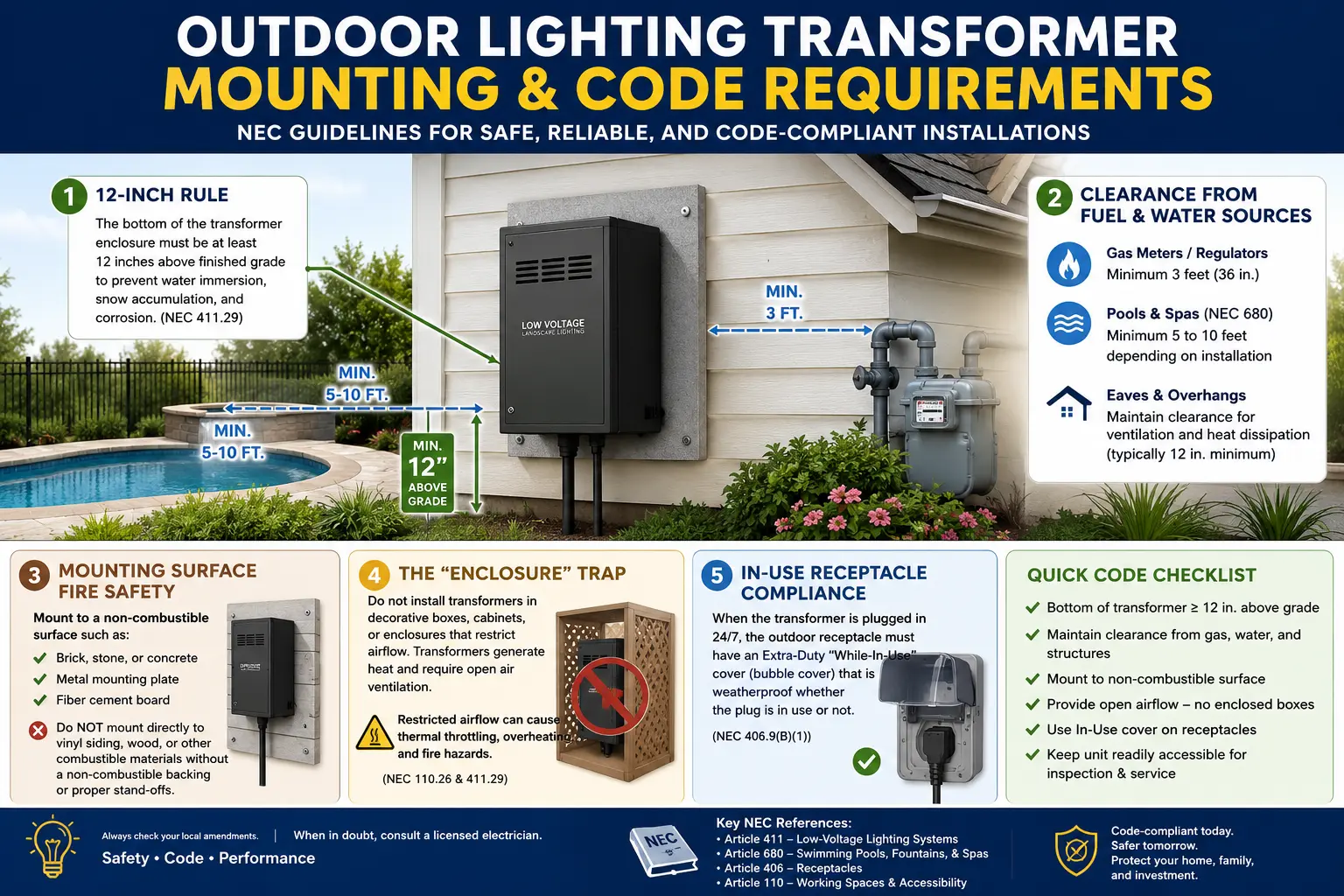
The safest setup is usually a dedicated outdoor-rated transformer mounted on a wall, post, or equipment board with the bottom of the enclosure roughly 12 inches or more above finished grade. The transformer should plug into a weather-resistant GFCI-protected receptacle with an extra-duty while-in-use cover. If you are sizing or troubleshooting the unit at the same time, use the Portfolio transformer sizing guide, transformer wattage guide, and transformer troubleshooting guide.
For a broader overview of transformer selection, taps, load planning, timers, and outdoor placement, use the landscape lighting transformer guide before choosing a permanent mounting location.
Logic Summary: The Transformer Mounting Checklist
- Height: Use 12 inches above finished grade as a practical minimum, then verify whether the transformer listing or instructions require more.
- Listing: Some larger or manufacturer-specific units may require the transformer base or terminals to be mounted higher, including 20-inch clearance language in certain instructions.
- Power: Use an outdoor-rated, GFCI-protected receptacle with an extra-duty while-in-use cover for plug-in transformers.
- Drip loop: Route cords and low-voltage cable so water drips below the entry point instead of running into terminals.
- Heat: Keep ventilation openings clear and avoid direct heat transfer into vinyl siding or enclosed decorative boxes.
- Pool zone: Keep standard landscape transformers away from pool and spa equipment zones unless the equipment is specifically listed for that use.
- Access: Keep the plug, GFCI reset, timer, photocell, door, and low-voltage terminals reachable for inspection and service.
1. Vertical Clearance and the Practical “12-Inch Rule”
The first mounting mistake is placing the transformer too low. A transformer mounted close to mulch, soil, snowpack, or a low patio corner can end up in the exact environment the enclosure is trying to avoid: standing water, splashback, salt, mud, and insect debris.
Many field installations use a practical rule of keeping the bottom of the transformer enclosure at least 12 inches above finished grade. The reason is simple: finished grade changes. Mulch gets added, snow piles up, soil splashes, and irrigation spray hits lower surfaces repeatedly.
I treat the 12-inch number as the starting point, not the finish line. If the transformer is mounted near mulch beds, snow buildup, irrigation spray, low patios, or a place where landscaping will rise over time, I would rather mount it higher than barely meet the minimum.
Transformer Height Diagram
This is especially important on larger Portfolio-style transformers because heavier units are often installed once and forgotten. If the location is too low, corrosion can start at the plug, transformer hinges, screws, low-voltage terminal area, or cable-entry points.
2. Clearance Danger Zones: Gas, Water, Heat and Pool Equipment
A transformer creates heat, contains electrical terminals, and is usually connected to a cord-and-plug outdoor receptacle. That means the mounting location should be chosen with a clearance bubble around the unit.
| Nearby Hazard | Practical Clearance Target | Why It Matters | Best Mounting Decision |
|---|---|---|---|
| Gas meter or regulator | Often treated as a 3-foot minimum danger zone; verify utility and local rules. | Regulators and vents should not be crowded by heat-producing electrical equipment. | Mount on a separate wall area, post, or equipment board away from gas service. |
| Pool or spa edge | Keep receptacles at least 6 feet from the inside pool wall where applicable, and keep standard landscape transformers farther away unless specifically listed for pool/spa use. | Pool and spa areas have stricter shock, bonding, GFCI, and equipment-zone rules than ordinary landscape beds. | Do not use a standard Portfolio landscape transformer for underwater pool lights. Use equipment specifically listed for pool and spa use and consult a licensed electrician. |
| Hose bib or sprinkler spray | Keep outside direct spray and runoff paths. | Repeated wetting shortens receptacle, cord, GFCI and enclosure life. | Move the transformer higher, sideways, or behind a splash-safe barrier that does not trap heat. |
| Dryer vent, furnace exhaust or grill area | Keep away from heated exhaust and cooking zones. | Extra heat can shorten transformer life and damage plastic housings or cords. | Choose a cooler wall or post location with open airflow. |
| Eaves and tight overhangs | Leave ventilation space above and around the enclosure. | Heat rises. A tight overhang can create a hot pocket around the transformer. | Mount where the transformer can breathe and the door can fully open. |
For planning, treat pools and spas as a separate electrical environment. Receptacle placement, transformer location, bonding, GFCI protection, and equipment listing all matter. A common homeowner mistake is assuming that “low voltage” means safe near a pool. It does not.
If the transformer is near a pool, spa, fountain, or wet deck, stop and verify the product listing, local code, and equipment instructions before mounting it. This is one of the areas where I would involve a licensed electrician instead of guessing.
Pool and spa lighting systems have stricter transformer placement and electrical separation requirements than ordinary landscape lighting because water dramatically increases shock risk. The Portfolio swimming pool lighting guide explains low-voltage pool lighting safety, wet-location fixture considerations, transformer placement logic, and underwater lighting troubleshooting.
The Drip Loop: How to Keep Water Out of Transformer Terminals
A drip loop is one of the simplest details that prevents water problems. When a cord or low-voltage cable leaves the transformer, it should dip below the entry point before it rises, turns, or enters the ground. That low point gives rainwater a place to drip off instead of following the wire into the transformer.
The drip loop only solves water routing at the transformer. For the rest of the run, use the landscape lighting cable guide to plan burial depth, routing, cable protection, and connection points.
If the transformer location forces a longer low-voltage run than expected, check the landscape lighting wire gauge guide before burying cable. Wire size affects voltage drop, heat, and how evenly fixtures perform at the far end of the run.
Water protection around transformer terminals matters just as much as mounting height. The low-voltage plug and limited-energy connector guide explains drip loops, terminal corrosion, connector leakage, and outdoor splice failures that can quietly damage low-voltage systems.
Correct Drip Loop Pattern
This matters most when the transformer is mounted below siding, near roof runoff, near sprinkler spray, or anywhere the cord and low-voltage wires can stay wet. A drip loop does not replace a weather-rated enclosure, but it helps keep water from using the wire as a path into the terminal area.
3. Mounting Surface Fire Safety: Wood, Masonry, Vinyl and Equipment Boards
The mounting surface matters more than many homeowners realize. A small 60-watt transformer may run barely warm, while a larger 200-watt or 300-watt transformer can generate enough heat that siding contact, poor airflow, or a tilted mount becomes a real problem.
I do not like mounting larger transformers directly to vinyl siding unless the manufacturer explicitly permits it and the installation uses the proper standoffs or backing. Vinyl can warp from heat and sun exposure even before you add transformer heat. A better approach is a stable mounting board, masonry surface, pressure-treated post, or manufacturer-approved bracket that leaves airflow behind the unit.
If the transformer is being replaced because the old unit overheated, tripped, buzzed, or melted terminal areas, also review Portfolio transformer replacement, transformer wiring diagrams, and low-voltage wire connector guidance before reusing the same wall location.
Transformer mounting rules work together with the electrical article that governs the entire lighting system. If you're unsure whether your installation falls under NEC Article 411 or Article 725, visit our complete comparison guide before making wiring changes.
Transformer temperature is affected by more than total fixture wattage. Nonlinear LED drivers can draw current in narrow peaks and introduce harmonic components that increase magnetic and winding losses. A transformer may therefore run warmer or produce more audible noise than the connected real-power load suggests. Before increasing transformer size or relocating equipment, use the LED driver harmonic distortion compliance guide to understand how THD, crest factor, source impedance, and driver quantity influence transformer performance.
Related Transformer and Outdoor Safety Guides To Help In Your Problem Solving
Transformer mounting is only one part of outdoor lighting safety. The fixtures connected to that transformer also need to be rated for the conditions where they operate, so review this outdoor wet-location listing guide before choosing exposed landscape fixtures.
Once a transformer is mounted, it also needs a safe way to shut off or isolate power for service. This landscape lighting transformer disconnect NEC guide explains the service-access side of transformer safety.
If a transformer supplies lighting near a pool, placement and clearance become more sensitive. This swimming pool lighting clearance guide explains the NEC 680 issues that can affect outdoor transformer planning.
Transformers feeding fountain or pond lights should be evaluated carefully because underwater lighting adds moisture and shock-risk concerns. This fountain lighting code requirements guide explains the added safety layer for water-feature lighting.
Outdoor lighting controlled by a transformer should still support safe walking routes. This ADA outdoor pathway lighting guide explains how fixture spacing and glare control affect accessibility.
A properly mounted transformer can still feed a failing system if the splices are weak or exposed. This landscape lighting splice connection guide explains why outdoor wire joints need proper sealing.
Mounting Standoffs and Thermal Breaks for Larger Transformers
Larger transformers need more than a screw through the back of the enclosure. Many heavier units use built-in feet, raised backs, or mounting standoffs so air can move behind the transformer and heat is not transferred directly into siding.
If the transformer has a flush back and no air gap, do not treat vinyl siding as the mounting surface. A better field method is to mount a pressure-treated 2x4, exterior-rated mounting board, or cement-board backer to the structure first, then mount the transformer to that support. This creates a more stable mount and adds a thermal break between the transformer and the siding.
4. The Decorative Box Trap: Why “Hiding” a Transformer Can Create Heat Risk
One of the most common homeowner questions is whether a landscape lighting transformer can be hidden inside a decorative box, planter, fake rock, cabinet, or bench. The issue is not just whether the transformer fits. The issue is heat and access.
Transformers need airflow. When a transformer is sealed inside a decorative enclosure, heat can build until the unit thermally throttles, trips, shortens component life, or creates a fire risk. The hotter the transformer runs, the worse the problem becomes.
Another problem is accessibility. Electrical equipment should remain serviceable. You should be able to reach the plug, GFCI, transformer door, timer, photocell, and low-voltage terminals without dismantling landscaping or moving heavy decorative covers. For broader safety context, compare this with the landscape lighting electrical code safety guide.
5. Receptacle “While-In-Use” Compliance: Why the Bubble Cover Matters
A plug-in outdoor lighting transformer is usually connected for months or years at a time. That is why a normal flat outdoor cover is not enough when the cord is plugged in continuously. The receptacle needs weather protection while the plug is inserted.
The best practice is a weather-resistant outdoor GFCI-protected receptacle with an extra-duty while-in-use cover, often called a bubble cover. This keeps rain from hitting the plug face and helps prevent the transformer cord from holding a cover open.
For deeper GFCI and outdoor circuit rules, use the outdoor lighting GFCI requirements guide. If the transformer is tripping the outlet, start with Portfolio lighting troubleshooting and then check the downstream cable, fixtures, connectors, and rain-related failures.
Dedicated GFCI Receptacle vs. General Outdoor Outlet
A small landscape transformer may plug into a general outdoor receptacle, but larger lighting loads deserve more planning. If the same outlet or circuit also serves a freezer, pool equipment, garage tools, pumps, or heavy outdoor appliances, nuisance trips and voltage problems become more likely.
For larger transformers, I prefer a dedicated outdoor GFCI-protected receptacle located close enough that the transformer cord is not stretched, modified, or routed through a wet area. Do not bypass GFCI protection to stop nuisance trips. If the GFCI trips repeatedly, the system is telling you to look for moisture, damaged cable, overloaded equipment, or a wiring fault.
6. Working Space and Readily Accessible Equipment
Landscape lighting transformers are not panels, but they still need service access. Do not bury them behind shrubs, lock them inside a decorative feature, mount them where the door cannot open, or place them where the only way to reset a timer is to stand in wet mulch.
NEC language around working space and readily accessible equipment is important because it teaches the correct design logic: equipment should be reachable for inspection, operation, maintenance, and emergency shutoff. On a lighting transformer, that includes the plug, GFCI reset, timer, photocell, low-voltage lugs, and cable exits.
Field Checklist: Is This Transformer Mounted Correctly?
Before permanently mounting the transformer, confirm that the connected load is properly sized with the landscape lighting transformer size calculator. A transformer mounted correctly can still fail early if it is overloaded or undersized.
- [ ] The transformer is listed for outdoor use.
- [ ] The bottom of the enclosure is roughly 12 inches or more above finished grade.
- [ ] The plug is connected to a GFCI-protected outdoor receptacle.
- [ ] The receptacle has an extra-duty while-in-use cover that fully closes over the plug.
- [ ] The transformer is not in direct sprinkler spray or runoff.
- [ ] The transformer is not crowded against a gas meter, regulator, dryer vent, grill, pool, or spa zone.
- [ ] Air can circulate around the transformer body.
- [ ] The door, timer, photocell, and terminals are accessible.
- [ ] Low-voltage cable exits downward or in a way that does not create a water path into the unit.
- [ ] The connected load has been checked against transformer capacity using the landscape lighting voltage drop calculator.
- [ ] The transformer instructions have been checked for any 20-inch or higher listing requirement.
- [ ] The transformer cord or low-voltage cable has a drip loop below the entry point.
- [ ] Larger transformers use standoffs, a mounting board, or a thermal break instead of sitting tight against vinyl siding.
- [ ] The receptacle is not shared with heavy loads such as pumps, freezers, or other large outdoor equipment.
- [ ] Standard landscape transformers are not being used for underwater pool or spa lights.
Mounting a low-voltage transformer may look simple, but licensing requirements can change when the project involves new outlets, hardwired equipment, or commercial property. The landscape lighting installer licensing guide explains when professional credentials may be required.
Proper transformer mounting is only one part of maintaining a safe low-voltage lighting system. Our detailed landscape lighting load calculation and NEC compliance guide explains how transformer sizing, ventilation clearance, startup current surges, and safe electrical headroom all influence operating temperature, long-term reliability, and code-compliant landscape lighting performance.
Outdoor Transformer Mounting FAQ
How high should an outdoor landscape lighting transformer be mounted?
A good practical field target is to keep the bottom of the enclosure at least 12 inches above finished grade, mulch, snow accumulation and splash zones. Always verify the product label, manufacturer instructions and local code requirements.
Can I mount a transformer on vinyl siding?
For larger transformers, avoid direct vinyl siding contact unless the instructions specifically allow it. A rigid backing board, standoffs or a post-mounted board is usually safer because it supports the weight and allows airflow.
Can I hide a transformer inside a box?
Do not seal a transformer inside a decorative box that traps heat or blocks access. If you use a screen or decorative cover, it should maintain airflow, drainage and access to the plug, GFCI, timer, photocell and terminals.
Does the transformer need a bubble cover?
When a plug-in transformer remains outdoors, the receptacle should be weather-resistant, GFCI-protected and covered with an extra-duty while-in-use cover that closes while the transformer cord is plugged in.
Is 12 inches high enough for an outdoor lighting transformer?
Twelve inches above finished grade is a common practical field target, but it is not always the final answer. Always check the transformer label and installation instructions because some listed units may require more clearance, such as 20 inches above ground level.
What is a drip loop on a landscape lighting transformer?
A drip loop is a low bend in the cord or low-voltage cable below the transformer entry point. It lets rainwater drip off the wire before water can follow the cable into the transformer terminals.
Can I use a Portfolio landscape transformer for pool lights?
Standard Portfolio landscape transformers should not be used for underwater pool or spa lights unless the equipment is specifically listed for that purpose. Pool and spa lighting requires stricter equipment, GFCI, bonding, and installation rules.
Electrical Safety Disclaimer
This guide is for planning and homeowner education. Electrical codes vary by jurisdiction, product instructions matter, and pool or spa installations can require stricter rules. Hire a licensed electrician for new receptacles, GFCI problems, damaged wiring, pool-adjacent equipment, hardwired transformers, or any installation you are not fully comfortable performing safely.