
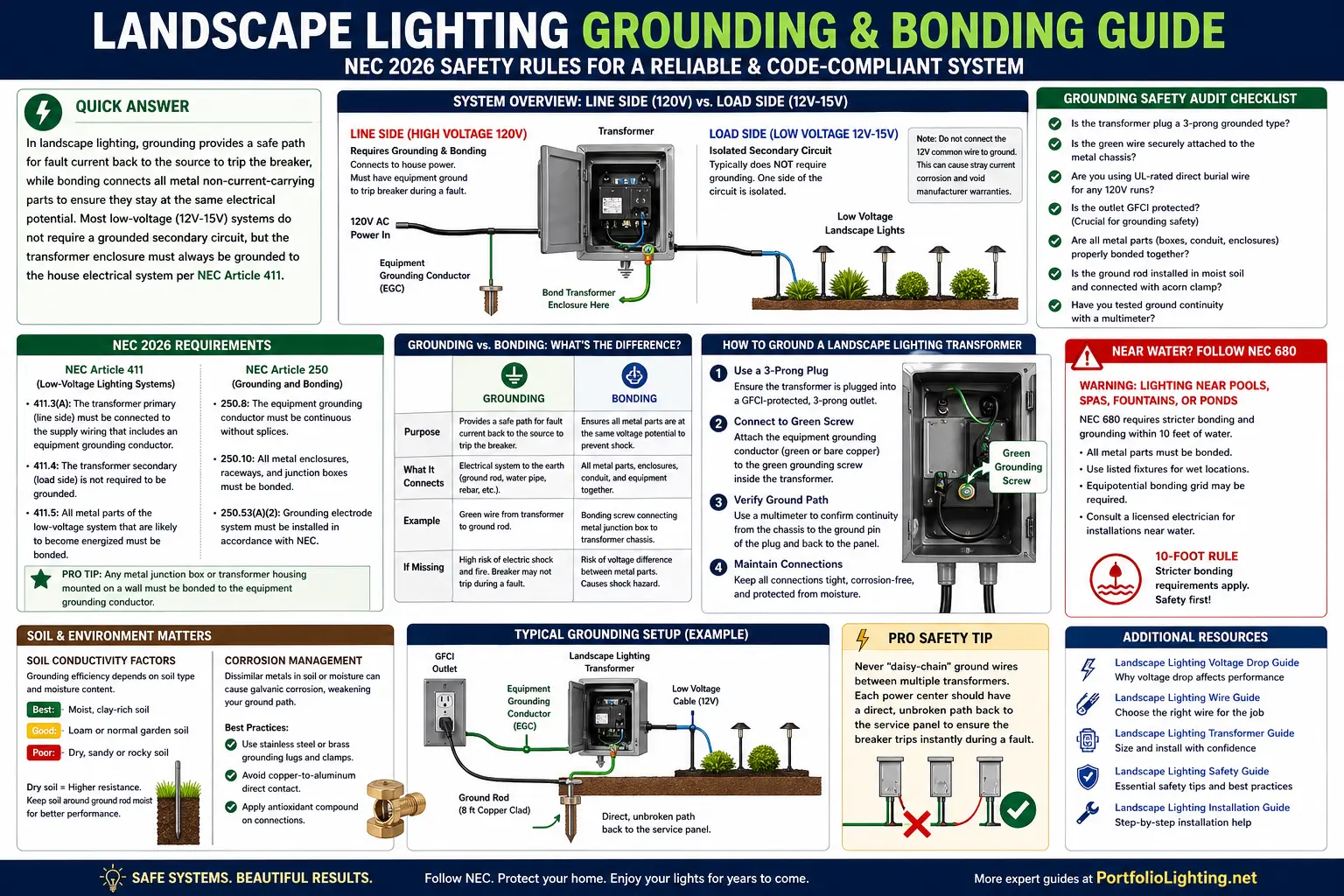
Quick Answer: Landscape Lighting Grounding and Bonding
Grounding provides a safe fault-current path back to the source so the breaker or protective device can trip. Bonding connects metal non-current-carrying parts together so they stay at the same electrical potential. In most residential landscape lighting systems, the 120V line side of the transformer must be grounded, while the 12V or 15V low-voltage side is usually an isolated secondary circuit.
- Grounding: fault-current path back to the electrical source.
- Bonding: connects metal parts so they do not sit at different voltages.
- Transformer enclosure: must be grounded or bonded according to its listing and the 120V supply method.
- Low-voltage cable: usually does not include an equipment grounding conductor on the 12V side.
Grounding protects people. Bonding protects systems. Both are required for safe landscape lighting installations.
Grounding & Bonding Logic Summary
| Situation | What Happens | What To Do |
|---|---|---|
| No grounding conductor | Fault current has nowhere to go | Add equipment grounding conductor |
| Loose or missing bond | Metal parts can stay energized | Bond all metal components |
| High resistance path | Breaker may not trip | Ensure low-impedance grounding path |
| Mixed metal components | Voltage difference between surfaces | Bond all conductive parts together |
Grounding Safety Audit Checklist
- 3-prong transformer plug: Is the transformer plug a grounded 3-prong type where required?
- Green grounding screw: Is the green or bare copper equipment grounding conductor attached to the metal chassis?
- Metal box bonding: Are metal junction boxes, conduit, and transformer housings bonded?
- Direct-burial wiring: Are any 120V underground runs using approved wiring methods such as UF cable or proper conduit?
- GFCI protection: Is the outdoor outlet or circuit GFCI protected where required?
- Corrosion check: Are grounding lugs and screws clean, tight, and free of rust or white/green corrosion?
Grounding works together with GFCI protection to reduce shock risk. See GFCI requirements for outdoor lighting.
Grounding and bonding requirements can change depending on whether the project is permitted, hardwired, or inspected. Review low voltage lighting permit requirements before finalizing the installation.
Grounding requirements tie into broader electrical code updates. For full context, see NEC 2026 landscape lighting code updates.
Landscape lighting grounding is easy to misunderstand because most fixtures in the yard operate at low voltage. That leads some homeowners to think grounding does not matter. The safer answer is more specific: the low-voltage side is usually isolated, but the transformer, outlet, metal enclosure, supply wiring, and any line-voltage equipment must still follow grounding and bonding rules.
This guide explains the practical difference between the line side and load side, what NEC Article 411 and Article 250 mean for outdoor lighting, how to ground a transformer, why soil and corrosion matter, and when water features make bonding much more serious.
Do Low Voltage Landscape Lights Need to be Grounded?
Most low-voltage landscape lighting fixtures on the 12V or 15V side do not need a separate grounding conductor the way a 120V outdoor fixture does. The reason is that listed landscape lighting transformers typically isolate the low-voltage secondary circuit from the 120V primary circuit.
The important part is not to confuse the low-voltage load side with the 120V line side. The line side feeding the transformer must be installed with proper grounding, GFCI protection where required, weatherproof enclosures, and approved outdoor wiring methods.
120V Line Side
The household power side feeding the transformer. This side must be grounded and protected according to code.
12V Load Side
The low-voltage output going to fixtures. This side is usually isolated and typically does not use a ground wire.
Plug-In Transformer
Should plug into a properly installed, grounded, weatherproof, GFCI-protected outdoor receptacle where required.
Hardwired Transformer
Requires proper equipment grounding conductor connection, box bonding, and approved wiring method.
For transformer-specific troubleshooting, see Portfolio lighting transformer troubleshooting and landscape lighting transformer guide.
NEC 2026 Requirements for Outdoor Lighting Grounding
Landscape lighting grounding and bonding pulls from more than one NEC topic. The two major concepts to understand are NEC Article 411 for low-voltage lighting systems and NEC Article 250 for grounding and bonding.
- NEC Article 411: covers low-voltage lighting systems and listed transformers or power supplies.
- NEC Article 250: covers grounding and bonding principles, equipment grounding conductors, and fault-current paths.
- Metal enclosures: metal transformer housings, metal junction boxes, and metal raceways must be bonded.
- Outdoor receptacles: GFCI protection is a separate but closely related safety layer.
For the outdoor GFCI side of the system, review outdoor lighting GFCI requirements NEC 2026.
Grounding and bonding work best when the overall electrical system is properly balanced and correctly loaded. The landscape lighting load calculation and compliance guide explains how transformer sizing, wire gauge selection, voltage-drop management, startup surge behavior, and NEC low-voltage system planning all contribute to safer long-term electrical performance in outdoor lighting installations.
Grounding vs. Bonding: What’s the Difference in Your Yard?
Grounding and bonding work together, but they are not the same thing. This table explains the practical difference in a landscape lighting system.
| Safety Concept | What It Means | Landscape Lighting Example | Why It Matters |
|---|---|---|---|
| Grounding | Provides a safe fault-current path back to the source | Green or bare copper wire connected to a transformer grounding screw | Helps the breaker trip if a hot conductor contacts metal |
| Bonding | Connects metal non-current-carrying parts together | Metal box, metal conduit, and transformer chassis connected together | Prevents dangerous voltage differences between metal parts |
| GFCI Protection | Detects current leakage and trips quickly | Outdoor receptacle feeding a plug-in landscape transformer | Reduces shock risk in wet outdoor locations |
| Low-Voltage Isolation | Separates the 12V output from the 120V supply | Listed landscape lighting transformer | Helps make the fixture side safer when installed correctly |
Buzzing, electronic interference, control resets, and unexpected neutral current are sometimes blamed on grounding even when the bonding system is intact. In installations with many LED drivers, distorted input current may be the real source of the abnormal behavior. The LED driver THD compliance guide explains how third-order and higher harmonics behave, why some currents accumulate instead of canceling, and what a power-quality analyzer should measure before grounding modifications are considered.
Why Bonding Matters: Touch Potential Explained
| Condition | Potential Risk | The Safety Fix |
|---|---|---|
| Ungrounded metal box | Metal stays energized during a fault | Grounding trips the breaker immediately |
| Unbonded fence & light | Different voltages between surfaces | Bonding equalizes voltage to 0V |
| High soil resistance | Fault current cannot return | Use proper grounding conductor |
How to Ground a Landscape Lighting Transformer
A landscape lighting transformer should have a safe equipment grounding path on the 120V supply side. The exact method depends on whether the transformer plugs into an outdoor receptacle or is hardwired.
Plug-in transformer grounding
- Use a listed transformer with an intact 3-prong plug where grounding is required.
- Plug it into a properly installed outdoor receptacle with a working ground.
- Use a weatherproof in-use cover that closes over the plug.
- Test the GFCI device before the season or before major landscape lighting use.
Hardwired transformer grounding
- Turn off power at the breaker.
- Confirm the 120V feed includes an equipment grounding conductor.
- Attach the green or bare copper conductor to the green grounding screw or grounding lug.
- Bond any metal junction box or metal transformer enclosure.
- Check continuity between bonded metal parts before energizing.
If the transformer is tripping a breaker, see Portfolio transformer tripping breaker.
- Lay-in lugs: Used to bond multiple grounding wires without cutting the main conductor.
- Green hex-head screws: Standard grounding screws used inside junction boxes and transformers.
- Split-bolt connectors: Used when bonding to a ground rod or copper conductor near water features.
The Soil Conductivity Factor: Why Dirt Conditions Still Matter
Soil conditions affect how electricity behaves around buried equipment, ground rods, and outdoor faults. Moist clay soil typically conducts better than dry sandy soil. Dry soil, rocky soil, and frozen ground can increase resistance.
That does not mean a landscape lighting installer can rely on soil as the safety path. The equipment grounding conductor is the required fault-current path for line-voltage equipment. Soil conditions simply explain why outdoor electrical faults can behave unpredictably and why proper grounding, bonding, and GFCI protection matter so much.
Corrosion Management: Grounding Lugs, Galvanic Action, and Outdoor Failure
Outdoor grounding and bonding connections fail when corrosion increases resistance or breaks the connection completely. This is common around wet walls, irrigation overspray, mulch beds, salty environments, and older transformer housings.
- Use stainless steel, brass, or listed corrosion-resistant grounding lugs where appropriate.
- Avoid mixing metals in ways that accelerate galvanic corrosion.
- Keep grounding screws tight and clean.
- Do not bury ordinary indoor-rated connectors in soil or mulch.
- Inspect white powder, green corrosion, rust, or pitted metal around grounding points.
For outdoor connector reliability, see low voltage wire connectors landscape lighting.
All grounding connections must be made inside properly rated enclosures. See outdoor junction box requirements for weatherproof installations.
Pool & Water Feature Proximity: When Bonding Gets Much Stricter
Lighting near pools, spas, fountains, ponds, and water features is not a casual DIY grounding topic. NEC Article 680 can impose much stricter bonding, spacing, and equipment requirements when lighting is near water.
For broader code and outdoor junction safety, see outdoor lighting junction box requirements.
Grounding Problems That Cause Real Landscape Lighting Symptoms
Grounding and bonding problems can look like other failures. A transformer may trip, metal parts may tingle, GFCIs may nuisance-trip, lights may fail after rain, or corrosion may create unstable behavior around the power center.
GFCI trips after rain
May be caused by moisture, damaged insulation, wet boxes, or leakage current.
Breaker trips instantly
Can indicate a line-side fault, damaged transformer, or short to a bonded metal enclosure.
Corroded transformer lugs
May create heat, resistance, and failure at the connection point.
Metal box feels energized
Stop using the system immediately and call an electrician.
For rain-related symptoms, see landscape lights not working after rain and Portfolio lights not working after rain.
Grounding, Wire Gauge, and Voltage Drop Are Different Problems
Grounding and voltage drop are often confused because both involve wire and electrical performance. They are different issues. Grounding is a safety path for fault current. Voltage drop is the loss of usable voltage along the low-voltage lighting run.
- Grounding protects people and equipment during faults.
- Bonding keeps metal parts at the same potential.
- Wire gauge helps control voltage drop on long low-voltage runs.
- Changing low-voltage wire gauge does not replace proper 120V grounding.
For the voltage side, see landscape lighting voltage drop and landscape lighting voltage drop calculator.
For safe wire routing and code-compliant installation, see landscape lighting wire burial depth requirements.
If you are planning a full lighting system, start with the landscape lighting electrical code and safety guide.
Related Electrical Safety Guides for Outdoor Lighting
Grounding and bonding help manage fault conditions, but fixture listing still matters at the point of exposure. This outdoor wet-location lighting requirements guide explains how fixture ratings protect against rain, splash, and wet-area installation risks.
Safe service access is part of a reliable electrical system. This transformer disconnect guide for landscape lighting explains why a shutoff point matters when testing, repairing, or isolating low-voltage circuits.
Pool lighting introduces stricter bonding and clearance concerns because water increases electrical risk. This NEC 680 pool lighting clearance guide explains why lighting near pools must be treated differently from ordinary yard lighting.
Fountain and pond lighting require special attention because submerged equipment must be protected differently than dry-location fixtures. This submersible fountain lighting safety guide explains the code logic around underwater fixtures.
Outdoor lighting safety also includes safe navigation for people using walkways and ramps. This ADA outdoor pathway lighting guide explains how lighting can reduce hazards without creating glare.
Grounding will not save a system from bad outdoor splices. This landscape lighting splice requirements guide explains how moisture-resistant connections reduce corrosion and failure risk.
Landscape Lighting Grounding and Bonding FAQ
Do low voltage landscape lights need to be grounded?
Most 12V to 15V landscape lighting fixture runs do not use a separate grounding conductor because they are supplied by an isolated listed transformer. The transformer’s 120V supply and metal enclosure still need proper grounding and bonding.
Does a landscape lighting transformer need to be grounded?
Yes. A metal transformer housing or hardwired power center should be connected to the equipment grounding conductor on the 120V supply side through the green grounding screw or listed grounding lug.
What is the difference between grounding and bonding?
Grounding provides the fault-current path back to the source. Bonding connects metal non-current-carrying parts together so they stay at the same electrical potential.
Can I install a separate ground rod for my landscape transformer?
A separate ground rod is not a substitute for the equipment grounding conductor back to the service panel. Ground rods and equipment grounding conductors serve different purposes. Ask a licensed electrician before adding grounding electrodes.
Are bonding rules different near pools and fountains?
Yes. Lighting near pools, spas, fountains, and water features may fall under stricter NEC Article 680 bonding and spacing requirements. This is a professional electrical safety area.
Final Grounding and Bonding Safety Checklist
- Confirm the transformer’s 120V line side is grounded.
- Confirm the green grounding screw or lug is tight and corrosion-free.
- Bond metal boxes, metal conduit, and metal transformer housings.
- Use GFCI protection for outdoor receptacles where required.
- Do not rely on soil, a random ground rod, or low-voltage cable as a fault path.
- Use corrosion-resistant outdoor-rated hardware and connectors.
- Call a licensed electrician for lighting near pools, spas, fountains, or water features.
More Landscape Lighting Safety Guides
Electrical Code Safety Guide
Start here for the full NEC-aware outdoor lighting safety framework.
Code safety guideOutdoor GFCI Requirements
Understand the outlet protection layer that works with grounding and bonding.
GFCI requirementsVoltage Drop Guide
Separate voltage performance problems from grounding and bonding safety problems.
Voltage drop guideTransformer Troubleshooting
Use this if the transformer trips, buzzes, overheats, or will not power the lights.
Transformer troubleshootingGrounding and Bonding Safety Note
This guide explains grounding and bonding concepts for educational purposes. Outdoor electrical work can involve shock, fire, corrosion, water exposure, and code compliance risks.
Always verify local code requirements, follow manufacturer instructions, and use a licensed electrician for hardwired transformers, line-voltage circuits, pool-area lighting, or any situation involving damaged grounding or bonding conductors.