
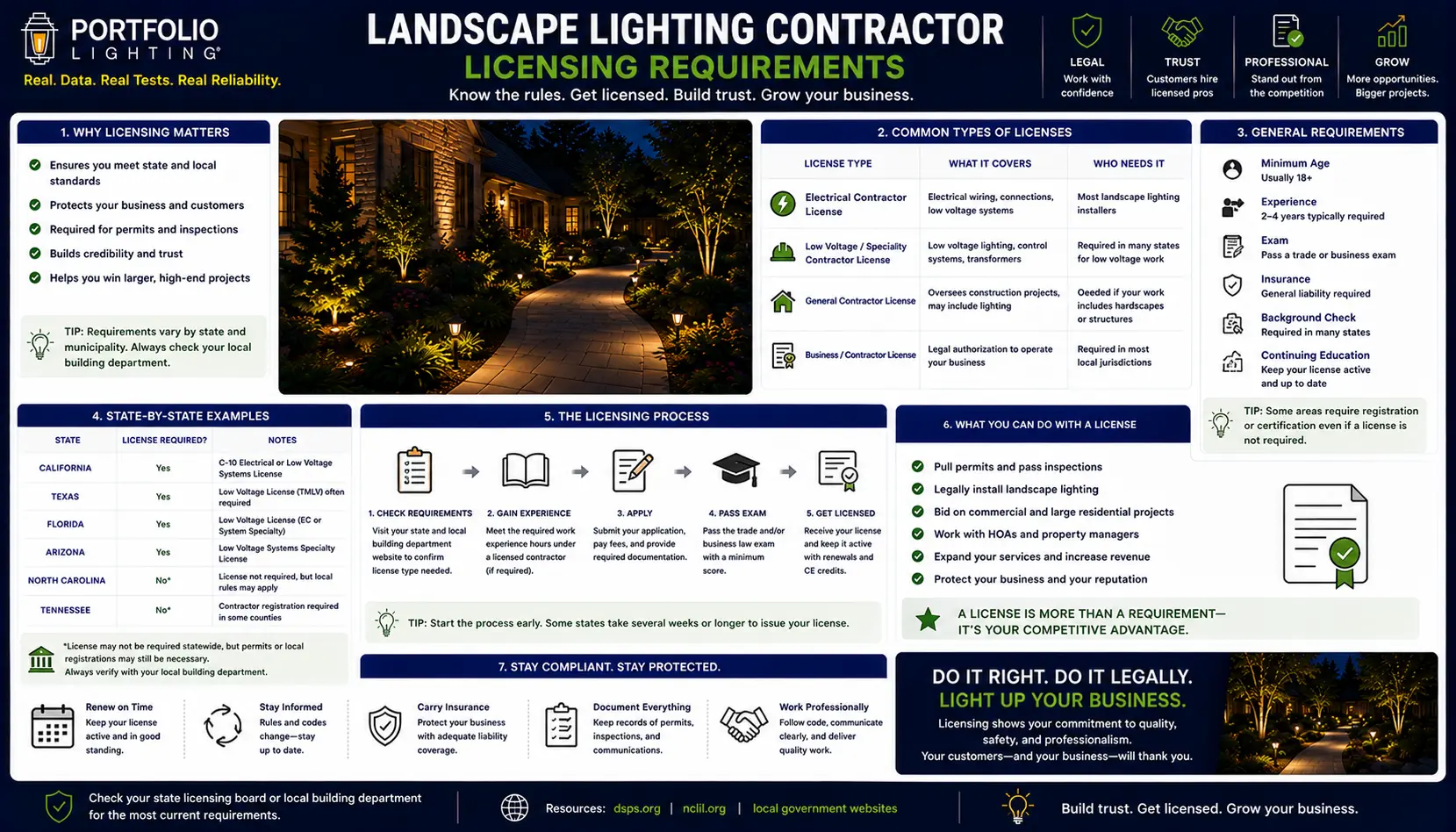
NEC Class 2 Circuits: The Federal Rule That Allows DIY Low-Voltage Landscape Lighting
Before discussing state licensing requirements, it is essential to understand the federal electrical code framework that governs low-voltage landscape lighting — because this framework is the reason most homeowners can legally install their own low-voltage system without any contractor license at all. The National Electrical Code (NEC) Article 725 creates a classification system for remote-control, signaling, and power-limited circuits that applies directly to low-voltage landscape lighting.
What Makes a Circuit "Class 2"
NEC Article 725 classifies circuits into three categories based on their power and voltage characteristics. Class 2 circuits are the lowest-risk category — they are power-limited circuits that cannot deliver enough energy to cause significant electric shock injury or to ignite a fire in normal circumstances. The NEC defines a Class 2 circuit as one powered by a listed Class 2 power supply (such as a UL-listed landscape lighting transformer) that limits its output to specific voltage and current parameters — not more than 30 volts and not more than 100 volt-amperes for AC systems.
Standard residential landscape lighting transformers — including the Portfolio transformer range — produce 12V AC output at power levels typically between 150 and 600 watts. Importantly, all of this output is on the secondary (low-voltage) side of the transformer. The transformer itself is a Class 2 power supply listed to UL 1838 (for landscape lighting transformers). Everything connected to the transformer's output terminals — the 12V wire runs, the connectors, the fixtures — constitutes a Class 2 circuit.
What Class 2 Status Means in Practice
The NEC grants Class 2 circuits significant installation flexibility compared to line-voltage wiring. Class 2 cable does not require conduit. Class 2 cable can be buried at shallower depths than line-voltage cable (though the specific burial depth requirements still apply). Class 2 circuits do not require the same box-fill calculations, ampacity derating, or termination methods as line-voltage circuits. And critically — Class 2 installation work is not subject to the same contractor licensing requirements that apply to line-voltage electrical work in most jurisdictions.
This is the legal basis for homeowner DIY low-voltage landscape lighting installation. When a homeowner plugs a listed transformer into an existing GFCI outlet and runs 12V wire to landscape fixtures, they are installing a Class 2 circuit that the NEC specifically designed to be accessible to non-electricians. They are not performing unlicensed electrical work — they are performing Class 2 low-power circuit installation that is explicitly outside the licensing requirement in most states.
The question I get most often from homeowners planning their own landscape lighting installation is some version of: "Am I allowed to do this myself?" The answer is almost always yes for the low-voltage side — running the 12V wire, connecting fixtures, burying cable — and almost always no for any new 120V work. The transformer is the boundary. Everything on the plug side requires a licensed electrician. Everything on the fixture side, the homeowner can typically do legally in most states. Understanding that single boundary eliminates the confusion in 90% of cases.
DIY vs Licensed: What Each Side of the Transformer Allows
The transformer is the legal boundary between work a homeowner can typically do without a license and work that requires a licensed electrician. This section maps every common landscape lighting task to which side of that boundary it falls on.
- Running 12V low-voltage wire from transformer to fixture locations
- Connecting fixtures to wire runs using low-voltage connectors
- Burying low-voltage cable at code-required depth
- Installing, replacing, and aiming landscape light fixtures on the 12V system
- Adding fixtures to an existing low-voltage zone
- Programming transformer timers and photocells
- Connecting a plug-in transformer to an existing outdoor GFCI outlet
- Replacing or upgrading a plug-in transformer at an existing outlet
- Installing solar-powered landscape fixtures (no electrical connection required)
- Troubleshooting and repairing low-voltage wire connections and fixtures
- Installing a new 120V outdoor GFCI outlet for transformer supply
- Hardwiring a transformer directly to a 120V branch circuit (no plug)
- Installing line-voltage (120V) landscape fixtures of any type
- Running conduit from the electrical panel to an outdoor location
- Adding a new circuit to the electrical panel for landscape lighting
- Installing pool or spa lighting connected to 120V circuits (NEC Article 680)
- Installing any 120V security floodlights or area lighting
- Installing or modifying a subpanel or disconnect for a large landscape lighting system
- Any work that opens or modifies the electrical panel
- Installing 120V motion-activated security lights wired to branch circuits
Work Type Licensing and Permit Reference Table
This table maps every common landscape lighting work type to its licensing requirement, permit requirement, and the specific code basis for that classification. Use it to quickly determine what credentials and approvals apply to each task in your project.
| Work Type | License Required? | Permit Required? | Code Basis and Notes |
|---|---|---|---|
| Plug-in transformer connected to existing GFCI outlet — 12V secondary wiring and fixtures | Generally No | Generally No | NEC Article 725 Class 2 circuit. Secondary side of listed transformer. Most jurisdictions exempt Class 2 installation from electrical licensing and permit requirements. |
| New 120V GFCI outlet installation for transformer | Yes — Electrician | Yes — Electrical Permit | NEC 210.8 GFCI protection required. Line-voltage work requires licensed electrician. Permit required in virtually all jurisdictions for new outlet installation. |
| Hardwired transformer (120V direct connection, no plug) | Yes — Electrician | Yes — Electrical Permit | Line-voltage termination at transformer primary. Licensed electrician required. Permit required. Some jurisdictions also require inspection of the transformer mounting. |
| Line-voltage (120V) path lights or area fixtures | Yes — Electrician | Yes — Electrical Permit | NEC Article 300, 410. Full line-voltage wiring requirements apply. Licensed electrical contractor required in virtually every state. |
| Low-voltage wire burial — 12V system | Generally No | Generally No | Class 2 cable. NEC burial depth rules apply (see burial depth guide) but licensing exemption applies to Class 2 secondary wiring in most jurisdictions. |
| Pool or spa lighting — any voltage | Yes — Electrician | Yes — Electrical Permit | NEC Article 680 applies to all pool/spa lighting regardless of voltage. Special bonding, GFCI, and equipment requirements. Licensed electrician and permit required in all jurisdictions. |
| Motion-activated security lights — 120V hardwired | Yes — Electrician | Yes — Electrical Permit | Line-voltage fixture. Licensed electrician required. Plug-in versions with existing outlet require no license for the fixture connection — only a licensed electrician for the outlet if it does not already exist. |
| Transformer timer programming and photocell adjustment | No | No | Control settings on secondary side of installed transformer. No licensing or permit requirement. See timer guide for programming procedures. |
| Landscape lighting system expansion — adding fixtures to existing 12V zone | Generally No | Generally No | Class 2 secondary work. See expansion guide for capacity and transformer load calculations. No licensing required for secondary-side expansion in most states. |
| Replacing existing transformer (same outlet, same location) | Generally No | Generally No | Plug-in replacement at existing outlet — no new line-voltage work. Secondary side reconnection only. No license or permit required in most jurisdictions. |
| Installing surge protection device on transformer | No | No | Secondary-side addition. See surge protection guide. No licensing requirement. |
| Adding new circuit from panel for landscape lighting | Yes — Electrician | Yes — Electrical Permit | Panel work always requires licensed electrician and permit. This is the highest-risk electrical work and is never a homeowner DIY activity in any jurisdiction. |
Permit Requirements for Landscape Lighting Work
Permits are separate from licensing — a permit is a project-specific approval from the local building or electrical department, while a license is a credential held by the individual or business doing the work. Work can require one, both, or neither depending on the jurisdiction and the work type. Understanding which landscape lighting work triggers a permit requirement prevents the expensive and inconvenient situation of discovering unpermitted work during a home sale inspection or insurance claim.
When Landscape Lighting Work Requires a Permit
The low-voltage permit requirements guide covers this topic in detail, but the core rule for landscape lighting is: any work involving the 120V supply side of the system requires a permit in virtually every jurisdiction. Installing a new outdoor GFCI outlet for a transformer, hardwiring a transformer, running conduit from the panel to an outdoor location, installing line-voltage security lights — all of these trigger permit requirements because they involve modifications to the home's electrical system that must be inspected by the local authority having jurisdiction (AHJ).
Low-voltage Class 2 work — the 12V secondary side — typically does not require a permit. Running wire, connecting fixtures, and burying cable on the secondary side of a plug-in transformer is Class 2 installation that most jurisdictions exempt from permit requirements. However, some local jurisdictions go beyond the NEC baseline and require permits for any landscape lighting work regardless of voltage — particularly in municipalities with aggressive building code enforcement or in areas where unpermitted outdoor electrical work has caused fires or other incidents.
The Local AHJ Always Takes Precedence
The NEC is a model code — it becomes law only when adopted by a state or local jurisdiction, and jurisdictions can modify it when they adopt it. Some states have adopted the NEC with amendments that expand permit and licensing requirements. Some municipalities have local ordinances that go beyond state requirements. The baseline rules in this guide reflect the NEC standard, but your specific municipality may have stricter requirements. Before beginning any landscape lighting project that involves new electrical work, contact your local building department and ask two questions: does this work require a permit, and does it require a licensed contractor? Those two answers govern your specific project regardless of what any general guide says.
Consequences of Unpermitted Work
Unpermitted electrical work creates several categories of risk. First, the insurance risk: a homeowner's insurance policy may deny claims for damage caused by or related to unpermitted electrical work — a fire caused by an unpermitted outdoor outlet installation is a legitimate basis for claim denial. Second, the sale risk: unpermitted work discovered during a home sale inspection requires remediation before closing and can kill a transaction entirely. Third, the safety risk: permitted work is inspected and therefore verified to be safely installed. Unpermitted work has no such verification. The landscape lighting insurance and liability guide covers these consequences in full, including which specific work types create the most significant insurance exposure.
Contractor License Types That Apply to Landscape Lighting Work
When a landscape lighting project does require a licensed contractor, the specific license type required depends on what work is being performed and in which state. Three distinct contractor license categories may apply to landscape lighting depending on the scope of work.
Which License Does a Landscape Lighting Company Need?
A company offering full-service landscape lighting installation — from the electrical panel to the finished fixture — needs two credentials: a licensed electrical contractor (EC) for the 120V supply side work, and either the EC license or a low-voltage specialty license for the 12V secondary work. Many landscape lighting companies hire a licensed electrician or subcontract the 120V work to a licensed EC while their own technicians handle the low-voltage secondary installation. This is a compliant arrangement as long as the 120V work is genuinely performed by the licensed EC and not by unlicensed landscape crew members.
A company offering only low-voltage secondary installation — connecting to existing outlets that the customer already has in place — may be able to operate under a low-voltage contractor license or in some states under a landscaping license with a low-voltage endorsement, without maintaining a full electrical contractor license. The specific authorization depends entirely on the state. Before hiring any landscape lighting contractor, verify that their license type covers the specific work they are proposing to perform.
Professional landscape lighting contractors are increasingly expected to understand far more than fixture placement alone. The landscape lighting load calculation and NEC compliance guide explains how transformer sizing, electrical load balancing, voltage-drop calculations, wire gauge selection, and safe low-voltage system design all contribute to code-compliant installations and long-term system reliability.
State-by-State Licensing Overview for Landscape Lighting
Licensing requirements vary significantly across states. This table provides a general overview of the licensing landscape for the most common landscape lighting work scenarios across major states. Always verify current requirements directly with your state's licensing board — these classifications can change with legislative updates and are subject to local AHJ modifications.
| State | DIY Low-Voltage (12V)? | Low-Voltage Contractor License? | 120V Work License? | Key Notes |
|---|---|---|---|---|
| California | Generally Allowed | C-10 Electrical (preferred) | C-10 Electrical Required | CSLB licenses contractors. Low-voltage landscape lighting falls under C-10 Electrical or C-27 Landscaping with low-voltage scope. Homeowner exemption for own property generally applies to Class 2 work. |
| Florida | Generally Allowed | Low-Voltage (LV) license available | EC License Required | Florida has a specific low-voltage systems contractor license category. 120V work requires licensed electrical contractor. Homeowner exemption for own primary residence commonly applies to Class 2 secondary work. |
| Texas | Generally Allowed | TDLR regulates — check current rules | Licensed Electrician Required | Texas Department of Licensing and Regulation (TDLR) oversees electrical licensing. Class 2 homeowner work generally exempt. Contractors installing low-voltage systems may need limited energy or electrical license depending on scope. |
| New York | Generally Allowed | Local jurisdictions — highly variable | Licensed Electrician Required | New York electrical licensing is primarily local — New York City has strict requirements; upstate municipalities vary widely. Always check local AHJ before any work. NYC Master Electrician license for line-voltage work. |
| Illinois | Generally Allowed | Local jurisdictions vary | Licensed Electrician Required | Illinois electrical licensing is largely municipal. Chicago requires licensed electrician for most work including outlet installation. Suburban jurisdictions vary. Class 2 homeowner exemption generally recognized statewide. |
| Arizona | Generally Allowed | Specialty contractor may apply | Licensed Electrician Required | Arizona Registrar of Contractors (ROC) licenses contractors. Low-voltage landscape lighting contractors may operate under landscape or specialty category. 120V work requires licensed electrical contractor. |
| Georgia | Generally Allowed | Low-voltage license available | Licensed Electrician Required | Georgia State Licensing Board licenses electrical and low-voltage contractors separately. Low-voltage landscape lighting contractors should verify current license category requirements with GCSLB. |
| North Carolina | Generally Allowed | Electrical contractor — check scope | Licensed Electrician Required | NC State Board of Examiners of Electrical Contractors. Low-voltage specialty licenses available. Homeowner exemption for own property generally applies for Class 2 secondary work. |
| Colorado | Generally Allowed | Local jurisdictions — varies | Licensed Electrician Required | Colorado electrical licensing is administered at local level in many municipalities. Denver and Front Range cities have specific licensing requirements. Always verify with local building department. |
| Washington | Generally Allowed | Specialty electrical available | Licensed Electrician Required | Washington Department of Labor and Industries. Specialty low-voltage license category available. Homeowner exemption for own property with Class 2 secondary work generally recognized. |
This table reflects general patterns as of the most recent NEC adoption cycles. State licensing laws change periodically. Always verify current requirements directly with your state's contractor licensing board and your local building department before beginning work. This table does not constitute legal advice.
How to Hire and Verify a Licensed Landscape Lighting Contractor
When your project requires a licensed contractor — for the 120V supply work, for pool lighting, or for any scope that exceeds Class 2 secondary installation — knowing how to verify credentials before signing a contract protects you from unlicensed work that creates liability, insurance, and permit problems.
Licensing, Insurance, and Liability: How They Connect for Landscape Lighting
Contractor licensing, permits, and insurance are not independent requirements — they are interconnected in ways that create real financial exposure when any one of them is missing. Understanding how they connect helps you make the right decisions about what work to DIY, what to hire out, and how to protect yourself when hiring a contractor.
How Unlicensed Work Affects Your Insurance
Homeowner's insurance policies typically contain exclusions for damage caused by defective workmanship or code violations. When unlicensed electrical work — specifically 120V outlet or transformer installation without a permit — is identified as a contributing cause of a fire, flood, or other covered event, the insurance company has a legitimate basis to deny the claim. This scenario is not theoretical: insurance companies routinely investigate the cause of electrical fires, and unpermitted or unlicensed electrical work is one of the first things they examine.
The key distinction is that Class 2 low-voltage work performed by a homeowner — within the NEC's explicit exemption for Class 2 circuits — does not create the same insurance exposure. Installing your own 12V landscape lighting system is not "unlicensed electrical work" in the insurance context — it is within the homeowner's legal right under the NEC. Installing your own 120V outdoor outlet without a permit and without a licensed electrician is unlicensed work that creates insurance exposure regardless of how cleanly it was done. The full framework is covered in the landscape lighting insurance and liability guide.
Contractor Insurance Protects You Specifically
When you hire a licensed contractor who carries proper liability insurance, their insurance covers damage they cause to your property during the work. If an unlicensed, uninsured contractor damages your electrical panel, cuts through a pipe, or causes a fire — you have no recourse through their non-existent insurance and often little recourse through your own policy, which may exclude contractor-caused damage not caused by a licensed party. Licensed and insured contractors are not just a legal requirement — they are financial protection for the homeowner.
The Electrical Code Compliance Connection
The landscape lighting electrical code safety guide covers the full NEC requirements that apply to landscape lighting installations — including GFCI requirements under NEC 2026, AFCI requirements, grounding and bonding requirements, and transformer mounting code requirements. Each of these code provisions is an element that a licensed electrician must follow and that an inspector will verify during a permitted inspection. When this work is done without a permit and without a licensed electrician, these code requirements are effectively unverified — and the homeowner bears the consequence of any failure that results.
Related Contractor Safety and Installation Guides For A Deeper Dive Into Your Research
Contractor responsibility includes selecting fixtures that are actually rated for the installation environment. This wet-location listing guide for outdoor lighting explains why fixture ratings matter in exposed landscape, poolside, and wet-area installations.
Serviceability is another professional installation detail homeowners may not notice until something fails. This landscape lighting transformer disconnect guide explains why safe transformer shutoff access should be part of a complete system plan.
Any contractor working near pools should understand that pool-area lighting has stricter clearance requirements. This swimming pool lighting clearance and NEC 680 guide explains the safety logic behind those separation rules.
Water-feature installations require extra care because submerged fixtures are not treated the same as standard outdoor landscape lights. This submersible fountain lighting requirements guide explains the added code concerns.
Lighting professionals should also consider accessibility when designing walkways, ramps, and outdoor routes. This ADA pathway lighting design guide explains how even lighting and glare control support safer movement.
A professional-looking job can still fail if outdoor splices are weak or unprotected. This landscape lighting splice code guide explains how connection protection affects long-term reliability.
Related Electrical Code and Compliance Guides
- Landscape Lighting Electrical Code Safety Guide
- Outdoor GFCI Requirements NEC 2026
- Arc Fault and GFCI Code Requirements
- Wire Burial Depth Code Requirements
- Low-Voltage Lighting Permit Requirements
- Grounding and Bonding Guide
- Junction Box Requirements
- Transformer Mounting Code Requirements
- NEC 2026 Landscape Lighting Code Updates
- Insurance and Liability Guide
- Landscape Lighting Wire Safety for Pets
- Portfolio Transformer Master Guide
- How to Wire Landscape Lighting
- Low Voltage System Diagram
- Landscape Lighting Transformer Guide
- Landscape Lighting Wiring Guide
- Landscape Lighting Connectors Guide
- Transformer Sizing Guide
- How to Replace a Landscape Lighting Transformer
- Surge Protection Guide
- Commercial Grade Lighting Upgrades
- How to Expand a Landscape Lighting System
- Low-Voltage Lighting Timer Guide
Landscape Lighting Contractor Licensing — FAQ
Do I need a license to install landscape lighting?
For low-voltage 12V landscape lighting connected through a plug-in transformer to an existing outdoor outlet — generally no. The 12V secondary side of the transformer is an NEC Class 2 circuit that most jurisdictions allow homeowners to install without a license. For any 120V work — installing a new outdoor outlet, hardwiring a transformer, or installing line-voltage fixtures — a licensed electrician is required in virtually every state. The transformer is the dividing line: 12V side is typically DIY-legal, 120V side always requires a licensed electrician.
What is a Class 2 circuit and why does it matter?
A Class 2 circuit is defined under NEC Article 725 as a low-power, limited-voltage circuit powered by a listed Class 2 power supply — which is exactly what a landscape lighting transformer is. Class 2 circuits carry low enough energy that they pose minimal shock and fire risk, so the NEC exempts them from many of the installation requirements that apply to line-voltage circuits, including in most jurisdictions the contractor licensing requirement. All the 12V wiring and fixtures on the secondary side of your landscape lighting transformer constitute a Class 2 circuit.
What landscape lighting work requires a licensed electrician?
Installing a new 120V outdoor GFCI outlet for the transformer, hardwiring a transformer to a 120V circuit, installing any line-voltage landscape fixtures, adding a new circuit from the electrical panel, and all pool and spa lighting work under NEC Article 680. Any work that involves 120V wiring on the supply side of the transformer requires a licensed electrician in virtually every state, regardless of how simple the task appears.
Do landscape lighting contractors need to be licensed?
Contractors who install only the 12V secondary side — plugging a transformer into an existing outlet and running low-voltage wire — may not require a full electrical contractor license in many states, though some form of contractor registration or specialty license may be required depending on the state. Contractors who also install or modify the 120V supply side must hold a licensed electrical contractor credential in virtually every state. Always verify that any contractor's license type covers the specific work they are proposing to perform.
Does low-voltage landscape lighting require a permit?
The 12V Class 2 secondary side typically does not require a permit in most jurisdictions — it is Class 2 work exempt from most permit requirements. The 120V supply side — new outlet installation, hardwired transformer, panel work — requires a permit in virtually every jurisdiction. Some local municipalities go beyond the NEC baseline and require permits for any landscape lighting work regardless of voltage. Always verify with your local building department for your specific jurisdiction.
What happens if I do unlicensed electrical work on my landscape lighting?
Unlicensed 120V electrical work — installing a new outlet or hardwiring a transformer without a permit and without a licensed electrician — creates three categories of risk: insurance risk (your homeowner's policy may deny claims related to damage caused by or associated with unpermitted electrical work), sale risk (unpermitted work must typically be disclosed during home sale and may require remediation before closing), and safety risk (uninspected work has not been verified to meet code requirements). Class 2 low-voltage work performed by a homeowner within the NEC exemption does not carry these risks — it is within the homeowner's legal rights and does not constitute unlicensed electrical work.