
NEC Article 411: Scope, History, and What It Actually Requires
NEC Article 411 has governed low-voltage landscape lighting through multiple code cycles — and its requirements have changed meaningfully with each revision. Understanding which edition your AHJ has adopted matters, because the obligations differ between cycles.
Article 411 Scope: The 30V Threshold
Article 411 covers lighting systems operating at 30 volts AC or less (or 60 volts DC or less) in dry locations. The threshold tightens significantly for wet locations where contact with the system is likely: 15 volts AC or 30 volts DC maximum. All standard 12V AC landscape transformer systems operate well within both thresholds. This 30V/15V division is one of the most important and least-understood aspects of Article 411 — because it creates a compliance issue for some "landscape" systems that use higher secondary voltages.
411.1 Scope: Lighting systems operating at 30V AC / 60V DC or less (dry); 15V AC / 30V DC (wet, where contact is likely).
411.2 Definitions: "Lighting System" means a low-voltage power supply and its associated luminaires, including the associated fittings and connectors, installed as a system.
411.3 Voltage limitations: Output circuits of the power supply shall not exceed 30V AC / 60V DC (dry) or 15V AC / 30V DC (wet with likely contact). Reconditioning of listed low-voltage lighting systems is not permitted.
411.4 Listing: Low-voltage lighting systems shall consist of listed components. Power supplies (transformers) shall be listed. Luminaires shall be listed. Low-voltage lighting systems shall not be used within 10 feet of pools, spas, or fountains unless permitted by Article 680.
411.5 Secondary circuit conductors: Exposed secondary conductors shall be (1) Class 2 cable from a Class 2 source per Article 725, or (2) conductors/cord/cable of the listed system installed 7 ft or more above finished floor, or (3) Chapter 3 wiring methods.
411.6 Branch circuit: Lighting systems operating at 30V or less shall be supplied from a maximum 20-ampere branch circuit.
How Article 411 Changed Across Code Cycles
| NEC Edition | Key Change | Practical Impact on Landscape Lighting |
|---|---|---|
| Pre-2011 | No dedicated article — landscape lighting covered under multiple articles with inconsistent interpretation | Wide variation in inspector requirements by jurisdiction; many systems installed without clear code basis |
| 2011 NEC | Article 411 formally established for "Lighting Systems Operating at 30V or Less" | Listing (UL 1838) and voltage requirements standardized; inspectors had clear code basis to evaluate systems |
| 2014 NEC | Article expanded to include Class 2 power sources; Class 2 language added throughout | Class 2 listed transformers and matching fixtures required; some consumer landscape products that were borderline became non-compliant |
| 2017 NEC | Title changed to "Low-Voltage Lighting"; most Class 2 references removed; output circuit rating clarified to 25A maximum | Simplified compliance — Class 2 references reduced to where necessary; 25A output limit codified |
| 2020/2023 NEC | Reconditioning prohibition added; requirements for wet locations clarified; updated cross-references to Article 680 pool requirements | Reconditioning prohibition creates inspection risk for modified systems; pool proximity requirements more clearly enforced |
UL 1838 System Listing vs Component Listing: The Distinction That Trips Inspectors
The listing requirement in Article 411 is a system-level requirement — not just a component-level requirement. Understanding the difference is the key to understanding what an inspector is actually checking when they examine a landscape lighting installation.
What System-Level Listing Means
Per electricallicenserenewal.com's documented analysis of Article 411: "Having a new listing requirement for low-voltage lighting equipment and Class 2 power supplies in 411.4 provides an additional informational resource and places the responsibility of verifying safety of the product in the hands of the nationally recognized testing laboratories."
UL 1838 is the product standard for "Low-Voltage Landscape Lighting Systems." A transformer listed to UL 1838 has been tested as a complete landscape lighting power supply for the specific application. UL 2108 is the product standard for "Low-Voltage Luminaires" — the standard for the fixtures themselves.
The system listing approach means: it is not sufficient to use components that each individually carry some UL listing if those components are assembled into a system configuration not covered by any listing. Per aspectLED's NEC compliance documentation: "Inspectors typically reference Article 411 to confirm the lighting system itself and Article 725 to evaluate how the wiring is installed. Linking these two articles correctly is key to passing inspection."
What the Listing Mark Tells an Inspector
When an inspector examines a landscape lighting transformer, they look for the UL listing mark and the text "Listed for Low-Voltage Landscape Lighting" or "UL 1838." The listing mark on a Portfolio, Hampton Bay, or Malibu landscape transformer is the primary compliance evidence for the transformer's safety and suitability. A transformer without a visible listing mark — because the label has been removed, degraded beyond legibility, or was never present — creates an inspection problem even if the transformer is functionally identical to a listed one.
Burial Depth: The 6-Inch Rule — and the Three Ways People Get It Wrong
Low-voltage landscape lighting wire burial depth is one of the most consistently misunderstood requirements in residential electrical work. The correct depth is significantly less than most people assume — but the nuances of how it is measured produce the most common violations.
The 6-Inch Requirement from NEC Table 300.5
NEC Table 300.5, Column 5 ("Circuits for Control of Irrigation and Landscape Lighting, 30 Volts or Less") specifies a minimum burial depth of 6 inches for low-voltage landscape cable. This is dramatically different from the 24-inch depth required for 120V direct-burial cable — and most people who know the 24-inch standard incorrectly apply it to landscape wiring.
Low-voltage landscape direct-burial cable at 30V or less: 6 inches minimum below grade. This applies to the 12/2 or 16/2 low-voltage cable from landscape transformer to fixtures. Cable must be rated for direct burial — the cable's jacket must be marked "Direct Burial" or equivalent. Standard wire specifications: 12 AWG or 16 AWG two-conductor direct-burial landscape cable, widely available at home improvement stores in rolls of 50–250 feet.
Under hardscapes without conduit:18 inches required when crossing under driveways, walkways, or other hardscapes without conduit protection — the hardscape increases the risk of future excavation damage. With Schedule 40 PVC conduit under the hardscape, depth flexibility increases. See the wire burial depth code guide and the NEC 300.5 calculators for the complete burial depth framework.
Standard UF-B cable at 120V requires 24 inches minimum burial depth. This is the requirement that most people know and incorrectly assume applies to landscape wiring. A contractor who buries landscape wire 24 inches deep is over-complying — which is fine but unnecessary. More importantly, a contractor who applies the 6-inch landscape lighting standard to 120V circuits is under-complying — a serious violation.
The confusion source:Most general installation guides cite "bury 18–24 inches" as a universal rule for outdoor wiring. This is correct for line-voltage circuits but significantly over-states the requirement for low-voltage landscape systems. The separate Column 5 standard for landscape circuits is less commonly known even among licensed electricians.
The Three Ways Installers Get the 6-Inch Requirement Wrong
- Measuring from the top of mulch, not the soil surface. The 6-inch depth in NEC Table 300.5 is measured from the finished grade — the soil surface — not from the top of mulch, rock, or ground cover. Cable buried 6 inches below a 4-inch mulch layer is only 2 inches below soil grade. An inspector who probes the soil after removing mulch will find a violation. The correct installation: 6 inches below the soil surface, then mulch or ground cover on top.
- Using non-direct-burial cable. Standard 14/2 NM-B (Romex) has insulation rated for indoor dry locations. It is not rated for direct soil burial — the PVC jacket is not designed to resist moisture diffusion over time in soil contact. Per Mike Holt forum documentation: "Use only wires listed for direct burial (e.g., UF cable) in underground applications." Landscape-specific 12/2 or 16/2 direct-burial rated cable is the correct product. Using Romex underground even at 6 inches depth is a violation because the cable type is wrong regardless of depth.
- Under driveways at 6 inches without conduit. The 6-inch minimum applies to landscape-area burial. Under driveways, parking areas, and roads, Table 300.5 requires 18 inches minimum without conduit — even for low-voltage circuits. A wire crossing under a driveway at 6 inches without conduit fails the depth requirement for that location. The solution: sleeve the cable in Schedule 40 PVC conduit under any hardscape crossing.
The GFCI Primary-Side Limitation: The Critical Compliance Gap Near Water
This is the most technically important compliance issue in low-voltage landscape lighting near pools, spas, and water features — and the one most installers and inspectors fail to address correctly.
Why GFCI on the Transformer Outlet Doesn't Protect Fixtures
Standard landscape lighting transformers use an isolation transformer design — the primary (120V) winding and secondary (12V) winding are electrically separated. No current path connects them. This isolation is intentional and required: it is what allows the secondary circuit to operate at low voltage without the line-to-neutral reference of the primary.
A GFCI device detects ground faults by measuring the current imbalance between the hot and neutral conductors. If more than 4–6 milliamps flows on a path other than through the neutral — such as through a person who has touched a faulted conductor — the GFCI trips. But this detection only works within the circuit the GFCI is monitoring. Per IAEI Magazine: "Since low-voltage landscape luminaires are supplied by a low-voltage power supply, such as a transformer, providing GFCI protection on the primary side of an isolation transformer will not provide GFCI protection on the secondary side."
A ground fault on the 12V secondary — a fixture with damaged insulation touching a wet metal stake, for example — creates a fault current on the secondary circuit. The isolation transformer prevents this fault current from propagating to the primary circuit. The GFCI on the primary outlet never detects the fault. The fixture continues to operate with a fault condition that can shock or electrocute someone who touches it near water.
NEC 680.22(B)(4): The Pool-Proximity Secondary Protection Requirement
NEC Section 680.22(B)(4) addresses luminaires within 5–10 feet of a pool edge: luminaires installed within this zone are permitted only where protected by a GFCI. Critically — and this is the key compliance point — this GFCI protection must be effective on the secondary circuit, not just on the primary transformer supply. Per IAEI Magazine's pool-proximity analysis: "There are many existing low-voltage lighting installations installed after the pool installation inspection has occurred where the luminaires are installed within 3 to 5 feet of the water's edge at or near ground level, which clearly is a violation."
For landscape fixtures within 5–10 feet of a pool edge: NEC 680.22(B)(4) requires GFCI protection. The standard transformer outlet GFCI does not satisfy this requirement because it doesn't protect the secondary circuit. The compliant approach requires one of: (1) using a transformer specifically listed for pool and spa use with secondary-side GFCI protection designed into the transformer; (2) installing a secondary-side ground-fault protection device on the 12V circuit feeding pool-adjacent fixtures (a specialty product used in professional landscape lighting near pools); or (3) maintaining the strict 10-foot setback required by NEC 411.4(2) for standard landscape luminaires without pool-use listing. Option 3 is simplest: keep all standard landscape fixtures at least 10 feet from any pool, spa, or fountain edge. See the GFCI requirements guide and the pool lighting clearance guide for the complete pool-proximity framework.
10-Foot Pool Setback: NEC 411.4 and the Article 680 Override
The 10-foot setback between standard low-voltage landscape luminaires and pools, spas, and fountains is one of the most commonly violated requirements in residential landscape lighting — and one of the most rigorously enforced by pool inspectors.
The 411.4 Setback Prohibition
NEC 411.4(2) explicitly prohibits low-voltage lighting systems from being installed within 10 feet of pools, spas, or fountains "unless permitted by Article 680." Standard landscape path lights, spotlights, and uplights are not Article 680 pool-rated equipment. Installing them within 10 feet of a pool edge is a clear NEC 411 violation regardless of how shallow the water is or how low the voltage is.
The 10-foot boundary is measured horizontally from the inside edge of the pool wall — not from the coping, the deck edge, or the water surface. For an in-ground pool, the compliance boundary extends 10 feet from the pool shell on all sides.
The Article 680 Override Path
Article 680 provides a compliance path for luminaires within the 10-foot boundary — but only for fixtures specifically designed and listed for pool and spa area use. NEC 680.22(B) permits luminaires within 5–10 feet of the pool edge if GFCI-protected (with the secondary-side GFCI requirement discussed above). Luminaires within 5 feet horizontally of the pool edge must be located at least 12 feet above the maximum water level — essentially ruling out standard path lights and uplights at this distance. The strict clearance requirements for within-5-foot applications essentially exclude standard landscape luminaires from that zone entirely.
The Timing Problem That Creates Most Pool Setback Violations: Per IAEI Magazine's documented inspector observation: "There are many existing low-voltage lighting installations installed after the pool installation inspection has occurred where the luminaires are installed within 3 to 5 feet of the water's edge at or near ground level, which clearly is a violation." Pool electrical inspections occur at pool completion, before the landscaping is installed. The landscape lighting is installed months later by a different contractor — sometimes a non-electrical contractor — without knowledge of the pool's 10-foot clearance requirement. The violation is created not during pool construction but during the landscaping phase. Verify all pool clearance measurements before finalizing landscape lighting fixture positions near any pool, spa, or decorative fountain. The landscaping permit (if any) may not require electrical inspection, but the violation exists and creates liability regardless of whether it is ever inspected.
Secondary Conductor Installation Methods: Three Permitted Options
NEC 411.5 specifies exactly three permitted methods for installing the exposed secondary conductors of a low-voltage landscape lighting system. Only these three options comply — and the first is the most commonly used in residential landscape lighting.
Art. 725
Ch. 3
The Splice Box Exception: When You Don't Need a Junction Box
Article 725 (Class 2 wiring), which is referenced by 411.5(1), allows open connections for Class 2 circuits when permitted by the AHJ. This means landscape lighting wire-to-wire connections — at fixture feed points and at splice locations — do not require metal or plastic junction boxes as long as the connectors are rated for direct burial and appropriate for the application. Per the Mike Holt forum documentation from a licensed electrician: "every kit I have ever installed has junctions rated for DB [direct burial]. No box, shrink wrap, nothing." The gel-filled or heat-shrink direct-burial connectors used in standard landscape lighting practice are compliant for Class 2 systems without additional box enclosures — a major installation simplification compared to line-voltage wiring. See the splice connection code requirements guide for the complete connector compliance framework, and the low-voltage connector guide for product selection.
Transformer Requirements: Branch Circuit, Mounting Height, and Output Limits
The landscape transformer is both the most important compliance element (it's the system's listed power supply) and the element with the most specific installation requirements beyond just having a UL listing.
Branch Circuit Maximum: 20 Amperes
NEC 411.6 specifies that lighting systems operating at 30V or less "shall be supplied from a maximum 20-ampere branch circuit." This limits the transformer to plugging into a standard 15A or 20A residential outlet — a 30A or 50A circuit is not permitted for this application. Most residential landscape transformers draw 2–15 amps at 120V depending on total wattage, well within the 20A limit. A 300W transformer at 120V draws 2.5A — far below the 20A maximum. The branch circuit breaker must be 20A or less per this section.
Transformer Output Circuit Maximum: 25 Amperes
The 2017 NEC revised the output circuit limit to a maximum of 25 amperes. This limit on the transformer's secondary output is separate from the primary branch circuit limit. Most consumer Portfolio landscape transformers are rated at 150W, 200W, or 300W — which at 12V corresponds to 12.5A, 16.7A, and 25A output respectively. A 300W transformer operating at full capacity reaches exactly the 25A output limit. This is why loading a landscape transformer to more than 80% of rated capacity (the standard rule of thumb) is not just practical advice — it provides meaningful headroom below the code maximum. See the load calculation and code compliance guide for the complete loading framework.
Transformer Mounting Requirements
Article 411 references the transformer's installation requirements from its UL 1838 listing and from NEC 110.3(B), which requires that all listed equipment be installed per its listing and labeling instructions. Most landscape transformer labels specify:
- Minimum mounting height above grade: Typically 12 inches minimum above the finished grade or flood plain level to prevent direct water immersion. The label controls — check the specific transformer's label for its required clearance.
- Wall or stake mounting: Most transformers are designed for mounting on an exterior wall near the GFCI outlet, not on a ground stake. Ground-mounted transformers should be assessed against their listing for ground-level installation suitability.
- GFCI-protected outlet required: Nearly all landscape transformer labels state "must be plugged into a GFCI-protected outlet." This is both a listing requirement and independently required by NEC 210.8(A)(3) for all outdoor receptacles. An outdoor outlet without GFCI protection violates two independent requirements: the NEC outdoor GFCI mandate and the transformer's listing instructions. See the GFCI requirements guide for the complete outdoor GFCI framework and the transformer mounting code requirements for the complete mounting compliance framework.
The Reconditioning Prohibition: What It Means for Repairs and Replacements
Article 411.3 now explicitly states that reconditioning of listed low-voltage lighting systems is not permitted. This prohibition has practical implications for the repair and maintenance of landscape lighting systems that most guides have never addressed.
What "Reconditioning" Means in the NEC Context
The NEC defines reconditioning as altering, rebuilding, or making a listed product usable for its intended purpose in a way that is not within the scope of the original listing. In landscape lighting practice, reconditioning violations most commonly arise when:
- A transformer's internal components (drivers, timers, photocells) are replaced with non-OEM parts that change the product's electrical characteristics beyond what the original listing covered
- Luminaires are modified with non-listed lamps, non-original sockets, or wire splices that are not part of the listed system
- Components from multiple listed systems are assembled into a combination not evaluated as a system by any NRTL — creating, in effect, a new unlisted system from listed parts
The Practical Compliance Line: Maintenance vs Reconditioning
The reconditioning prohibition does not mean that landscape lighting systems can never be repaired or maintained. The distinction is:
- Permitted maintenance: Replacing a lamp with an identical listed lamp; replacing a cable connector with the same type; replacing a fuse with an identical rated fuse; cleaning contacts and applying dielectric grease; replacing a gasket.
- Potential reconditioning: Replacing a transformer's timer board with a non-OEM board; modifying fixture wiring in ways not described in the fixture's installation instructions; installing a lamp of a different wattage or base type than what the fixture's listing covers.
- Clear reconditioning: Rebuilding a failed transformer using parts from multiple sources to create a functional but non-standard unit; modifying a listed fixture to accept a lamp type not covered by its listing.
Five Most Common Violations Inspectors Cite in Low-Voltage Landscape Lighting
These are the violations inspectors find most often in residential low-voltage landscape lighting, compiled from IAEI inspector documentation, Mike Holt forum licensed electrician discussions, and VOLT Lighting's published NEC compliance guidance.
1Insufficient Burial Depth
Cable buried only 1–3 inches below the soil surface, or cable buried in mulch with the measurement taken from the mulch surface rather than soil grade. This is the single most frequently cited violation because it requires only a probe or shovel to detect. The inspector uncovers the cable and measures to the soil surface — not to the mulch or ground cover top. Per Mike Holt forum: "burial depth is 6" below grade. Grade is the dirt level, like you said, not mulch." Correctly installed cable is 6 inches below the soil at every point along its run.
2Missing or Damaged Listing Mark
Transformer or fixture with no visible UL listing label — either because the label was never present (unverified product from an unknown source), because it degraded over years of outdoor exposure, or because it was removed. An inspector cannot verify compliance without the listing mark. A transformer whose label has faded to illegibility after 8 years outdoors creates the same inspection problem as an unlisted transformer. Maintain listing documentation for the transformer (save the original box label or photograph the label at installation) as backup when the physical label degrades.
3Pool Setback Violation
Standard landscape luminaires installed within 10 feet of the pool edge — the most commonly cited safety violation because it creates real shock hazard near water. Per IAEI: "There are many existing low-voltage lighting installations installed after the pool installation inspection has occurred where the luminaires are installed within 3 to 5 feet of the water's edge at or near ground level, which clearly is a violation." Measure from the inside pool wall edge, not the coping or deck surface. Document measurements before final inspection.
4Transformer Outlet Not GFCI-Protected
The 120V outdoor outlet where the landscape transformer plugs in lacks GFCI protection, violating both NEC 210.8(A)(3) (outdoor GFCI requirement) and the transformer manufacturer's installation instructions (most transformers require a GFCI-protected outlet per their listing). All outdoor 15A and 20A receptacles require GFCI protection per the NEC. An inspector who checks the transformer outlet finds the violation immediately — GFCI outlets have a visible TEST/RESET button. A standard outlet without these buttons at an outdoor location is a clear violation.
5Non-Direct-Burial Cable Underground
Standard 14/2 NM-B ("Romex") cable used for underground runs rather than direct-burial rated cable. NM-B has a PVC jacket rated for indoor dry locations only — it absorbs moisture when buried, causing the insulation to deteriorate within 1–5 years. The violation is both the wrong cable type AND the wrong burial application. Direct-burial rated landscape cable is specifically marked "Direct Burial" on the cable jacket. Per Super Bright LEDs' documented code requirement: "Use only wires listed for direct burial in underground applications."
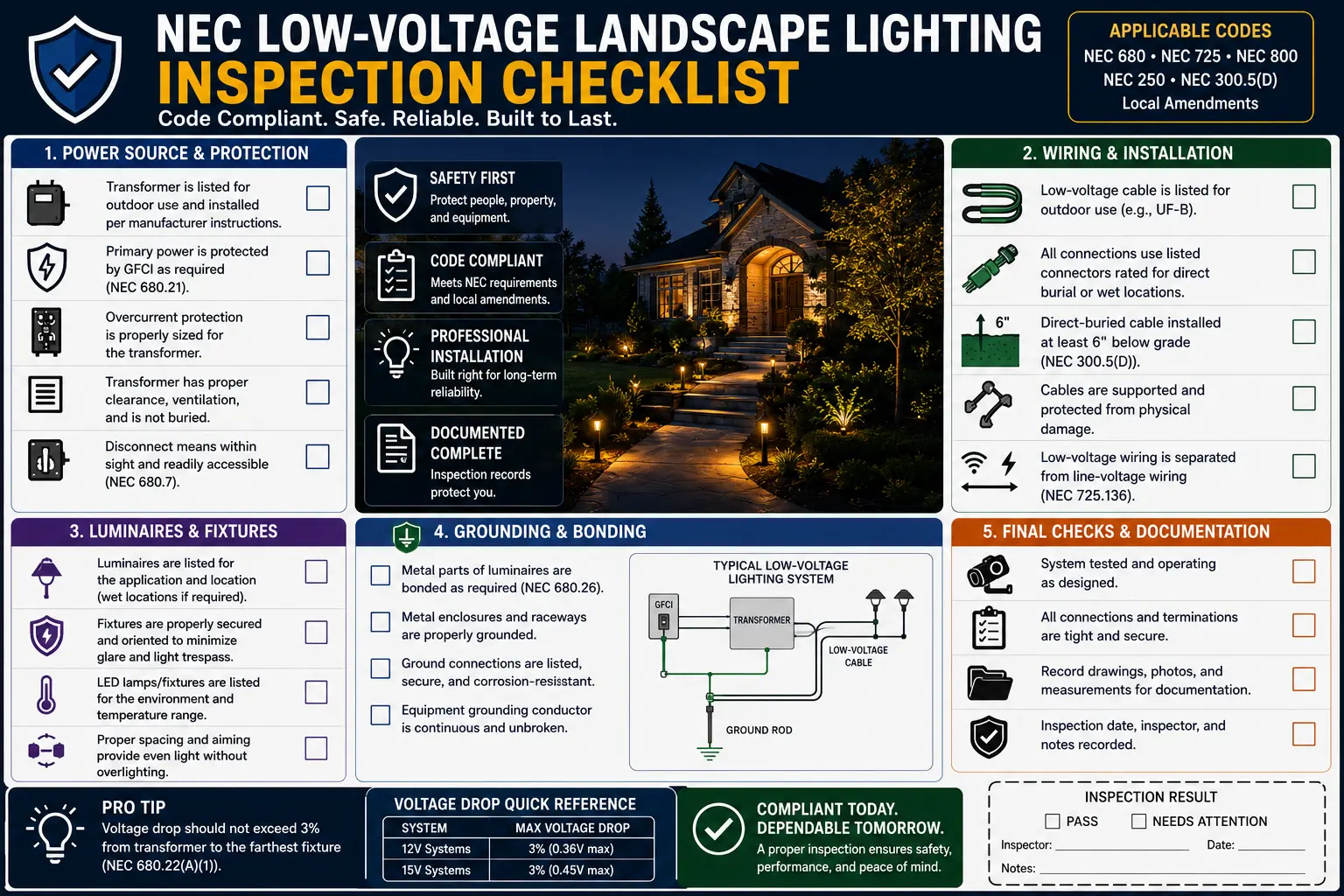
Checklists are most effective when paired with tools that help verify the underlying decisions behind each inspection item. The landscape lighting NEC compliance calculator allows users to work through questions involving transformer loads, cable protection, wet-location concerns, permitting considerations, and documentation requirements before requesting final approval. Think of it as a pre-inspection confidence check designed to uncover problems while they are still easy to correct.
Complete Pre-Inspection Checklist: Organized by Inspector Sequence
Use this checklist before requesting a rough-in or final inspection for any landscape lighting installation subject to AHJ review. Items are organized in the sequence a typical inspector follows — primary supply first, then transformer, then secondary wiring, then fixtures, then special locations.
The single most effective pre-inspection step is the probe test at multiple points along every wire run. An inspector with a thin metal rod will probe the run at 10–15 foot intervals and measure depth to the cable. A run that's buried correctly near the transformer but at 2 inches near a fixture — where the installer "tuck and cover" the cable under existing mulch — fails. The remedy before inspection is exposing, deepening, and reburying every section that measures less than 6 inches below soil grade. Checking your own installation with a probe before the inspector does is the only way to be confident about burial depth across the entire run.
Even the best inspection checklist depends on the decisions made before the first fixture is installed. The NEC landscape lighting code calculator helps users work through transformer sizing, cable protection, environmental exposure, voltage considerations, and documentation questions before requesting approval. Think of it as a compliance planning tool that supports the inspection process from the very beginning.
Turn the Checklist Into a Permit-Ready Record
A low-voltage lighting inspection checklist becomes much stronger when it connects every checked item to a permit file, as-built drawing, product standard, and correction history. Use the permit-ready as-built lighting diagram guide to document where fixtures, transformers, cable runs, splices, and controls were actually installed. If the project includes solar fixtures, verify component expectations with the UL 8750 solar lighting performance standards page. For broader approval planning, review the state-by-state landscape lighting permit guide, then cross-check the installation against the landscape lighting code violation list and the inspection failure database before calling the job complete.
A low-voltage checklist is strongest when it mirrors how an inspector actually moves through the system in the field. After reviewing transformer output, burial depth, splice ratings, fixture listings, voltage drop, and documentation photos, compare your notes against the electrical inspector checklist for landscape lighting so the project is not only functional, but easier to approve, document, repair, and defend during future inspections or property transfers.
Use Failure Codes and Correction Notices to Close the Inspection Loop
A checklist prevents missed items, but inspection approval often depends on how clearly you document defects and corrections. When a problem is found, assign it a category from the low-voltage lighting inspection failure codes so the issue is not described vaguely as “bad wiring” or “needs work.” If the inspector issues a stop-work or unsafe-condition notice, review the landscape lighting red tag correction guide. If the notice is a standard correction, use the inspector correction notice explanation to build the photo and repair record. Before requesting final approval, complete the outdoor lighting final approval checklist and avoid resubmittal mistakes covered in the landscape lighting permit rejection guide.
NEC Low-Voltage Landscape Lighting Inspection FAQ
Does my residential landscape lighting need an electrical permit and inspection?
This varies by jurisdiction. Many municipalities exempt low-voltage landscape lighting from permit requirements for standard residential installations — the reasoning is that the low voltage creates minimal hazard and the systems are self-contained listed products. However, some jurisdictions (particularly in California, certain counties, and some municipalities with aggressive residential permit requirements) require permits for any new outdoor electrical installation including low-voltage landscape lighting. Permits are more likely to be required when the landscape lighting installation involves trenching near existing utilities, installation on commercial property, connection to a new dedicated circuit, or installation as part of a larger permitted project. Contact your local building department or AHJ before starting a significant landscape lighting installation. The permit requirements guide covers the permit framework by installation type and provides guidance on when permits are typically required.
Can I use 14/2 Romex (NM-B) cable for low-voltage landscape lighting burial?
No. Standard 14/2 NM-B (Romex) cable has PVC insulation and jacket rated for indoor dry locations only — it is not rated for direct soil burial. Burying NM-B in soil causes the jacket to absorb moisture over time, degrading the insulation and eventually exposing the conductors to soil contact. This creates both a safety hazard and a code violation regardless of the low voltage involved — the cable type is wrong for the installation environment. Use only cable marked "Direct Burial" for any underground landscape wiring. Standard 12/2 or 16/2 low-voltage landscape cable sold specifically for this application is rated for direct burial and marked accordingly. Standard outdoor-rated extension cord cable (SJTW type) is also not rated for direct burial. See the wire burial depth code guide and the landscape lighting wiring guide for the complete conductor selection and installation framework.
My landscape transformer label has faded and I can't read the UL listing. What should I do before inspection?
Three options for documenting the listing when the physical label is no longer legible: (1) Locate the model number from another location on the transformer — often stamped into the housing bottom, on the inside of the access cover, or on the wire connection block. Search the model number in UL's Product iQ database at iq.ul.com to confirm the listing and download the listing documentation. (2) Contact the manufacturer directly with the model number and request a letter confirming the listing status — most major manufacturers (Portfolio, Hampton Bay, Malibu) will provide this. (3) If neither approach produces documentation, replace the transformer with a new listed unit. The listing mark on the physical product is the inspector's primary evidence of compliance, and an unreadable label creates the same problem as no label for inspection purposes. Photograph all listing marks at installation to avoid this problem in the future. See the Portfolio model number lookup for identifying specific Portfolio transformer models.
We have a 300W transformer powering a large landscape installation. Is there a limit to how many fixtures we can connect?
Yes — multiple limits apply simultaneously. The NEC 411 limit is 25 amperes maximum on the secondary output (at 12V, this is 300W — your transformer is already at the limit). The practical load limit is 80% of the transformer's rating (240W) to maintain voltage stability and prevent overheating. Beyond these, voltage drop limits the number of fixtures by determining how many fixtures can receive adequate voltage at the end of each wire run. A 300W transformer loading 240W (80%) across a 200-foot wire run at 12V may produce only 10.5V at the farthest fixtures — below the LED's operating threshold. The load calculation guide provides the complete load limit calculation, and the voltage drop guide and voltage drop calculator cover the run-length limits for specific wire gauges and loads.
Related Code, Compliance & Installation Guides
- Electrical Code Safety Guide
- Wire Burial Depth Code Guide
- GFCI Requirements Guide
- NEC 2026 Code Updates
- Arc Fault & GFCI Code
- Junction Box Requirements
- Transformer Mounting Code
- Grounding & Bonding Guide
- Load Calculation & Code
- Splice Connection Code
- Voltage Drop Code Requirements
- Permit Requirements
- Contractor Licensing
- Transformer Disconnect NEC
- Pool Lighting Clearance Code
- Dock & Pier Lighting NEC 555
- NEC 300.5 Burial Depth Calculators
- Wet Location Listing Requirements
- Insurance & Liability Guide
- ADA Outdoor Lighting Rules
- Low-Voltage Wire Connectors
- Voltage Drop Guide
- How to Wire Landscape Lighting
- Electrical Code Overview