
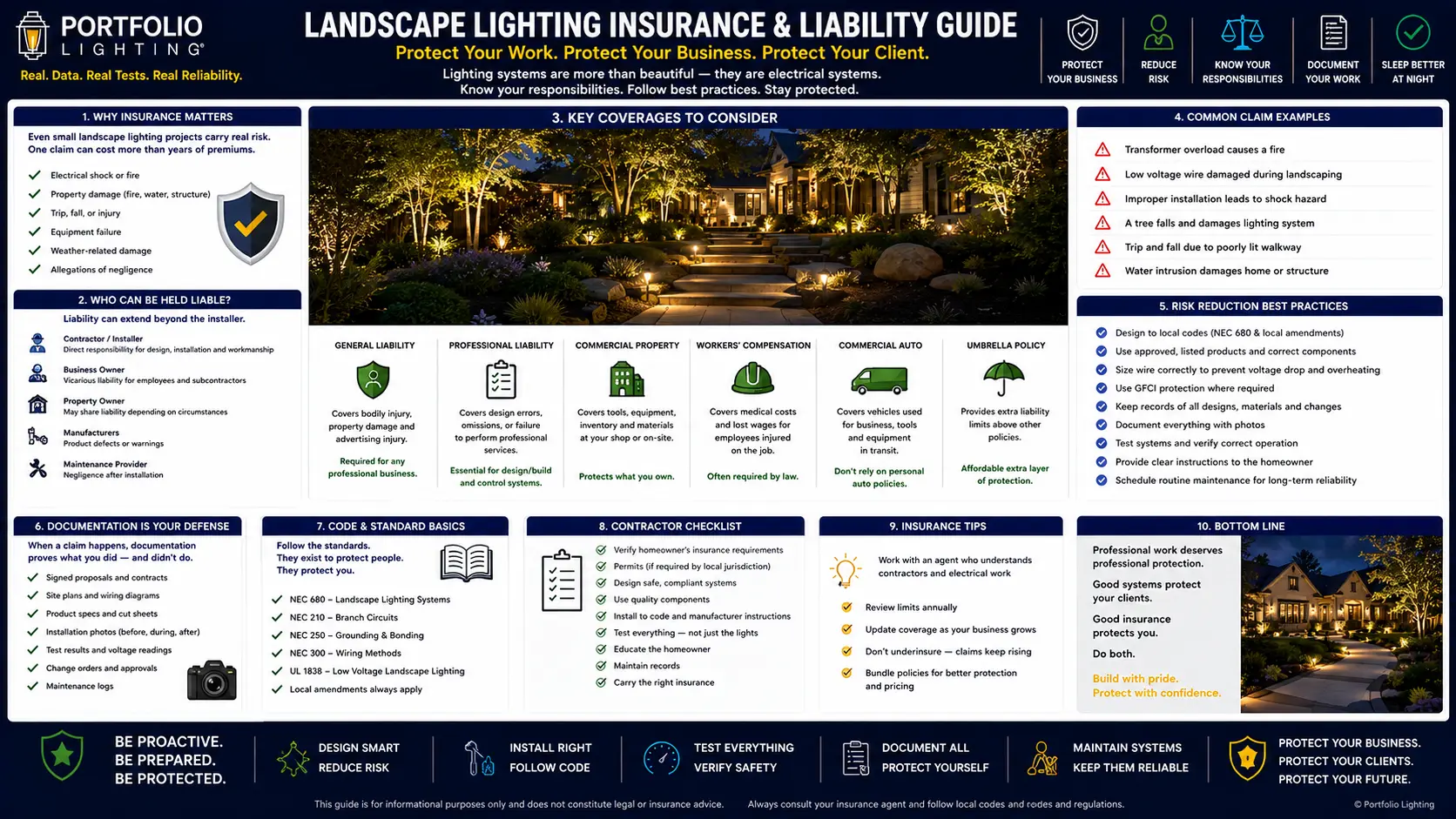
Where the Real Liability in Landscape Lighting Actually Comes From
The liability exposure in landscape lighting is almost never the 12V low-voltage side of the system. The 12V output from a transformer is below the threshold for dangerous shock — you can touch the output wires with your bare hands and feel nothing more than a mild tingle, if that. The real liability lives in three places: the 120V connection to household current, the physical installation of fixtures and wiring in areas where people walk, and the failure to meet code requirements that insurance companies use to evaluate claims.
I've looked at a lot of landscape lighting systems over 25 years. The ones that created real problems for homeowners were not the ones with dead fixtures or voltage drop problems — those are nuisances. The ones that created real problems were the ones where the transformer was plugged into an unprotected outdoor outlet that was never supposed to be unprotected, or where direct-burial wire was run at 2 inches instead of the required depth, or where a fixture housing had cracked and the homeowner didn't notice until water got to the driver and the breaker started tripping. Those are the conditions that create insurance and liability exposure.
Understanding liability in landscape lighting means understanding the distinction between the 12V low-voltage system and the 120V line-voltage system. They are connected — the transformer bridges them — but they carry very different regulatory requirements, different insurance implications, and very different levels of risk.
The 120V Side: Where Code Violations Create Insurance Risk
The 120V circuit supplying your landscape lighting transformer is a standard household electrical circuit. It is subject to the full requirements of the National Electrical Code — GFCI protection, proper receptacle installation, correct wire gauge, appropriate circuit loading. A violation on this side of the system is a real electrical code violation with real insurance implications. If your transformer is plugged into an unprotected outdoor outlet and a fault causes a fire, the insurance company will ask whether that outlet was code-compliant. If it wasn't, that violation becomes relevant to the claim.
The 12V Side: Where Physical Hazards Create Premises Liability
The 12V low-voltage side of the system — the wire runs, fixture connections, and the distribution network from transformer to fixture — carries minimal electrical shock risk. But it carries real physical hazard risk. A landscape fixture that is installed at tripping height instead of flush with the ground. Wire that runs across a walking path instead of under it. A fixture housing that has cracked and left a sharp edge at ankle height in a dark yard. These are premises liability risks — not electrical code risks — and they are the ones that homeowners most commonly overlook because they are focused on whether the lights work, not whether they are safe to be around.
The call I've gotten more than once over the years goes like this: the lights work fine, always have, but a guest tripped over a fixture during a party and twisted their ankle. Now the homeowner wants to know if their installation was done right. More often than not, the fixture was installed correctly from an electrical standpoint — but it was positioned in a spot that gets foot traffic after dark, and nobody thought about it that way when the system went in. The electrical inspection and the safety inspection are two different things, and you need to pass both.
NEC 2026 Code Requirements That Directly Affect Liability
The National Electrical Code is updated every three years. NEC 2026 is the current edition, though individual states and municipalities adopt it on their own schedules — some jurisdictions are still on NEC 2020 or earlier. The specific articles that govern landscape lighting create liability exposure when they are not met, because a code violation at the time of a loss gives an insurance company grounds to investigate whether the violation contributed to the loss.
Article 210.8 — GFCI Protection for Outdoor Receptacles
This is the most commonly violated code requirement in landscape lighting installations. NEC 2026 Article 210.8 requires GFCI protection for all 120V, 15- and 20-ampere receptacles installed in outdoor locations. This means the outlet your landscape lighting transformer is plugged into must be GFCI protected — either a GFCI outlet at the location, or a GFCI breaker protecting the circuit upstream.
Many older homes have outdoor outlets that were installed before this requirement existed or before it was enforced. If your transformer is plugged into one of those unprotected outlets, you are operating a code-non-compliant installation. That matters most if a fault on the 120V side of the transformer causes a fire or injury — the absence of GFCI protection will be identified in any post-incident investigation.
Article 300.5 — Underground Cable Burial Depth
If any part of your landscape lighting installation involves direct-burial wire, NEC 2026 Article 300.5 specifies minimum burial depths. For low-voltage (Class 2) landscape lighting wire, the NEC requires a minimum burial depth of 6 inches. For standard 120V residential wiring buried in conduit, the depth is 12 inches minimum. For 120V wiring without conduit, it is 24 inches.
Wire buried too shallow can be damaged by lawn aeration, landscaping work, or frost heaving. A damaged wire on the 120V side of the system creates a real shock and fire hazard. On the 12V side, shallow burial is primarily a physical damage risk rather than an electrical safety risk — but the resulting repair costs still fall on whoever installed it incorrectly. See our landscape lighting wiring guide for proper burial depth practices by wire type.
Article 410 — Luminaire Requirements
NEC Article 410 governs luminaire (fixture) installation requirements. For outdoor landscape lighting, the most relevant requirements are: fixtures must be listed (UL or equivalent) for the location type (wet location, damp location), fixtures must be installed according to their listing, and fixtures must be protected from physical damage when installed in areas subject to contact.
A fixture rated for damp locations installed in a wet location — such as a path light positioned where sprinkler overspray regularly reaches it — does not meet Article 410's requirements. Over time, moisture ingress will degrade the driver and socket. If that degradation leads to a fault, the improper fixture rating becomes part of the installation record. See our IP rating comparison guide for how to match fixture protection ratings to installation locations correctly.
NEC Class 2 Wiring — Low-Voltage System Requirements
Low-voltage landscape lighting systems operate as NEC Class 2 circuits. Class 2 classification means the system operates at 30V or less and the power source (transformer) limits output to safe levels. Class 2 status significantly reduces the regulatory burden — Class 2 wiring does not require conduit, does not require permit in most jurisdictions, and does not require licensed electrician installation. However, the transformer that creates the Class 2 output must be a listed transformer, and it must be connected to the 120V side correctly. The Class 2 status of the low-voltage wiring does not extend to the 120V side of the transformer.
Many outdoor lighting liability issues begin with overloaded transformers, improper wire sizing, or undocumented electrical modifications instead of obvious installation mistakes. The landscape lighting load calculation and compliance guide explains how proper load balancing, NEC low-voltage planning, voltage-drop control, and transformer headroom reduce long-term overheating risks and improve overall electrical system reliability.
Homeowner Insurance Exposure: What Landscape Lighting Actually Affects
Homeowner's insurance has two components that landscape lighting touches: property coverage (damage to your home and property from a covered peril) and liability coverage (injury to guests or damage to others' property). Understanding how each interacts with your landscape lighting installation tells you exactly where the risk lies.
Property Coverage: When Electrical Faults Are and Aren't Covered
Standard homeowner's policies cover fire damage caused by electrical faults — but with an important qualification: the electrical system must have been in compliance with applicable codes at the time of the loss. If a fire starts because a transformer was connected to a non-GFCI-protected outdoor outlet and an inspector determines the outlet was code non-compliant, the insurance company has grounds to investigate whether the code violation contributed to the loss.
In practice, a low-voltage landscape lighting system that develops a fault on the 12V side is extremely unlikely to start a fire — the power levels are simply too low. The risk is on the 120V side: the transformer connection, the outdoor outlet, and the 120V circuit wiring. A properly installed transformer on a properly protected circuit with correct wire gauge and proper mounting presents minimal property coverage risk. The coverage risk rises when any of those elements are out of compliance.
Liability Coverage: Premises Liability for Guest Injuries
Premises liability is the component of homeowner's insurance that covers injury to guests on your property. Landscape lighting creates premises liability exposure in several specific ways:
- Trip hazards: Fixtures mounted above grade in walking areas, wire runs crossing paths, fixture stakes that have heaved upward over winter — all create physical tripping hazards that a homeowner has a duty to address once they know or should have known about them.
- Inadequate path illumination: A landscape lighting system that leaves walking paths in shadow rather than illuminating them can create liability if a guest falls in a dark area that your lighting system was presumably installed to illuminate.
- Shock hazard from damaged fixtures: A fixture with a cracked housing that admits moisture to the electrical components can create a contact shock hazard. On the 12V low-voltage side, this is extremely unlikely to cause serious injury — but on a 120V line-voltage fixture, it is a real hazard.
- Pool area lighting requirements: Lighting installed near swimming pools is subject to additional NEC requirements — Articles 680.22 and 680.23 — and creates elevated liability exposure if those requirements are not met.
Contractor Liability: Coverage Gaps That Cost Installers
Landscape lighting contractors face a different liability profile than homeowners. The contractor's liability extends beyond the installation date — a defective installation can create liability years after the job is complete. Understanding where that exposure lives, and what insurance actually covers versus what it doesn't, is the difference between a business that survives a claim and one that doesn't.
General Liability Insurance: What It Covers and What It Doesn't
General liability insurance is the foundation of contractor coverage. A standard GL policy for a landscape lighting contractor covers bodily injury to third parties during operations, property damage to the client's property during installation, and completed operations liability — meaning claims that arise after the job is done because of something that was done incorrectly during installation.
What GL insurance does not cover by default: damage to the work itself (a fixture you installed that fails is not covered under GL — that is a warranty issue), professional errors in system design (that requires separate professional liability coverage), and employee injuries (that requires workers compensation). Some GL policies specifically exclude electrical work or require a licensed electrician endorsement for any work involving the 120V supply — contractors should verify their policy covers the 120V transformer connection specifically.
The Completed Operations Gap
Completed operations coverage — the portion of GL insurance that applies after a job is finished — often has time limits, and those limits vary by policy. A landscape lighting installation that develops a fault three years after completion may or may not be covered under the contractor's policy depending on when the claim is made versus when the policy was in force. Contractors should specifically verify that their completed operations tail coverage is adequate for the lifespan of the installations they perform.
Licensing Requirements and Liability
In most jurisdictions, installation of the 12V low-voltage landscape lighting system does not require an electrical license — it is classified as Class 2 low-voltage work that homeowners and unlicensed contractors can legally perform. However, the 120V transformer connection — the hardwired or plug-in connection between the transformer and the household electrical system — is where licensing requirements vary significantly by state and municipality.
A contractor who connects a transformer to a hardwired 120V circuit without a license in a jurisdiction that requires one has performed unlicensed electrical work. If that connection later fails and causes damage, the contractor faces liability for both the damage and the unlicensed work. Many insurance policies exclude coverage for work performed in violation of applicable licensing requirements. See our electrical code safety guide for jurisdiction-specific licensing considerations.
Hiring the right person can reduce liability when outdoor lighting affects walkways, entrances, commercial access, or shared property areas. The licensed landscape lighting contractor requirements guide explains what to verify before work begins.
Permit Requirements: When You Need One and When You Don't
The permit question for landscape lighting is one of the most frequently misunderstood aspects of residential outdoor electrical work. The short answer is that most low-voltage landscape lighting does not require a permit — but the conditions that trigger a permit requirement are more common than most homeowners and contractors realize.
Low-Voltage (12V) Systems: Generally No Permit Required
A plug-in low-voltage landscape lighting system — where the transformer plugs into an existing outdoor outlet and the 12V wire runs power the fixtures — almost universally does not require a permit. The NEC's Class 2 classification for low-voltage wiring was specifically designed to allow this type of installation without the regulatory overhead of a full electrical permit. The system operates at safe voltage levels, and the transformer limits current to safe levels even in fault conditions.
This is why landscape lighting is accessible to homeowners as a DIY project. A standard landscape lighting installation involving a plug-in transformer, low-voltage wire runs, and fixture connections is legally permissible for a homeowner to perform without a permit in virtually every US jurisdiction.
When a Permit IS Required
Several common landscape lighting scenarios trigger permit requirements that catch homeowners and contractors off guard:
- Adding a new outdoor outlet for the transformer: If the existing outdoor outlet is insufficient or inconveniently located and you want to add a new one, that new outlet installation requires a permit in virtually every jurisdiction — it is 120V electrical work involving a new circuit or outlet.
- Hardwired transformer installation: Some transformers are designed to be hardwired directly to the 120V circuit rather than plugged in. Hardwiring a transformer to household current is an electrical modification that requires a permit in most jurisdictions.
- 120V line-voltage outdoor lighting: Any outdoor lighting that operates at 120V — floodlights, security lights, post lights — always requires a permit because these are standard electrical fixtures subject to full NEC inspection.
- New circuit installation: Adding a dedicated circuit for landscape lighting requires a permit regardless of whether the end use is low-voltage or line-voltage.
- Pool and water feature lighting: Lighting installed near pools, fountains, or water features is subject to additional NEC Articles and always requires a permit and inspection.
Landscape Lighting Liability Risk Table: Every Common Scenario Assessed
This table maps the most common landscape lighting installation scenarios to their actual liability risk profile — insurance implications, permit status, and the specific conditions that elevate or reduce risk. Use this as a quick reference for your specific situation.
Many outdoor lighting liability problems begin with improper voltage management long before a visible failure occurs. Our detailed landscape lighting voltage-drop code and NEC requirements guide explains how overloaded transformer taps, undersized conductors, excessive run lengths, and improper load balancing can create overheating, LED driver stress, unstable nighttime operation, and long-term electrical reliability issues that may increase maintenance and insurance exposure over time.
| Installation Scenario | Permit Required? | Liability Risk | Key Risk Factors and Notes |
|---|---|---|---|
| Plug-in 12V transformer on existing GFCI outlet, low-voltage wire and fixtures | No (in most jurisdictions) | Low | Lowest risk scenario. GFCI outlet is key — if outlet is not GFCI protected, risk moves to Medium. Fixtures must be rated for outdoor wet/damp location as appropriate. |
| Plug-in 12V transformer on existing NON-GFCI outdoor outlet | No (transformer) / Yes (outlet upgrade) | Medium | Non-GFCI outdoor outlet is a code violation under NEC 210.8. If a fault occurs, the violation is part of the record. Insurance company may investigate. Upgrade the outlet before connecting the transformer. |
| Hardwired 12V transformer connected directly to household circuit | Yes (in most jurisdictions) | Medium | Hardwired transformer connection is an electrical modification requiring permit and inspection in most areas. If performed without permit, creates code violation. If performed by unlicensed person in a jurisdiction requiring license, creates contractor liability exposure. |
| New outdoor outlet installed for transformer | Yes | Medium | New outlet installation is standard electrical work requiring permit and licensed electrician in most jurisdictions. If done correctly with permit and GFCI protection, reduces ongoing liability. If done without permit, creates violation on record. |
| 120V line-voltage outdoor fixtures (floodlights, post lights) | Yes | High | Full NEC compliance required. GFCI protection required. Licensed electrician required in most jurisdictions. Any deviation from code creates significant liability. Always permitted and inspected. |
| Lighting near swimming pool or water feature | Yes | High | NEC Articles 680.22 and 680.23 apply. Specific distance requirements, GFCI requirements, and fixture listing requirements. Always requires permit and inspection. Highest liability exposure of any residential landscape lighting scenario. |
| DIY fixture installation in pedestrian areas without proper mounting | No (fixtures) | Medium | Premises liability risk independent of electrical code. Fixtures above grade in walking areas, exposed wire runs across paths, and unstable stake mounting all create trip hazard liability. Regular inspection and maintenance is the mitigation. |
| Contractor installation, 12V only, plug-in transformer, licensed contractor | No (in most jurisdictions) | Low | Lowest contractor liability scenario. Contractor's completed operations coverage should extend to the system lifespan. Keep records of installation date, transformer model, and fixture locations. |
| Contractor installation including 120V work, without required license | Yes | High | Unlicensed electrical work in a jurisdiction requiring license creates: contractor liability for the work, potential policy exclusion for the claim, and personal liability exposure for the individual performing the work. Never perform 120V work outside your license scope. |
| Smart landscape lighting with app control, low-voltage system | No (in most jurisdictions) | Low | Smart low-voltage systems carry the same code requirements as standard low-voltage systems. The smart controller does not change permit or GFCI requirements. The 120V transformer connection requirements remain identical. |
What Actually Voids Homeowner's Insurance — and What Doesn't
There is a lot of misinformation about what "voids" homeowner's insurance in the context of DIY electrical work. The reality is more nuanced — and understanding it precisely tells you exactly what you need to do to protect your coverage.
What Does NOT Void Your Insurance
Installing a plug-in low-voltage landscape lighting system yourself does not void your homeowner's insurance. Performing routine maintenance on your landscape lighting — replacing fixtures, replacing transformers, adding fixtures to an existing system — does not void your insurance. The act of DIY installation on Class 2 low-voltage systems is legally permissible and does not affect your coverage status.
What DOES Create Coverage Risk
The conditions that create coverage risk are not the act of DIY installation — they are code violations that exist at the time of a loss. Specifically:
- Non-GFCI outdoor outlet: If your transformer is connected to a non-GFCI outdoor outlet and a fault causes a fire, the insurance company will identify the code violation. They may argue the violation contributed to the loss and reduce or deny the claim accordingly.
- Unpermitted work where a permit was required: If you hardwired a transformer without a permit in a jurisdiction where a permit was required, that unpermitted modification to your electrical system is on record. If it is identified as a contributing factor in a loss, it affects coverage.
- Fixtures used outside their rating: Installing a damp-location fixture in a wet location, or using indoor fixtures outdoors, creates a documented code violation. A wet-location rated fixture in a wet location is code-compliant; a damp-location fixture in the same spot is not.
- Wire burial depth violations: Direct-burial wire installed too shallow — and subsequently damaged — that causes a fault is a code violation that affects coverage analysis.
The Practical Takeaway
You do not need a licensed electrician to install a low-voltage landscape lighting system. You do need the outdoor outlet to be GFCI protected. You do need fixtures rated for their actual installation location. You do need wire buried to the correct depth. And if you are doing any 120V work — adding outlets, hardwiring transformers — you need to check whether your jurisdiction requires a permit and follow that requirement. Those four things eliminate the vast majority of coverage risk in a residential landscape lighting installation.
For a deep dive into transformer diagnostics and maintenance that keeps your system in compliant working condition, see our transformer troubleshooting guide and landscape lighting maintenance guide.
Specific Failure Modes and Their Liability Implications
Certain landscape lighting failure modes create more liability exposure than others. Understanding which failures matter most — and why — helps prioritize maintenance and inspection activities. These are failure patterns I have seen create real problems for homeowners over 25 years of field work.
GFCI Trips That Keep Resetting
A GFCI outlet that keeps tripping on a landscape lighting circuit is not just an annoyance — it is a code protection device signaling that there is a ground fault somewhere in the system. The correct response is to locate and correct the fault. The wrong response — and the one that creates liability — is to replace the GFCI with a non-GFCI outlet to stop the tripping. That substitution removes the code-required protection and creates a code violation at the most vulnerable point in the circuit.
Corroded Wire Connections
Corroded wire splice connections in low-voltage landscape lighting create resistance, heat, and eventually intermittent failures. On the 12V low-voltage side, this is unlikely to create a fire — the power levels are too low. But corroded connections that cause a system to fail to illuminate path lighting create a premises liability condition: a dark walking area that guests reasonably expect to be lit. Regular inspection and replacement of degraded connectors is both a maintenance best practice and a liability management practice.
Moisture Ingress in Fixture Drivers
A landscape fixture with a degraded IP seal admitting moisture to the LED driver board will eventually fail in one of several ways — increased current draw, intermittent operation, or complete failure. On a properly rated fixture in a correct installation, IP seal degradation is a normal end-of-life event. On a mismatched fixture — damp-rated in a wet location — it is a code compliance failure. In both cases, a driver drawing excess current through degraded insulation can trip the transformer breaker and cause the entire system to go dark, potentially leaving path lighting unlit.
Transformer Overloading
A transformer operating above its wattage rating runs hot, may produce reduced output voltage, and can eventually fail its internal protection device. Overloading typically occurs when fixtures are added to an existing system without accounting for total wattage. The transformer's rated capacity should never be exceeded — most manufacturers recommend operating at no more than 80% of rated capacity to account for voltage drop and future additions. An overloaded transformer that fails and damages connected equipment creates a warranty and potentially a liability question about whether the installation was performed to specification.
On larger LED installations, documenting safety listings alone may not capture every foreseeable system-performance risk. Driver THD, power factor, inrush current, dimmer compatibility, generator compatibility, and manufacturer test data can become important when repeated failures or overheating affect a property. The LED driver harmonic distortion compliance standards guide provides a practical documentation framework for comparing product claims with measured field performance.
Installation Compliance Checklist: Eliminate Liability Before It Starts
This checklist covers every element of a low-voltage landscape lighting installation that affects code compliance, insurance coverage, and premises liability. Work through it before, during, and after installation. Every item checked is a liability risk eliminated.
Before Installation Begins
- Verify the outdoor outlet supplying the transformer is GFCI protected. If not, have it upgraded before proceeding.
- Confirm the outdoor outlet is on a circuit with adequate capacity for the transformer's rated load.
- Check with your local building department whether your specific installation requires a permit. Do this before starting — not after.
- Verify your planned fixtures are rated for their actual installation location — wet location for areas subject to direct water contact, damp location for areas subject to condensation and indirect moisture only.
- Calculate total fixture wattage and confirm it does not exceed 80% of the transformer's rated capacity. Use our wiring guide's load calculation section for this.
- Plan wire run routes to avoid pedestrian pathways where possible. Where unavoidable, plan for appropriate burial depth — minimum 6 inches for low-voltage Class 2 wire.
During Installation
- Mount the transformer at least 12 inches above grade to reduce moisture exposure to the 120V connection point.
- Bury all direct-burial wire at minimum 6 inches depth. Mark wire locations for future reference and to prevent damage during landscaping work.
- Use waterproof wire connectors rated for direct burial at all splice points. Push-in connectors that do not seal the wire ends are not appropriate for direct burial — they admit moisture and corrode.
- Install fixtures flush with or slightly below grade in any area subject to foot traffic. A fixture that sticks up above grade in a walking area is a trip hazard regardless of how well it is electrically connected.
- Test the GFCI protection by pressing the test button on the outlet after installation — confirm the system shuts off and resets correctly.
- Measure voltage at the most distant fixture on each zone and confirm it is within the fixture's operating range — typically 10.8V minimum for most 12V LED fixtures.
After Installation — Ongoing
- Inspect all fixture housings annually for cracks, UV degradation, or physical damage that could compromise the IP rating.
- Walk the system after each winter to identify any fixtures or wire runs that have heaved upward due to frost — reset or repair before the system is used seasonally.
- Test GFCI protection annually — GFCI mechanisms can fail, and a failed GFCI that no longer trips provides no protection while appearing functional.
- Keep records of transformer model, installation date, total system wattage, fixture locations, and any maintenance performed. These records are valuable if a claim is ever made.
- Replace any fixture showing visible corrosion, cracked housing, or flickering behavior before it creates a fault condition. See our troubleshooting guide for systematic fault diagnosis.
Homeowner vs Contractor: Side-by-Side Liability Comparison
The liability profile for a homeowner doing their own installation and a contractor doing the same work are meaningfully different. This table maps the key differences so both parties understand exactly where their exposure lies.
| Liability Dimension | Homeowner (DIY) | Licensed Contractor |
|---|---|---|
| 12V low-voltage installation | Legally permissible in all US jurisdictions. No license required. No permit required in most areas. | Same as homeowner for low-voltage work. Class 2 classification removes licensing requirements regardless of who performs the work. |
| 120V transformer connection (plug-in) | Homeowner may plug transformer into existing outlet. GFCI requirement applies to the outlet — homeowner's responsibility to verify. | Contractor may plug transformer into existing outlet. Contractor should document outlet GFCI status at time of installation for liability protection. |
| 120V hardwired transformer connection | Permit required in most jurisdictions. Licensed electrician required in most jurisdictions. DIY hardwiring creates code violation risk. | License required in most jurisdictions. Permit required. If contractor is not licensed for electrical work, must subcontract this element. Performing this work without license creates major liability exposure. |
| Premises liability for guest injuries | Homeowner is liable under premises liability law. Homeowner's insurance provides coverage if installation was code-compliant. Code violations reduce coverage. | Contractor has completed operations liability through GL policy. Contractor's liability for post-installation injuries depends on whether the injury was caused by a defect in the contractor's work. |
| Insurance coverage for fire damage | Homeowner's property insurance covers electrical fire if installation was code-compliant. Code violations — especially non-GFCI outlet — create investigation and potential coverage reduction. | Contractor's GL covers damage to client property caused by contractor's operations. Completed operations coverage extends after job completion. Policy must specifically cover electrical work. |
| Record-keeping requirements | No legal requirement, but keeping records of transformer model, installation date, and fixture locations is strongly recommended for any future claim or sale of the property. | Contractor should maintain job records including installation date, transformer specs, total wattage, fixture locations, and any permits pulled. These records are essential to defending completed operations claims. |
| Ongoing maintenance responsibility | Homeowner is responsible for ongoing maintenance and must address known hazards. Failure to address a known fixture defect after becoming aware of it increases liability exposure. | Ongoing maintenance responsibility ends with the warranty period unless the contractor also holds a maintenance contract. Clear written scope of work protects contractor from liability for post-warranty failures. |
Related Outdoor Lighting Risk and Compliance Guides To Assist In Your Research
Insurance and liability questions often begin with whether the correct equipment was used for the installation environment. This wet-location lighting listing guide explains why fixture ratings matter when lights are exposed to rain, splash, soil moisture, or poolside conditions.
Transformer access can become a liability concern if a system cannot be shut down safely during service or inspection. This landscape transformer disconnect requirements guide explains why safe service isolation matters.
Pool-area lighting carries higher risk because electrical clearance rules are stricter near water. This swimming pool lighting NEC 680 guide explains why pool lighting clearance should be documented carefully.
Water features create another liability layer because submerged lighting requires special protection. This submersible fountain lighting code guide explains why underwater fixtures should never be treated like ordinary outdoor lights.
Pathway lighting can also affect liability when poor visibility, glare, or dark spots contribute to trips or falls. This ADA pathway lighting compliance guide explains how outdoor lighting can support safer access.
Many hidden failures begin at outdoor splices that were never properly sealed. This landscape lighting splice requirements guide explains why connection quality matters for long-term safety and reliability.
Related Guides and Resources
- Landscape Lighting Electrical Code Safety Guide
- NEC 2026 GFCI Requirements for Outdoor Lighting
- How to Wire Landscape Lighting
- Portfolio Lighting Installation Guide
- Low Voltage System Diagram
- Transformer Troubleshooting Guide
- How to Test a Landscape Lighting Transformer
- Landscape Lighting Maintenance Guide
- Landscape Lighting Troubleshooting
- Portfolio Lighting Troubleshooting Hub
- IP Rating Comparison Guide
- LED Lifespan L70 Database
- Low Voltage Wire Connectors Guide
- Low Voltage Plug and Connector Guide
- Landscape Lighting Voltage Drop Guide
- Wire Gauge and Ampacity Database
- Landscape Lights Not Working — Diagnostic Guide
- Commercial-Grade Lighting: Safety and ROI
- Complete Landscape Lighting Guide
Landscape Lighting Insurance and Liability — FAQ
Does landscape lighting installation require a permit?
Low-voltage landscape lighting (12V plug-in systems) typically does not require a permit in most US jurisdictions — the NEC classifies these as Class 2 circuits that do not require licensed electrician installation or permit. However, the 120V transformer connection to household current may require a permit or licensed electrician depending on your local jurisdiction. Any 120V line-voltage outdoor lighting always requires a permit. Check with your local building department before starting any installation — requirements vary significantly by municipality.
Does a DIY landscape lighting installation void homeowner's insurance?
A low-voltage 12V DIY landscape lighting installation does not void homeowner's insurance. What creates coverage risk is not the act of DIY installation — it is code violations that exist at the time of a loss. If your transformer is connected to a non-GFCI outdoor outlet, or if you performed unpermitted 120V work where a permit was required, those violations become relevant if a claim is made. A code-compliant DIY low-voltage installation carries no coverage risk beyond that of a professionally installed system.
What GFCI requirements apply to landscape lighting?
NEC 2026 Article 210.8 requires GFCI protection for all 120V receptacles in outdoor locations. This means the outlet your landscape lighting transformer plugs into must be GFCI protected — either a GFCI outlet at the location or a GFCI breaker protecting the circuit upstream. The 12V low-voltage output side of the system does not require GFCI protection. If your outdoor outlet is not GFCI protected, you are operating a code-non-compliant installation — upgrade the outlet before connecting the transformer.
Can a homeowner be sued if a guest is injured by landscape lighting?
Yes. Premises liability law requires homeowners to maintain their property in a reasonably safe condition for guests. Injuries from tripping over a fixture, a shock from a damaged outdoor fixture, or a fall in an area your landscape lighting leaves dark can all create premises liability claims. The strongest protection is a code-compliant installation with no physical hazards and regular maintenance. A homeowner who can demonstrate a professionally installed, inspected, and maintained system is in a far stronger defensive position than one who cannot.
What insurance does a landscape lighting contractor need?
A landscape lighting contractor needs at minimum: general liability insurance with completed operations coverage, workers compensation for employees, and automobile liability for business vehicles. Contractors performing 120V electrical work should verify their GL policy covers electrical work specifically — some policies exclude it. Contractors who also design systems should carry professional liability (errors and omissions) insurance for design errors. Verify that completed operations tail coverage extends for the expected lifespan of your installations.
Does the senior safety lighting guide matter for liability?
Absolutely. Senior safety lighting design — high contrast, low glare, consistent path illumination — reduces trip hazard liability significantly. Proper path illumination that eliminates shadow pools, fixtures positioned to light foot-level obstacles rather than general ambiance, and consistent lumen levels along walking paths all reduce the conditions that create premises liability. These design choices are liability management, not just aesthetics.