
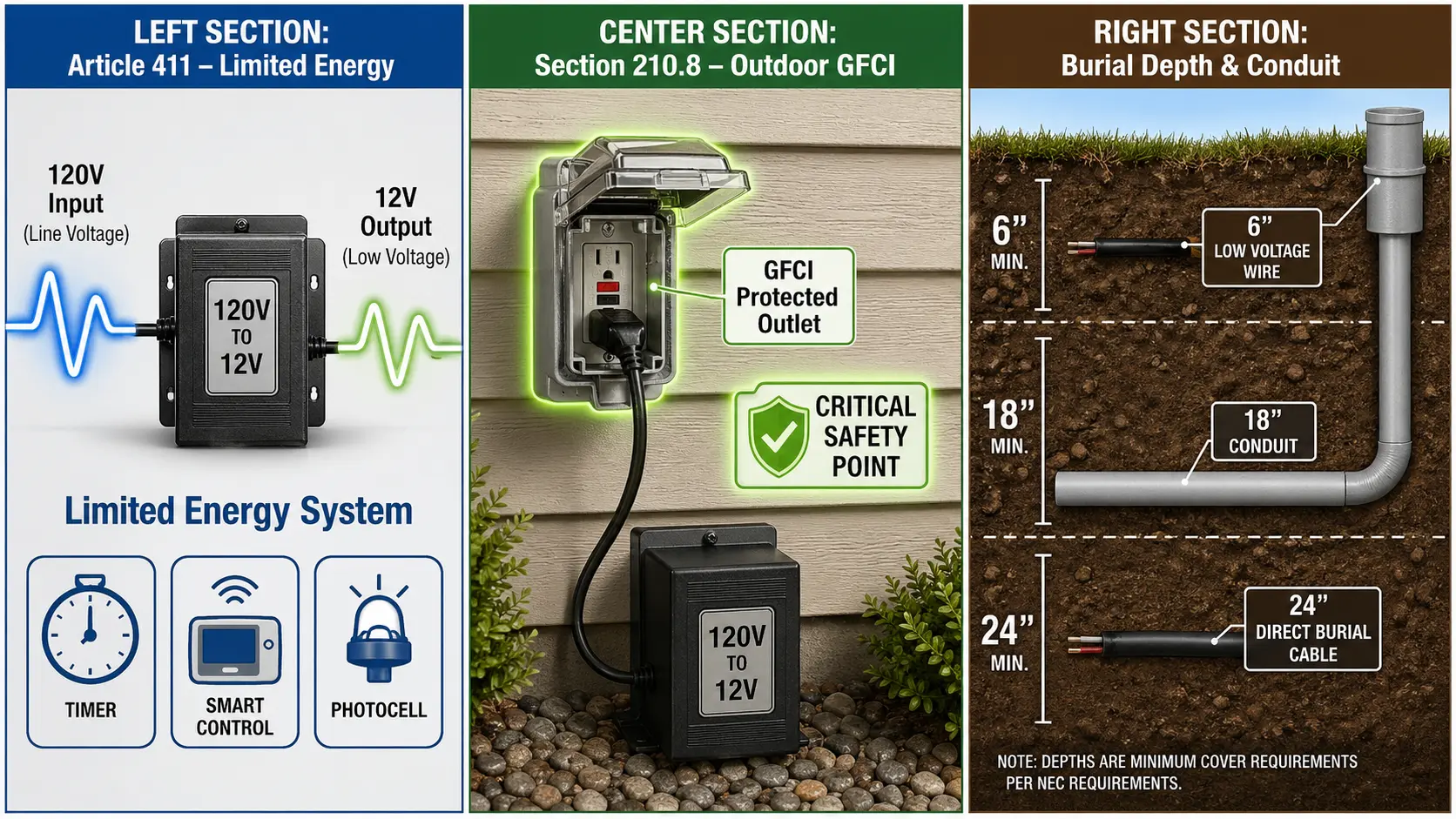
Transition from “Low Voltage” to “Limited Energy” (Article 411)
Homeowners usually say “low voltage” because the transformer steps 120V power down to 12V or 15V. The NEC 2026 conversation is becoming more precise because modern lighting systems may include smart controls, sensors, Wi-Fi bridges, photocells, Class 2-style power supplies, app-based controllers, and power/data combinations.
For landscape lighting, Article 411 remains the key reference area for lighting systems operating at 30 volts or less and their associated equipment. The practical takeaway is simple: the system must be treated as a listed lighting system, not just random wire connected to random lights.
Many smart LED drivers and landscape lighting controllers use Class 2 power supplies. A Class 2 power supply electronically limits available energy, which can allow different wiring methods than standard power circuits, but it does not remove the need for listed equipment, outdoor-rated enclosures, and manufacturer instructions.
General landscape-lighting rules are not the end of the code discussion when water enters the picture. A retaining wall beside an ordinary garden bed may be a straightforward low-voltage installation, while the same wall beside a pool, spa, fountain, or other water feature can require a different safety analysis. Our retaining wall lighting near water guide explains how to identify those situations before applying ordinary landscape-lighting installation rules.
Why limited energy language matters
A basic Portfolio transformer with a timer is one thing. A smart transformer with app control, color-changing modules, remote drivers, and sensors is more complex. The more your lighting system behaves like a smart-control network, the more important it is to verify listing, wiring method, separation from line-voltage conductors, and outdoor equipment ratings.
Plain-English translation
If your system is a standard listed low-voltage lighting kit, keep it installed as a listed kit. If you are mixing transformers, controllers, wire, LED drivers, smart modules, or third-party fixtures, confirm that each part is rated for the voltage, location, load, and control method.
For low-voltage basics, see Portfolio low voltage lighting and the landscape lighting transformer guide.
The NEC is not the only standard that can affect a commercial exterior lighting project. While NEC requirements focus primarily on electrical installation safety, commercial buildings and sites may also face energy-code requirements governing connected exterior lighting power and automatic controls. Our ASHRAE 90.1 exterior lighting requirements guide explains that separate compliance layer, including the 2025 standard's updated exterior lighting power densities, lighting zones, and control requirements.
New Outdoor GFCI Requirements (Section 210.8)
Section 210.8 is one of the biggest NEC areas to understand for outdoor lighting. The important point is that the 12V cable in the yard is usually not where GFCI protection starts. The GFCI question usually begins at the 120V outdoor outlet, receptacle, or hardwired supply point feeding the transformer.
NEC 2026 updates are commonly discussed around broader outdoor outlet protection and a 60-ampere threshold. For most residential landscape lighting, the transformer is far below that threshold. The practical effect is that plug-in transformer outlets should be treated as code-sensitive outdoor power points.
GFCI breaker vs. GFCI receptacle
- GFCI receptacle: protects at the outlet location and is common for outdoor plug-in transformers.
- GFCI breaker: protects the entire branch circuit from the panel and can be useful when the outdoor run has multiple outlets or hard-to-reach locations.
- Dead-front GFCI: may be used where reset access is needed but plug-in access is not.
- Weather-resistant receptacle: outdoor receptacles should be rated for the environment and protected by an in-use cover where cords remain plugged in.
For a deeper GFCI page, use outdoor lighting GFCI requirements NEC 2026. If your lighting trips after rain, use landscape lights not working after rain.
What NEC 2026 Means for Older Portfolio Lighting Systems
Many homeowners still use older Portfolio lighting systems installed years ago. These systems can continue to work reliably, but newer code expectations around GFCI protection, outdoor enclosures, and wiring protection can affect whether your setup would pass a modern inspection.
If NEC 2026 updates make you rethink an older lighting setup, compare your options in the commercial-grade landscape lighting upgrade guide.
Common Issues Found in Older Portfolio Installations
| Older Setup | Modern Code Concern | What To Check |
|---|---|---|
| Transformer plugged into non-GFCI outlet | Outdoor GFCI protection expected | Confirm outlet is GFCI protected and weatherproof |
| Exposed wire above mulch | Physical damage risk | Bury cable or protect with conduit |
| Older halogen fixtures | Heat and efficiency concerns | Upgrade to LED-compatible fixtures if needed |
| Loose or corroded connectors | Water intrusion and failure risk | Replace with waterproof connectors |
| Transformer mounted low or exposed | Weather exposure and clearance issues | Mount above grade and use proper enclosure |
When You Should Upgrade vs Leave It Alone
- Safe to keep: Existing low-voltage systems with no damage and proper operation.
- Upgrade recommended: Systems with exposed wiring, corrosion, or outdated transformers.
- Upgrade required: When adding new wiring, installing new outlets, or hardwiring a transformer.
If you are troubleshooting or updating an older system, start with Portfolio lighting troubleshooting before replacing parts or rewiring.
For transformer setup, wiring, and replacement guidance, see the Portfolio transformer master guide.
What Section 210.8 Means for Portfolio Transformer Outlets
Most Portfolio-style landscape lighting transformers plug into an outdoor receptacle. That receptacle is the first place to check. It should be properly located, weather resistant where required, protected from water intrusion, and GFCI protected according to current local adoption.
Transformer outlet checklist
- Is the receptacle outdoor-rated and weather resistant where required?
- Is it GFCI protected at the receptacle, upstream device, or breaker?
- Is there an extra-duty in-use cover that closes while the transformer is plugged in?
- Is the transformer mounted upright and above mulch, splash zones, and snow buildup?
- Are the low-voltage terminals tight, corrosion-free, and not melted?
- Is the total fixture wattage below the transformer rating with headroom?
If your transformer is failing, visit Portfolio Lighting transformer troubleshooting and Portfolio Lighting transformer replacement.
Meeting the NEC addresses electrical safety, but it does not by itself determine whether an outdoor pedestrian space has good nighttime visibility, controlled glare, appropriate brightness, or responsible light distribution. For that side of the design, see our ANSI/IES RP-43-25 Outdoor Pedestrian Lighting Guide, which explains the IES framework for pedestrian lighting, lighting zones, glare, controls, and environmental considerations.
Burial Depth and Conduit Standards
| Installation Type | Common Minimum Cover Used in the Field | Why It Matters | Best Practice |
|---|---|---|---|
| Listed 12V / 15V landscape lighting cable | Often about 6 inches where the listed system instructions allow it | Protects cable from rakes, mulch movement, light digging, and surface exposure. | Use 6 to 12 inches in homeowner beds, deeper in pet areas or high-traffic zones. |
| Low-voltage cable crossing lawn edges | More protection may be needed than open mulch beds | Edgers, aerators, shovels, and mower wheels can damage shallow wire. | Use conduit sleeves at bed edges and mark the route before landscaping. |
| 120V UF direct burial cable | Commonly discussed around 24 inches depending on wiring method and conditions | Line-voltage wiring creates higher shock and fire risk if damaged. | Use an electrician, follow NEC Table 300.5, and verify local amendments. |
| 120V branch circuit in PVC conduit | Often discussed around 18 inches depending on wiring method and conditions | Conduit protects conductors but still has minimum cover rules. | Use proper Schedule 40/80 protection, burial depth, and expansion considerations. |
| Riser where cable exits ground | Mechanical protection required where exposed to damage | Most cuts happen at the transition from buried wire to fixture or transformer. | Protect with conduit, sleeving, or fixture-specific strain relief. |
| Driveway, sidewalk, or hardscape crossing | Usually requires extra protection and deeper planning | Future repair is difficult once concrete, pavers, or asphalt cover the route. | Install a sleeve or conduit before hardscape work and document both ends. |
For a dedicated burial-depth breakdown, use landscape lighting wire burial depth code. For junction boxes, see outdoor lighting junction box requirements.
If you are unsure whether your project needs local approval, review low voltage lighting permit requirements before trenching or hardwiring equipment.
Many of the newest NEC landscape lighting discussions revolve around safe transformer loading, voltage-drop management, and long-term wiring reliability. The landscape lighting load calculation and code compliance guide explains how real-world load balancing, startup surge behavior, cable sizing, and low-voltage system planning influence whether an installation remains compliant, stable, and electrically safe over time.
Code vs Reality Checklist for Landscape Lighting
- Transformer power: Is the outdoor receptacle GFCI protected and covered by an in-use weatherproof cover?
- Transformer listing: Is the transformer listed for landscape lighting use and installed according to the label?
- Smart controller: Is the hub, bridge, or controller inside a weather-rated enclosure?
- Burial depth: Is the cable buried deep enough for the wiring method and location?
- Transitions: Is cable protected where it leaves the ground near the transformer or fixture?
- Inspection timing: If a permit is required, are trenches left open for rough-in inspection?
- 811 locate: Has the property been marked before digging?
Conduit Standards: Where Landscape Lighting Needs Extra Protection
Low-voltage cable may not always need conduit across a normal landscape bed, but conduit becomes important where the wire is exposed to damage. Inspectors and electricians pay close attention to transitions, risers, driveway crossings, retaining walls, and places where line-voltage conductors are involved.
Use conduit or sleeving when:
- wire exits the ground and rises into a transformer, fixture, wall, or junction box;
- the cable crosses a lawn edge where an edger can cut it;
- the run passes under pavers, concrete, or hardscape;
- pets, rodents, or yard tools can reach the cable;
- line-voltage conductors are present;
- the cable is mounted to a structure rather than buried.
Common Mistakes That Fail Inspections Under NEC 2026 Thinking
Many landscape lighting problems are not caused by the fixture. They are caused by the power source, splices, burial method, or incorrect assumptions about low voltage.
Non-GFCI Outdoor Power
Plug-in transformers connected to unprotected exterior receptacles create the biggest safety red flag.
Wrong Cover Type
A standard flip cover is not the same as an extra-duty in-use cover when a transformer remains plugged in.
Exposed Riser Cable
Wire that leaves the soil and runs exposed to a fixture, wall, or transformer needs mechanical protection.
Wet Splices
Twisted wires under tape or dry-location wire nuts do not belong in wet landscape beds.
Overloaded Transformer
Running close to 100% transformer capacity creates heat, voltage drop, flicker, and premature failure.
No Route Documentation
After mulch or sod covers the cable, future repairs become guesswork without photos or route notes.
Old Rule vs New Rule: What Changed in the 2026 NEC?
| Topic | Older Code Cycle Focus | 2026 NEC Focus | What This Means for Landscape Lighting |
|---|---|---|---|
| Outdoor GFCI | Outdoor receptacles and many outdoor outlets already required closer GFCI attention. | Outdoor outlet protection continues expanding, including more equipment and ampere thresholds. | Transformer receptacles, outdoor equipment connections, and replacement work need careful review. |
| Low Voltage / Limited Energy | Many homeowners thought “12V” meant “no code concerns.” | Limited-energy language better reflects LED drivers, controls, and smart systems. | Use listed transformers, Class 2 supplies where appropriate, and approved wiring methods. |
| Burial Depth | Installers often focused only on getting cable hidden. | Inspectors continue focusing on trench depth, conduit, transitions, and physical protection. | Know whether you are burying 12V cable, 120V conduit, or direct-burial UF cable. |
Related NEC Outdoor Lighting Guides
As outdoor lighting rules evolve, fixture listing remains one of the first details to verify. This outdoor wet-location listing requirements guide explains how fixture ratings affect wet, damp, and exposed installations.
Updated code discussions should also consider transformer service access. This landscape lighting transformer disconnect guide explains why disconnect planning matters for low-voltage lighting systems.
Pool lighting should always be evaluated separately from ordinary yard lighting because NEC 680 introduces stricter rules. This NEC 680 swimming pool lighting clearance guide explains the pool-specific safety concerns.
Fountain and underwater lighting create additional electrical concerns because water exposure is constant. This submersible fountain lighting code guide explains the special requirements for submerged lighting equipment.
Modern code conversations should also consider accessibility and safe navigation. This ADA outdoor pathway lighting guide explains how illumination supports safer walking routes.
Splice quality is one of the most overlooked parts of outdoor lighting safety. This landscape lighting splice connection requirements guide explains how outdoor joints should be protected against moisture and corrosion.
Code vs. Reality Checklist: Use This at the Transformer
Copy this checklist into your notes app before standing at the transformer. It is written for homeowners who want to identify obvious safety problems before calling an electrician or adding more fixtures.
- Power source: Is the transformer plugged into an outdoor-rated receptacle or hardwired by a qualified installer?
- GFCI: Can you identify where GFCI protection is located: receptacle, upstream device, or breaker?
- Cover: Does the outlet have an in-use cover that closes while the transformer is plugged in?
- Mounting: Is the transformer mounted upright, ventilated, and away from standing water or mulch buildup?
- Listing: Is the transformer listed for outdoor landscape lighting use?
- Load: Is total fixture wattage comfortably below the transformer rating?
- Terminals: Are terminal screws tight, clean, and free from melting or green corrosion?
- Burial: Are low-voltage runs buried and protected from edgers, pets, shovels, and surface exposure?
- Risers: Are exposed transition points protected with conduit, sleeving, or fixture hardware?
- Splices: Are all underground or wet-location connections made with waterproof connectors?
- Documentation: Do you have photos of wire routes before they were covered?
Code-Compliant Equipment to Check Before Buying
This page is educational, but the buying decision is simple: avoid bargain parts that are not rated for the location. Look for outdoor-rated equipment, weather-resistant receptacles, extra-duty in-use covers, waterproof low-voltage connectors, listed transformers, and direct-burial cable.
- Extra-duty in-use covers: needed when cords stay plugged in outdoors.
- Weather-resistant GFCI receptacles: common for outdoor transformer outlets.
- Listed landscape transformers: match wattage, voltage taps, timer features, and outdoor rating.
- Direct-burial landscape wire: sized correctly for voltage drop and fixture load.
- Waterproof connectors: silicone-filled or gel-filled connectors for landscape beds.
- Conduit and sleeves: protect risers, crossings, and vulnerable transitions.
For connector choices, read low voltage wire connectors for landscape lighting.
Related Compliance Resources
Burial Depth Guide
Use this when deciding how deep to bury low-voltage cable, UF cable, or conduit.
Open burial guideOutdoor GFCI NEC 2026
Use this to understand Section 210.8 outdoor outlet protection and transformer power sources.
Open GFCI guideJunction Box Requirements
Use this before adding wall-mounted outdoor boxes, post lights, or hardwired lighting.
Open box guideTransformer Guide
Use this before replacing a Portfolio or low-voltage landscape lighting transformer.
Open transformer guideNEC 2026 Landscape Lighting FAQ
Is GFCI required for all landscape transformers in 2026?
The low-voltage output side of a landscape transformer is not the same as the 120V outlet feeding it. In a typical plug-in setup, the outdoor receptacle or outlet supplying the transformer is the part that needs to be checked for GFCI protection under current outdoor rules and local adoption.
What is the burial depth for 12V landscape wire under NEC 2026?
Listed low-voltage landscape lighting systems are commonly installed with about 6 inches of cover when the listing and installation instructions allow it. That does not mean every wire everywhere can be shallow. Local code, site conditions, conduit, pet areas, hardscape, and traffic zones can require more protection.
Does Article 411 apply to Portfolio low-voltage lighting?
Article 411 is the main NEC reference area for lighting systems operating at 30 volts or less. Portfolio-style low-voltage lighting should be installed as a listed system with the correct transformer, cable, fixtures, connectors, and instructions.
Do I need conduit for low-voltage landscape lighting?
Not always across normal landscape beds, but conduit or sleeving is strongly recommended where wire exits the ground, crosses hardscape, passes near edgers, runs along structures, or may be damaged by pets or tools.
Can I install landscape lighting myself under NEC 2026?
Many plug-in low-voltage systems are homeowner friendly, but local permits and rules vary. Any 120V wiring, hardwired transformer, new receptacle, junction box, or trench crossing a public area should be checked with the local building department or a licensed electrician.