
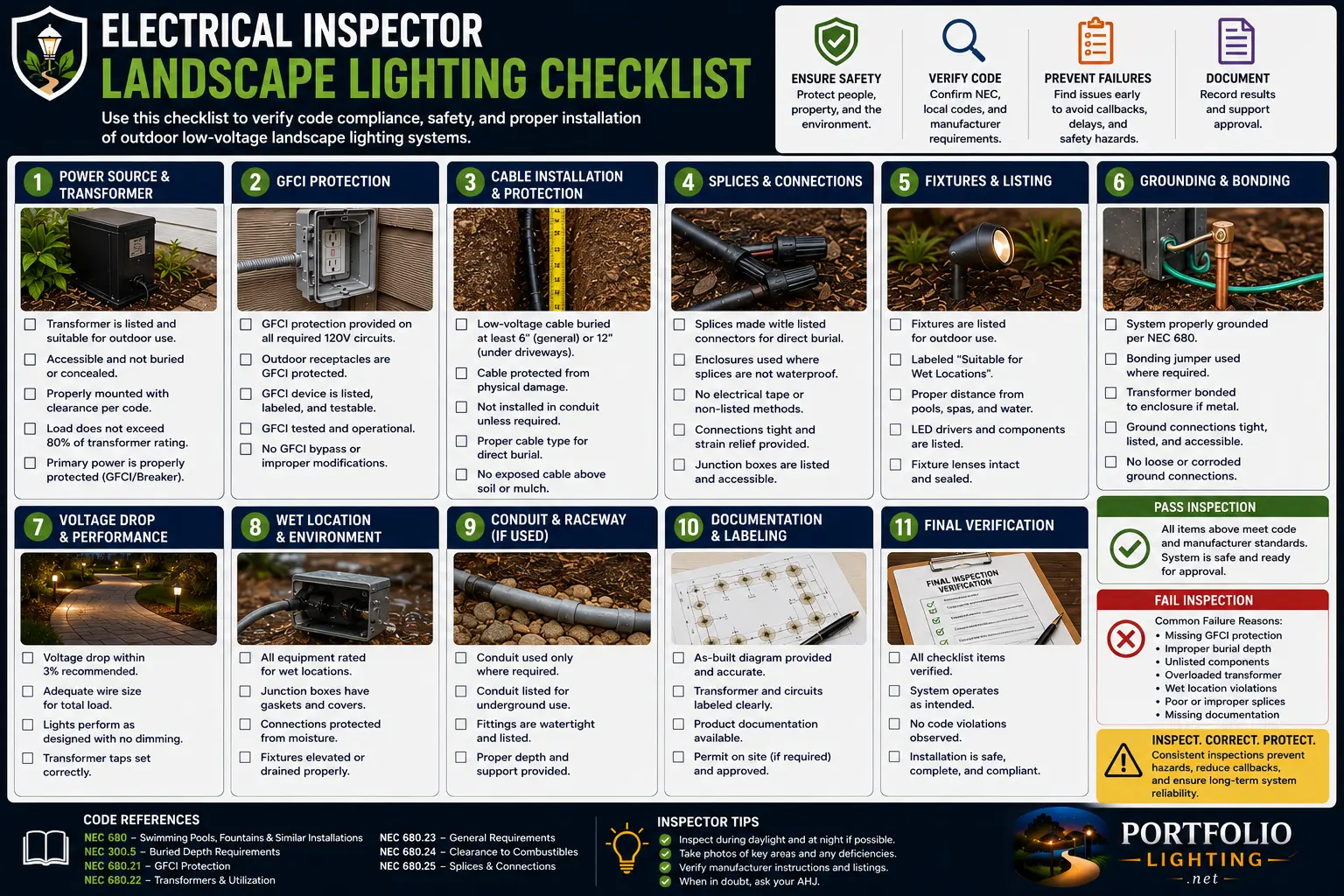
How Electrical Inspectors Are Trained — and What That Means for Landscape Lighting
Understanding an inspector's training background explains both their strengths and their gaps when they inspect something as specialized as low-voltage landscape lighting under Article 411.
The ICC and IAEI Certification Paths
There are two recognized inspector certification bodies in the US: the International Code Council (ICC) and the International Association of Electrical Inspectors (IAEI). Per the Mike Holt forum discussion on inspector qualifications: "There are really only two recognized inspector certifications out there. One is ICC and the other is IAEI's inspector certification. More states use ICC rather than IAEI."
ICC electrical inspector certification requires passing standardized examinations on the NEC and the International Building Code. The examinations cover the entire NEC — Articles 90 through 840 — meaning the inspector's training is deliberately broad. The depth on any specific article (such as Article 411, which governs low-voltage landscape lighting) depends heavily on its representation in the examination content, which is proportional to how frequently the article's requirements appear in typical residential and commercial construction. Article 411 is not a high-frequency exam topic compared to Articles 210, 220, 230, 250, and 300, which cover the bread-and-butter of electrical inspection work.
The Journeyman/Master Electrician Prerequisite
Most states require that electrical inspectors hold a journeyman or master electrician license as a prerequisite for inspector certification. Per the Mike Holt forum: "In Colorado an electrical inspector is required to have a journeyman license at the least so you can inspect commercial jobs as well." Minnesota: "All that's required to be a state inspector is a journeyman or master electrician license and a $1000 bond."
This prerequisite means that electrical inspectors come from the trade — they worked as electricians before becoming inspectors. Their practical knowledge is strongest in the areas where they spent their working years: service entrance, panels, branch circuits, outlets, lighting circuits, GFCI requirements. Low-voltage landscape lighting is not typically a significant part of a journeyman electrician's daily work. The inspector's field experience with Article 411 low-voltage landscape lighting may be limited compared to their experience with 120/240V work.
Combination Inspector Programs
Many jurisdictions — particularly smaller municipalities and counties — use combination inspectors who inspect everything: electrical, plumbing, mechanical, structural, and grading. Per the Mike Holt forum: "I just recently got hired as a building inspector. The area I work in has combination inspectors, which means that we inspect all aspects of construction." A combination inspector's electrical knowledge is typically shallower than a dedicated electrical inspector's, and their Article 411 landscape lighting knowledge is correspondingly narrower. This is the inspector profile most commonly encountered on residential landscape lighting inspections in smaller jurisdictions.
The Inspector's Mental Model: Hazard Focus vs Violation Hunting
The distinction between an inspector who is looking for hazards and one who is looking for violations produces entirely different field behavior — and understanding this distinction is the most important conceptual point about how inspectors work.
What IAEI's Chief Inspector Perspective Actually Says
Pete Jackson, Chief Electrical Inspector for the City of Bakersfield, California, and a member of NEC Code-Making Panel 4, articulates the inspector's purpose in IAEI Magazine: "The purpose of the NEC is the practical safeguarding of persons/property from hazards arising from the use of electricity (NEC 90.1). Applying the code correctly with the proper balance for all concerned is the greatest challenge and the most rewarding part of the job. We are often dealing with a very grey world and attempting to make it as black and white as possible."
The "grey world" observation is significant. An experienced inspector with this mindset approaches landscape lighting not as a checklist exercise but as a safety evaluation: does this installation create genuine hazards? The installation that creates the most visible hazards (unlisted equipment, GFCI missing at a pool, cable running along the surface with no burial) will receive the most aggressive scrutiny. The installation that demonstrates professional practice at every visible point will receive proportionally less scrutiny — not because the inspector is lax, but because the visible evidence of professional practice reduces the probability of hidden hazards.
The Safety Hierarchy Inspectors Apply
Electrical inspectors, consciously or not, prioritize their inspection time by the severity of the potential hazard. For landscape lighting, the hierarchy runs approximately:
- Pool proximity (highest priority). Any landscape lighting near water gets the most careful attention because the electrocution risk near water is real, direct, and severe. An inspector who finds a fixture within 10 feet of a pool edge will probe every detail of that installation — transformer listing, secondary-side GFCI if applicable, depth of any buried cable near the pool. This is the area where an inspector will spend the most time on a landscape lighting job.
- GFCI at primary supply (high priority). A missing GFCI at the transformer outlet is a straightforward NEC 210.8(A)(3) violation with a direct safety consequence — no GFCI protection on the primary circuit. This is the first electrical safety item inspectors check and the one most likely to generate a failure regardless of inspector experience level.
- Listed equipment (high priority). Unlisted equipment — transformer or fixtures without visible NRTL marks — represents unknown safety characteristics. NEC 110.3 requires listed equipment because listing is the code's proxy for verified safety. An inspector who cannot verify listing cannot approve the installation.
- Burial depth (medium priority). The safety consequence of shallow burial is physical damage risk — landscaping equipment, digging, foot traffic. Less immediate than electrical hazards but clearly relevant. Most inspectors probe burial depth, but the depth of investigation (how many probe points, how aggressively they follow up on shallow readings) depends on the overall signal the installation is sending.
- Cable type, connectors, outlet cover (lower priority). Important compliance items but lower on the immediate hazard scale. An inspector whose first three items passed cleanly is more likely to accept a quick visual on outlet cover type than one who already found two problems.
Two Modes: Cooperative and Search — What Triggers Each
The "two modes" concept is documented in the Mike Holt forum from an inspector's direct response to the question "Do inspectors have two modes?" — and the answer is instructive for anyone who works with inspectors regularly.
The direct response from a forum inspector: "What your boss is indicating is the practice of mutual respect. That is, you will only get as much cooperation out of your inspector that you are willing to give him. As a contractor/electrician, you can choose to have open and good communication with your inspector, you can disclose issues or problems you are encountering and be honest, you can be courteous to the inspector by providing ladders, good lighting, ready access for inspections, you get the idea. Hopefully in return, you will get an inspector that will give you the benefit of the doubt, that will work with your schedule and needs, will be open and a good communicator. OR, you can establish a relationship of distrust and frustration that tends to more rejections, a lack of cooperation, and poor or no communication at all. Everything in life is cause and effect. 90% of inspector and contractor conflict is EGO driven."
Before inspectors evaluate burial depth, transformer sizing, or GFCI protection, they often begin with broader installation quality standards. Equipment condition, workmanship, conductor protection, accessibility, and proper installation practices all fall under general electrical requirements that apply across nearly every lighting project. The NEC 110 landscape lighting guide provides a detailed breakdown of the foundational standards inspectors commonly reference during outdoor lighting evaluations.
- Permit card produced without being asked for it
- Stamped approved plan set ready to hand over
- Load calculation printed and labeled
- Listing documentation for any equipment whose label has degraded
- All zones on and all fixtures lit when inspector arrives
- GFCI outlet visibly has TEST/RESET buttons
- While-in-use cover is in place and closes
- Transformer label is legible
- No cable visible along the surface without burial
- Present and ready to answer questions
- Proactive about pointing out the key elements: "Here's the permit card, here are the plans, the transformer is over here"
- Has photographs of open trench before backfilling
- Discloses any known issues or questions upfront
Per Inside Out Electric: "Consider inviting the inspector for a pre-inspection walkthrough next time — they often appreciate the initiative." Per Simpro: "Liability follows the contractor, not the job. Inspectors want documentation that matches what was installed. Installation photos from before concealment are your primary defense."
- Permit card can't be located immediately
- Only a working drawing is available, not the stamped approved set
- Load calculation absent or is just a single-line number
- Transformer label is illegible and no backup documentation available
- A zone is off or one or more fixtures aren't lit
- Cable visible running along the surface
- Outlet at transformer location has no TEST/RESET button
- Any fixture is visibly close to a pool, spa, or water feature
- Scope clearly exceeds what was on the approved plan
- Contractor/homeowner is evasive, defensive, or dismissive when asked questions
- Work area is not accessible (inspector has to push through vegetation to reach transformer)
- Contractor is not present and nobody can answer technical questions
Per Mike Holt forum: "I agree with Mr. Holland that the respect is passed both directions. I recall one of my first inspections 20 years ago when I told the electrician that his job failed and when asked why, I answered that I was not really sure what I was looking at. Because of his honesty, he took about 1/2 hour and went over the installation and ever since we have gotten along great."
Visual Triggers: What the Inspector Sees in the First 60 Seconds
An experienced inspector forms their initial assessment of an installation within the first 60 seconds of site arrival — before they've measured or tested anything. The visual signals they receive in those first 60 seconds determine which mode they enter. Here is what they're registering.
The Pre-Inspection Walk: In the 30 minutes before the inspector is scheduled to arrive, walk the installation as if you are the inspector — starting from your car at the street. What do you see first? Are all zones on? Is the permit card visible? Is the outlet GFCI protected? Is any cable unburied? Is there a clear path to the transformer? Is anything visually close to a pool? Fix everything that would put an inspector in search mode before they arrive. Per Inside Out Electric: "The difference between pass and fail isn't just workmanship — it's preparation, organization, and inspector empathy."
Inspectors frequently encounter outdoor lighting systems that fail not because of installation mistakes, but because of long-term environmental deterioration. Corrosion can develop slowly inside plugs, connectors, sockets, and electrical contacts where moisture remains trapped for extended periods. Homeowners who install seasonal decorations each year can benefit from the storage practices outlined in our Christmas light corrosion prevention guide, which focuses on reducing moisture-related electrical damage before the next installation season begins.
Article 411 Knowledge Gaps: What Inspectors Know Well vs What They Don't
Electrical inspectors are strong on their primary inspection categories and variable on specialized areas like Article 411. Understanding the specific knowledge distribution helps you prepare the right documentation and ask the right questions.
Water features frequently receive additional scrutiny during inspections because they involve unique safety considerations that do not exist in typical path-light or accent-light installations. Inspectors commonly evaluate transformer location, GFCI protection, conductor routing, wet-location equipment listings, and separation distances from water. Our waterfall lighting code requirements guide provides a practical overview of the issues inspectors often review when evaluating illuminated waterfalls and decorative landscape water features.
Inspectors often evaluate more than fixture placement and wiring methods when reviewing larger properties. Emergency illumination, pathway visibility, exit access routes, and backup lighting systems may also fall within the scope of a project depending on occupancy type and site conditions. The emergency backup lighting code guide provides an overview of common egress-lighting considerations that frequently appear during commercial, multifamily, institutional, and public-facility inspections.
| Article 411 Requirement | Inspector Knowledge Level | Why | Practical Implication |
|---|---|---|---|
| GFCI at outdoor transformer outlet (NEC 210.8(A)(3)) | Strong — universal knowledge | All outdoor outlets require GFCI — inspectors cite this on every job type | Will always check and test. No need to explain. |
| Listed equipment requirement (NEC 411.4) | Strong — general NEC principle | NEC 110.3 requires listed equipment — applies to all electrical work | Will check for listing marks. Have documentation if labels degraded. |
| Burial depth: 6 inches minimum from SOIL surface (Table 300.5) | Variable — specifics less known | Most know 24-inch standard; fewer know 6-inch landscape exception in Column 5 | Some inspectors will cite 24 inches. Have Table 300.5 Column 5 text available. |
| Pool setback: 10 feet from INSIDE pool shell (NEC 411.4(2)) | Strong for pool-adjacent work | Pool electrical is a high-safety-priority inspection category | Will measure. Have pre-measured documentation from inside shell. |
| GFCI primary-side limitation (pool proximity, NEC 680.22) | Variable — nuance less known | The isolation transformer GFCI gap is technically subtle | Some inspectors miss this; others catch it precisely. Have documentation of secondary-side protection if applicable. |
| 20-ampere branch circuit maximum (NEC 411.6) | Moderate to strong | Branch circuit sizing is core electrical inspector knowledge | Will typically check panel breaker. Have load calculation showing primary amperage. |
| While-in-use outlet cover (NEC 406.9(B)(1)) | Strong — frequent citation | Outdoor outlet covers cited on all types of outdoor electrical work | Will check visually. Have it installed before inspector arrives. |
| Reconditioning prohibition (NEC 411.3 — 2020/2023 NEC) | Low — newer provision, specialized | Added in 2020 NEC, specialized to landscape lighting, not high-frequency | Most inspectors don't proactively check for reconditioning violations. Primarily cited when modification is visible or documented. |
| Secondary conductor methods (NEC 411.5 — Class 2 vs Chapter 3) | Variable | Article 725/Class 2 wiring is a specialized area many inspectors know less well | Most inspectors accept standard landscape cable without asking for specific 411.5 pathway identification. Unusual configurations may trigger questions. |
| Voltage class separation: LV not sharing conduit with 120V (NEC 300.3(C)) | Moderate — general principle known | Voltage class separation is a general NEC principle taught in licensing programs | Will check conduit runs. Don't share conduit between 12V landscape cable and 120V conductors. |
New Inspector vs Experienced Inspector: How They Differ on Landscape Lighting
Inspector experience profoundly affects how landscape lighting inspections are conducted. The differences are documented in inspector community discussions and IAEI Magazine, and they have direct practical implications for how to prepare.
The New Inspector Pattern
Per the Mike Holt forum discussion on inspector qualifications: "There are some hot shots (usually newer inspectors) who want to make up their own rules, but they seem to mellow after being knocked off their high horse a few times. Overall we have very good inspectors." The new inspector pattern manifests in several specific ways:
- More rigid code application. Newer inspectors are more likely to apply code text literally without the judgment to distinguish between a technical violation that creates a genuine hazard and one that's a paperwork issue. They are less likely to invoke NEC 90.4 special permission or alternative method approval.
- Less Article 411 familiarity, more template-checking behavior. New inspectors who haven't seen many landscape lighting inspections are more likely to rely on a mental checklist of "things I know inspectors check" rather than the specific Article 411 requirements. This can produce both over-enforcement (requiring 24-inch burial depth when 6 inches is required) and under-enforcement (missing the primary-side GFCI limitation near pools).
- More likely to cite everything. IAEI Magazine's "Role of the Electrical Inspector" describes this: "I remember when I was a new inspector, there was a job scheduled for an inspection. It was the end of a busy day... The electrician was a young man, and he was very proud of his work." New inspectors are more likely to generate correction notices for marginal items that experienced inspectors would accept with a verbal comment or overlook.
- More amenable to education. Paradoxically, the new inspector who incorrectly applies a requirement is often the most responsive to being shown the correct code text — they don't yet have a strong commitment to their interpretation. A factual, non-adversarial "I think the applicable section here is Table 300.5 Column 5 which specifies 6 inches for circuits at 30V or less — would you like to see the text?" frequently resolves the incorrect citation at the site.
The Experienced Inspector Pattern
Per IAEI Magazine: "Confidence and knowledge develop with experience. The longer you are out there, the more you see and the more experience you will have." The experienced inspector pattern:
- Hazard-focused, not violation-focused. Experienced inspectors spend their time where the hazards are and move quickly through areas that are clearly compliant. A landscape lighting job that has its pool setback documentation ready, all fixtures on, GFCI working, and a clean burial depth photograph set will receive a faster inspection from an experienced inspector than from a new one.
- More likely to exercise AHJ discretion (NEC 90.4). An experienced inspector who encounters a genuinely ambiguous situation is more likely to invoke their NEC 90.4 authority to accept an alternative method that achieves equivalent safety, rather than failing the inspection for not following the literal code path. This discretion typically works in favor of contractors who have built a professional relationship with the inspector over time.
- More likely to notice the less-obvious Article 411 items. The burial depth from soil vs mulch distinction. The pool setback from inside shell vs coping. The primary-side GFCI limitation. These nuances are more likely to be caught by an experienced inspector who has specifically been trained on or encountered Article 411 violations than by a new inspector relying on general electrical knowledge.
- Relationship history matters more. An experienced inspector who has worked with a contractor before and found their jobs consistently compliant will approach that contractor's jobs with more baseline trust. An experienced inspector who has found repeated problems with a contractor's work will approach their jobs with more scrutiny from the start.
What Documentation Impresses an Inspector — and Why It Matters
Documentation readiness is the fastest signal a contractor sends about the quality of their work. Per Simpro's electrical contractor inspection checklist: "Inspectors want documentation that matches what was installed. Installation photos from before concealment — conduit routing, grounding electrode connections, panel clearances: photograph all of it before closing up walls. Those images are your primary defense against inspection disputes."
The Documentation Package That Impresses Inspectors
For landscape lighting specifically, the documentation package that signals professionalism and puts the inspector in cooperative mode:
- Trench photographs before backfilling. Time-stamped photographs showing the open trench with a tape measure at multiple points, measuring from the soil surface to the cable jacket. This is the gold-standard documentation for burial depth — it proves the depth before backfilling, while still allowing the inspector's physical probe to verify at representative points. An inspector who receives a photograph showing 7.5 inches of burial depth at 10 probe points along the run before backfilling can verify this claim with a few spot probes rather than full re-excavation. Per Simpro: "Installation photos from before concealment. Those images are your primary defense against inspection disputes."
- Load calculation in table format. A structured table showing each fixture by type, quantity, wattage, zone subtotal, and transformer capacity — not a single-line total. This tells the inspector you understand what you installed and that you calculated it properly. An inspector who has to ask "how much is on this transformer?" when the calculation is there in front of them is less likely to probe deeper into the installation.
- Pool setback documentation. For any job near a pool: pre-measured photographs showing the tape measure running from the inside pool shell edge to the nearest fixture. These pre-measurements prevent a field dispute about which reference point to measure from.
- Listing documentation backup. For any equipment whose listing label has degraded: a printout from the UL Product iQ database showing the specific model's listing status. This is the fastest way to resolve a listing question — better than an argument about whether a faded mark is readable.
- As-built diagram. A simple site sketch showing actual fixture locations and wire routing. This is also what the inspector needs to confirm the as-installed matches the approved plan. An as-built diagram provided proactively, before the inspector asks to see the approved plan comparison, signals that you know the work was done as approved. See the as-built diagram requirements guide.
The IAEI RESPECT Framework: How to Work With Inspectors
IAEI Magazine's documented guidance on contractor-inspector relationships uses the RESPECT acronym — a practical framework from an inspector's own perspective on what makes the professional relationship work.
Gray Areas: What Inspectors Cite That Isn't Strictly in the Code Text
Per IAEI's Chief Inspector Pete Jackson: "We are often dealing with a very grey world and attempting to make it as black and white as possible." Some of what inspectors cite for landscape lighting reflects local interpretation, practice-based judgment, or requirements that exceed the strict code text. Knowing these helps you prepare rather than being surprised.
Local Interpretation Items Commonly Added Beyond Base NEC
- Burial depth deeper than 6 inches. Some jurisdictions have adopted local amendments requiring deeper burial — 8 inches, 10 inches, or even the line-voltage standard of 24 inches — for landscape lighting cable. Some inspector enforce local practice rather than specific amendment. If an inspector is citing a burial depth requirement beyond 6 inches, ask: "Is there a local amendment that specifies a deeper requirement for this circuit type?" If they cannot cite a specific local amendment, the NEC Table 300.5 Column 5 requirement of 6 inches should prevail. See the inspection failure codes guide for the appeal process.
- Warning tape above buried cable. Some inspectors and some jurisdictions require orange direct-burial warning tape placed 2 inches above the cable in the trench as a future excavation warning. This is a best practice but not a specific NEC requirement for Article 411 circuits. Many inspectors who suggest it are doing so as a helpful recommendation rather than a code-based citation. When an inspector mentions it as a requirement, ask for the specific NEC section — or simply comply, because it's a legitimate practice regardless of whether it's in the code.
- Minimum 12-inch transformer mounting height enforced as code. The 12-inch minimum mounting height above grade comes from most landscape transformer manufacturers' listing labels (NEC 110.3(B) requires installation per listing) — but the specific number is from the listing, not from any NEC section. An inspector enforcing "12 inches minimum" is technically citing 110.3(B) plus the listing requirement, which is correct but requires them to have seen the specific transformer's label. If an inspector cites a mounting height and you're not sure which label provision they're applying, produce the transformer's listing documentation.
- Conduit for exposed above-grade cable even when not explicitly required. Some inspectors require conduit for any above-grade exposed low-voltage cable, citing the physical protection principle of NEC 300.4 (protection against physical damage). The NEC Class 2 wiring methods of Article 725 permit exposed low-voltage conductors without conduit in many configurations, but some inspectors apply the general physical protection principle as a local overlay. This is a legitimate gray area — the inspector isn't wrong to want physical protection, but the specific code basis requires citation.
The gray area I encounter most often is the burial depth dispute — specifically, inspectors who cite 24 inches rather than 6 inches because they're applying the wrong column of Table 300.5. In my experience this happens with newer inspectors and combination inspectors who primarily do 120V work. The 24-inch standard is so thoroughly internalized from their line-voltage work that they apply it automatically to all buried cable. The resolution is always the same: produce the Table 300.5 text showing Column 5 ("Circuits for Control of Irrigation and Landscape Lighting, 30 Volts or Less") and the 6-inch minimum. In every case I've seen, the inspector reviews the text and immediately understands the distinction. Nobody gets defensive about it — it's a code reference question, not a judgment question. The key is producing the text matter-of-factly, not triumphantly.
Inspectors frequently evaluate more than wiring methods and fixture listings. They also assess whether electrical equipment can be safely accessed for operation, testing, and maintenance after the project is complete. The NEC 210 outdoor kitchen lighting clearance guide highlights how working-space considerations affect transformers, receptacles, disconnects, and other equipment commonly found in outdoor living environments.
The Inspector's 20-Item Landscape Lighting Field Checklist
This is the inspection from the inspector's perspective — what they're checking, what they're thinking as they check it, and what makes each item a quick pass or a potential flag. Use it to understand their mental process and to verify your preparation addresses everything they'll encounter.
Electrical Inspector FAQ
My inspector cited a 24-inch burial depth requirement for my landscape lighting cable. The code says 6 inches. What do I do?
This is the most common code interpretation dispute in landscape lighting inspections, and it is almost always resolvable without a formal appeal by simply presenting the correct code text. The inspector is applying Table 300.5 Column 1 (the standard direct-burial depth for 120V cable) instead of Column 5 (Circuits for Control of Irrigation and Landscape Lighting, 30 Volts or Less — 6 inches minimum). The resolution: produce the Table 300.5 text — either a printed copy or the NEC on your phone — and say calmly: "I believe the applicable column for low-voltage landscape circuits at 30V or less is Column 5, which specifies 6 inches minimum. Would you like to review the table?" In virtually every documented case, this factual presentation resolves the dispute at the site. The inspector who made the error is not in trouble for it — recognizing the correct column and adjusting is the professional outcome. Do not present this confrontationally; present it as a collaborative code reference. See the inspection failure codes guide for the formal appeal process if the site discussion doesn't resolve it.
My inspector is very thorough and has been probing everywhere and checking everything even on a clean job. What should I do?
An inspector who is conducting a thorough, methodical inspection of a clean job is doing exactly what they're supposed to do — their job. The correct response is cooperative participation, not frustration. Provide clear access to everything they want to examine. Answer every question factually and directly. Have all your documentation available. Per IAEI: "Listen to the inspector and learn." A thorough inspector who finds nothing wrong and finishes with a clean sign-off has done you a favor — the sign-off is unambiguous and the permit is cleanly closed. The problem isn't a thorough inspector on a clean job; the problem is a thorough inspector on a job that has issues. Keep the job clean, prepare the documentation, and let the inspector do their work. Per the Mike Holt forum inspector response: "Everything in life is cause and effect. 90% of inspector and contractor conflict is EGO driven." Don't make it about the inspection pace; make it about having a compliant installation that passes regardless of how thoroughly it's examined.
My inspector and I disagree about whether the pool setback should be measured from the coping or from the inside pool shell. Who is right?
The NEC is right — and the NEC measurement reference for pool setback is the inside edge of the pool shell (the structural wall), not the coping, the deck, or any other surface feature. NEC 411.4(2) prohibits lighting systems within 10 feet of pools, spas, and fountains. The "10 feet" is measured from the pool itself — the inside wall of the pool structure. The coping is a decorative cap on top of the pool shell; the deck is the surrounding surface. Both are outside the pool structure. An inspector who measures from the coping rather than the shell produces a measurement 2–6 inches shorter than the correct measurement — which can make a compliant installation appear non-compliant at the margin. The resolution procedure: request a joint measurement with the inspector at the site. Bring a tape measure. Measure from the inside face of the pool shell together, in the inspector's presence. If the joint measurement shows 10 feet or more, ask the inspector to withdraw the violation and document the correct measurement in writing. If the inspector insists on measuring from a different reference point, ask them to cite the specific code language supporting their reference point. The pool setback measurement dispute resolution process is covered in detail in the inspection failure codes guide.
Related Code, Inspection & Compliance Guides
- Electrical Code Safety Guide
- NEC Inspection Checklist
- Inspection Failure Codes
- Final Inspection Checklist
- Correction Notices Guide
- Permit Rejection Reasons
- Permit Requirements Guide
- State Permit Requirements
- As-Built Diagram Requirements
- Wire Burial Depth Code
- GFCI Requirements Guide
- Pool Lighting Clearance
- Transformer Mounting Code
- Splice Connection Code
- Load Calculation Code
- Contractor Licensing
- Insurance & Liability Guide
- Wet Location Listing
- NEC 2026 Code Updates
- NEC 300.5 Calculators
- Junction Box Requirements
- Grounding & Bonding
- Portfolio Model Number Lookup
- Landscape Lighting Guide