
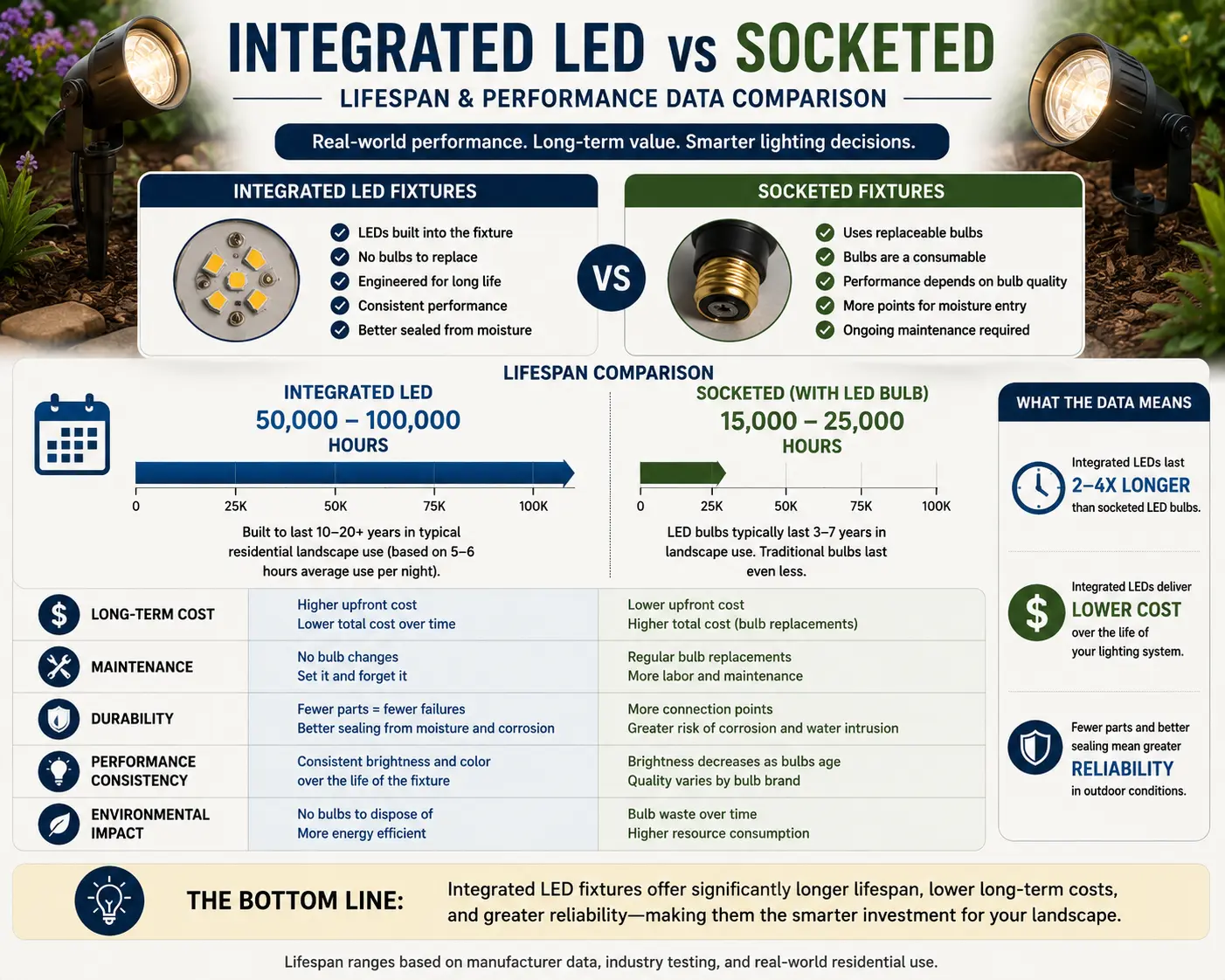
The LED Chip vs Driver Lifespan Asymmetry
Every LED lighting system contains two distinct components with fundamentally different lifespans. The LED chip is a solid-state semiconductor with extraordinary longevity potential. The LED driver is an assembly of electronic components — including electrolytic capacitors — with comparatively limited lifespan. This asymmetry is the single most important data point in integrated vs socketed LED fixture comparison.
Per the USPTO patent record for replaceable driver-control module design (US Patent 9,307,598): "While an LED chip has a potential lifetime of over 100,000 hours, the average lifetime of an LED driver is around 20,000 to 30,000 hours, which limits the overall lifetime of the LED lamp. The same lifetime limitation exists in the electronic components used in the LED light control module. This limitation gives rise to a new problem unique to the LED luminaire; namely, the LED light source or lamp has a significantly longer lifetime than the driver and the control module."
Per Eaton's LED system lifetime engineering documentation: "End of life for an LED is the first time the fixture requires maintenance, which would likely be due to a noticeable decrease in light output or a driver failure, resulting in a lack of light output." And critically: "A common misconception when considering fixture life is only accounting for the L70 rating. More often than not, the point of failure is the driver."
Why This Changes Everything for Integrated vs Socketed Analysis
In a socketed MR16/GU5.3 landscape fixture, the external driver (transformer) is separate from the bulb. When the driver fails, the bulb can be tested in another fixture; the driver is replaced independently. When the socket corrodes, the bulb is replaced while the driver may still be functional. Failures are isolatable.
In an integrated LED fixture, the driver and LED array share a housing that is replaced as a unit. When the driver fails at 25,000 hours despite the LED potentially having 75,000 hours of output remaining, the entire fixture is replaced. The LED's lifespan advantage is never realized — the driver's lifespan ceiling caps the system.
The Practical Math: A quality integrated LED landscape fixture rated L70 at 50,000 hours, operating 8 hours per night, has a theoretical rated service life of 17+ years. In an outdoor installation where summer peak enclosure temperatures reach 60°C, and the driver contains electrolytic capacitors rated at 105°C with a 10°C-rule degradation coefficient, the effective driver lifespan may compress to 12,000–18,000 hours — roughly 4 to 6 years of nightly operation. The 50,000-hour rating on the box describes a different thermal environment than a ground-mounted landscape spotlight in July in Phoenix.
Appalachian Lighting Systems Field Failure Data: 34 Million Operating Hours
The most robust publicly available field failure rate data for outdoor LED luminaires comes from Appalachian Lighting Systems' published failure analysis, cited in the US DOE's SSL reliability fact sheet.
Per the DOE SSL Lifetime and Reliability Fact Sheet: "Figure 2. The distribution of failures over 34 million operating hours for one manufacturer's family of outdoor luminaires. A total of 29 fixtures failed out of more than 5,400 (0.56%)."
This 0.56% failure rate across 34 million hours represents a high-quality commercial outdoor luminaire family — not the consumer-grade landscape lighting that represents the majority of residential installations. This data establishes the benchmark for well-engineered outdoor LED: very low failure rate when thermal management is adequate and components are quality-selected.
What the 0.56% Figure Tells — and Doesn't Tell
The Appalachian field data is encouraging but should be read carefully:
- These are commercial luminaires, not consumer landscape fixtures. Commercial outdoor luminaires use higher-grade drivers, larger thermal mass, and better-selected components than consumer landscape path lights and spotlights. The failure rate gap between commercial-grade and consumer-grade outdoor LED fixtures is substantial.
- The 34 million hours were accumulated in real installations, but the thermal conditions aren't fully described in the cited data. Commercial area luminaires mounted at pole height experience different ambient conditions than ground-mounted landscape spotlights with mulch or soil covering the lower fixture body.
- The L70 lumen maintenance performance of the surviving 99.44% is not described. Fixtures that haven't catastrophically failed may still be producing significantly reduced lumen output — running at L60 or L50 without triggering a maintenance call. The "failure" in this dataset is defined as requiring maintenance, not as reaching the L70 threshold.
- The DOE's own commentary on this data: "The rated life of the LED system is a function of both the LEDs and the driver." The Appalachian data demonstrates that the system failure rate is low — but the individual failure events that did occur were distributed across both lumen depreciation failures and driver/electronic failures.
The L70 Rating Gap: 25°C Test Conditions vs Outdoor Landscape Reality
L70 lumen maintenance ratings, calculated from LM-80 test data using IES TM-21 projection methodology, represent laboratory test conditions that routinely differ from outdoor landscape fixture operating conditions in ways that significantly compress the effective lifespan.
How L70 Ratings Are Generated
LM-80 testing measures lumen output of LED packages, modules, or arrays at specified temperatures and time intervals (typically 6,000 to 10,000 hours minimum). IES TM-21 projects the lumen maintenance curve forward to produce an L70 (or L80, L90) hour estimate. The test is performed at specific board temperature (Tc) points — commonly 55°C, 85°C, and 105°C Tc.
Per Auvolar's LED lifespan engineering documentation: "L80 @ 50,000 hours, 25°C — that second number, ambient temperature, is critical. Higher heat accelerates lumen depreciation, so a fixture rated for L90 at 25°C may only deliver L80 in a 40°C environment." Per American Lighting Systems: "Most LED drivers use electrolytic capacitors, which degrade rapidly in elevated temperatures. If operated above spec, a driver rated at 100,000 hours at 65°C could fail in half that time."
Outdoor Landscape Fixture Thermal Reality by Installation Type
| Fixture Position | Typical Summer Peak Enclosure Temp | vs 25°C L70 Test Temp | Expected L70 Compression | Effective Lifespan at 8 hrs/night |
|---|---|---|---|---|
| Shaded wall mount, north face | 30–40°C | +5–15°C above test | Minimal — 10–20% compression | 12–18 years at 50k hr L70 rating |
| Wall mount, sunny exposure, moderate climate | 45–55°C | +20–30°C above test | Moderate — 30–45% compression | 8–12 years at 50k hr L70 rating |
| Ground spike, partial sun, temperate climate | 50–60°C | +25–35°C above test | Significant — 40–55% compression | 7–10 years at 50k hr L70 rating |
| Ground spike, full sun, hot climate (SW US) | 60–75°C | +35–50°C above test | Severe — 50–70% compression | 4–8 years at 50k hr L70 rating |
| In-grade uplight, mulch-covered | 65–80°C+ | +40–55°C above test | Severe — driver failure likely before L70 | 3–6 years before driver failure |
The Tc Point Disclosure Gap
Per Litelees' LED lifespan engineering guidance: "Ask for the LM-80 test report for the specific LED package used in the fixture. Check the thermal point (Tc) used in LM-80. LM-80 results vary widely with temperature: lower Tc produces better lumen maintenance. The report should include the Tc point(s) and the test temperature(s)." Most landscape lighting manufacturers do not publish LM-80 data publicly, and consumer-grade products rarely provide Tc temperatures alongside L70 ratings. This omission makes it impossible to translate rated hours into real-world landscape performance without additional investigation.
How Integrated LED Drivers Actually Fail: The Electrolytic Capacitor Mechanism
Understanding the specific failure mechanism of LED drivers — particularly in outdoor thermal environments — explains why driver failure is the dominant mode in integrated LED landscape fixtures and what specification choices address it.
The Electrolytic Capacitor as the Rate-Limiting Component
LED drivers convert AC power to regulated DC current for the LED array. This conversion circuit requires energy storage — typically provided by electrolytic capacitors (aluminum electrolytic capacitors). Electrolytic capacitors are the most thermally sensitive component in the driver. Their failure mode: the liquid electrolyte inside the capacitor evaporates over time, with evaporation rate accelerating exponentially with temperature.
The governing relationship is the Arrhenius equation applied to capacitor life, which produces the practical "10°C rule": for every 10°C increase in operating temperature above the capacitor's rated temperature, the expected service life of the capacitor approximately halves. Per American Lighting Systems' driver failure analysis: "Most LED drivers use electrolytic capacitors, which degrade rapidly in elevated temperatures. If operated above spec, a driver rated at 100,000 hours at 65°C could fail in half that time."
The Driver Failure Sequence
Electrolytic capacitor degradation in an outdoor LED driver follows a predictable progression:
- Gradual electrolyte evaporation: The capacitor's electrolyte slowly depletes through the vent mechanism. Capacitance decreases slowly during this phase. The driver may still function normally but with reduced efficiency and marginally higher ripple current.
- ESR increase: As capacitance drops, the capacitor's equivalent series resistance (ESR) rises. Higher ESR increases heat generation within the capacitor itself, accelerating the degradation — a thermal runaway cycle operating over months, not seconds.
- Current ripple increase: The LED receives increasingly unstable DC current. In some LED arrays, this manifests as imperceptible flicker at the hardware level long before visible failure.
- Driver output instability: Voltage regulation becomes erratic. Some outdoor LED landscape fixtures begin to flicker visibly at this stage — see the lights work sometimes guide for how to diagnose this pattern.
- Complete driver failure: The capacitor physically fails (open circuit, short circuit, or vent opening). The LED extinguishes and the fixture no longer responds to power application.
The Quality Specification That Matters Most: Capacitor Temperature Rating
Per Teco Lighting's GU10 driver reliability analysis: "High-grade GU10 drivers use isolated topology and high-temperature capacitors (105°C-rated). Low-cost models often employ unregulated circuits, which can fail prematurely under surge or thermal stress." The single most impactful driver specification for outdoor landscape lighting: require 105°C-rated electrolytic capacitors rather than standard 85°C-rated capacitors. For an outdoor fixture operating at 60°C enclosure temperature with 85°C-rated capacitors, the effective capacitor life may be only 4,000–8,000 hours. With 105°C-rated capacitors at the same temperature, that extends to 30,000–50,000 hours. See the specification parameters section below.
Every integrated LED landscape fixture failure I've diagnosed in the field that wasn't due to physical damage (lawnmower strike, water intrusion through a cracked seal) has been the driver. Never the LED array itself. The LED chip survives. The PCB in the driver shows the failure — usually a bulged or vented electrolytic capacitor, or more subtly, no visible damage at all but a capacitor that reads outside spec on an ESR meter. The pattern is consistent with the temperature doubling rule: the hot-climate, ground-mounted, south-facing fixtures fail in 4 to 6 years. The shaded wall-mount fixtures in the same system are still running at 10 years. Same fixture model, same transformer, same installation — different thermal environment.
Socket Corrosion Failure Timeline for Outdoor MR16/GU5.3 Landscape Fixtures
Socketed landscape fixtures don't eliminate the driver problem — they trade it for a socket corrosion problem. For ground-mounted or low-mounted outdoor fixtures, socket corrosion is a parallel failure mechanism with a documented timeline.
The Socket Corrosion Mechanism
A GU5.3 bi-pin socket in an outdoor landscape spotlight has two small metal contacts that accept the MR16 LED bulb's bi-pin base. These contacts are exposed to the outdoor environment — condensation cycles nightly as the fixture heats and cools, soil moisture migrates into the fixture body, insects and debris enter the socket, and mulch acids contact the lower fixture body in typical landscape installations.
The socket contact corrosion follows the same electrochemical progression as buried splice connections — initial copper oxide formation, progressive buildup of basic copper salts, and eventual high-resistance green-blue verdigris at the contact surface. See the corroded socket cleaning and repair guide for the detailed chemistry and repair procedure.
Variables That Accelerate or Decelerate Socket Corrosion
- Accelerants: Ground-mount positions (proximity to soil moisture and mulch acids), coastal environments, flood irrigation that wets fixture bodies, fixtures near drip irrigation emitters, and any position where condensation cycles are frequent and severe
- Decelerants: Dielectric grease applied to bulb bi-pins at installation (see the socket maintenance guide), fixtures at heights above direct soil moisture (wall-mounted 18"+ off grade), fixtures with tighter housings that reduce condensation exposure, and drier climates with lower annual humidity
- The coastal multiplier: In coastal environments (Zone 1, within 1 mile of saltwater), socket corrosion progresses 3 to 5 times faster than in inland locations. A fixture that lasts 5 years before socket failure in Dallas may need socket service in 1 to 2 years in Sarasota. See the coastal lighting compliance guide.
Failure Mode Comparison: Integrated vs Socketed
- Driver electrolytic capacitor degradation: The dominant failure mode in hot outdoor environments. Accelerated by enclosure temperature; compressed timeline in ground-mounted sun-exposed positions. Failure typically catastrophic (complete loss of output). No field repair; driver or fixture replacement required.
- LED array lumen depreciation (L70 endpoint): The "failure" described by the rated L70 hours. Gradual — requires measurement to detect early. Human eye adapts, so L70 (30% lumen loss) is often not noticed until worse depreciation has occurred. No catastrophic failure; fixture continues to produce reduced-intensity light.
- Physical seal failure — water intrusion: Gasket degradation or mechanical damage allows moisture into the sealed fixture housing. Water contact with driver PCB causes corrosion of electronic components and eventual driver failure. IP65 and IP67 rated fixtures are more resistant; lower-rated consumer fixtures fail sooner. See the foggy lens condensation guide.
- LED chip catastrophic failure: Very rare in well-made fixtures. Represents a fraction of total integrated LED failures. More common in counterfeit or extremely low-cost fixtures where LED chip quality is compromised. Per Appalachian Lighting field data: catastrophic LED chip failure was rare across 34 million operating hours at 0.56% total failure rate.
- Socket contact corrosion: The dominant failure mode for ground-mounted outdoor MR16 fixtures in 3 to 7 years. Progressive resistance increase → voltage drop → reduced lumen output → overheating at contact → eventual dead fixture. Field repair: socket replacement and bulb replacement. Preventable with dielectric grease at installation.
- External transformer/driver failure: The same driver failure mode as integrated fixtures, but in the external transformer supplying the landscape system. Consumer-grade landscape transformers (Portfolio, Malibu, Hampton Bay) typically rated 2 to 5 years warranty; commercial-grade landscape transformers 5 to 10 years. When the transformer fails, all connected fixtures go dark simultaneously — a different failure pattern than individual fixture failures. See the transformer troubleshooting guide.
- MR16 LED bulb driver failure: Modern MR16 LED bulbs contain miniaturized integral drivers in the bulb housing. These miniature drivers are subject to the same thermal stress failures as integral fixture drivers — but at smaller thermal mass. MR16 LED bulb driver failure in a hot, enclosed, or poorly ventilated fixture is common. Per Teco Lighting: "The LED driver (power supply) is often the limiting factor in lifespan. High-grade GU10 drivers use isolated topology and high-temperature capacitors (105°C-rated). Low-cost models often employ unregulated circuits."
Lifespan Data Table: By Fixture Type, Component Quality, and Environment
This table synthesizes the documented data points above into practical lifespan estimates for the most common outdoor landscape lighting configurations. All figures assume 8 hours of operation per night unless noted.
Fixture lifespan is only one component of long-term ownership economics. Maintenance labor, replacement parts, electricity consumption, driver failures, and upgrade cycles can significantly alter the overall value of a lighting system. For a broader evaluation of these factors, see our lighting life-cycle cost analysis guide, which examines the financial and environmental implications of different fixture technologies over decades of use.
| Fixture Type | Environment | Rated Hours (spec sheet) | Realistic System Life | Primary Failure Mode | Maintenance Strategy |
|---|---|---|---|---|---|
| Integrated LED, commercial-grade, 105°C caps | Wall-mount, shaded, temperate | 50,000 hr L70 | 15–20+ yrs | LED lumen depreciation (L70) | Replace when visible dimming noticed; typically >15 years |
| Integrated LED, commercial-grade, 105°C caps | Ground stake, partial sun, temperate | 50,000 hr L70 | 10–14 yrs | Driver electrolytic cap degradation | Replace driver/fixture at first flicker symptom |
| Integrated LED, commercial-grade, 105°C caps | Ground stake, full sun, hot climate | 50,000 hr L70 | 6–10 yrs | Driver failure from thermal stress | Consider shading strategies; plan replacement at 6–8 yrs |
| Integrated LED, consumer-grade, 85°C caps | Wall-mount, shaded, temperate | 25,000–35,000 hr L70 | 7–12 yrs | Driver failure | Replace at first failure event |
| Integrated LED, consumer-grade, 85°C caps | Ground stake, any sun exposure | 25,000–35,000 hr L70 | 3–6 yrs | Driver failure from combined thermal stress | Budget for 3–5 yr replacement cycle in hot climates |
| Socketed MR16 LED, quality bulb, dielectric grease at install | Wall-mount or elevated stake, temperate | 25,000 hr bulb L70 | 10–15 yrs (socket); bulbs every 6–10 yrs | Bulb driver failure, then socket corrosion | Replace bulbs on 5–8 yr cycle; inspect socket at bulb change |
| Socketed MR16 LED, quality bulb, no dielectric grease | Ground stake, any exposure | 25,000 hr bulb L70 | 3–7 yrs (socket failure) | Socket contact corrosion | Annual inspection; apply dielectric grease retroactively at first sign of corrosion |
| Socketed MR16 LED + consumer transformer | Any outdoor, consumer system | Per above + transformer rated life | 3–6 yrs (transformer failure) | Transformer driver failure (all fixtures simultaneously) | Replace transformer before failure; test annually |
Total Cost of Ownership: The Framework That Should Drive Specification
First cost (fixture purchase price) drives most residential landscape lighting decisions. Total cost of ownership — purchase price plus labor for replacement, plus disposal costs, across the realistic service life — often reverses the apparent cost advantage of lower-price consumer fixtures.
The Consumer-Grade Replacement Cost Trap
A consumer-grade integrated LED landscape spotlight priced at $18 appears to cost $432 for a 24-fixture installation. If that fixture realistically lasts 4 years before driver failure in a hot outdoor environment, the 20-year total cost is: 5 replacement cycles × $432 + labor for each replacement cycle = $2,160 in fixtures plus significant labor cost.
A commercial-grade integrated LED spot at $65 per fixture appears to cost $1,560 for the same 24-fixture installation. If that fixture realistically lasts 15 years in the same environment, the 20-year total cost is approximately 1.5 fixture cycles = $2,340 in fixtures plus very little replacement labor.
The $18 fixture "saves" $1,128 at purchase. Over 20 years, it costs more — and that calculation doesn't include the labor for 4 additional replacement cycles or the disruption of garden re-installation each time.
The Socketed vs Integrated TCO Comparison
Socketed MR16 landscape fixtures have a different TCO structure: lower per-failure cost (replace the bulb, not the fixture) but more frequent partial replacements (socket corrosion in 3–7 years requires socket AND bulb replacement, plus labor) and the transformer dependency (one transformer failure affects all zones simultaneously, potentially requiring a service call rather than DIY replacement if the system is complex).
The net TCO comparison depends on three site-specific variables:
- Thermal environment severity: Hot, full-sun, ground-mounted installations favor socketed fixtures (driver thermal stress is in the external transformer, not inside a small fixture enclosure; socket corrosion is the issue but can be maintained incrementally)
- Maintenance access and frequency: If annual maintenance visits are planned, socketed MR16 fixtures with annual socket inspection and dielectric grease application can last 15+ years on the socket itself. If maintenance is deferred, socket corrosion runs its course unchecked
- Climate: Coastal environments accelerate socket corrosion to 2–4 years regardless of maintenance; integrated fixtures with quality IP65+ seals may be a better choice in coastal Zone 1 and Zone 2 applications
Specification Parameters That Extend Outdoor Lifespan: Integrated and Socketed
- 105°C-rated electrolytic capacitors in driver (not 85°C): The single most impactful specification parameter. Reduces driver failure rate by 4–8× in hot environments. Look for this in data sheets or request it from the manufacturer.
- Isolated driver topology: Per Teco Lighting: "High-grade GU10 drivers use isolated topology." Isolated topology creates a galvanic barrier between input and output that improves both safety and long-term reliability in wet environments.
- Tc rating with ambient temperature derating: Request the maximum rated ambient temperature for the fixture at full rated output. Lower is a red flag; ≥50°C is minimum acceptable; ≥60°C preferred for hot-climate outdoor installations.
- IP65 minimum; IP67 for ground-mount or wet-area positions: The gasket quality determines how long the fixture maintains its rated ambient temperature; a leaking gasket puts moisture on the driver PCB and accelerates all failure modes.
- Meanwell, Inventronics, or Sylvania driver brand specification: Per Auvolar: "Quality indicators: Reputable driver brands (Meanwell, Inventronics, Sylvania)." Driver brand specification creates supply chain accountability for component quality.
- Warranty length as proxy for manufacturer confidence: A 5-year warranty on an outdoor LED fixture represents approximately 14,600 operating hours at 8 hr/night. A 10-year warranty represents 29,200 hours. Manufacturers who offer 10-year warranties are either using better driver components or absorbing higher warranty replacement costs — ask which.
- Dielectric grease at installation, every bulb change: Applied to bi-pin contacts before socket insertion. A $3 tube of dielectric grease can extend socket life from 3 to 10+ years by displacing moisture from the contact interface at every maintenance opportunity.
- Commercial-grade transformer, not consumer-grade: Consumer landscape transformers (Malibu, Portfolio) are the most common failure point in socketed MR16 systems. Commercial-grade transformers (VOLT, FX Luminaire, Kichler) use better capacitors, better surge protection, and have documented longer service lives.
- MR16 LED bulbs with quality integrated drivers: The miniaturized driver inside the MR16 LED bulb is subject to the same thermal stress failures as fixture drivers. Specify MR16 bulbs from reputable brands; avoid ultra-low-cost generic MR16 LEDs whose driver component quality is unverifiable.
- Annual socket inspection as part of maintenance schedule: Socket corrosion is preventable with early intervention. See the maintenance guide for the annual inspection checklist that catches corrosion before it causes failure.
- Socket replacement at first visible corrosion: Stage 2 corrosion (visible green/blue) should trigger socket replacement, not just cleaning — the contact geometry is compromised at that stage. Socket replacement cost ($5–20 per position) is far lower than fixture replacement.
- Coastal Zone 1 and 2: consider integrated fixtures with IP67: In high-salt environments, socket corrosion may not be manageable through maintenance. Sealed integrated LED fixtures with IP67 rating and 105°C driver capacitors may have lower TCO than socketed fixtures requiring annual service.
Integrated vs Socketed LED Lifespan FAQ
What actually limits the lifespan of an integrated LED landscape fixture?
The LED driver, not the LED chip. This is the most consequential and most widely misunderstood fact in LED landscape lighting specification. LED chips can maintain L70 lumen output for 50,000 to 100,000+ hours under controlled conditions. But every integrated LED fixture contains an LED driver with electrolytic capacitors that degrade predictably with heat. Per Eaton: "More often than not, the point of failure is the driver." Per USPTO patent documentation: "The average lifetime of an LED driver is around 20,000 to 30,000 hours." In hot outdoor environments with ground-mounted fixtures, this can compress to 10,000–15,000 hours. The 50,000-hour L70 rating on the spec sheet describes the LED chip in a laboratory at 25°C ambient. The actual system failure in a hot outdoor landscape installation is usually the driver, at a fraction of that rated life.
How do L70 rated hours from manufacturer spec sheets compare to outdoor landscape lighting reality?
L70 ratings, generated from LM-80 test data at controlled ambient temperatures (typically 25°C), routinely overestimate outdoor landscape fixture effective lifespan because outdoor fixtures operate at substantially higher temperatures. Per Auvolar: "L80 @ 50,000 hours, 25°C — that second number, ambient temperature, is critical." The electrolytic capacitor 10°C rule means that a driver capacitor rated at 85°C operating at 65°C enclosure temperature (40°C above 25°C test ambient) has its life cut to approximately 25% of the lab-condition rating. A 50,000-hour L70 rating effectively becomes a 12,000–15,000-hour real-world lifespan for the driver in that environment. The LED chip itself may be performing at 90%+ output at that point — but the driver has already failed. Always ask: what is the maximum rated ambient temperature for this fixture, and at what Tc temperature was the L70 lumen maintenance rating established?
Do socketed MR16 landscape fixtures last longer than integrated LED fixtures?
Not categorically — they fail through different mechanisms on different timelines. Socketed MR16 fixtures don't face the integrated driver failure problem inside the fixture itself, but they still face it in the external landscape transformer, and they face socket corrosion as a parallel failure mode unique to socketed architecture. Ground-mounted socketed MR16 fixtures without dielectric grease maintenance typically need socket service in 3 to 7 years — often faster than quality integrated LED driver failure in moderate environments. The choice between integrated and socketed should be made on maintenance access, thermal environment, climate (coastal vs inland), and budget — not on a blanket assumption that one type outlasts the other. In hot, full-sun ground-mount positions where maintenance is deferred, either type fails relatively quickly; in cool, shaded, wall-mount positions with annual maintenance, either type can last 15+ years.
Why did my new LED landscape fixtures fail within 3 years when the box says 50,000 hours?
Almost certainly driver failure accelerated by outdoor thermal stress. Consumer-grade integrated LED landscape fixtures typically use 85°C-rated electrolytic capacitors in their drivers. In a ground-mounted landscape position in full sun in a warm climate, fixture enclosure temperatures can exceed 60°C during peak summer. At 60°C enclosure temperature with 85°C-rated capacitors (25°C thermal headroom), the capacitor life may be 5,000–12,000 hours by the 10°C doubling rule — which at 8 hours per night translates to 1.7 to 4 years of nightly operation. The 50,000-hour L70 rating on the box described the LED chip performance at 25°C ambient in a laboratory. The driver was not designed to outlast the chip in a hot outdoor environment. The specification fix: commercial-grade integrated LED fixtures using 105°C driver capacitors, or socketed MR16 architecture where the thermal load on any single driver component is distributed differently. See the LED vs halogen guide for the broader performance context.
Related Lighting Data, Maintenance & Specification Guides
- Lighting Hardware Data Hub
- Wire Gauge Ampacity Database
- LED vs Halogen Landscape Lighting
- Integrated LED Bypass Testing
- Foggy Lens & Condensation Fix
- Corroded Socket Cleaning & Repair
- Landscape Lighting Maintenance Guide
- Troubleshooting Guide
- Lights Work Sometimes Guide
- One Zone Not Working Guide
- Transformer Troubleshooting
- How to Test a Transformer
- Transformer Sizing Guide
- Voltage Drop Guide
- Voltage Drop Calculator
- Electrical Code Safety Guide
- RoHS Compliance & Heavy Metals
- Coastal Lighting Compliance
- Brand Comparison Guide
- Landscape Lighting Guide