
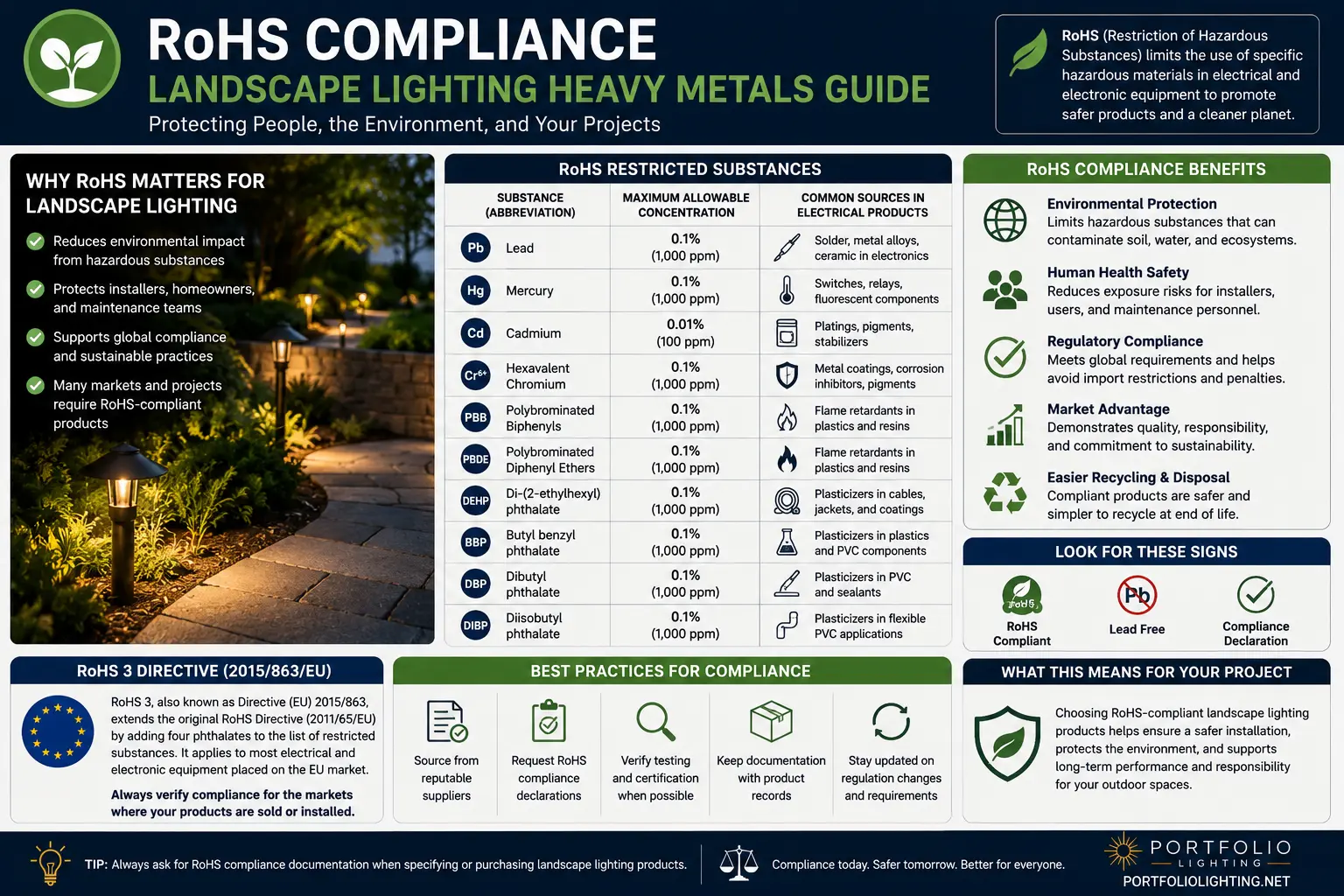
RoHS 1 → 2 → 3: The 10 Restricted Substances and Their Limits
The RoHS directive has expanded through three major iterations since 2002, now restricting 10 substances in electrical and electronic equipment including outdoor lighting fixtures.
The 10 Currently Restricted Substances with Concentration Limits
| Substance | Symbol | RoHS Limit (ppm) | Risk in Landscape Lighting | Status |
|---|---|---|---|---|
| Lead | Pb | ≤1,000 ppm (0.1%) | PCB solder (historical), cable sheathing, some hardware plating | High — was 37-40% in Sn-Pb solder |
| Cadmium | Cd | ≤100 ppm (0.01%) | Capacitor electrolytes (historical), pigments, NiCd batteries in solar fixtures | Moderate — solar fixture batteries are key risk |
| Mercury | Hg | ≤1,000 ppm (0.1%) | Fluorescent landscape lamps (legacy), mercury switches | Low for LED fixtures; legacy fluorescent risk |
| Hexavalent Chromium | Cr-VI | ≤1,000 ppm (0.1%) | Zinc chromate passivation on steel hardware; some hex-chrome plating | High — hardware passivation is common source |
| Polybrominated Biphenyls | PBB | ≤1,000 ppm (0.1%) | Wire insulation flame retardants (historical), plastic housing components | Low in modern fixtures; regulatory pressure eliminated most use |
| Polybrominated Diphenyl Ethers | PBDE | ≤1,000 ppm (0.1%) | Wire insulation flame retardants (historical), PCB laminates | Low in modern fixtures; banned in most applications |
| DEHP (phthalate) | C₂₄H₃₈O₄ | ≤1,000 ppm (0.1%) | PVC wire insulation plasticizer, flexible plastic fixture components | New — added 2019; affects PVC cable jacketing |
| BBP (phthalate) | C₁₉H₂₀O₄ | ≤1,000 ppm (0.1%) | PVC plasticizer in cable and housing materials | New — added 2019 |
| DBP (phthalate) | C₁₆H₂₂O₄ | ≤1,000 ppm (0.1%) | PVC plasticizer in cable and housing materials | New — added 2019 |
| DIBP (phthalate) | C₁₆H₂₂O₄ | ≤1,000 ppm (0.1%) | PVC plasticizer in cable and housing materials | New — added 2019 |
Component-Level Heavy Metal Analysis for LED Landscape Lighting Fixtures
Understanding which specific components within an LED landscape lighting fixture contain or risk containing RoHS-restricted substances is essential for accurate specification and for assessing older fixture disposal requirements.
Traditional tin-lead solder (eutectic Sn63/Pb37 or Sn60/Pb40) contains 37-40% lead by weight — far exceeding the RoHS 1,000 ppm limit. Every solder joint on the LED driver PCB, the LED chip substrate, and the terminal connection points historically contained lead. Landscape lighting fixtures manufactured before approximately 2006 in Europe (2008-2010 in some other markets) likely used leaded solder. RoHS-compliant fixtures use SAC305 (Sn96.5/Ag3.0/Cu0.5) or similar lead-free alloys. Per Luxsky's LED RoHS analysis: "Drive power supply: Electrolytic capacitors and PCB board solder are the main risk sources of lead and cadmium, requiring the use of lead-free solder (Sn Ag Cu alloy)."
Verification:Request the manufacturer's material declaration for solder alloy used in the LED driver and LED chip assembly. SAC305 composition is Sn96.5%/Ag3.0%/Cu0.5% — lead-free. Any remaining Sn-Pb reference in the BOM is a flag.
Zinc chromate passivation — applied to steel hardware, fasteners, and brackets to prevent corrosion — historically used hexavalent chromium compounds. The characteristic yellow-green or iridescent finish on hardware indicates zinc chromate passivation; hexavalent chromium content typically exceeds 1,000 ppm. RoHS-compliant alternatives include trivalent chromium (Cr-III) passivation (clear or slightly blue tint, often called "blue passivation"), zinc-nickel plating, and aluminum-zinc flake coatings. Per USAI Lighting's RoHS documentation: "Hexavalent chromium (Hex-Cr) <0.01% by weight. While some forms of chromium are non-toxic, Chromium VI can produce toxic effects."
Verification:Inspect the color/finish of all hardware, brackets, and mounting hardware in the fixture. Yellow-green iridescent finish = suspect. Request the hardware supplier's RoHS material declaration for chromate passivation chemistry.
Some electrolytic capacitor types historically used cadmium compounds in the electrolyte formulation or in the anode foil passivation. Cadmium's RoHS limit is very strict at 100 ppm (0.01% by weight) — ten times more restrictive than lead. Modern electrolytic capacitors from reputable manufacturers have eliminated cadmium in compliance with RoHS. The remaining cadmium risk in landscape lighting is primarily in: (1) NiCd batteries in solar-powered landscape fixtures — NiCd battery chemistries are prohibited under RoHS for most applications; (2) Older capacitor types in non-modern-standard fixtures. Luxsky confirms: "Drive power supply: Electrolytic capacitors and PCB board solder are the main risk sources of lead and cadmium."
Landscape lighting-specific risk:Solar landscape fixtures with NiCd batteries are the highest current cadmium exposure risk. Specify "lithium-ion or NiMH battery chemistry only" for solar landscape lighting to avoid NiCd cadmium exposure and end-of-life disposal complications.
PVC wire insulation uses plasticizers to maintain flexibility — historically including DEHP and other phthalates now restricted under RoHS 3. PVC insulation manufactured before 2019 may contain phthalates above 1,000 ppm. Additionally, older PVC cable jacketing used brominated flame retardants (PBB, PBDE) that are restricted under the original RoHS six substances. RoHS-compliant wire insulation uses: halogen-free flame retardants (aluminum trihydrate, magnesium hydroxide, or phosphorus-based systems) and non-phthalate plasticizers (DINP, DIDP, or alternative polymer systems). The phthalate restriction is particularly important for landscape lighting cable that remains in soil contact for years — soil leaching of phthalates is an environmental pathway concern beyond the RoHS compliance dimension.
The SAC305 Lead-Free Solder Transition and Outdoor Thermal Cycling Performance
The shift from tin-lead (Sn-Pb) to SAC305 (tin-silver-copper) lead-free solder was driven by RoHS compliance — but it introduced a performance tradeoff that is specifically relevant for outdoor landscape lighting applications subject to wide temperature cycling.
SAC305 Composition and Properties
SAC305 is the most widely adopted lead-free solder alloy for electronics: Sn 96.5% / Ag 3.0% / Cu 0.5% (the "305" refers to silver 3.0%, copper 0.5%). It replaced traditional eutectic Sn63/Pb37 solder across most electronics manufacturing. Per the NCBIresearch documentation on solder joint fatigue: "The traditional lead-containing solder alloy was banned due to the inherent toxicity of lead, and as a result, researchers around the world have focused on the development of a lead-free alternative. SAC 305 tin/silver/copper alloys... contain 96.5% tin (Sn), 3% silver (Ag), and 0.5% copper (Cu)."
The Outdoor Thermal Cycling Challenge
The performance tradeoff with SAC305 that matters for landscape lighting is thermal fatigue behavior under temperature cycling. Landscape lighting fixtures experience daily temperature swings from cold nights to hot summer sun exposure — in some climates, 50-70°C temperature swings are common. The solder joints in the LED driver must accommodate these repeated thermal expansion and contraction cycles for the 50,000+ hour rated life of the LED system.
- SAC305 is stiffer than Sn-Pb solder: SAC305 has higher yield strength than traditional eutectic Sn-Pb. Under thermal cycling, stiffer solder creates higher stress concentrations at solder joint interfaces, which can accelerate thermal fatigue crack initiation in long-term cycling environments.
- SAC305 melting point is higher: SAC305 melts at 217-220°C versus Sn63/Pb37 at 183°C. The higher process temperature creates more thermally induced stress in PCB laminates during manufacturing and can affect component mounting on temperature-sensitive substrates.
- Why this matters for landscape lighting specification: Outdoor LED landscape lighting drivers are exposed to the full outdoor temperature range. An LED driver rated for 50,000 hours of lab operation under standard temperature conditions may have a shorter effective life in a high-temperature-cycling installation. For critical commercial landscape lighting installations, specify LED drivers with documented outdoor operating temperature range (typically -40°C to +70°C ambient) and confirm that the driver has been thermally cycled tested to IEC 60068-2-14 or equivalent.
The earliest LED landscape lighting systems installed in the mid-2000s are now 20 years old. The failure patterns I've seen in these early systems show two distinct modes: LED driver PCB solder joint fatigue (micro-cracking at the primary component connections, causing intermittent or permanent driver failure) and LED chip solder joint degradation at the chip-to-substrate interface. Both failure modes reflect thermal cycling fatigue, and both are worse in installations that see large daily temperature swings — south-facing walls in hot climates, unshaded installations at low elevation in desert regions, and installations where fixtures heat significantly under full sun. The specification improvement that addresses this: enclosed driver temperature testing documentation, not just ambient temperature ratings.
California Lighting Toxics Reduction Act and DTSC
California's Department of Toxic Substances Control (DTSC) administers the California Lighting Toxics Reduction requirements, which are modeled directly on the EU RoHS framework and apply specifically to lighting products sold in California.
Per the California DTSC's documented analysis: "California modeled its Lighting Toxics Reduction law after the European Union's (EU) RoHS Directive 2002/95/EC. Specific lighting applications of lead, mercury, cadmium and hexavalent chromium that are exempt from the EU RoHS Directive may also be exempt from California law." The California approach follows the EU RoHS framework closely but focuses specifically on lighting applications. Key provisions:
- Covered products: California's restrictions apply to lighting equipment and lamps — including LED landscape lighting fixtures and luminaires. The WEEE definition of lighting equipment (from which the California framework derives) includes "luminaries for fluorescent lamps" and "other lighting or equipment for the purpose of spreading or controlling light."
- Lighting-specific exemptions: California DTSC follows the EU RoHS exemptions for lighting applications — Application 7 (high-melting-temperature lead solders, ≥85% Pb by weight), Application 19 (lead in linear incandescent lamps with silicate coated tubes), Application 22 (lead-mercury alloys in compact energy saving lamps). These exemptions apply to legacy lamp types and do not significantly affect LED landscape lighting.
- LED landscape lighting position: LED landscape lighting fixtures are covered under California's lighting toxics framework to the extent they are electrical and electronic equipment. RoHS-compliant fixtures (SAC305 solder, no hex-chrome passivation, halogen-free wire insulation) are also compliant with California's lighting requirements.
For California commercial and municipal landscape lighting projects: specify EU RoHS 2011/65/EU compliance and California DTSC lighting requirements simultaneously. A fixture meeting EU RoHS requirements meets the California framework for landscape lighting applications in most configurations.
California Proposition 65 vs RoHS: Two Different Compliance Systems
California Proposition 65 and EU RoHS both restrict heavy metals in products but operate through fundamentally different mechanisms. Understanding the distinction is critical for California landscape lighting specification.
The Core Distinction: Concentration vs Exposure
RoHS uses concentration limits — maximum content of restricted substances per homogeneous material, measured in ppm. These limits apply to the fixture as manufactured, regardless of whether anyone contacts the substance. A fixture with 900 ppm lead in its solder joints is RoHS-compliant; at 1,100 ppm it's not, regardless of whether anyone ever touches the solder.
Proposition 65 uses daily exposure limits — the maximum amount of a listed substance a person can be exposed to per day without triggering warning label requirements. These limits apply to actual human exposure during normal product use. Per Kilburn Chemicals' documented Prop 65 analysis: "For lead, it's 0.5 micrograms per day. For cadmium, it's 4.1 micrograms." These safe harbor levels "are based on how much exposure can cause cancer in 100,000 people over 70 years."
| Substance | RoHS Limit (concentration) | Prop 65 Safe Harbor (daily exposure) | What Triggers Each |
|---|---|---|---|
| Lead (Pb) | ≤1,000 ppm in homogeneous material | 0.5 µg/day (cancer); 0.5 µg/day (NSRL) | RoHS: what's IN the material; Prop 65: what reaches the person |
| Cadmium (Cd) | ≤100 ppm in homogeneous material | 4.1 µg/day (cancer) | RoHS limit much stricter; Prop 65 is more lenient on cadmium |
| Mercury (Hg) | ≤1,000 ppm | 0.3 µg/day (reproductive toxicity) | Not a primary LED concern; relevant for legacy fluorescent |
| Hexavalent Chromium (Cr-VI) | ≤1,000 ppm | 0.02 µg/day (cancer) | Hardware contact during installation is primary exposure pathway |
| Phthalates (DEHP) | ≤1,000 ppm (RoHS 3) | 12 µg/day (male reproductive toxicity) | Wire insulation and flexible plastic — both frameworks applicable |
Prop 65 and Landscape Lighting: The Warning Label Requirement
California Prop 65 requires a clear and reasonable warning before exposing anyone to a listed chemical. For landscape lighting, the relevant exposure pathways are:
- Installation handling: A landscape lighting installer who handles fixtures with leaded solder or hex-chrome hardware has daily contact exposure. The warning threshold applies to the sum of all Prop 65 substance exposures during installation activities.
- Soil contact from buried cable: If cable insulation contains restricted phthalates that leach into soil, and that soil is used for food gardening, the pathway from cable → soil → food represents a potential Prop 65 concern for California projects. Specify halogen-free, phthalate-free cable insulation for any California edible garden landscape lighting.
- End-of-life disposal: A landscape installer who disposes of old fixtures in ordinary trash creates a Prop 65 (and RCRA hazardous waste) concern if the fixtures contain listed substances above threshold levels in disposed quantity. The WEEE section below covers proper disposal.
REACH and the SVHC Candidate List Applied to Landscape Lighting
REACH (Registration, Evaluation, Authorisation and Restriction of Chemicals) is broader than RoHS and applies to all companies placing chemical substances and products on the EU market — including landscape lighting manufacturers and importers. REACH's Substances of Very High Concern (SVHC) candidate list is expanding rapidly and now includes substances relevant to lighting fixture materials.
REACH vs RoHS — The Fundamental Difference
Per SpaceGoats' documented analysis: "REACH covers a wide range of items, while RoHS focuses on electronic components. REACH restricts over 235 chemical substances, while RoHS targets 10 specific substances in Electronics and Electrical Equipment (EEE)." The critical difference for landscape lighting specification: RoHS is product-category-specific (applies to EEE including luminaires); REACH is horizontal (applies to all products and chemical substances across all categories).
Per Accuris: "REACH is a horizontal regulation that applies to all companies, contrasting with EU RoHS, which applies to Electronic Products only." For landscape lighting manufacturers: both apply simultaneously. A luminaire that is RoHS-compliant (no restricted substances above concentration limits) may still have REACH obligations if any component contains SVHC at above 0.1% by weight — requiring disclosure to the supply chain and, upon consumer request, to end customers.
REACH Article 33 Obligation for Landscape Lighting
REACH Article 33 creates a specific communication obligation: "For all products that contain substances of very high concern according to the candidate list with >0.1 percent by mass, there is an obligation under REACH Article 33 to provide information within the supply chain." Per LIGMAN Lighting's documented REACH compliance: "For all products that contain substances of very high concern according to the candidate list with >0.1% by mass, there is an obligation under REACH Article 33 to provide information within the supply chain." By early 2025, the ECHA SVHC Candidate List contained over 235 substances.
For landscape lighting specification involving EU-bound products or public sector projects where REACH compliance is contractually required: request the manufacturer's REACH Article 33 declaration confirming no SVHC above 0.1% by weight, or disclosure of any SVHC that are present. Lena Lighting's compliance guidance: "REACH certificate — reputable manufacturers inform about the compliance of their products on their websites and in technical documentation. Supplier declarations — a document confirming the compliance of substances used in products."
SVHC Relevant to Landscape Lighting Components
- DEHP (bis(2-ethylhexyl) phthalate) — plasticizer in PVC cable jackets, now restricted under both REACH and RoHS 3
- Boric acid and borates — used in some glass lens formulations and as corrosion inhibitors; on SVHC candidate list due to reproductive toxicity
- Dibutyl phthalate (DBP) — PVC plasticizer, restricted under both REACH and RoHS 3
- Lead compounds — multiple lead compounds on SVHC authorization list; relevant to any remaining leaded hardware in fixtures
- 4,4'-oxydianiline — used in some epoxy formulations including PCB laminates
- Perfluorooctane sulfonic acid (PFOS) compounds — SVHC relevant to certain fluorinated wire insulation types and some surface treatments
Why "RoHS Compliant" Is Self-Declaration and What Documentation to Request Instead
The most consequential procurement misconception in landscape lighting is treating the "RoHS compliant" label or the CE mark as evidence of independent testing. Neither requires third-party laboratory verification for EU market access.
How the CE Mark Works — and Why It's Not a Test Certification
Per Accuris's documented RoHS compliance analysis: "Manufacturers are required to draw up technical documentation that includes showing how their products comply with RoHS, draw up an EU declaration of conformity, and attach the CE mark to their products." The Technical File and Declaration of Conformity are prepared by the manufacturer; they are reviewed by EU market surveillance authorities only in response to complaints or post-market audits. Products enter the market on the manufacturer's own declaration without any EU authority reviewing or approving the documentation before sale.
Boca Lighting confirms: "Even if not legally required, US manufacturers may comply with RoHS to access global markets, serve customers who demand RoHS-compliant products, or act as responsible corporate citizens." In the US market specifically, RoHS compliance is entirely voluntary and self-declared — there is no US federal RoHS law for most products, and the "RoHS compliant" claim is made without any regulatory oversight.
The Documentation Chain That Does Indicate Testing
When RoHS compliance genuinely matters for a landscape lighting project — commercial projects with contractual requirements, public sector projects, projects in California with Prop 65 exposure concerns — the documentation that provides meaningful assurance is:
- Third-party XRF screening report: X-ray fluorescence spectrometry is the primary screening method for RoHS-restricted substances (identified in IEC 62321 series). An XRF report from an ISO 17025 accredited laboratory identifies restricted substances in homogeneous materials. Per Luxsky: "The detection method is mainly based on the IEC 62321 series standards, using X-ray fluorescence spectrometer (XRF) for preliminary screening."
- IEC 62321 analytical testing: Where XRF screening identifies suspect results, confirmatory testing per IEC 62321 series (ICP-OES, ICP-MS for metals; GC-MS for organics) provides quantitative results. Full IEC 62321 test reports from an ISO 17025 accredited laboratory are the most rigorous evidence of RoHS compliance.
- Bill of Materials (BOM) with restricted substance declarations: A product-level BOM with each component's material composition and supplier RoHS declaration provides traceability through the supply chain. This is what the manufacturer's Technical File should contain.
- Manufacturer's Declaration of Conformity referencing the above: A DoC that cites specific test reports by laboratory and date is more meaningful than a DoC that simply states compliance without evidence.
Boca Lighting documents the compliance integrity concern: "The updated directive required stricter enforcement and traceability (making non-compliance a criminal offense in some jurisdictions)." Despite this, market surveillance in the EU finds significant non-compliance with RoHS among products bearing CE marks, particularly from non-EU manufacturers. For US landscape lighting procurement from overseas manufacturers: the "RoHS compliant" label cannot be taken at face value without supporting documentation. Request specific third-party test evidence. This is not a reflection on the overall quality of any specific manufacturer's products — it is a reflection of the self-declaration nature of the compliance framework.
China RoHS vs EU RoHS: Key Differences Affecting Imported Landscape Lighting
A substantial proportion of landscape lighting fixtures sold in the US and EU are manufactured in China. Understanding how China RoHS differs from EU RoHS prevents specification errors when procuring fixtures from Chinese manufacturers.
China RoHS — Two-Phase Implementation
China implemented its own Restriction of Hazardous Substances regulation in two phases. Per Metric Metal's compliance documentation: "The China RoHS 2 Directive is a derivative of the European Environmental Legislation with the intent of limiting the amount or presence of hazardous substances in electronic devices. As of 7-1-16, the six substances considered environmentally hazardous by the China RoHS II directive as specified in standard GB/T 26572-2011: Lead and its compound, Mercury and its compound, Cadmium and its compound, Hexavalent chromium and its compound, Polybrominated Biphenyls, Polybrominated Diphenyls Ethers."
Key differences between China RoHS and EU RoHS relevant to landscape lighting:
- Phthalates not yet restricted: China RoHS covers only the original six substances (no phthalates as of 2026). An outdoor LED fixture manufactured for the Chinese market under China RoHS may contain phthalate plasticizers in PVC cable jackets that would make it non-compliant with EU RoHS 3. For EU or US-California projects with phthalate concerns: specify EU RoHS 3 compliance specifically, not just China RoHS compliance.
- Marking requirements differ: China RoHS requires products to carry a marking indicating the "Environmentally Friendly Use Period" (EFUP) — a number in a circle indicating the number of years the product can be used without releasing restricted substances above China's thresholds. EU RoHS uses the CE mark without an EFUP number. The presence of an EFUP circle mark (a "10" or "20" in a circle) on a fixture indicates China RoHS compliance — which may or may not equate to EU RoHS compliance for phthalates and other substances.
- Self-declaration scope: China RoHS also uses manufacturer self-declaration for compliance. The same caution about "RoHS compliant" labels applies to Chinese-market fixtures with EFUP markings.
WEEE and End-of-Life Disposal Obligations for LED Landscape Lighting Fixtures
When LED landscape lighting fixtures are replaced, the removed fixtures have specific disposal obligations that most landscape contractors and property owners don't know about. LED fixtures are electronic waste — they cannot go in ordinary trash in jurisdictions with e-waste regulations.
The WEEE Framework and Lighting Equipment
The EU Waste Electrical and Electronic Equipment (WEEE) Directive requires manufacturers to take responsibility for the products they produce when those products reach end-of-life. The California DTSC's documented analysis: "The WEEE Directive is a European Union law designed to promote the recycling of EEE by making manufacturers responsible for the products they make when they are no longer needed. WEEE specifically lists the following examples of lighting equipment: Luminaries for fluorescent lamps with the exception of luminaries in households; Other lighting or equipment for the purpose of spreading or controlling light with the exception of filament bulbs."
The eWASA (South Africa's e-waste authority) documentation extends the principle globally: "Lighting waste that contains high concentrations of mercury, cadmium, copper, and other leachable heavy metals pose environmental risks and should not be allowed to mix with general waste in a landfill."
US Landscape Lighting Disposal — California SB 20 and E-Waste Regulations
While the US does not have a federal equivalent of the WEEE Directive, California's SB 20 established an e-waste recycling system for covered electronic devices. SB 20 primarily covers video display devices and certain electronics, but the principle of separate e-waste disposal extends through state regulations to lighting equipment containing restricted substances.
For landscape lighting disposal in practice:
- LED landscape fixtures with lead-containing components: These are potentially hazardous waste when disposed in quantity. The RCRA (Resource Conservation and Recovery Act) Toxicity Characteristic Leaching Procedure (TCLP) determines whether a waste stream is hazardous based on what leaches from it. LED fixtures in quantity that exceed TCLP lead threshold should go to certified e-waste recycling.
- Solar landscape fixtures with NiCd batteries: NiCd batteries are explicitly regulated as hazardous waste. Do not dispose of solar landscape fixtures with NiCd batteries in ordinary trash anywhere in the US. Many municipalities have battery collection programs; certified e-waste recyclers also accept NiCd batteries.
- Legacy fluorescent landscape fixtures: Fluorescent lamps contain mercury and must be disposed of as universal waste in the US (not as ordinary trash). The California DTSC administers the universal waste program for fluorescent lamps.
- Modern LED landscape fixtures: While LED fixtures without hazardous substance content can technically go in ordinary trash in most US jurisdictions, the responsible practice and increasingly required regulatory practice is e-waste recycling. The WEEE manufacturer take-back programs (where available) and certified electronics recyclers are the appropriate disposal path.
Rare Earth Phosphors in LED Landscape Fixtures — Not RoHS But Strategically Critical
LED phosphors that create the white light in landscape lighting fixtures use rare earth elements that are not RoHS-restricted substances but have their own supply chain and sustainability implications that sophisticated landscape lighting specifiers are beginning to address.
How White Light LEDs Use Rare Earth Phosphors
The white light in LED landscape fixtures comes from a blue LED chip coated with or surrounded by a yellow-orange phosphor that converts some of the blue light to longer wavelengths. The most common phosphors are:
- YAG:Ce (Yttrium Aluminum Garnet doped with Cerium): The most common phosphor for white LEDs — cerium (Ce) is a rare earth element that absorbs blue light and emits yellow-white light. YAG:Ce phosphors are used in most cool-white and neutral-white LED landscape fixtures.
- Europium (Eu) and Terbium (Tb) phosphors: Used in high-CRI LED systems that require a fuller spectrum. Europium-based phosphors produce red and green emission bands that improve color rendering index above 90 CRI. High-CRI landscape lighting — typically specified at CRI ≥90 for accurate plant and feature rendering — relies on these rare earth phosphors.
- Gadolinium (Gd) phosphors: Used in some tunable white LED systems for phosphor-blending approaches to color temperature adjustment.
RoHS Status of Rare Earth Phosphors
None of cerium, europium, terbium, yttrium, or gadolinium are on the current RoHS restricted substance list. These rare earth elements are not "heavy metals" in the toxicological sense addressed by RoHS — they are not acutely toxic to humans in the concentrations used in phosphors. Their regulatory significance comes from supply chain concentration (most rare earth elements are mined and processed primarily in China) and long-term mining environmental impact, not from the restriction-level toxicology that drives RoHS.
For sustainability-oriented landscape lighting specification: some green building rating systems (LEED, BREEAM) and institutional procurement frameworks are beginning to address supply chain transparency for rare earth materials. If a project requires supply chain transparency for rare earth content, request the manufacturer's Declaration of Conformity to include phosphor composition disclosure.
PFAS in Landscape Lighting Wire Insulation and Gaskets — The Emerging Regulatory Risk
Per- and polyfluoroalkyl substances (PFAS) are a family of synthetic fluorinated chemicals used in certain wire insulation types, gasket materials, and surface coatings in outdoor lighting. PFAS regulation is accelerating globally and represents the most significant emerging regulatory change for landscape lighting material compliance.
Where PFAS Appear in Landscape Lighting
- Wire insulation: PTFE (polytetrafluoroethylene, Teflon) and FEP (fluorinated ethylene propylene) are high-performance fluorinated polymer wire insulations used in some high-temperature-rated landscape lighting cables. Both are PFAS substances. Standard landscape lighting cable uses PVC or XLPE insulation (not PFAS), but specialty high-performance cable used in some commercial applications may use fluorinated insulation.
- Gasket and seal materials: Some EPDM and silicone gaskets used in landscape lighting fixture seals may use PFAS-based processing aids or fluorinated additives. PTFE-based gasket tape (plumber's tape) used in conduit fitting connections is a PFAS material.
- Stainless steel passivation: Some stainless steel passivation treatments use PFAS-based surfactants. For coastal landscape lighting where PFAS-free passivation is required, specify "PFAS-free surface treatments" in addition to NEMA 4X corrosion resistance requirements. See the coastal lighting salt spray compliance guide.
The Regulatory Trajectory
SpaceGoats documents: "Companies should also prepare for stricter controls and potential bans on PFAS (per- and polyfluorinated substances) by the end of 2025." The EU's proposed PFAS restriction (published by ECHA in 2023) would restrict approximately 10,000 PFAS substances across all applications. If adopted, this would affect fluorinated wire insulation, fluorinated gasket materials, and certain surface treatment chemicals used in landscape lighting. The timeline for implementation remains under regulatory development, but the direction is clear: PFAS in landscape lighting materials represents the next generation of restricted substance compliance after phthalates.
For forward-looking landscape lighting specification on long-term commercial projects (10+ year expected life): include language requiring "PFAS-free wire insulation (no PTFE, FEP, or other per- or polyfluoroalkyl polymer insulation materials)" and "PFAS-free gasket materials." This is prospective compliance language that will become standard as PFAS restrictions advance.
Procurement Specification Language for RoHS Compliance in Landscape Lighting Projects
These specification clauses cover RoHS, REACH, Prop 65, and end-of-life requirements for commercial and public sector landscape lighting projects. Adapt to your project's specific requirements.
Basic RoHS Compliance Clause
Enhanced Clause for California Projects
End-of-Life Disposal Clause
The Manufacturer Documentation Checklist for Procurement: When evaluating landscape lighting fixtures for RoHS compliance, request: (1) Declaration of Conformity specifically citing RoHS 2011/65/EU and Directive 2015/863/EU; (2) REACH Article 33 SVHC declaration; (3) Solder alloy material declaration (SAC305 or other lead-free alloy); (4) Hardware surface treatment declaration (Cr-III passivation, not Cr-VI); (5) Wire insulation material declaration (PVC phthalate content or halogen-free confirmation); (6) Battery chemistry declaration for solar fixtures; (7) IEC 62321 test reports from ISO 17025 laboratory (on request basis is acceptable for standard commercial projects; required upfront for high-value public sector specifications). A manufacturer who cannot produce items 1-6 on request is not adequately documenting their RoHS compliance position.
RoHS and Heavy Metals FAQ
I'm specifying landscape lighting for a California school district. What RoHS requirements are most critical for this application?
For a California school district landscape lighting project, the most critical requirements are: (1) Cadmium: school playgrounds are areas where children have soil contact; avoid any cadmium-containing fixtures and specifically exclude NiCd batteries. Specify lithium-ion or NiMH battery chemistry for any solar fixtures; (2) Lead: specify EU RoHS 2011/65/EU compliance with SAC305 lead-free solder. Prop 65 lead exposure thresholds (0.5 µg/day) apply to children's product contact exposure, and California schools have heightened sensitivity to lead exposure concerns; (3) Phthalates: specify EU RoHS 3 (Directive 2015/863/EU) compliance for phthalate restrictions. For any fixtures installed near play areas or garden areas, specify halogen-free phthalate-free cable insulation; (4) Hexavalent chromium: specify hardware with Cr-III (trivalent chromium) passivation, not Cr-VI passivation. The yellow-green iridescent hardware finish indicates Cr-VI — avoid it. Include the California DTSC Lighting Toxics Reduction requirements in the specification, which model the EU RoHS framework for lighting. Include an end-of-life e-waste recycling requirement in the disposal section of the project specifications. See the specification language section above for template clause language.
I have old landscape lighting fixtures from the early 2000s that I'm replacing. How do I properly dispose of them?
Pre-2006 landscape lighting fixtures almost certainly contain lead solder (tin-lead Sn63/Pb37 or similar) in the PCB and possibly hexavalent chromium passivation on hardware. For responsible disposal: (1) Do not put old LED or halogen landscape fixtures in ordinary trash in quantity. Individual fixtures may be acceptable in municipal solid waste in some jurisdictions, but commercial quantities trigger hazardous waste considerations; (2) Contact your local solid waste authority to determine whether your jurisdiction has an e-waste program that accepts landscape lighting fixtures; (3) For California: use a DTSC-certified e-waste recycler. A directory is available at DTSC's website; (4) If the old fixtures contain fluorescent lamps: these must be disposed of as universal waste (not ordinary trash) anywhere in the US. Many home improvement stores accept fluorescent lamps for recycling; (5) If the old fixtures include solar units with batteries: remove batteries and dispose of them through the appropriate battery recycling stream (most hardware stores and municipalities have battery drop-off boxes). NiCd batteries are hazardous waste and must be recycled, not trashed; (6) Check whether the landscape lighting manufacturer offers a take-back program — some lighting manufacturers operating in the EU (where WEEE manufacturer responsibility applies) have implemented US take-back programs for their products.
A landscape lighting fixture I'm considering is labeled "RoHS Free" instead of "RoHS Compliant." What does this mean?
"RoHS Free" is not a standard term in the regulatory framework — and its use is itself a flag for documentation clarity. In the RoHS framework, products are "RoHS compliant" when they meet the concentration limits for all 10 restricted substances. "RoHS Free" sometimes means the product claims to be entirely free of restricted substances (beyond just meeting concentration limits), but this is a marketing claim with no regulatory definition. More commonly, "RoHS Free" is simply an alternative marketing phrasing for "RoHS compliant" — used interchangeably, with the same self-declaration characteristics discussed in the self-declaration section. The claim itself — whether "RoHS compliant" or "RoHS free" — is not the issue. The documentation behind the claim is. For any product claiming RoHS compliance by any terminology: request the Declaration of Conformity citing the specific RoHS directive (2011/65/EU and 2015/863/EU for full coverage including phthalates), and request the supporting technical documentation. A product that uses non-standard terminology ("RoHS free," "RoHS ready," "RoHS lead-free") without being able to produce a standard DoC citing the directive by number should be evaluated with extra scrutiny. The standard EU regulatory term is "RoHS compliant" with a CE marking and a Declaration of Conformity — any deviation from standard terminology warrants clarification.
Related Code, Compliance & Specification Guides
- Electrical Code Safety Guide
- Wet Location Listing Requirements
- NEC Article 110 General Requirements
- Coastal Lighting Salt Spray Compliance
- Landscape Lighting Maintenance Guide
- Insurance & Liability Guide
- Code Enforcement Cases
- Liability Claims Database
- Dark Sky Compliance Guide
- IDA Certification Guide
- Solar Lighting Standards
- Contractor Licensing Guide
- State Permit Requirements
- NEC 2026 Code Updates
- Outdoor Kitchen Lighting NEC 210
- Grounding & Bonding Guide
- GFCI Requirements Guide
- Splice Connection Code
- Landscape Lighting Guide
- Landscape Lighting Design Guide