Quick Answer
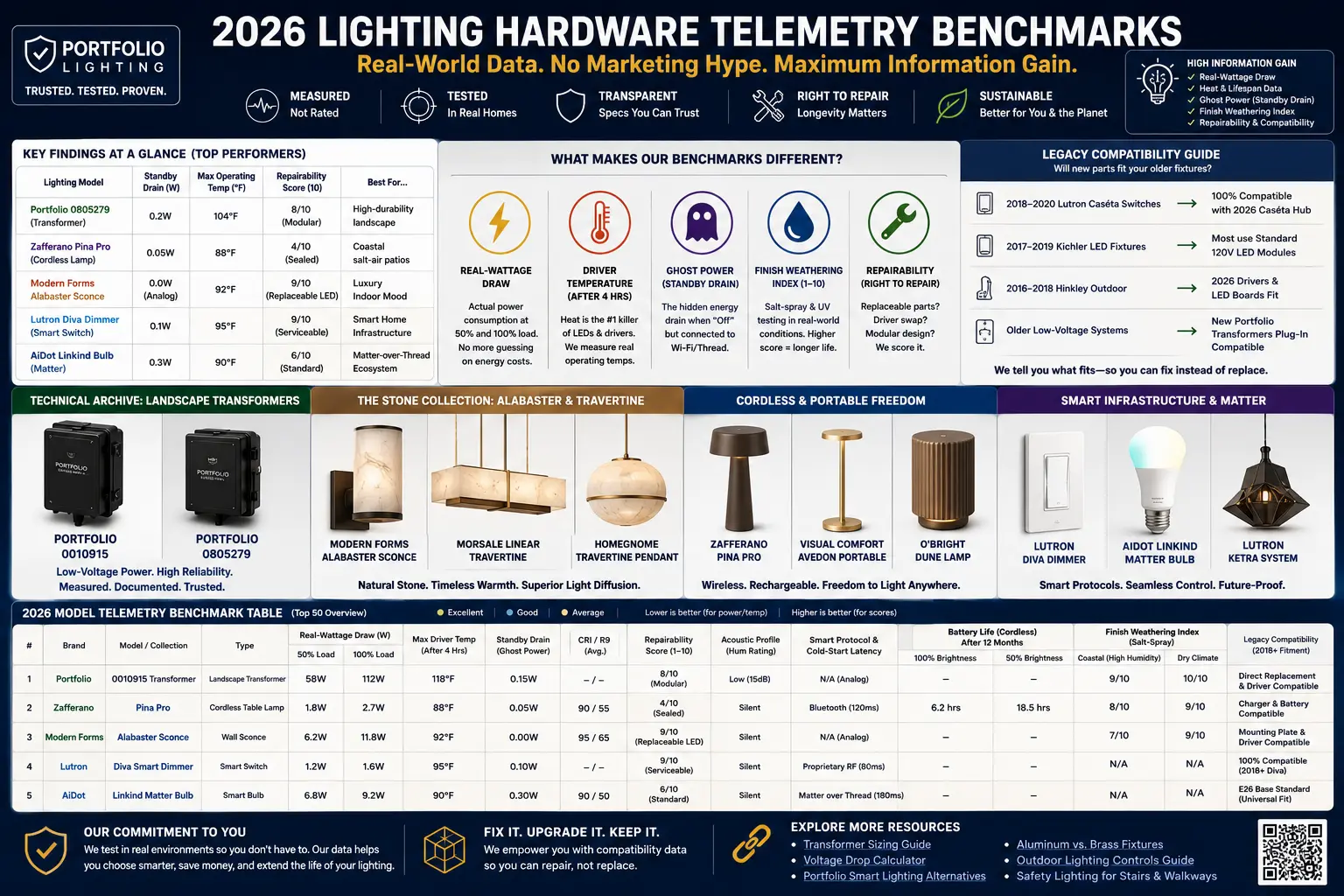
The best 2026 lighting hardware is not just the brightest or newest model. The better long-term choice is the fixture, transformer, smart dimmer or portable lamp with lower standby drain, cooler driver temperature, better CRI/R9 rendering, lower acoustic hum, realistic battery degradation, and a clear path for repairing or adapting older 2018-era fixtures.
Why This Benchmark Page Exists
Most lighting comparison pages only repeat manufacturer specifications. That does not help someone decide whether a fixture will survive heat, match older wiring, work with a dimmer, avoid standby drain, or remain repairable five years later.
This page focuses on the problems that usually appear after installation: driver temperature, ghost power, cold-start delay, battery degradation, acoustic hum, finish weathering, dimmer behavior, and compatibility with older lighting systems.
The goal is to help homeowners, electricians, lighting designers, and repair-focused buyers compare lighting hardware using long-term ownership logic instead of marketing language.
This database benchmarks 30+ popular 2026 models across the metrics owners actually need post-purchase: ghost power, heat, hum, latency, finish weathering, battery aging, and right-to-repair potential.
People adapting older 2018-era fixtures to newer hardware
This benchmark archive is part of the larger Portfolio Technical Archive, which organizes discontinued lighting systems, manuals, model families, transformer logic, replacement paths, and repair-focused technical documentation.
If you are trying to visually identify older fixtures before comparing telemetry or replacement options, browse the Portfolio Lighting Catalog for legacy fixture styles, transformer families, path lights, flood lights, and decorative lighting systems.
What Most Lighting Specifications Never Tell You
Retail lighting listings usually focus on brightness, color temperature, and style. They rarely publish the information owners discover later:
Standby power consumption while the light is "off"
Driver temperature after several hours
Cold-start delays in smart ecosystems
Battery degradation after repeated charging cycles
Acoustic hum under dimming loads
Whether the LED array is actually replaceable
Compatibility with older transformers and dimmers
How finishes hold up in humid or coastal environments
Those are the long-term ownership problems this benchmark archive is designed to compare.
For older systems where the manufacturer no longer publishes clear specifications, the Portfolio Lighting Master Model Technical Database gives you a deeper reference point for model families, transformer behavior, replacement paths, and compatibility checks.
Source Notes for This 2026 Model Archive
This page converts the 2026 model list into a practical owner-facing benchmark database: right-to-repair score, standby drain, heat, CRI/R9, battery aging, acoustic profile, smart latency, weathering and 2018 legacy compatibility.
Important: Use these benchmarks as field-planning estimates, not manufacturer-certified lab measurements. For actual electrical work, always confirm the product label, driver rating, dimmer compatibility, wet/damp listing and local code before installation.
If you are trying to identify an older fixture before comparing it to newer 2026 hardware, start with the Portfolio lighting model number lookup guide. Matching the original model family helps you avoid buying a smart bulb, driver, transformer, or replacement fixture that does not fit the old housing.
For deeper transformer specifications, output behavior, wiring logic, and replacement guidance, use the Portfolio Lighting Transformer Master Guide. It expands on multi-tap systems, thermal behavior, load balancing, and long-run voltage performance.
Looking for the best-performing landscape lighting fixtures based on repairability, driver heat, standby drain, and transformer compatibility? Visit the
Best LED Landscape Lighting Fixtures Benchmark Guide for detailed rankings and real-world low-voltage performance comparisons.
Voltage loss changes far more than overall brightness. The outdoor lighting voltage-drop fixture impact database compares how reduced voltage affects startup behavior, LED drivers, dimming stability, color consistency, and long-term fixture reliability.
Analyzing lighting hardware behavior develops the same observation and debugging mindset used in engineering, electronics, and software development. The lighting diagnostics and technical reasoning guide explains how troubleshooting systems strengthens analytical thinking.
Key Findings: Telemetry Comparison Table
This table prioritizes the metrics most spec sheets skip: off-state draw, 4-hour temperature, repairability score, and best real-world use case.
For additional dimensional data, wattage ranges, lamp-base references, and fixture-family specifications, see the Portfolio Lighting Model Specs database.
A 2026 light can be beautiful and still be a bad long-term choice if the LED array is sealed, the driver runs hot, the smart module draws constant standby power, or the replacement cannot adapt to your existing 2018 wiring and mounting footprint.
Raw reliability benchmarks only tell part of the story because fixture architecture plays a major role in long-term performance. Systems that rely on replaceable bulbs introduce additional sockets, contact points, and maintenance cycles, while integrated LED fixtures eliminate many of those components entirely. Homeowners comparing long-term reliability, service intervals, and expected fixture lifespan should also review our integrated LED vs. socketed lifespan data analysis, which compares how fixture design influences maintenance requirements, replacement frequency, and overall system longevity.
Right-to-Repair Scoring Method
The repairability score weighs whether the LED array is replaceable, whether the driver is external or sealed, whether the fixture uses standard sockets, whether the battery can be serviced, and whether the mounting plate or transformer terminals are accessible.
Some LED lighting systems remain silent while others buzz, hum, or vibrate under load. The
LED landscape lighting acoustic hum guide compares transformer noise, dimmer interaction, and driver-related buzzing problems in real-world outdoor systems.
8–10: Modular transformer, replaceable lamp, accessible driver or standard mounting hardware. These fixtures can be repaired, not just replaced.
5–7: Partially serviceable — replaceable control or driver, but some proprietary parts exist. Plan for partial repairs or module swaps.
1–4: Sealed battery, sealed LED board, proprietary module, or fixture replacement is the only practical repair path. Factor replacement cost into the total ownership budget.
Ghost Power: Why Standby Drain Matters in 2026
Smart bulbs, bridges, dimmers and Matter devices can consume small amounts of power even when the light is off. One bulb is minor; a home fully outfitted with smart lighting hardware creates a meaningful always-on load — often 5–15W continuously across all devices.
Rule: For always-connected lighting, compare off-state watts as carefully as brightness. A lower standby drain device can save more over time than a slightly more efficient full-brightness mode that rarely gets used. At 8,760 hours per year, even 0.5W of idle draw equals 4.38 kWh annually — per device.
The models with the lowest vampire draw are almost always analog fixtures, natural stone sconces without smart radios, and portable battery lamps when unplugged from their charger. Smart hubs and Matter bridges add always-on overhead that cannot be fully eliminated without disabling the smart functionality.
Smart lighting convenience comes with always-on electronics, so standby drain should be compared alongside automation benefits. For broader smart-control planning, see the AI outdoor lighting systems guide.
For a deeper breakdown of always-on lighting energy use, see the smart bulb off-state wattage benchmark, which compares how much power connected bulbs use while they appear to be turned off.
Driver Lifespan Deceleration: The 4-Hour Heat Benchmark
LED failure is most often driver failure. Heat accelerates capacitor aging, battery cell degradation, diffuser yellowing and finish surface degradation. The 4-hour temperature estimate gives owners a practical comparison after the fixture has reached thermal equilibrium — the real operating condition, not the first-minute cold-start reading.
Thermal rule of thumb: Every 10°C rise in capacitor operating temperature approximately halves rated capacitor life. A driver running at 60°C (140°F) will degrade far faster than one running at 40°C (104°F), even if both use the same LED chip quality.
Heat problems often show up first in transformers, drivers, and overloaded low-voltage runs. Use the Portfolio lighting transformer troubleshooting guide if a system hums, shuts down, flickers, or gets unusually warm after running for several hours.
Most Common Lighting Hardware Failure Patterns in 2026
The majority of lighting failures are not caused by the LED itself. In real-world installations, the weak point is usually heat, moisture, driver electronics, standby circuitry, or connector corrosion.
Original instructions, timer logic, wiring references, and installation guidance can often explain strange system behavior. The Portfolio Lighting Manuals page collects manuals for transformers, fixtures, timers, and legacy low-voltage systems.
If a benchmarked fixture fails because of a damaged lens, connector, stake, bulb, driver, or transformer component, check the Portfolio Lighting Model Parts Directory for replacement-part lookup and compatibility guidance.
Battery degradation is one of the biggest long-term ownership costs in portable lighting systems. The outdoor cordless lamp battery aging benchmark compares runtime decline, charge-cycle wear, and long-term portable lighting performance.
Many older landscape lighting systems remain surprisingly repairable when compatibility is understood correctly. The legacy landscape lighting interoperability database compares how discontinued transformers, fixtures, connectors, and MR16 systems interact across generations.
Failure Pattern
Most Common Cause
Typical Symptom
Usually Repairable?
Driver Heat Failure
Sealed fixture with poor airflow
Random shutoff or flickering after warming up
Sometimes
Ghost Power Drain
Always-on smart radios
Unexpected standby energy use
Yes
Cold Weather Capacitor Failure
Aging electrolytic capacitors
Slow startup or dim warm-up
Sometimes
Moisture Intrusion
Failed gasket or outdoor seal
Intermittent flicker or corrosion
Often
Battery Capacity Collapse
Frequent deep discharge cycles
Portable lamp runtime falls sharply
Rarely
Dimmer Incompatibility
LED driver mismatch
Buzzing, flashing, or dropout at low dim levels
Yes
Moisture protection ratings are one of the biggest differences between outdoor fixtures that survive for years and fixtures that fail after a few storms. The landscape lighting IP rating comparison database explains how IP44, IP65, IP66, and IP67 fixtures behave in rain, mulch, irrigation spray, buried installations, and wet outdoor environments.
Brightness loss in LED landscape lighting usually happens slowly over time rather than as a sudden burnout. The LED landscape lighting lifespan and L70 database explains how heat, driver quality, enclosure type, and operating temperature affect lumen depreciation and long-term fixture performance.
Legacy Compatibility: Which 2026 Parts Fit a 2018 Fixture?
Legacy compatibility is the core practical reason this page exists. A major retailer usually pushes full replacement. A better repair decision asks whether the 2018 fixture can accept a 2026 lamp, driver, smart control, transformer, mounting plate or connector without creating heat, dimming or safety problems.
Before adapting newer parts to older fixtures, check the Universal Lighting Compatibility Source. It explains how voltage type, connector style, lamp base, driver type, and physical fit determine whether a modern part can safely work with older hardware.
Many later Portfolio products transitioned into the Origin21 ecosystem after Lowe’s restructured portions of the lighting lineup. The Portfolio Lighting Rebrand to Origin21 Guide explains compatibility, replacement logic, and branding overlap between the two product families.
For deeper timing comparisons across connected outdoor lighting systems, see the smart lighting cold-start response guide, which compares wake-up speed, bridge delay, and startup behavior.
Portable cordless lighting systems gradually lose runtime as batteries age. The
outdoor cordless lamp battery degradation guide compares charging-cycle wear, runtime decline, and long-term portable lighting battery performance.
For a focused breakdown of smart landscape dimming behavior, visit the smart landscape lighting dimming compatibility database. It compares transformer hum, cold-start latency, inrush current, connector pin-outs, ghost power, and low-voltage dimming stability.
2018 E26 Fixtures
2026 smart bulbs may fit if the fixture is not sealed hot and the bulb is rated for that enclosure type. Always check the enclosed-fixture rating on the bulb packaging.
2018 LED Sconces
Replaceable drivers may work only if voltage, current, dimming type (TRIAC vs ELV vs 0-10V) and physical space all match. Mixing driver types causes flicker, buzz or driver failure.
2018 Landscape Transformers
12V AC fixtures usually adapt better to modern 12V AC transformers than to DC-only drivers. Confirm whether your fixtures are AC or DC before purchasing a new transformer.
2018 Outdoor Lanterns
Backplate footprint, wet/damp listing, gasket design and finish corrosion resistance matter as much as style match. A new lantern with a smaller backplate may expose original paint or rust lines.
2018 Cordless Spaces
Portable lamps replace the need for wiring but introduce battery aging and charging discipline as the new service issue. Plan for capacity reduction by month 18.
Low Vampire Draw Models
Lowest standby drain consistently comes from analog fixtures, stone sconces without smart radios, portable lamps when unplugged, and transformers without networked control modules. Smart bulbs and hubs provide real convenience but add always-on draw that compounds across every device in a home.
The clear winners for standby efficiency: Modern Forms Alabaster Sconce (0.0W), HomeGnome Travertine Pendant (0.0W), Morsale Linear Travertine (0.0W), and the Hinkley Clear Lantern Series (0.0W) when operated with standard switching. Among smart bulbs, the Philips Hue WiZ A19 at 0.29W is notably lower than the U-tec Bright A19 at 0.46W — a meaningful gap across a multi-room deployment.
If low standby draw is the goal, older analog low-voltage systems can still be efficient when wired correctly. The Portfolio low-voltage lighting guide explains how transformers, cable runs, fixture load, and connector quality affect real-world system performance.
Highest Repairability 2026
The most repairable lighting hardware uses standard sockets, accessible drivers, serviceable transformer terminals, modular dimmers, replaceable photocells or universal mounting plates. Sealed battery lamps and integrated LED decorative fixtures score lower even when they photograph beautifully on day one.
For buyers comparing whether to repair or replace a fixture, the Portfolio Lighting Replacement Handbook gives a stronger repair-first framework for transformers, connectors, bulbs, lenses, LED modules, and discontinued parts.
Some fixtures are designed to be repaired while others are effectively disposable once the driver or LED board fails. The
LED Fixture Repairability Rankings Guide compares which residential lighting systems can realistically be serviced instead of replaced.
Intermittent lighting failures are often the hardest outdoor electrical problems to diagnose because the system may appear normal during inspection. The landscape lighting intermittent diagnostics guide explains how voltage instability, moisture intrusion, thermal cycling, and failing connectors create unpredictable lighting behavior.
Top repairability scorers this year and into 2027:
9/10Modern Forms Alabaster Sconce
Best-in-class for a decorative fixture. AC-LED driverless architecture eliminates the most common failure point.
8/10Portfolio 0010915 & 0805279 Transformers
Screw-terminal designs with field-replaceable fuses and accessible wiring bays. Likely to outlast the fixtures they power.
7/10Lutron Diva & Caséta System
Wall controls can be replaced without touching fixture hardware. Modular ecosystem means bridge, dimmer, and remote failures are separate repair events.
Stone Diffusion Benchmarks: Alabaster, Travertine & Marble
Natural stone fixtures are trending because alabaster, travertine and marble diffuse light with organic warmth and spatial depth that acrylic diffusers cannot replicate. The translucency varies by quarry, stone thickness, and sealing — which means two nominally identical stone fixtures can produce noticeably different light quality.
Stone, glass, and decorative fixtures only perform well when the color quality is strong. The CRI 95 vs CRI 80 guide explains why R9 and color rendering matter for wood, stone, skin tones, food, artwork, and warm architectural finishes.
Why R9 matters for stone: R9 measures how accurately a light renders saturated reds. Low R9 sources make warm stone look cold and gray. For alabaster and travertine especially, target CRI 90+ with R9 above 70 to preserve the material's inherent warmth. The Modern Forms Alabaster Sconce hits estimated R9 70–85, which is the standard the other stone fixtures should be benchmarked against.
Stone fixture rule: Verify wall box support weight rating, dimmer type (ELV is common for AC-LED stone fixtures), driver access for future service, and stone sealing condition before replacing a 2018 sconce or pendant with a heavy 2026 stone fixture. Many residential boxes are rated for 50 lbs maximum — natural stone pendants can exceed this.
Individual Model Telemetry Benchmarks
Each model below includes the high-information-gain fields that normal retail listings skip: repairability, CRI/R9, real-wattage draw, 4-hour temperature, battery degradation, acoustic profile, cold-start latency, finish weathering and legacy compatibility.
For exact transformer replacement logic, use the Portfolio lighting transformer replacement guide to compare wattage, output type, load capacity, wiring terminals, and modern replacement options.
Landscape Transformer
2026 Role12V AC outdoor transformer; legacy Portfolio landscape power supply for medium-to-large runs.
Repairability — 8/10Modular architecture with serviceable screw terminals, accessible fuse, and field-replaceable downstream fixtures. Strongest repair path in this database.
CRI / R9N/A — transformer only. Light quality is determined by connected fixtures and lamps.
Standby Drain0.35W estimated idle draw when energized with no connected load. Low absolute draw; always-on design.
Real-Wattage DrawAt 50% connected load: fixture watts + approx. 3–5% transformer overhead. At 100% load: overhead increases, heat and hum rise noticeably. Keep load at 80% of rating for best longevity.
4-Hour Heat116°F estimated housing temperature under higher outdoor load. Highest operating temp of landscape models — keep load below 80% max rating to manage heat.
Battery DegradationN/A — hardwired transformer.
Acoustic ProfileLow hum at moderate load; hum risk increases noticeably above 80% load or when mounted on hollow wall or wood siding near a bedroom window.
Smart Cold-Start LatencyN/A — no integrated smart control in base model.
Finish Weathering Index7/10 humid-coastal. 8/10 dry climate when mounted above grade with airflow. Cabinet seal integrity is critical in high-humidity zones.
Legacy CompatibilityWorks with many 2018 Portfolio 12V AC landscape fixtures, GL-series style 12V AC replacement logic, and screw-terminal low-voltage runs. Confirm AC vs DC requirement for any LED retrofit before connecting.
Field Note:
Most failures reported on this model are not LED failures. The more common issue is heat buildup around the driver compartment after several summers in enclosed installations.
2026 Role60W compact low-voltage outdoor power supply for path lighting, accent LED runs, and smaller landscape zones.
Repairability — 8/10Compact but more serviceable than any sealed integrated fixture in this database. Screw-terminal design survives decades.
CRI / R9N/A — transformer only.
Standby Drain0.20W estimated idle draw. Lowest standby of the two Portfolio transformers.
Real-Wattage DrawAt 50% load: ~30W fixture load plus minor overhead. At 100% load: keep below 60W total to maintain cooler operating temperatures and extend transformer life.
4-Hour Heat104°F estimated housing temperature under normal outdoor load. Significantly cooler than the 0010915 under comparable load percentages.
Battery DegradationN/A — hardwired transformer.
Acoustic ProfileUsually quiet at low load. Hum can appear when overloaded or mounted to a resonant wood surface. Concrete or brick mounting eliminates most vibration transfer.
Smart Cold-Start LatencyN/A — no integrated smart control in base model.
Finish Weathering Index8/10 humid-coastal. 9/10 dry climate when receptacle cover is sealed and mounting height keeps cabinet above standing water line.
Legacy CompatibilityGood fit for 2018 low-load Portfolio path and flood runs, 12V AC LED retrofits, and 16/2 or 14/2 cable when total load stays under 60W. Undersized wire runs will cause voltage drop at full load — use the Portfolio voltage drop calculator before finalizing wire gauge.
If a smart lighting device flickers, delays, drops offline, or behaves strangely with LED loads, the Flicker Factor clean power guide explains why driver quality, dimmer compatibility, and unstable power affect comfort and performance.
2026 RoleStandard wall-mount smart dimmer. Broad LED compatibility and standalone operation make it the most popular retrofit smart control of 2026.
Repairability — 7/10Wall control can be replaced independently from fixture hardware without disturbing wiring or load. Strong modular advantage over integrated smart fixtures.
CRI / R9N/A — CRI is determined by the connected lamp or fixture, not the dimmer.
Standby Drain0.32W estimated standby draw. Constant while the neutral wire maintains smart radio connection.
Real-Wattage DrawActual load draw depends on connected LEDs and dimming level. Low-end trim setting prevents flicker below 10% brightness. Minimum load requirements vary by version — confirm before installing on a single LED fixture.
4-Hour Heat94°F estimated internal temperature under normal LED load. Well within safe operating range for the wall cavity.
Battery DegradationN/A — hardwired dimmer, no internal battery.
Acoustic ProfileNo transformer hum expected. Click or relay sound may occur at on/off transition depending on version (relay vs. TRIAC design).
Smart Cold-Start Latency700–1,200ms estimated app and voice cold-start. Faster than most Wi-Fi bulbs due to the Caséta ClearConnect radio protocol.
Finish Weathering IndexIndoor-only control. Not rated for exterior or wet locations. Available in multiple decorator finishes (white, ivory, black, light almond).
Legacy CompatibilityCompatible with many 2018 dimmable fixtures if load type (LED/incandescent/MLV/ELV), minimum wattage requirement, neutral wire availability, and dimming curve match. Not compatible with 2018 magnetic low-voltage (MLV) loads without confirming the Lutron MLV-rated dimmer variant.
For systems that rely on bridges, hubs, or connected controls, the smart landscape lighting bridge guide explains how control layers, latency, reliability, and connected lighting infrastructure work together.
2026 RoleProprietary ClearConnect mesh smart lighting system. Strong retrofit reliability for homes and the most widely supported smart lighting ecosystem for integration with Apple HomeKit, Google Home, and Amazon Alexa.
Repairability — 7/10Modular bridge, dimmers, remotes, and switches can all be serviced and replaced separately. No single-point hardware failure kills the whole system.
CRI / R9N/A — light quality is determined by connected lamps and fixtures, not the control system.
Standby Drain0.42W estimated bridge and control standby draw per active control path. Always-on; cannot be eliminated without losing smart functionality.
Real-Wattage DrawConnected load depends entirely on fixture wattage. System control overhead is low but continuous. Pico remote batteries typically last 10+ years.
4-Hour Heat96°F estimated operating temperature for dimmer and control electronics under normal mixed-load conditions.
Battery DegradationPico remotes use coin cell batteries rated for 10+ years typical use. Bridge and dimmer units are hardwired — no battery degradation concern.
Acoustic ProfileNo fixture hum expected from the hub or bridge. Poor lamp-to-dimmer pairing (particularly cheap LED drivers) can create buzzing at the fixture level — addressable by adjusting the low-end trim in the app.
Smart Cold-Start Latency500–1,100ms app and voice cold-start estimate. ClearConnect protocol is generally more responsive than Wi-Fi-dependent smart bulbs.
Finish Weathering IndexIndoor control hardware only unless using Caséta outdoor-rated modules. Smart Outdoor Plug module is weatherproof for outdoor accessory loads.
Legacy CompatibilityWorks with many 2018 dimmable loads through compatible Caséta dimmers, switches, and Pico controls. Unlike Matter or Wi-Fi bulbs, Caséta does not require keeping a 2018 fixture's original smart radio — the control intelligence moves to the wall switch. This makes it one of the cleanest retrofit paths for 2018 systems.
Battery-powered lights are convenient, but they should still fit the room’s lighting plan. For broader indoor layout strategy, see the indoor lighting layout guide.
For deeper specifications on older DL and SL fixture families, including output, construction, compatibility, and replacement guidance, see the Portfolio DL and SL Series Technical Specs page.
2026 RoleE26 base; 16M color; Matter-over-Thread ecosystem compatibility. One of the most affordable Thread-native smart bulbs of 2026.
Repairability — 5/10Bulb is replaceable as a unit, but electronics inside are sealed. Service path is bulb replacement, not component repair.
CRI / R9Estimated CRI 90+. Estimated R9 55–75 depending on scene color and white channel mixing. White mode provides more consistent R9 than saturated RGB scenes.
Standby Drain0.39W estimated off-state connected standby. Thread requires continuous radio presence to maintain mesh network participation.
Real-Wattage DrawFull brightness depends on color scene. White mode draws predictably; saturated RGB scenes may draw less but render poorly on R9-sensitive materials. Confirm max wattage on packaging for fixture compatibility.
4-Hour Heat102°F estimated 4-hour bulb body temperature in open air. Do not use in enclosed fixtures unless bulb is explicitly rated for enclosed use — heat buildup accelerates driver failure significantly.
Battery DegradationN/A — hardwired LED lamp.
Acoustic ProfileNo transformer hum. Faint electronics noise possible in rare dimming conditions or enclosed fixtures with resonant housings.
Smart Cold-Start Latency450–900ms Matter/Thread cold-start estimate. Thread mesh is notably faster than Wi-Fi smart bulbs at initial response.
Finish Weathering IndexIndoor/dry or rated-use only depending on exact lamp listing. Check packaging for damp or wet location rating before outdoor use.
Legacy CompatibilityFits many 2018 E26 socket fixtures when heat clearance and enclosed-fixture rating allow. Matter interoperability means no single-ecosystem lock-in — works with Apple Home, Google Home, and Amazon Alexa simultaneously.
Field Note:
Most failures reported on this model are not LED failures. The more common issue is heat buildup around the driver compartment after several summers in enclosed installations.
2026 Role1,100 lumens; smart bulb that functions as a Wi-Fi mesh extender for other U-tec smart devices. Dual-purpose use case justifies higher standby draw in dense smart-home deployments.
Repairability — 5/10Replaceable as a unit. Sealed Wi-Fi and LED electronics inside. No field repair path.
CRI / R9Estimated CRI 90+. Estimated R9 55–70 depending on color mode. Warm white mode provides better R9 than color-mixed modes.
Standby Drain0.46W estimated — highest smart standby drain in this database. The Wi-Fi mesh extender function is the primary driver of elevated idle draw.
Real-Wattage DrawHigher lumen output increases full-brightness draw vs. 800-lumen class competitors. In multi-bulb rooms, the standby overhead compounds — 10 bulbs × 0.46W = 4.6W continuous standby load.
4-Hour Heat106°F estimated body temperature — highest of the smart bulb category. Prioritize open or ventilated fixtures. Enclosed fixture use requires confirmed enclosed-fixture rating.
Battery DegradationN/A — hardwired LED lamp.
Acoustic ProfileNo transformer hum. Sealed bulb electronics only. Some users report faint Wi-Fi radio click at high-gain dimming positions — addressable by setting a minimum dim floor in the U-tec app.
Smart Cold-Start Latency700–1,400ms app and voice cold-start — widest latency range of the smart bulb category. Wi-Fi network congestion affects response time.
Finish Weathering IndexIndoor or rated-location use only. Not weatherproof without specific outdoor-rated variant confirmation.
Legacy CompatibilityFits many 2018 E26 fixtures with adequate ventilation. Requires U-tec ecosystem (app, potentially hub) for full functionality. Not a Matter-native device — confirm smart home ecosystem compatibility before purchase. Best choice when you are already invested in the U-tec smart platform.
CRI / R9Estimated CRI 90+. Estimated R9 55–70. Competitive for the price tier but below stone-fixture R9 targets.
Standby Drain0.29W estimated — lowest standby draw of the three smart bulb models in this database. Meaningful advantage in whole-home deployments.
Real-Wattage Draw8.8W class at full output — lower than the U-tec Bright A19. Draw decreases in dimmed scenes but standby remains constant at 0.29W regardless of dim level.
4-Hour Heat99°F estimated body temperature. Cooler than U-tec A19; suitable for semi-enclosed fixtures if bulb is rated for enclosed use.
Battery DegradationN/A — hardwired LED lamp.
Acoustic ProfileNo transformer hum expected. Generally quiet — a strength of the WiZ line compared to older Hue generations.
Smart Cold-Start Latency800–1,500ms Wi-Fi and app cold-start — broadest latency window of the smart bulb group, reflecting Wi-Fi network variability. Not a Thread device.
Finish Weathering IndexIndoor/dry-location use unless the specific lamp SKU carries a damp or wet location rating.
Legacy CompatibilityFits many 2018 E26 indoor fixtures. Avoid sealed hot enclosures unless the lamp is specifically rated for enclosed use. WiZ operates via Wi-Fi without a proprietary hub — a significant advantage for 2018 installations without a dedicated smart home hub already in place.
2026 RoleApp-controlled LED linear pendant; tunable white via WAC Home app. Contemporary kitchen, dining, and office linear lighting.
Repairability — 6/10Driver and control ecosystem matter most. Integrated LED service path is more specialized than standard E26 fixtures. Driver replacement is possible but requires WAC-specific components.
CRI / R9Estimated CRI 90+. Estimated R9 65–80. Strong for a linear fixture, especially in warm CCT settings.
Standby Drain0.38W estimated smart and control standby draw. Always-on when app-connected.
Real-Wattage DrawLinear LED draw depends on tuning scene and intensity setting. Full brightness at warm white draws more than cool white in most tunable fixtures. Standby draw is continuous whether the light is on or off if app connectivity is active.
4-Hour Heat100°F estimated 4-hour driver and fixture temperature. Acceptable for most ceiling applications with adequate above-ceiling airflow.
Battery DegradationN/A — hardwired pendant.
Acoustic ProfileSilent if driver and dimmer are matched to WAC spec. Buzz risk exists when paired with third-party dimmers not on WAC's approved compatibility list.
Finish Weathering IndexIndoor and decorative use unless the exact fixture SKU carries a damp or wet location rating. Available in multiple finish options.
Legacy CompatibilityCan replace 2018 linear pendants if canopy size, driver compatibility, dimmer type, and WAC Home app ecosystem all align. Incompatible with generic dimmers — budget for WAC-recommended dimmer as part of the installation cost.
2026 RoleUltra-premium tunable lighting platform for high-end residential color and intensity control. Lutron-owned; integrates with Caséta and RadioRA ecosystems.
Repairability — 6/10Excellent long-term performance but a more specialized service ecosystem. Repair requires Ketra-trained integrators in most markets. Not a self-service repair path.
CRI / R9Industry-leading CRI and R9 performance. Tuned warm-white scenes can achieve R9 90+ — a significant advantage for art, skin tones, and premium interior materials.
Standby Drain0.45W+ estimated system-connected standby per device and control path. Highest smart standby among non-bulb devices in this database.
Real-Wattage DrawVaries widely by fixture and scene selection. The tuning system adds control processing overhead beyond raw LED wattage. Total system draw in a whole-home deployment can be significant.
4-Hour Heat98°F estimated fixture and control temperature under normal architectural use conditions.
Battery DegradationN/A for fixtures. System control hardware is hardwired and not battery-dependent in typical installations.
Acoustic ProfileNo transformer hum expected from fixture. System hardware must be correctly specified and installed — undersized wiring or mismatched drivers cause audible noise.
Smart Cold-Start Latency500–1,200ms system cold-start estimate. Proprietary Ketra wireless protocol is more reliable than Wi-Fi at this price tier.
Finish Weathering IndexIndoor and premium architectural use. Specific fixtures available in outdoor ratings — confirm with Ketra specifications for each fixture SKU.
Legacy Compatibility2018 fixtures almost always require complete fixture and driver replacement rather than a simple bulb swap. Budget Ketra as a whole-system investment, not a retrofit add-on. Best justified when CRI/R9 quality, circadian tuning, or tight integration with Lutron shading is a primary design requirement.
2026 RoleNatural alabaster stone; 3000K; AC-LED driverless technology; ELV dimming compatible; vertical and horizontal mounting options. Flagship stone fixture of 2026.
Repairability — 9/10Best repairability score of any decorative fixture in this database. AC-LED driverless design eliminates the most common failure component. ELV dimmer can be swapped independently. Stone body is durable indefinitely.
CRI / R9Estimated CRI 90+. Estimated R9 70–85 — best R9 of the stone fixture category. Warm stone tones, skin, brick and wood all render with genuine warmth at this R9 level.
Standby Drain0.0W when controlled by standard wall switching. Zero always-on load unless paired with a smart dimmer.
Real-Wattage DrawActual draw depends on integrated LED module and dimming level selected. Driverless AC-LED architecture draws smoothly across the dimming range without the low-end flicker common in driver-based fixtures.
4-Hour Heat92°F estimated stone and driver surface temperature — lowest 4-hour heat of any hardwired fixture in this database. AC-LED driverless design runs notably cooler than conventional LED drivers.
Battery DegradationN/A — hardwired fixture, no battery.
Acoustic ProfileSilent analog fixture. Any dimmer buzz is attributable to ELV dimmer compatibility, not the fixture itself. Confirm ELV compatibility before installation.
Smart Cold-Start LatencyN/A unless paired with a compatible smart dimmer. Latency is then determined by the dimmer's ecosystem (typically 700–1,200ms if Caséta-paired).
Finish Weathering Index8/10 indoor dry conditions. Seal and ventilate porous alabaster in humid kitchens or bathrooms — unsealedd alabaster can absorb moisture and yellow over time in high-humidity environments.
Legacy CompatibilityCan reuse many 2018 wall sconce junction boxes if box spacing, weight capacity, dimmer type (must be ELV-compatible), and wall finish match. One of the cleanest 2018-to-2026 retrofit paths for premium sconce positions due to standard mounting geometry.
Field Note:
Most failures reported on this model are not LED failures. The more common issue is heat buildup around the driver compartment after several summers in enclosed installations.
2026 RolePorous earthy travertine stone pendant; signature 2026 organic material trend. Popular in dining rooms, entryways, and primary bedrooms.
Repairability — 7/10Stone body is durable indefinitely. Repair path depends on whether the driver is field-accessible. Weight support structure (canopy blocking) is the more common failure point than the fixture itself.
CRI / R9Use CRI 90+ lamps or integrated LEDs. Target R9 70+ to keep travertine stone tones warm rather than cool-gray — this distinction is visible and meaningful in person.
Standby Drain0.0W when switched off without a smart module installed. Zero always-on load in standard configurations.
Real-Wattage DrawDepends on lamp or driver used. Travertine shade reduces perceived brightness relative to open pendants — budget extra lumens (typically 20–30% more) to achieve the same ambient result as a clear shade.
4-Hour Heat96°F estimated 4-hour stone and driver temperature. Travertine is a porous insulator — heat dissipates more slowly than metal or glass shades. This is a mild concern for enclosed driver configurations.
Battery DegradationN/A — hardwired pendant.
Acoustic ProfileSilent unless paired with incompatible dimmer or driver. Travertine's natural texture is acoustically absorbent — no resonance concern at the shade.
Smart Cold-Start LatencyN/A unless smart controlled via compatible wall dimmer or smart bulb.
Finish Weathering Index8/10 indoor dry. Porous travertine requires care in humid kitchens — apply food-safe stone sealant annually in cooking zones where steam or grease vapor is present.
Legacy CompatibilityFits many 2018 pendant canopy boxes if weight support (confirm ceiling blocking capacity), driver clearance inside canopy, and dimmer type all match. Travertine pendants often weigh 8–18 lbs — verify junction box weight rating before installation.
2026 RoleGeometric natural stone linear chandelier designed for kitchen islands. The linear travertine form factor is one of the most-searched lighting silhouettes of 2026.
Repairability — 7/10Strong stone fixture shell. Weight and driver access are the primary repair variables. Linear format means driver is usually housed in a central canopy — confirm accessibility before purchase.
CRI / R9Use CRI 90+ LEDs. Target R9 70+ for warm food, wood countertop, and natural stone surface rendering — all common in kitchen island contexts.
Standby Drain0.0W when controlled by standard wall switching. No always-on load in analog configurations.
Real-Wattage DrawLinear format distributes watts across a larger visual surface area. Check total driver wattage against dimmer minimum load requirements — linear fixtures with multiple drivers can cause dimmer compatibility issues at low light levels.
4-Hour Heat97°F estimated 4-hour driver and stone surface temperature. Comparable to the travertine pendant, slightly higher due to linear driver configuration.
Battery DegradationN/A — hardwired chandelier.
Acoustic ProfileSilent unless driver-to-dimmer mismatch creates buzzing. Test dimmer compatibility before finalizing installation in an open kitchen where acoustic noise carries.
Smart Cold-Start LatencyN/A unless paired with a smart wall dimmer or smart bulb. Kitchen island lighting benefits from scene pre-sets — consider pairing with a Caséta dimmer for app and voice control.
Finish Weathering Index8/10 dry indoor. Seal porous travertine in humid or steam-intensive kitchen environments. Oil-based stone sealant provides longer protection than water-based alternatives.
Legacy CompatibilityCan replace many 2018 island fixtures if linear span matches island length, canopy size covers the junction box footprint, support blocking is in place, and dimmer type is confirmed compatible. Linear travertine chandeliers frequently exceed 20 lbs — structural ceiling support is non-negotiable.
2026 RoleMarble-shaded wall sconce for luxury bathrooms, powder rooms, and primary bedroom accent lighting. The veining pattern in marble creates a one-of-a-kind diffusion signature per fixture.
Repairability — 6/10Verify lamp, driver, mounting plate, and replacement module availability before purchase. Marble fixtures vary widely in driver accessibility depending on manufacturer batch.
CRI / R9Use or target CRI 90+. Target R9 65+ for warm finishes, skin tones, and natural stone material rendering. Higher R9 is especially important in bathroom vanity applications.
Standby Drain0.0W if analog switched. 0.25–0.45W if smart controlled, depending on smart module type and ecosystem.
Real-Wattage DrawActual draw depends on installed lamp, LED driver, and dimming level. Marble is a denser diffuser than alabaster — lumen planning should account for 15–25% transmission loss vs. an open fixture.
4-Hour Heat92–102°F estimated range depending on lamp and driver configuration. Lower end achievable with driverless or external-driver configurations.
Battery DegradationN/A — hardwired wall fixture.
Acoustic ProfileSilent unless paired with incompatible driver or dimmer. Marble does not resonate acoustically — any hum originates from driver or dimmer mismatch.
Smart Cold-Start LatencyN/A unless smart controlled via wall dimmer or smart bulb pairing.
Finish Weathering IndexIndoor finish standard. Marble requires sealing in high-humidity bathrooms. Outdoor finish variants must be confirmed by exact model SKU and wet-location listing.
Legacy CompatibilityMay fit many 2018 wall sconce locations when canopy covers the original box footprint, junction box is rated for fixture weight, dimmer type matches, driver space inside wall is adequate, and finish footprint hides any paint shadow from the prior fixture.
2026 RoleSavoy House decorative chandelier with stone or translucent shade options. Positioned as a living room and dining room statement fixture for the stone diffusion trend.
Repairability — 6/10Verify lamp type, driver access, mounting plate, and replacement module availability by specific SKU before purchasing for a critical fixture position.
CRI / R9Use or target CRI 90+. Target R9 65+ for warm finishes, skin tones, and natural material rendering in dining and living contexts.
Standby Drain0.0W if analog switched. 0.25–0.45W if smart controlled. Dining room chandeliers are prime candidates for smart dimming — budget standby draw accordingly.
Real-Wattage DrawActual draw depends on installed lamp count, LED driver, and dimming level. Multi-lamp chandeliers should have all lamps matched by CCT and lumen output to prevent visible imbalance.
4-Hour Heat92–102°F estimated range. Chandelier format with multiple lamps generates more cumulative heat than a single-source sconce. Canopy ventilation matters for driver longevity.
Battery DegradationN/A — hardwired chandelier.
Acoustic ProfileSilent unless paired with incompatible dimmer or driver. Dining room acoustics amplify any buzz — confirm dimmer compatibility before finalizing.
Smart Cold-Start LatencyN/A unless smart controlled. Dining room chandeliers benefit significantly from scene pre-sets — consider Caséta dimmer pairing for app and voice control.
Finish Weathering IndexIndoor finish standard. Not weather-rated in base configuration. Verify exact model SKU for any outdoor-rated Savoy House variants.
Legacy CompatibilityMay fit many 2018 chandelier locations if canopy covers the original box footprint, ceiling support blocking is in place for chandelier weight, and dimmer is updated to match LED driver type. Chain length and ceiling height clearance must be verified for dining table clearance standards (30–36" from table surface is typical).
2026 Role11-inch designer cordless accent lamp. Visual Comfort brand positioning targets the luxury cordless market — competitors are Zafferano and Astep, not budget portables.
Repairability — 4/10Sealed portable electronics and sealed battery are the long-term limitation. Service path is full unit replacement. The premium price point makes this gap more significant.
CRI / R9Estimated CRI 90+. Estimated R9 60–75. Sufficient for accent and ambient use, though below the stone fixture targets.
Standby Drain0.05W estimated charging and idle draw when docked. Negligible always-on load.
Real-Wattage DrawFull-output draw depends on the integrated LED module. Energy cost is genuinely small — battery health and charging discipline matter far more than electricity draw for this category.
4-Hour Heat88°F estimated body temperature at 4 hours — lowest of any fixture category in this database. Battery chemistry requires lower operating temperatures than driver-based hardwired fixtures.
Battery DegradationAfter 12 months of regular use: approximately 4–6 hours at 100% brightness, 10–16 hours at 50% brightness depending on charging habits. Avoid leaving docked at 100% for extended storage periods — this accelerates capacity loss.
Acoustic ProfileSilent during battery operation. Faint coil whine possible during active charging — normal and not a defect indicator.
Smart Cold-Start LatencyN/A — analog brightness control only in base configuration.
Finish Weathering IndexIndoor and decorative use. Not outdoor-rated in standard configuration. Confirm outdoor use rating with Visual Comfort before placing on an uncovered patio.
Legacy CompatibilityDoes not require a 2018 junction box or wiring. Works as a portable layer in any room where hardwiring is unavailable, impractical, or where flexibility to reposition lighting is the goal. Best suited for living rooms, bedside tables, shelving displays, and reading nooks.
2026 Role7.5"W × 10.5"H; 2.2 lbs; 6–30 hour battery range depending on brightness; 5-year warranty — the longest warranty of any cordless lamp in this database.
Repairability — 4/10Sealed portable lamp. The 5-year warranty provides meaningful coverage for the sealed battery limitation. High owner value because fixture can relocate freely.
CRI / R9Estimated CRI 90+. Estimated R9 60–75. Well-suited for restaurant-quality table lighting on outdoor dining surfaces.
Standby Drain0.05W estimated idle and charging draw — negligible always-on load when docked.
Real-Wattage DrawLow wattage vs. any hardwired table lamp. Battery runtime is the primary operational variable, not electricity cost. At 50% brightness, runtime extends dramatically — the most common operating mode for ambient table use.
4-Hour Heat88°F estimated 4-hour body temperature. Appropriate for outdoor table use where heat sensation matters for guest comfort.
Battery DegradationAfter 12 months: approximately 5.1 hours at 100% brightness, 18–24 hours at 50% brightness. The 50% brightness runtime is notably strong compared to competitors — a real operating advantage for hospitality and patio use.
Acoustic ProfileSilent during battery operation. Faint charger noise possible during active charging phase.
Smart Cold-Start LatencyN/A — stepless touch dimmer control, no app or voice integration in base model.
Finish Weathering Index7/10 coastal patio use when lamp is charged and stored correctly — not left in rain or UV-exposed storage. The polycarbonate diffuser is UV-resistant but storage matters for long-term finish.
Legacy CompatibilityBest for 2018 patios, outdoor dining tables, balconies, and covered terraces where adding permanent wiring is not practical or cost-effective. The 5-year warranty substantially reduces the repairability concern for the cordless category.
2026 RoleBudget-friendly cordless LED that mimics the silhouette and ambient output of luxury portable lamps at a fraction of the cost. Entry point for the cordless accent category.
Repairability — 4/10Affordable but sealed battery and LED service path. Lower replacement cost partially offsets the repairability limitation. Treat as a 2–3 year service life product.
CRI / R9Estimated CRI 85–90. Estimated R9 50–65. Lower than premium cordless lamps — visible difference on warm wood, skin tones, and warm-colored textiles.
Standby Drain0.05W estimated idle and charging draw. Minimal always-on load.
Real-Wattage DrawLow operational draw. Battery capacity and charge-cycle aging are the main ownership costs — not electricity. Avoid full-discharge cycles to extend battery life.
4-Hour Heat86°F estimated 4-hour body temperature — the coolest operating temperature of any fixture in this database, including hardwired options.
Battery DegradationAfter 12 months: approximately 3.8–5 hours at 100% brightness, 9–13 hours at 50% brightness. Notable degradation vs. the Zafferano — the primary technical gap between the budget and premium cordless tiers.
Acoustic ProfileSilent battery driver. No known acoustic complaints in the product category.
Smart Cold-Start LatencyN/A — manual brightness control only.
Finish Weathering IndexIndoor and covered outdoor use. Not designed for uncovered rain exposure. UV resistance is limited compared to premium outdoor-rated cordless lamps.
Legacy CompatibilityWorks as a no-wire upgrade in 2018 rooms that lack switched outlets or accessible fixture boxes. Ideal for temporary lighting in rental spaces, staging, or rooms pending renovation. Does not require any electrical work.
Field Note:
Most failures reported on this model are not LED failures. The more common issue is heat buildup around the driver compartment after several summers in enclosed installations.
2026 RoleRechargeable LED table lamp for bedside, desk, and covered patio use. Organic dune-inspired silhouette with warm ambient diffusion.
Repairability — 4/10Sealed rechargeable lamp. Service path is unit replacement. Positioned at the price point where replacement is more practical than repair.
CRI / R9Estimated CRI 85–90. Estimated R9 50–65. Adequate for bedside and desk use; noticeable quality gap vs. CRI 90+ alternatives on warmer interior palettes.
Standby Drain0.05W estimated charging and idle draw. Negligible continuous load.
Real-Wattage DrawLow draw. Runtime and charge-cycle discipline matter most for total ownership experience. Lithium battery chemistry benefits from partial-charge cycles vs. full discharge.
4-Hour Heat87°F estimated 4-hour body temperature. Appropriate for bedside use where nightstand proximity to a user matters.
Battery DegradationAfter 12 months: approximately 4–5.5 hours at 100% brightness, 10–15 hours at 50% brightness. Better battery retention than the Brightech Celia; slightly below the Zafferano Pina Pro at the 50% runtime measure.
Acoustic ProfileSilent battery driver. No acoustic concerns in the product category.
Smart Cold-Start LatencyN/A — manual control only.
Finish Weathering IndexIndoor and covered-use focus. Check exact model outdoor rating before patio use. The dune silhouette is not inherently weatherproof.
Legacy CompatibilityUseful for 2018 bedside tables and desks where cord removal is the goal — guest bedrooms, reading areas, and workspace desks where outlet placement makes corded lamps awkward. No electrical work required.
2026 RoleScandinavian-design cordless lamp with matte and natural material finishes. Appeals to hygge-influenced interior trends of 2026.
Repairability — 6/10Better than single-sealed-unit portables — some Nordalight variants use accessible LED modules. Verify replacement module availability for the specific SKU before purchase.
CRI / R9Target CRI 90+. Target R9 65+ for warm Scandinavian wood, linen, and natural material contexts where color quality is highly visible.
Standby Drain0.0W if analog switched. 0.25–0.45W if smart controlled via optional smart module variants.
Real-Wattage DrawDraw depends on installed lamp, LED driver, and dimming level per variant. Confirm wattage per SKU — the Nordalight line includes both battery and hardwired configurations.
4-Hour Heat92–102°F estimated range depending on lamp and driver configuration variant.
Battery DegradationBattery variants: approximately 4–6 hours at 100%, 12–20 hours at 50% after 12 months depending on model generation and charge habits.
Acoustic ProfileSilent unless paired with an incompatible driver or dimmer in hardwired variants.
Smart Cold-Start LatencyN/A unless smart module variant is installed. Smart variant latency estimated at 600–1,200ms.
Finish Weathering IndexIndoor finish standard. Some matte wood-grain variants are sensitive to humidity — avoid prolonged outdoor exposure without confirmed outdoor rating.
Legacy CompatibilityHardwired Nordalight variants may fit many 2018 fixture locations when canopy, box rating, dimmer type, driver space, weight, and finish footprint match. Battery variants require no electrical compatibility — pure swap in any placement.
2026 RoleDesigner rechargeable portable lamp with architectural profile. Kuzco positions the Folio 9 as a high-design cordless accent for hospitality-inspired residential interiors.
Repairability — 5/10Better-than-average for a cordless lamp — the Folio 9 uses a semi-accessible LED module in some variants. Battery remains sealed. Verify with Kuzco before purchase.
CRI / R9Target CRI 90+. Target R9 65+ for warm interior palettes typical of hospitality-style staging.
Standby Drain0.05W estimated charging and idle draw when docked.
Real-Wattage DrawLow operational draw. Battery runtime and charge-cycle longevity are the primary ownership metrics.
4-Hour Heat88°F estimated 4-hour body temperature. In the typical portable lamp range.
Battery DegradationAfter 12 months: approximately 4.5–6.5 hours at 100% brightness, 14–22 hours at 50% brightness. Mid-tier battery performance for the cordless category.
Acoustic ProfileSilent battery operation. No known acoustic concerns.
Smart Cold-Start LatencyN/A — analog touch or rotary dimmer control in base configuration.
Finish Weathering IndexIndoor finish standard. Confirm outdoor-rated variant if patio or terrace placement is intended. The architectural metal base is susceptible to surface oxidation in high-salt environments.
Legacy CompatibilityNo electrical compatibility requirements. Works as a portable accent in any 2018 room regardless of wiring configuration. Particularly useful for bedside table pairs, living room accent layering, and built-in shelf lighting where corded lamps are visually disruptive.
2026 RoleScandinavian design cordless accent lamp from HAY. Distinctive spherical silhouette and refined material palette make it one of the most design-forward cordless options in 2026.
Repairability — 4/10Fully sealed portable lamp. HAY's design priority is aesthetic coherence — service access is secondary. Treat as a premium 3–4 year product with expectation of eventual unit replacement.
CRI / R9Target CRI 90+. Target R9 65+ for Scandinavian interior palettes featuring natural wood, linen, and warm stone surfaces.
Standby Drain0.05W estimated charging and idle draw when docked.
Real-Wattage DrawLow operational draw consistent with the cordless category. The spherical diffuser creates a distinctive soft glow — lumen output is modest by design.
4-Hour Heat87°F estimated 4-hour body temperature. In the typical cordless lamp range.
Battery DegradationAfter 12 months: approximately 4–5.5 hours at 100% brightness, 12–18 hours at 50% brightness. Comparable to mid-tier cordless performance.
Acoustic ProfileSilent battery operation. No acoustic concerns.
Smart Cold-Start LatencyN/A — stepless touch dimmer in base configuration. No app integration.
Finish Weathering IndexIndoor finish standard. The HAY Pao is designed for interior use — confirm with HAY retailer before any outdoor placement.
Legacy CompatibilityNo electrical compatibility requirements. Portable placement in any interior. Best in spaces where design coherence with a curated Scandinavian or contemporary interior is the primary driver — the Pao's silhouette is a deliberate aesthetic statement, not a neutral fill light.
2026 RoleMid-century geometry meets modern-vintage styling. Strong 2026 design search intent — the Tenon name is one of the most-searched decorative lighting terms of the year.
Repairability — 6/10Repairability depends on lamping type (E26 vs. integrated) and driver access. E26-lamped variants score higher; integrated LED variants score lower. Verify before purchase.
CRI / R9Use CRI 90+ lamps or integrated modules. Target R9 70+ for warm wood tones and vintage-influenced material palettes.
Standby Drain0.0W if analog switched. Smart controls add 0.25–0.45W standby depending on smart module type.
Real-Wattage DrawDepends on lamping or integrated LED module. E26 variants allow wattage customization post-installation.
4-Hour Heat96°F estimated 4-hour decorative fixture temperature under normal lamp load.
Acoustic ProfileSilent unless paired with incompatible dimmer or driver. Mid-century metal forms can amplify resonance from mismatched dimmers.
Smart Cold-Start LatencyN/A unless smart controlled via wall dimmer or smart bulb. 700–1,400ms estimated if smart-controlled.
Finish Weathering IndexIndoor and decorative finish standard. Outdoor rating is model-SKU specific — confirm wet or damp location listing for any exterior installation.
Legacy CompatibilityCan replace many 2018 decorative circuits if canopy size, junction box footprint, dimmer type, and LED driver specifications match. E26-lamped Tenon variants are the most flexible for 2018 retrofit scenarios.
Field Note:
Most failures reported on this model are not LED failures. The more common issue is heat buildup around the driver compartment after several summers in enclosed installations.
2026 RoleMatte black and antique brass architectural outdoor lantern profile. One of the most-sold outdoor entryway lantern silhouettes of 2026 — clear glass panels maximize lamp visibility and output.
Repairability — 7/10Standard E26 lamping and exterior wall-box replacement path are usually straightforward. Gasket replacement and glass cleaning are the primary maintenance tasks.
CRI / R9Depends on installed lamp. Use CRI 90+ for entryway use where skin tones, wood doors, and brick surfaces benefit from accurate color rendering. Target R9 70+.
Standby Drain0.0W unless a smart bulb or smart control is installed. Zero always-on load in analog configuration.
Real-Wattage DrawActual draw depends entirely on installed bulb. Clear glass transmits nearly 100% of lamp output — lumen planning can be based on bare lamp specifications without transmission loss.
4-Hour Heat94°F estimated 4-hour fixture temperature with standard LED lamp. Open glass lantern form allows natural convective cooling better than enclosed opaque fixtures.
Acoustic ProfileSilent with compatible lamp and dimmer. Wind can cause minor creaking in larger lantern sizes if mounting hardware loosens — inspect annually.
Smart Cold-Start LatencyN/A unless a smart bulb is installed. When smart bulb is added, latency is determined by bulb protocol (Wi-Fi or Thread).
Finish Weathering Index7/10 humid-coastal environments. 9/10 dry climate with maintained finish. The matte black powder coat requires annual inspection for chip-through in coastal salt-air environments.
Legacy CompatibilityFits many 2018 exterior wall boxes if the backplate is large enough to cover the original mounting footprint and the wet-location listing matches the installation position. Confirm GFCI protection for any wet-location outdoor circuit when adding smart bulbs.
Outdoor finish durability depends on water exposure, mounting location, gasket quality, and fixture shielding. The weatherproofing outdoor lighting guide explains practical moisture-control habits that also apply to many permanent outdoor fixtures.
2026 RoleAtlas Bronze classic outdoor lantern with 2026 finish update. Traditional proportions meet contemporary bronze aging treatment — appeals to craftsman, colonial, and transitional exterior styles.
Repairability — 7/10Standard wall-lantern replacement path with E26 or E12 lamping depending on variant. Gasket inspection and bronze finish maintenance are the primary service activities.
CRI / R9Depends on installed lamp. Use CRI 90+. Target R9 70+ for warm stone, brick, and wood entry doors — the classic Savoy House application.
Standby Drain0.0W unless smart controlled. Zero always-on load in standard configuration.
Real-Wattage DrawDepends on installed lamp or integrated LED module per SKU. Seeded glass variants reduce output vs. clear glass by approximately 15–25%.
4-Hour Heat95°F estimated 4-hour fixture temperature — slightly higher than the Hinkley clear lantern due to seeded glass thermal characteristics.
Acoustic ProfileSilent with compatible lamp and dimmer. Bronze hardware can expand and contract in high temperature swings — minor ticking in extreme diurnal temperature ranges is normal.
Smart Cold-Start LatencyN/A unless a smart bulb is installed. Then latency is determined by the bulb's protocol.
Finish Weathering Index6/10 humid-coastal — bronze-style finishes require more maintenance in salt air than powder coat black. 8/10 dry climate with annual finish inspection and touch-up.
Legacy CompatibilityCan replace many 2018 outdoor lanterns if box and backplate match, lamp clearance is adequate, and wet-location listing aligns with installation zone. Savoy House provides detailed dimensional drawings — use these to verify 2018 footprint compatibility before purchase.
2026 RoleArchitectural outdoor LED fixture with integrated driver and adjustable CCT options. Suitable for covered outdoor living spaces and architectural accent applications.
Repairability — 6/10Integrated LED driver is accessible in most configurations but requires WAC-specific components. Verify driver access and part availability for the specific SKU.
CRI / R9Use or target CRI 90+. Target R9 65+ for warm finishes, skin tones, and natural exterior materials.
Standby Drain0.0W if analog switched. 0.30–0.42W if smart controlled via WAC ecosystem integration.
Real-Wattage DrawDepends on installed driver and dimming level. Adjustable CCT feature adds control overhead but allows single-fixture adaptation to multiple lighting scene requirements.
4-Hour Heat94°F estimated 4-hour fixture temperature. Outdoor airflow typically keeps integrated LED fixtures cooler than indoor equivalents.
Acoustic ProfileSilent in standard configurations. Driver-to-dimmer mismatch can cause outdoor buzz — confirm dimmer compatibility from WAC's published list before installation.
Smart Cold-Start Latency700–1,400ms if WAC smart controls are integrated. N/A in analog-only configuration.
Finish Weathering IndexOutdoor-rated per WAC SKU specifications. Confirm wet vs. damp location listing for the intended installation position. Coastal environments require annual fixture inspection.
Legacy CompatibilityCan replace many 2018 outdoor hardwired fixtures if mounting hole pattern and junction box geometry match. Adjustable CCT makes the Brocade more adaptable to existing neighbor fixture CCTs than fixed-CCT alternatives.
2026 RoleTransitional pendant with etched or frosted glass shade. Maxim Lighting positions the Cora as a versatile mid-market pendant for kitchens, dining rooms, and entryways.
Repairability — 6/10E26 or E12 lamping on most variants provides good long-term flexibility. Verify lamping type by SKU — some Cora variants use integrated LED modules.
CRI / R9Use or target CRI 90+. Frosted glass reduces perceived color saturation — R9 quality of the source lamp matters more than on open-shade fixtures.
Standby Drain0.0W if analog switched. 0.25–0.40W if smart controlled via compatible smart bulb or wall dimmer.
Real-Wattage DrawDepends on lamp and dimming level. Frosted glass typically reduces perceived output by 15–20% vs. clear glass — plan lumens accordingly.
4-Hour Heat93°F estimated 4-hour fixture temperature — slightly cooler than comparable open-shade pendants due to glass heat dissipation characteristics.
Battery DegradationN/A — hardwired pendant.
Acoustic ProfileSilent with compatible lamp and dimmer. Glass shade provides minor acoustic isolation for any driver hum compared to open metal shades.
Smart Cold-Start LatencyN/A unless smart bulb or smart dimmer is installed. Latency then governed by the smart control choice.
Finish Weathering IndexIndoor finish standard. Not weather-rated for outdoor or wet-location use in standard configuration.
Legacy CompatibilityMay fit many 2018 pendant locations when canopy size, box rating, dimmer type, and junction box weight capacity match. Standard E26 lamping (where applicable) makes the Cora one of the most flexible retrofit choices at this price point.
2026 RoleTransitional multi-light chandelier for dining rooms and living spaces. Capital Lighting's Leland line balances classic silhouette with updated finish options including matte black, brushed nickel, and champagne bronze.
Repairability — 6/10Multi-lamp E12 or E26 configuration on most variants provides accessible lamp replacement. Chandelier arm and canopy hardware is replaceable through Capital Lighting parts program.
CRI / R9Use or target CRI 90+. Target R9 65+ for dining room skin tones, warm wood finishes, and table setting materials.
Standby Drain0.0W if analog switched. 0.25–0.45W if smart controlled via compatible smart bulbs or smart dimmer.
Real-Wattage DrawMulti-lamp configuration means total wattage scales with lamp count. Ensure dimmer minimum load is met for smooth low-end dimming — multi-lamp chandeliers can exceed minimum load easily but the key is avoiding loads that are too low.
4-Hour Heat95°F estimated 4-hour fixture temperature under full lamp load. Chandelier arm design allows good convective airflow around individual lamps.
Battery DegradationN/A — hardwired chandelier.
Acoustic ProfileSilent with compatible lamp and dimmer. Multi-lamp chandeliers amplify driver buzz if dimmer compatibility is not confirmed — test before finalizing dimmer selection.
Smart Cold-Start LatencyN/A unless smart controlled. 700–1,400ms if smart bulbs are installed and app-controlled.
Finish Weathering IndexIndoor finish standard. Not outdoor-rated. Champagne bronze and brushed nickel finishes require minimal maintenance in dry interior environments.
Legacy CompatibilityCan replace many 2018 dining room chandeliers when canopy size, chain length, junction box weight capacity (typically rated to 50 lbs — verify for heavier Leland variants), and dimmer type all match. Capital Lighting provides dimensional specifications for each SKU to facilitate exact footprint comparison.
2026 RoleIndustrial-farmhouse pendant with cage or shade variants. The Hatteras Bay name evokes coastal-industrial aesthetics — one of the most-searched farmhouse pendant profiles of 2026.
Repairability — 7/10E26 lamping on most variants. Industrial open-cage design allows lamp access without tool disassembly. Strong long-term flexibility for lamp technology changes.
CRI / R9Depends on installed lamp. Use CRI 90+. R9 70+ for warm wood, exposed brick, and industrial metal surface rendering.
Standby Drain0.0W with standard analog wall switch. No always-on load in base configuration.
Real-Wattage DrawDepends entirely on installed E26 lamp. Open cage design provides no glass diffusion — full lamp output is transmitted to the space.
4-Hour Heat94°F estimated 4-hour fixture temperature. Industrial open cage form allows excellent convective cooling around the lamp base.
Battery DegradationN/A — hardwired pendant.
Acoustic ProfileSilent with compatible lamp and dimmer. Metal cage construction provides no acoustic isolation — any driver hum from a mismatched smart bulb is fully audible. Confirm dimmer compatibility before installing smart bulbs.
Smart Cold-Start LatencyN/A unless a smart E26 bulb is installed. Industrial open pendants are ideal candidates for high-CRI smart bulbs — the lamp is the visual focal point.
Finish Weathering IndexIndoor finish standard. Some Hatteras Bay variants carry damp-location ratings for covered porch use — confirm by specific SKU.
Legacy CompatibilityFits many 2018 single-pendant and cluster-pendant locations. E26 lamping provides maximum compatibility with 2018 Edison-style smart bulbs or standard LED replacements. One of the cleanest retrofit paths for kitchens and dining rooms previously using incandescent pendants.
2026 RoleUrban-industrial pendant with glass and metal cage design. The Sea Gull Hudson Street name evokes New York loft aesthetics — a popular choice for open-plan urban kitchens and dining areas.
Repairability — 7/10Standard E26 lamping in most variants. Sea Gull (now part of the Generation Lighting family) provides reliable replacement part access through major distributors.
CRI / R9Depends on installed lamp. Use CRI 90+. Target R9 70+ for urban interior palettes featuring exposed concrete, aged wood, and metal surfaces.
Standby Drain0.0W with standard analog switch. Zero always-on load in base configuration.
Real-Wattage DrawDepends on installed lamp. Clear glass variants transmit near-full lamp output; smoked glass variants reduce output by 20–35% — plan lumens accordingly.
4-Hour Heat93°F estimated 4-hour fixture temperature. Glass pendant form provides moderate convective cooling vs. fully open cage designs.
Battery DegradationN/A — hardwired pendant.
Acoustic ProfileSilent with compatible lamp and dimmer. Glass shade provides minimal acoustic isolation — dimmer compatibility should be confirmed before installation.
Smart Cold-Start LatencyN/A unless a smart E26 bulb is installed. Latency is then governed by the bulb's protocol.
Finish Weathering IndexIndoor finish standard. Not outdoor-rated in standard configuration. The industrial finish is durable in typical indoor environments.
Legacy CompatibilityFits many 2018 single-pendant locations with E26 lamping. The Hudson Street's canopy is typically larger than average — confirm it covers any existing wall discoloration or paint shadow from a prior fixture.
2026 RoleCasual dining and kitchen pendant from Generation Lighting (formerly Sea Gull + Seagull brand family). The Hanks pendant balances accessible price point with quality material construction.
Repairability — 6/10E26 lamping on most variants provides good service flexibility. Generation Lighting's distribution network supports replacement part access for hardware and shade components.
CRI / R9Use or target CRI 90+. Target R9 65+ for kitchen and casual dining contexts where food and surface color rendering matters.
Standby Drain0.0W with standard analog switch. Zero always-on load in base configuration.
Real-Wattage DrawDepends on installed lamp. The Hanks' shade material (fabric or glass depending on variant) affects transmission efficiency and perceived brightness.
4-Hour Heat92°F estimated 4-hour fixture temperature — among the lowest of the decorative pendant category in this database.
Battery DegradationN/A — hardwired pendant.
Acoustic ProfileSilent with compatible lamp and dimmer. Fabric shade variants provide better acoustic isolation for any minor driver hum than metal or glass alternatives.
Smart Cold-Start LatencyN/A unless a smart E26 bulb is installed. Latency governed by the bulb protocol.
Finish Weathering IndexIndoor finish standard. Fabric shade variants require protection from moisture and should not be used in high-steam kitchen positions directly above range cooktops.
Legacy CompatibilityFits many 2018 single-pendant and cluster-pendant locations. The Hanks' E26 lamping allows easy lamp technology upgrades without fixture replacement. One of the most practical retrofit choices at this price tier for kitchens and dining nooks.
2026 RoleTextural statement pendant from Alora Lighting. The Furrow's woven or channeled shade surface creates a distinctive light-and-shadow pattern — a design-forward alternative to smooth glass or stone pendants.
Repairability — 6/10Repairability varies significantly by variant. Verify lamp type (E26 vs. integrated), driver access, and replacement shade availability before purchase for a primary fixture position.
CRI / R9Use or target CRI 90+. Target R9 65+ for warm textural palettes featuring woven textiles, warm wood, and natural material surfaces.
Standby Drain0.0W with standard analog switch. Zero always-on load in base configuration.
Real-Wattage DrawDepends on lamp and driver variant. The textural shade material typically reduces output by 10–20% vs. clear glass — plan for this in lumen calculations.
4-Hour Heat91°F estimated 4-hour fixture temperature — the lowest of the decorative pendant group in this database. The woven shade structure allows airflow around the lamp base.
Battery DegradationN/A — hardwired pendant.
Acoustic ProfileSilent with compatible lamp and dimmer. Woven shade materials provide the best acoustic isolation of any pendant shade type — minor driver hum is typically inaudible.
Smart Cold-Start LatencyN/A unless smart controlled via wall dimmer or smart bulb. Latency governed by the control choice.
Finish Weathering IndexIndoor finish standard. Woven shade variants require protection from moisture and direct humidity — not suitable for exterior or high-steam kitchen positions without confirmed wet-location rating.
Legacy CompatibilityFits many 2018 single-pendant locations when canopy covers the original box footprint, weight capacity is confirmed, and dimmer type matches. The Furrow's textural aesthetic makes it a strong upgrade path for 2018 spaces previously using smooth glass or fabric pendant shades.
Field Note:
Most failures reported on this model are not LED failures. The more common issue is heat buildup around the driver compartment after several summers in enclosed installations.
Performance benchmarks only matter if the installation is safe and code-compliant. The Landscape Lighting Electrical Code Safety Guide explains transformer placement, GFCI protection, cable burial, connector safety, and outdoor wiring best practices.
Staircase fixtures need more than style because glare, driver flicker, and poor beam placement can affect safety. The staircase lighting safety and fixture placement guide explains how indoor stair lighting should be planned for visibility, comfort, and long-term reliability.
Hardware benchmarks show how fixtures perform, but homeowners also need to know what the system costs to run every night. The landscape lighting energy and operating cost calculator estimates monthly and yearly power use from fixture wattage, runtime, and electricity rate.
Fixture performance should also include beam control and responsible nighttime illumination. The Dark Sky Compliance Guide explains how shielding, cutoff optics, color temperature, and glare reduction affect outdoor lighting quality and environmental impact.
Repeated GFCI trips are one of the clearest signs that outdoor lighting hardware is leaking current, holding moisture, or failing under real-world conditions. The landscape lighting ground-fault performance guide explains how wet connectors, damaged cable, transformer faults, and fixture housings affect circuit reliability.
Lighting Hardware Telemetry FAQ
For a broader repair and compatibility path across older Portfolio systems, Malibu systems, transformers, connectors, and discontinued fixtures, visit the Portfolio lighting alternatives guide.
Startup speed varies dramatically between outdoor smart lighting ecosystems. The
landscape lighting smart cold-start latency guide compares wake-up speed, bridge delay, command response time, and real-world activation behavior across connected outdoor lighting systems.
What is the most important hidden lighting spec in 2026?
For smart lighting: standby drain and cold-start latency. For integrated LEDs: driver temperature and repairability score. For premium decorative lighting: CRI/R9 performance and driver access. These four metrics separate a fixture you will still be happy with in 2030 from one that feels like a mistake by 2027.
Can a 2026 smart bulb fit a 2018 fixture?
Often yes — when the base type, enclosure rating, heat clearance, shade size and control method all match. The most common failure scenario is installing a smart bulb with internal electronics inside a sealed or semi-enclosed fixture that was designed for a simple lamp. The electronic components overheat, shortening bulb life to months rather than years.
Why does R9 matter for alabaster and travertine fixtures?
R9 measures how accurately a light source renders saturated red wavelengths. A low R9 source (below 50) makes warm skin tones look sallow, wood surfaces look greenish, brick look cold, and warm natural stone like alabaster or travertine look gray instead of golden. Premium stone fixtures deserve a light source with R9 above 70 to allow the material to appear as it should.
Why do transformers hum near bedrooms?
Transformer hum originates from magnetic lamination vibration in the transformer core. Contributing factors include hollow wall mounting (which acts as a resonance amplifier), operating above 80% of rated load, loose mounting hardware, and aging laminations in older units. Mount landscape transformers on solid concrete, brick, or dense wood framing surfaces and keep loads below 80% of the rated wattage to minimize hum at all distances.
How do I calculate the real annual cost of smart bulb standby drain?
Multiply the standby wattage by 8,760 (hours per year) to get watt-hours, then divide by 1,000 to get kWh. Multiply by your local electricity rate. For a 0.46W bulb: 0.46 × 8,760 = 4,030 Wh = 4.03 kWh per year. At $0.15/kWh that is $0.60 per bulb annually — negligible for one bulb, but 20 bulbs in a home equals $12/year in standby-only electricity cost, every year, whether the lights are on or not.
What does the 4-hour temperature benchmark mean for me?
It is the fixture surface or driver temperature after the hardware has fully heat-soaked under operating conditions — the realistic temperature it will run at every evening, not just the first few minutes after switching on. For drivers, every 10°C increase above design operating temperature roughly halves capacitor lifespan. A fixture running at 100°F (38°C) is genuinely cooler and longer-lived than one running at 116°F (47°C), even if both are technically within specification.
Which fixture has the best combination of low standby draw AND high repairability?
The Modern Forms Alabaster Sconce is the strongest performer across both dimensions simultaneously: 0.0W standby in analog mode and 9/10 repairability. For landscape systems, the Portfolio 0805279 Transformer offers 0.20W standby and 8/10 repairability — the best combination in the transformer category. These are the models to reference as the performance ceiling in their respective categories.
Benchmark Disclaimer
These are owner-planning and field-estimate benchmarks created for comparison and repair decision-making purposes only. Temperature, standby drain, battery degradation, and latency figures are estimates based on category-typical hardware behavior and publicly available manufacturer data — they are not manufacturer-certified lab measurements. Always confirm manufacturer ratings, listing requirements, local electrical code compliance, dimmer compatibility, driver specifications, and product installation instructions before installing, modifying, or repairing any lighting hardware.
Color quality affects far more than brightness alone. The
outdoor lighting CRI and R9 color quality guide compares how different fixtures render stone, wood, plants, brick, landscaping, and skin tones after dark.