
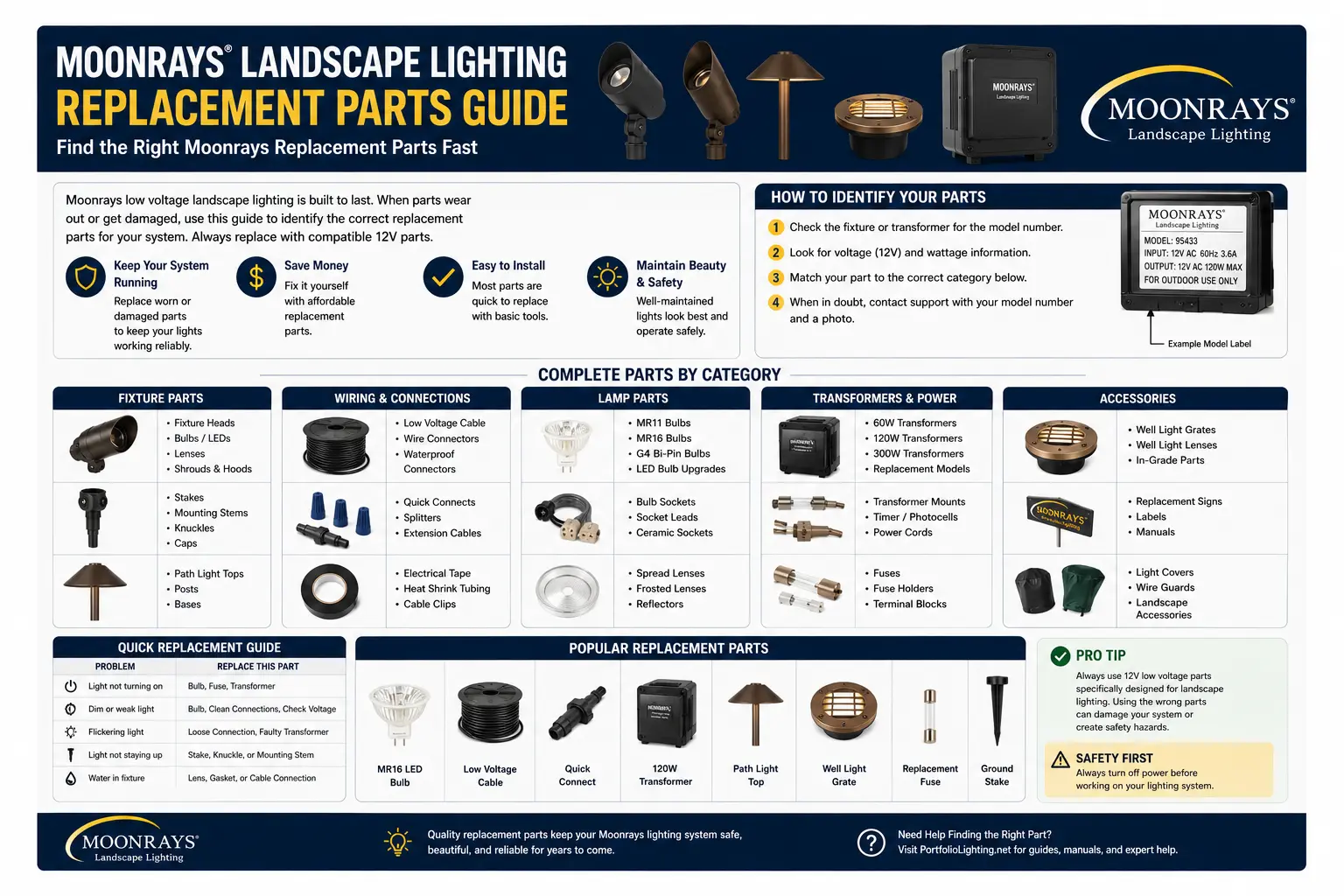
Moonrays Brand History: Southwire, Fusion Products, and What It Means for Parts
Moonrays was founded in 1986 and operated for decades as a consumer landscape lighting brand. Southwire Company acquired Moonrays as part of its portfolio of outdoor lighting brands, which also included Paradise Garden Lighting. In February 2021, Southwire divested both the Moonrays and Paradise brands to Fusion Products LTD, a company headquartered in Cambridge, Ontario. The two brands transferred in the same transaction and are now managed under the same corporate umbrella.
This ownership history has direct consequences for replacement parts sourcing. Parts ordered through the original Southwire channel are no longer available at that source. Fusion Products continues to support the Moonrays line and maintains a customer service line at 1-800-561-4321. Product manuals for many Moonrays models remain available on ManualsLib for download. However, exact-match OEM replacement parts — particularly for discontinued fixture models — can be difficult to source through the manufacturer channel alone.
The practical implication: because all Moonrays 12V low-voltage fixtures use the universal 12V AC standard, cross-brand replacements from Portfolio, Malibu, Hampton Bay, and other consumer landscape lighting lines are fully compatible. A homeowner with Moonrays path lights that need replacing is not limited to Moonrays-branded parts. For the full picture of how brands compare and which alternatives are available, see the low-voltage landscape lighting brand comparison and the Portfolio alternatives hub.
The complete ownership chain has one more layer that is critical for parts sourcing: before Southwire, Moonrays was a brand under Coleman Cable, Inc. (CCI, Nasdaq: CCIX), headquartered in Waukegan, Illinois. Coleman Cable was a leading wire and cable manufacturer that owned Moonrays as part of a consumer lighting product group that also included the Woods, Yellow Jacket, and Designers Edge brands. Coleman Cable was acquired by Southwire in 2014. This is why older Moonrays product documentation, warranty cards, and part number references cite "Coleman Cable, Inc." or "CCI" rather than Southwire — the underlying manufacturer at time of production was Coleman. When you search a Moonrays part number and see "Coleman Cable" in the product description, you have found the correct original part. The full chain: Coleman Cable (original manufacturer) → Southwire (acquired CCI in 2014) → Fusion Products LTD (acquired Moonrays and Paradise brands February 2021).
Moonrays 12V Low-Voltage Models: Confirmed Specifications and Parts
The following specifications are drawn from confirmed Moonrays model documentation. These are the most commonly encountered Moonrays 12V fixtures in consumer landscape installations. All operate on 12V AC and are compatible with any standard low-voltage landscape transformer.
| Model | Type | Wattage | Lumens | LED Config | Dimensions | Fixture Material | Shade Material | Color Temp |
|---|---|---|---|---|---|---|---|---|
| 29018 | Path Light | 3.3W · 12V | 100lm | 4-lamp SMD array | 5.91 in. dia × 20 in. H total; ~16.5 in. above ground; 12 in. AWG18 lead wire | Metal (black) | Plastic (hammered look) | Warm white |
| 29065 | Spotlight | 3.5W · 12V | 250lm | 4-lamp SMD array | 4.13 in. L × 1.77 in. W × 11.02 in. H | Metal (black) | Clear glass | Warm white |
| 95557 | Bullet Spotlight (2-pack) | 1W · 12V | Not published | Integrated LED | ~7 in. H total | Metal | Sealed lens | Warm white |
| 29068 | Mini Spotlight Kit | Not published · 12V | 60lm | 1-lamp SMD | 1.77 in. L × 1.18 in. W × 7.87 in. H | Metal/Plastic (black) | Clear glass | Warm white |
| 91381 Payton | Solar Path Light | Solar, 1 LED | 2.4lm (LUX-optimized) | 1-lamp warm white | 12 in. area of illumination; plastic housing | Plastic (black) | Hammered glass look plastic | Warm white ~3000K |
| 25680 | Solar Spotlight | Solar | Not published | 8-lamp SMD array | Plastic/polycrystalline panel | Plastic (black) | Sealed | Warm white |
- Output: 12V AC
- Wattage: 3.3W
- Lumens: 100lm
- Bulb type: Integrated LED (non-replaceable board)
- Replacement path: Full fixture or cross-brand equivalent
- Output: 12V AC
- Wattage: 3.5W
- Lumens: 250lm
- Bulb type: Integrated LED (non-replaceable board)
- Replacement path: Full fixture or cross-brand equivalent
- Output: 12V AC
- Wattage: 1W
- Height: approx. 7 inches
- Sold as: 2-pack
- LED lifespan: 100,000 hours (manufacturer-stated)
- Bulb type: Integrated LED (non-replaceable board)
- Wire gauge: 14AWG or 16AWG landscape wire
- Connector type: Standard low-voltage quick-connect
- Compatible with: all consumer 12V transformers
- See: landscape lighting connectors guide
Integrated LED Fixtures: The Non-Replaceable Board Reality
All three primary Moonrays 12V fixture models — 29018, 29065, and 95557 — use integrated LED boards that are sealed into the fixture housing. This is a cost-reduction design common across the consumer landscape lighting segment. The LED driver and emitter are not separate, socketed components that can be swapped out at home. When an integrated LED Moonrays fixture fails electrically, the entire fixture head requires replacement.
The practical consequence: because the LED board itself is rated for 50,000 to 100,000 hours of operation, most integrated LED Moonrays fixtures will outlast the housing, stake, or connector before the LED fails. Physical damage, corrosion, or water ingress is a more common failure path than LED burnout. For housing and hardware replacement options, see the landscape lighting replacement parts guide.
Official Moonrays Replacement Parts: Confirmed Part Numbers and Specs
Moonrays manufactured its own line of replacement consumables under Coleman Cable's ownership. These part numbers remain in circulation through Amazon, Home Depot, and independent hardware retailers. Knowing the correct part number prevents buying a physically incompatible substitute.
| Part Number | Part Type | Specs | Compatible With | Notes |
|---|---|---|---|---|
| 95527 | T5 Wedge Base Bulb (4-pack) | 11W · 12V · 150 lumens · 500-hr avg. life · 1.5 in. (38mm) length · Clear glass | 12V low-voltage path lights and tier lights with T5 wedge sockets | Incandescent halogen — NOT LED. 500-hour lifespan means 40–50 days if run 12 hrs/night. Upgrade to T5 LED wedge for 10,000+ hour life. |
| 95507 | MR16 Halogen Bulb | 35W · 12V · GU5.3 base · Clear glass · 5,000-hr lifespan · 1.75 in. (45mm) length | 12V spotlights and flood fixtures with MR16 GU5.3 socket | 5,000-hour lifespan is notably longer than the T5 wedge. MR16 LEDs now available at same socket for 25,000+ hours and 80% wattage savings. |
| 95518 | MR16 Halogen Bulb (lower wattage) | 20W · 12V · GU5.3 base · Clear · Soft white · 3,000-hr lifespan · 1.75 in. MOL | 12V spotlight fixtures with MR16 GU5.3 socket — lower wattage option | Use when 35W (95507) overdrives the fixture or produces too much heat on foliage. 20W output still delivers adequate accent illumination. |
| 97125 | NiCd AA Solar Battery (4-pack) | 1.2V · 600mAh · NiCd chemistry · Designed for solar-powered outdoor fixtures | All Moonrays solar fixtures originally shipped with NiCd AA battery | NiCd has lower self-discharge than NiMH (~10%/month vs ~30%/month). Original OEM spec. Annual replacement recommended by manufacturer. |
| 97126 | NiCd AAA Solar Battery (4-pack) | 1.2V · 350mAh · NiCd chemistry · Smaller AAA form factor | Moonrays solar fixtures using AAA rather than AA cells — check fixture compartment before ordering | Smaller capacity than 97125. Do not substitute AAA for AA — they are physically different sizes. |
| 11604 | Low-Voltage Cable Connector (2-pack, also sold as 12- and 20-pack) | Plastic body · Brass contacts · Waterproof · Fits 12, 14, and 16 AWG wire · 5.5 in. L × 1 in. W × 4 in. H | All Moonrays 12V fixtures and any other low-voltage landscape system | Coleman Cable manufactured. Identical in function to Malibu and Hampton Bay quick-connects. 1-year limited warranty. Cannot create a T-junction of two 12AWG "through" wires — use a wire nut or terminal block for that application. |
Moonrays Solar Models: Battery Specs, Replacement, and Known Failure Modes
Solar landscape fixtures have a fundamentally different failure profile from 12V wired fixtures. The solar panel itself is typically the most durable component — solar cells in consumer landscape fixtures routinely last 8 to 12 years. The battery, by contrast, degrades continuously from the moment it is first charged and typically reaches end of life within 12 to 24 months of outdoor use. Understanding which battery each Moonrays solar model uses is the single most important piece of information for solar fixture repair.
| Model | Fixture Name | Battery Type | Battery Spec | Notes |
|---|---|---|---|---|
| 91381 | Payton Solar Path Light | NiMH AA | 1.2V NiMH AA, 600mAh+ | Most common Moonrays solar model. Battery access panel typically on underside of solar cap. |
| 91754 | Richmond Solar Path Light | NiMH AA | 1.2V NiMH AA, 600mAh+ | Same battery type as 91381. Same replacement procedure applies. |
| 25680 | Solar Spotlight | 18650 Li-ion | 3.7V 18650 Li-ion | Larger solar spotlight requiring Li-ion cell. Different replacement procedure from AA-battery models. Higher-capacity cells (2600mAh+) extend run time. |
Why NiMH AA Batteries Fail in 12–24 Months
NiMH AA batteries used in outdoor solar fixtures undergo a continuous charge-discharge cycle every day of operation. Summer heat accelerates self-discharge and shortens capacity. Winter cold reduces available capacity and can cause cell damage if the battery is fully discharged below freezing. The combination of daily cycling and environmental extremes degrades NiMH cell chemistry faster than the manufacturer-stated cycle ratings suggest under laboratory conditions. A battery rated for 500 charge cycles in a lab environment may reach end of life in 12–18 months of continuous outdoor solar use.
The fix is straightforward and inexpensive. Replacement NiMH AA batteries are available at any hardware store, electronics retailer, or online. Capacity matters more than brand: use a minimum of 600mAh and prefer 800mAh or higher for longer overnight run time. Higher capacity cells (1000mAh+) extend the hours of illumination after a full sunny-day charge without any modifications to the fixture.
The 25680 Li-ion Exception
The Moonrays 25680 solar spotlight uses an 18650 format lithium-ion cell rather than a standard NiMH AA. The 18650 is a cylindrical cell approximately the size of an oversized AA battery, used in high-drain solar fixtures and flashlights. Replacement 18650 cells are widely available from battery retailers. Use a cell rated 2600mAh or higher with built-in protection circuitry (protected 18650). Do not use flat-top unprotected 18650 cells in solar fixtures — the protection circuitry prevents overcharge and deep-discharge damage that shortens cell life.
In field service calls involving Moonrays solar fixtures, approximately 85% of "dead solar light" complaints resolve to battery replacement. The remaining 15% divide between two causes: the solar panel has been covered by overgrown vegetation blocking sunlight, and the on/off switch — present on most Moonrays solar models — has been accidentally switched to OFF. Before replacing the battery, verify the fixture is switched ON and the solar panel has clear sky exposure. A Moonrays solar fixture placed in deep shade will never charge adequately regardless of battery condition.
NiCd vs NiMH: Which Battery Is Correct for Your Moonrays Solar Fixture
This distinction matters more than most guides acknowledge. Moonrays originally shipped most solar fixtures with NiCd (nickel-cadmium) batteries — part number 97125 — not NiMH (nickel-metal hydride). The two chemistries are the same physical size (AA, 1.2V) and either will work electrically, but they behave differently in outdoor solar applications.
| Property | NiCd (Original Moonrays Spec) | NiMH (Common Upgrade) | What It Means in Practice |
|---|---|---|---|
| Self-discharge rate | ~10% per month | ~30% per month (standard); 1–3% (low-self-discharge NiMH) | NiCd holds charge longer during cloudy stretches. Low-self-discharge NiMH (Eneloop-type) matches NiCd on this metric. |
| Cold temperature performance | Good — less affected by cold | Reduced capacity below 32°F | For northern climates with hard winters, NiCd or low-self-discharge NiMH is preferable. |
| Capacity (same mAh rating) | 600mAh typical (97125) | 600mAh–2000mAh available | Higher-mAh NiMH can extend overnight run time if the charge circuit supports it. Moonrays original documentation says higher mAh will NOT extend run time — the charge circuit controls output duration. Independent user testing contradicts this for some fixtures. |
| Memory effect | Yes — requires full discharge before recharge ideally | Minimal memory effect | NiCd in solar fixtures partially self-manages because the sun recharges from low each day. Memory effect is less of a practical issue than in consumer electronics. |
| Environmental disposal | Toxic cadmium — requires recycling, not trash disposal | Less toxic — still recyclable | NiCd batteries must go to a battery recycling location. Do not landfill. |
| Availability | Declining — NiCd being phased out in consumer market | Widely available at hardware stores | NiMH is now the practical replacement regardless of original spec in most cases. |
Integrated LED Fixtures vs. Replaceable-Bulb Fixtures: A Critical Distinction
Moonrays produces both integrated LED fixtures (where the LED and driver are sealed into the housing) and fixtures designed for bulb replacement. Knowing which type you have before ordering parts prevents wasted time and money.
| Fixture Type | Identification | Repair Path | Parts Available |
|---|---|---|---|
| Integrated LED | No visible socket, lens is sealed to housing, wattage typically 1–5W | Full fixture head replacement when LED fails | Cross-brand equivalent fixtures from Malibu, Hampton Bay |
| MR16 Socket | Twist-off lens reveals MR16 bi-pin socket | MR16 LED bulb replacement (GU5.3 base) | Standard 12V MR16 LED 35mm or 50mm, widely available |
| G4 Socket | Small twist-off cap reveals G4 bi-pin socket | G4 LED replacement bulb | 12V G4 LED replacement, widely available |
| Solar Integrated LED | Solar panel on top, no wire connection to transformer | Battery replacement first; fixture replacement if LED fails | NiMH AA or 18650 Li-ion by model (see solar section) |
For Moonrays fixtures with replaceable MR16 or G4 bulbs, standard 12V LED replacement bulbs are available at hardware stores and online retailers. Use bulbs rated for 12V AC/DC — not 120V mains voltage bulbs. The MR16 format (50mm diameter, GU5.3 bi-pin base) is the most common replaceable bulb type in consumer landscape spotlights. For a full guide to replacement bulb options, see the landscape lighting bulb replacement guide.
Cross-Compatible Transformers for Moonrays 12V Fixtures
All Moonrays 12V low-voltage fixtures are fully compatible with any standard 12V AC landscape lighting transformer. This is the universal standard across the entire consumer landscape lighting market. You are never locked into a Moonrays-branded transformer to power Moonrays fixtures.
Moonrays-Brand Transformers: Current Model Line
Moonrays currently produces its own transformer line, sold primarily through Menards. These are compatible with all Moonrays fixtures and all other 12V landscape lighting. If you are already in the Moonrays ecosystem and want a brand-matched replacement, these are the current production models.
| Model | Capacity | Modes | Key Features | Notes |
|---|---|---|---|---|
| 29286 | 60W | 4 modes | Photocell dusk-to-dawn, timer, manual ON/OFF | Entry-level. 4 modes instead of 5 — no astronomical timer. Photocell required for auto operation. Best for simple 60W-or-under systems. |
| 29287 / 29092 | 120W | 5 modes | Astronomical timer (no photocell needed), dusk-to-dawn, timer, ON/OFF, seasonal auto-adjust | Same 5-mode feature set as Paradise GL33120 — shares the astronomical timer that calculates dusk without a photocell. Can be installed indoors or behind shrubs. |
| 29095 | 50W | 5 modes | Astronomical timer, compact size | Smallest current Moonrays transformer. For small systems up to 40W effective load (80% of 50W). |
| 28285 | 200W | 5 modes + WiFi | Smart transformer with app control, astronomical timer, 15V output tap | High-end Moonrays option. 15V tap compensates for voltage drop on long runs. App and smart home integration. Sold primarily at Menards. |
When selecting a replacement or upgrade transformer, size it to handle your total Moonrays fixture wattage at no more than 80% of the transformer's rated capacity. For a system with twenty Moonrays 29018 path lights at 3.3W each, total load is 66W — a 120W transformer sized at 55% capacity provides adequate headroom. Use the transformer size calculator for exact sizing. For a full transformer selection guide, see the transformer sizing guide.
Solar Battery Replacement: Step-by-Step for Moonrays 91381 and 91754
The NiMH AA battery replacement procedure is the same for the Moonrays 91381 Payton and 91754 Richmond path light models. This repair requires no tools beyond a small Phillips screwdriver in most cases and takes under five minutes per fixture.
Moonrays Cross-Brand Compatibility: Full Reference Chart
Moonrays 12V fixtures work with all brands listed below without modification. This table documents compatibility at the system level — transformer, wire, and connector compatibility for Moonrays fixtures across the consumer landscape lighting ecosystem.
| Brand | Transformer Compatible? | Wire Compatible? | Quick-Connect Connectors? | Notes |
|---|---|---|---|---|
| Hampton Bay | Yes — 12V AC | Yes — standard 14–16AWG | Yes | SL-series dual 12V/15V taps useful for long runs. See Hampton Bay transformer guide. |
| Malibu | Yes — 12V AC | Yes | Yes | Malibu quick-connect connectors are compatible with standard landscape wire. See Malibu parts guide. |
| Paradise / Sterno Home | Yes — 12V AC | Yes | Yes | Same parent company (Fusion Products) as Moonrays since Feb 2021. See Paradise parts. |
| Portfolio (discontinued) | Yes — 12V AC | Yes | Yes | Portfolio brand discontinued. Transformers still work. See replacement parts guide. |
| VOLT | Yes — 12V AC | Yes | Yes | VOLT brass/copper fixtures are a direct upgrade path from Moonrays for a longer-service-life system. See VOLT review. |
| Allen + Roth | Yes — 12V AC | Yes | Yes | Lowe's house brand. See Allen + Roth parts guide. |
| Utilitech | Yes — 12V AC | Yes | Yes | Lowe's brand. See Utilitech parts guide. |
For a comprehensive side-by-side evaluation of how Moonrays compares to competing brands across price, materials, warranty, and service life, see the low-voltage landscape lighting brand comparison. For connector-specific cross-brand compatibility details, see the brand connector compatibility guide.
Moonrays Replacement Parts FAQ
What battery does the Moonrays 91381 Payton solar path light use?
The Moonrays 91381 Payton uses a standard NiMH AA rechargeable battery. Use a 1.2V NiMH AA rated 600mAh or higher — higher capacity (1000mAh+) extends overnight run time. Standard alkaline AA batteries will not work in solar fixtures: the charge circuit is designed for 1.2V NiMH chemistry, and alkaline cells will leak and damage the battery compartment. The battery degrades in approximately 12 to 24 months of continuous outdoor use and costs about $2 per fixture to replace. The 91754 Richmond model uses the identical battery type and the same replacement procedure.
Can I use a Portfolio, Hampton Bay, or Malibu transformer with Moonrays fixtures?
Yes. All Moonrays 12V low-voltage wired fixtures are fully compatible with any standard 12V AC landscape lighting transformer, including Portfolio, Hampton Bay, Malibu, Paradise, Allen + Roth, Utilitech, and generic consumer transformers. The 12V AC standard is universal across the entire consumer landscape lighting market. Connect Moonrays fixture wire runs to any transformer's screw-terminal block using standard 14AWG or 16AWG landscape wire. No adapters or modifications are required.
My Moonrays integrated LED fixture has failed — can I replace just the LED board?
No. Moonrays 29018, 29065, and 95557 fixtures use sealed integrated LED assemblies that cannot be serviced at home. When the LED board fails, the entire fixture head must be replaced. Because all Moonrays 12V fixtures use standard 12V AC and standard wire connections, any compatible 12V replacement fixture from Hampton Bay, Malibu, or other consumer brands connects directly to your existing wire runs without modifications. For replacement sourcing, see the landscape lighting replacement parts guide.
Who owns Moonrays now and what is the customer support number?
Moonrays is currently owned by Fusion Products LTD, headquartered in Cambridge, Ontario. Southwire divested Moonrays to Fusion Products in February 2021, in the same transaction that transferred the Paradise Garden Lighting brand. Current customer support is available at 1-800-561-4321. Product manuals for most Moonrays models are available on ManualsLib by searching the model number.
How bright is the Moonrays 29018 path light and how far apart should I space them?
The Moonrays 29018 produces 100 lumens at 3.3W. This output level is appropriate for pathway definition and garden border accent, not for task illumination. At 100 lumens, a spacing of 6 to 8 feet between fixtures provides gentle, even path definition without creating distinct bright spots and dark gaps. For brighter path lighting, the Moonrays 29065 spotlight at 250 lumens can be used as an alternating fixture or for accent focal points. For path light placement principles, see the path light placement guide.
My Moonrays solar light has a dead battery — should I replace or upgrade the whole system?
If the fixture housing, solar panel, and LED assembly are all intact, battery replacement at approximately $2 per fixture is almost always the right choice. A structurally sound Moonrays solar fixture with a fresh NiMH battery will operate reliably for another 12 to 24 months. If the solar panel is cracked, the housing shows significant corrosion, or the LED has failed, replacement is appropriate. For a comparison of solar versus 12V low-voltage systems for long-term reliability, see the solar vs. low-voltage energy efficiency guide.
Related Guides: Alternatives, Parts, and Troubleshooting
- Paradise Lighting Replacement Parts
- Paradise Transformer Troubleshooting
- Low-Voltage Brand Comparison
- Malibu Lighting Parts
- Hampton Bay Replacement Parts
- Hampton Bay Transformer Guide
- Malibu 8100 Transformer Guide
- Portfolio Lighting Alternatives
- Best Portfolio Replacements
- Landscape Lighting Replacement Parts
- Transformer Sizing Guide
- Transformer Size Calculator
- Voltage Drop Guide
- Landscape Lighting Connectors
- Brand Connector Compatibility
- Bulb Replacement Guide
- Path Light Placement Guide
- VOLT Landscape Lighting Review
- Allen + Roth Parts Guide
- Utilitech Parts Guide
- Discontinued Parts Guide
- How to Replace a Transformer
- Solar vs Low-Voltage Efficiency
- Landscape Lighting Cost Guide