
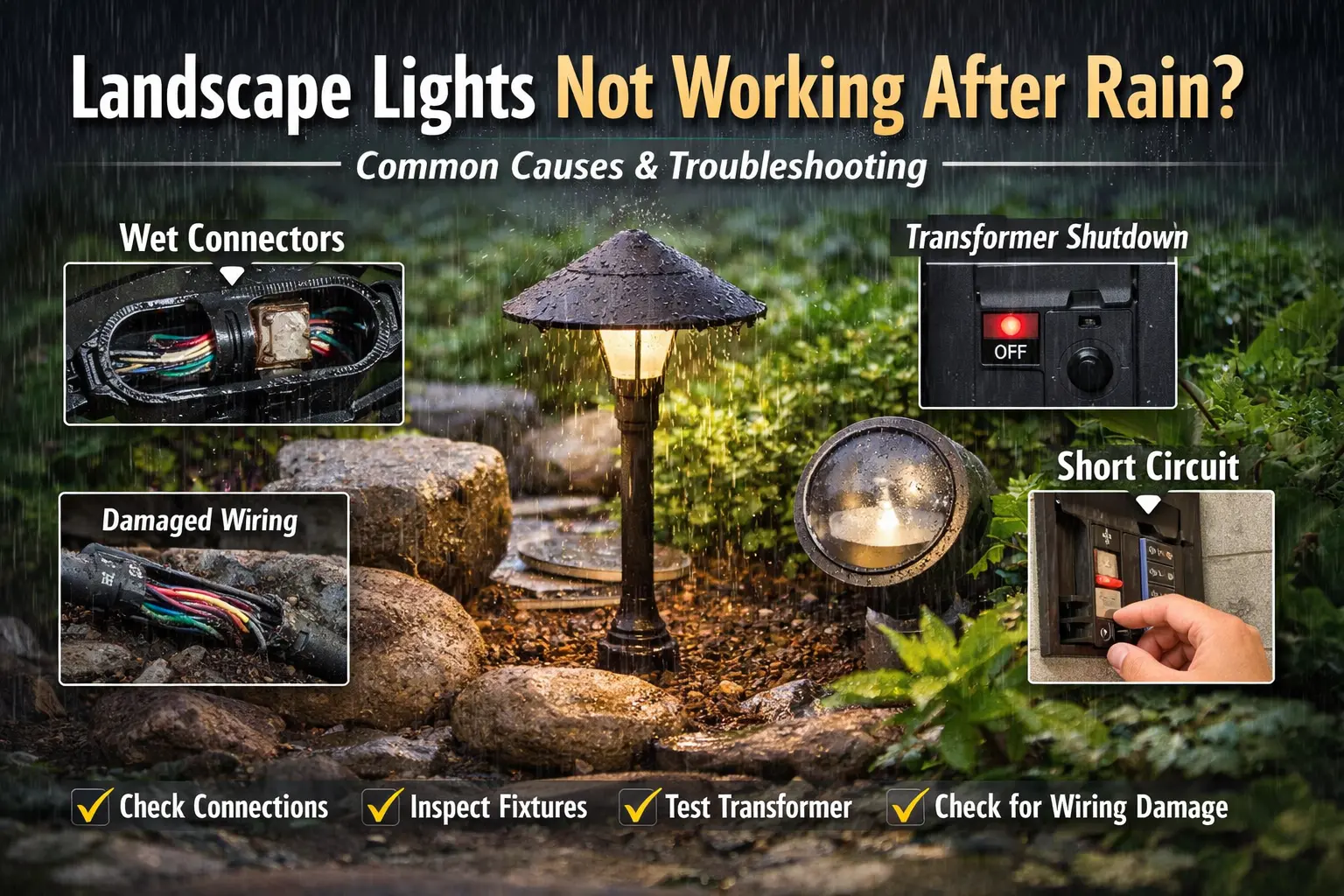
Quick Answer: Why Did My Landscape Lights Stop Working After Rain?
Landscape lights usually stop working after rain because water gets into connectors, fixtures, or damaged cable and creates a short circuit or causes the transformer to shut down. In most cases, the problem is one wet connection or one damaged section of wire—not the entire system.
The fastest way to fix it is to check connectors first, then test the transformer, inspect fixtures for water, and isolate one section of the lighting run at a time until the fault is found.
1. Check wet connectors
2. Check transformer output
3. Inspect fixtures for water
4. Isolate sections of the wiring run
Entire system off → check transformer
Some lights off → check connectors
One light off → check fixture
Works when dry → hidden moisture fault
For full system diagnosis, go to lighting troubleshooting.
When outdoor lights fail after rain, the problem is usually not random. Moisture tends to expose the weakest point in the system first, whether that is a connector, fixture, buried splice, or damaged section of cable.
The most common causes are wet connectors, transformer shutdown, water inside fixtures, damaged underground wire, and corroded electrical connections. Start with the quick diagnosis table below, then work through the system one section at a time instead of replacing parts too early.
Why Landscape Lights Stop Working After Rain
Landscape lights usually stop working after rain because water exposes a weakness in the electrical path. The most common causes are moisture in wire connectors, short circuits in the wiring, water inside fixtures, damaged underground cable, transformer shutdown from overload or fault protection, and corroded electrical connections.
Some systems fail completely after a storm, while others lose only one branch of lights. If the entire system goes dark, focus first on the transformer and main feed. If only some lights stop working, the problem is more often local to one connector, one splice, one fixture, or one damaged section of wire.
If your seasonal lights also stop working after rain, follow our weatherproofing outdoor holiday lights guide to protect plugs, cords, sockets, and connections.
Lights that fail after rain can leave paths, stairs, and driveways unexpectedly dark. The outdoor lighting failure liability guide explains why rain-related outages should be repaired quickly when lighting supports safe access.
Some outdoor fixtures fail after storms because they were never designed for severe moisture exposure. The outdoor fixture IP rating and rain exposure guide explains how enclosure protection levels affect real-world landscape lighting reliability.
Most Common Moisture Causes
- water inside wire connectors
- wet buried splice points
- fixture housing taking on water
- corroded low-voltage connections
Most Common Cable Causes
- damaged underground cable insulation
- cut wire exposed to wet soil
- pinched cable that fails when wet
- older cable with cracked jacket
Most Common Transformer Clues
- entire system stopped at once
- transformer shut down after rain
- breaker or protection tripped
- system works again after drying out
Most Common Fixture Clues
- one light filled with moisture
- well lights or low fixtures fail first
- only one section stays dark
- fixture lens or seal looks damaged
If rain keeps causing connector failures, GFCI trips, or fixture corrosion, a commercial-grade landscape lighting upgrade may solve the root problem with better fixtures, splices, and weather protection.
Some outdoor lighting systems fail only during wet weather and then begin working again after drying out. The landscape lights work sometimes troubleshooting guide explains how moisture, damaged connectors, and underground cable issues create intermittent failures.
When landscape lights stop working after rain and the outlet or breaker trips, the problem is often a wet splice, water-filled fixture, or underground cable fault. The rain-related landscape lighting GFCI trip guide explains what to check first.
Quick Diagnosis Table for Landscape Lights Not Working After Rain
Use this table to match the exact symptom you are seeing to the most likely moisture-related cause before you start replacing transformers or digging up the entire run.
After rain, timer and control problems can sometimes appear alongside wiring or connector issues, especially if moisture has affected the transformer or control components. Our Landscape Lighting Timer Not Working guide can help you rule out timer failure as part of the troubleshooting process.
If your system still has power but performance is inconsistent, voltage imbalance may be part of the issue. Use the voltage tap calculator to verify your output voltage is correct for your setup.
If the failed fixture is an in-ground well light, do not treat it like a normal path light. The well light water intrusion repair guide shows how drainage, gasket failure, and vampire-clip corrosion cause repeated outages.
Rain-related lighting failure is often blamed on buried cable or wet fixtures, but the first water-entry point may be the receptacle itself. A flat outlet cover, cracked gasket, upward-facing cord loop, or worn weather-resistant receptacle can let moisture reach the plug blades and trip the circuit before the transformer ever gets involved. The outdoor lighting receptacle code requirements page explains why wet-location covers, GFCI protection, and drip-loop placement matter so much for lighting systems that fail after storms.
| Symptom | Likely Cause | What To Check | Detailed Fix |
|---|---|---|---|
| Entire system stopped after rain | Transformer shutdown | Transformer output, GFCI, breaker, protection trip | Portfolio lighting transformer troubleshooting |
| Some lights are off | Wet connectors | Splice points, branch connectors, low spots | Landscape lighting cable guide |
| Breaker is tripping | Short circuit | Cable damage, wet splices, flooded fixtures | Portfolio landscape lights short circuit |
| Lights flicker after rain | Moisture in wiring | Connectors, sockets, wet branch sections | Landscape lights flickering |
| Only one fixture is off | Water inside fixture | Fixture housing, lens seal, socket area | Landscape lighting replacement parts guide |
| System works when dry, fails when wet | Corroded connection or hidden cable damage | Buried splices, damaged insulation, low-ground areas | How to wire landscape lighting |
How to Troubleshoot Landscape Lights After Rain
Rain-related failures are often tied to GFCI protection reacting to moisture. Learn how this works in outdoor lighting GFCI requirements.
Inspect wire connectors first
Wet connectors are one of the most common reasons outdoor lights stop working after rain. Open accessible connection points and look for water, corrosion, darkened copper, loose pierce connectors, or splices that were never sealed well in the first place.
Check the transformer
Transformers may shut down when they detect electrical faults caused by moisture or shorts in the run. If the entire system is dark, confirm the outlet still has power, check the GFCI, and look for signs that the transformer tripped, reset, or is no longer delivering output.
Look for damaged cable
Shovels, edging tools, pets, and landscaping work sometimes damage underground wire long before a storm reveals the problem. Once the ground is wet, exposed or cracked cable can short more easily and interrupt power to part or all of the system.
Inspect fixtures for water intrusion
Water inside the fixture housing can interrupt the circuit or damage sockets and internal contacts. Well lights, in-ground fixtures, and low-mounted path lights are especially vulnerable because they collect water more easily than elevated fixtures.
Test individual lighting runs
Disconnect sections of the system one at a time to isolate the failure point. If the system comes back when one branch is removed, that section usually contains the wet connector, damaged cable, or flooded fixture causing the fault.
Moisture in Landscape Lighting Connectors
Underground connectors can trap water over time, especially if they were poorly sealed, buried too shallow, or left in places where water collects. Moisture inside a connector may not cause a failure right away, but repeated wet-dry cycles can lead to corrosion, weak contact, and intermittent power loss.
This is one of the biggest reasons low-voltage landscape lights stop working after rain. A connector that seemed fine in dry weather may fail once moisture bridges the contact points or exposes corroded wire that was already weakening.
For deeper help, compare the cable and connector layout to landscape lighting cable guide and how to wire landscape lighting.
Moisture-related issues are common in outdoor systems, especially around connections and fixtures installed at ground level. Problems affecting Portfolio path lights, such as water intrusion, loose wire connections, or corroded terminals, should be inspected carefully after heavy rain.
If your lights stop working after rain, the issue may be water entering a splice or box. Review our outdoor lighting junction box requirements to check whether the connection is properly protected.
If your lights fail after rain, also watch for the opposite clue: some systems actually work only when wet because moisture is temporarily bridging a bad connection. That usually points to corroded copper, a pierced cable jacket, or an old connector that can show voltage but cannot carry load when dry.
Transformer Shutdown After Rain
A transformer may shut down after rain because moisture-related faults in the lighting run make the system look overloaded or shorted. Some transformers stop sending power when they detect unsafe conditions, while others trip protection or appear dead until the fault is removed.
If the whole system stopped after rain, the transformer becomes one of the first places to check, especially if the outlet still works and the lights were fine before the storm. In many cases the transformer is not the original problem. It is simply responding to a wet fault elsewhere in the run.
For deeper transformer-specific help, review Portfolio lighting transformer troubleshooting, landscape lighting transformer guide, and landscape lights tripping breaker.
Short Circuits Caused by Water
Water can create short circuits by bridging electrical contacts, filling damaged fixtures, or reaching exposed cable where the insulation has failed. In low-voltage systems, that kind of wet fault may shut down the transformer, trip protection, or kill power to one branch of the run.
Short circuits after rain are especially common in older systems with weathered splices, damaged underground cable, and fixture housings that no longer seal properly. If the system went dark immediately after a storm, or if the breaker began tripping in wet weather, a short circuit becomes much more likely.
For a more specific short-focused guide, continue with Portfolio landscape lights short circuit and compare the symptom to the exact way your system is failing.
Why Some Landscape Lights Fail After Rain While Others Still Work
If only one section of the yard is dark, the transformer may still be fine and the problem may be limited to one branch. That usually points to one wet connector, one flooded fixture, or one damaged section of cable in the affected part of the run.
Start with the first fixture where the working section changes to the dead section. That transition point often reveals the connector, splice, or wire section that became a problem once everything got wet.
- one dead branch often points to one wet splice or connector
- one flooded fixture can affect later fixtures in the same run
- partial failure after rain is often easier to isolate than a full outage
- the first dead light is often near the real fault
Do Not Replace the Whole System First
Homeowners sometimes assume rain damage means the transformer, fixtures, and cable are all failing together. Sometimes a transformer does need replacement, but much more often the real cause is one wet connector, one damaged fixture seal, or one section of cable that was already weak.
That is why isolating the wet fault matters so much. A careful inspection of the most vulnerable points usually saves far more money than replacing the full system without diagnosis.
Portfolio Systems and Landscape Lights Not Working After Rain
Many outdoor lighting systems installed over the past two decades used Portfolio low-voltage transformers and fixtures sold through Lowe’s. If your landscape lights stopped working after rain and your system includes Portfolio components, the issue may be related to moisture in connectors, transformer shutdown, or wiring damage in the lighting run. You can explore more detailed troubleshooting in our Portfolio lighting troubleshooting guide, review outdoor system layouts in Portfolio landscape lighting, diagnose transformer issues in Portfolio lighting transformer troubleshooting, or learn how wiring systems are connected in our Portfolio lighting wiring diagram guide.
Landscape Lights Not Working After Rain FAQ
Why do landscape lights stop working after rain?
The most common causes are moisture inside wire connectors, water entering fixtures, damaged underground cable, transformer shutdown from a short circuit, and corroded electrical connections.
Can rain damage landscape lighting systems?
Yes. Rain can expose weak connectors, cracked fixtures, damaged cable insulation, and poorly sealed splice points. Water intrusion can create shorts, corrosion, and full or partial power loss.
Why do outdoor lights stop working after a storm?
Storms can saturate the ground, push water into fixtures and splices, trip transformer protection, and expose damaged cable or connectors that were already weak.
Can water cause a transformer to shut down?
Yes. Moisture-related faults in the lighting run can cause overload or short-circuit protection to trip, which can make the transformer shut down or stop sending power.
How do you fix landscape lighting after rain damage?
Start by checking wet connectors, transformer behavior, fixture housings, buried cable, and branch sections one at a time. Dry or replace damaged connections and isolate the part of the run causing the fault.
Final Thoughts on Landscape Lights Not Working After Rain
Landscape lights that stop working after rain usually point to one core issue: moisture exposed a weak spot in the system. The most common places to check are connectors, buried splices, damaged cable, wet fixtures, and the transformer response to those faults.
Start with the wettest and most vulnerable parts of the run first, then isolate the system one branch at a time. That troubleshooting order gives you the best chance of finding the real moisture-related failure without replacing more than necessary.
More Landscape Lighting Troubleshooting Guides
Landscape Lights Not Working
Main troubleshooting page for low voltage landscape lights that stop working fully or partially.
Fix landscape lights not workingLandscape Lights Not Turning On
Use this page when the system stays dark because of outlet, transformer, timer, or wiring problems.
Fix landscape lights not turning onLandscape Lights Flickering
Fix unstable lighting caused by loose connections, bad transformers, weak runs, or inconsistent power.
Fix flickering landscape lightsLandscape Lights Tripping Breaker
Diagnose overloads, damaged cable, wet connections, and faults that trip circuit protection.
Fix breaker tripsLandscape Lighting Cable Guide
Review cable selection, run planning, and common low-voltage wiring mistakes.
Landscape lighting cable guideLandscape Lighting Transformer Guide
Learn how transformers respond to faults, overload, and moisture-related failures.
Landscape lighting transformer guideHow to Wire Landscape Lighting
Review practical cable and connector setup before rebuilding a wet or damaged section of the run.
How to wire landscape lightingLandscape Lighting System Diagram
See how transformers, connectors, runs, and fixtures fit together before tracing a moisture-related fault.
View system diagramUnderstanding Landscape Lights That Stop Working After Rain
This page is designed to help readers diagnose landscape lights that stop working after rain by matching the moisture-related symptom to the most common causes first. Use the diagnosis table and step-by-step checks above before replacing the transformer or rebuilding the entire lighting run.
Because this symptom is usually tied to wet connectors, water intrusion, transformer shutdown, and damaged cable, this page focuses on those moisture-related faults instead of broader design topics. That makes it more useful for homeowners trying to solve the exact problem quickly.