Portfolio Indoor Lighting
This is the broader indoor lighting hub and the best starting point for understanding how ceiling lighting fits into the full room-lighting cluster.
Read the guide
The best ceiling lighting depends on your room size, ceiling height, and how the space is used—but most rooms work best with a fixture that provides even light and is supported by additional lighting layers.
Start here: use flush mount lights for low ceilings, chandeliers or pendants for larger spaces, and recessed lighting when you need even coverage.
Many room-lighting problems begin when a space depends too heavily on a single ceiling fixture and nothing else supports it. A room may technically have light, but the light may be poorly placed, too harsh, too weak, or not well matched to the way the room is used. That is why ceiling lighting matters so much. It is not just about the fixture style. It is about how that fixture fits into the full room-lighting plan.
This page is designed to help you understand ceiling lighting clearly. You will learn what ceiling lighting is, which fixture types fit different spaces, how to choose the right brightness, how ceiling lighting compares with other fixture categories, and how it works best when layered with wall lights, lamps, or room-specific task lighting.
This page works as the main ceiling lighting hub in the indoor cluster. If you want the broader indoor foundation first, start with Portfolio indoor lighting. If you are planning room lighting layout in more detail, also see indoor lighting layout guide.
See the Indoor Lighting HubThe best ceiling lighting depends on ceiling height and room size. Flush mount fixtures work best for low ceilings, chandeliers and pendants work well in larger rooms, and recessed lighting provides even coverage across the space.
Stairwells often need a different ceiling-lighting plan than flat rooms because the ceiling height, landing position, and step shadows change as you move. The stairwell ceiling lighting guide explains fixture placement for safer staircase visibility.
Ceiling lighting provides the ambient base layer in most rooms. That means it delivers the general room light that makes the space usable overall before other lights add task support, softness, or accent. In practical terms, ceiling lighting often decides whether the room feels bright enough to move through comfortably, whether dark areas remain in the corners, and whether other lights in the room have to work too hard to compensate.
Good ceiling lighting does not need to do every job in the room by itself, but it should create a strong starting point. Once that base layer is right, the room becomes much easier to complete with lamps, wall lighting, task lights, or decorative fixtures that support the space in more specific ways.
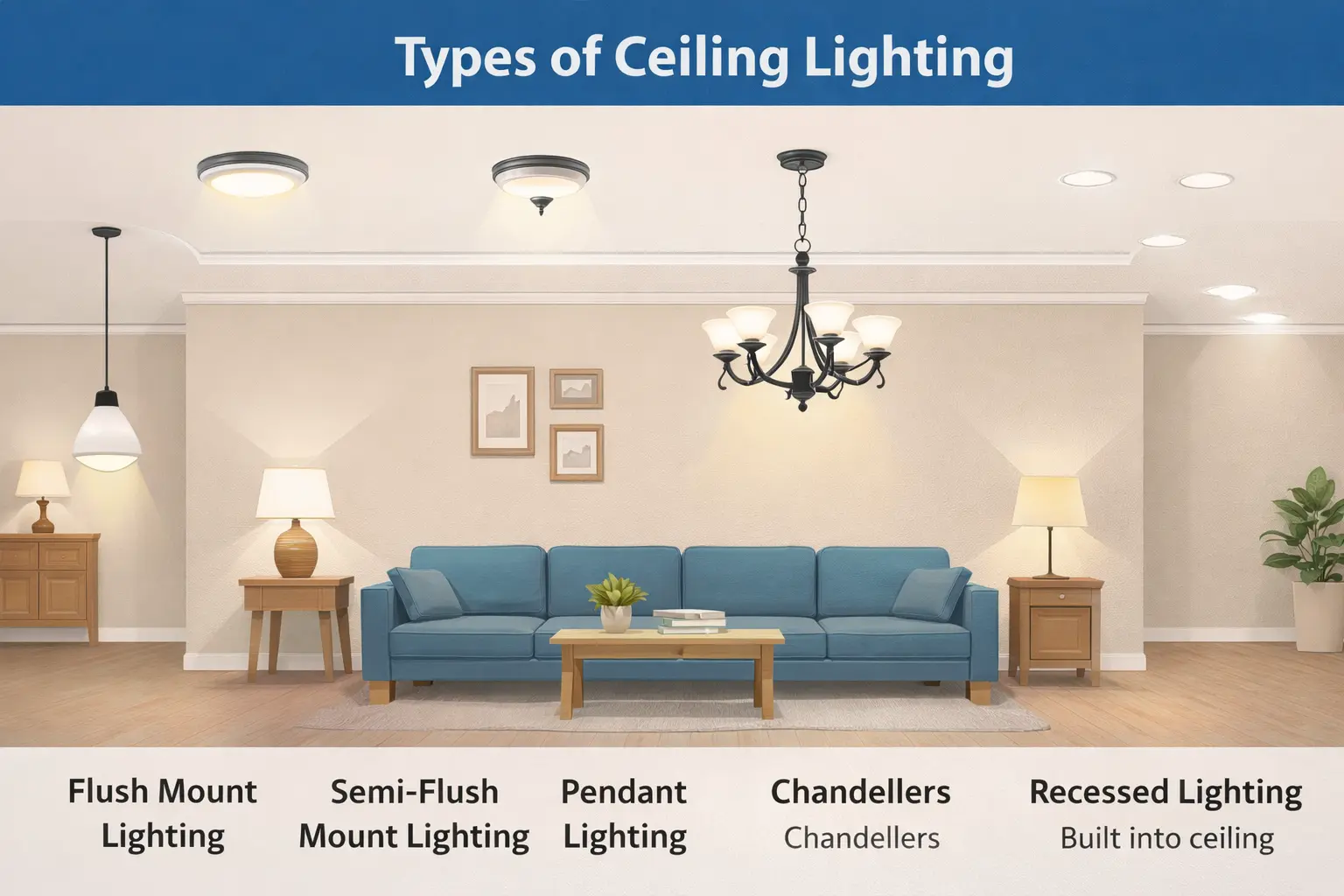
Ceiling lighting refers to fixtures mounted directly to the ceiling that provide general illumination across a room. In most spaces, ceiling lighting acts as the ambient or base layer of light. It is the main source that fills the room broadly before other fixtures add more focused or decorative effects.
Ceiling lighting can take several forms depending on the room and the style of the home. Common examples include flush mount fixtures, semi-flush mount fixtures, chandeliers, pendant lights, and recessed lighting. Some rooms rely on one central ceiling fixture. Others use several ceiling-mounted fixtures spaced across the room for more even coverage.
Flush mount fixtures sit close to the ceiling and are one of the most practical choices for rooms with lower ceiling height. They are often used in bedrooms, hallways, smaller rooms, and spaces where a hanging fixture would feel too low or crowded.
Semi-flush fixtures hang slightly below the ceiling instead of sitting tight against it. They add a little more visual style than flush mount fixtures while still working well in rooms that do not have very tall ceilings.
Chandeliers are more decorative ceiling fixtures that often serve as both a light source and a focal point. They are commonly used in dining rooms, entryways, and selected living spaces. For the dedicated category page, see Portfolio chandeliers lighting.
Pendant fixtures hang from the ceiling and are especially common over islands, tables, and selected focal-point zones. While they are not always the main room light, they are still part of the ceiling lighting family because they are ceiling-mounted and often play an important role in the room plan. For more, see Portfolio pendant lighting.
Recessed lighting is built into the ceiling itself and provides clean, even room light without a visible hanging fixture. It is often used when a room needs broader coverage or a more minimal ceiling appearance. For deeper help, use Portfolio recessed lighting.
Ceiling lighting often provides the main room brightness in a living room, but it usually works best when combined with lamps or wall lights so the space feels softer and more balanced at night.
Standard ceiling fixtures often struggle in taller spaces. The high bay lighting layout and mounting guide explains how to light garages, workshops, storage buildings, and open commercial ceilings more effectively.
Bedrooms often use ceiling lighting as the general room source while bedside lamps or other softer fixtures support evening use.
Kitchens often combine ceiling lighting with task lighting because the room needs both broad coverage and stronger light over work areas. Ceiling lighting gives the room its ambient base, while pendants or other fixtures handle more focused zones.
Hallways benefit from consistent ceiling lighting because the goal is usually safe, even navigation through the space.
Bathrooms use ceiling lighting for general room brightness, but the mirror area often needs additional help from vanity lighting or other more focused sources. For the room-specific category page, see Portfolio bathroom lighting.
Ceiling lighting is often one important layer in a room, but it rarely solves the whole lighting plan by itself. This room-by-room lighting plan guide explains how ceiling fixtures work alongside task and accent lighting so each room feels better balanced and more useful.
Ceiling lighting coverage depends on how many fixtures are used and how they are spaced across the room. This lighting calculator and spacing guide helps determine the correct number of lights for even coverage.
Ceiling lighting usually provides the broad ambient base for a room, while wall lighting often adds softer light, accent light, or secondary support lower in the space. For more on that category, see Portfolio wall lighting.
Ceiling lighting is fixed and built into the room plan, while floor lamps are portable and flexible. Lamps are often used to support reading corners, seating areas, and softer evening lighting. See Portfolio floor lamps.
Track lighting is still ceiling-mounted, but it is more directional and targeted than many standard ceiling fixtures. Ceiling lighting often aims for broad room coverage, while track lighting is useful when you want adjustable beams and more focused direction. For more, read Portfolio track lighting.
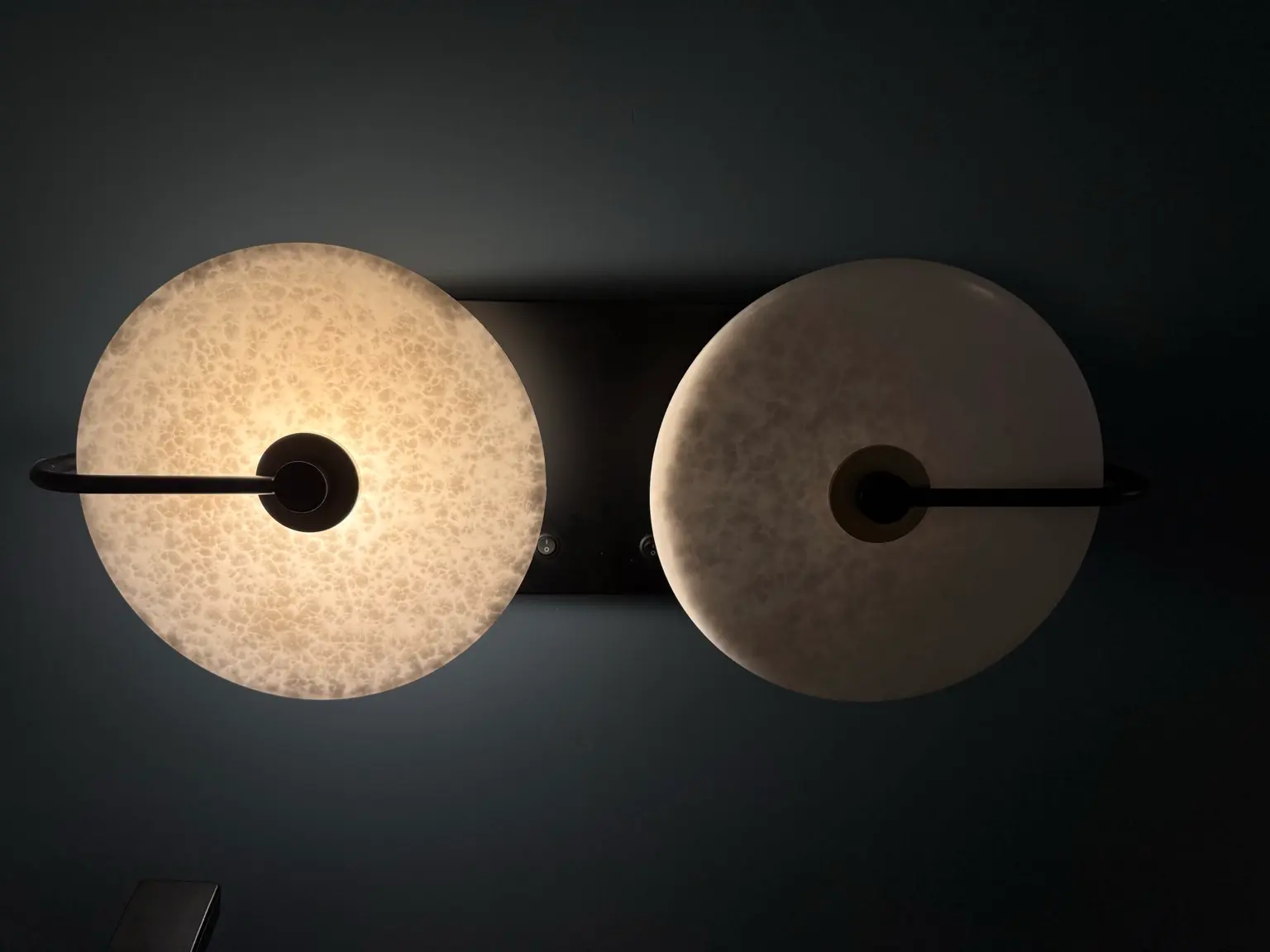
A ceiling fixture can look outdated or too harsh when the bulb and shade are not working together. The right LED bulb can improve efficiency, but the shade still controls glare, spread, and comfort.
For older Portfolio ceiling fixtures, inspect the socket condition, shade fit, bulb clearance, and dimmer compatibility before replacing the whole fixture.
Before replacing a ceiling fan, confirm that the electrical box is fan-rated, the mounting hardware is secure, and the blade clearance fits the room. A ceiling fan places dynamic load on the ceiling box in a way a standard light fixture does not, so it should not be treated as a simple fixture swap. Our Portfolio ceiling fans guide gives homeowners a practical overview of fan sizing, mounting height, light-kit selection, control options, and replacement planning for older Portfolio fan installations.
Brightness is easier to evaluate in lumens than in watts because lumens tell you how much visible light the fixture actually produces.
| Room Size | Common Ceiling Lighting Range | What to Keep in Mind |
|---|---|---|
| Small rooms | About 1,500 to 2,500 lumens | Works well when the room is compact and may also have lamp support |
| Medium rooms | About 2,500 to 4,000 lumens | A good range for many bedrooms, living rooms, and multipurpose spaces |
| Large rooms | 4,000 lumens or more | Large rooms may need stronger fixtures or multiple ceiling light sources |
Ceiling lighting often performs best when it is not the only source in the room. Other fixtures can reduce shadows, improve comfort, and keep the ceiling light from having to do every job alone.
The best ceiling fixture depends on several practical factors:
Lower ceilings usually work better with flush or semi-flush fixtures. Taller ceilings give you more flexibility for chandeliers, pendants, or larger visual statement pieces.
Larger rooms often need a fixture with more output or several ceiling-mounted light sources instead of one small central fixture.
Think about whether the ceiling light is expected to provide all the room brightness or mainly act as the ambient base supported by other fixtures.
Ceiling lighting affects the visual character of the room, so fixture style should fit the home and the room design while still meeting the practical lighting needs.
This often means the fixture output is too low, the bulb choice is not strong enough, or the room is depending too much on one ceiling fixture without any support.
Harsh shadows are common when a room depends on one central light source and does not have any other lighting layers to soften the result.
Uneven lighting can come from poor fixture placement, using one fixture in a room that is too large, or failing to distribute light where the room actually needs it.
Glare often comes from bulbs that are too bright for the fixture, poor shade design, or fixture placement that creates direct visual harshness rather than comfortable room light.
If your ceiling fan remote stopped working or you need to replace both the remote and canopy receiver, see the Portfolio ceiling fan remote replacement guide for reset steps, remote identification, and compatibility tips.
Ceiling lighting layout matters almost as much as fixture choice. In some rooms one centered ceiling fixture is enough. In other rooms, especially larger rooms or rooms with multiple use zones, several ceiling-mounted light sources may work much better.
A single central fixture is common, but it is not always the best solution. Larger rooms often need more distributed lighting or a combination of ceiling-mounted fixture types.
The goal is even, comfortable coverage rather than bright spots and dark corners.
Ceiling lighting is strongest when it works as part of a layered plan instead of trying to solve the whole room alone. For the broader room-planning page, see indoor lighting layout guide.
Ceiling light installation should always begin with power turned off. Once power is safely disconnected, the general process is usually straightforward:
For the installation guidance page, use Portfolio lighting installation and instructions.
If your ceiling light is missing the mounting bracket or hardware, refer to our mounting hardware and bracket replacement guide to get the correct parts before installation.
Ceiling lighting maintenance often comes down to bulbs, shades, mounting hardware, and keeping the fixture in good working condition over time. If the fixture uses replaceable bulbs, they are often the first maintenance item. Shades and hardware also matter because damage to those parts can affect both safety and light quality.
For parts help, visit Portfolio lighting parts and accessories.
Not every Portfolio ceiling fixture is a simple flush mount or retail LED light. Some ceiling installations use Cooper Portfolio architectural recessed systems with modular drivers, trims, and LED engines. If your ceiling label has a long specification code, use this Portfolio architectural LED model specs to decode the parts path.
Ceiling lighting works best when you think of it as the general layer of the room rather than the only layer. A strong lighting plan often looks like this:
That layered approach helps reduce shadows, improve comfort, and make the room feel more complete. For the broader indoor lighting hub, see Portfolio indoor lighting.
This is the broader indoor lighting hub and the best starting point for understanding how ceiling lighting fits into the full room-lighting cluster.
Read the guideUse this page when a decorative chandelier may be the right ceiling-lighting choice for dining areas, entries, or living spaces.
Read the guideHelpful when hanging ceiling fixtures are part of the room plan, especially above islands, tables, or focused zones.
Read the guideBest when you want cleaner ceiling lines and more distributed room coverage instead of one visible central fixture.
Read the guideUse this page when the room needs more layered light below ceiling level for balance, softness, or accent.
Read the guideHelpful for adding flexible room lighting that supports the ceiling fixture rather than replacing it.
Read the guideBest when the ceiling-mounted fixture needs to be more directional and adjustable instead of purely ambient.
Read the guideUse this room-specific page when ceiling lighting is part of a bathroom plan that also needs strong mirror and vanity support.
Read the guideHelpful when you are moving from ceiling fixture selection into installation, mounting, and wiring work.
Read the guideThe best ceiling lighting depends on the room size, ceiling height, and how the room is used. Many rooms work best with ceiling lighting as the main ambient source, supported by lamps or wall lighting for balance.
Small rooms often work well around 1,500 to 2,500 lumens, medium rooms around 2,500 to 4,000 lumens, and larger rooms may need 4,000 lumens or more depending on layout and other light sources.
Sometimes, but many rooms feel better when ceiling lights are combined with lamps, wall lights, or other fixture types so the room has more balanced light and fewer shadows.
Flush mount fixtures are often one of the best choices for low ceilings because they stay close to the ceiling and provide general room lighting without hanging too low.
The right number depends on room size, ceiling height, fixture output, and whether the ceiling lighting is the only light source or part of a layered lighting plan.
This page is designed to be the main ceiling lighting hub in the indoor cluster, helping you move from fixture basics into room-specific guidance, layout planning, installation, and the supporting fixture pages that complete a well-balanced lighting plan.