
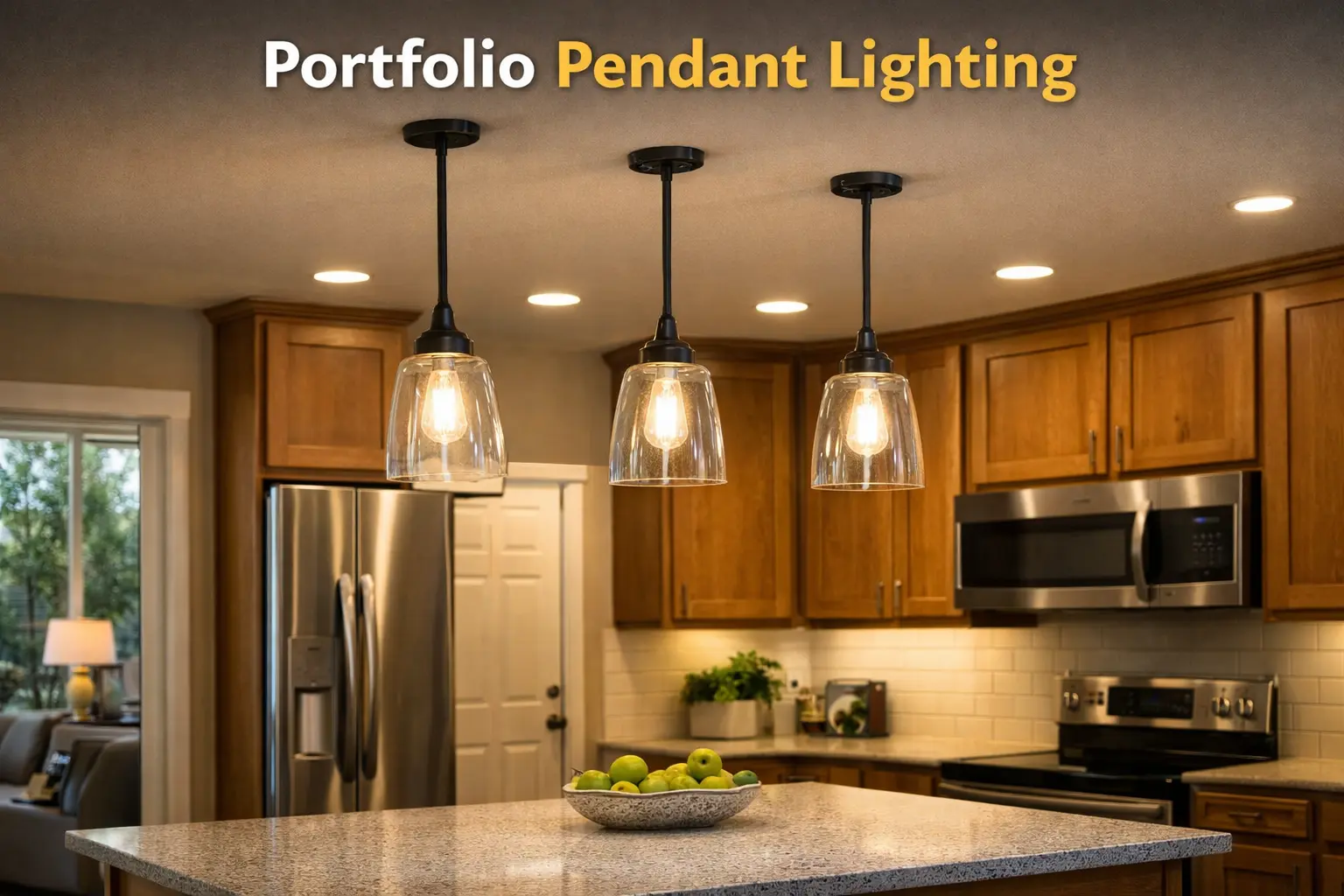
Quick Answer: What Size Pendant Lights Should You Use?
The right size for Portfolio pendant lighting depends on the space and how the lights are used. For kitchen islands, pendants are typically 10–14 inches wide each, spaced about 24–30 inches apart. For single pendants over small areas, choose a fixture around one-third the width of the surface below.
For hanging height, most pendants are installed 30–36 inches above countertops or tables. In open spaces, hang them high enough to maintain at least 7 feet of clearance from the floor.
Island lighting → 10–14" wide pendants, spaced 24–30" apart
Single pendant → about 1/3 the width of the surface below
Hanging height → 30–36" above surface or 7 ft clearance
If you're planning a full layout, start with the how many lights per room guide to avoid spacing and sizing mistakes.
The goal is simple: pendant lighting should look balanced over the surface and provide enough light without crowding the space or leaving dark gaps.
Pendant lighting is usually chosen to fix a specific problem in a room. A kitchen island may not have enough light for prep work. A dining table may feel unfinished. An entryway may need a fixture that stands out instead of blending into the ceiling. The right pendant light can solve all of these at once by adding focused light and a clear visual center to the space.
The key is choosing a pendant that fits the room, hangs at the right height, and works with your overall lighting setup. This guide shows where pendant lights work best, how to size and space them correctly, and when they are a better choice than recessed, track, or ceiling-mounted fixtures. If you are comparing options across your home, start with the Portfolio indoor lighting guide to see how everything fits together.
- Small island (4–5 ft) → 2 pendants
- Medium island (6–7 ft) → 2–3 pendants
- Large island (8+ ft) → 3 pendants
- Wide fixtures → fewer lights
- Narrow fixtures → more lights
If you are comparing pendant fixtures with other ceiling-mounted options, see Portfolio ceiling lighting to understand how different ceiling fixtures perform.
How to Choose the Right Portfolio Pendant Light
The best Portfolio pendant lighting depends on three things first: where the fixture will hang, how much light the space needs, and whether the pendant is mainly decorative, mainly functional, or both. For example, pendant lights over a kitchen island usually need stronger task lighting and more careful spacing than pendant lights used in an entryway or above a dining table.
Before buying, it helps to think about fixture width, hanging height, bulb type, and how the pendant will work with the rest of the room. If you are comparing multiple indoor fixture categories before you buy, start with Portfolio indoor lighting. If you are ready to compare actual fixture and replacement options, visit Buy Portfolio Lighting.
What Is Pendant Lighting?
Pendant lighting is a ceiling-mounted light fixture that hangs down using a cord, rod, or chain. It is commonly used to provide focused lighting over areas like kitchen islands, dining tables, bars, and counters while also serving as a decorative element in the room.
Portfolio pendant lighting fits into the broader indoor lighting category as a fixture type that bridges practical use and design. It is more visible than recessed lighting and more decorative than many basic ceiling fixtures, which is why it is often chosen for spaces where the light fixture itself becomes part of the room’s finished look.
Understanding Portfolio Pendant Lighting
Pendant lighting is one of the most common indoor fixture types used in modern homes because it gives you light where you need it while also helping define the room visually. In kitchens, pendants often hang over islands or bars. In dining areas, they help center the table. In entryways, they add height and create a stronger first impression. In stairwells and vaulted spaces, they can help fill vertical space in a way flat ceiling fixtures cannot.
The reason pendant lighting works so well is simple: it brings the light source down closer to the surface or area that matters. That makes it useful for both task lighting and decorative lighting. The key is choosing a fixture that fits the room, hangs at the right height, and provides the right amount of brightness. Many homeowners get the style right but overlook scale, spacing, or bulb choice. That is usually where disappointment starts.
Best Places to Use Pendant Lighting
Kitchen islands
Kitchen islands are one of the most common places to use pendant lights because they need focused light for cooking, prep work, serving, and everyday gathering. Pendant lights also help visually define the island as its own zone inside the room. In open kitchens, that design role matters almost as much as the lighting itself.
Dining tables
Pendant lighting works well over dining tables because it centers the room and brings light closer to the tabletop. A well-sized pendant or a group of pendants can make a dining area feel more intentional and finished, especially in spaces that otherwise rely on broad general ceiling light.
Entryways
In foyers and entry spaces, pendant fixtures can create instant visual impact. They are often used when a homeowner wants the lighting to feel more styled than a basic flush mount while still giving the space practical brightness.
Pendant lighting can look beautiful in a stairwell, but it should not create glare at eye level or leave lower steps dark. The staircase pendant lighting guide explains height, scale, and placement for stairwell fixtures.
Bars and counters
Pendant lights are also a strong fit over smaller counters, breakfast bars, and serving areas. Because they bring the light source closer to the work surface, they can improve visibility in places where general overhead light feels too spread out or too weak.
Pendant lights are often a key part of a kitchen lighting plan, especially over islands, peninsulas, and dining areas. Even so, they work best when they are coordinated with the rest of the room instead of used as the only major light source. Our Kitchen Lighting Layout Guide explains how pendant lighting fits into a full kitchen layout alongside recessed lighting and under-cabinet lighting for better balance and everyday usability.
Portfolio Pendant Lighting for Kitchen Islands
Kitchen islands are one of the most common places to use pendant lights because they need both focused light and strong visual balance. In many kitchens, two or three pendant lights are enough, but the right number depends on island length, fixture width, ceiling height, and how much additional recessed or under-cabinet lighting the room already has.
Pendant lights over an island should look centered, feel proportionate, and provide useful light for prep work without creating glare. If you are planning a full kitchen layout instead of choosing a fixture in isolation, use the Kitchen Lighting Layout Guide to see how pendants fit into a complete kitchen lighting plan.
How to Choose the Right Pendant Lighting Fixture
Pendant size
Size is one of the first things to get right. A pendant that is too small can look lost over an island or table. A fixture that is too large can feel heavy and out of proportion. Many homeowners choose medium-size pendants for kitchen islands, but the real answer depends on the island length, the number of fixtures, ceiling height, and how much of a visual statement the fixture should make.
Ceiling height
Ceiling height affects how low the pendant can hang and whether a long drop looks elegant or awkward. Standard-height ceilings usually need a more controlled hanging length. Higher ceilings give more flexibility, especially in entryways or stairwells where the pendant can occupy more vertical space without getting in the way.
Brightness and bulbs
The fixture has to look right, but it also has to light the space properly. Some pendants are mostly decorative and cast limited light. Others are designed to function more like strong task lighting. If the fixture will hang over a work area, brightness matters much more than it does in a purely decorative application.
Fixture style
Pendant fixtures come in many styles, including modern, farmhouse, industrial, minimalist, transitional, and more decorative glass or metal designs. The right style should fit the room, but it should also fit the scale and tone of nearby fixtures so the lighting feels coordinated rather than random.
Before choosing a fixture, review the Portfolio lighting compatibility guide to make sure your wiring, bulbs, and dimmer setup will work correctly.
How Far Apart Should Pendant Lights Be?
This is one of the most common homeowner questions because spacing changes how balanced the whole room feels. A common starting guideline is to space pendant lights about 24 to 30 inches apart, but that is only a starting point. The right answer depends on fixture width, island length, and how much empty space you want between the pendants.
Pendant lights often serve as both decorative fixtures and functional task lighting, especially above kitchen islands, dining tables, and workspaces. However, their effectiveness depends heavily on how they fit into the overall lighting layout of the room. Our Indoor Lighting Layout Guide explains how pendant lights work alongside ceiling lighting, wall fixtures, and accent lighting to create a balanced indoor lighting plan.
| Planning Factor | What to Check | Why It Matters |
|---|---|---|
| Island or counter length | Longer surfaces often need two or three pendants instead of one | Improves both coverage and visual balance |
| Fixture width | Wider pendants need more breathing room between fixtures | Prevents crowding and overlap |
| Ceiling height | Higher ceilings can support slightly larger visual spacing | Helps the layout feel proportionate |
| Light output | Brighter pendants may not need to sit as close together | Affects coverage over the surface below |
| Room style | Some layouts aim for symmetry while others allow a looser look | Changes how formal or casual the installation feels |
Common Pendant Lighting Mistakes
- Using too few lights for the size of the island
- Spacing pendants too far apart or too close together
- Choosing fixtures that are too small for the space
- Hanging lights too high or too low
- Relying on pendants as the only light source
Pendant Lighting vs. Recessed Lighting vs. Track Lighting
Pendant lighting vs recessed lighting
Recessed lighting gives you a cleaner ceiling look and is often used for general room brightness. Pendant lighting is more visible and more decorative. If your goal is to create a focal point above an island or table, pendants usually make more sense. If your goal is quiet, evenly distributed ceiling light, recessed fixtures may be the better answer. Compare both styles on the Portfolio recessed lighting page.
Pendant lighting vs track lighting
Track lighting is stronger when you need directional control and adjustable beams. Pendant lighting is stronger when you want a hanging fixture that visually defines a space. A kitchen with artwork or complex task areas may benefit from track lighting, while an island that needs centered feature lighting may benefit more from pendants. For that comparison, see the Portfolio track lighting guide.
If you are comparing multiple indoor fixture styles before you choose a pendant light, our Portfolio indoor lighting guide explains how pendant fixtures relate to recessed lighting, track lighting, ceiling-mounted fixtures, and LED options across the broader indoor cluster.
If pendant lighting does not fit your space, explore Portfolio lighting alternatives for other fixture options that may work better.
How to Install Portfolio Pendant Lighting
Pendant lighting installation is often straightforward when you are replacing an existing fixture at the same ceiling box, but it still requires care. The box must be secure, the mounting hardware must match the fixture, and the hanging length must be set correctly before the final assembly is tightened into place.
- Turn off power at the breaker and confirm the circuit is dead.
- Remove the old fixture and inspect the electrical box.
- Mount the new bracket or canopy hardware securely.
- Connect the fixture wiring and grounding according to the instructions.
- Adjust the rod, cord, or chain length to the correct drop height.
- Install bulbs or secure the integrated light assembly, then test power.
If you need broader help with fixture setup, visit the Portfolio lighting installation and instructions page.
Common Pendant Lighting Problems
Pendant light not turning on
Start with the breaker, switch, bulb, and wiring connections. If the entire fixture is dead, the problem may be the switch feed, canopy connection, or the fixture itself.
Pendant light hanging crooked
This is often caused by mounting hardware that is not seated correctly, a canopy that is not aligned well, or a cord or chain length that was not adjusted evenly during installation.
Flickering light
Flickering usually points to a loose bulb, loose connection, failing lamp, or dimmer compatibility problem. This becomes more common when older fixtures are updated with LED bulbs and the switch was never changed to match.
For broader troubleshooting help across fixture types, go to the Portfolio lighting troubleshooting guide. If you are using LED bulbs in your pendant fixture, the Portfolio LED lighting page may also help with upgrade decisions.
If you cannot identify your fixture or need additional help, visit Portfolio lighting customer service for support options.
Finding Portfolio Pendant Lighting Replacement Parts
Many pendant lighting searches turn into parts searches. Homeowners may be trying to replace a broken shade, a missing mounting piece, a worn socket, a damaged canopy, or simply an old bulb with something more efficient. Whether the fixture is worth repairing depends on the cost of the part, the age of the fixture, and how easy it is to match the style.
The best place to start is the Portfolio lighting parts and accessories page, especially if you are trying to identify a compatible part before you buy. If you are shopping more broadly, you can also browse Portfolio lighting replacement parts on eBay and Portfolio lighting parts on Amazon.
Should You Repair a Pendant Light or Replace It?
Repairing a pendant light often makes sense when the fixture body is still in good condition and only one part has failed, such as a socket, canopy piece, shade, bulb, or hanging hardware. In those cases, replacing the part is usually more cost-effective than replacing the entire fixture.
Full replacement is usually the better choice if the fixture is damaged, badly outdated, difficult to match, or no longer worth repairing. If you are deciding between fixing a part and buying a new fixture, the Portfolio lighting parts and accessories page can help with repair paths, while Buy Portfolio Lighting is better for complete fixture and replacement shopping.
Explore More Indoor Lighting Guides
Portfolio Indoor Lighting
This is the main pillar page for the indoor lighting cluster and the best place to compare fixture categories side by side.
Read the hubPortfolio Track Lighting
Compare pendant fixtures with directional track lighting when you need more aiming control.
Read the guidePortfolio Recessed Lighting
Explore the clean ceiling alternative when you want less visible fixtures and broader room coverage.
Read the guidePortfolio LED Lighting
Useful when you are choosing bulb types or comparing traditional lamps with newer LED options.
Read the guideInstallation and Instructions
Use this for broader setup help, instructions, and installation support across fixture categories.
Read the guideBuy Portfolio Lighting
Review broader buying options when you are ready to compare fixtures and replacement choices.
Read the guideCommon Questions About Portfolio Pendant Lighting
How many pendant lights should go over a kitchen island?
That depends on island length and fixture size, but many kitchen islands use two or three pendants for balanced coverage and a symmetrical look.
How far apart should pendant lights be?
A common starting range is about 24 to 30 inches apart, but the right spacing depends on fixture width, island length, and visual balance.
What size pendant light should I use?
The right size depends on the room, the ceiling height, and the surface below the fixture. The goal is to look proportionate, not too small or too heavy.
Can pendant lights be dimmed?
Many can, but the bulbs or LED modules and the dimmer switch need to be compatible to avoid flickering or poor dimming performance.
Are LED bulbs good for pendant lights?
Yes. LED bulbs are a strong choice in many pendant fixtures because they are efficient, run cooler, and usually last longer than older bulb styles.
Are pendant lights outdated?
No. Pendant lights are still widely used because they combine focused light and decorative style in kitchens, dining spaces, bars, and entryways.
This pendant lighting guide is designed to help homeowners understand fixture sizing, spacing, installation, troubleshooting, and replacement decisions before buying or updating a Portfolio pendant light.