

Quick Answer: What Is the Best Bathroom Lighting Setup?
The best bathroom lighting combines mirror lighting with overall room lighting. Lights placed beside or above the mirror reduce shadows, while ceiling lighting provides general brightness.
- ✔ Use mirror lighting for face visibility
- ✔ Add ceiling lighting for full room brightness
- ✔ Avoid relying on a single fixture
- ✔ Match fixture size to mirror width
Start Here (Choose Your Bathroom Setup)
- ✔ Planning a new bathroom → follow layout section below
- ✔ Fixing poor lighting → go to troubleshooting
- ✔ Replacing fixtures → go to fixture section
- ✔ Choosing brightness → go to brightness section
If you are planning more than just a bathroom upgrade, start with the Portfolio lighting guide, plan and placement to build a complete lighting strategy for your home.
Start With Your Bathroom Lighting Layout
Most bathroom lighting problems come from layout, not the fixture itself. Before choosing a vanity light or ceiling fixture, it helps to match your bathroom setup to the right lighting plan.
- Single vanity: one centered light or two side sconces
- Double vanity: separate lighting for each mirror
- Small bathroom: combine mirror lighting with one ceiling light
- Large bathroom: use layered lighting with vanity, ceiling, and accent fixtures
Once the layout is correct, choosing fixtures and brightness becomes much easier.
If you are planning lighting beyond just the bathroom, use the indoor lighting layout guide to position fixtures correctly across different rooms and avoid uneven lighting.
Quick Bathroom Lighting Decision Table
| If you have this | Best lighting setup |
|---|---|
| Single vanity | One centered vanity light or two side sconces |
| Double vanity | Separate fixture for each mirror or sink area |
| Small bathroom | Mirror lighting plus one ceiling light |
| Large bathroom | Layered lighting with vanity, ceiling, and accent lighting |
A good bathroom lighting plan usually combines three different jobs. It needs task lighting around the mirror, ambient lighting for the whole room, and sometimes accent or decorative lighting that gives the bathroom a more finished look. That balance matters because many bathroom lighting problems come from relying too heavily on just one fixture, especially a single light above the mirror or one plain ceiling light in the middle of the room.
This guide helps you avoid common lighting mistakes and get the setup right the first time.
Top 3 Bathroom Lighting Mistakes
- ❌ Using only one ceiling light
- ❌ Poor lighting around the mirror
- ❌ Choosing the wrong size fixture
Fix: Use mirror lighting + proper sizing + layered lighting.
Most Common Bathroom Lighting Mistakes
- Only one ceiling light: leaves shadows at the mirror
- Fixture too small: mirror area feels underlit
- No layered lighting: room feels uneven and dim
- Wrong bulb color: bathroom feels too yellow or too harsh
What Size Vanity Light Should You Use?
Quick rule: Your vanity light should be about 70–80% of the mirror width for balanced lighting.
Vanity light size should match the width of your mirror or vanity. A fixture that is too small will leave the mirror underlit, while one that is too large can overpower the space.
- 24–30 inch vanity → 18–24 inch fixture
- 36 inch vanity → 24–30 inch fixture
- Double vanity → separate fixtures for each sink
Where Should Bathroom Lights Be Placed?
Bathroom lighting works best when it surrounds the mirror instead of sitting only above it. Lights placed beside the mirror reduce shadows and improve visibility for grooming.
Fast answer: Bathroom lights work best when they light the face from the sides or evenly across the mirror, instead of relying on one overhead bulb that creates shadows.
- Side sconces: eye-level for even face lighting
- Above mirror: centered and wide enough for coverage
- Ceiling lights: centered for overall room brightness
Understanding Bathroom Lighting
Bathrooms are different from many other rooms because the lighting has to perform well at close range, especially in front of mirrors. A bathroom may look adequately bright overall and still cast poor light on the face if the mirror area is not handled well. That is why bathroom lighting should be thought of in layers instead of as one fixture choice.
Task lighting
Task lighting is the light used for grooming activities like shaving, brushing teeth, skincare, and makeup. This is the most important layer around the mirror because it affects how clearly and evenly the face is lit.
If you want to improve visibility for grooming and daily use, see Portfolio task lighting to understand how focused lighting improves function in key areas.
Ambient lighting
Ambient lighting is the general room brightness that helps the whole bathroom feel usable and safe. This often comes from a ceiling fixture, recessed lights, or a combination of ceiling and vanity lighting.
For a deeper look at how general room lighting works, see Portfolio ambient lighting and how it supports overall brightness in indoor spaces.
Accent lighting
Accent lighting is not always essential in a bathroom, but it can improve how the room looks. Decorative sconces, attractive vanity fixtures, and lighting that adds depth to the walls or mirror area can help the bathroom feel more finished and less flat.
The best bathroom lighting plans usually blend these three layers instead of asking one fixture to do every job by itself.
Vanity Lighting Mistake: Mixed Bulbs Make the Whole Room Look Wrong
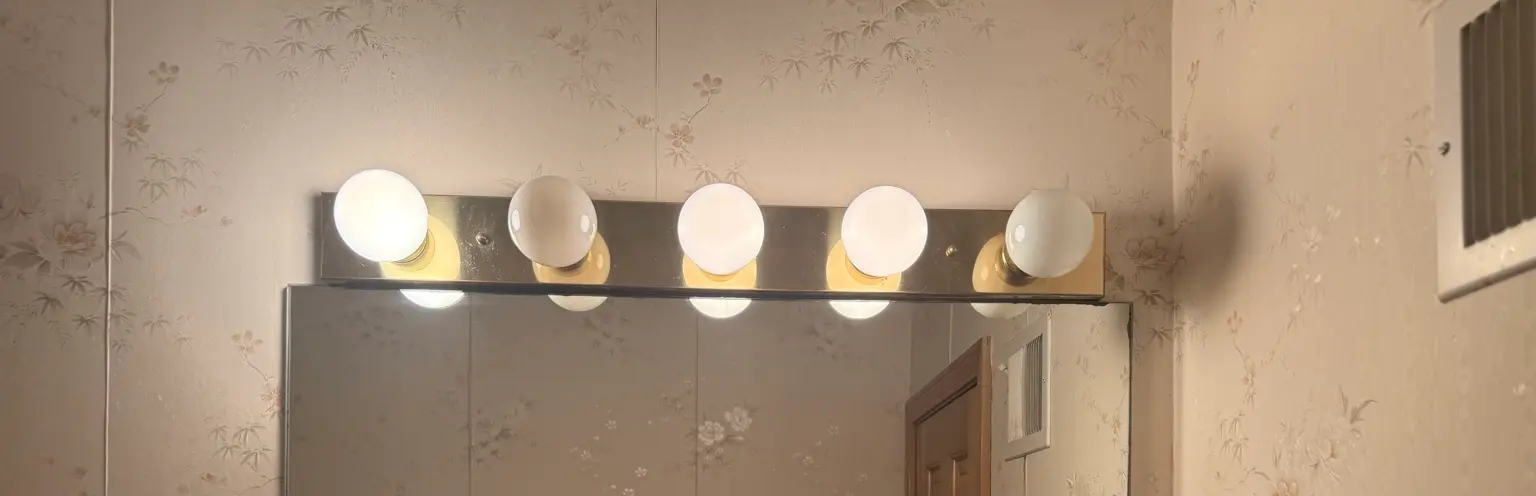
Bathroom vanity lighting should be consistent from one socket to the next. When one bulb is cooler, warmer, brighter, dimmer, or lower quality than the others, the mirror area can look uneven even if the fixture itself is still usable.
In my experience, the fastest improvement is to replace every bulb in the vanity bar at the same time with matching LED bulbs. Use the same color temperature, the same brightness range, and preferably a higher-CRI bulb so skin tones, tile, paint, and grooming details look more natural.
Best Lighting Fixtures for Bathrooms
Vanity lighting
Vanity lights are the most common bathroom lighting fixtures because they are built around the mirror area where the most detail work happens. They are often mounted above the mirror or across the top of a vanity cabinet and are designed to provide focused light where people stand every day.
Above-mirror vanity fixtures can work very well, especially in smaller bathrooms where a simple, centered fixture is the most practical solution. The key is choosing a fixture wide enough and bright enough to support the mirror area properly.
Wall sconces
Wall sconces are especially helpful in bathrooms because side lighting often reduces shadows on the face better than depending only on a single light above the mirror. This can be a strong setup for makeup, shaving, and other close-up grooming routines. If you want to understand that fixture type more deeply, see the Portfolio wall sconce lighting guide.
Ceiling lighting
Most bathrooms also need a ceiling light for general brightness. Flush mount and semi-flush ceiling fixtures are common because they distribute light through the room without taking up too much vertical space. This is especially useful in bathrooms with standard ceiling heights. For broader ceiling-fixture guidance, read the Portfolio ceiling lighting page.
If you are using a standard ceiling fixture, compare options on Portfolio flush mount lighting to find a design that fits your space.
Recessed lighting
Recessed lights can work very well in modern bathrooms or in bathrooms where a clean ceiling look matters. They are especially useful for adding broad room light without visually crowding the ceiling. They also pair well with vanity lighting when the goal is to keep the mirror area bright and the room evenly lit. For more on that option, visit the Portfolio recessed lighting guide.
How Many Lights Do You Need in a Bathroom?
The number of lights depends on bathroom size and layout. Most bathrooms need more than one light source to avoid shadows and dark areas.
If you are unsure how many fixtures your space needs, see how many lights you need per room for a broader guide based on room size and lighting goals.
- Small bathroom: 1 vanity + 1 ceiling light
- Medium bathroom: vanity + ceiling + optional recessed
- Large bathroom: layered lighting with multiple fixtures
Where Bathroom Lighting Should Be Placed
Lighting around mirrors
One of the most common bathroom questions is where the light should go around the mirror. Lighting beside the mirror often reduces shadows better than relying only on a light above it because it spreads light across both sides of the face. That can make everyday grooming easier and more flattering.
For more detailed placement strategies across different rooms and fixture types, see Portfolio lighting placement.
Vanity lighting height
A common mounting height for vanity lighting is around 65 to 70 inches from the floor, but the exact height still depends on mirror size, fixture design, and the height of the people using the space most often. The goal is to place the light where it supports the mirror well without causing harsh glare.
Vanity lighting width
Vanity lighting should usually feel proportional to the mirror rather than much narrower than it. A fixture that is too small can leave the mirror area underlit, while a fixture that is too large may overpower the vanity visually.
Ceiling lighting placement
Ceiling fixtures are usually centered to the room or to the main walking path, depending on the layout. In larger bathrooms, multiple light points often work better than asking one central fixture to fill the entire space.
Choosing the Right Brightness
Bathrooms often need brighter lighting than many other rooms because they support close visual tasks. It helps to think in lumens instead of wattage when planning brightness, because lumens tell you how much light you are actually getting.
| Bathroom Size | Typical Brightness Range | Why It Matters |
|---|---|---|
| Small bathrooms | About 2,000–4,000 lumens | Helps the mirror and room stay usable without feeling dim |
| Medium bathrooms | About 3,000–6,000 lumens | Supports both general light and grooming needs |
| Larger bathrooms | About 4,000–8,000 lumens | Prevents the room from feeling uneven or underlit |
| Mirror area | Best handled with dedicated task lighting | Improves visibility where detail work happens |
| Layered layouts | Multiple fixtures usually work better than one bright fixture | Creates more balanced, comfortable light |
How Bright Should Bathroom Mirror Lighting Be?
Mirror lighting should be bright enough to light the face clearly without harsh glare. In most bathrooms, this means using dedicated vanity lighting instead of depending only on a ceiling fixture.
The goal is even facial lighting for shaving, makeup, skincare, and everyday grooming.
Best Bulbs for Bathroom Lighting
LED bulbs
LED bulbs are a strong choice for many bathroom fixtures because they use less energy, last longer, and provide consistent brightness. They are especially practical in vanity fixtures and ceiling fixtures that are used every day.
Color temperature
Many homeowners prefer bathroom lighting in the 3000K to 4000K range because it feels clean and bright without becoming too blue or overly harsh. This range often strikes the best balance between comfortable room light and useful mirror lighting.
If you are comparing LED fixture choices more broadly, the Portfolio LED lighting page is a good next read because it helps connect bulb choice with fixture performance across the indoor cluster.
Bathroom lighting often goes wrong when homeowners focus only on fixture style instead of how the room is actually used. This room-by-room lighting plan guide helps explain how bathroom lighting fits into a full-house plan, including task lighting, ambient balance, and better room-to-room consistency.
Best Color Temperature for Bathroom Lighting
For most bathrooms, the best color temperature is between 3000K and 4000K. This range feels clean and bright without looking too yellow or too blue.
- 3000K: warmer and softer
- 3500K: balanced and natural
- 4000K: brighter and crisper for task lighting
Bathroom Lighting Safety
Bathrooms are humid spaces, so fixture ratings matter more here than they do in many other rooms. A fixture that works fine in a dry bedroom or hallway may not be the right choice in a bathroom if it is exposed to moisture regularly.
Damp-rated fixtures
Damp-rated fixtures are suitable for most bathroom areas where humidity is present but water is not directly hitting the fixture. Many vanity lights and general bathroom fixtures fall into this category.
Wet-rated fixtures
Wet-rated fixtures are designed for areas where direct water exposure is more likely, such as very near showers or tubs. If the fixture location is close to water spray, this rating becomes much more important.
Installing Bathroom Lighting
Bathroom lighting installation is often straightforward when you are replacing an existing fixture at the same box location, but placement and fixture choice still matter. Because bathrooms often combine mirror lighting and general room lighting, the installation plan should reflect how the room will actually be used rather than simply replacing one fixture with another without thinking about the layout.
- Turn off the breaker and confirm the circuit is dead.
- Install or inspect the mounting bracket and electrical box.
- Connect the fixture wiring and grounding path.
- Attach the fixture and make sure it is level and secure.
- Install bulbs or complete the LED assembly, then test power.
For broader step-by-step help across fixtures, go to the Portfolio lighting installation and instructions page.
Common Bathroom Lighting Problems
Lights too dim
This is often caused by low-lumen bulbs, weak fixture output, or too much dependence on a single fixture. In many bathrooms, adding or improving mirror lighting solves the problem better than simply using a brighter bulb in one overhead light.
Shadows around the mirror
This usually happens when the bathroom relies only on a light above the mirror. Side lighting from sconces or better-placed vanity fixtures often improves this dramatically.
Flickering lights
Flickering may be caused by loose bulbs, poor connections, socket issues, or dimmer incompatibility. This is especially common after switching to LED bulbs without checking whether the control switch supports them properly.
For broader diagnostic help, use the Portfolio lighting troubleshooting guide. That page is especially useful when the problem seems bigger than one bathroom fixture or when you are not sure whether the issue is the wiring, switch, bulb, or fixture itself.
Finding Replacement Parts
Bathroom fixtures may need replacement components over time, especially bulbs, glass shades, mounting hardware, and other wear items. Whether the fixture is worth repairing depends on the condition of the fixture, the age of the design, and how easy the part is to match.
Your best starting point is the Portfolio lighting parts and accessories page, especially if you are trying to identify a replacement piece before ordering. If you are shopping more broadly, you can also browse Portfolio lighting replacement parts on eBay and Portfolio lighting parts on Amazon.
If you are not sure which fixture you have, use the Portfolio model number lookup before ordering replacement parts.
Comparing Bathroom Lighting Options
Bathroom lighting overlaps naturally with several other indoor fixture types. Wall sconces are helpful for side mirror lighting. Ceiling fixtures provide general room brightness. Recessed lights support cleaner modern layouts. In some larger bathrooms, decorative pendants may be used over certain areas if the ceiling height and layout allow it.
If you are comparing bathroom lighting with other indoor fixture types, your best next stop is the Portfolio indoor lighting hub page. You can also compare directly with wall sconces, recessed lighting, ceiling lighting, and LED lighting depending on the kind of bathroom layout you are planning.
Compare Bathroom Lighting With Other Indoor Options
Explore More Indoor Lighting Guides
Portfolio Indoor Lighting
This is the main pillar page for the indoor lighting cluster and the best place to compare room-based and fixture-based lighting choices.
Read the hubPortfolio Wall Sconce Lighting
Useful when you want to improve side mirror lighting and reduce facial shadows around the vanity area.
Read the guidePortfolio Recessed Lighting
Explore the cleaner ceiling option when you want modern-looking general room light in the bathroom.
Read the guidePortfolio Ceiling Lighting
Compare bathroom ceiling fixtures when you need dependable ambient light for the whole room.
Read the guidePortfolio LED Lighting
Helpful when you are comparing brightness, bulb efficiency, and LED upgrade options for bathroom fixtures.
Read the guideInstallation and Instructions
Use this page for broader setup help and fixture instructions across bathroom and indoor lighting categories.
Read the guidePortfolio Lighting Troubleshooting
Work through flickering, dimness, dead fixtures, and other lighting problems that may affect bathroom setups.
Read the guidePortfolio Lighting Parts and Accessories
Start here if your bathroom fixture needs shades, bulbs, mounting hardware, or other replacement parts.
Read the guideBuy Portfolio Lighting
Browse the broader buying hub when you are ready to compare fixtures, room categories, and replacement options.
Read the guideCommon Questions About Portfolio Bathroom Lighting
What is the best lighting for a bathroom vanity?
The best vanity lighting usually combines even light around the face with enough overall brightness for the room. Side lighting often reduces shadows better than relying only on a fixture above the mirror.
Should bathroom lighting be warm or cool?
Many homeowners prefer bathroom lighting in the 3000K to 4000K range because it feels clean and bright without becoming overly harsh.
How bright should bathroom lighting be?
Small bathrooms often need around 2,000 to 4,000 lumens, while larger bathrooms may need 4,000 to 8,000 lumens depending on layout and fixture count.
Is it better to have lights above or beside a mirror?
Lighting beside a mirror often reduces shadows better than depending only on a fixture above it, although many bathrooms benefit from a combination of both.
Can LED bulbs be used in bathroom fixtures?
Yes. LED bulbs are a strong choice for many bathroom fixtures because they are efficient, bright, and long lasting.
Do bathroom fixtures need a special rating?
Yes. Many bathroom fixtures should be damp rated, and fixtures near showers or tubs may need a wet-rated design depending on the location.
This bathroom lighting guide is designed to help homeowners understand mirror lighting, vanity placement, brightness, fixture safety, troubleshooting, and replacement decisions before buying or updating Portfolio bathroom lighting.