
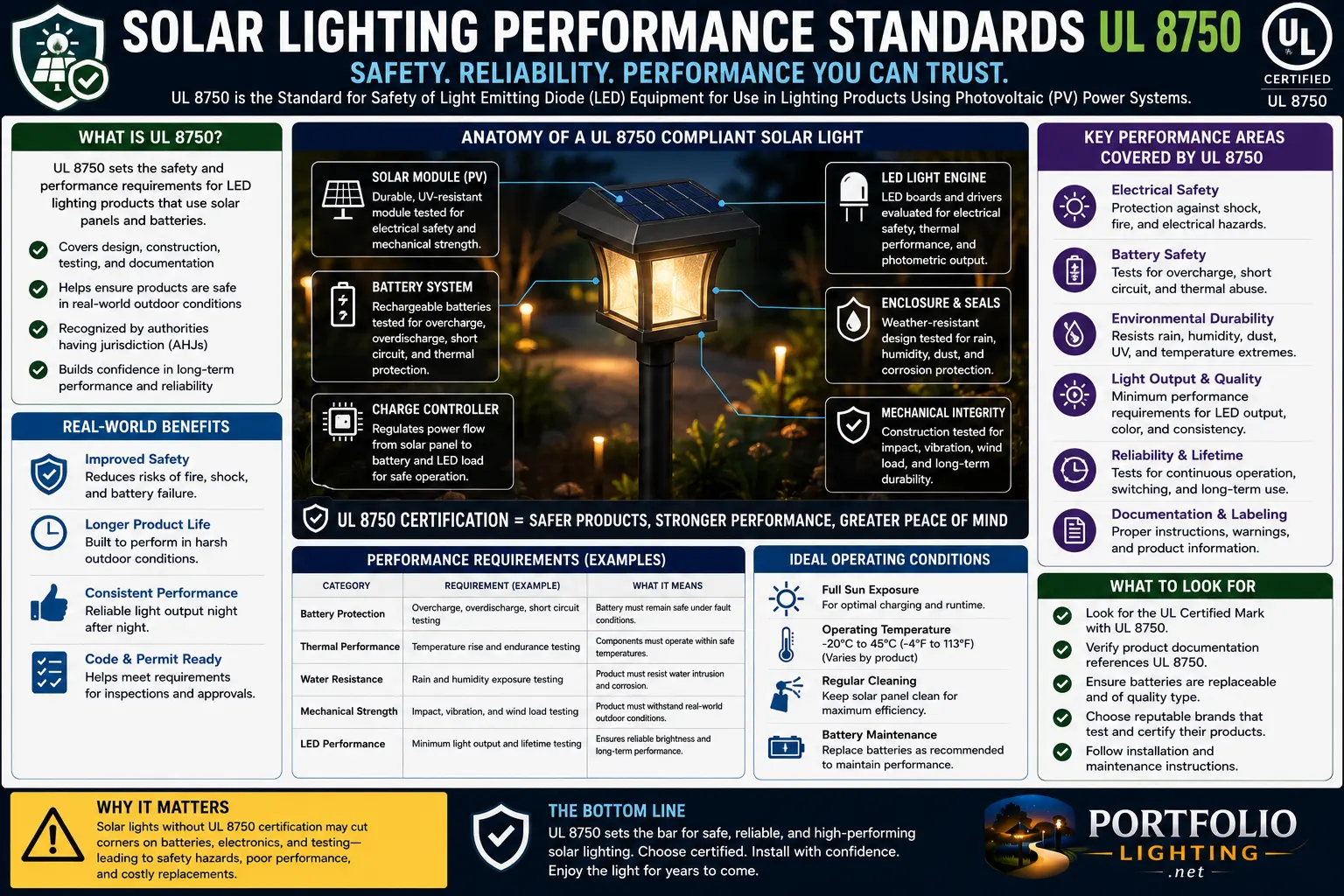
What UL 8750 Actually Is — Component-Level LED Standard, Not a Solar Product Standard
The confusion around UL 8750 and solar landscape lighting starts with a fundamental misunderstanding of what UL 8750 covers. It is not a solar product standard. It is not an outdoor lighting standard. It is a component-level standard for the LED electronics inside a lighting product.
The Actual Scope of UL 8750
From the UL 8750 standard text (Section 1.1): "These requirements cover LED equipment that is an integral part of a luminaire or other lighting equipment and which operates in the visible light spectrum between 400–700 nm. These requirements also cover the component parts of light emitting diode (LED) equipment, including LED drivers, controllers, arrays, modules, and packages as defined within this standard."
The scope is specifically: LED components inside a luminaire. Not the luminaire itself. Not the power source. Not the environmental enclosure. Not the solar panel. Not the battery. UL 8750 evaluates: electrical insulation of the LED driver; dielectric strength testing; overcurrent protection; temperature management of the driver electronics; and abnormal operation behavior of the drive circuit. This is precisely what Intertek's UL 8750 documentation confirms: "When certifying an LED luminaire, UL 8750 is used in combination with UL 1598 and many other luminaire standards, ensuring both the fixture and its LED components meet rigorous safety requirements." UL 8750 is one layer of a multi-standard certification stack — not the complete stack.
UL 8750 vs UL 1598: The Component vs System Distinction
Per LED Light Expert's certification documentation: "UL 1598 is the umbrella standard for complete indoor and outdoor luminaires in general use. Covers enclosure construction, wiring, spacing, grounding, ingress protection for wet and damp locations, and thermal performance. UL 8750 is the component-level standard for LED drivers, engines, and arrays. UL 8750 is almost always paired with UL 1598 inside a finished fixture file."
This pairing is the key: a complete outdoor luminaire certification requires UL 1598 (the complete luminaire standard) with UL 8750 covering the LED component inside it. A product that carries only UL 8750 without UL 1598 has had its internal LED component evaluated — but not the complete fixture's outdoor suitability, enclosure integrity, or system safety. For a solar landscape path light, the applicable combination would need to include wet-location rated UL 1598 for the luminaire, UL 8750 for the LED component, and additional standards for the solar and battery subsystems. In practice, consumer solar landscape lights typically have none of these as a complete package.
UL 8750 Section 1.4: The Two Exclusions That Apply to Every Solar Path Light
This is the most important passage in UL 8750 for understanding what the standard cannot certify — and it comes directly from the standard's own scope section.
"The requirements in this standard do not anticipate additional construction, performance and marking considerations for the following end-applications:
▶ LED equipment subject to weather (outdoor use) — [applies to all solar landscape path lights, which are permanently installed outdoors]
LED equipment installed in air handling spaces or in other environmental air spaces (plenums)
LED equipment intended for Emergency Lighting and Power Equipment
▶ LED equipment with integral batteries (and battery packs) — [applies to all solar landscape path lights, which contain an integral rechargeable battery]
LED equipment used in fire rated installations
"LED equipment with such end-applications is subject to additional evaluation per applicable standards."
What the Exclusions Mean in Practice
Section 1.4 is the standard acknowledging its own limitations: UL 8750 was designed for LED components in indoor luminaires on branch circuits. When those components are used in outdoor equipment (exclusion 1) or battery-powered equipment (exclusion 4), the standard itself requires additional evaluation. Both exclusions apply to every consumer solar landscape path light.
The additional evaluation referenced — "per applicable standards" — is what should constitute the complete certification stack for solar landscape lighting. The standard body is pointing buyers toward the additional standards needed. The problem is that the consumer solar landscape light market has largely not responded to this requirement: the additional evaluations under IEC 61215, IEC 61730, IEC 62509, and battery standards are expensive, require product samples, and take time — costs that consumer-grade solar path lights selling at $8–25 each cannot easily absorb per-product.
The practical result of the compliance gap is that most consumer solar landscape lights sold at mass retail (Amazon, Walmart, Home Depot) carry either: (1) no meaningful third-party listing at all; (2) a factory-issued "CE" mark (self-certified for EU market access, not tested by an independent NRTL); or (3) a UL 8750 mark on the LED component only, with no UL 1598 or solar-panel standard listing for the complete product. The LED Light Expert's certification guide confirms: "ETL-Listed is fully equivalent to UL-Listed for code purposes when the same standard is cited" — meaning the equivalence is in the standard applied, not in the mere presence of any mark. A CE mark on a solar path light and a UL 1598 listing on a wired luminaire are not equivalent protections for the buyer.
The Complete Standards Map for Solar Landscape Lighting
A fully compliant solar landscape light system — if one were built to the standard that the individual subsystem standards collectively require — would need independent certification across four distinct technical areas. Here is the complete map.
The Compliance Gap: Why Consumer Solar Path Lights Carry No Meaningful Complete Listing
The absence of a unified standard for complete solar landscape light systems creates a market condition where the regulatory protection that buyers reasonably expect from a "certified" product is largely absent in practice.
Third-Party Listed vs Self-Certified
A meaningful safety listing — UL Listed, ETL Listed, CSA Listed — requires independent third-party testing by a Nationally Recognized Testing Laboratory (NRTL). The manufacturer submits product samples; the NRTL tests them against the applicable standard; and if they pass, the manufacturer is licensed to apply the listing mark to compliant products, subject to ongoing factory inspections. This process costs thousands to tens of thousands of dollars per product family and takes weeks to months.
A self-certified mark — particularly the CE mark that appears on many Chinese-manufactured consumer electronics and lighting products — is self-declared by the manufacturer without independent testing. The manufacturer reviews the applicable EU directives, determines their product complies, and applies the CE mark. There is no independent laboratory involved; there is no NRTL. "CE" on a solar path light is not equivalent to "UL Listed."
What "UL 8750" on Solar Path Light Packaging Actually Means
When a consumer solar landscape light package shows "UL 8750," the most accurate interpretation is: the LED driver component inside this fixture was evaluated, possibly by an NRTL, to the UL 8750 component standard. This evaluation determined that the LED driver operates safely under the conditions described in UL 8750 — which, per Section 1.4, explicitly does not include outdoor weather conditions or integral battery operation.
The UL 8750 marking does not indicate: that the solar panel was tested; that the charge controller was tested; that the battery was tested; that the complete system was tested for outdoor use; that the fixture housing meets wet-location ingress protection requirements; or that the integrated system performs as described on the packaging (lumen output, runtime, lifetime).
How to Verify Any Solar Lighting Certification Claim: For any solar landscape light product claiming UL or ETL listing, verify the claim directly at productiq.ulprospector.com (for UL) or database.intertek.com (for ETL). Enter the manufacturer name or model number. The database will show: which exact standard was applied; whether it is "Listed" (complete product), "Recognized" (component), or "Classified" (limited testing); and what the tested product configuration is. If the product does not appear in either database, any UL or ETL marking on the packaging is either incorrect or refers to a component tested independently — not the complete product system.
NEC Article 411 and Solar Landscape Lights: The Jurisdiction Vacuum
Low-voltage wired landscape lighting systems are governed by NEC Article 411, which requires listed components and specific installation practices. Solar landscape lights occupy a regulatory vacuum that Article 411 cannot fill — and most buyers don't know this.
Why Solar Landscape Lights Are Outside NEC Article 411
NEC Article 411 covers "lighting systems operating at 30 volts or less" — but its compliance framework is built around systems connected to a branch circuit. The transformer must be listed to UL 1838; the transformer plugs into a GFCI-protected outdoor outlet; the branch circuit that feeds the outlet has an overcurrent protective device; the complete system is subject to inspection by an AHJ under the permit and inspection process. All of these connection points to the regulated electrical system create the enforcement framework.
Standard consumer solar landscape path lights have none of these connections. They contain a self-sufficient power source (solar panel + battery) and connect to no branch circuit, no transformer, no utility-connected outlet. Per NEC 90.2(B), the NEC doesn't cover installations "in ships, watercraft other than floating buildings, railway rolling stock, aircraft, or automotive vehicles" — but more relevantly, the NEC's enforcement mechanism depends on connection to premises wiring. A self-contained device with no premises wiring connection is, functionally, outside the enforcement reach of Article 411 even if it technically operates at under 30 volts. The NEC inspection checklist applies to wired low-voltage landscape lighting — not to solar path lights operating from integral batteries.
What the Jurisdiction Vacuum Means Practically
Because consumer solar landscape path lights are not connected to premises wiring, they typically:
- Do not require a permit in any jurisdiction that has reviewed this question
- Are not subject to AHJ inspection for NEC compliance
- Do not need to be UL 1838 listed (the UL 1838 requirement applies to wired landscape lighting systems, not self-contained solar products)
- Are not subject to the pool setback requirement of NEC 411.4(2) as a wired system — though NEC 680's pool area requirements still apply to any electrical device near a pool regardless of power source
- Can be installed by anyone without any licensing requirement
This regulatory vacuum is intentional to the extent that low-energy self-contained consumer products don't warrant the full permit-and-inspection framework. But it also means buyers have no code-based protection against misrepresentation of solar landscape light performance — only FTC advertising rules, which are difficult to enforce at the individual consumer level. See the permit requirements guide for the distinction between wired and solar installation requirements.
The STC Rating Fraud: Why Rated Solar Panel Output Is Meaningless for Consumer Path Lights
Every solar landscape light package shows a solar panel power rating. The rating is measured under Standard Test Conditions that never exist for any consumer solar path light in actual operation — creating a systematic overstatement of real-world performance.
What Standard Test Conditions (STC) Actually Specify
Per EnergySage's solar certification documentation: "Solar panel performance testing occurs in fixed laboratory conditions, known as Standard Test Conditions (STC). Because these conditions are consistent across the industry, you can compare performance metrics between different solar panels." The STC conditions are: 1,000 W/m² irradiance; 25°C cell temperature (not ambient temperature — the cell itself at 25°C, which requires approximately 0°C ambient air temperature to achieve with typical solar irradiance); and AM 1.5 spectral distribution (matching sunlight at mid-latitudes).
Why STC Conditions Never Occur for Consumer Solar Path Lights
- Irradiance: 1,000 W/m² is direct solar noon on a cloudless day at optimal panel angle. Consumer solar path lights are typically horizontal (suboptimal angle), may be partially shaded by the fixture cap, vegetation, or nearby structures, and receive real-world irradiance averaging 400–700 W/m² over a useful charging day in most US locations — 40–70% of STC conditions.
- Cell temperature: At 1,000 W/m² irradiance on a typical 85°F summer day, solar cell temperature reaches 55–65°C — not 25°C. Per IEC 61215 documentation, solar panels lose approximately 0.3–0.5% of output per °C above 25°C cell temperature. At 60°C cell temperature, a panel loses approximately 17.5% of STC rated output before any other derating. In summer heat, when the sun is strongest, temperature derating is also worst.
- Small panel area: A 5cm × 5cm consumer path light solar panel at 15% efficiency produces approximately 0.375W at true STC conditions — 375 milliwatts. Over a 6-hour charging day at 50% of STC average, the panel delivers approximately 1.1 Wh of energy. A 100-lumen LED at typical efficacy draws approximately 1W — meaning the panel can charge enough energy to run the LED for about 1.1 hours at full brightness, not the "8 hours" shown on packaging.
Lumen Maintenance Over the Discharge Cycle: Why Solar Lights Always Dim Through the Night
This is the operating characteristic of solar landscape lighting that most buyers don't understand before purchase and most guides don't explain: solar lights always get dimmer as the night progresses, regardless of initial brightness, because LED output tracks battery voltage.
The Voltage-Output Relationship in Unregulated Solar Path Lights
Professional landscape lighting transformers maintain constant output voltage regardless of load — that is their engineering purpose. The LEDs in a wired low-voltage landscape light receive stable voltage throughout the night and produce stable, constant light output. Consumer solar path lights use a fundamentally different circuit: a rechargeable battery connected directly (or through minimal regulation) to the LED load. Battery voltage decreases as charge depletes — this is a basic electrochemical property, not a manufacturing defect.
For most consumer solar path lights, the LED circuit is not constant-current regulated. This means LED drive current decreases as battery voltage decreases, and LED brightness decreases proportionally. The dimming is progressive: brightest at dusk when the battery is at full charge; measurably dimmer by 10 PM; significantly dimmer by 2 AM; barely visible by 5 AM on a long winter night. A light that produces 30 lumens at 7 PM may produce 8–10 lumens at 4 AM — a 70%+ reduction in output.
Approximate values for a typical unregulated NiMH consumer solar path light. Actual curve varies by battery chemistry, temperature, and LED circuit design. LiFePO4 batteries with constant-current drivers maintain output better; NiMH without regulation dims most severely. Wired low-voltage landscape lighting (transformer-based) produces constant output throughout the night regardless of time.
Wired Low-Voltage vs Solar: The Constant Output Advantage
A wired low-voltage landscape light connected to a transformer produces its rated output from dusk to dawn, every night, regardless of season or weather. The transformer maintains constant secondary voltage; the LED driver maintains constant current; output is stable. This is the fundamental performance advantage of wired low-voltage systems over self-contained solar systems for landscape applications where consistent illumination quality matters. The solar vs low-voltage energy efficiency guide compares these systems across multiple dimensions including output consistency, long-term cost, and maintenance.
Battery Chemistry: LiFePO₄ vs NiMH vs Li-ion for Landscape Solar Applications
The battery inside a solar landscape light determines cold-weather performance, cycle life, and long-term lumen maintenance. Most consumer path lights don't disclose battery chemistry, and the difference between chemistries is significant.
LiFePO4 is the safest lithium chemistry — thermally stable, no fire or thermal runaway risk that characterizes standard lithium-ion. Cycle life is typically 2,000–5,000 charge cycles (5–14 years of daily cycling) vs 300–500 cycles for NiMH and 500–1,000 for standard Li-ion. Cold weather performance is significantly better than NiMH — capacity loss at 0°C is approximately 10–15% vs 25–40% for NiMH.
Voltage discharge curve:LiFePO4 has a very flat discharge curve — voltage stays relatively constant until deep discharge, then drops sharply. This means solar lights using LiFePO4 with appropriate constant-current drivers maintain more consistent brightness throughout the night compared to NiMH.
Identification:Product may list "LiFePO4," "lithium iron phosphate," or "LFP" battery. Higher-priced solar landscape lights from quality-focused brands often use LiFePO4. It's rarely found in sub-$15 consumer solar path lights.
NiMH is the most common battery in consumer solar landscape lights because it's inexpensive, widely available in standard AA and AAA sizes, and user-replaceable. The replaceable format is actually an advantage — when the battery degrades after 300–500 cycles (1–2 years of daily cycling), the buyer can replace it with a fresh AA NiMH cell rather than replacing the entire fixture.
Cold weather failure:NiMH loses 25–40% of capacity at 0°C and can lose 50–60% at -10°C. In northern climates, a solar path light that works well in September may barely illuminate at all in January — both because winter days provide less solar charging and because the battery can barely hold charge in the cold. NiMH batteries can also fail to accept a charge when very cold.
The recovery behavior:NiMH batteries that appear dead in winter often recover in spring when temperatures rise — a temporary failure pattern that confuses many buyers into thinking the light has been repaired when the battery simply warmed up.
Standard lithium-ion batteries offer better energy density than NiMH (more stored energy per unit volume) and better cold-weather performance than NiMH — capacity loss at 0°C is approximately 20–30%, less severe than NiMH's 25–40%. Cycle life is approximately 500–1,000 cycles (1.4–2.7 years of daily cycling), better than NiMH.
Safety concerns:Standard lithium-ion has thermal runaway risk — under certain conditions (overcharging, physical damage, manufacturing defects) the battery can go into a self-sustaining exothermic reaction. In a well-designed charge controller circuit, this is managed with protection circuitry. In a poorly designed consumer solar path light with a minimal charge controller IC, the protection may be inadequate. This is why UL 1973 or IEC 61960 listing for the battery is meaningful — it indicates the battery was tested for abuse conditions.
Not user-replaceable:Most Li-ion cells in solar path lights are not user-replaceable without disassembling the fixture — when the battery degrades, the fixture typically becomes landfill.
| Property | LiFePO₄ | NiMH | Standard Li-ion |
|---|---|---|---|
| Cycle life (daily charge) | 2,000–5,000 (5–14 yrs) | 300–500 (1–1.5 yrs) | 500–1,000 (1.4–2.7 yrs) |
| Capacity at 0°C | ~85–90% of rated | ~60–75% of rated | ~70–80% of rated |
| Capacity at -10°C | ~75–80% of rated | ~40–50% of rated | ~55–65% of rated |
| Thermal runaway risk | Essentially none | None | Present — requires protection circuit |
| Discharge curve flatness | Very flat — consistent brightness | Sloped — dims progressively | Moderately flat |
| User-replaceable | Usually not | Often yes (AA/AAA format) | Usually not |
| Relative cost | Highest | Lowest | Moderate |
| Typical consumer solar path light use | Premium-grade fixtures | Most common consumer choice | Mid-range fixtures |
Solar vs Low-Voltage Wired: What the Standards Gap Means for Your Decision
The certification and performance landscape for solar vs wired low-voltage landscape lighting is not symmetric — and understanding this asymmetry helps frame the technology choice correctly.
Solar lighting systems contain electronic components, batteries, circuit boards, drivers, and control assemblies that often fall under multiple manufacturing and environmental standards. In addition to performance testing and electrical safety requirements, many products are also designed to comply with restrictions on hazardous substances. Our RoHS compliance guide explains how heavy-metal restrictions affect modern outdoor lighting products and electronic assemblies.
What Wired Low-Voltage Landscape Lighting Offers That Solar Cannot Match
- Listed system compliance: A wired low-voltage landscape system with a UL 1838-listed transformer and listed fixtures meets NEC Article 411 requirements — a tested, inspectable compliance framework. No solar path light system offers the equivalent. The NEC inspection checklist applies only to wired systems.
- Constant output regardless of weather: A wired system produces identical light output on a cloudy day after three cloudy days in a row, in January, and at 3 AM. A solar system's output after three cloudy days may be dramatically reduced — the battery may not reach full charge, and the night's output will be correspondingly diminished.
- Meaningful lumen verification: Wired landscape lighting products are subject to IES LM-79 testing for actual luminaire output — a standardized test performed by accredited laboratories producing verified lumen output numbers. Consumer solar path lights are not typically LM-79 tested; their lumen claims are largely self-asserted.
- Long-term output consistency: Wired landscape lighting with LED fixtures maintains output within ±10% over the fixture's lifetime (per LM-80 lumen depreciation testing). Solar path lights degrade on two dimensions: LED lumen depreciation AND battery capacity reduction — the combination produces significantly faster apparent output decline.
Where Solar Landscape Lighting Has Genuine Advantages
- No wiring infrastructure needed: Areas where trenching is impractical or where wire routing would cross obstacles make solar path lights genuinely practical. The burial depth requirements and trenching labor that wired systems require are real costs that solar avoids.
- No transformer required: Locations far from any power outlet — a distant garden area, a property easement, a mailbox approach — may make solar the only practical option without significant electrical work.
- Genuine sustainability argument: When the solar charging is adequate for the site (good sun, mild climate), a solar path light's long-term energy consumption is effectively zero. The sustainability comparison for specific sites is covered in the solar vs low-voltage energy efficiency guide.
The question I get most often about solar landscape lighting is "why does my new solar path light get dimmer as the night goes on and barely works in winter?" The answer combines three factors: the lumen claim on the packaging was measured at conditions that don't exist in operation; the battery doesn't store enough energy for 8 hours at rated output; and NiMH batteries in particular lose a substantial fraction of capacity below freezing. For customers in northern climates who want reliable pathway illumination from October through March, I recommend against consumer solar path lights specifically because of the cold-weather NiMH failure pattern. For California, Texas, Florida — where winters are mild and sun is abundant — consumer solar path lights are a reasonable aesthetic choice for low-intensity pathway marking. For security or safety-critical illumination, wired low-voltage with a properly sized transformer is the only reliable choice regardless of climate.
Solar Lighting Standards FAQ
If UL 8750 doesn't fully apply to solar landscape lights, what should I look for on packaging?
For the most meaningful certification verification, look for: (1) UL 1598 listed for the complete luminaire — this is the umbrella standard for complete outdoor fixtures. If the packaging shows "UL Listed" with a file number you can verify at productiq.ulprospector.com, this is more meaningful than any component-level mark. (2) IEC 61215 and IEC 61730 or UL 61730 for the solar panel — these are the durability and safety standards for the PV module. (3) A named battery standard (UL 1973, IEC 61960) for the battery cell. (4) An IP65 or higher weather rating for the enclosure — this is verifiable and meaningful for outdoor use durability. Products that provide all four data points are likely to be from manufacturers who have invested in independent testing. Products that cite only "UL 8750" for a solar landscape light with no other certification details have provided the minimum possible certification claim with the minimum actual coverage for the product type.
Why do solar landscape lights fail faster in winter?
Winter solar landscape light failure combines three simultaneous effects: (1) Shorter days reduce charging time — in northern states in December, effective charging hours may be 3–4 hours vs 8–10 hours in summer, dramatically reducing the energy stored per day; (2) Lower sun angle reduces irradiance intensity at the panel — even during those shorter charging hours, the sun's lower angle means the panel receives less energy per hour than in summer; and (3) Cold temperatures reduce battery capacity — NiMH batteries lose 25–40% of their usable capacity at 0°C, meaning the battery can neither accept as much charge during the day nor deliver as much energy during the night. These three effects combine multiplicatively: a fixture that stores 2.0 Wh on a summer day may store 0.4–0.6 Wh on a cold December day in Minnesota — 20–30% of summer storage. At that charge level, the fixture may illuminate for 1–2 hours before the battery is depleted. Winter solar landscape light failure is not a malfunction — it is the expected behavior of NiMH battery technology combined with winter solar resource reduction. Upgrading to LiFePO4 battery chemistry addresses factor 3 significantly but cannot overcome factors 1 and 2.
Does Portfolio make solar landscape lighting, and is it better quality than typical consumer solar path lights?
Portfolio does offer solar landscape lighting products through Lowe's alongside its wired low-voltage landscape lighting line. Portfolio solar products are in the consumer/mass-market tier — comparable in quality and certification to other major retail brands. Per the Portfolio solar lighting guide, Portfolio solar path lights use NiMH batteries in most models, standard LED drivers, and carry the same general quality tier as other mass-market solar landscape lights. They benefit from Lowe's supply chain quality controls and Portfolio's brand certification processes, which typically means better consistency than unbranded Amazon imports — but they occupy the same certification category (consumer-grade, component-level certification) rather than the commercial-grade solar landscape lighting category with more complete independent testing. For applications where consistent illumination quality is required, Portfolio's wired low-voltage landscape lighting system (transformer-based) is the more technically sound choice from the same brand.
Related Standards, Compliance & Lighting Guides
- Electrical Code Safety Guide
- NEC Inspection Checklist
- Wet Location Listing Requirements
- Permit Requirements Guide
- NEC 2026 Code Updates
- Solar vs Low-Voltage Efficiency
- Portfolio Solar Lighting
- Dark Sky Compliance Guide
- IDA Certification Guide
- Landscape Lighting Lumen Guide
- Color Temperature Guide
- Transformer Sizing Guide
- Landscape Lighting Troubleshooting
- Landscape Lights Dim Guide
- Wire Burial Depth Code
- GFCI Requirements Guide
- Landscape Lighting Maintenance
- Landscape Lighting Guide
- LED vs Halogen Landscape Lighting
- Insurance & Liability Guide
- Load Calculation & Code
- Landscape Lighting Cost Guide
- Wildlife-Friendly Outdoor Lighting
- Turtle-Safe Lighting Codes