
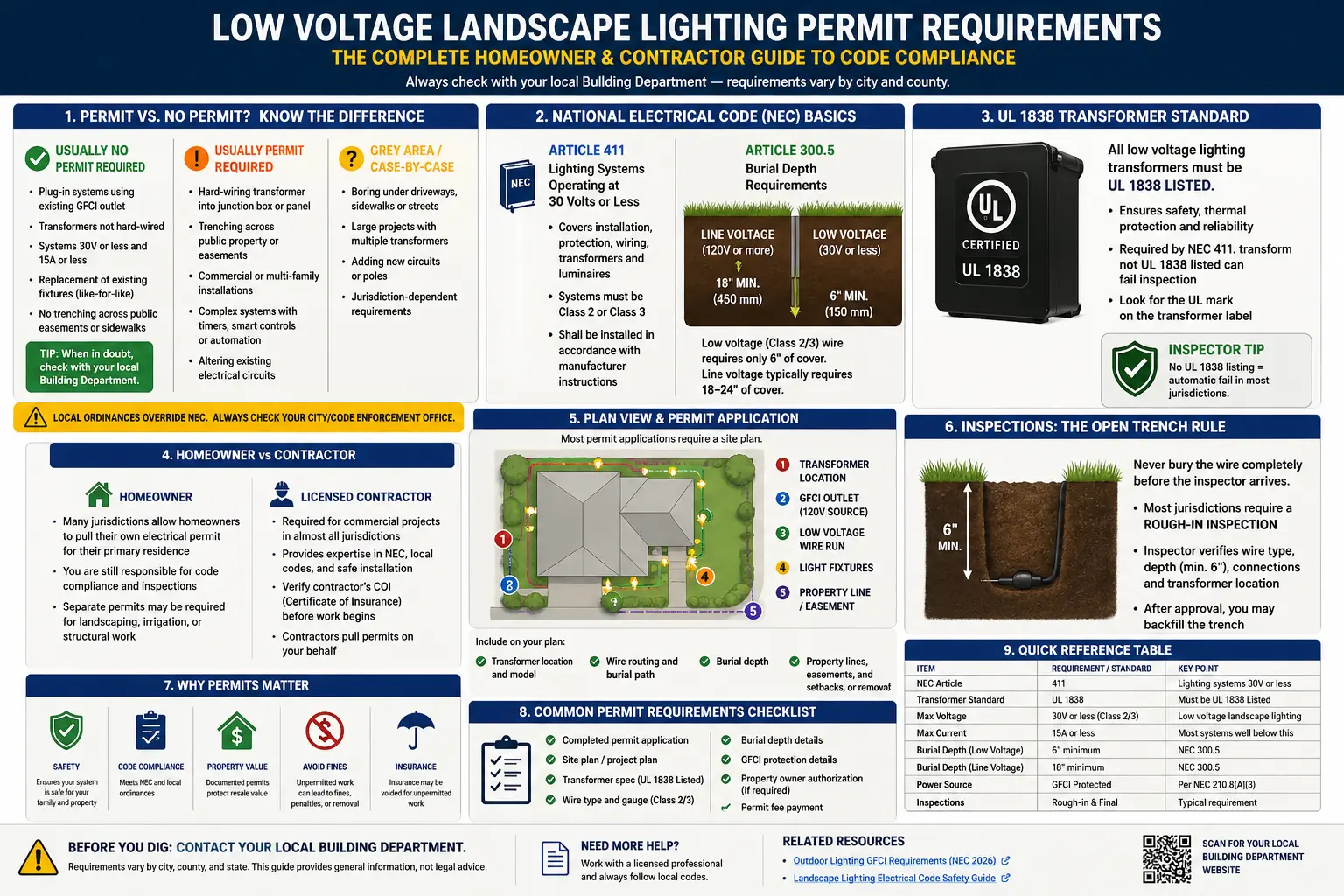
Do I Need a Permit for 12V Landscape Lighting?
Usually, a basic 12V plug-in landscape lighting kit does not need a permit when it plugs into an existing code-compliant GFCI-protected outdoor receptacle and stays entirely on private property. But a permit is more likely when the transformer is hardwired, a new outlet is added, the project crosses an easement, the job is commercial, or the trenching affects public sidewalks, driveways, or shared property.
If the project uses an outdoor receptacle, also review outdoor lighting GFCI requirements NEC 2026.
Permit Decision Logic Summary
| Situation | Permit Likely? | Main Reason |
|---|---|---|
| Plug-in transformer to existing outlet | No | No new 120V wiring |
| Hardwired transformer | Yes | Line-voltage electrical work |
| New outdoor outlet | Yes | New circuit installation |
| Trenching across easement | Often yes | Public right-of-way rules |
| Commercial installation | Yes | Inspection and liability requirements |
Permit vs. No Permit Logic Gate
| Project Type | Permit Likelihood | Why | What to Check |
|---|---|---|---|
| Plug-in 12V kit using existing outdoor GFCI outlet | Usually no permit | No new 120V wiring and transformer plugs into an existing receptacle | City rules, HOA rules, transformer listing, outlet condition |
| Hardwired transformer in a junction box | Usually permit required | Line-voltage wiring, enclosure, grounding, and inspection concerns | Electrical permit, licensed contractor rules, inspection timing |
| New outdoor receptacle for transformer | Usually permit required | New 120V branch-circuit work and GFCI/weatherproof requirements | Electrical permit, GFCI, in-use cover, box type |
| Low-voltage wire buried only in private landscape bed | Often no permit, but varies | Low-voltage field wiring may be treated as limited energy | Burial depth, listed cable, local low-voltage ordinance |
| Boring under driveway or public sidewalk | Grey area to likely permit | May involve right-of-way, hardscape, easements, or utility conflicts | Building department, public works, 811 utility marking |
| Commercial landscape lighting | Usually permit required | Public access, liability, energy code, inspection, and licensed work rules | Electrical permit, contractor license, COI, final inspection |
Permit rules and contractor licensing rules are related, but they are not the same thing. The low-voltage lighting contractor licensing guide explains when landscape lighting work may require a licensed electrical or specialty contractor.
Permit and inspection requirements often depend on much more than fixture placement alone. Our landscape lighting load calculation and code compliance guide explains how transformer capacity, low-voltage wiring methods, NEC load calculations, cable sizing, and system expansion planning all influence whether a landscape lighting installation meets safe electrical design standards.
Permit requirements often depend on which section of the National Electrical Code governs the installation. Many homeowners mistakenly assume every low-voltage lighting system falls under the same rules. Our NEC 411 vs. NEC 725 guide explains why different wiring methods and power supplies can change which code article applies before you begin work.
The confusing part of low-voltage lighting permits is that two systems can look identical in the yard but be treated differently by the building department. A transformer plugged into an existing outlet is different from a transformer hardwired into a box. A cable buried in your mulch bed is different from a cable crossing a sidewalk, driveway, easement, or commercial walkway.
This page gives you the decision logic, code language, site-plan requirements, inspection warnings, and permit application steps so you can ask the right question before digging.
Permit requirements often depend on the current NEC cycle. Review NEC 2026 landscape lighting code updates to understand how newer rules may affect your project.
For larger commercial or multi-zone LED projects, an inspector, engineer, owner, or utility may ask for more than transformer wattage and fixture listings. Driver power factor, current THD, dimming behavior, inrush current, and harmonic data may also appear in the project specification. The LED driver harmonic distortion compliance guide explains which standards address individual equipment, which apply to the complete electrical system, and what documentation should be requested from the manufacturer.
Jurisdiction First: Local Ordinances Override General Advice
The National Electrical Code is the technical language most inspectors use, but your local Authority Having Jurisdiction controls permit requirements, inspection timing, amendments, forms, fees, and contractor licensing rules.
The AHJ may be your city building department, county inspection office, electrical inspection authority, public works department, or another local agency. Some areas are relaxed about plug-in low-voltage kits. Others require permits when any exterior wiring is buried, when a transformer is mounted to a structure, or when work affects public easements.
NEC Article 411: Understanding Low Voltage Code
NEC Article 411 covers lighting systems operating at 30 volts or less. For most residential landscape lighting, this is the key low-voltage article because many systems operate at 12V or 15V from a listed transformer.
To ensure safety, the installation must create an effective ground-fault current path, which is an intentionally constructed low-impedance conductive path designed to carry fault current from a wiring system back to the electrical supply source.
- Use listed equipment designed for low-voltage lighting.
- Follow manufacturer instructions for transformer loading and wiring methods.
- Do not exceed the transformer’s rated output capacity.
- Keep the 120V supply side separate from the low-voltage output side.
- Use wiring and connectors rated for outdoor or direct-burial use where applicable.
For the safety side of outdoor wiring, see landscape lighting grounding and bonding guide.
Most landscape lighting transformers are classified as Class 2 power supplies, meaning they are designed to limit voltage and current to reduce shock risk under normal conditions.
For complete outdoor electrical safety rules, see the landscape lighting electrical code safety guide.
Burial Depth and Trenching Compliance
Burial depth is one of the biggest reasons low-voltage lighting projects get inspected. Low-voltage cable is not treated the same as 120V line-voltage cable, but the trench still must protect the wire from damage.
- Low voltage 12V–30V: commonly installed with about 6 inches of cover when allowed by local code and manufacturer instructions.
- 120V in PVC conduit: often requires deeper burial than low voltage.
- 120V direct-burial UF cable: often requires deeper burial than conduit-protected low-voltage runs.
- Driveways and sidewalks: may require conduit, boring rules, right-of-way approval, or inspection.
For exact depth comparisons, use landscape lighting wire burial depth code.
Burial Depth Comparison: Low Voltage vs Line Voltage
| System Type | Typical Burial Depth | Why It Matters |
|---|---|---|
| Low Voltage (12V–30V) | ~6 inches cover | Protected from damage but easier installation |
| 120V in PVC Conduit | ~18 inches | Protects higher voltage wiring |
| 120V Direct Burial (UF) | ~24 inches | Maximum protection for exposed cable |
UL 1838: Why the Transformer Listing Matters
A listed landscape lighting transformer is one of the fastest ways to show an inspector that the system is designed for low-voltage outdoor lighting. UL 1838 is a key standard used for low-voltage landscape lighting systems and power units.
If a transformer is not listed for landscape lighting use, an inspector may reject the installation, especially on a permitted project. This matters even more when the transformer is mounted outdoors, hardwired, or used on a commercial job.
For transformer selection and troubleshooting, see landscape lighting transformer guide and Portfolio lighting transformer troubleshooting.
Homeowner vs. Contractor Permits
Some jurisdictions allow a homeowner to pull an electrical permit for work on their own primary residence. Others restrict certain electrical work to licensed contractors, especially when new 120V wiring, hardwired transformers, commercial property, or shared buildings are involved.
Homeowner Permit
May be allowed for a primary residence, but the homeowner is responsible for code compliance, inspections, and corrections.
Licensed Contractor
Often required or strongly recommended for hardwired transformers, new outlets, line-voltage work, or commercial installations.
COI Verification
A Certificate of Insurance helps verify the contractor carries insurance for the type of work being performed.
Separate Permits
Some projects may involve electrical, landscaping, trenching, public works, or right-of-way approval.
If the project involves a new junction box, review outdoor lighting junction box requirements.
Plan View Schematic: What to Submit With a Permit Application
A permit application may require a simple site plan or plan-view drawing. It does not always need to be fancy, but it should clearly show what the inspector needs to verify.
- Transformer location: show where the power unit will be mounted or plugged in.
- Power source: identify the existing GFCI outlet, new outlet, or hardwired junction box.
- Wire runs: draw the route of each low-voltage cable run.
- Burial depth: note planned cable cover depth and any conduit sections.
- Fixture locations: mark path lights, spotlights, step lights, wall lights, and zones.
- Hardscape crossings: show sidewalks, driveways, patios, retaining walls, and boring locations.
- Easements: mark utility easements, property lines, and public right-of-way.
- GFCI protection: show how the transformer power source is protected.
Inspections: The Open Trench Rule
If a permit is required, do not bury everything before inspection unless the inspector specifically tells you it is allowed. Many jurisdictions require a rough-in inspection where the inspector can physically see the wire, trench, depth, conduit, and route before backfill.
To ensure safety, the installation must create an effective ground-fault current path, which is an intentionally constructed low-impedance conductive path designed to carry fault current from a wiring system back to the electrical supply source.
Take photos before backfill even when an inspection is not required. Photos can help later if you need to locate wires, sell the home, repair a damaged run, or explain the system to a future contractor.
Common Grey Areas That Trigger Permit Questions
These situations are where homeowners often get surprised by local rules.
- Boring under public sidewalks: may involve public works or right-of-way approval.
- Crossing a driveway: may require conduit, deeper protection, or inspection.
- Commercial frontage: often requires permits even for low-voltage lighting.
- HOA communities: may regulate brightness, fixture style, and glare even when the city does not require a permit.
- Pools and water features: may require stricter bonding, spacing, and inspection.
- New outdoor receptacles: usually make the project a 120V electrical permit issue.
For water and shock-risk topics, see landscape lighting grounding and bonding guide.
Related Permit and Code Planning Guides
Permit requirements often depend on where and how the lighting is installed. This outdoor wet-location fixture listing guide helps explain why fixture rating can matter when lighting is installed in exposed weather conditions.
Some projects may need clear service access to the transformer or power supply. This landscape lighting transformer disconnect code guide explains why safe shutoff access can be part of a compliant installation plan.
Lighting near pools should always be reviewed more carefully than ordinary path or garden lighting. This swimming pool lighting clearance guide explains why NEC 680 can affect fixture placement and electrical planning.
Water-feature lighting may require additional safety review because submerged fixtures create a different installation environment. This submersible fountain lighting code guide explains what makes underwater lighting different from normal landscape lighting.
Permit planning should also consider accessible routes and public-facing pathways. This ADA pathway lighting guide explains how outdoor lighting supports safer navigation for more users.
Before any buried splice or permanent connection is approved, the splice method matters. This landscape lighting splice connection requirements guide explains how outdoor wire joints should be protected.
Low Voltage Lighting Permit Requirements FAQ
Do I need a permit if I am just plugging into an outlet?
Usually no for a listed plug-in transformer using an existing compliant outdoor GFCI receptacle, but always check your local building department. Some cities regulate exterior lighting, accessory structures, easements, or commercial work separately.
Is low voltage lighting considered electrical work?
Yes. It is still electrical work, even though it may be treated differently than 120V line-voltage wiring. Many areas classify it as low-voltage, limited-energy, or Class 2 type work depending on the system and local rules.
What happens if I install landscape lighting without a permit?
If a permit was required, you could face stop-work orders, required removal, correction notices, fines, failed inspections, insurance issues, or problems during a home sale when unpermitted electrical work is discovered.
Does a hardwired low-voltage transformer need a permit?
Usually yes, because hardwiring brings the project into 120V electrical work. Local rules vary, but hardwired transformers often require an electrical permit and inspection.
Can a homeowner pull their own electrical permit?
In many jurisdictions, a homeowner can pull a permit for work on their primary residence. Other areas restrict certain electrical work to licensed contractors. Check your local building department before starting.
Do inspectors need to see the trench before I cover it?
Often yes when a permit is required. Many inspectors want a rough-in inspection before backfill so they can confirm burial depth, wiring method, conduit, and route.
Final Permit Compliance Checklist
- Search your city or county building department before starting.
- Confirm whether the transformer is plug-in or hardwired.
- Use a listed transformer intended for landscape lighting use.
- Verify GFCI protection for the outdoor power source.
- Call 811 before digging.
- Confirm burial depth and trench route before backfill.
- Prepare a simple site plan if applying for a permit.
- Leave trenches open until rough-in inspection if required.
- Keep photos, labels, manuals, and inspection records.
More Code, Safety, and Low Voltage Lighting Guides
Electrical Code Safety Guide
Use this as the main hub for outdoor lighting code, safety, and inspection topics.
Code safety guideOutdoor GFCI Requirements
Make sure the transformer power source is protected correctly.
GFCI requirementsBurial Depth Code
Compare low-voltage burial depth with 120V conduit and direct-burial cable.
Burial depth guideTransformer Guide
Understand transformer sizing, placement, and system layout before buying.
Transformer guidePermit and Code Disclaimer
This page is an educational guide to help homeowners understand common permit triggers for low-voltage landscape lighting. It is not legal advice and does not replace your local building department, electrical inspector, licensed electrician, or Authority Having Jurisdiction.
Always verify local permit requirements before installing, trenching, hardwiring, crossing easements, working near water, or hiring a contractor.