
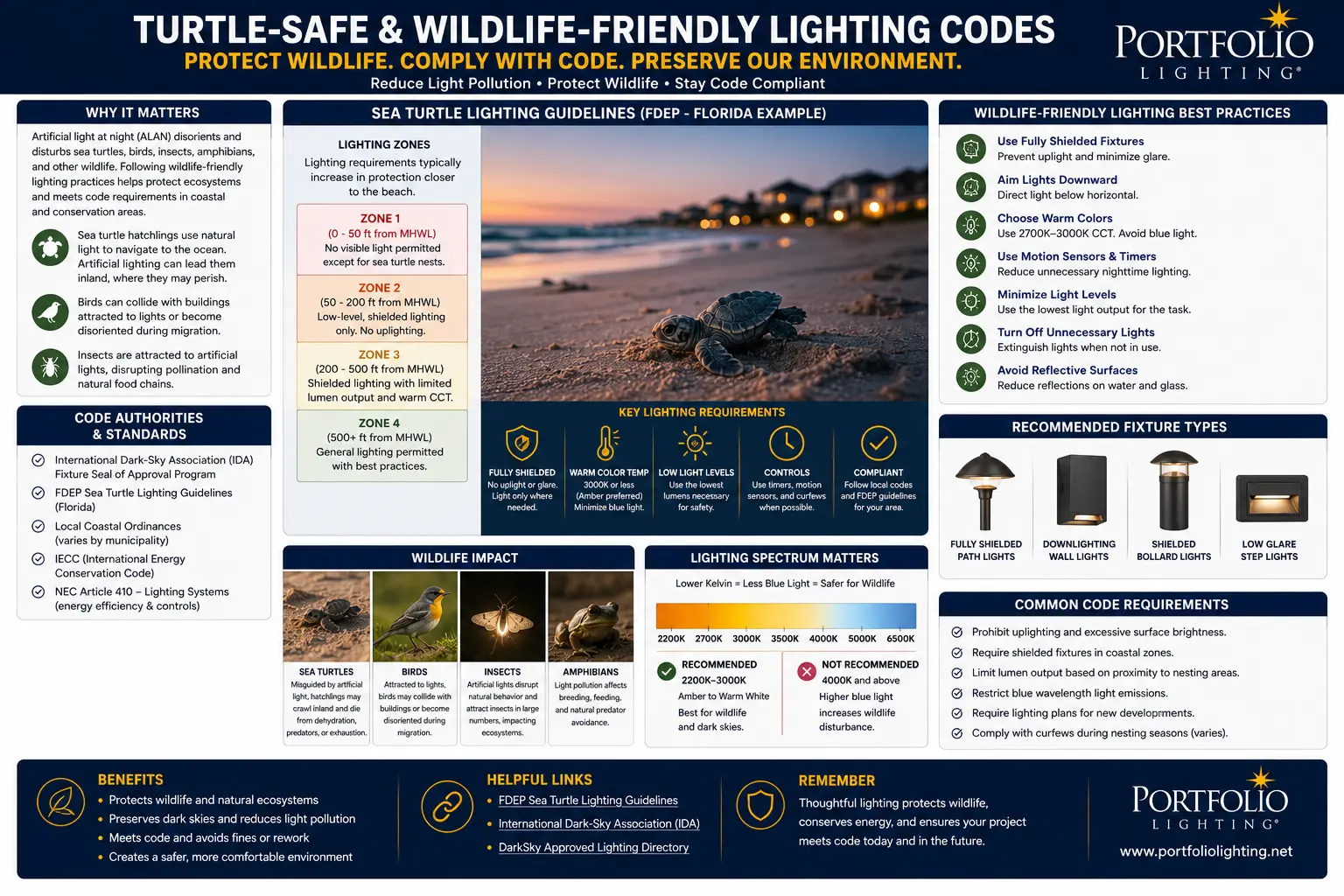
Sea Turtle Vision Science: Why 560nm Is the Cutoff and Why It Was Chosen
The 560nm wavelength cutoff in Florida's sea turtle lighting regulations is not arbitrary — it is derived from published scientific research on sea turtle photoreceptor spectral sensitivity. Understanding the science explains why the cutoff is where it is, why it matters more than color temperature, and why common landscape lighting fails even when it "looks warm."
Sea Turtle Photoreceptor Biology
Sea turtles have duplex retinas containing both rod and cone photoreceptors. Published research (microspectrophotometry and electroretinogram studies) has documented the following spectral sensitivities:
- Loggerhead turtles (Caretta caretta): Rod photoreceptors peak at 500–505nm. ERG data shows spectral peaks around 580nm for loggerheads (Levenson et al., 2004). The rod sensitivity at 500–505nm means loggerheads are highly responsive to blue-green light — wavelengths common in white and warm-white artificial lights.
- Green turtles (Chelonia mydas): Four photoreceptor classes — one rod with peak absorption at 500–505nm and three cone photoreceptors with peaks at 440nm, 502nm, and 562nm (Liebman and Granda, 1971). Multiple peaks at 520nm and 580nm with secondary peaks at 460nm and 600nm (ERG data). The 440nm cone means green turtles respond to violet-blue light that humans barely register as a color.
- The sea-water connection: Sea turtles have evolved short-wavelength-shifted sensitivity compared to freshwater turtles because saltwater absorbs red and orange wavelengths at depth, making blue-green the dominant visible wavelength underwater (Levenson et al., 2004). This evolutionary adaptation is precisely what makes them so sensitive to the blue-green components of artificial white light.
Visible Light Spectrum — Sea Turtle Sensitivity vs 560nm Compliance Cutoff
300–380
380–500
500–560
560–620
620–700+
Why Hatchlings Use Brightness to Find the Ocean — and Why Light Breaks This
Sea turtle hatchlings navigate from nest to ocean using a phototropotaxis mechanism — they instinctively move toward the brightest visible horizon. Under natural conditions, the ocean horizon is brighter than the dark dune vegetation on a moonlit beach. Artificial lights from coastal development create a false "bright horizon" landward, drawing hatchlings away from the ocean toward roads, pools, and development.
A critical and important finding from the FWC literature: "A common misconception is that long-wavelength lighting is not visible to sea turtles. This is FALSE." Per FWC sea turtle lighting guidelines: amber, orange, and red light IS visible to sea turtles. The regulations use amber/long-wavelength light not because turtles cannot see it at all, but because it is significantly less disorienting at typical use intensities. Intensity (lumens) matters independently of color — even amber light at excessive brightness can disorient hatchlings. This is why the FWC's "LOW" criterion (minimum necessary lumens) is required alongside LONG wavelength and SHIELDED fixture design.
The 3000K Trap: Why Warm White LEDs Fail Turtle Compliance Despite Feeling "Warm"
This is the single most important and most misunderstood fact in coastal landscape lighting compliance. Warm white LEDs — including those at 2700K and 3000K commonly used in residential landscape lighting — are NOT compliant for sea turtle protection zones, despite being marketed as "warm," "amber-toned," or "wildlife-friendly."
The Spectral Power Distribution Problem
Color temperature measured in Kelvin is a perceptual metric — it describes how humans perceive the overall warmth or coolness of a light source. A 3000K LED appears warm, yellowish, and incandescent-like to the human eye. But the spectral power distribution (the actual energy output at each wavelength) of a 3000K LED still includes significant energy at wavelengths sea turtles respond to:
- A typical 3000K phosphor-converted white LED has its spectral peak energy around 450–460nm (the blue LED "pump" wavelength) plus a broad phosphor emission spanning 490–700nm
- The blue pump at 450–460nm alone is well within the sea turtle's peak rod sensitivity (500–505nm) and within loggerhead cone sensitivity ranges
- The phosphor emission includes significant output from 490nm to 560nm — the green range that sea turtles also respond to
- Only wavelengths above 560nm from the phosphor output are compliant — and a 3000K LED produces substantial energy below this threshold
Warm, soft, incandescent-like. Looks amber or yellow-orange. Feels "warm" and "natural."
What it actually emits:Blue LED pump at ~450–460nm (high intensity) + broad phosphor emission from 490–700nm. Significant energy below 560nm — in the blue and green range that sea turtles are most sensitive to.
FWC compliance status:FAILS the LONG criterion: the lamp produces wavelengths below 560nm (both the blue pump and the blue-green phosphor emission). Even though it appears warm to humans, it contains the exact wavelengths that disorient hatchlings.
Distinctly orange-amber. Not white, not warm-white — clearly different from standard LED light. Similar to old sodium street lights or amber incandescent bulbs.
What it actually emits:Narrow-band amber LED emission centered at 580–590nm. No blue pump at 450nm. No short-wavelength output below 560nm. The entire emission spectrum is above the FWC compliance threshold.
FWC compliance status:PASSES the LONG criterion when specified as >560nm narrow-band amber LED without filters or gels. Also satisfies the "absent wavelengths below 560nm" condition that filters alone cannot satisfy.
Why Filtered White Lights Also Fail
A common workaround is to install an amber-colored filter, gel, or lens cover over a standard white LED to produce amber-colored output. FWC certification explicitly disallows this approach. Per the FWC certification criteria: compliant sources must use "long wavelength (greater than 560nm AND absent wavelengths below 560nm) light sources such as amber, orange, or red LEDs without the use of filters, gels, or lenses to achieve the long wavelength."
The reason filters don't satisfy the requirement: filters reduce the transmission of short wavelengths but don't eliminate them. An amber gel that blocks 90% of blue-green output still transmits 10% — which at high lumen output from a white LED can still be a significant amount of disorienting light. Additionally, filters degrade over time with UV exposure, heat, and weathering — a filter that was partially effective at installation becomes progressively less effective as the coastal environment degrades it. The lamp itself must be the amber source.
FWC Three Criteria: Low, Long, and Shielded — Every Condition Decoded
Florida Fish and Wildlife Conservation Commission's Wildlife Lighting Certification program requires simultaneous satisfaction of three criteria — Low, Long, and Shielded — before a fixture or lamp combination can be placed on the certified list. All three must be met. A fixture that is Long and Shielded but not Low fails certification. Understanding each criterion prevents the expensive mistake of buying compliant lamps for non-compliant fixtures.
- Fixtures must be appropriately sized for low-mounting applications — mounted as close to the ground or floor as possible while still serving the needed purpose
- Bulbs/lamps must produce the lowest wattage and lumen output necessary for the needed purpose
- For path lighting: use the minimum lumens needed for safe passage — NOT decorative illumination levels
- Bollard lights must not exceed 42 inches in height per Florida Model Ordinance provisions
- FWC explicitly notes: "LEDs tend to be much brighter than incandescent bulbs, so be sure not to over light an area!"
Even amber light at sufficient intensity can disorient hatchlings. A 100-watt-equivalent amber floodlight illuminating a beachfront property could still cause disorientation events — the LOW criterion prevents this by requiring minimum-necessary lumen levels.
- Light source must produce wavelengths of 560nm or greater
- The spectrum must be absent of wavelengths below 560nm — reduction is not sufficient; elimination is required
- Must be achieved through the lamp itself — NOT through filters, gels, or lenses
- Compliant sources: amber LEDs (580–590nm peak), orange LEDs (600–620nm peak), red LEDs (>620nm), low-pressure sodium vapor (589nm near-monochromatic)
- Non-compliant: 3000K warm white LED, 2700K warm white LED, incandescent, halogen, fluorescent, metal halide, mercury vapor, filtered white LEDs
Low-pressure sodium (LPS) lamps emit nearly monochromatic light at 589nm — essentially entirely above 560nm. This is why older sodium streetlights on some coastal roads were less disorienting than modern white LED streetlights, even though LPS looks intensely orange to human eyes.
- Fixtures must meet or exceed full cutoff classification — the lamp or glowing lens must not be directly visible from the beach or nesting habitat
- Fixture must be completely downward-directed
- Mounted with beachside shields where needed to prevent direct or indirect light reaching the beach
- Pool, patio, and deck lighting visible from the beach must have shields that restrict light to the immediate area
- Interior lights visible through windows from the beach must be blocked — blinds, curtains, or window tinting required after 9:00 PM in some county ordinances
An amber lamp in an unshielded floodlight aimed at the dune face still illuminates the beach and can disorient hatchlings — because it's the illumination of the beach horizon, not just the lamp color, that creates the disorientation. Shielding prevents the amber light from reaching the nesting zone regardless of wavelength compliance.
The FWC Certified List Is the Compliance Shortcut: Rather than verifying wavelength specifications and shielding calculations independently, use the FWC's published list of certified Wildlife Lighting fixtures and lamps at myfwc.com. Fixtures on this list have been tested and verified to meet all three criteria. This is the fastest path to compliance verification and the best documentation to present to a code enforcement officer or inspector. Products NOT on the list require independent verification of all three criteria — including spectroradiometer measurements confirming no output below 560nm — which is expensive and impractical for most property owners.
Florida's 62B-55 Model Ordinance Framework: What the Law Actually Requires
Florida implements sea turtle lighting protection through a state-level framework established by Section 161.163, Florida Statutes, which required the Florida Department of Environmental Protection to create guidelines for local governments to regulate beachfront lighting. The resulting model ordinance is Chapter 62B-55, Florida Administrative Code.
The Enabling Statute and Regulatory Chain
Florida Section 161.163, F.S. requires DEP to designate coastal areas used for sea turtle nesting and establish guidelines for local government lighting regulations. DEP published the Model Lighting Ordinance as Chapter 62B-55. Individual counties and municipalities then adopt ordinances based on — or more stringent than — the model ordinance. The FWC maintains an interactive map showing all Florida counties and municipalities with adopted lighting ordinances.
A notable gap documented in published compliance reports: as of early 2025, Miami-Dade County remained the only coastal county without a county-wide lighting ordinance, though individual municipalities within Miami-Dade (including Miami Beach) have adopted their own regulations.
What Chapter 62B-55 Actually Requires for Outdoor Lighting
Scope: Applies to all structures seaward of the Coastal Construction Control Line (CCCL), the primary dune structure, or the mean high water line. Applies to any light source whose glow or direct beam can be seen from the nesting habitat during nesting season (generally March 1 – October 31).
New construction standard (most protective): "All lighting of outdoor areas shall be long wavelength, downward directed, full cutoff, fully shielded and mounted as close to the ground or finished floor surface as possible."
Path and walk lighting: "Lighting of paths, walks and routes of building access shall use low level fixtures such as step, paver, path, recessed wall or bollard lights. Bollard lights are not to exceed 42 inches in height."
Interior lighting: Light visible through windows and doors from the beach must be blocked — particularly after 9:00 PM. Window film, blinds, and curtains are required management tools for interior light visible from nesting habitat.
Non-egress outdoor lighting: May be installed landward of buildings or other opaque structures provided it has long-wavelength lamps and beachside shields preventing beach visibility.
Seasonal mandate: Generally March 1 through October 31. Non-compliant light sources must be extinguished or modified during nesting season.
Penalties: Model ordinance provides template language for fines per day per violation, with liens attachable to non-remedying properties. Violations also potentially implicate ESA federal enforcement.
Existing vs New Construction Standards
| Lighting Category | New Construction Standard | Existing Construction Standard | Timeline |
|---|---|---|---|
| Outdoor area lighting (all types) | Most protective: Long wavelength + downward + full cutoff + fully shielded + minimum necessary lumens | Must be replaced or modified to conform to standards in Section 3.7 of model ordinance at local adoption date | At permit or inspection trigger |
| Path, walk, and access route lighting | Low-level fixtures only. Bollards ≤42 inches. Downward directed. Long wavelength. Beachside shields. | Modification required to long wavelength + shielded at earliest opportunity | At renovation, sale inspection, or complaint |
| Pool and patio area lighting | Long wavelength + shielded to prevent beach visibility + minimum necessary intensity | Shields required for any fixture whose light is visible from beach | Nesting season enforcement |
| Interior lighting visible from beach | Window tinting, blinds, or other blocking required to prevent beach visibility | Management measures required — typically after 9:00 PM | During nesting season (March–October) |
| Security and safety lighting | Cannot be turned off (safety requirement) but must be modified to long wavelength + shielded + minimum lumens. Motion sensors recommended. | Modification to amber/red + shielded required. Motion sensors and timers are compliant management tools. | Required modification; turning off not permitted if safety function |
ESA Section 9 Federal Liability: When Artificial Lighting Becomes a Federal "Take"
The most significant and least-understood legal dimension of sea turtle lighting requirements is that non-compliant artificial lighting at coastal properties is not merely a local ordinance violation — it creates potential liability under the federal Endangered Species Act. The legal basis was established in a landmark federal court decision in 2000.
Loggerhead Turtle v. Volusia County (2000): The Case That Changed Everything
The court found: "At this juncture, it is clear that: 1) endangered and threatened sea turtles in Volusia County are 'taken' in violation of the ESA; and 2) these takings result from artificial beachfront lighting."
The case established that Volusia County's adoption and enforcement of an ineffective artificial beachfront lighting ordinance — one that failed to actually prevent hatchling disorientation — constituted a proximate cause of harm to sea turtles. Count 1 asserted County violation of ESA Section 9(a)(1)(B), the taking prohibition, 16 U.S.C. § 1538(a)(1)(B).
The legal significance: This case established that not just actively harmful lighting but also failure to enforce effective lighting standards creates ESA Section 9 "take" liability. It directly drove the strengthening of Florida's model ordinance and the development of the FWC's certified Wildlife Lighting program.
The ESA "Take" Definition and How Lighting Qualifies
The ESA defines "take" as "to harass, harm, pursue, hunt, shoot, wound, kill, trap, capture, or collect" or any attempt to do so (16 U.S.C. § 1532(19)). "Harm" is further defined by regulation to include "significant habitat modification or degradation that actually kills or injures wildlife by significantly impairing essential behavioral patterns, including breeding, feeding, or sheltering." The disorientation of hatchlings away from the ocean by artificial lighting qualifies as "harm" because it kills and injures sea turtles by impairing the essential behavioral pattern of sea-finding — the instinctive movement from nest to ocean that hatchlings must complete within hours of emergence.
Recent ESA Citizen Suits Against Florida Properties
The citizen suit provision of the ESA (Section 11) allows private environmental organizations to sue violators directly. Environmental groups have served 60-day notices of intent to sue Florida beach resorts — including Hilton Hotels, Bahia Mar Resorts, and Suntex Marinas — under ESA Section 9 for artificial lights disorienting loggerhead and green sea turtle hatchlings. These notices document specific instances: over 3,000 loggerhead and sea turtle hatchlings disoriented between 2016 and August 2020 at one resort complex.
Per published endangeredspecieslawandpolicy.com analysis: "With the availability of wildlife-friendly light alternatives, we may see more instances where private lighting systems constitute a 'take' under the ESA." The practical implication: coastal property owners with artificial lighting visible from nesting beaches who do not use FWC-certified fixtures face potential exposure to federal citizen suits, independent of any local ordinance enforcement.
All five sea turtle species nesting in Florida — Loggerhead, Green, Leatherback, Kemp's Ridley, and Hawksbill — are protected under the federal ESA and Florida's Marine Turtle Protection Act (Section 379.2431, Florida Statutes). ESA Section 9's taking prohibition applies to all individuals, organizations, and agencies — including private property owners. There is no exemption for residential properties. A beachfront homeowner whose outdoor landscape lights disorient hatchlings faces the same federal "take" liability as a large resort hotel. The availability of compliant FWC-certified amber LED alternatives at reasonable cost means that the "no reasonable alternative" defense is not available for lighting violations.
Bird-Safe Lighting Ordinances: The Emerging Regulatory Layer
While sea turtle lighting codes represent the most developed and technically specific wildlife lighting regulatory framework, a parallel body of bird-safe building legislation is developing rapidly across North American cities. Understanding both frameworks helps coastal property owners who may be subject to both sets of requirements.
The Scale of the Problem: Why Lighting Laws Are Emerging
An estimated 1 billion U.S. bird deaths occur annually from collisions with buildings and structures, with migratory species at greatest risk. Over 80% of migratory birds navigate using stars and natural darkness — artificial light pollution disrupts their orientation, drawing them into illuminated urban areas where window collisions kill them. Chicago's Lights Out program has documented over 80% reductions in bird collision fatalities in participating buildings.
Mandatory vs Voluntary Programs
Mandatory Bird-Safe Ordinances (City/State Level)
Jersey City, NJ: Bird-Safe Ordinance (unanimous City Council vote) — requires bird-friendly glass and lighting in new construction and major renovations. New York City: LED specifications and "Lights Out" requirements enacted for city buildings during peak migration. Dallas, TX: Kay Bailey Hutchison Convention Center adopting bird-friendly glass as part of $3.7B renovation. Some cities have adopted requirements for all structures, not just commercial buildings, during migration peak periods.
Voluntary Programs with Strong Adoption
Chicago's Lights Out program (1995): voluntary but highly adopted — participates include individual homeowners to major skyscrapers. Toronto's FLAP (Fatal Light Awareness Program): tracks casualties, works with building owners, documented measurable reductions. Lights Out Texas! (Audubon): statewide campaign for the Central Flyway; 1-in-3 US migratory birds passes through Texas. Building owners asked to dim non-essential lights 11pm–6am during spring (April-May) and fall (August-October) migration.
Dark Sky Ordinances with Bird-Safety Co-Benefits
Texas Senate Bill 1090: allows cities to enforce dark sky ordinances near observatories. International Dark Sky Association communities (Dripping Springs TX, Wimberley TX, Bee Cave TX): 3,000K or lower color temperature requirements, shielded downward-only fixtures, curfews for non-essential lighting. The color temperature and shielding requirements of dark sky ordinances broadly align with bird-safe and wildlife-friendly lighting principles — a single fixture choice often satisfies all three frameworks simultaneously. See the dark sky compliance guide.
What Landscape Lighting Owners Should Do During Migration
Even without mandatory ordinance requirements, landscape lighting practices that reduce bird risk during peak migration periods: turn off non-essential decorative uplighting and accent lighting from 11pm–6am during April-May and August-October; use timers set to dim or extinguish landscape lighting after midnight; replace cool-white or daylight landscape spotlights with amber (580nm+) or warm (2700K maximum) alternatives; eliminate any upward-directed landscape lighting that illuminates the sky rather than the ground. See the landscape lighting timer settings guide for timer configuration options.
How Amber Landscape Lighting Serves Both Sea Turtle and Bird Safety
Amber LED landscape lighting (580–590nm) that complies with FWC sea turtle standards also provides significant bird migration benefits. Research on avian light attraction shows birds are most strongly disoriented by blue and white light (400–500nm) and are significantly less attracted to amber and red wavelengths above 580nm. A coastal property owner who upgrades from standard warm-white landscape lighting to FWC-certified amber LED fixtures simultaneously satisfies Florida's sea turtle lighting requirements and significantly reduces their contribution to migratory bird mortality — a single investment addressing both regulatory frameworks.
How Standard Landscape Lighting Must Change to Comply
A standard residential landscape lighting system — Portfolio or Hampton Bay path lights, uplights, and spotlights on a 12V transformer — requires specific modifications to comply with sea turtle lighting ordinances. This section maps every component of a standard system to its compliance status and required change.
| Component | Standard Configuration | Compliance Status | Required Change for Compliance |
|---|---|---|---|
| Path light fixtures (mushroom/tier style) | Standard white LED, any color temp, 1–5W, stake-mounted 12–24 inches | FAILS — white LED regardless of color temp has sub-560nm output | Replace lamp with FWC-listed amber (580–590nm) LED or replace entire fixture with FWC-certified path light. Keep stake height at minimum necessary. |
| Path light fixtures — position | Placed at path edge, facing up or outward in mushroom design | May fail shielding if visible from beach | Downward-directed fixtures only. Beachside shields required if glow visible from beach. Recess or shield fixtures that emit toward dune/beach. |
| Spotlights / uplights | Directed upward at palms, plantings, or architecture. White or cool LED. | FAILS — both wavelength (white LED) and direction (upward) violations | Remove or fully redirect downward. If accent lighting is permitted landward of opaque structure, use amber LED + beachside shield. Most uplighting in beach zones cannot be brought into compliance and must be removed. |
| 12V transformer | Standard UL 1838 landscape transformer (Hampton Bay, Portfolio, Malibu) | PASSES — transformer itself has no color requirement. Timer and GFCI compliance remain standard NEC requirements. | No change to transformer required. Set timer to extinguish lights at 9pm or to use motion sensors. See the transformer guide. |
| Bollard lights | Standard white LED bollards, 36–48 inches height, ambient illumination | FAILS — white LED wavelength violation. Height may exceed 42-inch maximum in ordinance areas. | Replace lamps with amber (580nm+) LED. Verify height is 42 inches or less. Confirm shielding prevents beach glow. FWC-certified bollard fixtures are the preferred solution. |
| Step and deck lighting | Recessed LED in risers or deck surface, white LED, downward directed | Downward direction may comply. Wavelength fails (white LED). Check if visible from beach. | Replace with amber LED sources (not filtered white). Recessed step lights with amber LEDs and downward direction satisfy all three FWC criteria if not visible from beach. |
| Pool and spa lighting | Underwater LED pool lights, typically white or color-changing | Underwater pool lighting visible from beach FAILS all criteria. Major non-compliance source. | Pool lighting must be shielded from beach visibility or converted to long-wavelength (amber/red) underwater fixtures certified for pool use. Nighttime pool covers significantly reduce compliance burden. See the pool lighting clearance code guide. |
The most common compliance mistake I see on coastal landscape lighting projects: the homeowner replaces all outdoor fixtures with "2700K warm white" LEDs from a big-box store, calls it compliant, and gets cited by code enforcement anyway. The 2700K designation is meaningless for sea turtle compliance purposes — only FWC-certified amber fixtures (specifying 580nm+ peak wavelength with absent sub-560nm output) satisfy the ordinance. In practice, installing FWC-certified amber path lights alongside fully shielded downward step lights is the cleanest compliance path — it's also better aesthetically in most coastal settings because the warm amber light complements the natural beach environment better than cool white LEDs that make everything look clinical.
Coastal Property Lighting Compliance Checklist
Use this checklist to evaluate any coastal property lighting system against Florida sea turtle ordinance requirements. Verify which specific ordinance your local jurisdiction has adopted before finalizing any compliance determination.
- ✅ Identify your zone: Is the property seaward of the CCCL (Coastal Construction Control Line), primary dune structure, or mean high water line? These are the trigger zones for ordinance requirements.
- ✅ Identify which ordinance applies: Check the FWC interactive ordinance map for your county and municipality. Verify adoption date — new construction vs existing construction standards differ.
- ✅ Inventory all light sources visible from the beach: Walk the beach at night during season and note every artificial light visible from the nesting zone — including interior lights through windows and doors.
- ✅ Verify all outdoor lamps are FWC-certified amber (580nm+) — not just 3000K warm white. Check the FWC certified Wildlife Lighting list for fixture and lamp verification.
- ✅ Verify all fixtures are fully shielded and downward-directed: No lamp, glowing lens, or direct beam should be visible from the beach. Beachside shields required for any fixture visible from nesting habitat.
- ✅ Verify minimum necessary lumens: Remove excess fixtures. Reduce lamp wattage to the minimum needed for safe use of the path, step, or area.
- ✅ Verify bollard height ≤42 inches for all bollard-style fixtures in ordinance areas.
- ✅ Install timer or motion sensors: Timer set to extinguish non-safety lighting at 9pm minimum (check local ordinance). Motion sensors recommended for safety lights to minimize duration.
- ✅ Address interior lighting visible from beach: Window tinting, blinds, or blackout curtains on all windows and doors facing the beach during nesting season (March 1 – October 31).
- ✅ Remove or redirect all uplights: Uplighting directed at palms, architecture, or any fixture directing light skyward cannot comply and must be removed from beach-visible zones.
- ✅ Document compliance: Photograph all compliant fixtures, save FWC certification documentation for all lamps and fixtures, retain for property disclosure and permit records.
Turtle-Safe & Wildlife-Friendly Lighting FAQ
Are 3000K warm white LEDs turtle-safe for Florida coastal properties?
No — 3000K warm white LEDs are not compliant for Florida sea turtle lighting zones. Florida FWC's standards require lamp wavelengths of 560nm or greater AND absent of wavelengths below 560nm. A 3000K warm white LED has a spectral power distribution that includes the blue LED pump at ~450nm and phosphor emission from 490nm upward — substantial energy below 560nm. FWC-compliant lamps are specifically engineered amber or red LEDs with peak wavelengths at 580–590nm, producing distinctly orange light. The distinction between 3000K color temperature and 580nm wavelength is the most important fact in coastal lighting compliance. See the biological impact of outdoor light color guide and the color temperature guide.
What does "Low-Long-Shielded" mean for FWC Wildlife Lighting Certification?
The FWC uses three simultaneous criteria for Wildlife Lighting Certification: LOW means fixtures use the minimum necessary lumens mounted as low as possible — not overly bright or raised unnecessarily; LONG means the lamp produces wavelengths of 560nm or greater with no wavelengths below 560nm, achieved through the lamp itself rather than filters; SHIELDED means the fixture fully shields the lamp and glowing lens from direct beach visibility and is completely downward-directed. All three must be satisfied simultaneously — a fixture that is Long and Shielded but not Low fails certification. The FWC's certified fixture list is available at myfwc.com and is the authoritative compliance reference.
Does sea turtle lighting law apply to my private beachfront home?
Yes — on two levels. First, if your county or municipality has adopted a sea turtle lighting ordinance, it applies to your property if it is seaward of the CCCL or other defined trigger boundary. These ordinances apply to residential properties. Second, and independently of local ordinances, ESA Section 9 applies to all persons, including private homeowners. The Loggerhead Turtle v. Volusia County (2000) federal case established that artificial beachfront lighting causing hatchling disorientation constitutes a "take" under ESA. The absence of a local ordinance does not remove ESA liability. Environmental groups have served citizen suit notices against private resorts for documented hatchling disorientation events. The compliance path for residential coastal properties is the FWC's certified amber LED fixtures plus shielding and timers.
Do bird-safe lighting ordinances apply to residential landscape lighting?
Generally not at the residential scale for most current mandatory ordinances — bird-safe building ordinances in New York, Jersey City, Dallas, and similar cities primarily target commercial buildings, office towers, and large residential structures. Voluntary programs like Chicago's Lights Out and Lights Out Texas! encourage all property owners to dim non-essential lighting during peak migration periods (April-May and August-October) from 11pm to 6am. The best residential practice that satisfies both sea turtle and bird-safe goals simultaneously: FWC-certified amber LED landscape lighting (580nm+) with timers set to extinguish non-safety lighting by 11pm. Amber LEDs are less disorienting to migratory birds than white or blue-white LEDs, providing bird-safe benefits even without a specific bird ordinance requirement. See the wildlife-friendly outdoor lighting guide.
Why can't I just put an amber filter or gel over my existing white outdoor lights?
Florida FWC's Wildlife Lighting Certification explicitly disallows the use of "filters, gels, or lenses" to achieve long-wavelength compliance. The lamp itself must be the long-wavelength source. Two reasons: first, filters reduce but don't eliminate short-wavelength output — they transmit some blue-green light even when substantially attenuated. Second, filters degrade over time in coastal environments with UV exposure, salt air, heat cycles, and weathering — a filter that was partially effective at installation becomes progressively less effective, making the "filtered white" solution a non-durable workaround. FWC-certified amber LEDs cost roughly the same as quality white LED path light bulbs and are available in the standard base types (MR16, GU5.3, A19, PAR38) used in most landscape fixtures. There is no practical cost argument for filter workarounds when compliant lamp replacements are available.
Related Wildlife Lighting, Design, and Code Guides
- Wildlife-Friendly Outdoor Lighting Guide
- Dark Sky Compliance Guide
- Biological Impact of Light Color
- Dark Sky Fixture Selection Guide
- Outdoor Lighting & Human Health
- Lumen Pollution vs Light Pollution
- Outdoor Lighting Ordinance Guide
- Fix Light Trespass Guide
- Color Temperature Guide
- Color Temperature — Sustainability Edition
- Landscape Lighting Design Guide
- Landscape Lighting Lumen Guide
- Beam Spread Guide
- Landscape Lighting Layout Guide
- Path Light Placement Guide
- Landscape Lighting Guide
- Timer Settings Guide
- Maintenance Guide
- Pool Lighting Clearance Code
- Electrical Code Safety Guide
- Wet Location Listing Requirements
- Insurance & Liability Guide
- ADA Outdoor Lighting Rules
- Transformer Sizing Guide