
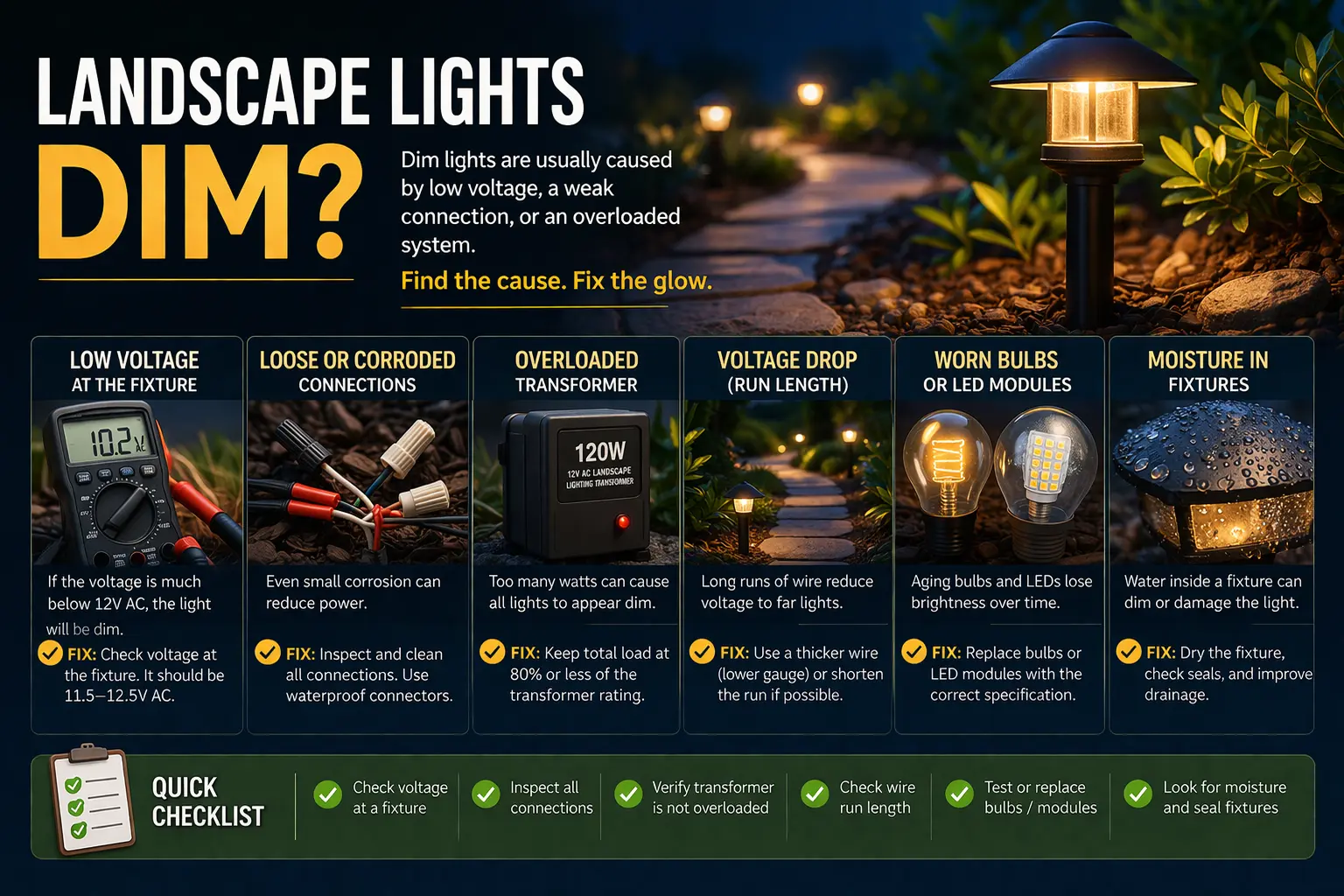
Why Are My Landscape Lights Dim? (Quick Answer)
Landscape lights become dim when they are not receiving enough voltage. The most common causes are voltage drop, overloaded transformers, loose connectors, aging bulbs, or too many fixtures on one run.
- All lights dim: transformer or overload
- Lights dim farther away: voltage drop
- One light dim: bulb or connection issue
If landscape lights become noticeably dim farther away from the transformer, the wire itself may be undersized for the load. The wire gauge distance and load guide explains how long cable runs affect brightness.
Dim Landscape Lights – Problem Guide
| What You See | What It Means | What To Do |
|---|---|---|
| All lights dim | Transformer overload or weak output | Check transformer capacity |
| Lights dim farther away | Voltage drop | Shorten run or upgrade wire |
| One light dim | Bad bulb or connector | Replace bulb or fix connection |
| Lights dim after rain | Moisture in wiring | Inspect connectors and splices |
| Lights dim when others turn on | System overload | Reduce load or split runs |
Dim lighting almost always comes from weak voltage—not fixture failure.
Dim Landscape Lights – Problem Guide
| What You See | What It Means | What To Do |
|---|---|---|
| All lights dim | Transformer overload or weak output | Check transformer capacity |
| Lights dim farther away | Voltage drop | Shorten run or upgrade wire |
| One light dim | Bad bulb or connector | Replace bulb or fix connection |
| Lights dim after rain | Moisture in wiring | Inspect connectors and splices |
| Lights dim when others turn on | System overload | Reduce load or split runs |
Dim lighting almost always comes from weak voltage—not fixture failure.
Dimness often becomes most noticeable at the end of a run, especially along walkway lighting runs. To better understand how spacing and layout affect performance, review our path lighting layout and spacing guide.
Start Here: Fix Dim Lights Fast
- All lights dim → check transformer
- Only far lights dim → fix voltage drop
- One light dim → replace bulb or connector
- Dim after rain → check moisture damage
Follow this order to avoid replacing parts that are still working.
Dim landscape lighting usually means the fixtures are still getting power, but not enough clean voltage to perform at normal brightness. That often makes this problem easier to solve than a full outage.
The most common causes are voltage drop, overloaded transformers, weak connectors, damaged cable, old bulbs, and too many fixtures sharing one run. Start with the quick diagnosis table below, then work through the troubleshooting order so you can restore brightness without guessing.
If your lights are not working at all, start with the Portfolio lighting troubleshooting guide before focusing only on dimness.
If your lights are dim due to voltage drop, increasing the transformer tap is often the fix. Use the voltage tap calculator to find the correct voltage setting for your system.
Quick Fix: Check These First
- Check transformer capacity and output
- Inspect wire connections and connectors
- Look for voltage drop on long runs
- Replace aging bulbs or LED modules
- Check for overloaded lighting branches
Most dim lighting problems are solved in these first steps.
Most Common Reasons Landscape Lights Are Dim
- Voltage drop on long cable runs
- Overloaded transformer
- Loose or corroded connectors
- Old or failing bulbs
- Too many fixtures on one run
Why Landscape Lights Become Dim
Landscape lights become dim when the voltage reaching the fixtures drops below what the system needs for strong, stable brightness. The most common causes are voltage drop in long cable runs, overloaded transformers, aging LED or halogen bulbs, loose connectors, damaged wiring, and too many fixtures sharing one transformer.
In many low-voltage landscape lighting systems, dimness becomes more noticeable over time. A run that once looked fine may slowly become weaker after extra fixtures are added, connectors age, or the transformer begins to struggle. Some homeowners only notice the issue when the farthest lights start looking much weaker than the ones closest to the transformer.
Most Common Causes
- voltage drop on long cable runs
- overloaded transformer
- aging LED or halogen bulbs
- loose or corroded connectors
- damaged buried cable
- too many fixtures on one transformer
System-Wide Dimness Clues
- all fixtures look weaker than normal
- brightness drops when more lights turn on
- transformer runs warm or hums
- system expanded over time
Run-Length Dimness Clues
- lights farther from the transformer are weaker
- end-of-run path lights look dull
- brightness fades across one branch
- wire gauge may be too small
Single Fixture Dimness Clues
- one path light looks weak
- bulb is aging or loose
- socket or internal contact is worn
- fixture lens is dirty or damaged
Quick Diagnosis Table for Dim Landscape Lights
Use this table to match what you are seeing in the yard to the most likely cause before replacing fixtures or rewiring the full system.
| Symptom | Likely Cause | What To Check | Detailed Fix |
|---|---|---|---|
| All lights look dim | Overloaded transformer, weak output | Total wattage load and transformer condition | Portfolio lighting transformer troubleshooting |
| Lights get dim farther from the transformer | Voltage drop | Cable length, wire gauge, fixture count | Landscape lighting voltage drop |
| One light is dim | Bad bulb, dirty lens, socket issue | Bulb fit, lens condition, fixture contact points | Landscape lighting replacement parts guide |
| Lights dim after rain | Moisture in connectors, weak splice | Wire connections, wet fixtures, buried splices | Portfolio lights not working after rain |
| Lights dim when others turn on | Transformer capacity, system overload | Connected load and branch balance | Landscape transformer overload |
| Dim lights later start blinking | Voltage instability, overload, weak connection | Transformer, connectors, wet wiring | Portfolio lights blinking |
How to Fix Dim Landscape Lights
Check transformer capacity first
If the transformer is overloaded, lights across the system may look weak even though nothing is fully dead. This often happens in low-voltage systems that were expanded over time without recalculating total fixture load. If all the lights are dim together, the transformer is one of the first places to check.
Inspect cable runs
Long wiring runs can cause voltage loss before power reaches the farthest fixtures. This is one of the biggest reasons landscape lights are dim farther from the transformer. The longer the run and the more fixtures attached to it, the more likely voltage drop becomes.
Check wire connectors
Loose, corroded, or poorly sealed connectors reduce power flow. Even a connection that still looks attached may be weak enough to lower brightness. Open accessible splice points and inspect for blackened copper, rust, partial pierces, and connectors that no longer make solid contact.
Replace aging bulbs or LED modules
Older bulbs lose brightness over time. A halogen lamp near the end of its life or an older LED lamp with weakening output can make one fixture look noticeably dim. If only one light is weak, test it with a known good bulb where possible before assuming the whole run is the problem.
Balance the lighting system
Spreading fixtures across multiple cable runs helps maintain voltage. If one branch carries too many lights, that branch may look weak even if the rest of the yard is acceptable. Rebalancing fixtures or shortening one overloaded run often restores stronger brightness.
Voltage Drop in Landscape Lighting
Voltage drop is one of the most common reasons landscape lighting becomes dim. When cable runs are long, wire gauge is too small, or too many fixtures share one line, the voltage reaching the end of the run falls. That reduced voltage makes lights look weaker, especially the farthest ones from the transformer.
This is why path lights often look brightest near the transformer and dimmer as the run continues. Homeowners sometimes think those far fixtures are failing, when the real issue is not the fixture at all. It is the amount of usable voltage reaching it.
If your landscape lights are not bright enough and the dimness increases with distance, continue with landscape lighting voltage drop, landscape lighting cable guide, and how to wire landscape lighting.
Transformer Problems That Cause Dim Lights
A bad transformer does not always fail completely. In many cases it still powers the system, but not strongly enough to keep the lights bright. An overloaded transformer, aging internal components, or weak voltage output can make the whole yard look dull instead of fully dark.
Signs of transformer-related dimness include all fixtures looking weak at once, brightness dropping when more fixtures come on, or a system that became dimmer after adding more lights to the same transformer.
If your lighting system includes Portfolio components, use Portfolio lighting transformer troubleshooting to go deeper into overload symptoms, weak output, and transformer-related dimness.
Wiring and Connector Problems
Corroded connectors, damaged cable, and improper wire splices can all reduce power before it reaches the fixtures. This kind of resistance loss is a very common reason outdoor lights look dim, especially in older systems that have been wet, disturbed by yard work, or repaired multiple times.
If dimness affects one section more than another, inspect the connectors and splice points in that branch first. A weak connection may still allow the lights to work, but not at full brightness. The same issue can get worse over time and later become flickering, blinking, or full failure.
For deeper help, compare your system to landscape lighting cable guide and how to wire landscape lighting.
When Dim Lights Turn Into Bigger Problems
Dim landscape lights are often the early warning stage before more obvious trouble appears. A weak run may later start flickering. An overloaded transformer may eventually blink or shut down. A wet connector that only causes slight dimness now may later fail completely.
That is why dim outdoor lights are worth fixing early. The problem is often still small enough to solve with better connections, a corrected run layout, or a simple bulb replacement.
- dim lights farther from the transformer often point to voltage drop
- all lights dim together often point to transformer load or weak output
- one dim light often points to a local bulb, socket, or connector issue
- dimness after rain may point to moisture inside connectors or cable splices
Portfolio Systems and Dim Landscape Lights
Many outdoor lighting systems installed over the past two decades used Portfolio low-voltage transformers and fixtures sold through Lowe’s. If your landscape lights appear dim and your system includes Portfolio components, the problem may be related to transformer output, wiring connections, or aging fixtures. You can explore detailed troubleshooting in our Portfolio lighting troubleshooting guide, learn about system layouts in Portfolio landscape lighting, diagnose power issues in Portfolio lighting transformer troubleshooting, or review system wiring in our Portfolio lighting wiring diagram guide.
Landscape Lights Dim FAQ
Why are my landscape lights dim?
The most common causes are voltage drop, overloaded transformers, aging bulbs, loose wire connections, damaged cable, and too many fixtures sharing one low-voltage run.
Can voltage drop cause dim landscape lighting?
Yes. Voltage drop is one of the most common reasons landscape lights become dim, especially on long cable runs or systems with too many fixtures on one line.
Why are landscape lights dim farther from the transformer?
Lights farther from the transformer often receive less voltage because of cable distance, wire gauge limits, and load across the run. That makes the farthest fixtures look weaker.
Can a bad transformer cause dim lights?
Yes. An overloaded or aging transformer may still power the system but produce weak or unstable output that makes landscape lights look dim.
How do I make my landscape lights brighter?
Start by checking transformer capacity, cable run length, wire connectors, bulb condition, and how many fixtures are on each run. Reducing voltage drop and improving connections often restores brightness.
Final Thoughts on Dim Landscape Lights
Dim landscape lights usually point to weak voltage delivery rather than total failure. The most common causes are voltage drop, overloaded transformers, worn bulbs, poor connectors, and cable layout problems.
Start with the transformer and cable run first, then work outward into connectors and fixtures. That troubleshooting order gives you the best chance of finding the real cause without replacing more than necessary.
More Landscape Lighting Troubleshooting Guides
Landscape Lights Not Working
Main troubleshooting page for low voltage landscape lights that stop working fully or partially.
Fix landscape lights not workingLandscape Lights Flickering
Fix flickering caused by loose connections, bad transformers, weak runs, or inconsistent power.
Fix flickering landscape lightsLandscape Lights Blinking
Troubleshoot blinking outdoor lights, overload conditions, timers, and intermittent short issues.
Fix blinking landscape lightsLandscape Lights Not Working After Rain
Moisture-related troubleshooting for wet fixtures, soaked connectors, and outdoor short problems.
Fix landscape lights after rainLandscape Transformer Overload
How overload happens, what symptoms to watch for, and how to size a system more safely.
Landscape transformer overload guideLandscape Lighting Voltage Drop
Learn how long cable runs and undersized wire can create weak outdoor lighting performance.
Landscape lighting voltage drop guideLandscape Lighting Cable Guide
Review cable selection, run planning, and common low-voltage wiring mistakes.
Landscape lighting cable guideHow to Wire Landscape Lighting
Review practical cable and connector setup before rebuilding a dim section of the run.
How to wire landscape lightingLandscape Lights Dim, Landscape Lighting Dim, and Outdoor Lights Not Bright Help
This page is designed to help readers diagnose dim landscape lights by matching the visible symptom to the most common causes first. Use the diagnosis table and step-by-step checks above before replacing a transformer or rebuilding the full lighting run.
Because dim lighting usually points to weak voltage delivery rather than total power loss, this page focuses on voltage drop, transformer capacity, wiring connections, cable length, and aging bulbs. That makes it more useful for homeowners trying to solve the exact symptom quickly.