
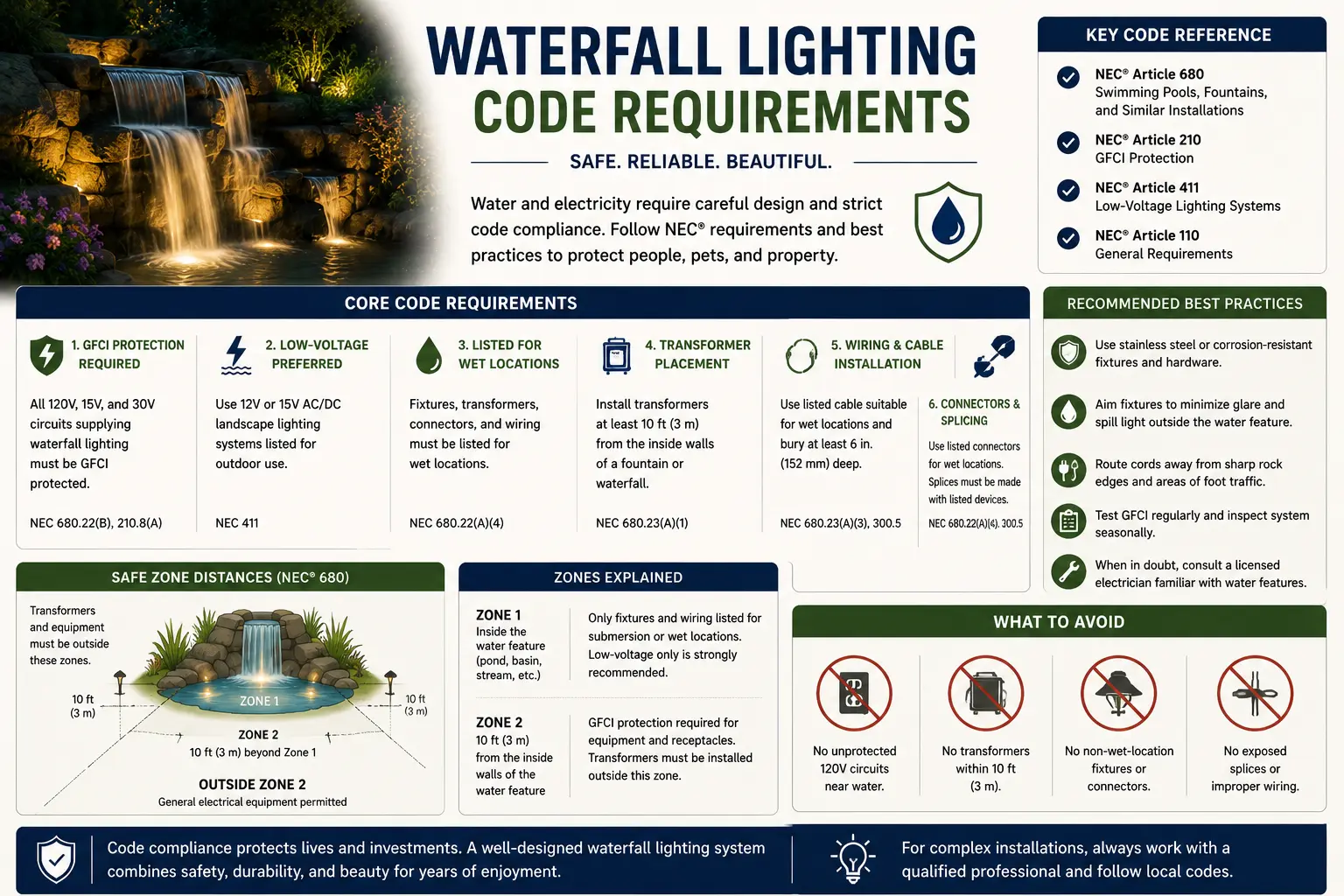
Why NEC 680.1 Names Waterfalls But 680.2 Never Defines Them
This is the single most overlooked compliance question in waterfall lighting design — and it begins with an actual gap in the National Electrical Code's structure.
The Scope Names It; the Definitions Section Doesn't Define It
NEC 680.1 establishes the Scope of Article 680: "This article applies to the construction and installation of electrical wiring for, and equipment in or adjacent to, all swimming, wading, therapeutic, and decorative pools; fountains; hot tubs; spas; and hydromassage bathtubs, whether permanently installed or storable, and to metallic auxiliary equipment, such as pumps, filters, and similar equipment." Industry references documenting this scope confirm that "artificial waterfalls" appear explicitly alongside pools, fountains, and decorative pools in the installations Article 680 is understood to cover.
However, NEC 680.2 — the Definitions section that provides the precise legal meaning of every term used throughout Article 680 — never includes a standalone definition for "waterfall." The only closely related definition is for Fountains: "Fountains, ornamental pools, display pools, and reflection pools. The definition does not include drinking fountains." This is a real structural gap in the Code: a term that appears in the Scope but has no corresponding definition.
Forum Participant, Mike Holt Electrical Code Forum:"Does a small waterfall in someone's front yard meet this definition, and therefore is governed by part V of Article 680?"
Responding Participant:"OK, I'll bite. I'm gonna say yes, cuz the only difference that I see between a waterfall & a fountain is the direction of water flow."
Responding Participant (citing 680.2):"Fountains, ornamental pools, display pools, and reflection pools. The definition does not include drinking fountains... The fact that this is a waterfall and, I think, not portable, it would still be a fountain in the 2002 cycle. If this is a fountain that is falling from one bowl level to a bowl under it then I would think of it as a portable fountain."
This documented exchange among licensed electricians captures the practical reality: there is no clean, universally-cited Code passage that says "a waterfall is a fountain." The classification is an inference drawn from the absence of a separate waterfall definition combined with the functional similarity between falling water and the defined fountain category. The practical compliance approach that has emerged from this gap: treat a permanently installed waterfall as a fountain under 680.2, applying Part I (General) and Part V (Fountains) of Article 680 per 680.50: "The provisions of Part I and Part V of this article shall apply to all permanently installed fountains as defined in 680.2."
Why "Permanently Installed" Is the Operative Distinction
The 680.50 application hinges on whether the waterfall is "permanently installed" — constructed in the ground, on the ground, or in a building in such a manner that it cannot be readily disassembled for storage. Per 680.2's structure for fountains generally, units "primarily constructed for their aesthetic value and not intended for swimming or wading" that are permanently installed fall under Part V. A landscape waterfall built into rockwork, with a constructed basin, recirculating plumbing, and integrated electrical — virtually any residential or commercial waterfall feature — satisfies this permanence test and is not the "self-contained, portable fountain not larger than 1.5 m (5 ft) in any dimension" exception that 680.50 carves out for small portable units (which instead comply with Article 422 Parts II and III).
Article 680 vs Article 682: The Classification Boundary for Natural-Style Waterfalls
The fountain-based classification above resolves most landscape waterfall installations. But a meaningfully different framework exists for waterfalls that integrate into a naturalistic pond, stream, or lake feature rather than a discrete constructed basin — and understanding when this alternate framework applies is essential for larger or more naturalistic water features.
Governs swimming, wading, therapeutic, and decorative pools; fountains; hot tubs; spas; and hydromassage bathtubs — and, per industry-documented scope summary and forum interpretation, artificial waterfalls treated under the fountain definition.
- Framework: pool/fountain-specific Parts (I, II, III, IV, V) with detailed depth, bonding, and GFCI requirements
- Applies to: constructed basins, decorative pools, formal fountains, most residential/commercial landscape waterfalls
- Key concept: underwater luminaire depth (18" rule), bonding grid, GFCI at 15V threshold
- Covered in detail: fountain lighting guide and pool lighting guide
Created in the 2005 NEC specifically to address installations not adequately covered by Article 680 — aeration ponds, fish farm ponds, storm retention basins, treatment ponds, irrigation channels, lakes, streams, and similar bodies of water, both natural and artificially made.
- Framework: built around the "electrical datum plane" — a horizontal benchmark referencing equipment location to expected water level
- Applies to: naturalistic ponds, artificial lakes, decorative water features that function more like a constructed pond than a discrete fountain basin
- Key concept: electrical datum plane, GFCI for all underwater lights/pumps over 15V, equipment elevation and disconnect rules
- 2005 NEC Handbook explicitly cites "decorative pond with a fountain" as an example application
The Electrical Datum Plane: Article 682's Core Concept
Article 682 introduced a concept new to the NEC: the electrical datum plane, "a horizontal benchmark to which the location of electrical equipment on or near the water is referenced." Per the IAEI Magazine's documentation of the 2005 article, the electrical datum plane is defined across four conditions: a horizontal plane 2 feet above the highest tide level in tidal areas; 2 feet above the highest water level for non-tidal bodies of water under normal circumstances; 2 feet above the prevailing high water mark in areas subject to flooding or storm runoff; and for floating structures and docks, 30 inches above the water level and a minimum 12 inches above the deck level.
Once the electrical datum plane is established for a specific waterfall/pond installation, Article 682 requires that electrical equipment and transformers not approved for submersion be installed above that plane, that service equipment be located no closer than 5 feet horizontally from the shoreline with live parts elevated at least 12 inches above the datum plane, and that a disconnecting means be located on land within specified distances. This is a fundamentally different compliance framework than the pool/fountain-specific rules of Article 680.
When Article 682 Applies Instead of Article 680
Per the Electrician Exam Practice documentation of Article 682's scope: the article explicitly excludes "pools, fountains, and spas," which "are covered under Article 680." This creates a mutual-exclusivity framework in theory — but in practice, the boundary for a naturalistic waterfall/pond feature is genuinely interpretive. A waterfall feature with these characteristics leans toward Article 682 classification:
- Integrated into what functions as an artificial lake or large naturalistic pond rather than a discrete, engineered fountain basin
- Designed to mimic a natural water body in scale, edge treatment, and planting rather than presenting as an obviously constructed decorative feature
- Large enough that the "electrical datum plane" concept (referencing a fluctuating natural water level) is more applicable than the fixed-depth assumptions built into Article 680's pool/fountain framework
- Used for purposes beyond pure decoration — stormwater retention function, fish/koi habitat at meaningful scale, irrigation source — that align with the agricultural and water-management examples cited in Article 682's documented scope
A waterfall feature with these characteristics leans toward Article 680 (fountain) classification:
- A discrete, engineered basin with defined edges, even if rock-faced or naturalistic in appearance
- Constructed specifically for aesthetic/decorative purposes, matching the fountain definition's "primarily constructed for their aesthetic value" language
- A scale and configuration consistent with residential or commercial landscape installation rather than a true pond, lake, or retention basin
- Pondless design with no standing visible water body at all (see the pondless waterfall section below — these remain squarely within Article 680's fountain framework, not Article 682)
When a Waterfall Basin Becomes a Regulated Pool
A third classification boundary exists independent of the 680-vs-682 question above: at what point does a deep waterfall basin or catch pool cross from "fountain" into "swimming pool" classification — triggering the substantially more stringent Part II requirements of Article 680 rather than the Part V fountain requirements?
The NEC Pool Depth and Construction Threshold
The NEC defines a "pool" based on a combination of construction method and depth: a pool constructed in the ground, partially in the ground, or capable of holding water greater than 42 inches deep, or any pool located inside a building regardless of its depth, falls under the pool classification and its associated Part II requirements — which are substantially more stringent than the fountain-specific Part V requirements covered above. This threshold matters directly for waterfall design: a waterfall feature with a deep catch basin or plunge pool at its base — common in larger naturalistic waterfall installations, especially those incorporating a swimmable or wading area — can cross from "fountain" classification into "pool" classification purely based on the basin's depth and construction method, independent of how the feature is marketed or visually presented.
| Basin Characteristic | Classification Outcome | Governing NEC Part |
|---|---|---|
| Shallow basin, ≤42" depth, not in-ground construction | Fountain | Article 680 Part I & V |
| Basin constructed in or partially in the ground (any depth) | Pool | Article 680 Part I & II |
| Basin capable of holding water >42" deep (any construction) | Pool | Article 680 Part I & II |
| Any basin/water feature inside a building | Pool | Article 680 Part I & II |
| Pondless reservoir/vault (no standing surface water) | Fountain (functional) | Article 680 Part I & V |
| Naturalistic pond/lake feature, fluctuating water level | Possible Article 682 | Article 682 (datum plane framework) |
Why This Threshold Matters for Lighting Specification Specifically
Crossing into "pool" classification triggers Part II requirements that are meaningfully more demanding than the fountain requirements of Part V, including the comprehensive equipotential bonding grid requirement of 680.26, more stringent underwater luminaire requirements, and the pool-specific transformer listing requirements of 680.23(A)(2). See the swimming pool lighting clearance guide for the complete Part II framework. For waterfall designers: if the design incorporates any catch basin, plunge pool, or swimmable area at the base of the falls, evaluate that basin against the depth and construction threshold above before finalizing electrical design — a basin that appears decorative may still trigger full pool classification based purely on its physical dimensions.
Pondless Waterfalls: Hidden Reservoir, Same Code Exposure
Pondless waterfall systems are increasingly popular in residential landscape design specifically because they eliminate the visible standing-water pool while preserving the sound and visual effect of moving water — but this design choice creates a documented compliance recognition gap.
The Pondless Physical Configuration
A pondless waterfall's water-holding structure is hidden below grade rather than presented as a visible pool. The typical configuration includes an underground reservoir or basin — often constructed using modular water-storage units (sold under trade names such as AquaBlox) or simply an excavated and rock-covered basin — that holds the system's recirculating water out of sight. A pump vault provides serviceable, accessible housing for the submersible pump that drives the recirculation, typically positioned for retrieval without excavating the surrounding rockwork. The submersible pump itself is commonly sized using the field rule of thumb of approximately 100 gallons per hour of flow for each inch of spillway width — a wider waterfall spillway requires proportionally more pump output to maintain adequate sheet flow across the full width.
Why "No Visible Pond" Does Not Mean "No NEC 680 Exposure"
This is the critical compliance point: even though a pondless system presents no visible standing pool or fountain basin at the surface, the underground reservoir is a genuine water-holding structure containing a submersible pump and, in the large majority of installations, submersible or wet-location-listed lighting fixtures positioned to illuminate the falls and splash zone. Both the pump and any submersible lighting are subject to the full NEC 680 Part V fountain requirements covered above — GFCI protection for equipment operating above 15 volts to ground per 680.51, voltage and overtemperature protection, and the serviceability requirement that luminaires be removable from a dry location without entering the water.
The recognition gap is real and shows up at two points: first, at the design and permitting stage, where a pondless feature described to a permit reviewer as having "no pool, no fountain, just a recirculating waterfall" can be mistakenly treated as exempt from Article 680 entirely, when in fact the buried reservoir with its submersible pump and lighting is functionally identical to a fountain's water-holding structure for code purposes. Second, at the inspection stage, where a visual walk-through of the finished landscape shows only rockwork and falling water — no basin is visible to inspect — making it easy for both installer and inspector to overlook the buried reservoir's compliance requirements unless the inspector specifically requests access to the pump vault and reservoir construction documentation. The fix: document the pondless reservoir and its electrical equipment explicitly in the permit submittal exactly as you would a visible fountain basin, including GFCI protection, fixture listing, and serviceability documentation, regardless of the fact that the finished installation has no visible standing water.
Fixture Placement Physics Unique to Flowing Water
Lighting falling, moving water requires a fundamentally different design approach than lighting the still water of a pool or formal fountain — a physics consideration that has no equivalent in NEC 680's pool and fountain guidance, but is essential to a functional waterfall lighting design.
Why Light Doesn't Follow Falling Water
Industry lighting-design documentation establishes a core physical reality: light does not bend to follow flowing water the way it illuminates a still surface. A top-down light source aimed at a waterfall illuminates the water only briefly as it passes through the beam — the water's downward motion carries it out of a fixed downward beam almost immediately, producing a much weaker and less consistent visual effect than the same fixture would produce on still water. This is the core reason waterfall lighting design differs fundamentally from fountain or pool lighting design, where the water surface is static relative to the fixture's beam.
The Below-Water, Upward-Aimed Technique
The established best practice documented across waterfall lighting design sources: position the light source in the splash zone at the base of the falls — fully or partially submerged in the catch pool — and aim it upward, so that light travels up through the falling water sheet toward its source. Because the water is moving toward the light source rather than away from a fixed downward beam, this technique produces sustained, dramatic illumination of the entire falling water column rather than a brief flash as water passes through a downward beam. This single placement decision is the most consequential design choice in waterfall lighting and has no equivalent consideration in still-water fountain or pool lighting design.
Layered Lighting: Combining Top-Down and Bottom-Up
Many professional waterfall lighting designs combine both techniques for a fuller effect: a below-water, upward-aimed fixture in the splash pool for the primary illumination of the falling water, paired with a downward-aimed fixture from above (positioned at the top of the falls or along the surrounding rockwork) to highlight the water's origin point and surrounding landscape features. When using this layered approach, avoid placing the downward fixture in a position that creates glare directly toward the primary viewing position from across the water feature — angling the downward fixture to graze across the rockwork rather than shine directly at viewer eye level minimizes this glare risk while still providing the complementary top-down illumination.
IP68 Splash-Zone Chemistry vs Full Submersion: A Waterfall-Specific Distinction
Waterfall lighting installations create a fixture exposure condition that doesn't exist in still-water pool or fountain applications: the splash zone, where fixtures experience repeated wetting and drying cycles rather than constant, stable submersion — and this distinction has real consequences for fixture selection and longevity.
Fixtures positioned in the splash zone — near the base of the falls but not fully and continuously submerged — experience a fundamentally different chemical exposure pattern than fully submerged fixtures.
- Water splashes onto the fixture and then evaporates, leaving behind concentrated mineral and chemical deposits with each wet/dry cycle
- Repeated cycling concentrates dissolved minerals (calcium, magnesium) and any pool chemicals (chlorine, salt) at the fixture surface as water evaporates, unlike full submersion where the fixture remains in a consistent diluted chemical environment
- This concentration effect can accelerate corrosion and surface degradation compared to constant submersion in the same water chemistry
- Even fixtures installed inside the lip of a weir or spillway (not visibly underwater) can experience splash-back that effectively simulates immersion exposure
- Industry specification guidance: "leading manufacturers strongly recommend utilizing IP68-rated fixtures for waterfall applications, even if the light bar is installed inside the lip of the weir and not underwater"
Fixtures fully and continuously submerged in the catch pool or basin — the typical condition for pool and still-fountain underwater lighting — experience a more chemically stable exposure pattern.
- Consistent contact with diluted water chemistry rather than concentrated residue from evaporation cycles
- IP68 rating (full submersion to a specified depth, commonly up to 5 meters per manufacturer listing) is the standard and sufficient specification for this exposure type
- Primary degradation factors are biofilm/algae growth on the lens (reducing light output, not a safety issue) and standard long-term material degradation
- Maintenance focus: periodic lens cleaning to remove algae and mineral buildup that dims output, rather than the accelerated corrosion risk of splash-zone cycling
Why "IP68" Alone Doesn't Fully Specify Waterfall Fixture Suitability
The IP rating system's second digit defines water-tightness — the degree of protection against water ingress — but it does not define chemical resistance to the concentrated mineral and chemical deposits that splash-zone wet/dry cycling produces. An IP68 fixture using a housing and gasket material that resists water ingress perfectly can still suffer accelerated surface corrosion or seal degradation from repeated exposure to concentrated mineral deposits if the housing material itself isn't chemically resistant to that specific concentration effect. For waterfall splash-zone applications specifically: specify not just the IP68 ingress rating but also confirm the housing material's documented chemical resistance (brass, 316 stainless steel, and fully resin-filled/potted LED modules are commonly cited as offering superior resistance to this splash-zone concentration effect compared to lower-grade materials).
Biofilm and Mineral Scale: The Maintenance-Level Degradation
Independent of the corrosion risk above, both splash-zone and fully submerged waterfall fixtures accumulate biofilm (algae and organic growth) and mineral scale on the lens surface over time — a maintenance issue rather than a safety or code-compliance issue, but one that directly affects whether the lighting design continues to perform as specified. Per documented underwater lighting maintenance guidance: "the clearing of algae and debris from pond lights should happen periodically to keep the light free from blockages," and a "dirty or algae-coated lens significantly reduces brightness and color output." For waterfall installations specifically — where moving water continuously circulates nutrients and biofilm-promoting organic material past the fixture — lens cleaning frequency should be evaluated more frequently than for still-water pool applications, where biofilm accumulation tends to be slower. Build a periodic lens-cleaning interval into the maintenance plan for any waterfall lighting installation from the outset, rather than waiting for a visible decline in light output to prompt cleaning.
Underwater Luminaire Depth and Serviceability Rules
For any waterfall fixture that is genuinely submerged — whether in a splash-zone pool or a deeper catch basin — the standard NEC 680 underwater luminaire depth and serviceability requirements apply directly.
680.23(A)(5) / (B)(6) — Underwater luminaires shall be installed with the top of the luminaire lens not less than 18 in. (455 mm) below the normal water level of the pool or fountain, unless the luminaire is listed and identified for use at lesser depths. Per documented field interpretation, a 4-inch minimum is commonly cited for fixtures specifically listed by the manufacturer for shallower-depth installation.
The 18-Inch Standard and Its Waterfall-Specific Application
This depth rule exists primarily to limit the intensity of light directly visible at the water surface and to maintain a meaningful buffer of water above the fixture. For a waterfall's splash-zone or catch-pool lighting, applying this standard requires accurate measurement of the "normal water level" at the specific fixture location — which, in a waterfall's turbulent splash zone, can be a less stable reference point than the calm surface of a pool or formal fountain. Document the design water level at each submerged fixture location based on the system's normal operating flow rate, and verify the 18-inch (or manufacturer-listed shallower) clearance against that documented level rather than an assumed or eyeballed water line.
The Relamping-Without-Entering-Water Requirement
680.23(B)(6) requires that underwater luminaires be servicable — relampable or replaceable — without the need to enter the water. In practice this requires both adequate cord length to allow the fixture to be lifted to a dry deck, ledge, or maintenance access point for service, and a mounting method that doesn't require disassembly of rockwork or structural elements to retrieve the fixture. For waterfall installations specifically, where fixtures are commonly mounted within or beneath constructed rockwork rather than a simple open pool floor, this serviceability requirement deserves particular attention during design: a fixture buried under stacked boulders with no planned retrieval path satisfies the letter of "submersible" but fails the practical intent of 680.23(B)(6) if relamping genuinely requires disassembling the rock feature. Plan a documented, physically accessible retrieval path for every submerged waterfall fixture at the design stage, not as an afterthought during the first maintenance call.
Yoke-Lock Mounting and Aim Stability in Moving Water
Moving water creates a physical mounting challenge that has no equivalent in still-water pool or fountain lighting: the force of flowing or falling water can physically shift an inadequately secured fixture's aim over time, degrading the lighting design's effectiveness even when the fixture itself remains fully functional and code-compliant.
Why Standard Mounting Hardware Can Be Insufficient
A fixture aimed upward in a waterfall's splash zone is subjected to continuous, often turbulent water flow and impact force from the falling water — a meaningfully different mechanical loading condition than a fixture resting on a still pool floor. Standard friction-fit or simple bracket mounting hardware, adequate for still-water applications, can allow gradual aim drift under this continuous force, particularly in higher-flow waterfall designs or installations where the fixture sits directly in or very near the primary water impact zone.
The Yoke-Lock Mounting Solution
Fixtures specified for waterfall splash-zone applications should use yoke-lock mounting mechanisms — a mounting bracket design that allows initial aim adjustment but then physically locks the fixture's angle in place via a tightening mechanism (commonly a locking screw or clamp on the yoke bracket), preventing the aim from drifting under the ongoing mechanical force of moving water. This is functionally similar in concept to the aiming-angle-lock practice recommended for adjustable landscape and architectural fixtures generally, but the consideration is more acute in waterfall applications because the "force" working against the locked aim is continuous physical water impact rather than just gravity or incidental contact.
The symptom of inadequate aim-locking in a waterfall installation typically shows up gradually rather than as a sudden failure: a fixture that was perfectly aimed at installation slowly tilts a few degrees over weeks or months of continuous operation, until the lighting design's carefully planned upward illumination of the falling water sheet is instead aimed slightly off-target — still functional, still producing light, but no longer achieving the intended visual effect. Because this drift is gradual, it's often not noticed until a seasonal maintenance check or a client comment that "the waterfall doesn't look as good as it used to," at which point the fix is usually a simple re-aim and tightening of the yoke lock rather than any fixture replacement. Specifying genuine yoke-lock hardware (not just a simple friction-fit bracket) at the design stage prevents this entirely avoidable degradation.
Transformer Listing and the 10-Foot Field Rule
The low-voltage transformer powering waterfall lighting fixtures has its own listing and placement requirements, distinct from the fixtures themselves, and this is an area where field practice has developed conventions beyond the literal Code text.
The 680.22(B)(6) Low-Voltage Luminaire Exception
NEC 680.22(B)(6), added in the 2014 NEC cycle, provides that listed low-voltage luminaires not requiring grounding, and supplied by transformers complying with 680.23(A)(2), can be located closer than 5 feet from the inside walls of a pool — an exception to the general setback requirement that would otherwise apply. The application of this specific exception to waterfall and basin edges (as opposed to strictly "pool" walls in the literal sense) is an interpretive extension that aligns with the fountain-classification approach to waterfalls established earlier in this guide: if the waterfall is being treated as a fountain under 680.2/680.50, the parallel low-voltage exception logic from 680.22(B)(6) reasonably extends to the waterfall's basin or splash-zone edges for listed low-voltage fixtures supplied by a properly-listed transformer.
The Documented Field Practice: 10 Feet for Ordinary Transformers
Beyond the Code-specified 5-foot exception threshold, a widely cited installer field practice rule of thumb holds that ordinary landscape lighting transformers should not be located within 10 feet of a pool or water feature unless the transformer is specifically listed and marked "For Use with Submersible Fixtures or Submersible Pumps" in compliance with 680.23. This is a non-Code, professional field convention rather than a literal NEC requirement, but it reflects a real and well-documented compliance risk:
Ordinary landscape lighting transformers — the type used throughout a typical residential property for path lights, uplights, and general accent lighting — do not provide GFCI-equivalent protection on the low-voltage secondary side and are not listed for the submersible or near-water fountain/pool application. A transformer specifically listed per 680.23(A)(2) for submersible fixture and pump use IS required to provide this protection. The documented compliance trap: a 12-volt transformer used for a waterfall's submersible lighting and pump can be visually identical to an ordinary landscape transformer used elsewhere on the same property — the difference is in the listing and internal protection circuitry, which is only distinguishable by reading the transformer's listing label and documentation, not by visual inspection. This creates a real risk of an installer grabbing "a 12V transformer" from inventory without verifying it carries the specific 680.23(A)(2) listing required for the waterfall application, producing a visually unremarkable but genuinely non-compliant installation.
The compliance practice: always verify and document the specific UL/ETL listing of any transformer supplying waterfall submersible lighting or pumps, confirming it is listed for use with submersible fixtures/pumps per 680.23(A)(2) — not simply rated for "outdoor" or "wet location" general landscape use, which is a different and insufficient listing category for this specific application. See the landscape lighting transformer guide for the general transformer listing framework and how it compares across application types.
Bonding Requirements for Waterfall Rockwork
Where a waterfall installation crosses into pool classification (per the depth/construction threshold covered earlier) or otherwise falls within reach of 680.26's bonding requirements, the rockwork construction common to waterfall features introduces a bonding consideration that doesn't arise in simpler fountain installations.
The 5-Foot/12-Foot Bonding Zone
NEC 680.26(C) requires bonding of all metallic parts located within 5 feet horizontal and 12 feet vertical of a pool's water — a broad zone intended to eliminate voltage gradient hazards from any conductive metal in proximity to the water. Waterfall rockwork — particularly larger, engineered rock features using rebar or metal anchoring pins to secure boulders in a stacked or cantilevered configuration — frequently contains exactly this kind of metallic structural element within the 680.26(C) zone, even though the rockwork's primary function is structural/aesthetic rather than electrical.
Why This Is Frequently Overlooked in Waterfall Design
Bonding requirements are most commonly associated in installer practice with obviously "electrical" metallic components — ladder rails, diving board anchors, metal pool coping — rather than structural landscape elements like rockwork rebar, which is specified and installed by a hardscape or masonry contractor who may have no direct involvement in or awareness of the electrical bonding scope of the project. This division-of-labor gap is a documented source of missed bonding compliance on waterfall projects specifically: the rockwork rebar is installed correctly from a structural standpoint, the lighting and electrical are installed correctly from an electrical standpoint, but the bonding connection between the two systems — required because the rebar falls within the 680.26(C) zone — is missed because neither contractor's scope explicitly flagged the requirement.
Waterfall Lighting Code Requirements FAQ
Does my waterfall need GFCI protection if the lighting fixtures are technically above the waterline, just in the splash zone?
Yes, in nearly all practical waterfall configurations. NEC 680.51 (applied to waterfalls under the fountain classification framework established earlier in this guide) requires GFCI protection for underwater luminaires, submersible pumps, and other submersible equipment operating at over 15 volts to ground. A fixture positioned in the splash zone — even if technically not continuously submerged below a defined waterline — is functionally exposed to direct water contact through splash-back, spray, and intermittent immersion during normal operation, which is precisely the wet-location hazard GFCI protection at this voltage threshold is designed to address. Industry specification guidance for waterfall lighting confirms this practical reality directly: "leading manufacturers strongly recommend utilizing IP68-rated fixtures for waterfall applications, even if the light bar is installed inside the lip of the weir and not underwater," because "in a waterfall application, water flows directly over or near the fixture, and splash-back can simulate immersion." The same logic that drives the IP68 fixture-rating recommendation for splash-zone fixtures applies directly to the GFCI protection requirement — treat any fixture within the splash zone as requiring the full GFCI protection and equipment listing that a fully submerged fixture would require, rather than assuming proximity-without-full-immersion exempts it from these requirements.
I'm planning a large naturalistic waterfall that feeds into what's essentially an artificial pond with koi. Should I be designing to Article 680 or Article 682?
This is exactly the genuinely ambiguous classification scenario discussed in the Article 680 vs Article 682 section of this guide, and the honest answer is that it requires AHJ consultation rather than a confident self-determination, because the feature you're describing has characteristics pulling toward both frameworks. Characteristics pulling toward Article 682 (Natural and Artificially Made Bodies of Water): the koi pond function aligns with the agricultural/aquaculture examples (fish farm ponds) explicitly cited in Article 682's documented scope; if the pond has a fluctuating water level subject to rainfall and evaporation rather than a precisely maintained fixed level, the "electrical datum plane" concept built into Article 682 is more naturally applicable than the fixed-depth assumptions in Article 680's pool/fountain framework; the overall scale and naturalistic design intent (as opposed to an obviously engineered decorative feature) also leans toward 682. Characteristics pulling toward Article 680: if the waterfall itself is a discrete, engineered feature even if it feeds into a more naturalistic pond, the waterfall structure specifically may still be classified under the fountain provisions while the downstream pond is separately evaluated; and if any portion of the system was marketed, designed, or constructed explicitly as a decorative water feature rather than a functional aquaculture/retention pond, that aesthetic-purpose framing supports Article 680 classification per the fountain definition's "primarily constructed for their aesthetic value" language. Given the genuine ambiguity industry sources acknowledge in this exact scenario, bring the complete design — water source, depth, fluctuation pattern, intended use (purely decorative vs functional pond/habitat), and scale — to your AHJ before finalizing electrical design, and document their classification determination in your permit file for future reference.
My waterfall lights are submerged in the splash pool and are constantly getting coated in mineral scale faster than my pool lights ever did. Is something wrong with the installation?
This is very likely the expected splash-zone wet/dry cycling effect documented in this guide, not necessarily an installation defect. Fixtures positioned in a waterfall's splash zone experience repeated wetting and evaporation cycles as water splashes onto the fixture and then dries between flow surges or pump cycling, and each evaporation cycle leaves behind a concentrated layer of whatever minerals (calcium, magnesium) or chemicals (if the system shares water chemistry with a treated pool) were dissolved in that water. This concentration effect through repeated evaporation is fundamentally different from a fully submerged pool light, which remains in continuous contact with diluted water chemistry rather than experiencing this concentration-through-evaporation cycle. The accelerated mineral scale buildup you're observing on the waterfall fixture relative to pool lights is the expected difference between these two exposure conditions, not necessarily a sign of installation error. That said, verify a few things: confirm the fixture is genuinely IP68-rated and that the housing material (brass, 316 stainless, or fully potted/resin-filled LED module) is appropriate for this elevated splash-zone exposure rather than a lower-grade material; confirm your water source's hardness level, since harder water (higher mineral content) will produce more aggressive scale buildup through this same evaporation-concentration mechanism regardless of fixture quality; and build a more frequent lens-cleaning interval into your maintenance routine for splash-zone fixtures specifically, since this faster scale accumulation is the expected tradeoff of that fixture position rather than something a different fixture choice will fully eliminate.
Related Water Feature, Compliance & Specification Guides
- Fountain Lighting Code Requirements (NEC 680)
- Swimming Pool Lighting Clearance (NEC 680)
- Electrical Code Safety Guide
- GFCI Requirements Guide
- NEC Article 110 Guide
- Outdoor Kitchen Lighting Clearance (NEC 210)
- Transformer Guide
- Splice Connection Requirements
- Arc Fault & GFCI Code Requirements
- Wet Location Listing Requirements
- State Permit Requirements
- Permit Rejection Reasons
- Inspection Failure Codes
- Inspector Perspective Guide
- Code Enforcement Cases
- Maintenance Guide
- Corrosion Guide
- Coastal Lighting Compliance
- Landscape Lighting Guide
- NEC Compliance Calculator