
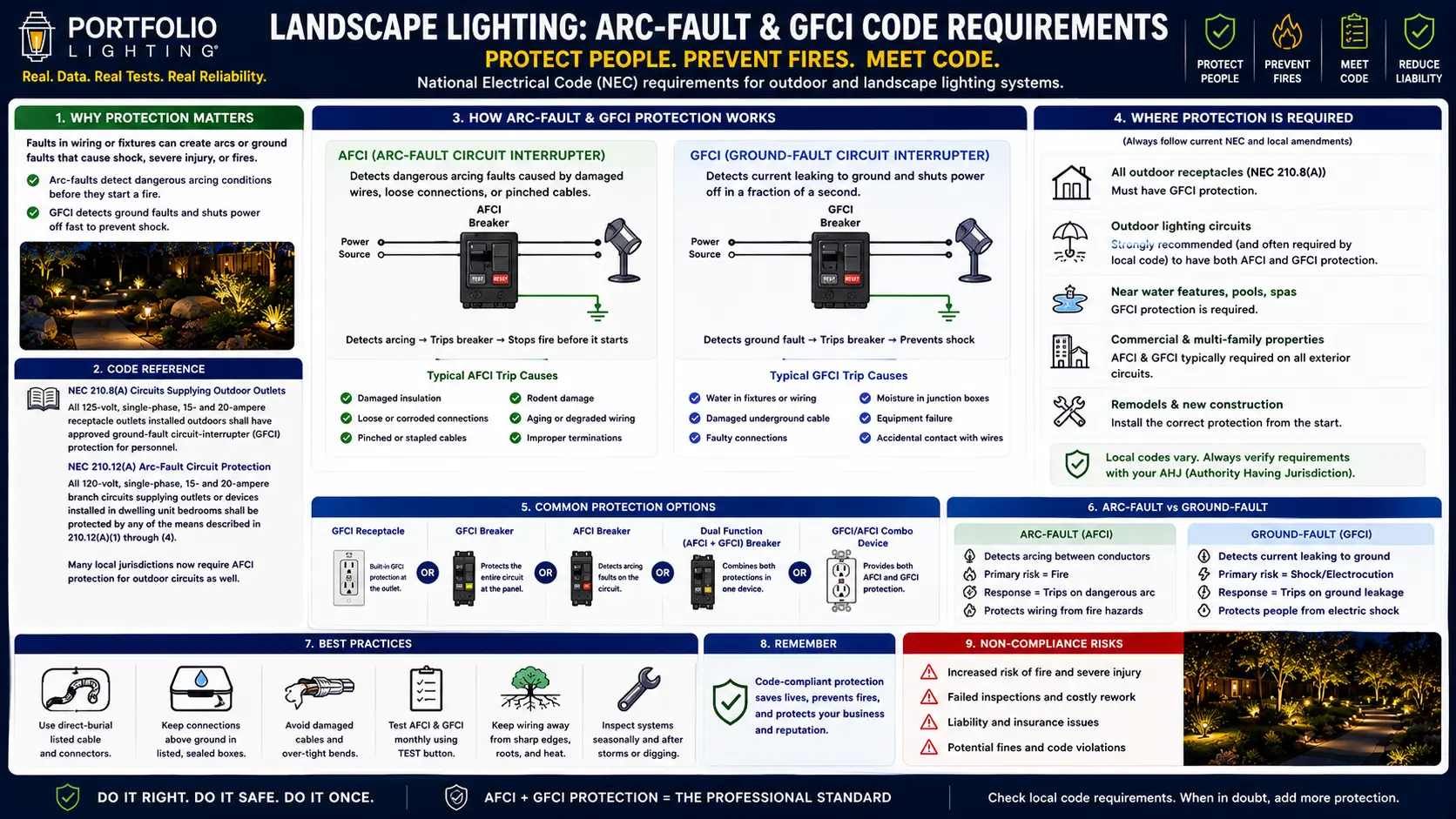
GFCI vs AFCI: What Each One Actually Does — and Why the Difference Matters
GFCI and AFCI are both circuit protection devices, but they protect against completely different hazards. Confusing them — or assuming one substitutes for the other — is one of the most common electrical code mistakes in residential outdoor work. Understanding the difference is the foundation for understanding every code requirement that follows.
What it detects: Current leaking from the hot or neutral conductor to ground — called a ground fault. This happens when current finds an unintended path to ground, such as through a person touching an energized conductor, through water bridging a hot wire to a grounded surface, or through damaged wire insulation contacting a grounded enclosure.
How sensitive: Trips at 4–6 milliamps of ground fault current. A standard circuit breaker trips at thousands of milliamps. GFCI protection operates far below the lethal current threshold — even 10 milliamps can cause painful shock, and as little as 50–100 milliamps can be lethal under the right conditions.
Primary hazard prevented: Electric shock and electrocution. Not fire.
In landscape lighting: Protects people from shock if a fixture, transformer, or wire develops a fault that allows contact with household current. Critical wherever water and electricity are in proximity.
What it detects: The electrical signature of arcing — the kind of high-energy sparking that occurs when a wire is damaged, a connection is loose, insulation is compromised, or a cord is stapled or pinched. Arc faults can occur without tripping a standard breaker because the arc current may be too small to exceed the breaker's trip threshold while still being energetic enough to ignite nearby wood, insulation, or debris.
How it works: Uses digital signal processing to analyze the waveform of current flowing through the circuit. Arcing produces a distinctive high-frequency signature that AFCI detectors recognize and distinguish from normal loads like motor startup or switching.
Primary hazard prevented: Electrical fires caused by arcing in wiring and connections. Not shock.
In landscape lighting: Protects against arc faults in the wiring from the panel to the outdoor outlet. Generally not required for outdoor circuits under NEC 2026 base code, but jurisdiction amendments vary.
I've seen homeowners replace a tripping GFCI outlet with a standard outlet because they figured the GFCI was "too sensitive." That is not a solution — that is removing the one protection device standing between household current and the wet soil their transformer wire is buried in. A GFCI that trips repeatedly is detecting a real fault. The right answer is to find the fault, not remove the protection. And no, an AFCI breaker does not replace GFCI protection — they protect against different things entirely.
NEC 2026 Articles That Govern Landscape Lighting Protection
Three NEC 2026 articles directly govern the protection requirements for landscape lighting installations. Understanding what each article actually says — not just what people claim it says — is the difference between a compliant installation and a code violation.
Article 210.8 — GFCI Protection for Personnel
This is the most directly relevant article for landscape lighting. Article 210.8(A)(3) states that GFCI protection is required for all 125-volt, 15- and 20-ampere receptacles installed in outdoor locations of dwelling units. The requirement is absolute — there are no exceptions based on what is plugged into the outlet. Whether your outdoor outlet powers a landscape lighting transformer, a power tool, a holiday display, or a phone charger, the outlet must be GFCI protected.
Article 210.8 does not require GFCI protection on the 12V low-voltage output side of the transformer. The protection requirement is for the 120V receptacle — the outlet the transformer plugs into. Once current has been transformed to 12V, the Class 2 classification of the low-voltage circuit exempts it from GFCI requirements. The boundary is the transformer itself: 120V in must have GFCI protection, 12V out does not.
For the full context of how this interacts with outdoor GFCI requirements across all outdoor lighting types, our dedicated GFCI requirements guide covers every scenario including pool lighting, post lights, and hardwired fixtures.
Article 210.12 — AFCI Protection for Dwelling Units
Article 210.12 requires AFCI protection for branch circuits supplying outlets in specific locations within dwelling units: all 120V, single-phase, 15- and 20-ampere branch circuits supplying outlets installed in kitchens, family rooms, dining rooms, living rooms, parlors, libraries, dens, bedrooms, sunrooms, recreation rooms, closets, hallways, laundry areas, or similar rooms or areas of dwelling units.
Outdoor locations are not included in this list under the base NEC 2026 text. An outdoor branch circuit supplying a landscape lighting transformer outlet is not subject to Article 210.12's AFCI requirements in most standard NEC 2026 interpretations. However — and this is where jurisdiction matters — if a circuit originates at a panel location that itself requires AFCI protection, or if local amendments have extended the list of required locations to include outdoor areas, AFCI protection may be required.
Article 300.5 — Underground Cable Burial Depth
While not a protection device requirement, Article 300.5 directly affects the conditions that create ground faults in landscape lighting wiring. Wire buried at the correct depth — 6 inches minimum for NEC Class 2 low-voltage wiring, 12 inches for UF cable in conduit, 24 inches for direct-burial 120V conductors — is far less likely to be damaged by landscaping activity, frost heaving, or soil movement. Damaged wire is the most common cause of ground faults that trip GFCI protection in landscape lighting systems.
Article 410 — Luminaire Installation Requirements
Article 410 requires that outdoor fixtures be listed for their actual installation location. A fixture rated for damp locations installed in a wet location — where it receives direct water contact from rain or irrigation — does not meet Article 410 requirements. Moisture ingress into an improperly rated fixture is the second most common cause of GFCI trips in landscape lighting systems. See the IP rating comparison guide for exactly how to match fixture protection ratings to installation conditions.
Articles 680.22 and 680.23 — Pool and Spa Lighting
If any part of your landscape lighting installation is within proximity of a swimming pool, spa, or water feature, Articles 680.22 and 680.23 introduce additional requirements beyond standard GFCI protection. These articles specify minimum distances from water, required equipment types, and installation methods that go significantly beyond the standard outdoor lighting requirements. Pool-area landscape lighting always requires a permit and inspection — this is not a DIY area regardless of whether the system is 12V or 120V.
12V Low-Voltage Landscape Lighting: What Protection Is Actually Required
Low-voltage 12V landscape lighting is the most common residential outdoor lighting system — and the one most often misunderstood from a code standpoint. The protection requirements are simpler than most people think, but the one requirement that does apply is non-negotiable.
The Class 2 Classification and What It Means
A low-voltage landscape lighting system powered by a listed transformer operates as an NEC Class 2 circuit on the 12V output side. Class 2 circuits are defined by two criteria: operating voltage of 30V or less, and power output limited by the source (the transformer) to levels that are inherently safe. A listed landscape lighting transformer limits its 12V output to safe current levels even under fault conditions — the transformer will shut down or limit current rather than allowing dangerous power levels to reach the low-voltage wiring.
Class 2 status exempts the 12V wiring, connectors, and fixtures from the protection requirements that apply to standard branch circuits. No GFCI required on the 12V side. No AFCI required on the 12V side. No conduit required. No licensed electrician required for the 12V installation in most jurisdictions. This is why low-voltage landscape lighting installation is accessible as a homeowner DIY project.
The One Requirement That Does Apply: The 120V Supply Outlet
The Class 2 exemption covers everything on the 12V output side of the transformer. It does not cover the 120V input side. The outlet that the transformer plugs into is a standard 120V outdoor receptacle — and NEC 210.8 requires that outlet to be GFCI protected, full stop.
This is the single most commonly violated code requirement in residential landscape lighting installations. Older homes frequently have outdoor outlets installed before GFCI requirements were in force. Homeowners plug their transformer into these unprotected outlets without realizing the outlet itself is a code violation. The transformer works fine, the lights work fine, and the code violation sits there silently until either an inspector notices it, a fault occurs, or an insurance claim is made.
AFCI not required*
120V outdoor receptacle
Protection boundary
No GFCI / AFCI required
*AFCI not required for outdoor circuits under NEC 2026 base code. Local amendments may vary. If circuit also serves indoor AFCI-required locations, AFCI may apply to entire circuit.
Does the Transformer Itself Need to Be GFCI Protected?
If the transformer is hardwired rather than plug-in, the 120V circuit serving the transformer must still provide GFCI protection — either through a GFCI breaker at the panel or a GFCI outlet at the transformer connection point. A hardwired transformer does not eliminate the GFCI requirement; it changes where that protection must be installed. The requirement is for the circuit supplying the transformer, not specifically for the outlet type.
GFCI protection becomes particularly important when lighting systems are installed near water. Decorative waterfalls, pond features, streams, and water walls often contain multiple electrical components operating in damp or wet conditions where fault protection is critical. Our waterfall lighting code requirements guide explains how GFCI requirements, equipment placement, transformer separation distances, and wet-location ratings combine to improve safety around illuminated landscape water features.
For transformer-specific troubleshooting including GFCI trip diagnosis, the transformer troubleshooting guide walks through every failure mode that causes GFCI trips on landscape lighting circuits.
120V Line-Voltage Outdoor Landscape Lighting: Full Protection Requirements
Line-voltage 120V outdoor landscape lighting — floodlights, security lights, hardwired post lights, soffit lights — carries the full weight of NEC requirements that low-voltage systems avoid. The protection requirements are more extensive and the consequences of non-compliance are more serious.
GFCI Requirement: Absolute for All 120V Outdoor Circuits
NEC 2026 Article 210.8 requires GFCI protection for all 120V outdoor receptacles and for circuits supplying outdoor luminaires in dwelling units. There are no exceptions for fixture type, circuit load, or installation location. Every 120V outdoor lighting circuit in a residential installation must have GFCI protection — either at a GFCI outlet, a GFCI breaker, or a GFCI deadfront (where no receptacle is present but the circuit powers hardwired fixtures).
The GFCI deadfront requirement is frequently missed in hardwired outdoor fixture installations. If a 120V outdoor floodlight or pathway fixture is hardwired — connected directly to 120V wiring with no outlet — the circuit still requires GFCI protection. A GFCI breaker at the panel satisfies this requirement and protects the entire circuit including the hardwired fixtures.
AFCI Requirement: Depends on Circuit Origin and Local Amendments
The AFCI question for 120V outdoor lighting is genuinely more complex than for low-voltage systems. Under the NEC 2026 base text, outdoor branch circuits are not in the explicit list of locations requiring AFCI protection under Article 210.12. However, several factors can change this:
- Circuit origin location: If the outdoor circuit's wiring passes through or originates from an interior location that is AFCI-required — the wiring runs through a bedroom wall on its way to an exterior outlet, for example — some inspectors and AHJs interpret this as requiring AFCI for the entire circuit.
- Local amendments: Many states and municipalities have adopted amendments that extend AFCI requirements beyond the NEC base text. California, for example, has historically adopted more aggressive AFCI requirements than the base NEC. Check your jurisdiction's specific adoption.
- New construction vs retrofit: New construction typically requires full compliance with the currently adopted code. Retrofit installations — adding an outdoor circuit to an existing panel — may be subject to different requirements depending on the scope of work and local interpretation.
The Combination AFCI/GFCI Breaker: The Clean Solution
When both AFCI and GFCI protection are required — or when you want to satisfy both requirements definitively without worrying about which applies — dual-function combination AFCI/GFCI breakers provide both protections in a single panel-mount device. They cost more than a standard GFCI breaker but eliminate the compliance question entirely for circuits where both requirements may apply. For new outdoor circuit installations, installing a combination breaker is the lowest-risk path to long-term compliance regardless of how local interpretations evolve.
Protection Requirements by Specific Circuit Scenario
These are the most common landscape lighting circuit configurations and exactly what protection each one requires under NEC 2026. Each scenario is stated as precisely as the code allows — with the jurisdiction caveat that local amendments may add requirements beyond what is shown here.
The requirement: The outdoor outlet must be GFCI protected — NEC 210.8(A)(3). If the existing outlet is not GFCI protected, it must be upgraded before connecting the transformer.
What is NOT required: AFCI protection on the circuit (for outdoor-only circuits under NEC 2026 base text). GFCI protection on the 12V output side. Conduit for the 12V wire runs. Licensed electrician for the 12V installation in most jurisdictions.
- Verify the outlet has GFCI protection before connecting — test the test/reset buttons to confirm the GFCI is functional, not just present
- If the outlet lacks GFCI protection, replace it with a GFCI outlet or have a GFCI breaker installed upstream
The requirement: New outlet installation requires a permit in most jurisdictions and must be GFCI protected. A GFCI outlet at the new location or a GFCI breaker at the panel satisfies the protection requirement.
AFCI consideration: If the new circuit also passes through or originates from interior AFCI-required spaces, AFCI protection may be required. Installing a combination AFCI/GFCI breaker at the panel satisfies both requirements definitively.
- Pull required permit before installation — unpermitted work creating a code violation is the primary liability risk here
- Mount transformer minimum 12 inches above grade
- Verify GFCI protection before energizing the system
The requirement: GFCI protection is mandatory for the outdoor circuit. If the circuit also supplies outlets in living rooms, dining rooms, bedrooms, or similar AFCI-required locations, the entire circuit — including the outdoor transformer connection — may require AFCI protection depending on AHJ interpretation.
Best practice: Install a combination AFCI/GFCI breaker at the panel. This satisfies both requirements with one device and eliminates the ambiguity entirely. The added cost is modest compared to the code compliance certainty it provides.
- Do not share outdoor landscape lighting circuits with indoor AFCI-required rooms if you want the clearest code compliance position
- If the circuit already exists and is shared, verify with your local AHJ whether AFCI is required for the outdoor portion
The requirement: GFCI protection mandatory for all 120V outdoor circuits — NEC 210.8. A GFCI breaker at the panel or a GFCI deadfront at the fixture location satisfies the requirement. Permit required in virtually all jurisdictions. Licensed electrician required in most jurisdictions.
AFCI consideration: Check local amendments. New circuit from panel through exterior wall: AFCI may or may not be required depending on whether the routing passes through AFCI-required interior spaces. Safest approach: combination AFCI/GFCI breaker.
The requirement: No GFCI or AFCI protection required on the 12V Class 2 output side of the system. This covers all wire runs from the transformer terminals to fixtures, all wire connectors and splices, all fixture connections, and the fixtures themselves.
What this means in practice: The 12V side of a landscape lighting installation is entirely exempt from the protection requirements that make outdoor 120V work complex. Wire gauge, burial depth, connector type, and fixture ratings still matter — but GFCI and AFCI protection are not part of the 12V compliance picture.
The requirement: Articles 680.22 and 680.23 apply in addition to standard GFCI requirements. Minimum distances from water, listed equipment requirements, and bonding requirements apply regardless of whether the system is 12V or 120V. Always requires permit and inspection. Consult a licensed electrician with pool electrical experience — this is not a standard outdoor lighting installation.
Complete AFCI and GFCI Requirements Table for Landscape Lighting
This table is designed to be the fastest possible reference for the protection requirements that apply to every common landscape lighting installation scenario under NEC 2026 base code. Bookmark this. The answer to most code questions is in here.
If a lighting system keeps tripping a GFCI, the cause is usually different from an arc-fault event. The GFCI-specific landscape lighting troubleshooting guide focuses on moisture leakage, wet fixtures, damaged insulation, and outdoor outlet problems.
| Installation Element | GFCI Required? | AFCI Required? | NEC 2026 Basis and Notes |
|---|---|---|---|
| 120V outdoor receptacle (outlet) supplying transformer | YES | Generally No* | Article 210.8(A)(3). GFCI mandatory for all outdoor 120V receptacles. AFCI not required for outdoor circuits under NEC 2026 base text — local amendments may vary. |
| 120V hardwired transformer connection (no outlet) | YES | Generally No* | GFCI breaker at panel or GFCI protection point required even without a receptacle. AFCI same caveat as above. |
| 12V output wiring from transformer to fixtures | NO | NO | Class 2 circuit — exempt from GFCI and AFCI requirements. Article 725.41 governs Class 2 circuits. Neither protection device is required or effective on low-voltage side. |
| 12V wire splices and connectors | NO | NO | Class 2 — no protection required. Proper waterproof connectors and correct burial depth are the relevant requirements for connectors. |
| 12V landscape lighting fixtures | NO | NO | Class 2 — no protection required. Fixture must be listed for location type (wet/damp) per Article 410, but no GFCI or AFCI required. |
| 120V outdoor floodlights / hardwired fixtures | YES | Generally No* | Article 210.8 requires GFCI for outdoor 120V circuits. GFCI breaker or GFCI deadfront required. Permit and licensed electrician required in most jurisdictions. |
| Outdoor circuit shared with interior AFCI-required rooms | YES | YES (likely) | AFCI requirement applies to the most restrictive location on the circuit. If circuit serves a bedroom or living room, AFCI likely required for entire circuit including outdoor portion. Combination breaker recommended. |
| Pool / spa area lighting (any voltage) | YES | Verify locally | Articles 680.22 and 680.23 apply in addition to standard requirements. Special distance, bonding, and listing requirements. Always requires permit and licensed electrician. |
| Smart landscape lighting controller (low-voltage) | YES (120V supply) | Generally No* | Smart controller's 120V supply outlet requires GFCI protection — same as standard transformer. The smart functionality does not change protection requirements. |
| Solar-powered landscape lighting (no 120V connection) | NO | NO | No connection to household current. No 120V outlet required. Neither GFCI nor AFCI applies. No permit required in most jurisdictions. |
When the GFCI Keeps Tripping: What It Means and What to Do
A GFCI that trips repeatedly on a landscape lighting circuit is not malfunctioning — it is detecting a real ground fault and doing its job. The fault is real. The question is where it is. Understanding the most common causes in landscape lighting systems gives you a systematic path to resolution without replacing the GFCI or removing the protection.
Arc-fault and GFCI issues are often symptoms of deeper electrical design problems instead of defective protection devices alone. Our landscape lighting load calculation and code compliance guide explains how transformer overloads, voltage imbalance, undersized wiring, startup surge spikes, and improper connector distribution can contribute to unstable low-voltage system behavior and repeated protection-device trips.
The Most Common Causes of GFCI Trips in Landscape Lighting
1. Moisture in a fixture housing through a degraded IP seal. This is the most frequent cause. A fixture whose IP seal has cracked or degraded admits moisture to the interior of the housing. Water bridging the energized terminals of the LED driver to the grounded fixture body creates exactly the ground fault condition that GFCI protection is designed to detect. The fix is to identify the affected fixture — disconnect fixtures one at a time and test whether the GFCI holds — and replace it. See the IP rating guide for how to select replacements with appropriate moisture protection for your installation conditions.
2. Water in a wire splice connection. A wire splice connector that has admitted moisture creates a conductive path between the conductors inside the connector and the wet soil surrounding it. At 12V this is not a shock hazard, but the ground fault current through the transformer can still trip GFCI protection on the 120V supply side. Inspect all splice points in the affected zone — look for connectors that are not fully sealed, caps that have loosened, or direct-burial splices that are too shallow and exposed to soil moisture.
3. Transformer internal fault. A transformer that has developed an internal fault — failed insulation on the primary winding, moisture in the enclosure, or a failed component creating a leakage path — will trip GFCI protection even with nothing connected to the 12V output terminals. Test this by disconnecting all 12V output wires from the transformer terminals and plugging only the transformer into the GFCI outlet. If the GFCI trips with no load connected, the transformer is the fault source. Our transformer troubleshooting guide covers this diagnostic sequence in full.
4. Direct-burial wire with damaged insulation. Wire that was buried too shallow and subsequently damaged by a shovel, lawn aerator, or frost heaving can have insulation breaks that allow current leakage to the surrounding soil. This is particularly common on long wire runs where the wire crosses areas of regular landscaping activity. Locate the damage by progressively disconnecting wire segments and testing whether the GFCI holds after each disconnection.
5. Nuisance tripping from inrush current. Less common but worth knowing: some older or lower-quality GFCI devices can nuisance-trip when a landscape lighting transformer is first energized, because the transformer's inrush current spike at startup is briefly asymmetrical in a way that an older GFCI interprets as a ground fault. Modern GFCI devices are designed to ignore inrush current spikes. If a GFCI trips consistently at the moment the system energizes but holds after reset, replacing the GFCI outlet with a current-edition listed device is a reasonable first step before deeper fault investigation.
Combination AFCI/GFCI Breakers: When to Use One and How They Work
Combination AFCI/GFCI breakers — also called dual-function breakers — provide both arc fault and ground fault protection in a single panel-mounted device. They are increasingly the preferred solution for outdoor circuits because they eliminate the ambiguity in scenarios where both requirements may apply.
How Combination Breakers Work
A dual-function AFCI/GFCI breaker incorporates both detection technologies in one device. The GFCI circuitry monitors current balance between the hot and neutral conductors — any imbalance of 4–6 milliamps or more triggers the ground fault trip. The AFCI circuitry simultaneously analyzes the waveform of the current for the high-frequency signature of arcing. Either condition independently trips the breaker. The device resets the same way as a standard breaker and typically includes a test button to verify both protection functions are operational.
When a Combination Breaker Makes Sense for Landscape Lighting
Three situations make a combination breaker the clearly right choice:
- New outdoor circuit installation: Installing a new circuit for landscape lighting from the panel gives you a clean slate. A combination breaker at the panel satisfies both GFCI and AFCI requirements definitively, regardless of how your local AHJ interprets the NEC for outdoor circuits. One installation, maximum future compliance.
- Outdoor circuit shared with interior AFCI-required rooms: If your outdoor landscape lighting circuit also feeds a living room, bedroom, or dining room outlet, AFCI is required for the entire circuit. A combination breaker at the panel satisfies GFCI for the outdoor portion and AFCI for the indoor portion simultaneously.
- Jurisdiction with outdoor AFCI amendments: If your state or municipality has adopted NEC amendments extending AFCI requirements to outdoor circuits, a combination breaker satisfies both requirements with one device.
Combination Breaker vs GFCI Outlet: Key Differences
A GFCI outlet at the transformer location provides GFCI protection for devices plugged into that outlet — but it does not provide AFCI protection for any portion of the circuit, and it does not protect the wiring from the panel to the outlet itself. A GFCI breaker at the panel protects the entire circuit including the wiring, but also does not provide AFCI protection. Only a combination AFCI/GFCI breaker provides both types of protection for the entire circuit from the panel to the load.
For most standard residential low-voltage landscape lighting installations on a dedicated outdoor circuit, a GFCI outlet at the transformer location is sufficient under NEC 2026 base code. The combination breaker becomes the preferred solution when circuit sharing, new construction, or local amendments create ambiguity about what is required.
Practical Installation Guide: Getting Protection Right on the First Try
This section walks through the specific actions required to install AFCI and GFCI protection correctly in each common landscape lighting scenario. These are field-grounded steps — the kind of things that actually come up during installation, not the sanitized version.
Step 1: Determine What You Already Have
Before installing anything, test your existing outdoor outlet. Press the test button on the outlet — if it's a GFCI outlet, the outlet should go dead. Press reset and confirm it restores power. If the outlet has no test/reset buttons, it is not a GFCI outlet. Check the breaker panel — the circuit breaker for that outlet may be a GFCI breaker (identified by a test button on the breaker face) that provides protection even without a GFCI outlet at the location.
If neither the outlet nor the breaker provides GFCI protection, you have an unprotected outdoor circuit — a code violation under NEC 210.8 regardless of when it was installed. Upgrade the outlet to a GFCI outlet or have a GFCI breaker installed before connecting a transformer. This is the single most common code issue in residential landscape lighting, and it is a straightforward fix.
Step 2: Install the Transformer Correctly
Once GFCI protection is confirmed on the supply outlet, mount the transformer at least 12 inches above grade. This is not a code requirement — it is a practical moisture protection measure that significantly reduces the ground fault risk that trips GFCI protection. A transformer mounted close to grade accumulates water in the housing enclosure during heavy rain and irrigation. Mounting it higher keeps the 120V connection point away from water runoff and soil splash.
Confirm the transformer is a listed device — UL listing or equivalent. An unlisted transformer does not carry the Class 2 protection mechanisms that make the low-voltage side of the system safe. See our transformer testing guide for how to verify a transformer is functioning within its rated parameters before committing to a full installation.
Step 3: Wire the Low-Voltage System Correctly
The 12V output side of the system is Class 2 and requires no GFCI or AFCI protection — but the installation practices that prevent ground faults are still important because ground faults on the 12V side trip GFCI protection on the 120V supply. Bury wire at minimum 6 inches depth. Use waterproof connectors rated for direct burial at all splice points. Use the correct connector type — push-in wire taps that do not seal the wire ends are not appropriate for direct burial.
Match fixtures to their installation locations using correct IP ratings — IP65 minimum for standard outdoor path and accent lighting, IP67 for in-ground installations, IP68 for installations subject to temporary submersion. A fixture with an inadequate IP rating will admit moisture, create a ground fault, and trip the GFCI on the supply circuit. Getting the IP rating right at installation eliminates that failure mode entirely. The IP rating comparison database has every Portfolio fixture's rating with installation scenario recommendations.
Step 4: Test Before You Cover
Before burying wire runs or final-mounting fixtures, energize the system and verify: GFCI protection holds (does not trip), voltage at the most distant fixture is within the operating range for the fixture type, and all fixtures illuminate correctly. Measure voltage at the transformer terminals and at the last fixture on the longest run to confirm wire gauge is sufficient for the run length and load. Address any voltage drop issues by adjusting wire gauge, splitting zones, or adjusting transformer tap before covering wire runs.
If the GFCI trips during this test with all wire runs connected but no fixtures installed, the fault is in the wire runs or connectors. If it trips with only the transformer connected and no output wiring, the fault is in the transformer. Isolate before covering anything.
Step 5: Document the Installation
Keep a record of: transformer model and rated wattage, total system load, wire gauge used for each zone, burial depth, fixture locations and models, and the date of installation. These records matter if a GFCI trip is investigated, if an insurance claim is ever made, or if the property is sold and the new owner needs to understand the system. A sketch of wire run routing is particularly valuable years later when landscaping work risks disturbing buried wire.
For ongoing maintenance that keeps the system operating correctly and the GFCI from tripping, the landscape lighting maintenance guide covers annual inspection steps, connector replacement intervals, and the specific failure modes that develop over time in buried low-voltage systems.
AFCI vs GFCI: Side-by-Side Technical Comparison
For anyone who wants the complete technical picture of how these two protection technologies differ — the mechanism, the detection method, the hazard protected, and the code requirement — this table maps every relevant dimension.
| Dimension | ⚡ GFCI — Ground Fault CI | 🔥 AFCI — Arc Fault CI |
|---|---|---|
| What it detects | Current imbalance between hot and neutral conductors — indicating current is leaking to ground through an unintended path | High-frequency electrical signature of arcing in the circuit wiring — the signature of sparking at a damaged or loose connection |
| Primary hazard prevented | Electric shock and electrocution — protects people from contact with ground-faulted conductors | Arc-ignited electrical fires — protects structures from fires started by arcing in walls and connections |
| Trip threshold | 4–6 milliamps of ground fault current — far below the lethal threshold of 50–100 mA | Detection of arc signature waveform — no simple milliamp threshold; uses pattern recognition of current waveform |
| What causes trips | Water in fixtures, damaged wire insulation, faulty transformer, wet connectors, direct contact with energized conductor | Damaged wire insulation, loose connections, stapled or pinched cords, corroded terminals, parallel arcing between conductors |
| Does NOT protect against | Arc faults that don't reach ground — a loose connection arcing between hot and neutral is invisible to GFCI | Ground faults — a person touching a live wire is invisible to AFCI. AFCI does not protect people from shock. |
| Can one substitute for the other? | NO. They protect against different hazards. An AFCI does not provide ground fault protection. A GFCI does not provide arc fault protection. They are not substitutes for each other. | |
| Form factors available | GFCI outlet (most common for landscape lighting supply), GFCI breaker, GFCI inline device, GFCI deadfront | AFCI breaker only (panel-mounted). No outlet form factor exists for AFCI alone — only combination AFCI/GFCI outlets exist. |
| Required for outdoor landscape lighting circuits | YES — NEC 210.8(A)(3) — mandatory for all outdoor 120V receptacles | Generally No for outdoor-only circuits under NEC 2026 base text. Yes if circuit serves interior AFCI-required spaces or local amendments apply. |
| Required on 12V low-voltage side | NO — Class 2 circuits exempt | NO — Class 2 circuits exempt |
| Cost range (approximate) | GFCI outlet: $15–$30. GFCI breaker: $25–$50. | AFCI breaker: $35–$60. Combination AFCI/GFCI breaker: $45–$75. |
Related Guides and Resources
When a lighting project involves AFCI/GFCI protection, new circuits, outdoor receptacles, or breaker-panel work, licensing requirements may apply. The landscape lighting code and licensing requirements guide explains when contractor credentials become part of the safety picture.
- GFCI Requirements for Outdoor Lighting — NEC 2026
- Landscape Lighting Electrical Code Safety Guide
- Landscape Lighting Insurance and Liability Guide
- How to Wire Landscape Lighting
- Portfolio Lighting Installation Guide
- Low Voltage System Diagram
- Transformer Troubleshooting Guide
- How to Test a Landscape Lighting Transformer
- IP Rating Comparison Guide
- Wire Gauge and Ampacity Database
- Low Voltage Wire Connectors Guide
- Low Voltage Plug and Connector Guide
- Landscape Lighting Voltage Drop Guide
- Landscape Lighting Maintenance Guide
- Landscape Lighting Troubleshooting
- Portfolio Lighting Troubleshooting Hub
- Landscape Lights Not Working — Diagnostic Guide
- Commercial-Grade Lighting Safety and ROI
- Complete Landscape Lighting Guide
Arc Fault and GFCI Code Requirements — FAQ
Does landscape lighting need AFCI protection?
Low-voltage 12V landscape lighting systems do not require AFCI protection under NEC 2026 base code. NEC Article 210.12 lists specific interior locations requiring AFCI — outdoor locations are not included. However, if the outdoor circuit also serves interior AFCI-required spaces, or if your jurisdiction has adopted local amendments extending AFCI to outdoor circuits, AFCI may be required. The 12V low-voltage output side of the system never requires AFCI protection regardless of jurisdiction — it is a Class 2 circuit exempt from these requirements.
Does landscape lighting need GFCI protection?
Yes — specifically the 120V outdoor outlet that the landscape lighting transformer plugs into. NEC 2026 Article 210.8(A)(3) requires GFCI protection for all 120V outdoor receptacles in dwelling units, without exception. This applies whether the outlet powers a landscape lighting transformer, a power tool, or anything else. The 12V low-voltage output side of the transformer does not require GFCI protection — the requirement is on the 120V supply side only.
What is the difference between AFCI and GFCI protection?
GFCI detects current leaking to ground — a condition that creates shock hazard. It protects people. AFCI detects the electrical signature of arcing in circuit wiring — a condition that can start fires inside walls even when current levels are too low to trip a standard breaker. It protects structures. They protect against different hazards and neither one substitutes for the other. An AFCI breaker does not provide ground fault protection. A GFCI outlet does not provide arc fault protection.
Can you use a GFCI breaker instead of a GFCI outlet for landscape lighting?
Yes. NEC 2026 allows GFCI protection to be provided either at the point of use (a GFCI outlet) or upstream at the panel (a GFCI breaker). A GFCI breaker protecting the outdoor circuit provides protection for the entire circuit including the wiring from panel to outlet — a broader scope of protection than a GFCI outlet provides. The choice between them is primarily about convenience and cost. For circuits where AFCI may also be required, a combination AFCI/GFCI breaker satisfies both with one panel-mount device.
What causes a landscape lighting GFCI to keep tripping?
A GFCI that repeatedly trips on a landscape lighting circuit is detecting a real ground fault. The most common causes are: moisture in a fixture housing through a degraded IP seal, water in a wire splice connector, a fault inside the transformer, or damaged wire insulation on a buried run. Disconnect fixtures and wire runs one zone at a time to isolate which element is generating the fault. Never replace a tripping GFCI with a standard outlet — the fault is real and the protection is required.
Does 12V low-voltage landscape lighting wire require GFCI or AFCI protection?
No. The 12V output side of a landscape lighting system — wire runs, connectors, and fixtures — is classified as an NEC Class 2 circuit. Class 2 circuits operate at safe voltage and current levels that are exempt from GFCI and AFCI requirements. This covers everything from the transformer output terminals to the fixtures. The protection requirements apply only to the 120V supply circuit that powers the transformer — everything on the 12V side of the transformer is outside the scope of GFCI and AFCI code requirements.