
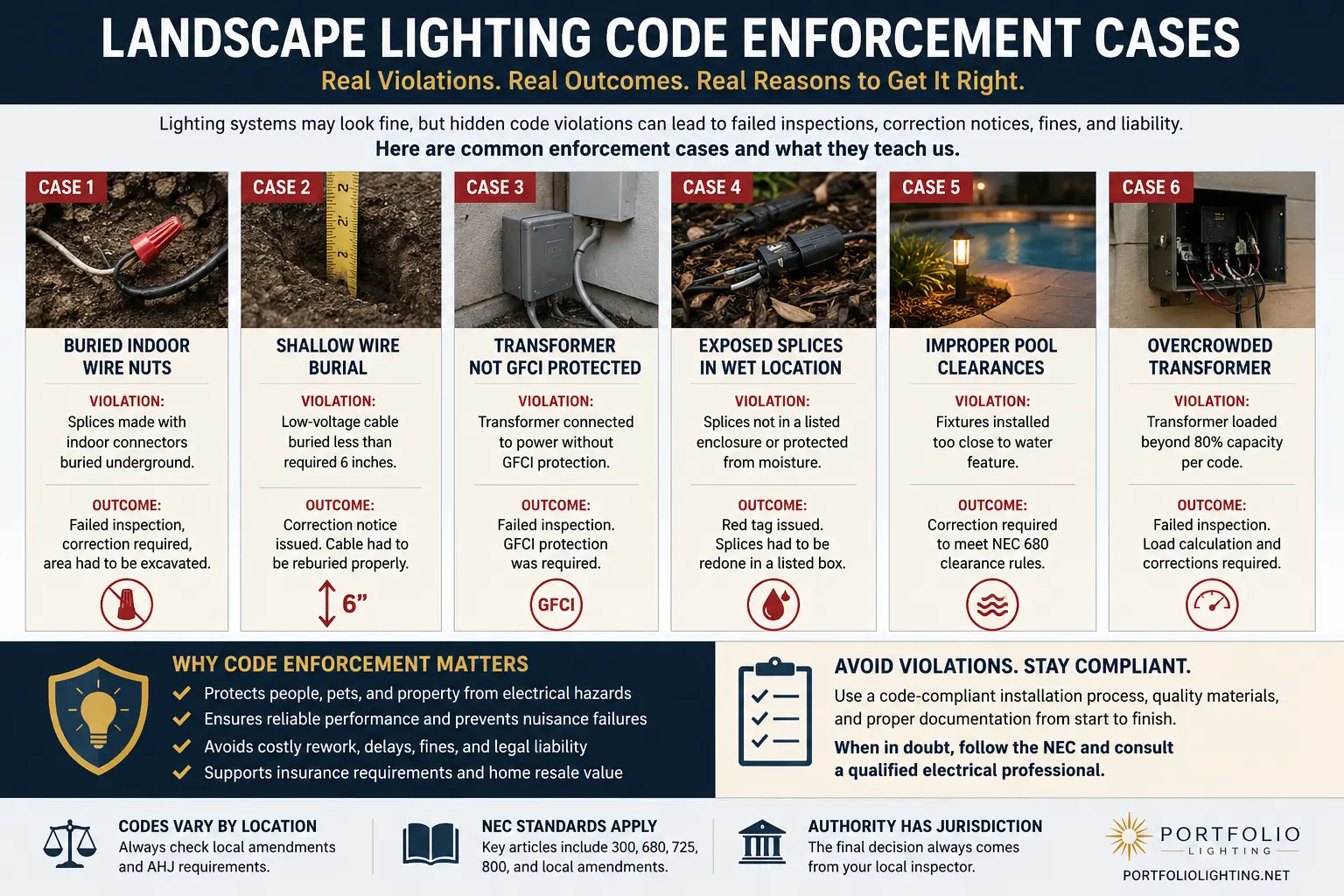
Code Enforcement  ●  Real Penalties  ●  Civil Liability  ●  Unlicensed Contractor Cases  ●  Daily Fines & Liens

Landscape Lighting Code Enforcement Cases: Real Penalties, Civil Liability & What Goes Wrong

Most guides on this site explain what the code requires. This page explains what happens when it's violated — not hypothetically, but through documented enforcement actions, court decisions, and civil liability patterns. The $75-per-day municipal fine that becomes a property lien. The dark sky ordinance penalties reaching $1,500 per violation in Texas commercial zones. The NYC court ruling that barred an unlicensed contractor from collecting payment for properly completed work. The civil suit where a correction notice was exhibit A proving the property owner had constructive knowledge of a hazardous condition. These are the real downstream consequences of landscape lighting code non-compliance — and understanding them is the best argument for getting compliance right the first time.

The Daily-Fine Compounding Problem Nobody Calculates in Advance

Per California Local's documented analysis of municipal code enforcement: a senior citizen in Fresno who was cited for multiple violations in 2014, removed the offending items, but had the city characterize the violations as ongoing, accumulated well over $500,000 in fines by 2022 on a fixed income with no attorney. While that case involved yard violations rather than lighting, the enforcement mechanism is identical: "Each and every day during which the violation continues shall constitute a separate offense." At $75 per day (Eagle Mountain UT outdoor lighting standard), a violation that goes uncorrected for one year costs $27,375. At $200 per day (documented for some commercial dark sky violations), the same year costs $73,000. The correction notice deadline is not a suggestion — it is the moment at which the financial compounding begins.

$75/Day: Eagle Mountain UT Outdoor Lighting Ordinance $200–$1,500/Violation: Texas Dark Sky Commercial Enforcement $5,000/Violation: Virginia DPOR Unlicensed Contractor Penalty NYC Court: Unlicensed Contractor Barred from Collecting Payment $25,000 First-Offense Cap: Some Jurisdictions for Unlicensed Work Open Permit + Injury = Correction Notice as Proof of Known Hazard
⚡ Legal Notice This guide documents enforcement mechanisms, penalty structures, and legal patterns from published ordinance text, court documentation, and regulatory sources. Case outcomes described are patterns drawn from documented sources — not legal predictions for any specific situation. For any enforcement action or civil claim involving landscape lighting, consult a licensed attorney. This guide is educational and does not constitute legal advice. Full Disclaimer

The Enforcement Escalation Ladder: From First Notice to Property Lien

Municipal code enforcement for outdoor lighting violations follows a documented escalation sequence that is consistent across jurisdictions. Understanding the complete ladder — and where fines begin to compound — is the single most important context for understanding why prompt compliance is financially critical.

Stage 1
Notice
Notice of Violation issued. Per the Model Lighting Ordinance framework: "If, after investigation, the Code Enforcement Officer finds that any provision of the Ordinance is being violated, he shall give notice by hand delivery or by certified mail, return-receipt requested, of such violation to the owner and/or to the occupant of such premises, demanding that violation be abated within thirty (30) days." The 30-day correction window begins. No fine has yet accrued — this is still correctable at zero financial cost beyond the correction work itself. This is the cheapest moment to act. See the correction notices guide.
Stage 2
Daily Fines
Correction deadline passes without compliance. Per the Eagle Mountain UT outdoor lighting ordinance (typical of most jurisdictions): "A violation of this chapter, or any provision thereof, shall be punishable by a civil penalty of $75.00 per day and each day of violation after the expiration of the 30-day period shall constitute a separate offense." At $75/day: 30 days = $2,250 additional exposure. 90 days = $6,750. 180 days = $13,500. One year = $27,375. At $200/day (commercial dark sky violations in some jurisdictions): the same year generates $73,000. These figures compound from a correction notice that initially required a $300-600 correction.
Stage 3
Abatement
Legal or equitable action initiated. Per Model Lighting Ordinance enforcement provisions: "If the violation is not abated within the thirty-day period, the Code Enforcement Officer may institute actions and proceedings, either legal or equitable, to enjoin, restrain, or abate any violations of this Ordinance and to collect the penalties for such violations." Sonoma County documented: "A 'Notice of Abatement Proceedings' will be recorded against the title of the property. This recorded document serves to notify the public of the violation and may prevent you from selling the property or obtaining refinancing or title insurance on the property." The recorded notice of abatement proceedings is the first property-title consequence — visible to any title search.
Stage 4
Lien
Property lien recorded. Sonoma County documents three lien types: Partial Abatement Lien (records specific dollar amounts of costs incurred by the county pursuing abatement); Supplemental Abatement Lien (additional costs after partial lien); and Notice of Lis Pendens (filed by counsel before litigation begins). Per Sonoma County: "These documents remain recorded until the violation has been corrected and costs and penalties are paid." The lien is attached to the property — it travels with the property at sale and must be paid to clear title. Combined accrued daily fines + county abatement costs + attorney fees can produce liens of tens of thousands of dollars for violations that originated as simple outdoor lighting code deficiencies.
⚠ "I Didn't Do the Work or Cause This Problem — Why Must I Pay?" Per Sonoma County's code enforcement FAQ: "Civil penalties are mandatory under Section 1-7.1 of the Sonoma County Code." The property owner is responsible for code compliance regardless of who created the violation, whether they were aware of it when they purchased the property, or whether a previous contractor caused the problem. The correction notices guide addresses this in the address doctrine section — the notice attaches to the property, not to any person. New owners who purchase a property with existing violations inherit the obligation to correct them. This is why pre-purchase permit and violation searches are essential.

Municipal Outdoor Lighting Penalty Cases and Documented Fine Structures

These documented penalty structures from published ordinance text establish the real financial stakes of outdoor lighting violations across multiple jurisdictions.

Municipal Ordinance Eagle Mountain, UT — Outdoor Lighting Standards Ch. 17.56 $75/day
Eagle Mountain UT's Chapter 17.56 (Outdoor Lighting Standards) establishes: 30-day correction window from notice; then $75.00 per day civil penalty with each day constituting a separate offense. The ordinance covers shielding requirements, light trespass, and fixture specifications for all exterior lighting. Landscape lighting within the city's outdoor lighting zone standards is explicitly covered. After the correction period: "the planning director or designee may institute actions and proceedings, either legal or equitable, to enjoin, restrain or abate any violations of this chapter and to collect penalties for such violations." The civil penalty is $75 per day minimum — not negotiable, not suspended.
Source: Eagle Mountain UT Code of Ordinances Ch. 17.56, via codepublishing.com
Municipal Ordinance Model Lighting Ordinance (IDA/IES) — Penalty Framework Used by 2,000+ Municipalities $50–$1,000/day
The Model Lighting Ordinance's enforcement provisions establish the framework adopted by municipalities across the US: "A violation of this Ordinance, or any provision thereof, shall be punishable by a civil penalty of not less than fifty dollars nor more than one thousand dollars for any individual (and not more than ten thousand dollars for any corporation, association, or other legal entity) for each violation." Per the ordinance: "The imposition of a fine under this Code shall not be suspended." The non-suspension provision means the judge cannot waive the penalty — once the violation is established and the correction period has passed, fines must be imposed. For a corporation operating a commercial property with outdoor lighting in violation of a dark sky ordinance, the $10,000/day corporate maximum represents potential daily exposure that makes the upfront cost of compliance trivial by comparison.
Source: Model Outdoor Lighting Ordinance for Cities and Towns, cbat.eps.harvard.edu
Municipal Ordinance Calimesa, CA — Ch. 18.120 Outdoor Lighting (10-Day Emergency Correction) Civil action after 10 days
Calimesa CA's outdoor lighting ordinance takes a different approach: rather than a standard 30-day window, light trespass corrections must be made within 10 days after the community development director's determination. The ordinance also provides a hardship extension: "Upon written application by the responsible party, the community development director may grant additional time (not to exceed 90 days) to remedy the light trespass for hardship." After the 10-day correction period (or granted extension), the ordinance allows civil action. Note the 90-day hardship maximum — extensions are not unlimited. The Calimesa ordinance also specifically prohibits certain fixture types (aerial lasers, searchlight-style lights, flashing lights) with no correction period — these must be removed immediately upon citation.
Source: Calimesa CA Code ch. 18.120, codepublishing.com
Municipal Ordinance Los Angeles, CA — LAMC Sec. 93.0117 (2 Footcandle Neighbor Window Limit) City enforcement + neighbor civil nuisance claim
Los Angeles Municipal Code Section 93.0117 specifically addresses "Outdoor Lighting Affecting Residential Property" and establishes: no exterior light source may cause more than two footcandles (21.5 lux) of lighting intensity at "any exterior glazed window or sliding glass door on any other property containing a residential unit" or at "any elevated habitable porch, deck or balcony on any other property." This provision directly covers landscape uplighting, spotlights, and pathway lighting systems that spill onto neighboring properties. The 2 fc threshold applies to the neighbor's window — not the property line. A landscape spotlight aimed upward at a tree that projects 2.5 fc onto a neighbor's bedroom window is an LAMC violation. Violations can be addressed through both city code enforcement and independent neighbor nuisance actions. See the light trespass laws guide for the complete LA and regional framework.
Source: Los Angeles Municipal Code Sec. 93.0117, amlegal.com (2026 Rev. 7)
JurisdictionViolation TypeCorrection WindowDaily FineMaximum Penalty
Eagle Mountain UT Outdoor lighting ordinance violation 30 days $75/day Unlimited (lien)
Model Lighting Ordinance (IDA/IES) Any ordinance provision — individual 30 days $50–$1,000/day $1,000/day (non-suspended)
Model Lighting Ordinance — Corporation Any ordinance provision — entity 30 days Up to $10,000/day $10,000/day (non-suspended)
Riverside County CA Light trespass (proposed ordinance pattern) Warning period $100 first / $250 second $500 + misdemeanor (3rd offense)
California residential (general) Local outdoor lighting ordinance Varies $100–$130 first offense $500 repeat violation
Texas dark sky commercial zones Commercial light trespass near residential Varies $200–$1,500/violation $1,500/day (West Texas)
Penalty structures from published ordinance text. Actual enforcement outcomes vary by jurisdiction, severity, and compliance history. Scroll right on mobile.

Dark Sky Ordinance Enforcement: Texas and California Documented Patterns

Dark sky ordinance enforcement has evolved from largely unenforced aspirational policy to active civil penalty enforcement in jurisdictions that have made light pollution a priority. Texas's recent legislative changes are the most significant shift.

Dark Sky Enforcement Texas Dark Sky Ordinances — Legislative Shift to Civil Penalties, $500 Cap (2025) Up to $1,500/violation
Texas dark sky legislation enacted in 2025 made two significant changes: it shifted dark sky ordinance enforcement from criminal to civil penalties, and it capped violation fines at $500 at the state level. However, the shift to civil enforcement actually makes enforcement easier (lower burden of proof, no jury required), and individual ordinance frameworks can exceed the cap in specific commercial enforcement contexts. Per Texas Lighting Consultants' documented analysis: "Commercial sites near residential areas often face strict limits, such as a maximum of 0.1 footcandles at the property boundary, to prevent light trespass. Violations of these rules can result in fines ranging from $200 to $1,500, with some West Texas areas imposing penalties up to $1,000 per violation." The legislation also established that existing lighting is grandfathered "until the later of September 1, 2026, or five years after the ordinance is adopted" — meaning a significant portion of Texas landscape and outdoor lighting installations will come out of grandfather status in 2026-2027, creating a wave of compliance obligations for existing commercial properties. Fixtures emitting over 1,500 lumens in many Texas ordinances must be fully shielded. See the dark sky compliance guide.
Source: Texas Lighting Consultants analysis of Texas dark sky ordinances (texaslightingconsultants.com, March 2026)
Dark Sky Enforcement California Residential — $100–$500 Escalating Fines for Light Trespass $100–$500/violation
California's residential outdoor lighting enforcement follows a documented escalating pattern under local ordinances. Per LegalClarity's documented California enforcement analysis: "Enforcement of local outdoor lighting ordinances is handled by local planning or code enforcement departments. The process often begins with a neighbor complaint regarding light trespass or excessive glare, triggering an investigation. Enforcement typically starts with a warning or a notice of violation, allowing the property owner time to correct the issue. Failure to correct the violation results in administrative fines, which vary by jurisdiction. Fines may begin at $100 to $130 for a first offense and escalate for repeat violations within a year, potentially reaching up to $500 for each additional violation." Note the critical complaint-based trigger: unlike building permit violations, outdoor lighting ordinance enforcement typically requires a neighbor complaint to initiate. A landscape lighting system creating measurable light trespass at a neighbor's property may violate the ordinance for years without enforcement action — until the neighbor files a complaint. The neighbor complaint creates a documented record of the violation and the owner's knowledge of it, which has civil liability implications beyond the ordinance fine.
Source: LegalClarity residential outdoor lighting regulations California (legalclarity.org, December 2025)
Dark Sky Enforcement Riverside County CA — Proposed Ordinance with Criminal Misdemeanor Escalation $100 / $250 / $500 + jail
Riverside County CA Supervisor John Tavaglione's proposed outdoor lighting ordinance (documented by CBS Los Angeles) established a three-offense escalation structure: first offense: $100 minimum fine; second offense within six months: $250; third or subsequent offense within six months: $500 plus possible criminal misdemeanor charge with up to six months county jail. The criminal misdemeanor pathway for third-offense outdoor lighting violations is among the most aggressive enforcement frameworks proposed for residential landscape and outdoor lighting. The proposal was triggered by a constituent complaint that commercial glare from a neighboring business was disrupting sleep — the same complaint-trigger pattern that activates California residential enforcement generally. The ordinance also established that each night of continuing violation qualifies as a separate offense. While this was a proposed ordinance rather than a finalized enforcement record, it documents the direction of ordinance enforcement in high-complaint jurisdictions.
Source: CBS Los Angeles (cbsnews.com/losangeles), Riverside County proposed lighting ordinance

Unlicensed Contractor Enforcement: State Actions and the Payment Bar

Unlicensed contractor enforcement for landscape lighting work is documented across multiple states — and the consequences fall on both the contractor (licensing board penalties, payment bars) and the property owner who hired them (civil liability for injuries, retroactive permitting costs, and in some cases personal liability for the unlicensed worker's injuries).

Contractor Enforcement NYC Court — Unlicensed Contractor Barred from Collecting Payment Even for Compliant Work Contract void
In a case documented by NY Construction Law, a New York City court ruled that an unlicensed electrical contractor had no right to enforce its contract or collect payment for work performed, even though the work was properly done and the property owner benefited from it. The court's ruling: "Failure to comply can render a contract void and leave a contractor without any right to payment, even if the work was done properly and the owner benefited." This is the full consequence of unlicensed contractor work in New York — not just regulatory fines, but complete loss of the legal right to collect for work done. For landscape lighting contractors operating in NYC without the master electrician-supervised permit required for all electrical work including low-voltage: every payment received for work performed without a permit and license is legally vulnerable to refund demands. The contractor cannot sue for unpaid work. The contract is void. See the state permit requirements guide for NYC-specific requirements.
Source: NY Construction Law, "Unlicensed Electrical Work in NYC: Court Bars Contractor's Claims" (nyconstructionlaw.com, June 2025)
Contractor Enforcement Minnesota DLI — $6,000 Fine for Georgia Contractor Doing Unlicensed Work in Minnesota $6,000 fine + cease and desist
Minnesota's Department of Labor and Industry (DLI) published enforcement actions documenting: "A contractor operating out of Cummings and Alpharetta, Georgia, was found to have engaged in unlicensed electrical work in Minnesota. The contractor was ordered to cease and desist from the unlicensed activities and fined $6,000." This documented action illustrates that out-of-state contractors who perform landscape lighting or low-voltage electrical work in states requiring licenses cannot avoid the licensing requirement by claiming unfamiliarity with the local rules. The $6,000 fine is consistent with documented enforcement patterns for unlicensed electrical work across states — typically $1,500–$6,000 for first offenses, escalating with repeat violations. See the contractor licensing guide for Minnesota's Power Limited Technician (PLT) license requirement.
Source: Minnesota DLI Enforcement Update (dli.mn.gov/sites/default/files/pdf/hpp-0126-enf-update.pdf)
Contractor Enforcement Virginia DPOR — Up to $5,000 Per Violation for Unlicensed Electrical Practice Up to $5,000/violation
Virginia's DPOR (Department of Professional and Occupational Regulation) operates a parallel penalty structure for unlicensed electrical contractor work. Per Virginia Electrical Authority's documented analysis: "DPOR may impose fines up to $5,000 per violation under Va. Code Ann. §54.1-111 for unlicensed practice." The building official refers unlicensed contractor matters to DPOR, which then operates independently of the building code civil penalty track — meaning an unlicensed Virginia landscape lighting contractor faces both the municipal code enforcement penalty AND the DPOR licensing board penalty as separate enforcement actions. For a landscape lighting installer in northern Virginia doing 10 jobs per month without the required general contractor license, potential DPOR exposure is 10 × $5,000 = $50,000 per month in accumulated violation exposure.
Source: Virginia Electrical Authority, Virginia Electrical Code Violations and Enforcement Penalties (virginiaelectricalauthority.com, February 2026)
⚠ The $25,000 First-Offense Ceiling in Some Jurisdictions

Per LegalClarity's documented unlicensed electrical work penalty analysis: "State licensing boards can levy civil penalties against individuals who perform electrical work without proper credentials. These fines can range from a few thousand dollars to tens of thousands, with some jurisdictions imposing fines as high as $25,000 for a first offense." The $25,000 first-offense maximum is not hypothetical — it represents the statutory cap in certain states for unlicensed electrical contractor practice. For landscape lighting contractors operating in states with C-7 (California), C-2d (Nevada), PLT (Minnesota), or similar specialty license requirements, the combination of penalty exposure plus contract unenforceability makes operating without a license an acute financial risk — not merely a regulatory technicality.

Civil Liability: When Non-Compliant Landscape Lighting Injures People

The civil liability dimension of landscape lighting code violations is the highest-stakes enforcement consequence — because the financial exposure from a single injury lawsuit can dwarf any regulatory fine. The code violation doesn't just generate a correction notice; it establishes the legal foundation for a negligence claim.

The Four Negligence Elements and How Code Violations Satisfy Them

Per documented premises liability case law: "In a personal injury lawsuit related to inadequate lighting, the injured party (plaintiff) and their legal team typically needs to establish: The property owner had a duty to provide adequate/safe lighting; there was a breach of that duty; the inadequate lighting directly caused the accident or injury; the injuries sustained resulted from the inadequate lighting and could have been prevented." For landscape lighting code violations specifically, each element maps precisely to documented code requirements:

1
Duty — Established by Property Ownership
Property owners have a duty to maintain safe conditions on their property. Regarding electrical installations: the NEC establishes the minimum safety standard. An installation subject to NEC requirements creates a legal duty to comply with those requirements. Per Thomas Edison Electric's documented liability analysis: "Property owners who hire outside companies for maintenance, landscaping, or security — if a contractor's negligent work creates a hazard that causes an injury, both the property owner and the third-party contractor may be named as defendants in a lawsuit." The duty exists regardless of who performed the installation.
2
Breach — The Code Violation Is Evidence of Breach
A documented code violation — especially one evidenced by a correction notice or open permit on file — is strong evidence of breach of duty. The Virginia Electrical Authority's documented analysis: violations "range from minor deficiencies to life-safety violations," with life-safety violations having direct civil liability implications. The correction notice is documentary proof that the property owner had constructive knowledge of the non-compliant (hazardous) condition. Per documented case law analysis: "Non-compliant electrical installations with documented open permits or violations create the highest liability exposure because the owner has been formally notified of the hazard." The more time elapsed between the correction notice and the injury, the stronger the breach evidence — the owner was told, and still didn't fix it.
3
Causation — The Non-Compliant Condition Caused the Injury
For pool-adjacent landscape lighting violations specifically — the most dangerous non-compliance — the causation element is strongest. A fixture within the 10-foot pool setback with missing secondary-side GFCI protection near a pool edge creates an electrocution pathway. If an injury occurs near the pool, the non-compliant condition is the proximate cause. For inadequate landscape lighting causing a fall: "Poorly lit stairwells, hallways, and parking lots" are established negligence categories. The same principle applies to landscape pathways with failed lighting where a person falls — the failure to maintain adequate pathway lighting after a correction notice for non-functional fixtures is a documented breach with causation.
4
Damages — Compensable Injuries
Medical expenses, lost wages, pain and suffering, and in the most severe cases wrongful death. For electrical injuries: electrocution injuries range from minor shock to cardiac arrest and death. For fall injuries from inadequate landscape lighting: fractures, head injuries, and the full range of slip-and-fall damages. The degree of damages doesn't affect liability analysis — once duty, breach, and causation are established, even significant damages can be recovered. Per the Wapner Newman law firm's documented analysis: "Lawsuits are emerging that allege harm not just from a lack of light, but from improper lighting, such as excessive glare or the type of light used (e.g., high-intensity blue-rich LEDs)." The civil liability categories are expanding, not contracting.

The Pool-Adjacent Lighting Civil Liability Pattern: The highest civil liability exposure in landscape lighting is the pool-adjacent violation — specifically, a fixture within the 10-foot NEC setback with an open correction notice for that violation, near a pool where someone is subsequently injured. The plaintiff's attorney presents: (1) the correction notice establishing the property owner's knowledge of the non-compliant condition; (2) the NEC Article 411.4(2) requirement establishing the duty; (3) the fact that the condition remained uncorrected; (4) the injury near the pool as the resulting harm. Each element is established by documentary evidence before any witness testimony is heard. IAEI Magazine's pool-proximity analysis confirms: "There are many existing low-voltage lighting installations installed after the pool installation inspection has occurred where the luminaires are installed within 3 to 5 feet of the water's edge at or near ground level, which clearly is a violation." This is exactly the condition documented in the correction notice. See the pool lighting clearance guide and the insurance and liability guide.

HOA Enforcement Cases and Lien Escalation Patterns

HOA enforcement of landscape lighting rules is faster, more aggressive, and more financially immediate than municipal code enforcement for most residential property owners. The HOA lien mechanism gives associations collection tools that municipalities take months or years to deploy.

HOA Enforcement Lighting Violation Pattern — Written Warning → Fine → Removal Demand → Lien Fines + lien
Per Comfort Experts' documented HOA enforcement analysis: "HOAs often enforce lighting rules aggressively. A simple mistake can lead to a written warning, a fine, or a demand to remove the fixture. Even if you follow city code, installing a new light without HOA approval can trigger a violation. Some HOAs require you to submit plans before making any external changes — even temporary ones. Too much brightness or using a fixture that's not approved can lead to fines. In some cases, you may need to uninstall and replace your lighting, even if it's brand new. Light pollution is one of the top lighting-related complaints in HOA communities. If your light spills onto someone else's property, the HOA can force you to make changes. Don't underestimate how quickly neighbor disputes can escalate." The HOA enforcement advantage over municipal enforcement: most HOA governing documents allow fines to begin within 14-30 days of the first notice (versus the typical 30-day municipal correction window), and unresolved HOA fines become assessments that are automatically secured by a lien on the property. The lien is then collectible through foreclosure in most states — a faster path to property action than municipal abatement proceedings. See the correction notices guide for the HOA response process.
Source: Comfort Experts Inc., "HOA Lighting Rules That Could Ruin Your Setup" (comfortexpertsinc.com, December 2025)

What HOA Lighting Rules Cover Beyond City Code

Homeowners sometimes assume that complying with city code satisfies HOA requirements. In practice, HOA CC&Rs typically require more than city code. Documented HOA lighting requirements that exceed typical municipal requirements include:

  • Fixture style approval: HOAs often require specific fixture styles (dark bronze sconces, down-facing only, specific manufacturers) that are aesthetic requirements with no code equivalent. A UL-listed fixture that passes all NEC requirements but is the wrong style for the HOA is an HOA violation regardless of code compliance.
  • Color temperature limits: Some HOAs restrict color temperature to warm white (2700K–3000K), which is stricter than most municipal requirements but consistent with dark sky compliance practice. Landscape lighting at 4000K or 5000K may be city-compliant but HOA-violation.
  • Curfew requirements: Some HOAs require outdoor lighting to be off or dimmed after 10 PM or 11 PM, addressing neighbor nuisance from overnight security lighting. This is rarely in municipal code but common in CC&Rs.
  • Pre-approval requirement: Any exterior modification including new landscape lighting often requires architectural review committee (ARC) pre-approval — meaning an installation can be code-compliant and fully inspected but still be an HOA violation if the ARC approval wasn't sought first. The installation-before-ARC-approval violation is one of the most common HOA lighting enforcement triggers.

Insurance Denial Patterns: Open Permits and Non-Compliant Installations

Homeowner's insurance policies don't cover the cost of bringing non-compliant work into compliance — but the more significant insurance implication is the denial of injury and property damage claims when an open permit or documented violation establishes that the property owner had knowledge of a hazardous condition.

Insurance Denial Unpermitted Landscape Lighting → Insurance Coverage Voided at Claim Claim denied
Per MacCloud Electric's documented Florida pattern: "Unpermitted work often flies under the radar until you sell your home, file an insurance claim, or have an electrical failure. Worse, it can void your homeowners' insurance or delay a closing." The insurance denial mechanism for unpermitted landscape lighting is indirect: homeowner's insurance policies exclude coverage for known defects and condition-specific exclusions. An open permit or correction notice on file establishes that the property owner had constructive knowledge of a non-compliant electrical installation. When a claim arises from that installation (e.g., a fixture near a pool that shocks someone, or a cable fire in a trench from an improperly buried non-direct-burial cable), the insurer's claims adjuster will research the permit status. Discovery of an open permit for the non-compliant installation — or discovery of work performed without any permit — provides the basis for claim denial on grounds of known defect. Per Thomas Edison Electric: "If faulty electrical work leads to damage or injury, you could be held legally responsible." The insurance that was supposed to cover that liability may not respond.
Source: MacCloud Electric (maccloudelectric.com, March 2026); Thomas Edison Electric (thomasedisonelectric.com)

The Three Insurance Denial Triggers for Landscape Lighting

  • Trigger 1: Open permit discovered at claim investigation. When an injury or property damage claim is filed, the insurer's investigation typically includes a permit search. An open permit for landscape lighting work — especially an open permit with a correction notice on file for a safety violation — provides the basis for claim denial on grounds of known uncorrected hazard. The correction notice is documentary evidence of constructive knowledge.
  • Trigger 2: Unlicensed work discovered. If the landscape lighting installation was performed by an unlicensed contractor (in states requiring a license) and the insurer discovers this, the claim may be denied on grounds that the installation was not performed by qualified workers — meaning the risk the policy was priced for (licensed, inspected work) is not the risk that was actually present. LegalClarity documents: "Homeowners can face lawsuits or homeowners' insurance disputes if faulty wiring leads to fires or electrocution."
  • Trigger 3: Non-compliant installation known to owner. For pool-adjacent violations specifically: if the property owner received a correction notice for a fixture too close to the pool and didn't correct it, the correction notice is evidence of actual (not just constructive) knowledge of the hazard. An injury occurring near the pool after the correction notice was ignored by the owner creates the strongest possible claim-denial argument for the insurer — and the strongest possible negligence theory for the injured party's attorney.

Property Sale Disclosure Cases: When Undisclosed Violations Create Post-Sale Liability

The property sale context creates a distinct liability pathway for landscape lighting code violations: the seller who knew about a violation and didn't disclose it faces post-sale legal exposure that is separate from and potentially larger than any municipal enforcement consequence.

Property Sale Undisclosed Open Permit → Non-Disclosure Claim Against Seller Post-sale liability
Per Robinson & Henry's documented Colorado real estate analysis: "In Colorado, homeowner liability ultimately makes you responsible for your home and the outcome of the work completed on it. You can be sued if the result of unpermitted work injures someone or damages their property." The property sale disclosure obligation for known code violations is established across most states. Sellers who have received a correction notice for landscape lighting work — establishing constructive knowledge of a specific code violation — and fail to disclose this in the property sale have exposure for: (1) post-sale breach of disclosure duty if the buyer discovers the violation; (2) post-sale negligence liability if the violation causes injury to the buyer or their guests after closing; and (3) potential fraud claims if the non-disclosure was intentional. Robinson & Henry: "You may be able to file a negligence claim specifically based on those violations. Permit rules exist to protect the public. If the contractor ignores them and causes damage, you may be able to file a negligence claim specifically based on those violations."
Source: Robinson & Henry Attorneys at Law, "Can I Sue My Contractor for Doing Unpermitted Work?" (robinsonandhenry.com, December 2025)

The Retroactive Permitting Cost Pattern at Sale

When a buyer or title company discovers an open landscape lighting permit during sale due diligence, the cost to resolve it retroactively is consistently higher than the original correction would have cost. The documented cost pattern:

  • Retroactive permit fee: Most jurisdictions charge 1.5–3× the standard permit fee for retroactive applications (also called "after-the-fact" permits or "permit after the fact")
  • Current-code compliance: Work must comply with the NEC edition currently adopted — which may have changed since the original installation. Work compliant under the 2017 NEC may require modification to comply with the 2023 NEC
  • Re-inspection requiring excavation: For buried cable, retroactive inspection may require re-excavation of representative sections to verify burial depth — labor that was avoided during original installation by not calling for underground inspection before backfilling
  • Correction of original violations: Any violations cited on the original correction notice must be corrected before the retroactive permit can be closed
  • Real estate attorney costs: If the sale was delayed, interrupted, or disputed due to the open permit, both parties may incur attorney costs

Per Sonoma County's documented code enforcement process: "In addition, the violation may be referred to the Office of the Sonoma County Counsel for violation abatement to be pursued in Superior Court. This could result in a judgment against you and increased costs and penalties." The court judgment on unresolved violations becomes a lien that attaches to the property and must be cleared before any sale can close. See the correction notices guide for the complete open permit at sale framework, and the as-built diagram guide for the documentation that prevents these sale complications.

The California Daily-Fine Compounding Pattern — A Documented Warning

California's municipal code enforcement documented cases provide the clearest illustration of how daily-fine compounding from code violations — including outdoor lighting — can reach catastrophic financial consequences when owners don't respond or can't afford to comply.

California Local's documented reporting on municipal code enforcement in California (April 2022) describes specific cases in Fresno and other California municipalities where daily fines for code violations accumulated to amounts entirely disproportionate to the original violation:

  • The Fresno case: A homeowner with multiple code violations — some of which were corrected, some of which the city characterized as ongoing — accumulated over $500,000 in civil penalties as of 2022 on a fixed income. A court-appointed receiver was authorized to sell the house to pay the penalties if not resolved.
  • The Alstatt case (Fresno): "Daniel Alstatt, a senior citizen who was cited for multiple violations due to several vehicles and car parts stored in his yard. That was 2014. Alstatt removed the offending vehicles and other items. But the city considered the violations to be ongoing, and continued to charge him daily fines. By 2022, Alstatt, on a fixed income with no attorney, owed the city well over half a million dollars."

These cases involve yard violations, not outdoor lighting specifically. But the enforcement mechanism — daily fines that compound indefinitely until corrected — is identical for outdoor lighting ordinance violations in California jurisdictions that have adopted the same enforcement framework. The critical differences in outdoor lighting cases: (1) outdoor lighting violations are often visible from the street, making them easier to document as ongoing; (2) neighbor complaints can restart the enforcement clock; and (3) some jurisdictions characterize lighting violations as continuing offenses even when the fixture has been removed, if the after-the-fact correction was never formally verified by a code officer.

The case that crystallized the daily-fine risk for me was a commercial property client in a California jurisdiction with an outdoor lighting ordinance. A newly installed landscape lighting system had several fixtures with uplight that exceeded the ordinance's shielding requirements — something the landscaping contractor didn't know and the ordinance wasn't widely publicized. Neighbor complaint. First notice. 30 days to correct. Contractor unavailable. Replacement fixtures on backorder. 31st day: first daily fine. By the time the shielded fixtures arrived, were installed, and the code officer verified correction, 47 days had passed. At $100/day, that's $4,700 in fines on top of the replacement fixture cost for an installation that had nothing wrong with it except the wrong fixture style. The lesson: when you receive a notice, the correction timeline is not flexible. Get the correction underway immediately, and if you can't make the deadline, file the extension request in writing before the deadline.

Compliance as Financial Risk Management: The Cost-Benefit Calculation

The enforcement cases documented in this guide establish a straightforward financial risk management argument for landscape lighting code compliance. The calculation is not about avoiding bureaucratic inconvenience — it's about comparing quantifiable financial risks.

The Upfront Compliance Costs vs Downstream Enforcement Costs

For a typical residential landscape lighting installation requiring a permit:

  • Permit fee: $50–200 for most residential low-voltage permits
  • Underground inspection: Scheduling one visit before backfilling — no fee beyond the permit, 30 minutes of time
  • Final inspection: One visit — included in permit or $50–150 re-inspection fee if corrections needed
  • Total compliance cost for a clean, first-time pass: $50–350 in fees plus 2–3 hours of scheduling and preparation time

For the same installation with an uncorrected correction notice that becomes an open permit discovered at property sale 3 years later:

  • Retroactive permit fee with penalty: $150–600 (1.5–3× original fee)
  • Accumulated daily fines if an ordinance violation was involved: 3 years × $75/day = $82,125 at Eagle Mountain UT rates
  • Re-excavation for underground inspection: $300–800 in labor
  • Sale delay costs: Holding costs, price reduction demands from buyer, attorney fees
  • Civil liability exposure if any injury occurred in the interim: Potentially unlimited, bounded only by insurance limits and court judgment
✓ The Complete Compliance Resource Chain for This Site The enforcement consequences documented in this guide are the downstream outcomes of the compliance failures documented in the inspection and permit guides. The resources for preventing each category of enforcement risk: permit rejection prevention → permit rejection guide; inspection failure prevention → inspection failure codes and NEC inspection checklist; correction notice response → correction notices guide; final inspection preparation → final inspection checklist; inspector relationship management → inspector perspective guide; state-specific permit requirements → state requirements guide; as-built documentation → as-built diagram guide; insurance implications → insurance and liability guide; dark sky compliance → dark sky compliance guide; contractor licensing → contractor licensing guide.

Code Enforcement FAQ

I received a code violation notice for landscape lighting that I installed myself two years ago. How do I respond without making things worse?

The critical first action is not to ignore the notice — the financial compounding from daily fines begins the moment the correction deadline passes. Read the notice within 24 hours of receiving it, identify the specific violation(s) cited, and determine whether you can correct them before the stated deadline. If you can: begin immediately, don't wait until the last day, and schedule the re-inspection as soon as corrections are complete. If you cannot correct within the deadline: file a written extension request before the deadline expires — not after. The extension request must be in writing, must state a specific reason why the deadline cannot be met, and must propose a specific extended date. Per the correction notices guide, extensions filed before the deadline are routinely granted; extensions requested after the deadline have been missed are treated with significantly less favor. For corrections that require a contractor (re-burial for depth violations, GFCI replacement, transformer relocation), get a contractor on the schedule immediately and document your scheduling effort in the extension request letter. See the correction notices guide and inspection failure codes guide for the specific correction required for each violation type.

My neighbor is complaining about my landscape lighting being too bright and threatening to file a code complaint. Do I have any exposure?

Potentially yes — depending on your jurisdiction's outdoor lighting ordinance and the actual measurable illuminance at your neighbor's property. Per documented California enforcement patterns: enforcement "typically begins with a neighbor complaint regarding light trespass or excessive glare, triggering an investigation." If your jurisdiction has an outdoor lighting ordinance with light trespass limits (common in California, Texas dark sky zones, and many other municipalities), a neighbor complaint can trigger a formal investigation and measurement. If the measurement shows your installation exceeds the applicable limit (Los Angeles enforces 2 footcandles maximum at a neighbor's window; many ordinances set 0.5 fc limits at the property line), you will receive a violation notice. The practical response to a neighbor complaint before a formal complaint is filed: take the complaint seriously as a pre-enforcement warning, have a lighting professional measure the illuminance at the property line and at the neighbor's window, and if the measurement exceeds the applicable limit, modify the installation proactively. Proactive modification before formal enforcement begins is dramatically cheaper than responding to a formal violation notice. See the light trespass laws guide for the applicable limits in major jurisdictions.

A landscaping company installed my landscape lighting and it failed inspection. They've since gone out of business. What are my options?

When the contractor who performed non-compliant landscape lighting work is no longer in business, the property owner's obligation to the building department is unchanged — the correction notice addresses you as the property owner, and the violation must be corrected regardless of the contractor's status. Your remedies against the defunct contractor are limited: if the contractor was licensed and bonded, a bond claim may still be possible depending on whether the bonding company is still solvent and whether the claim deadline has passed (bond claims typically must be filed within 1–3 years of the work); if the contractor was incorporated, there may be assets against which a judgment can be enforced, but this typically requires civil litigation; if the contractor was an individual working without a license or bond, practical recovery options are minimal. The pragmatic path: hire a new licensed contractor to make the corrections and close the permit. Address the correction notice deadline as your first priority. Document all communications with and about the original contractor for insurance purposes and any future legal action. For the correction notice response strategy, see the correction notices guide and specifically the contractor-abandoned section.