
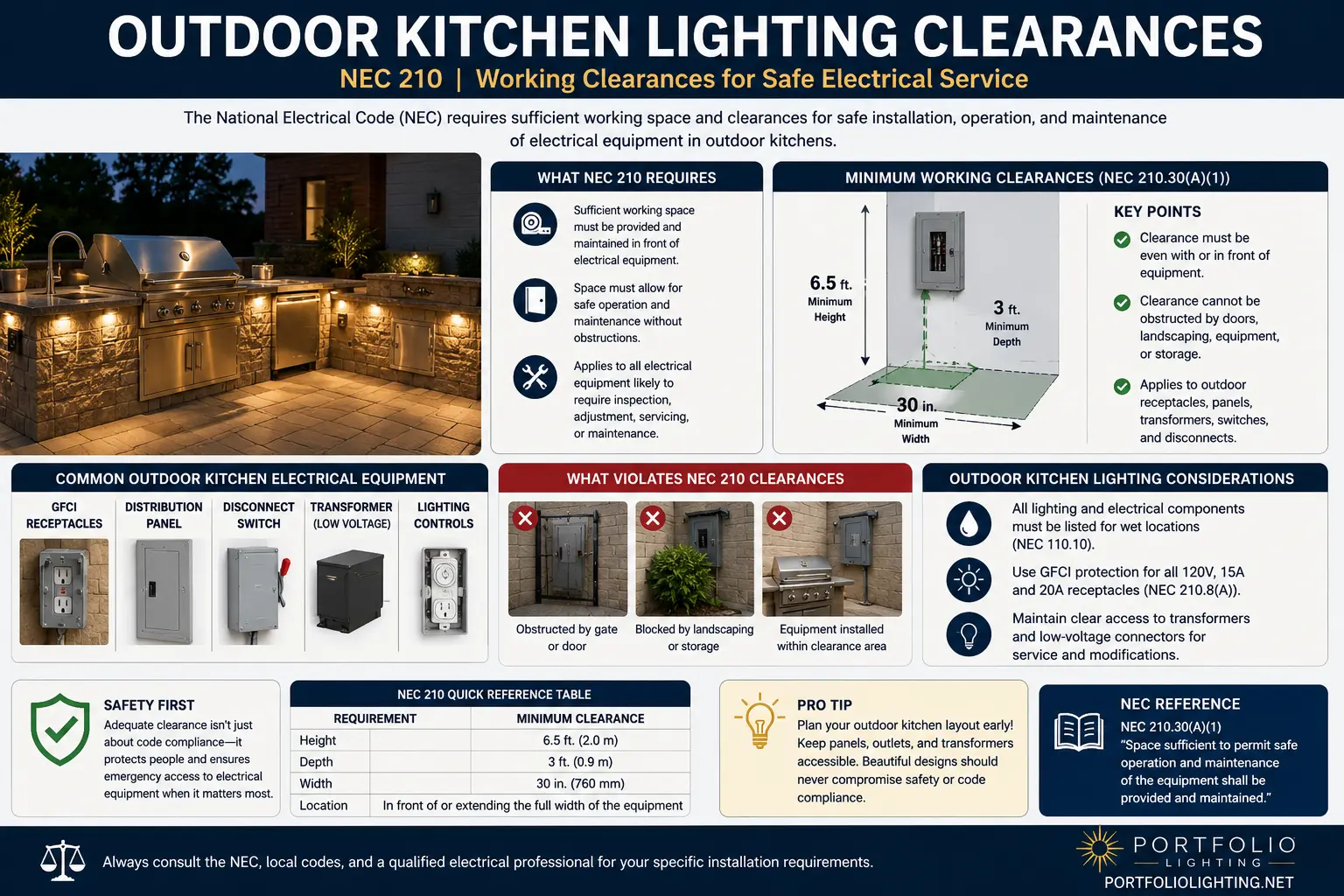
⚡ NEC Code Alert: Roughing in outdoor kitchen lighting without tracking NEC Article 210 and Section 406 wet-location clearances is a fast track to a failed electrical inspection or a dangerous ground fault. Before you mount under-counter tracks or run conduit near a sink, use my 7-Point Outdoor Kitchen Clearance & NEC Code Matrix right below to lock down your exact spacing boundaries.
Quick Answer: My 7-Point Outdoor Kitchen Clearance & NEC Code Matrix
Meeting NEC code for outdoor kitchen lighting isn't just about pick-and-place fixture styling—it is a strict game of physical clearance boundaries, zone mapping, and moisture mitigation. Because these setups combine high-amp cooking appliances, open water sources, and direct exposure to rain, the National Electrical Code dictates exactly where your lighting lines, switch enclosures, and low-voltage drivers can live relative to the wet perimeter.
Whenever I lay out a stone island footprint or audit an outdoor cooking space prior to inspection, I enforce these seven non-negotiable code and clearance rules:
- 1. The 6-Foot Sink GFCI Radius (NEC 210.8): Every single 120V lighting circuit, outlet, or switch box sitting within 6 feet of the outer edge of an outdoor kitchen sink basin must be protected by a Class A GFCI breaker or receptacle.
- 2. Vertical Clearance Over Cooking Surfaces: I maintain a strict minimum of 36 inches of vertical clearance between the top of a grill grate and any under-hood task lighting or under-cabinet puck tracks to prevent extreme thermal damage.
- 3. Mandatory Wet-Location Marking (NEC 406.9): Any lighting fixture installed out in the open, under a non-solid pergola, or anywhere subject to beating rain must carry an official UL "Suitable for Wet Locations" label, not just a damp-rated mark.
- 4. Low-Voltage Enclosure Isolation: I always isolate low-voltage transformers and LED drivers inside a dedicated, ventilated, weatherproof enclosure sub-counter, keeping them off the ground and away from plumbing line joints.
- 5. Countertop Receptacle Height Boundaries: Per NEC 210.52, countertop lighting outlets cannot be mounted face-up in the stone; they must sit horizontally on the island walls, no more than 20 inches above the prep deck.
- 6. Conduit Sub-Staging Requirements: All exposed structural wiring feeding down into stone columns or steel island frames must be completely contained within rigid PVC or liquid-tight flexible metal conduit (LFMC).
- 7. The Open-Flame Clearance Boundary: I push accent lighting controls and primary ambient fixtures away from the direct exhaust path of high-heat searing grills and pizza ovens to prevent heavy grease build-up and lens warping.
⚠️ CRITICAL INSPECTION RISK: Running standard indoor flexible cord or unrated tape light under an outdoor countertop edge creates an immediate shock hazard when wet. Skipping these specific clearance zones triggers three direct NEC code violations and dangerous component short-circuits that I break down inside my wiring blueprints below.
In my experience working on these outdoor builds, trying to cut corners around water and heat boundaries will always bite back during inspections or, worse, when the first heavy storm rolls through. Taking the time to map out your 6-foot sink arcs and double-checking your fixture wet ratings beforehand is what keeps your backyard build predictable, safe, and fully up to code.
Don't start drilling into stone or running conduit blindly. Use my step-by-step island layout mockups, conduit sizing charts, and NEC compliance diagrams detailed further down this page to build a perfectly legal, professional setup.
The NEC 100 "Kitchen" Definition: The Threshold Question Nobody Asks
The most consequential decision in outdoor kitchen electrical design is one that most contractors and homeowners never consider: does your outdoor cooking area meet the NEC's definition of a kitchen? The answer determines whether you're subject to the full suite of kitchen electrical requirements or just the standard outdoor electrical requirements — and the difference is substantial.
The NEC Article 100 Kitchen Definition
NEC Article 100 defines a kitchen as: "An area with a sink and permanent provisions for food preparation and cooking." This definition has three elements, and all three must be present simultaneously:
- A sink — a permanently installed sink, not a portable container or hose connection
- Permanent provisions for food preparation — a fixed countertop or work surface permanently installed, not a portable folding table
- Cooking — a permanently installed cooking appliance, not a portable or freestanding grill that can be moved
Per IAEI Magazine's documentation of how the NEC kitchen definition functions: "Kitchen: An area with a sink and permanent provisions for food preparation and cooking. This definition 'drives where branch-circuit controls are required [210.70, Lighting Outlets Required], how you classify outlets, and how you count VA.'"
Triggers full NEC kitchen requirements:
- Permanently plumbed sink installed in outdoor structure
- Built-in grill or outdoor range permanently connected to gas or 240V electric (not a portable unit)
- Fixed countertop or work surface as part of the permanent structure
- All three elements present simultaneously
Code requirements triggered: NEC 210.70 lighting outlet required; small-appliance branch circuit consideration; 210.8 GFCI for kitchen; all receptacle outlets 210.52 kitchen rules apply.
Only outdoor electrical requirements apply:
- Portable or freestanding grill (can be moved) — no permanent cooking provisions
- No permanently installed sink
- Portable prep table or fold-out surface — not permanent
- Even one missing element means it's not a "kitchen" under NEC 100
Code requirements still apply: NEC 210.8 GFCI for any outdoor receptacles; NEC 410.10 wet or damp location fixture listing; NEC 406.9 weather-resistant receptacles; NFPA 54 clearances above grill if any structure exists.
Why This Threshold Question Matters in Practice
The threshold matters most for two situations: (1) a permit application where the plan reviewer will determine whether the outdoor cooking area is a kitchen, affecting required small-appliance branch circuits, lighting outlet requirements, and GFCI trigger rules; and (2) an inspection where the inspector's interpretation of the NEC kitchen definition controls what they look for.
The practical guidance for outdoor kitchen designers: if your project has a permanently plumbed sink, a built-in cooking appliance permanently connected to gas or electric, and a fixed countertop — design it as a kitchen from the start. The GFCI requirements, the lighting outlet requirements, and the branch circuit requirements all apply regardless of whether the AHJ formally classifies it as a kitchen on permit review, because the NEC definition is satisfied. Designing it as an "outdoor patio" to avoid kitchen requirements, when it meets the NEC kitchen definition, creates the same compliance risk as any other code evasion strategy: it passes initial review and fails on inspection or produces liability exposure when something goes wrong.
NEC 210.70: When a Lighting Outlet Is Required in an Outdoor Kitchen
NEC 210.70(A)(1) requires at least one wall-switch controlled lighting outlet in every habitable room, kitchen, and bathroom in a dwelling unit. The 2017 NEC specifically added "kitchen" to this list — a change that directly affects outdoor kitchens meeting the NEC 100 definition.
The 2017 NEC Addition of "Kitchen" to 210.70(A)(1)
Per electricallicenserenewal.com's documented NEC history: "The 2014 NEC required lighting outlets to be located in every 'habitable' room and bathroom. In the 2017 NEC, the word 'kitchen' was added to 210.70(A)(1)." The NEC defines a "habitable space" using the International Building Code's definition: "a space in a building for living, sleeping, eating or cooking." The electrical license renewal resource explains: "This aligns with the definition of a 'habitable space' located in other code books. Now, at least one wall switch–controlled lighting outlet is required in every habitable room, kitchen, and bathroom."
For outdoor kitchens meeting the NEC 100 kitchen definition: NEC 210.70(A)(1) applies and requires at least one wall-switch controlled lighting outlet. This is a hardwired outlet controlled by a wall switch — not a plug-in lamp or a switched receptacle. The lighting outlet must be:
- Controlled by a wall switch accessible from the entrance to the outdoor kitchen area
- Listed for the applicable location (damp or wet, depending on whether the outdoor kitchen is covered)
- On a branch circuit with appropriate GFCI protection per the applicable 210.8 provisions
- Not solely battery-operated (the 210.70 exception allows battery-powered emergency lighting in some locations, but this is not applicable to the primary kitchen lighting outlet)
The Exception: Switched Receptacle in Lieu of Lighting Outlet
NEC 210.70 Exception 1 allows a wall-switch controlled receptacle in lieu of a lighting outlet — but not in kitchens or bathrooms. The exception specifically excludes kitchens. Per the documented NEC text: "Exception No. 1: In other than kitchens and bathrooms, one or more receptacles controlled by a wall switch shall be permitted in lieu of lighting outlets." An outdoor kitchen meeting the NEC 100 definition must have an actual lighting outlet — a wall-switch controlled plug-in lamp is not compliant. This is one of the practical distinctions between an outdoor patio (where a switched receptacle might substitute for a lighting outlet) and an outdoor kitchen (where it cannot).
Outdoor Entrance Lighting Outlet — NEC 210.70(A)(2)(b)
Regardless of whether the outdoor cooking area is classified as a kitchen, NEC 210.70(A)(2)(b) requires: "For dwelling units, attached garages, and detached garages with electric power, at least one wall switch–controlled lighting outlet shall be installed to provide illumination on the exterior side of outdoor entrances or exits with grade level access." If the outdoor kitchen area includes an exterior entrance to the home (a sliding door onto the patio with the outdoor kitchen, for example), a lighting outlet is required at that entrance under 210.70(A)(2)(b) — separate from and in addition to any kitchen lighting outlet requirement.
The Practical Lighting Outlet Strategy for Outdoor Kitchens: Install a minimum of two separate wall-switch controlled lighting outlets — one at the outdoor kitchen work area (satisfying 210.70(A)(1) for the kitchen) and one at the entry/access point from the home (satisfying 210.70(A)(2)(b) for the exterior entrance). Wire both on the same circuit where practical, but make each independently switch-controlled. Both fixtures must be rated for the applicable location (covered = damp minimum; uncovered = wet). Both circuits require GFCI protection per the applicable 210.8 provisions. This dual-outlet approach satisfies multiple NEC requirements simultaneously and creates the task lighting for the cooking area plus the general ambient lighting for safe movement to and from the cooking area.
Damp vs Wet Location: The Classification That Determines Which Fixture Listing Is Required
The single most common reason outdoor kitchen lighting fixtures fail inspection in exterior and food-service spaces is specifying the wrong location classification. Per IAEI Magazine: "Getting the location wrong is the #1 reason luminaires fail inspection in exterior and food-service spaces." Understanding the NEC location classification for outdoor kitchens is foundational.
NEC Article 100 Location Definitions
The NEC defines three relevant location categories:
- Dry location: "A location not normally subject to dampness or wetness." Indoor spaces; not applicable to outdoor kitchens.
- Damp location: "A location protected from weather and not subject to saturation with water or other liquids but subject to moderate degrees of moisture." Per ExpertCE: "Examples include covered porches, patios, and similar structures." The critical qualifier: "protected from weather."
- Wet location: "Installations underground or in concrete slabs or masonry in direct contact with the earth; in locations subject to saturation with water or other liquids, such as vehicle washing areas; and in unprotected locations exposed to weather." Unprotected locations exposed to weather.
| Outdoor Kitchen Configuration | NEC Location Classification | Required Fixture Listing | Required Fixture Rating |
|---|---|---|---|
| Under solid roof (covered patio, pergola with solid cover, covered lanai) | Damp Location | Listed for damp location minimum | Damp or Wet (wet is also acceptable for damp) |
| Partial overhead cover (pergola with open lattice, shade sail, open-structure overhead) | Wet Location | Listed for wet location — required | Wet location listed only (damp-only is not acceptable) |
| No overhead cover (fully exposed outdoor kitchen) | Wet Location | Listed for wet location — required | Wet location listed only |
| Under a solid roof overhang — fixture in soffit over cooking area | Damp Location (if adequately protected) | Damp location minimum; wet preferred | Verify with AHJ — "adequately protected" is interpretive |
| In-grade or surface-mounted near outdoor kitchen, exposed | Wet Location | Wet location listed | IP67 minimum for in-grade; IP66 minimum for surface |
Why Pergolas Are Almost Always Wet Locations
The most common outdoor kitchen structure causing location classification errors is the pergola — an overhead structure with open sides and a lattice or slatted roof. A pergola does not provide protection from weather that meets the NEC's damp location standard. Rain falls through the open roof structure and saturates the area beneath. This is a wet location. Per the NEC: damp location requires "protected from weather and not subject to saturation with water." A pergola without a solid waterproof cover does not satisfy either condition — fixtures mounted in or on the pergola structure above the cooking area are in a wet location and must be listed for wet location. See the wet location listing requirements guide for the complete listing framework.
One of the most common outdoor kitchen lighting violations: recessed fixtures installed in a wood soffit directly above the cooking area. This creates two overlapping violations: (1) A wood soffit is a combustible overhead structure. If the outdoor cooking appliance is unlisted or if the manufacturer's clearance from listed appliances specifies more than the soffit height, the soffit violates NFPA 54 Section 10.19.2 (no overhead combustible construction above unlisted cooking appliances) or the listing clearance requirement. (2) Recessed fixtures in a soffit above an outdoor kitchen that faces downward into a wet or damp environment must be rated for that environment — standard recessed fixtures rated for dry locations only are a wet or damp location installation violation under NEC 410.10. An IC-rated or AT-rated recessed fixture is an insulation rating, not a moisture location rating. These are separate listing axes.
NEC 210.8 GFCI Requirements: The Complete Outdoor Kitchen Matrix
GFCI requirements for outdoor kitchens are determined by three separate NEC 210.8 provisions that may all apply simultaneously to different outlets in the same outdoor kitchen installation.
NEC 210.8(A)(6) — GFCI for Kitchen Receptacles in Dwelling Units
For outdoor kitchens meeting the NEC kitchen definition at a dwelling unit, NEC 210.8(A)(6) requires GFCI protection for all 125-volt, 15- and 20-ampere receptacles in the kitchen. The 2023 NEC expanded this provision to cover all 125V through 250V receptacles, not just 125V. Per the Minnesota DLI's 2023 NEC FAQ: "This change broadens the GFCI protection requirement to include all 125V through 250V receptacles in kitchens." Every receptacle at a dwelling-unit outdoor kitchen meeting the NEC kitchen definition requires GFCI protection.
NEC 210.8(A)(7) — GFCI Within 6 Feet of a Sink
NEC 210.8(A)(7) requires GFCI protection for receptacles within 6 feet of the outer edge of a sink — regardless of whether the area is classified as a kitchen. An outdoor sink installed in any context triggers this requirement for all receptacles within 6 feet measured along the wall line or counter. For outdoor kitchens with a sink: every receptacle within 6 feet of the sink requires GFCI protection, even if the outdoor cooking area is not classified as a full kitchen under NEC Article 100. The sink-proximity trigger is independent of the kitchen classification.
NEC 210.8(F) — 2023 NEC GFCI for ALL Outdoor Outlets
The most expansive GFCI provision for outdoor kitchens is NEC 210.8(F), added in the 2023 NEC: GFCI protection is required for all outdoor outlets on dwelling units supplied by single-phase branch circuits rated 150V or less to ground and 50A or less. The critical word is "outlet" — not "receptacle." Per ExpertCE's 2023 NEC analysis: "The Code uses the term 'outlet,' which includes receptacles and other points where current is taken to supply utilization equipment — so hard-wired outdoor equipment can also be affected." This means the hardwired lighting fixtures in your outdoor kitchen — if they're on a 120V circuit at a dwelling unit — may require GFCI circuit protection under the 2023 NEC. The circuit breaker for the outdoor kitchen lighting branch circuit should be a GFCI breaker, or a GFCI device should be installed at the first outlet in the circuit.
| Outdoor Kitchen Condition | GFCI Required? | NEC Reference | Applies To |
|---|---|---|---|
| All outdoor receptacles at dwelling unit (any voltage through 250V/50A) | Required — 2023 NEC | 210.8(A) outdoor provision | All 15A and 20A 125V receptacles outdoors |
| All outdoor outlets at dwelling unit — hardwired fixtures | Required — 2023 NEC | 210.8(F) — new 2023 | Hardwired luminaires on circuits ≤150V/50A |
| Kitchen receptacles (outdoor kitchen meeting NEC 100 definition) | Required | 210.8(A)(6) expanded 2023 | All 125V–250V receptacles in kitchen |
| Within 6 feet of outdoor sink | Required | 210.8(A)(7) | All receptacles within 6 ft of sink edge |
| Non-dwelling commercial outdoor kitchen — all areas | Required 2023 NEC | 210.8(B)(3) — new category | Areas with sinks and permanent food prep/cooking provisions |
| Outdoor kitchen circuits on 2020 NEC jurisdictions | Receptacles: required; Hardwired lighting: not required by 210.8(F) | 210.8(A) 2020 NEC | 2020 NEC doesn't include 210.8(F) outdoor outlet provision |
Overhead Clearance from Cooking Surfaces: NFPA 54 and IRC G2447.5
The clearances required above outdoor cooking appliances are governed not by the NEC but by the gas code (NFPA 54), the International Residential Code (IRC), and the specific cooking appliance's listing and manufacturer's installation instructions. These clearances directly control where overhead lighting can be placed because the fixture, its housing, and the material it mounts into all factor into the clearance calculation.
NFPA 54 Section 10.19.2 — Unlisted Outdoor Cooking Appliances
NFPA 54 (the National Fuel Gas Code) Section 10.19.2, as documented by UpCodes, establishes the absolute rule for unlisted outdoor cooking appliances:
"Unlisted outdoor cooking appliances shall be installed outdoors with clearances to combustible material of not less than 36 inches (914 mm) at the sides and back and not less than 48 inches (1219 mm) at the front. In no case shall the appliance be located under overhead combustible construction."
The phrase "In no case" makes this an absolute prohibition. An unlisted outdoor cooking appliance cannot be placed under any overhead structure that includes combustible material — wood, composite decking material, vinyl, or any other combustible — regardless of the height above the appliance. For lighting: any fixture mounted in or on overhead combustible construction directly above an unlisted cooking appliance violates NFPA 54 Section 10.19.2.
What "Unlisted" Means for Outdoor Grills
Most residential outdoor gas grills purchased at home improvement stores are listed appliances — they carry UL or CSA listing marks and come with manufacturer installation instructions specifying clearances. The "unlisted" category typically applies to older appliances, commercial-style appliances used residentially, or DIY-modified equipment. For listed appliances, the manufacturer's installation instructions govern clearances and supersede the NFPA 54 unlisted clearances. If your grill is listed, follow the manufacturer's instructions. If it's not listed, NFPA 54 Section 10.19.2 applies.
IRC G2447.5 — Vertical Clearance for Listed Household Cooking Appliances
For listed household cooking appliances (the standard residential gas grill with a listing mark), IRC G2447.5 establishes the minimum vertical clearance above the cooking top:
Electric and Charcoal Outdoor Grills — Different Clearance Analysis
The NFPA 54 overhead combustible construction prohibition specifically applies to gas-fired outdoor cooking appliances (NFPA 54 governs natural gas and propane). Electric outdoor grills are governed by their listing and the NEC — not NFPA 54. Charcoal grills are governed by NFPA 1. For electric outdoor grills: the manufacturer's installation instructions and the IRC G2447.5 household cooking appliance clearance still apply, but the absolute "no overhead combustible construction" prohibition of NFPA 54 Section 10.19.2 does not. For charcoal grills: NFPA 1 requires a safe distance from flammable materials — check NFPA 1 and local fire codes.
NEC 410.10: Luminaire Requirements for Outdoor Kitchen Locations
NEC Article 410, Part II governs the installation requirements for luminaires in specific locations. For outdoor kitchens, NEC 410.10 is the primary provision determining what fixtures are acceptable and how they must be installed.
NEC 410.10(A) — Wet and Damp Locations
NEC 410.10(A) requires that luminaires installed in wet locations be "marked wet location." Luminaires installed in damp locations must be marked for either wet or damp locations. This is the listing requirement that flows from the location classification analysis in the previous section. The practical meaning:
- A fixture marked "suitable for damp locations" can be installed in a covered outdoor kitchen with adequate weather protection — but not in an uncovered outdoor kitchen or one with an open-lattice pergola overhead.
- A fixture marked "suitable for wet locations" can be installed in any outdoor kitchen configuration.
- A fixture with no outdoor location marking — standard residential interior fixtures — cannot be legally installed in any outdoor kitchen location regardless of how the fixture is positioned relative to the elements.
NEC 410.10(B) — Luminary Installation in Corrosive Locations
NEC 410.10(B) requires that luminaires in corrosive locations be approved for those environments. Outdoor kitchens represent a potentially corrosive environment due to: grease vapor and grease accumulation on fixture surfaces; salt spray in coastal locations; cleaning chemicals used on outdoor kitchen surfaces that may reach overhead fixtures. For outdoor kitchen fixtures: specify fixtures with corrosion-resistant housings (anodized aluminum, AAMA 2604 or better coating, or polymer housing) for any installation near the cooking area. See the coastal lighting compliance guide for salt spray material specifications.
NEC 410.10(D) — Luminaires Near Combustible Material
NEC 410.10(D) requires that luminaires installed near combustible material be designed for that use. Specifically: recessed fixtures installed in insulated ceilings or within ½ inch of combustible material must be Type IC (insulation contact) rated. For outdoor kitchens with combustible overhead structure (wood soffit, cedar pergola, wood overhead panels): any recessed fixtures must be IC-rated for the combustible material contact condition. This is in addition to the wet or damp location rating — a recessed fixture in a covered outdoor kitchen needs both: (1) IC-rated for contact with combustible overhead structure, and (2) damp-location (minimum) or wet-location rated for the outdoor environment.
NEC 406.9 and 210.52: Receptacle Requirements for Outdoor Kitchen Installations
Outdoor kitchen receptacles are governed by NEC 406.9 (outdoor receptacle enclosures) and, for outdoor kitchens meeting the NEC kitchen definition, by the kitchen receptacle requirements of NEC 210.52.
NEC 406.9 — Outdoor Receptacle Enclosures
Per ExpertCE's documented analysis of NEC 406.9: "For damp locations [covered outdoor kitchens]: any 15‑ and 20‑amp non‑locking receptacle must be a listed weather‑resistant (WR) receptacle, installed in a weatherproof enclosure, and have a cover that is weatherproof when the cover is closed." For wet locations (uncovered outdoor kitchens): the receptacle must have a while-in-use weatherproof cover — a cover that seals even when something is plugged in. The while-in-use requirement for outdoor kitchen receptacles is the same as for any outdoor kitchen outlet — see the GFCI requirements guide for the complete weather-resistant and while-in-use cover framework.
NEC 210.52 — Kitchen Countertop Receptacle Spacing
For outdoor kitchens meeting the NEC 100 kitchen definition, the countertop receptacle spacing requirements of NEC 210.52(C) apply: no point along the countertop shall be more than 24 inches from a receptacle outlet, requiring a maximum spacing of 48 inches between receptacles along a continuous countertop. Per ExpertCE: "The NEC requires that no point along the wall countertop be more than 24 inches from a receptacle, which results in a maximum center-to-center spacing of 48 inches between two outlets in practical terms."
NEC 210.52(C)(5) limits receptacle height: "No more than 20 inches above the countertop or work surface." For outdoor kitchen countertops with overhead lighting fixtures, the 20-inch maximum receptacle height and the minimum lighting clearances above the cooking surface must both be satisfied simultaneously in the vertical space above the countertop.
The 2023 NEC Island and Peninsula Clarification
The 2023 NEC made island and peninsula receptacles optional (previously required in the 2020 NEC). However, per the 2023 NEC documentation: "if the receptacles are not installed at the time the cabinets and countertops were initially placed, the section requires provisions for a future outlet to be provided. The provision must include a wiring method (conduit, raceway, or cable) to be extended to the island or peninsula and terminated into a junction box with cover." For outdoor kitchen islands: while the 2023 NEC makes the receptacle itself optional, the rough-in conduit path must still be provided at time of construction. This affects the permit submittal and rough-in inspection stages.
Branch Circuit Requirements: Do Outdoor Kitchens Need Dedicated Circuits?
Whether outdoor kitchens require the dedicated small-appliance branch circuits (SABCs) mandated for indoor kitchens is one of the most frequently misunderstood outdoor kitchen electrical questions.
NEC 210.11(C)(1) Small-Appliance Branch Circuits
NEC 210.11(C)(1) requires that dwelling units have at least two 20-ampere small-appliance branch circuits (SABCs) serving kitchen, dining room, pantry, breakfast room, and similar areas. These circuits must serve only those areas. For outdoor kitchens meeting the NEC kitchen definition: the SABC requirement applies. An outdoor kitchen that meets the NEC kitchen definition needs to be served by the required SABCs — either the two required SABCs are extended to serve the outdoor kitchen, or separate SABCs are provided for the outdoor kitchen.
The practical implication: if you're adding an outdoor kitchen to an existing home and the two indoor SABCs are already at capacity serving the indoor kitchen and dining room, you cannot simply run an extension cord or tap a general-purpose circuit for the outdoor kitchen countertop receptacles. You need to verify that SABC capacity is available for the outdoor kitchen or add additional SABC circuits.
Dedicated Circuits for Specific Outdoor Kitchen Appliances
- Built-in outdoor refrigerator: Most built-in outdoor refrigerators require a dedicated 15A or 20A circuit per the manufacturer's installation instructions. Ice makers, wine coolers, and keg refrigerators similarly require dedicated circuits in most cases.
- Outdoor dishwasher: A dedicated 120V 15A or 20A circuit, GFCI protected, with local disconnect.
- Electric outdoor grill or cooking appliance: 240V dedicated circuit sized per the appliance's nameplate rating. Large outdoor electric grills typically require 240V/30A–60A dedicated circuits.
- Outdoor lighting circuit: Landscape and outdoor kitchen lighting is typically on a general-purpose circuit, not a dedicated circuit — but the GFCI requirements apply. A separate 15A or 20A circuit for the outdoor kitchen lighting is the cleanest design.
- Exhaust hood with integrated fan motor: A motor load requires a circuit sized at 125% of the motor's full-load current per NEC 430.22. An outdoor kitchen exhaust hood with a 1HP motor at 120V draws approximately 16A full-load current; the circuit must be sized for at least 20A (125% × 16A = 20A). Hood-integrated lighting may share this circuit if the total load is within circuit capacity.
NFPA 96 Ventilation Hoods and Integrated Lighting
When an outdoor kitchen includes a ventilation hood above the cooking appliance — required for indoor commercial cooking operations and strongly recommended for covered outdoor kitchens with gas appliances — the lighting integrated into or adjacent to the hood is subject to NFPA 96 requirements for commercial cooking installations and to the same NEC requirements that apply to the outdoor kitchen environment.
When NFPA 96 Applies to Outdoor Kitchens
NFPA 96 (Standard for Ventilation Control and Fire Protection of Commercial Cooking Operations) applies to commercial cooking operations. For residential outdoor kitchens: NFPA 96 typically does not apply directly, though some AHJs apply it by reference or adopt it locally for large outdoor kitchen installations. For commercial establishments with outdoor cooking operations (restaurants with outdoor grills, food trucks, commercial food service outdoor spaces): NFPA 96 applies fully. The distinction matters because NFPA 96 has specific requirements for hood-integrated lighting that don't exist in the residential code framework.
NFPA 96 Hood-Integrated Lighting Requirements
Where NFPA 96 applies to an outdoor cooking hood, the integrated lighting must:
- Use fixtures listed and approved for use in the cooking zone and grease vapor environment
- Be protected against grease accumulation — either enclosed (sealed fixture with lens) or with a grease-collection means that prevents grease from accumulating in the fixture housing
- Be accessible for cleaning, which in practice means the fixture must be accessible for the regular cleaning and inspection that NFPA 96 requires for the hood system
- Not create a grease or fire hazard — exposed lamp surfaces within the hood are prohibited in most NFPA 96 applications because accumulated grease on lamp surfaces creates a fire ignition risk
The NFPA 96 requirement that hood lighting not create a grease/fire hazard has a practical design implication: fully enclosed, sealed fixture housings with flush lenses are the correct fixture type for integration into outdoor kitchen ventilation hoods. Open fixtures, fixtures with exposed lamp surfaces, and decorative pendant fixtures within the hood zone are not appropriate.
For Residential Outdoor Kitchens: The Practical Hood Lighting Approach
For residential outdoor kitchen hoods (not subject to NFPA 96 directly), the AHJ will typically apply NEC 410.10 and the general damp or wet location listing requirements. The practical specification: specify sealed, fully-enclosed LED fixtures with a wet-location listing for any hood-integrated or hood-adjacent lighting. LED technology operates at much lower surface temperatures than incandescent or halogen, reducing the grease-on-lamp ignition risk that is the primary concern in cooking hood applications. The while-in-use requirement for any receptacle outlets in the hood or adjacent to it applies under NEC 406.9.
NEC 210.12 AFCI Requirements for Outdoor Kitchen Circuits
Arc-fault circuit interrupter (AFCI) protection under NEC 210.12 applies to dwelling unit kitchen circuits — a requirement that potentially extends to outdoor kitchens meeting the NEC kitchen definition.
NEC 210.12 Kitchen AFCI Application
NEC 210.12 requires AFCI protection for all 120-volt 15- and 20-ampere branch circuits installed in dwelling unit kitchens (among many other locations). The 2023 NEC maintained and clarified AFCI requirements for kitchen circuits at dwelling units. For an outdoor kitchen meeting the NEC 100 definition at a dwelling unit: the kitchen AFCI requirement may apply to the branch circuits serving that outdoor kitchen, in addition to the GFCI requirements.
AFCI + GFCI dual protection options: Combination AFCI/GFCI circuit breakers ("dual-function" breakers) provide both protections simultaneously on a single circuit breaker. This is the most common approach when both AFCI and GFCI protection are required on the same circuit. For outdoor kitchen lighting circuits, a dual-function AFCI/GFCI breaker is the cleanest solution where both requirements apply.
Complete Outdoor Kitchen Lighting Inspection Checklist
This checklist covers every outdoor kitchen lighting compliance item an inspector will check, organized in the sequence they typically perform the inspection. Run through it before calling for any inspection stage.
Outdoor Kitchen Lighting Code FAQ
I have a covered outdoor kitchen with a built-in gas grill and a wood pergola overhead. Can I install recessed fixtures in the pergola wood members above the grill?
This is a two-violation analysis. First, the wood pergola is combustible overhead construction. If the gas grill is unlisted, NFPA 54 Section 10.19.2 prohibits locating the appliance under any overhead combustible construction — full stop. If the grill is listed, IRC G2447.5 requires at least 30 inches from the cooking surface to combustible material above (24 inches with protective measures). You need to measure the vertical clearance from the grill cooking grate to the pergola members. Second, a wood pergola with open lattice structure is typically a wet location, not a damp location — rain falls through open lattice. Recessed fixtures in wet locations must be wet-location listed, which most standard recessed fixtures are not. Additionally, fixtures within ½ inch of combustible material (the wood pergola members) must be IC-rated per NEC 410.10(D). The practical answer: recessed fixtures in combustible pergola wood members above a gas grill require — simultaneously — wet-location listing, IC rating, and a minimum 30-inch clearance above the grill cooking surface (or 24 inches with protective measures per IRC G2447.5). This combination of requirements is rarely met by standard fixtures. The more practical approach: mount pendant or surface-mounted wet-location-listed fixtures on non-combustible supports (metal pole, non-combustible post) outside the minimum clearance zone above the grill, not in the combustible wood structure overhead.
My outdoor kitchen doesn't have a sink — does that mean I don't need GFCI for the receptacles?
No — the absence of a sink removes the NEC 210.8(A)(7) GFCI-within-6-feet-of-sink trigger and the NEC 100 kitchen definition trigger (since a sink is required for the definition), but it does not remove the outdoor outlet GFCI requirements. Under the 2023 NEC, NEC 210.8(F) requires GFCI protection for all outdoor outlets at dwelling units on circuits rated ≤150V/50A — regardless of whether there's a sink, regardless of kitchen classification. Even under earlier NEC editions (2020, 2017), all outdoor receptacles at dwelling units require GFCI protection per NEC 210.8(A). An outdoor cooking area without a sink still has outdoor receptacles that must be GFCI-protected. The GFCI requirement for outdoor receptacles is absolute under every NEC edition since 1978 — it predates every other GFCI expansion and applies to every outdoor receptacle at a dwelling unit without exception related to proximity to a sink. The sink proximity rule adds to the base outdoor GFCI requirement rather than substituting for it.
I want to put a ceiling fan with a light kit above my covered outdoor kitchen. What are the code requirements?
A ceiling fan with a light kit in a covered outdoor kitchen involves multiple compliance layers. First: the location classification. A covered patio or lanai is typically a damp location — the ceiling fan and light kit must both be listed for damp locations (or wet, which is also acceptable for damp). Most outdoor ceiling fans carry a "suitable for damp locations" or "suitable for wet locations" listing — verify on the label. Second: the overhead clearance above a gas grill. NEC 110.3(B) requires installation per listing instructions, and the ceiling fan/light kit listing almost certainly specifies a minimum distance from open flame cooking appliances. Check the fan's installation instructions. Additionally, IRC G2447.5's 30-inch combustible clearance applies to any overhead structure including the fan housing if it is within the clearance zone — a fan motor housing directly above a gas grill at 28 inches is a code violation. Third: the GFCI requirement. The ceiling fan circuit is an outdoor outlet (if in a covered outdoor kitchen) and is subject to the GFCI requirements discussed in the section above — under the 2023 NEC, this is a hardwired outdoor outlet requiring GFCI circuit protection per NEC 210.8(F). Fourth: the NEC 210.70 lighting outlet requirement. If the outdoor kitchen meets the NEC 100 kitchen definition, the ceiling fan with light kit satisfies the lighting outlet requirement if it's wall-switch controlled. The practical approach: specify a ceiling fan and integrated light kit listed for wet locations (not just damp — wet is the better conservative choice for any outdoor kitchen), install it outside the manufacturer's specified clearance from the cooking appliance, and protect the circuit with a GFCI breaker.
Related Code, Inspection & Compliance Guides
- Electrical Code Safety Guide
- GFCI Requirements Guide
- Wet Location Listing Requirements
- Junction Box Requirements
- Transformer Mounting Code
- Grounding & Bonding Guide
- NEC Inspection Checklist
- Inspection Failure Codes
- Final Inspection Checklist
- Inspector Correction Notices
- Inspector Perspective Guide
- Permit Rejection Reasons
- Permit Requirements Guide
- State Permit Requirements
- Coastal Lighting Salt Spray Compliance
- Dock & Pier Lighting
- Pool Lighting Clearance
- Fire Pit Proximity Lighting Code
- NEC Compliance Calculator
- NEC 2026 Code Updates
- Load Calculation Code
- Splice Connection Code
- Landscape Lighting Guide
- Maintenance Guide