
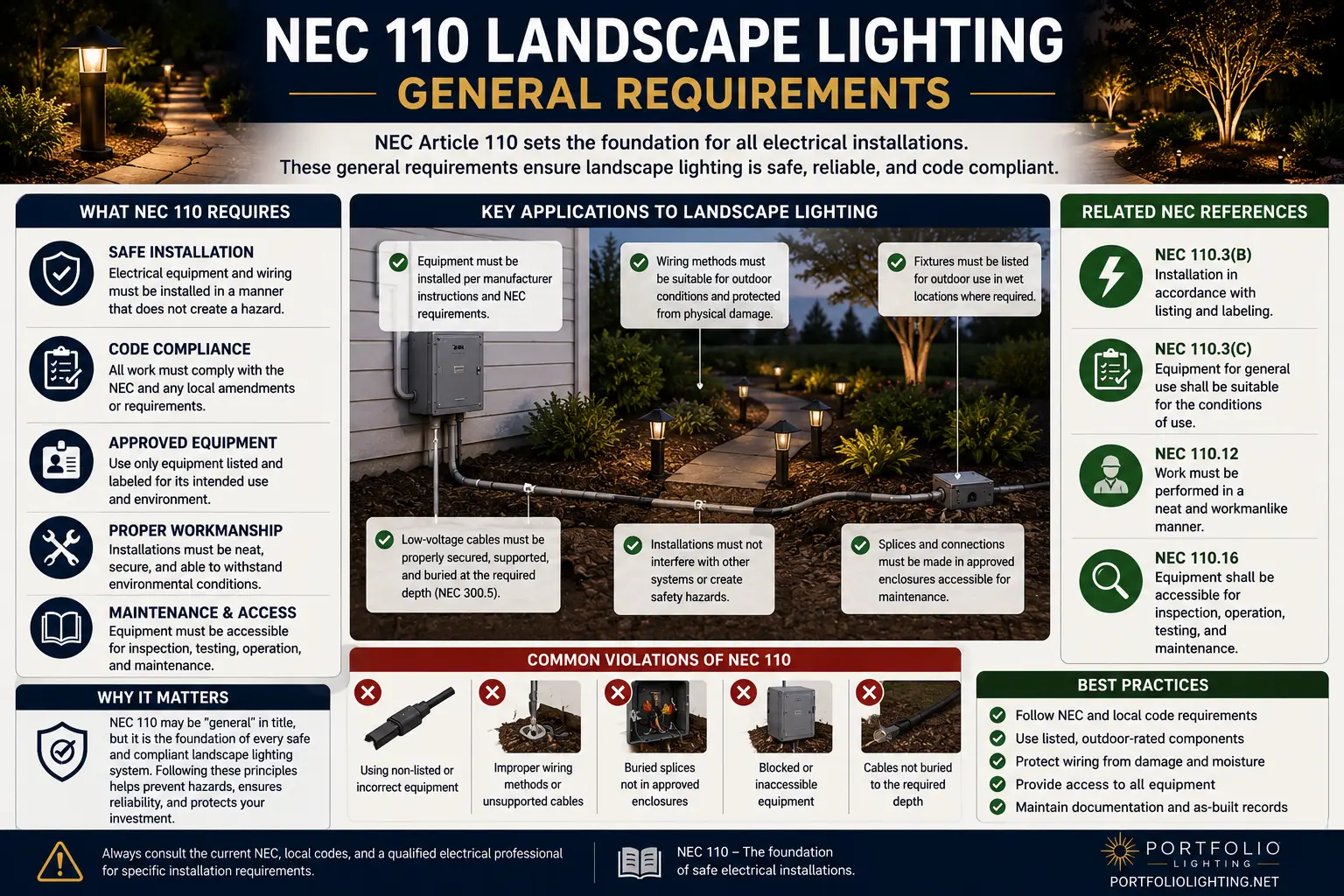
How NEC Article 110 Relates to Landscape Lighting — The Foundation Layer Concept
NEC Article 110 is titled "Requirements for Electrical Installations" — general requirements that apply to every electrical installation covered by the NEC regardless of what specific article governs the particular application. Article 110 is not supplementary or optional; it applies simultaneously with every specific article.
Per EC&M's documented overview of NEC Article 110: "Article 110 covers general requirements for the examination and approval, installation and use, access to and spaces about electrical conductors and equipment; enclosures intended for personnel entry; and tunnel installations." The scope statement — "general requirements... for electrical installations" — establishes that Article 110 requirements apply to landscape lighting in addition to Article 411, not instead of it.
The relationship hierarchy: Article 110 establishes the foundational floor; specific articles like Article 411 add requirements specific to that application. When Article 411 is silent on a requirement (for example, on how to make a wire splice), Article 110 fills the gap. NEC 110.14(B)'s direct-burial splice listing requirement applies to landscape lighting cable splices because Article 411 doesn't address splice connector type — Article 110 does. Many landscape lighting inspection citations trace to Article 110 provisions rather than Article 411 because inspectors have Article 110 as a foundation for citing any electrical installation deficiency.
NEC 110.2 — Approval: The AHJ's Foundational Authority Over All Landscape Lighting Equipment
NEC 110.2 is the broadest provision in the entire NEC: everything must be "approved." "Approved" means "acceptable to the authority having jurisdiction" — which means the inspector, the building official, or whoever is enforcing the NEC in your jurisdiction has the final word on whether any piece of equipment is acceptable for use in a specific installation. This authority is broader than the listing mark on the equipment.
Per the Mike Holt forum documentation: "110.2 applies to everything. Most 'voiding a listing' violations would fall under 110.2, not 110.3(b). Unfortunately 110.2 is incredibly broad and vague so it gives inspectors basically unlimited power to refuse just about anything." This observation is important for landscape lighting: even a UL-listed landscape lighting transformer can be refused by an AHJ under 110.2 if the AHJ determines that the specific installation configuration is not acceptable — for example, if the transformer is installed in a location where it would be regularly flooded despite being rated for wet locations, or if it's mounted in a way that creates a safety hazard not addressed by the listing.
- Landscape lighting application: An AHJ can reject any landscape lighting component — fixture, transformer, connector, enclosure — under 110.2 approval authority even if it carries a listing mark, if the AHJ determines the installed configuration doesn't meet the approval standard for that application.
- The practical limit: AHJ rejection under 110.2 without a specific code basis is subject to the appeal process under NEC 90.4. An AHJ who rejects equipment under 110.2 should be able to articulate the specific reason for rejection. "I just don't like that brand" is not a 110.2 rejection — it's arbitrary. A substantiated 110.2 rejection cites a specific installation condition that the equipment is not suitable for.
- Implications for unlisted equipment: Article 110.2 allows approval of unlisted equipment if the AHJ determines it is acceptable. This is how non-standard or specialty landscape lighting equipment without NRTL listing can sometimes be installed — the AHJ can approve it under 110.2 even without a listing mark, though this is rarely exercised and requires specific AHJ buy-in before installation.
- AHJ determination that equipment is acceptable for use
- Applies to every piece of equipment in every installation
- Can reject listed equipment in specific configurations
- Can approve unlisted equipment in specific configurations
- Broad, subjective — requires AHJ discretion and judgment
- Landscape lighting: transformer, fixtures, connectors, boxes must all be "approved"
- NRTL certification (UL, ETL, CSA) that equipment meets specific product standards
- Testing performed by recognized qualified electrical testing laboratory
- Creates a presumption of approval — listed equipment is generally approvable
- Listing tests the product as manufactured — not how it's installed
- Specific, objective — either listed or not, for a specific standard
- Landscape lighting: UL 1838 listing for transformers; UL 1598 for wet-location fixtures
NEC 110.3(A) — Examination: The 8-Factor Suitability Test
NEC 110.3(A) lists the criteria that must be evaluated when judging whether equipment is suitable for its intended use. These criteria guide both the listing laboratory's testing and the AHJ's field evaluation. An inspector determining whether a specific landscape lighting component is "suitable for use" in a particular application applies these factors.
The "heating effects under abnormal conditions" factor (item 5) is the one I see most relevant to landscape lighting in the field. A 300W landscape transformer installed in a closed planting bed enclosure with mulch on all sides and no airflow fails factor 5 even if it has a wet-location listing. The listing test was performed in free air; the installed condition creates an abnormal heating scenario the listing didn't address. An inspector who takes the time to evaluate factor 5 can cite 110.3(A) even when the equipment has a valid listing mark for the location. The solution: install transformers in positions with adequate airflow per the transformer's listing documentation and NEC 110.13.
NEC 110.3(B) — Installation Per Listing: How the Manufacturer's Instructions Become Code
NEC 110.3(B) is one of the most consequential provisions in Article 110 for landscape lighting, because it incorporates the manufacturer's installation instructions into the binding code requirements for any listed equipment. Understanding exactly how this works — and the documented examples of how it applies to landscape lighting transformers — is essential for installers and inspectors alike.
The operative phrase is "any instructions included in the listing or labeling." When a UL-listed landscape lighting transformer has instructions on its label or in the documentation included with the listing — including instructions that reference the UL 1838 product standard under which it was listed — those instructions become legally binding installation requirements by virtue of NEC 110.3(B). This is not a manufacturer preference; it is a code requirement.
The Landscape Transformer Indoor vs Outdoor Prohibition — A Documented 110.3(B) Application
The Mike Holt forum documents a direct 110.3(B) application to a landscape lighting transformer. A contractor asked: "Malibu Lighting instructions state 'Mount power pack vertically outdoors only.' Am I correct in telling the customer that the transformer cannot be installed in the basement, even though his argument is that the LV wire can be installed per NEC Chapter 3?" The forum response from a licensed electrician: "I would say you are correct in telling the customer no, under 110.3(B)." The label says "outdoors only." NEC 110.3(B) makes "outdoors only" a code requirement, not a manufacturer suggestion. Installing the transformer in the basement violates NEC 110.3(B) — even if there's no specific NEC provision barring landscape transformers from indoor use.
The UL 1838 → NEC 110.3(B) → Table 300.5 Connection for Secondary Wiring
The Mike Holt forum also documents the chain of authority connecting UL 1838 to the burial depth requirement for landscape lighting secondary wiring:
- UL 1838 clause 51.1 (Installation Instructions): "The instructions shall inform the installer that the main secondary wiring is intended for shallow burial — less than 6 inches — unless the manufacturer has provided wiring intended for direct burial."
- UL 1838 clause 53.3 (Main secondary wiring): Secondary wiring must be SPT-3, SPT-2W, underground low-energy circuit cable, or wire that is intended for wet locations, is sunlight-resistant, and is intended for direct burial as defined in UL 493.
- NEC 110.3(B): These UL 1838 clauses are "instructions included in the listing" for the UL 1838-listed transformer. NEC 110.3(B) makes them binding installation requirements.
The result: the burial depth for landscape lighting secondary wiring has two simultaneous code bases — NEC Table 300.5 Column 5 establishes the minimum (6 inches from soil surface), AND NEC 110.3(B) incorporating UL 1838 clause 51.1 establishes cable type requirements. An inspector can cite both provisions for the same violation. This is why landscape lighting cable type is not discretionary — it's required by the transformer's listing standard, which is incorporated into the NEC by 110.3(B).
What "Instructions Included in the Listing or Labeling" Covers
The scope of NEC 110.3(B) has been debated in the electrical community. The Mike Holt forum discussion captures the nuance: "What you and I think doesn't matter. Greg it really does not matter what the manufacturer suggests unless it is included in the equipment's labeling or the equipment's listing. 110.3(B) only applies to those two situations." The key phrase is "included in the listing or labeling" — which typically includes:
- Text printed directly on the equipment label
- Instructions packaged with the equipment and referenced in the listing
- The product standard (like UL 1838) under which the equipment was listed, including its installation instruction requirements
Marketing materials, the manufacturer's website, and general product documentation that are not part of the listing or labeling are not incorporated by NEC 110.3(B). The critical test: is the instruction part of what was reviewed and approved during the UL listing process? If yes — it's a code requirement. See the NEC Article 411 inspection checklist for how 110.3(B) interacts with the transformer installation requirements at NEC 411.4.
Why 110.3(B) Matters for Every Inspection: An inspector who is not an Article 411 expert but is a general electrical inspector can still cite non-compliant landscape lighting installations using NEC 110.3(B) — because the listing violations are Article 110 violations regardless of the specific article governing the circuit. The landscape lighting installer who argues "there's no NEC section requiring that" is wrong if the requirement comes from the equipment's listing instructions. Every landscape lighting installer should read the transformer's installation instructions as code, not as suggestions. The instructions are the code under 110.3(B).
NEC 110.3(C) — Listing: What NRTL Certification Actually Means for Landscape Lighting
NEC 110.3(C) establishes the requirements for the listing process itself — who can perform it (recognized qualified electrical testing laboratories, called NRTLs: UL, ETL/Intertek, CSA, MET Labs, and others) and what the listing must be based on (applicable product standards). For landscape lighting, the relevant product standards are UL 1838 (landscape lighting systems, including transformers) and UL 1598 (luminaires, including wet-location outdoor fixtures).
What the UL 1838 Listing Tests for Landscape Transformers
UL 1838 is the standard for landscape lighting power units. A transformer listed to UL 1838 has been tested for: output voltage limits (maximum 30V AC, 60V DC — the Article 411 low-voltage boundary); output current limits (maximum 25 amperes — the Article 411.6 circuit limit); protection against output short-circuit and overload; weatherability for the rated outdoor installation location; insulation adequacy; and compliance with the installation instruction requirements of UL 1838 clause 51.1 and 53.3. The listing scope is specific — a UL 1838 listing certifies the transformer as a landscape lighting power unit, not as a general-purpose transformer. Using a UL 1838-listed transformer for a different application than landscape lighting is a 110.3(B) violation (used outside the scope of its listing). See the transformer mounting requirements for how 110.3(B) governs transformer installation orientation and position.
The Listing Mark Limitation — What It Doesn't Guarantee
A listing mark guarantees that the product was tested by a recognized laboratory against the applicable product standard at the time of manufacture. It does not guarantee:
- That the specific unit shipped to your job site is identical to the tested sample (manufacturing variation)
- That the product has not been modified after manufacture (modifications after listing do not invalidate the listing mark but may require AHJ re-evaluation under 110.2)
- That the product is suitable for every installation configuration — only configurations within the scope of the listing tests are covered
- That the product will perform adequately in conditions beyond the listing test parameters (coastal salt spray, extreme heat, etc.)
This limitation is why NEC 110.2 approval and NEC 110.3(A) examination exist alongside the 110.3(C) listing requirement — they address the installation-specific factors that a general product test cannot fully anticipate.
NEC 110.12 — Workmanlike Execution Applied to Landscape Lighting
NEC 110.12 is the provision that makes "neat and workmanlike manner" a code requirement, not a quality preference. EC&M's documented analysis: "Electrical equipment and cabling must be installed in a neat and workmanlike manner [Sec. 110.12]. One aspect of this is that unused openings must be closed by fittings that provide protection substantially equivalent to the wall of the equipment [Sec. 110.12(A)]. Exposed cables must be supported by the structural components of the building so that the cable will not be damaged by normal building use. Electrical equipment must be firmly secured to the surface on which it is mounted [Sec. 110.13]."
What "Workmanlike" Means for Landscape Lighting Installations
The workmanlike execution standard has specific applications in landscape lighting that inspectors commonly cite:
- Cable not mechanically supported: NEC 110.12(C) (added in the 2020 NEC) requires cables to be supported by structural components so they won't be damaged by normal use. Landscape cable zip-tied to a fence rail, draped over a shrub, or run across a walkway surface without any physical protection or support fails this standard. The cable must be buried (protected by soil), in conduit, or secured to a structural component in a way that protects it from damage.
- Exposed splices not in an approved enclosure: A splice between landscape lighting cable conductors must be in a proper splice enclosure or in a listed buried splice device. An exposed wire nut sitting on the ground surface, regardless of whether it's a gel-filled burial-rated connector, fails the workmanlike standard — it must be either buried per burial depth requirements or in an enclosure. See the junction box requirements guide.
- Transformers not firmly secured: NEC 110.13 requires equipment to be firmly secured to the surface on which it's mounted. A landscape lighting transformer balanced on a landscape rock, propped against a tree, or loosely attached to a post fails NEC 110.13. The transformer must be firmly secured with appropriate hardware per the mounting requirements. See the transformer mounting code guide.
- Unused openings in enclosures not closed: Any landscape lighting junction box or transformer enclosure with unused knockouts left open fails NEC 110.12(A). All unused openings must be closed with appropriate fittings.
- Cable installation creating a tripping hazard or damage exposure: Landscape cable run across walkways at grade level or across areas regularly traversed by lawnmowers fails the workmanlike standard because it creates conditions where the cable will be damaged by normal property use.
NEC 110.14(A) and (B) — Conductor Terminations and the Direct-Burial Splice Listing Requirement
NEC 110.14 is the most frequently violated Article 110 provision in landscape lighting installations — specifically Section 110.14(B)'s requirement that splicing means for direct-burial conductors be listed for that use. This is the specific code section behind the gel-filled connector requirement.
NEC 110.14(A) governs how conductors connect to terminals — the connection points on transformers, timers, and other landscape lighting equipment. The critical provision: "Terminals for more than one conductor and terminals used to connect aluminum shall be so identified." Landscape lighting transformers have terminals for the primary (120V) connection and the secondary (12V/24V) connections. Per IAEI Magazine's documented Article 110 analysis: "Some materials will work with others and some will not, specifically copper and aluminum shall not be intermixed in a terminal where such intermixing causes a reaction. If a termination device is rated for both copper and aluminum, then it can be done."
The copper-aluminum mixing issue in landscape lighting: Most landscape lighting cable is copper conductors. Many landscape lighting transformers have aluminum secondary terminals (the screw terminals where the 12V cable connects). Connecting copper conductors to an aluminum terminal is permissible under 110.14(A) if and only if the terminal is identified as suitable for copper conductors (marked "CU" or "CU/AL" or "CO/ALR"). Standard aluminum terminals marked only "AL" cannot accept copper conductors per NEC 110.14(A). This distinction is worth verifying on any new transformer installation.
NEC 110.14(B) is the direct-burial splice listing requirement. Per ICC Digital Codes documentation: "Wire connectors or splicing means installed on conductors for direct burial shall be listed for such use." This requirement applies to every wire connector installed in a buried position in a landscape lighting installation — at every fixture connection point where cable is spliced underground.
What "Listed for Direct Burial" Means for Splice Connectors
Not all outdoor-rated or wet-location-rated connectors are listed for direct burial. A connector that is acceptable for outdoor use in a junction box (wet location) may not be listed for direct burial (buried in soil). The distinction is the corrosion and moisture environment — soil contact creates a continuously moist, chemically active environment that standard outdoor connectors are not tested for. Per EC&M: "Single direct burial types UF or USE conductors can be spliced underground with a device that is listed for direct burial."
| Connector Type | Listed for Direct Burial? | Acceptable for Landscape Lighting Buried Splices? | Notes |
|---|---|---|---|
| Standard wire nuts (no gel) | No | No | Not listed for direct burial; moisture infiltrates and causes corrosion and connection failure |
| Gel-filled wire nuts (UL-listed, e.g. King Innovation DryConn) | Yes — when labeled "direct burial" | Yes | Must carry explicit direct burial listing mark. Most blue or orange gel-filled connectors marketed for landscape lighting are listed for direct burial — verify the label |
| Heat-shrink direct-burial splice kits | Yes — when labeled "direct burial" | Yes | Proper application requires heat gun for full seal. Effective when properly applied |
| Pre-filled direct-burial splice connectors (e.g., ¾" gel splice blocks) | Yes — when labeled "direct burial" | Yes | Check manufacturer label for direct burial listing explicitly |
| Standard push-in connectors (WAGO, wire Lever-Nuts) | No | No | Suitable for junction box use only; not listed for direct burial soil contact |
| Standard crimp connectors (no insulation) | No | No | Bare metal crimps corrode rapidly in soil; no moisture protection |
| Outdoor wet-location rated connectors (not direct-burial listed) | No — unless label says "direct burial" | No for buried splices; acceptable above grade in junction box | "Weatherproof" and "outdoor rated" are not equivalent to "listed for direct burial" |
The single most common 110.14(B) violation in landscape lighting: the installer made splice connections at each fixture location using standard wire nuts (the kind used indoors and in above-grade junction boxes) and buried them without any burial-rated connector. Standard wire nuts absorb soil moisture over months, the wire connection corrodes, resistance increases, voltage drop increases, and eventually the connection fails. The inspector who probes a burial depth point near a fixture and finds a standard wire nut is a straightforward 110.14(B) citation. The fix: pull the wire nut, apply a gel-filled direct-burial listed connector, verify the burial depth is adequate, and re-bury. See the splice connection code requirements guide for complete direct-burial connector analysis.
NEC 110.14(C) and (D) — Temperature Ratings and Torque Requirements
NEC 110.14(C) requires that conductor ampacity be selected at or below the temperature rating of the weakest component in the circuit — conductor, terminal, or device. For landscape lighting:
- Most landscape lighting transformer terminals are rated for 60°C or 75°C operation. If the cable connecting to those terminals is rated for 90°C, the conductor ampacity must be determined using the 60°C or 75°C column of NEC Table 310.16, not the 90°C column.
- For the primary (120V) supply circuit to the transformer: the supply wire connects to a standard 60°C or 75°C rated duplex outlet terminal. Conductor ampacity must be coordinated with the outlet's temperature rating per 110.14(C).
- Per EC&M's Article 110 documentation: "For equipment rated 100A or less, size conductors 1 AWG and smaller per the ampacities in the 60°C temperature column of Table 310.16." This is the standard landscape lighting transformer primary circuit sizing basis.
NEC 110.14(D) was revised in the 2020 NEC to require calibrated torque tools where the manufacturer specifies a torque value. Per EZ-PDH's 2020 NEC change documentation: "Where a tightening torque is indicated as a numeric value on equipment or in installation instructions provided by the manufacturer, a calibrated torque tool shall be used to achieve the indicated torque value, unless the equipment manufacturer has provided installation instructions for an alternative method of achieving the required torque."
Landscape lighting application: Many landscape lighting transformers specify torque values for the primary-side terminal connections in their installation instructions. Under the 2020 NEC and 110.3(B), those torque values become code requirements, and 110.14(D) requires a calibrated torque tool to achieve them. EC&M: "Improper terminations, poor workmanship, violating the manufacturer's instructions, and improper torqueing can each cause poor electrical connections." A study cited in IAEI Magazine's Article 110 analysis found that "over 30 percent of the connections were less than half the recommended torque." Under-torqued connections create high-resistance connection points that cause heat buildup, voltage drop, and eventual failure — the same failure mode as improper burial connectors.
NEC 110.20 and 110.21 — Reconditioned Equipment and Field-Applied Label Requirements
NEC 110.20 is the foundational provision for what became Article 411.3's prohibition on reconditioned landscape lighting equipment. The 2020 NEC restructured the reconditioning prohibition, placing the general rule in Article 110 and requiring Article 411 to specifically prohibit reconditioning of landscape lighting systems (since listed systems for reconditioning don't exist in this category).
For landscape lighting: because no landscape lighting transformer or fixture system has been listed specifically for reconditioning (no UL standard covers reconditioning of these products), the practical effect is a complete prohibition on reconditioned landscape lighting equipment. A landscape lighting transformer that has been repaired, modified, or refurbished outside the original manufacturer's factory process cannot be installed in a new installation — it is reconditioned equipment without a reconditioning listing. See the NEC Article 411 inspection checklist for the specific Article 411.3 reconditioning prohibition.
NEC 110.21 requires that labels and markings on electrical equipment be durably legible and suited to the environment. For outdoor landscape lighting, this means:
- The listing label on any landscape lighting transformer or fixture must remain legible throughout the equipment's service life. UV degradation, moisture damage, and physical abrasion can cause labels to fade or become illegible.
- An inspector who cannot read the listing label on a transformer or fixture has a 110.21 citation basis — the label must be legible. See the inspector perspective guide for how inspectors handle illegible labels: they look for the listing on the product database if the label is unclear, but a completely illegible label is a citation.
- Any field-applied labels — marking a circuit at the panel, labeling the transformer zone connections, marking a junction box as "landscape lighting zone 1" — must comply with 110.21's durability requirement for outdoor environments. Paper labels in wet locations are not compliant.
NEC 110.26 — Working Space and the Critical Low-Voltage Exception
NEC 110.26 requires working space clearances around electrical equipment that may need to be accessed while energized — examined, adjusted, serviced, or maintained. For landscape lighting, this applies primarily to the transformer installation and any outdoor panelboard or disconnect supplying the landscape lighting system.
The working space requirement applies to equipment "likely to require examination, adjustment, servicing, or maintenance while energized." For landscape lighting:
- The transformer's primary-side terminal area (where the 120V supply connects): This is line-voltage equipment likely to require servicing while the system is energized. Standard working space requirements apply to this side of the transformer — minimum 30-inch width, depth per Table 110.26(A)(1) (typically 3 feet for the primary voltage level), and minimum 6.5-foot headroom.
- The outdoor panel or subpanel supplying landscape lighting circuits: Full 110.26 working space required as with any panel installation.
- The outdoor disconnect for the landscape lighting system: Per the Mike Holt forum: "Any equipment that may need to be accessed while energized requires working space clearances. This includes... disconnects, and any other equipment where a worker might need to open a cover, operate a switch, or take measurements."
The Critical Low-Voltage Exception — NEC 110.26(A)(1)(b)
NEC 110.26(A)(1)(b) includes a specific exception for low-voltage equipment that directly applies to the secondary side of landscape lighting transformers: "By special permission, smaller working spaces shall be permitted where all exposed live parts operate at not greater than 30 volts rms, 42 volts peak, or 60 volts dc." Per ICC Digital Codes documentation of NEC 110.26.
The landscape lighting secondary side — the 12V or 24V output side of the transformer — operates at exactly the threshold that qualifies for this exception (30V rms for 12V AC systems; well below 60V DC for 12V DC systems). The secondary-side zone of the transformer and any junction boxes or connection points on the secondary circuit can qualify for reduced working space clearances "by special permission" from the AHJ.
| Equipment Location | Voltage Level | Working Space Required? | Applicable NEC Provision |
|---|---|---|---|
| Outdoor panel supplying landscape lighting | 120/240V (line voltage) | Yes — full 110.26(A) clearances | 110.26(A)(1) Table — Condition 1: typically 3 ft depth minimum |
| Transformer (primary side connection point) | 120V (line voltage) | Yes — full 110.26(A) clearances | 110.26(A)(1): primary side is line voltage, full clearances required |
| Transformer (secondary zone terminal connections) | 12V or 24V (≤30V rms) | Reduced clearances allowed by special permission | 110.26(A)(1)(b): low-voltage exception applies to ≤30V rms |
| Above-grade junction box (secondary circuit) | 12V (≤30V rms) | Reduced clearances allowed by special permission | 110.26(A)(1)(b): low-voltage exception applies |
| Outdoor disconnect for landscape lighting supply | 120V | Yes — 110.26(A) clearances required | Any disconnect "likely to require examination while energized" requires working space |
The Practical Implication: Transformer Placement and Shrub Growth. The most common real-world 110.26 violation for landscape transformers: a transformer installed on a wall with adequate clearance at time of installation, then landscaping overgrows to the point where the 30-inch minimum working space in front of the transformer is obstructed. NEC 110.26(B) states: "The working space required by this section shall not be used for storage." A planting that grows into the working space converts a compliant installation into a non-compliant one. The clearances must be maintained throughout the service life, not just at installation. Include a note in the as-built documentation that the transformer's working space must be maintained clear, and specify the minimum clear space dimension.
NEC 110.28 — Enclosure Types for Outdoor Landscape Lighting Installations
NEC 110.28 establishes NEMA enclosure type requirements and their environmental suitability. For landscape lighting installations, the relevant enclosure types govern junction boxes, transformer housings, and any outdoor panelboards or disconnects used in the system.
NEMA Enclosure Types for Landscape Lighting Applications
| NEMA Type | Environmental Suitability | Landscape Lighting Application | IP Equivalent |
|---|---|---|---|
| Type 1 | Indoor general use — light dust, light splashing | Not acceptable — outdoor only acceptable types start at Type 3 | IP30 |
| Type 3 | Outdoor — rain, sleet, windblown dust | Acceptable for above-grade outdoor junction boxes in typical residential landscape | IP54 |
| Type 3R | Outdoor — rain, sleet, ice formation; no windblown dust | Acceptable for typical residential landscape junction boxes where dust is not a concern | IP54 |
| Type 3S | Outdoor — rain, sleet, windblown dust, ice on exterior | Better than Type 3 for exposed installations subject to ice | IP54 |
| Type 4 | Outdoor — hose-directed water, windblown dust and rain | Appropriate for landscape lighting installations near irrigation systems or wash-down areas | IP66 |
| Type 4X | Outdoor + corrosion resistant — all Type 4 plus corrosion resistance | Required for coastal installations (Zone 1 and 2); NEMA 4X = IP66 + ASTM B117 salt fog tested | IP66 + corrosion |
| Type 6 | Submersible — temporary submersion | Required for in-grade junction boxes that may be inundated; equivalent to IP67 | IP67 |
| Type 6P | Prolonged submersible | For permanently submerged in-grade applications | IP68 |
Complete NEC Article 110 Landscape Lighting Compliance Checklist
This checklist covers every Article 110 provision applicable to landscape lighting installations. Use it alongside the Article 411 checklist — both apply simultaneously to every landscape lighting installation.
Equipment Approval and Listing (110.2, 110.3)
- ☐ All equipment is approved by the AHJ (110.2): Every transformer, fixture, connector, junction box, and enclosure in the installation is acceptable to the authority having jurisdiction. No modified equipment, no equipment with voided configurations.
- ☐ Transformer is UL 1838 listed (110.3(C)): The listing mark is visible and legible on the transformer. If degraded: listing documentation from UL Product iQ database is available. See the NEC Article 411 checklist.
- ☐ All fixtures are listed for applicable location (110.3(C)): Wet-location listed for uncovered outdoor kitchens, damp or wet for covered. See the wet location listing guide.
- ☐ Transformer is installed per listing label instructions (110.3(B)): Label says "outdoors only" → transformer is outdoors. Label says "mount vertically" → transformer is vertical. No installation configuration outside what the label and listing instructions authorize.
- ☐ Secondary cable type matches UL 1838 clause 53.3 requirements (110.3(B)): SPT-3, SPT-2W, underground low energy circuit cable, or direct-burial rated cable. See the wire burial depth guide.
- ☐ No reconditioned equipment installed (110.20): No modified transformers, refurbished fixtures from unknown sources, or repaired equipment without reconditioning listing.
Workmanlike Execution (110.12, 110.13)
- ☐ All cable is buried, in conduit, or secured to structural members — not laying on the surface (110.12, 110.12(C)): No cable running across walkways or landscaped surfaces without burial or conduit protection.
- ☐ Transformer firmly secured to mounting surface (110.13): No balanced, propped, or loosely attached transformers. Hardware is per the transformer's listing requirements. See the transformer mounting guide.
- ☐ All unused enclosure openings are closed (110.12(A)): Every junction box and transformer enclosure has all unused knockouts filled with appropriate fittings.
- ☐ All splice connections are in approved enclosures or buried with listed direct-burial connectors (110.12, 110.14(B)): No exposed splices sitting on the ground surface without appropriate enclosures.
Electrical Connections (110.14)
- ☐ All buried splice connectors are listed for direct burial (110.14(B)): Gel-filled connectors, heat-shrink direct-burial kits, or listed burial splice blocks — not standard wire nuts, push-in connectors, or unrated crimp connectors. See the splice connection code guide.
- ☐ Transformer terminals rated for the conductor material (110.14(A)): Copper cable connecting to aluminum transformer terminals requires "CU" or "CO/ALR" rated terminals. Verify the terminal marking.
- ☐ Terminal connections torqued to manufacturer's specification if torque value is stated (110.14(D)): Check the transformer installation instructions for torque values on primary-side terminal connections. Use calibrated torque tool if values are specified.
- ☐ Conductor ampacity is coordinated with terminal temperature rating (110.14(C)): Primary-side supply conductors sized using 60°C column of Table 310.16 if terminals are rated 60°C.
Markings, Working Space, Enclosures (110.21, 110.26, 110.28)
- ☐ All labels are durable and legible for the outdoor environment (110.21): No paper labels in wet locations. Printed/engraved labels on junction boxes exposed to weather. Transformer listing label still legible.
- ☐ 30-inch minimum working space maintained in front of transformer primary side (110.26(A)(1)): Clear path from transformer front to any obstruction. Verify this is maintained after any landscaping changes.
- ☐ Working space not used for storage or blocked by vegetation (110.26(B)): Measure from transformer front to nearest obstruction. Clear the zone and maintain clearance.
- ☐ Junction boxes are appropriate NEMA enclosure type for location (110.28): Outdoor above-grade: NEMA 3R minimum; areas subject to hose water: NEMA 4; coastal Zone 1-2: NEMA 4X; in-grade with inundation risk: NEMA 6. See the junction box requirements guide.
NEC Article 110 Landscape Lighting FAQ
My landscape lighting transformer's listing label is almost completely faded and unreadable. Is this an automatic inspection failure?
A completely illegible listing label is a potential NEC 110.21 citation — markings must be "durably legible" per 110.21. However, in practice, inspectors and AHJs typically give latitude if the listing can be verified through other means. Per the electrical inspector perspective guide: inspectors will often accept a printout from UL's Product iQ database (productiq.ulprospector.com) showing the specific transformer model and its listing status. For an inspection-ready installation, print the UL Product iQ page showing the transformer model's listing and have it available before calling for inspection. This proactively resolves the 110.21 question before it becomes a citation. If the label is completely gone or unreadable and you cannot identify the model for UL lookup, the transformer may need to be replaced — an unidentifiable transformer cannot be confirmed as listed, which is an NEC 110.3(C) issue as well as 110.21. See the Portfolio model number lookup and the inspector perspective guide.
I used waterproof wire connectors that say "outdoor rated" and "weatherproof" for my buried landscape lighting splices. Are those listed for direct burial under NEC 110.14(B)?
"Outdoor rated" and "weatherproof" are not equivalent to "listed for direct burial." NEC 110.14(B) requires specifically that connectors for direct burial be "listed for such use" — meaning the listing must cover the direct-burial soil-contact condition specifically. A connector rated for outdoor use in a wet-location junction box (exposed to rain and moisture) has not been tested for the continuous soil-contact, chemical activity, and sustained moisture immersion of a buried installation. Most connectors labeled "weatherproof" or "outdoor rated" do not carry a direct-burial listing. The specific language to look for on the connector package is "suitable for direct burial," "listed for underground use," or "direct burial rated." Products specifically designed and listed for this purpose include gel-filled wire nuts from manufacturers like King Innovation (DryConn), 3M DBR connectors, and similar products explicitly marketed and listed for direct burial use in landscape lighting. If the connector package doesn't say "direct burial" in its listing description, it's not listed for direct burial under NEC 110.14(B). See the splice connection code requirements guide for the complete connector analysis.
Does the NEC 110.26 working space requirement mean I can't plant anything near my landscape lighting transformer?
NEC 110.26 requires that working space clearances be maintained throughout the life of the installation — not just at time of initial installation. Per NEC 110.26(B): "Working space required by this section shall not be used for storage." Plantings that grow into the required working space technically violate this provision because they obstruct the working space. In practice, the working space requirement for landscape lighting transformers is most relevant to the primary-side connection area — the space needed to safely access and work on the 120V connection. A minimum of 30 inches in front of the transformer must remain accessible. Most landscape lighting transformers are wall-mounted at accessible height, and the working space in front of the transformer can coexist with landscaping — as long as the plants don't physically block the 30-inch minimum depth of working space in front of the transformer door or access point. The practical guidance: don't plant large shrubs or place permanent garden features within 30 inches directly in front of the transformer's primary connection access. Note the 30-inch requirement as a maintenance item in the as-built documentation so it's not forgotten as landscaping matures over years. The secondary side (the 12V zones) qualifies for reduced working space under the 110.26(A)(1)(b) low-voltage exception by special permission.
Related Code, Inspection & Compliance Guides
- Electrical Code Safety Guide
- NEC Article 411 Inspection Checklist
- Inspection Failure Codes
- Wet Location Listing Requirements
- Splice Connection Code Requirements
- Transformer Mounting Code
- Junction Box Requirements
- Wire Burial Depth Code
- Grounding & Bonding Guide
- GFCI Requirements Guide
- Load Calculation Code
- Final Inspection Checklist
- Inspector Perspective Guide
- Inspector Correction Notices
- Permit Rejection Reasons
- NEC 2026 Code Updates
- Coastal Lighting Salt Spray Compliance
- Outdoor Kitchen Lighting NEC 210
- Arc Fault & GFCI Code
- Portfolio Model Number Lookup
- NEC Compliance Calculator
- Landscape Lighting Guide