
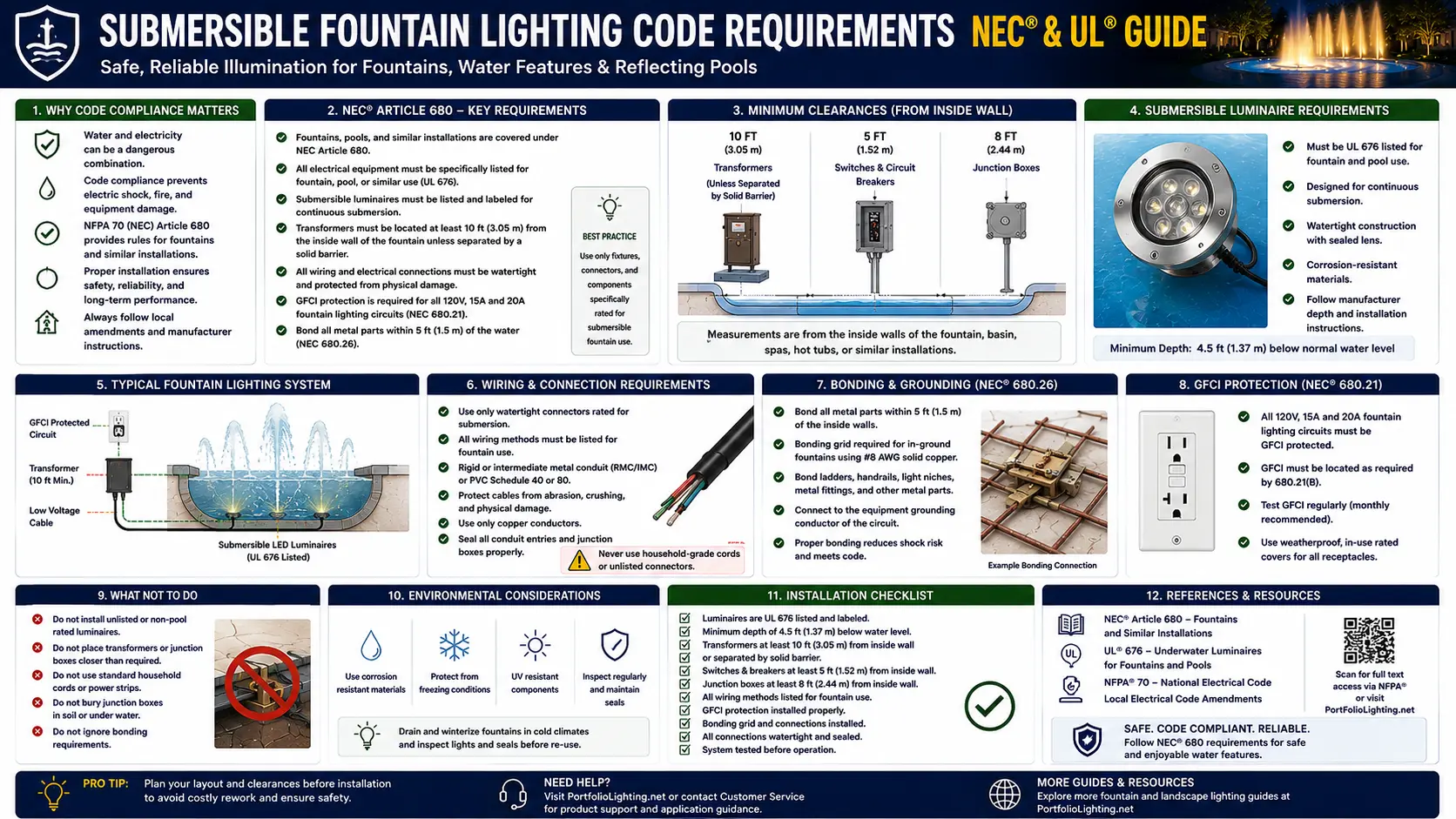
What Is a "Fountain" Under NEC Article 680?
The starting point for any fountain lighting code question is the NEC 680.2 definition of "fountain" — because the definition is significantly broader than common usage of the word, and the breadth of the definition determines whether your installation is subject to NEC 680 Part V or not.
The NEC 680.2 Definition Through the Code Editions
The NEC defines a fountain as: "An ornamental structure or recreational water feature from which one or more jets or streams of water are discharged into the air, including splash pads, ornamental pools, display pools, and reflection pools. The definition does not include drinking water fountains or water coolers." (2020 NEC and later editions)
Earlier editions (through 2017) used simpler language: "Fountains, ornamental pools, display pools, and reflection pools."
The 2023 NEC added language specifically excluding natural or man-made bodies of water such as lakes, lagoons, and surf parks from the fountain definition — clarifying that these are not regulated under Article 680.
Key implication: The word "fountain" in everyday language typically means a jet of water spraying upward. The NEC definition includes any ornamental, display, or reflection pool regardless of whether water is sprayed. A still reflecting pond with submersible LED lights is a "fountain" under NEC 680.2.
Many homeowners assume fountain lighting rules apply only to fully submerged fixtures, but larger decorative water features introduce additional safety and installation considerations. Waterfalls often combine submerged lights, perimeter lighting, transformers, pumps, exposed rock structures, and wet-location wiring methods that must work together safely. If your project includes a pondless waterfall, cascading stream, natural rock feature, or illuminated water wall, review our waterfall lighting code requirements guide for a detailed breakdown of electrical safety, equipment placement, NEC considerations, and common installation mistakes.
What Qualifies as a "Fountain" — A Comprehensive List
| Water Feature Type | NEC 680 Fountain? | Code Path | Notes |
|---|---|---|---|
| Traditional jet/spray fountain (permanent install) | Yes — NEC 680 Part V | Parts I + V | Classic fountain — always covered |
| Decorative reflecting pool (permanent, in-ground) | Yes — NEC 680 Part V | Parts I + V | No spray required — "reflection pool" in definition |
| Ornamental garden pond (permanent, with pump/lights) | Yes — NEC 680 Part V | Parts I + V | "Ornamental pool" in definition — even without jets |
| Display pool (commercial, hotel lobby, mall) | Yes — NEC 680 Part V | Parts I + V | "Display pool" explicitly named in definition |
| Splash pad (pedestrian recreational water feature) | Yes — NEC 680 Part V | Parts I + V | Added to definition in 2020 NEC — ≤1-inch depth for recreational pedestrian use |
| Fountain sharing water with a swimming pool | Yes — Parts I, II, AND V | Parts I + II + V | If water is common to a pool, must also comply with Part II (pool requirements) |
| Self-contained portable tabletop fountain | No — Article 422 | Article 422 (Appliances) | Portable, self-contained — NEC 680 Part V explicitly excludes |
| Portable fountain on patio (plug-in, no permanent installation) | No — Article 422 | Article 422 (Appliances) | Not permanently installed — Article 422 applies, not Article 680 |
| Drinking water fountain | No — explicitly excluded | General NEC | NEC 680.2 specifically excludes drinking water fountains |
| Natural pond or lake (man-made or natural) | No — excluded in 2023 NEC | General NEC | 2023 NEC specifically excluded natural/man-made bodies of water (lakes, lagoons) from the definition |
The Permanently Installed vs Portable Distinction
NEC 680.50 explicitly states that Part V applies to permanently installed fountains as defined in NEC 680.2, and that self-contained portable fountains are NOT covered by Part V. Portable fountains instead comply with NEC Article 422 (Appliances), Parts II and III. The practical distinction between "permanently installed" and "portable" is not always obvious. The NEC does not define "portable" for this context with a dimensional threshold (a historical exception for fountains "no larger than 5 feet in any dimension" was removed from the code in the 1999 NEC revision). Current guidance treats a fountain as portable if it is self-contained, not built into or installed in the ground or a structure, and can be moved without demolition or significant modification. A fountain basin that is poured concrete, lined masonry, or built into the landscape is permanently installed. A pre-formed plastic or fiberglass basin set on grade and filled with water is in a gray zone — the AHJ determination may depend on whether it is anchored, connected to a water supply, or otherwise integrated into the property.
Decision Tree: Does NEC Article 680 Part V Apply to Your Water Feature?
Work through these questions in sequence to determine which code provisions apply to your water feature and its lighting.
GFCI Requirement and the Low-Voltage Exception: NEC 680.51(A)
The GFCI requirement is the most consequential provision in NEC 680.51 for fountain lighting design. The default rule requires GFCI protection for all submersible equipment. The exception — using a 680.23(A)(2)-listed transformer — changes the compliance path for low-voltage LED fountain lighting entirely.
The Default Rule: GFCI Required
"Luminaires, submersible pumps, and other submersible equipment, unless listed for operation at low voltage contact limit or less and supplied by a transformer or power supply that complies with 680.23(A)(2), shall be protected by a ground-fault circuit interrupter."
Default: ALL submersible fountain equipment requires GFCI protection on its branch circuit.
Exception: Equipment that is (a) listed for operation at or below the low-voltage contact limit AND (b) supplied by a 680.23(A)(2)-compliant transformer does NOT require GFCI protection on the equipment circuit.
For line-voltage fountain lighting — any luminaire operating at 120V or above — GFCI protection is mandatory, no exception. The GFCI is installed in the branch circuit supplying the fountain luminaire. This GFCI is specifically for submersible equipment; the general outdoor receptacle GFCI requirement (NEC 210.8) applies to any receptacles near the fountain regardless of the equipment voltage.
The Low-Voltage Exception Path: What Makes It Work
The exception to the GFCI requirement requires simultaneous satisfaction of two conditions — identical to the conditions in the pool lighting proximity exception discussed in the pool lighting clearance code guide:
- Listed for operation at low-voltage contact limit or less: The submersible luminaire must be listed and operate at or below the low-voltage contact limit: 15V AC sinusoidal, 30V DC continuous, 21.2V peak for nonsinusoidal AC. Standard 12V AC landscape lighting LED submersibles operate below the 15V AC threshold and satisfy this condition.
- Supplied by a 680.23(A)(2)-compliant transformer: The transformer must be the pool/spa-listed type with a grounded metal barrier between primary and secondary windings or listed double insulation — not a standard landscape lighting transformer. This condition eliminates standard UL 1838-listed landscape transformers (Portfolio, Hampton Bay, Malibu, VOLT) from this exception path.
A standard landscape lighting transformer — including every consumer brand transformer sold for residential landscape use — does not include a grounded metal barrier between primary and secondary windings. This barrier is what makes the 680.23(A)(2) transformer significantly safer for water-adjacent applications: a primary-to-secondary winding failure in a standard transformer could allow primary voltage to appear on the secondary circuit and potentially energize the water. The grounded metal barrier intercepts this failure and routes the fault current to ground before it reaches the secondary. Without a 680.23(A)(2)-listed transformer, the GFCI protection requirement in 680.51(A) applies — period. Using a standard landscape transformer for submersible fountain lighting without GFCI protection is a code violation even at 12V.
The Two Practical Compliance Paths for Low-Voltage Fountain Lighting: Path A — Use a 680.23(A)(2)-listed pool/spa transformer and listed low-voltage (≤15V AC) luminaires without grounding terminals. No GFCI on the equipment circuit required. This is the premium path: higher transformer cost, simpler ongoing operation (no nuisance GFCI trips from water intrusion). Path B — Use a standard landscape transformer with GFCI protection on the branch circuit supplying the fountain equipment. This path is more accessible hardware-wise but creates nuisance GFCI trips anytime moisture reaches any connection point — which is inevitable in a submersible application. Path A is strongly preferred by professional fountain lighting installers for this reason.
All NEC 680.51 Requirements Mapped: Every Subsection Explained
NEC 680.51 contains eight subsections covering every aspect of submersible fountain equipment. Here is the complete guide to each requirement.
Covered in detail in the GFCI section above. The most consequential provision for fountain lighting design. GFCI is required on the branch circuit — the outlet or wiring that powers the fountain equipment. For the low-voltage exception path, the equipment must be listed for ≤15V AC and use a 680.23(A)(2) transformer.
Fountain luminaires: maximum 150V between any two conductors. This permits 120V single-phase (120V hot-to-neutral), but prohibits 240V circuits for luminaires. Note that 120V is between conductors, not to ground — a 120/240V split-phase system's 240V between hot legs would prohibit fountain luminaires. Submersible pumps and other equipment: 300V maximum between conductors, permitting 240V single-phase. The 150V luminaire limit is absolute — no exception for GFCI protection.
The lens must be submerged — the top of the lens (not the fixture body, the lens itself) must be at or below the normal water level. Exception: luminaires listed for above-water use. For upward-facing luminaires (aimed skyward through the water surface), the lens must either: (1) have a guard preventing human contact with the lens, or (2) be listed for use without a guard in upward-facing configuration. The lens-below-water requirement serves a thermal function: fountain luminaires are typically water-cooled and depend on submersion for safe operating temperatures. Running them above the waterline causes overheating.
Many fountain luminaires and submersible pumps are designed to operate submerged and use the surrounding water for heat dissipation. Running this equipment out of water — during fountain draining, maintenance, low-water conditions, or drought — will cause overheating, shortened equipment life, or fire. NEC 680.51(D) requires that equipment depending on submersion for safe operation be protected by a low-water cutoff switch or other approved means that de-energizes the equipment when it is no longer submerged. Low-voltage LED submersible lights that don't generate significant heat may not require this protection — verify with the luminaire manufacturer.
Equipment must be designed with provisions for either: threaded conduit entries (for hard-wired conduit installations) OR a suitable flexible cord. Exposed cord within the fountain basin: maximum 10 feet. Power supply cords that extend beyond the fountain perimeter must be enclosed in a wiring enclosure approved by the AHJ — not left as open exposed cord. Metal parts of equipment that contact water must be brass or other approved corrosion-resistant metal — not standard steel hardware that will rust in water contact.
Luminaires and other submersible equipment must be removable from the water for relamping (in non-LED equipment), inspection, or normal maintenance. Luminaires shall not be permanently embedded into the fountain structure such that the water level must be reduced or the fountain drained for maintenance. This is both a practical and safety requirement — it prevents scenarios where electrical equipment must be accessed in live water, and ensures maintenance can be performed without disturbing the fountain structure. For LED luminaires with rated lifespans of 50,000+ hours, this requirement is less practically critical but remains a code mandate.
Submersible fountain equipment must either be designed to be inherently stable when submerged (due to weight, shape, or buoyancy design) or be securely fastened to the fountain structure. Tipping or floating equipment creates entanglement hazards, cord damage from movement, and potential exposure of connections above the waterline. LED submersible puck lights placed loose on the floor of a fountain basin without any fastening violate this requirement unless the fixture is designed with sufficient ballast for self-stability. The manufacturer's installation instructions will specify whether the fixture is self-stable or requires fastening.
This is the most commonly missed sub-requirement of 680.51(C). A luminaire aimed upward through the water surface (a common aesthetic in fountains and reflection pools) creates a scenario where a person reaching into the water could contact the lens. NEC 680.51(C) requires upward-facing lenses to either: (1) have the lens guarded to prevent contact by any person, or (2) be specifically listed for use without a guard in the upward-facing configuration. A bare LED puck pointed upward in a shallow reflection pool that a person's hand could easily reach does not satisfy this requirement without either a physical guard or a confirmed listing for unguarded upward-facing use.
Underwater Enclosures: NEC 680.52
Any junction box, pull box, or other electrical enclosure installed underwater or in contact with the fountain basin water must meet the specific requirements of NEC 680.52. These requirements are distinct from standard outdoor enclosure requirements because of the continuous water submersion environment.
Above-Water vs Underwater Enclosures
NEC 680.52(A) specifies that junction boxes and other enclosures used for above-water installation (even if near the fountain) must comply with NEC 680.24 — the same junction box requirements that apply to pool applications. These require: listed pool junction boxes, minimum dimensions (12-inch square for conduit entries from ground), appropriate grounding provisions, and minimum height above grade. See the junction box requirements guide for the general box requirements that form the foundation for 680.24 compliance.
Underwater Enclosure Requirements — NEC 680.52(B)
For enclosures that will be submerged in fountain water, NEC 680.52(B) applies specific construction requirements:
- Submersible construction: Underwater enclosures must be submersible — rated and tested for continuous water immersion. Standard NEMA 3R weatherproof boxes are not sufficient; NEMA 6P or equivalent submersible-rated enclosures are required.
- Corrosion-resistant material: Made of copper, brass, or other approved corrosion-resistant material. Standard zinc-plated or galvanized steel hardware will corrode rapidly in fountain water, particularly if treated with algaecides or other water treatments.
- Threaded conduit entries or compression glands: Underwater enclosures must have provisions for threaded conduit entries (the most waterproof entry method) or compression glands/seals for cord entry. Knock-outs with standard connectors are not appropriate for underwater installation.
- Firm attachment: Underwater enclosures must be firmly attached to supports or directly to the fountain surface and bonded as required. Where supported only by conduits, the conduits must be copper, brass, stainless steel, or other approved corrosion-resistant metal (not standard steel EMT).
- Additional supports for nonmetallic conduit: Where the box is fed by nonmetallic conduit, additional supports and fasteners of copper, brass, or approved corrosion-resistant material must be provided.
The underwater enclosure requirement is the most commonly non-compliant element in DIY fountain lighting installations — specifically the requirement for copper, brass, or corrosion-resistant metal construction. The typical homeowner fountain lighting kit uses plastic connector housings and standard galvanized or zinc hardware. After one or two seasons of water contact, these connections corrode, resistance increases, and the system starts failing — usually with GFCI trips or simply dead lights. Professional fountain lighting installations use brass or copper hardware throughout, potted connection points in the submersible equipment, and minimize underwater junction boxes by routing cords to above-water connection points wherever possible.
Bonding and Grounding: NEC 680.53 and 680.54
NEC Article 680's bonding and grounding requirements for fountains differ from pool requirements — fountains do not require an equipotential bonding grid extending under and around the basin, but they do require specific bonding of metal piping and grounding of electrical equipment within 5 feet.
NEC 680.53 — Bonding of Metal Piping Systems
"All metal piping systems associated with the fountain shall be bonded to the equipment grounding conductor of the branch circuit supplying the fountain."
This provision requires that any metal pipes, fittings, or other metallic components of the fountain's water circulation system be bonded together and connected to the equipment grounding conductor of the electrical branch circuit that powers the fountain. The purpose: if a ground fault occurs in any fountain electrical equipment, any stray current flowing through the water must have a clear path back to the panel through the EGC — not through a person who bridges a fountain structure and a grounded surface outside the fountain.
NEC 680.53 references NEC 250.122 for sizing the bonding conductors — use the applicable table based on the branch circuit overcurrent protection rating.
NEC 680.54 — Grounding
NEC 680.54 specifies which equipment must be grounded at a fountain installation:
- All electrical equipment located within the fountain or within 5 feet of the inside wall: Except for listed low-voltage luminaires that do not require grounding (the 680.22(B)(6)/680.51(A) no-ground-required type). This 5-foot zone mirrors the pool bonding zone and ensures that any metallic electrical equipment in the accessible area adjacent to the fountain is properly grounded.
- All electrical equipment associated with the recirculating system of the fountain: Pumps, filter motors, heaters, and other equipment in the water circulation system.
- Panelboards not part of the service equipment that supply any electrical equipment associated with the fountain: Any sub-panel or distribution equipment dedicated to the fountain.
The grounding requirement applies to the equipment grounding conductor — the protective conductor in the branch circuit wiring that creates the fault-clearing path if equipment develops a ground fault. For cord-connected fountain equipment, an insulated copper equipment grounding conductor must be an integral part of the cord and connected to the grounding terminal in the supply junction box or transformer enclosure per NEC 680.55(B). For the low-voltage exception path (no-ground luminaires), the grounding requirement for the luminaire itself is specifically waived — but other grounded equipment (pumps, enclosures, piping) still requires grounding per 680.54. See the grounding and bonding guide for the broader principles that support NEC 680's specific requirements.
Receptacle Requirements Near Fountains
NEC Article 680 contains specific receptacle requirements applicable to the area around fountains. These requirements apply both to receptacles used to power fountain equipment and to general-purpose convenience receptacles in the fountain area.
GFCI Protection Within 20 Feet of a Fountain
NEC 680 Part V incorporates Part I general requirements, which include the provision that all 125V through 250V receptacles (up to 60A) located within 20 feet of a fountain basin shall have GFCI protection. This is a broader requirement than standard outdoor receptacle GFCI (which applies to outdoor receptacles generally per NEC 210.8(A)(3)) — it specifically mandates GFCI for a 20-foot radius around fountain basins, compared to the 6-foot and 20-foot zone requirements around pool walls.
The practical implication for landscape installations: any outdoor receptacle within 20 feet of a decorative fountain — including ones used for landscape lighting transformers, outdoor entertainment equipment, or garden tools — requires GFCI protection. Since standard outdoor receptacles already require GFCI per NEC 210.8(A)(3), this typically doesn't add a new hardware requirement for most residential installations. However, it does confirm that no exemption from GFCI applies simply because the receptacle is serving a low-voltage landscape lighting transformer rather than line-voltage equipment directly.
The GFCI-for-Outdoor-Receptacles Connection to Landscape Lighting Transformers
For cord-and-plug connected landscape lighting transformers located within 20 feet of a fountain: the GFCI at the outdoor receptacle protects the primary circuit. This GFCI protection is required by both NEC 210.8(A)(3) (general outdoor receptacle rule) and NEC 680 (fountain proximity rule). Whether the fountain lighting uses the standard landscape transformer path (with GFCI) or the 680.23(A)(2) pool transformer path (GFCI not required for the equipment circuit), the outlet serving the transformer must be GFCI protected. The GFCI at the outlet is a separate requirement from the GFCI on the submersible equipment branch circuit. See the GFCI requirements guide for the complete outdoor receptacle GFCI framework and the arc fault and GFCI code requirements guide for arc fault considerations in outdoor circuits.
Special outdoor lighting zones such as fountains, pools and fire features all create unique installation conditions that affect fixture selection and placement. This fire pit lighting clearance and heat exposure guide explains how nearby gas systems and elevated temperatures can impact outdoor lighting safety and long-term fixture reliability.
Pool vs Fountain: Key Differences in NEC 680 That Matter for Lighting
Since pools and fountains are both governed by NEC Article 680, understanding the specific differences in requirements between the two prevents both over-compliance (applying pool requirements to fountains) and under-compliance (applying fountain requirements to water features that share water with a pool).
Many decorative water features extend beyond simple fountains and incorporate streams, cascades, waterfalls, and illuminated rock structures. While these installations often share similar NEC safety principles, waterfalls introduce additional considerations involving splash zones, wiring protection, transformer placement, and fixture selection. If your project includes moving water beyond a traditional fountain basin, see our waterfall lighting code requirements guide for a detailed review of electrical safety and compliance considerations.
| Requirement | Swimming Pool (Part II) | Fountain (Part V) | Why It Differs |
|---|---|---|---|
| Governing NEC sections | Parts I and II | Parts I and V only (unless shares water with pool) | Different Parts explicitly named for different installation types |
| Luminaire lens depth below water | 18 inches minimum below normal water level (NEC 680.23) | Below normal water level only — no specific depth (NEC 680.51(C)) | Pool swimmers can potentially reach lights at any depth; fountain contact less likely |
| Equipotential bonding grid | Extensive grid required: structural steel, perimeter 3 ft out, all metal within 5 ft, all equipment (NEC 680.26) | Metal piping bonded to branch circuit EGC only (NEC 680.53) | Pool occupants immersed in water path; fountain visitors typically not fully immersed |
| Luminaire proximity to edge (landscape lights) | 10-ft default prohibition; 5-ft possible with 680.22(B)(6) conditions | No landscape lighting proximity restriction specific to Part V fountains | Fountain proximity rules not specified in Part V; general outdoor rules apply beyond the basin |
| Maximum luminaire supply voltage | No explicit maximum in Part II (GFCI required for line voltage) | 150V maximum between conductors (NEC 680.51(B)) | Fountain-specific limitation; pool Part II doesn't impose this cap separately |
| Low-water cutoff requirement | Not in Part II (pools maintain water level) | Required for equipment depending on submersion (NEC 680.51(D)) | Fountains may be drained, seasonally de-watered, or suffer low-water conditions |
| Equipment removability | Pool wet-niche: cord-length requirements for removal without draining | Must be removable without reducing water level or draining (NEC 680.51(F)) | Both require removal access, but pool uses cord length as the mechanism |
Submersible Fountain Lighting Code FAQ
My garden has a decorative stone-lined reflection pool with submersible LED puck lights. Is this subject to NEC 680 Part V?
Yes — a permanently installed decorative reflection pool is a "fountain" under NEC 680.2's definition, which explicitly includes "reflection pools." The fact that it's stone-lined, decorative rather than recreational, and doesn't spray water does not exempt it. Parts I and V of NEC Article 680 apply to all permanently installed fountains as defined in 680.2 per NEC 680.50. The submersible LED puck lights are subject to NEC 680.51's requirements: GFCI protection on the branch circuit (unless using a 680.23(A)(2)-listed pool transformer), lens below normal water level, 10-foot maximum exposed cord, stability and servicing requirements, and proper underwater enclosure construction if junction boxes are submerged. The good news: for low-voltage 12V LED pucks using a properly listed pool transformer, all of these requirements are achievable within a normal landscape lighting budget.
Can I use my standard Hampton Bay or Portfolio landscape lighting transformer to power submersible fountain lights?
With GFCI protection: yes, technically. The default rule in NEC 680.51(A) requires GFCI protection for all submersible fountain equipment, and a standard landscape transformer with GFCI on the branch circuit satisfies the default path. Without GFCI protection: no. The GFCI-exception path requires a 680.23(A)(2)-listed pool/spa transformer — which standard landscape transformers (Portfolio, Hampton Bay, Malibu, VOLT, Kichler, and all UL 1838-only listed brands) are not. In practice, using the standard landscape transformer with GFCI path creates persistent nuisance tripping because water inevitably infiltrates submersible connections over time, and any moisture at a connection point triggers the GFCI. Professional fountain lighting installations use the 680.23(A)(2) pool-listed transformer path for this reason. See the transformer sizing guide and transformer alternatives guide for general transformer information and the pool lighting clearance code guide for the 680.23(A)(2) transformer requirement detail.
My fountain lights keep tripping the GFCI. Is this normal and how do I fix it?
Recurring GFCI trips from submersible fountain lighting are common and are caused by moisture infiltrating electrical connections — typically at the luminaire's power cord connection point or at the junction box where the cord connects to the supply wiring. Water slowly wicks into connections through capillary action, creating a ground fault current path. The GFCI correctly detects this and trips. This is not a malfunction — it's the GFCI protecting against exactly the hazard it was installed for. The solutions, in order of effectiveness: (1) Use UL 486D direct-burial listed waterproof connectors (see splice connection code requirements) for all connections — gel-filled connectors like King Innovation DryConn seal the splice against moisture intrusion. (2) Move the connection point above water level where possible — a connection above the waterline with appropriate wet-location listed hardware is more reliably watertight than a submerged one. (3) Upgrade to the 680.23(A)(2) pool-listed transformer path, which eliminates the GFCI on the equipment circuit entirely and removes the tripping mechanism, while providing superior safety through transformer design.
What is the 10-foot cord rule and does it apply to the power cord from my submersible pump or light to the transformer?
NEC 680.51(E) limits the length of exposed flexible cord within the fountain basin to 10 feet. "Exposed" means the cord is in the water or accessible — not enclosed in conduit. If your fountain is small (under 10 feet from the equipment to the perimeter), the full cord can be flexible cord within the fountain. If the equipment is more than 10 feet from the fountain perimeter, the cord must run in a listed conduit or approved wiring enclosure for any portion that exits the fountain. The 10-foot limit does not apply to the cord from the transformer to the outdoor receptacle — that cord is outside the fountain basin entirely and is governed by standard appliance cord rules, not NEC 680.51(E). If your fountain is large and the luminaire is more than 10 feet from the basin edge, the installation needs conduit rather than exposed cord for the run beyond the fountain perimeter.
My in-ground fountain is being drained for winter. Does the NEC 680.51(D) overheating requirement mean I need to de-energize all the lighting?
Yes — for any submersible luminaire that depends on water submersion for safe thermal operation, NEC 680.51(D) requires a low-water cutoff or other approved means to de-energize the equipment when it is no longer submerged. Running water-cooled submersible equipment dry will cause overheating, damage the equipment, and in some cases create a fire hazard. The low-water cutoff switch automatically de-energizes the circuit when water level drops below the equipment. For LED submersible luminaires specifically, check the manufacturer's specifications for operating temperature range without water cooling — modern LED fixtures with low wattage may not depend on submersion for thermal safety, but this must be confirmed in the product's listed specifications, not assumed. For winter shutdown: de-energizing all submersible fountain equipment is the safest approach regardless of whether the equipment technically depends on submersion.
Related Electrical Code and Water Feature Guides
- Swimming Pool Lighting Clearance Code
- Electrical Code Safety Guide
- GFCI Requirements NEC 2026
- Arc Fault & GFCI Code Requirements
- Grounding and Bonding Guide
- Junction Box Requirements
- Splice & Connection Code Requirements
- Wet Location Listing Requirements
- Transformer Disconnect Requirements
- Load Calculation & Code Compliance
- Voltage Drop Code Requirements
- NEC 2026 Updates
- Wire Burial Depth Code
- Permit Requirements
- Contractor Licensing Requirements
- Insurance & Liability Guide
- Transformer Sizing Guide
- Transformer Alternatives
- Portfolio Pool Lighting Guide
- Transformer Mounting Code
- Landscape Lighting Corrosion Guide
- Landscape Lighting Maintenance
- Landscape Lighting Layout Guide
- How to Wire Landscape Lighting