
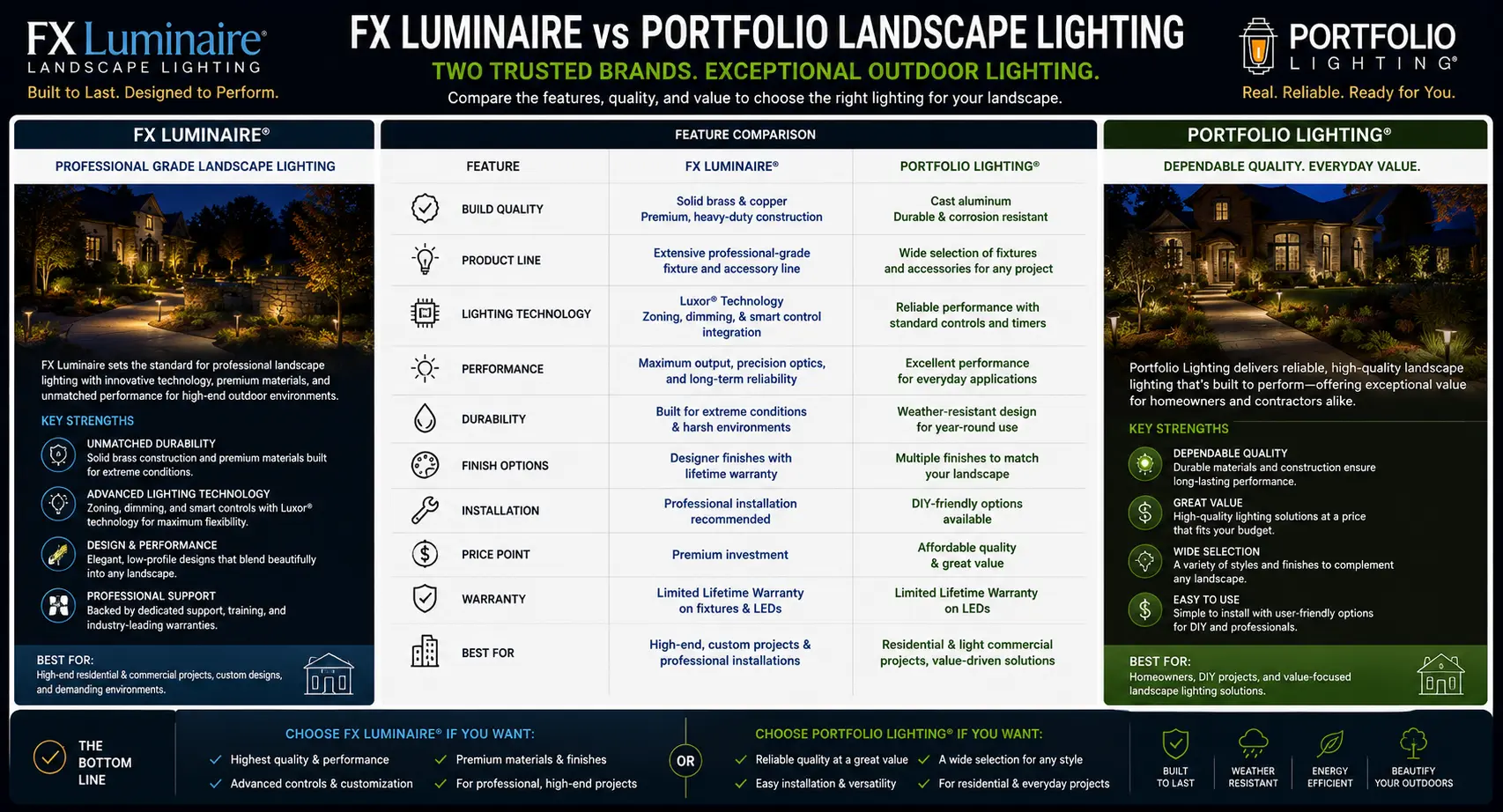
Quick Verdict: Which Brand Belongs in Your Yard
Before the deep comparison, here is the decision framework most buyers need. Both brands output 12V AC and connect to the same standard landscape lighting wire and transformers. The difference is almost entirely in three areas: material durability, smart control capability, and price.
- Permanent installation: You are lighting a property you plan to own for 15 to 30+ years and want fixtures that will still be functional and repairable in 2045.
- Coastal or harsh environment: Saltwater air, heavy humidity, or freeze-thaw conditions that destroy zinc and aluminum fixtures within 3 to 5 years.
- Smart control desired: You want per-fixture dimming, multi-zone scheduling, or color-changing capability through the Luxor ZD or ZDC system.
- High-visibility installation: Front-of-home or entertaining areas where fixture quality and finish will be noticed and compared over decades.
- Landscape contractor spec: You want professional-grade fixtures that can be serviced, have module replacement kits, and carry a real 10-year warranty.
- Budget-constrained install: The priority was getting functional landscape lighting at the lowest possible upfront cost — $15 to $45 per fixture vs $100 to $200+.
- Short-horizon property: Rental properties, homes with a 5 to 10 year ownership horizon, or installation where the buyer did not want to invest in permanence.
- DIY without contractor: Portfolio was available at Lowe's without a trade account or contractor relationship. FX is primarily sold through professional distribution channels.
- Inland, mild environment: Conditions where aluminum and zinc fixtures have adequate service life without brass or copper corrosion resistance.
- Simple system — no smart control: Standard timer on/off control with no need for zoning, dimming, or color capability.
Portfolio is discontinued. For current-production alternatives at similar price points see the best replacement guide and the alternatives overview.
Brand Origins and Market Position
Understanding where each brand comes from explains why they are positioned the way they are — and why the comparison is not really between two competing equals. They were never trying to serve the same customer.
The fundamental asymmetry in this comparison is that Portfolio was never designed to compete with FX Luminaire. Portfolio was designed to serve DIY homeowners who needed functional landscape lighting at Home Depot-comparable price points. FX Luminaire was designed to serve landscape contractors who install systems on $500,000 properties where the client expects the lights to still look identical in 25 years. These are categorically different design briefs, which is why the materials, warranties, and control systems are so different — they were optimized for different customer requirements, not for different price points of the same requirement.
Master Comparison: FX Luminaire vs Portfolio — Every Dimension
| Category | 🌿 FX Luminaire | 🏠 Portfolio (Lowe's) |
|---|---|---|
| Primary fixture materials | Solid brass, copper, stainless steel (Premium Level); aluminum with midgrade brass (Plus Level); aluminum and zinc (Base Level) FX Wins | Zinc alloy, aluminum, and composite plastic (most models); some mid-range models use zinc/aluminum blend |
| Fixture warranty | Limited lifetime warranty on most brass and copper fixtures; 10-year on Designer Series and LED modules; 5-year on Standard Series LED lamps FX Wins | 1-year standard (Lowe's return window era); no current OEM warranty — Portfolio is discontinued Discontinued |
| LED module repairability | Replacement LED boards (ZD and ZDC kits), MR16 LED lamps, G4 replacement lamps available — fixtures are designed to be serviced FX Wins | Integrated LED modules in most current-era fixtures not designed for replacement; some older halogen-socket models accept bulb replacement |
| Smart control capability | Luxor ZD: per-fixture zoning and dimming (1–100%); Luxor ZDC: + 30,000 RGBW colors; astronomical timer; scene programming — all over two-wire standard landscape cable FX Wins | None — standard digital timer and photocell only; no zoning, dimming, or color capability |
| Transformer ecosystem | FX PotenzaX (stainless housing, multi-tap); Luxor ZD transformer; Luxor ZDC transformer — all 12V AC; also compatible with any 12V transformer for standard operation FX Wins | Portfolio SL-series (120W, 200W, 300W); LTF-series magnetic-core (older); EE-series — all 12V AC Discontinued |
| Color temperature options | 2700K, 3000K, 3900K lamp options; color filter kits (Amber, Green, Blue); full RGBW spectrum via ZDC FX Wins | Fixed color temperature per fixture — 2700K or 3000K typical; no filters or adjustment |
| Beam angle options | 10° spot to 60° flood across Evo and NP series; specialty lenses for beam adjustment; ZDC LED board field-replaceable FX Wins | Fixed beam angle per fixture — no adjustment; limited range of beam angles across product line |
| Finishes available | 9+ finish options per fixture including bronze, copper, natural brass, antique bronze, flat black, stainless — aesthetic choices outlast trends FX Wins | Black, bronze, antique brass, white — limited by retail channel SKU constraints |
| Installation channel | Professional irrigation/lighting distributors; landscape contractor accounts; some retail through specialty dealers | Lowe's retail stores and Lowes.com (exclusive) — discontinued; no current active retail channel Discontinued |
| Compatible with 12V AC systems | Yes — all FX standard fixtures: 10–15V AC input; Luxor features require Luxor transformer Both compatible | Yes — all Portfolio landscape fixtures: 12V AC Both compatible |
| Connector format | Standard 12/14 AWG landscape cable; screw terminal connections at transformer; compatible with standard connector hardware | Standard 3-prong quick-connect format; compatible with most consumer landscape lighting connector hardware |
| Typical 20-year ownership cost (10 fixtures) | Higher upfront ($600–$2,000 depending on series) + near-zero maintenance — fixtures serviceable and repairable Lower long-term | Lower upfront ($150–$450) + higher maintenance — fixtures typically replaced every 5–8 years in typical outdoor conditions |
Material Construction: The Real Reason FX Luminaire Costs More
The price difference between FX Luminaire and Portfolio fixtures is not primarily a marketing premium — it is a direct reflection of material cost and manufacturing process. Solid brass costs approximately 4 to 6 times as much as zinc alloy by weight. Copper costs even more. The fixtures that cost $165 wholesale cost that partly because the material in them costs that much before any machining, finishing, or assembly.
FX Luminaire Material Tiers (From Official Product Documentation)
Portfolio Material Construction
Portfolio landscape fixtures used zinc alloy die-casting for the fixture housing in most path lights and spotlights, with plastic or composite diffusers and acrylic globes. Zinc alloy is significantly cheaper to source and cast than brass but has materially different long-term corrosion behavior. In low-humidity inland environments, zinc alloy outdoor fixtures can last 8 to 15 years before significant corrosion becomes visible. In coastal environments, brackish air, or high-humidity regions, zinc alloy fixtures may show surface corrosion and structural failure within 3 to 5 years. Portfolio transformers used steel or aluminum housings — the older LTF-series magnetic-core transformers used a potted design that provides reasonable weather resistance but degraded insulation over time.
Why Material Matters More Than It Appears
The materials question is not just about appearance — it determines whether the fixture can be serviced rather than replaced. A brass fixture that develops a stuck screw can be drilled out and re-tapped because the brass is both soft enough to work and strong enough to hold new threads. A zinc-cast fixture with a frozen screw often fractures at the housing when forced, requiring full fixture replacement. This is why FX Luminaire publishes replacement LED board kits and lamp replacement procedures — the fixtures are expected to outlive multiple lamp generations. The service life math for brass and copper fixtures in professional installations routinely extends to 25 to 30 years. For Portfolio zinc fixtures in similar outdoor conditions, 8 to 12 years was more typical. For the material durability dimension in detail, see the durable landscape lighting materials guide.
Luxor Smart Control: ZD vs ZDC — What They Actually Do
Luxor is the feature that most distinguishes FX Luminaire from every other landscape lighting brand at any price point — including premium competitors. Understanding the distinction between ZD (Zone/Dim) and ZDC (Zone/Dim/Color) determines whether the Luxor system is worth adding to an FX installation, and whether ZDC's color capability is a useful feature or an expensive one you will never use.
How Luxor Works — The Technical Foundation
The Luxor system communicates with compatible fixtures using a digital signal sent over the same two-wire landscape cable that carries power. No additional control wiring is required. The transformer's Luxor controller sends commands to each fixture's ZD or ZDC LED board, which interprets the signal and adjusts output accordingly. This means a Luxor ZD installation is wired identically to a standard landscape lighting installation — the smart control capability is embedded in the fixture's LED board, not in additional wiring. Up to 250 independently controllable zones can be configured in a single Luxor system, with each zone able to follow its own brightness curve throughout the night using event-based scheduling.
- On or off — no dimming capability
- One brightness level per circuit
- Timer or photocell controlled at transformer level
- Works with any 12V AC transformer (including Portfolio, Hampton Bay, Malibu)
- Most affordable FX option
- Color temperature: fixed per fixture
- Color: fixed per fixture (includes optional filter kit)
- Per-fixture and per-group zone assignment — up to 250 zones
- Dimming from 1% to 100% per zone
- Event-based scheduling: zones change brightness at different times throughout the night
- Example: front-yard path lights at 70% until midnight, then 30% until dawn
- Astronomical timer — calculates local sunset/sunrise by GPS location
- Requires Luxor ZD transformer — not compatible with standard transformers
- Two-wire installation — no additional control wiring
- No color-changing capability
- All ZD capabilities plus full RGBW color control
- 30,000 available colors via RGBW LED mixing
- Color scenes: different zones at different colors simultaneously
- Seasonal color themes: green for St. Patrick's Day, red/white/blue for July 4th, etc.
- Color temperature shift: warm white to cool white to colored per event
- Requires Luxor ZDC transformer and ZDC-equipped fixtures
- Two-wire installation — same as ZD, no additional wiring
- Highest-cost FX Luminaire tier
Is Luxor ZDC Worth the Premium?
ZDC's color-changing capability is genuinely useful for two distinct use cases: properties where seasonal holiday lighting themes are a priority (color can replace or augment physical holiday decorations), and entertainment-focused outdoor spaces where lighting mood changes for events. For standard landscape lighting where the goal is consistent, attractive illumination of plantings and architecture, ZD's zoning and dimming capability is far more useful than ZDC's color. The ability to dim path lights after midnight, run different zones at different brightness levels, and schedule brightness transitions throughout the night adds real quality to the lighting experience. Adding RGBW color to standard landscape uplighting is less transformative for most homeowners.
FX Luminaire Product Series: Which One Matches Your Project
FX Luminaire's 400+ product catalog is organized into identifiable series. Knowing the series names and their target applications eliminates the confusion of browsing 400 products. This is the map contractors use when specifying FX systems.
| Series / Model | Type | Material | Best For | ZD/ZDC Compatible |
|---|---|---|---|---|
| Evo | Up light (flagship) | Cast brass | Tree uplighting, architectural facades, specimen plants — 10° to 60° beam options | Yes — full ZDC |
| RC | Up light (compact) | Brass, copper, bronze | Tight planting beds, concealed uplighting — smaller housing than Evo | Yes |
| LC | Up light (value) | Aluminum/brass | Budget-conscious residential — standard MR16 LED lamps for easy bulb replacement | Standard version; ZD available |
| NP | Up light (6-LED) | Brass / aluminum | Compact professional-grade uplighting with multi-LED output | Yes |
| FB / PB1 | Up light (compact) | Brass, aluminum | Small landscapes, wall-wash accent, tight spaces | Yes |
| DM (DelMare) | Path light | Copper, brass | Mid-sized landscapes; signature FX path light — modular top assembly, replaceable | Yes |
| HC | Path light | Copper, bronze | Hat-style cap — compact, low-profile — modeled on DM, smaller scale | Yes |
| CA | Path light | Copper, brass | Bauhaus-inspired minimalist design — clean architectural appearance | Yes |
| JS | Path light | Copper, antique bronze | Mid-sized landscapes — wider path illumination | Yes |
| SC / SP | Path light | Copper, zinc/aluminum | Simple, chic, compact — budget entry into FX path light ecosystem | Yes (ZD) |
| PL / M-PL | Path/spread light | Aluminum | Wider angle path illumination; contemporary aluminum aesthetic | Yes |
| C-PL (CPL7) | Path light | Midgrade brass | Compact coastal-ready design; 2700K LED output | Standard |
| XN-70 / Terra TN-60 / TG-60 | In-grade / well light | Solid brass | Drive-over rated in-grade fixtures; 360° rotation; IP66/67/68; high-traffic areas | Yes — full ZDC |
| FC / HP-48 | In-grade | Brass, aluminum | Paver lighting, driveway edge, hardscape integration | ZDC available |
| MP (MetalloPesante) | Up light (compact) | Zinc/aluminum alloy | Value compact uplight — GU4/MR-11 socket, standard lamp replacement | Standard lamp version |
| JB / LE-1LED | Down light | Cast aluminum | Tree-mounted or structure-mounted downlighting — moonlighting effect | Yes |
| LP (underwater) | Underwater | Brass | Pond, fountain, or water feature illumination — ZDC color for water effects | Yes — ZDC |
| PotenzaX PX300TSS / PX300SS | Transformer | Stainless steel housing | 300W commercial-grade multi-tap transformer with integrated timer | Standard (non-Luxor) |
20-Year Total Cost of Ownership Calculator
The per-fixture price is not the right number to compare. The 20-year total cost — including fixture replacement cycles, bulb replacement, and labor — often tells a different story. Enter your installation details to compare FX Luminaire vs Portfolio-equivalent over time.
Using FX Luminaire Fixtures on an Existing Portfolio Landscape System
One of the most practical questions for homeowners transitioning from a Portfolio system to FX Luminaire is whether their existing wire runs, connectors, and transformer are usable. The answer is mostly yes — with one important qualification.
Standard FX Fixtures: Fully Compatible With Portfolio Wire and Transformers
All FX Luminaire standard (non-ZD) fixtures operate on 10 to 15V AC — the same range as all Portfolio, Hampton Bay, and Malibu landscape lighting systems. You can connect FX standard fixtures directly to an existing Portfolio wire run and transformer without any modification. The output voltage, wire gauge compatibility, and connection approach are identical. An FX DM path light connected to a Portfolio SL-200-12 transformer using existing buried 14AWG wire will operate exactly as specified.
The connection method at the fixture differs slightly — FX fixtures use a 10-foot lead wire that connects to the main wire run via standard gel-filled splice connectors or the homeowner's preferred connection method. Portfolio's 3-prong quick-connect clips also work at the fixture connection point as long as they are rated for the wire gauge in use.
Luxor ZD and ZDC Features: Require Luxor Transformer
The Luxor smart control features — zoning, dimming, and color — require a Luxor-specific transformer that outputs the ZD control signal over the power wire. An existing Portfolio SL-series transformer will power ZD-capable FX fixtures normally, but the ZD features will not activate without the Luxor transformer's control signal. The fixtures will simply turn on at full brightness with standard timer control — they default to standard operation in the absence of a Luxor control signal. Upgrading to Luxor ZD control requires only replacing the transformer; the wire runs and fixtures remain in place.
Phased Transition Strategy
The most cost-effective way to transition from a Portfolio system to FX Luminaire is phased: connect ZD-capable FX fixtures to the existing Portfolio transformer now, then replace the transformer with a Luxor unit when the budget allows. The fixtures will operate normally in the interim and activate full Luxor functionality when the transformer is upgraded. This avoids the need to replace the entire system at once. See the Portfolio transformer alternatives guide for the current-production transformer options that can replace the Portfolio SL-series, and the transformer replacement guide for the installation procedure.
Who Should Choose Each Brand: The Honest Decision Guide
Choose FX Luminaire Standard Series If:
- You want significantly better fixture quality and warranty than consumer brands but do not need smart control. The Standard Series at the Plus or Premium level delivers brass or midgrade brass construction with a 10-year fixture warranty at a price point closer to the high end of consumer brands.
- You are replacing a failed Portfolio system and want fixtures that will not need replacing again in your ownership of the property.
- You have a landscape contractor doing the installation who has access to FX distribution pricing.
Choose FX Luminaire with Luxor ZD If:
- You want per-zone scheduling and dimming — particularly the ability to reduce brightness after midnight or create different brightness levels for different fixture groups without additional wiring.
- You have a multi-zone system (front yard / back yard / entertainment area) that would benefit from independent control of each zone.
- Energy efficiency and lamp life extension through dimming are priorities — Luxor ZD systems running at reduced brightness after midnight save meaningful energy and extend LED board life.
Choose FX Luminaire with Luxor ZDC If:
- Color-changing capability for seasonal holiday themes is genuinely important to you. This is the specific use case that justifies ZDC's premium over ZD.
- You have an entertainment-focused outdoor space where lighting mood changes for events and parties will actually be used.
- You are specifying a high-budget landscape installation where ZDC's capabilities are part of the design brief.
The Portfolio Replacement Decision
Portfolio is discontinued — there is no new-production Portfolio option. The decision for a homeowner with an existing Portfolio system is between: (1) repairing the existing system with compatible parts and secondary market fixtures, (2) replacing with a comparable consumer brand at similar price points, or (3) upgrading to a professional-grade system like FX Luminaire. The repair and compatible-replacement paths are covered in the discontinued Portfolio guide and the best replacement guide. The comparable consumer alternatives to Portfolio include Malibu, Hampton Bay, and Paradise — covered in the brand comparison guide.
The landscape contractor perspective from professional forums is consistent: the FX vs consumer brand decision is primarily a client-expectation conversation, not a quality debate. For a client spending $20,000 on landscape installation, specifying $45 consumer fixtures is a warranty and durability mismatch — the installer gets called back in 5 years when the lights start corroding. For a DIY homeowner installing their own system with a $500 budget, FX Luminaire is simply not accessible — both in price and in distribution channel. The brands serve genuinely different markets, and the friction in this comparison exists when buyers from one market try to evaluate options from the other.
FX Luminaire vs Portfolio FAQ
Is FX Luminaire worth the price compared to Portfolio landscape lighting?
For permanent installations where the fixtures are expected to last 20 to 30 years, yes — decisively. A brass FX Luminaire fixture that costs $120 to $165 wholesale will still be functional, repairable, and visually attractive in 25 years. A Portfolio zinc alloy fixture that cost $25 at Lowe's will typically require replacement within 5 to 10 years in outdoor conditions. Over a 20-year ownership window on a 12-fixture system, the 20-year total cost calculator on this page consistently shows the FX system within $500 to $800 of a consumer alternative system that has been replaced twice — before accounting for the value of Luxor smart control or the cost of two replacement installation events.
Can FX Luminaire fixtures work on an existing Portfolio system?
Yes — standard FX Luminaire fixtures run on 10 to 15V AC and are fully compatible with any Portfolio, Hampton Bay, or Malibu 12V AC transformer. Connect FX fixtures to existing Portfolio wire runs without modification. ZD and ZDC smart control features require a Luxor transformer specifically — standard Portfolio transformers will power ZD-capable fixtures normally but the smart control features will not activate. See the compatibility section above for the phased transition strategy that allows adding ZD fixtures now and upgrading the transformer later.
What is the difference between FX Luminaire ZD and ZDC?
ZD provides zone control and dimming (1% to 100%) per fixture or per group, with event-based scheduling that allows brightness to change throughout the night on a per-zone basis. ZDC adds RGBW color capability — 30,000 colors — to all ZD features. Both use a standard two-wire landscape cable installation with no additional control wiring. The Luxor controller communicates with ZD and ZDC LED boards through the same wires that carry power, which is what makes the installation identical to standard landscape lighting wiring despite the smart control capability.
Where can I buy FX Luminaire fixtures?
FX Luminaire is distributed primarily through professional irrigation and landscape lighting distributors — companies that serve landscape contractors rather than retail consumers. Sprinkler supply houses, irrigation wholesale distributors, and specialty landscape lighting dealers carry FX Luminaire. Some products are available through specialty online retailers. FX Luminaire is not sold through Home Depot, Lowe's, or general hardware retailers. Homeowners wanting FX fixtures typically need either a contractor relationship or an account with a specialty dealer. For contractor-wholesale pricing, a trade account is required.
What FX Luminaire series is closest to a Portfolio path light in function?
The FX SP, SC, or HC path lights in the Standard Series most closely parallel the Portfolio path light in function and scale. The SP-A is the most budget-accessible entry point in the FX path light line. The DM (DelMare) in copper or bronze is the closest FX equivalent to a traditional Portfolio path light in visual style, but at a significantly higher price point with substantially better construction. All of these accept standard 12V AC and can be connected to any existing Portfolio wire run and transformer.
What is the best alternative to Portfolio at a similar price point?
At the $15 to $45 per-fixture price point that Portfolio occupied, the current-production alternatives are Malibu (Intermatic), Hampton Bay (Home Depot), and Paradise. These share similar construction — zinc alloy, aluminum, composite — and similar service life expectations. For a meaningful step up in quality without reaching FX Luminaire's price point, Volt Lighting offers brass construction at approximately $50 to $80 per fixture with better warranty support than the big-box brands. The Volt vs Portfolio comparison, the full brand comparison guide, and the best replacement guide cover the complete current-production alternative landscape.
Related Brand Comparisons and Alternative Guides
- Portfolio Lighting Alternatives Hub
- Volt vs Portfolio Comparison
- Full Brand Comparison Guide
- Best Replacements for Portfolio
- Hampton Bay Transformer Guide
- Malibu Top 40 Model Library
- Paradise Lighting Transformer Guide
- Moonrays Replacement Parts
- Discontinued Portfolio Lighting Hub
- Portfolio Transformer Alternatives
- How to Replace a Transformer
- Voltage Drop Guide
- Landscape Lighting Connectors
- Brand Connector Compatibility
- Durable Materials Guide
- Dark Sky Fixture Selection
- Landscape Lighting Design Guide
- Landscape Lighting Cost Guide
- Landscape Lighting Maintenance
- Portfolio Landscape Lighting Hub
- Portfolio Model Number Lookup
- AI Outdoor Lighting Systems
- Smart Outdoor Controls Guide
- Complete Lighting Guide