
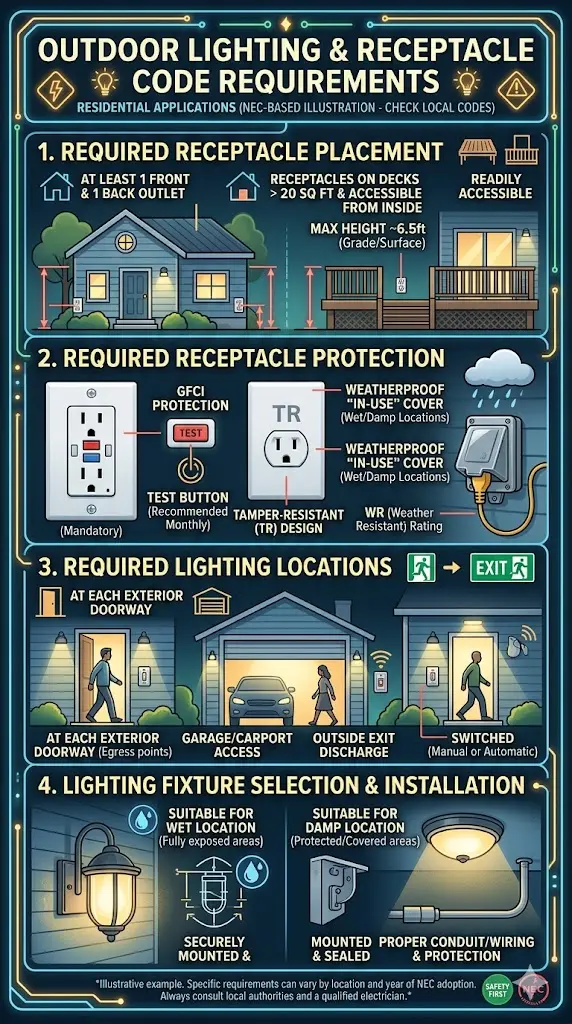
Quick Answer: What an Outdoor Lighting Receptacle Usually Needs
For residential outdoor lighting, the safe default is this: the receptacle powering the lighting equipment should be a properly grounded, weather-resistant exterior receptacle, GFCI protected, installed in a box listed for the location, covered with the correct weatherproof cover for whether a plug remains inserted, and positioned so the cord does not become permanent wiring or a water channel.
| Requirement | What It Means in the Field | Common Failure |
|---|---|---|
| GFCI protection | Outdoor receptacle is protected by a GFCI receptacle or upstream GFCI breaker/device. | Outlet works, but the test/reset protection is absent or hidden and undocumented. |
| Weather-resistant device | Receptacle body is marked WR or otherwise listed for outdoor exposure. | Indoor receptacle installed under an exterior bubble cover. |
| Correct cover | While-in-use cover when a transformer or lighting cord stays plugged in. | Flat flap cover held open by the cord. |
| Listed box and gasket | Exterior-rated box, intact gasket, correct cover orientation, no cracked caulk-dependent seal. | Cover is present but gasket is crushed, missing, or installed upside down. |
| Cord not used as wiring | Factory cord reaches the receptacle without burial, concealment, staples, mulch cover, or extension-cord permanence. | Extension cord runs behind shrubs all season to reach the transformer. |
| Location-specific clearance | Pool, spa, hot tub, fountain, and outdoor kitchen areas trigger extra rules. | General patio outlet used to feed equipment inside a special hazard zone. |
That table is the reason this page exists. Generic receptacle articles usually stop at “use GFCI outdoors.” Outdoor lighting systems fail in the gray zone between the outlet and the light: the plug is left in permanently, the cover was designed only for a closed flap, the transformer cord slopes into the box, the outlet is behind wet landscaping, or the receptacle is convenient but not acceptable for the hazard area.
The Outdoor Lighting Receptacle Compliance Map
Before you quote, install, troubleshoot, or inspect an outdoor lighting system, classify the receptacle by what it powers. The same-looking 15-amp outdoor outlet can mean different risks depending on the lighting use.
| Lighting Use | Typical Power Source | Field Risk Nobody Notices | Best Compliance Habit |
|---|---|---|---|
| Low-voltage landscape lighting transformer | Plug-in exterior receptacle | Transformer is listed, but the receptacle is not GFCI protected or the cover cannot close over the plug. | Photograph GFCI test, WR marking if visible, cover type, and transformer mounting. |
| Plug-in string lights or patio lights | Exterior wall receptacle | Flat cover is left open for months, turning a damp-rated cover into a wet-entry funnel. | Use an in-use cover and a cord path with a drip loop below the box. |
| Holiday lighting controller | Garage or exterior receptacle | Load is split through cube taps, timers, and light strings that hide total connected wattage. | Map each plug chain; never bury multi-taps in mulch or snow. |
| Pond, fountain, or waterfall lighting | Outdoor receptacle near water feature | Installer treats it like landscape lighting, but water-feature rules and equipment listing matter. | Cross-check with the waterfall lighting code guide and local inspection rules. |
| Outdoor kitchen lighting | Counter-area or appliance-area receptacle/circuit | Lighting is tapped from a convenience outlet without considering wet, heat, appliance, and counter rules. | Review outdoor kitchen lighting clearance requirements before wiring. |
| Pool or hot tub accent lighting | Nearby exterior receptacle or controller | Distance and bonding zones override normal patio assumptions. | Use the pool lighting clearance guide before selecting the outlet. |
The inspection shortcut is to ask one question: “Could this outlet safely remain in this exact plugged-in condition during a sideways rain?” If the honest answer is no, the problem is usually not the light. It is the receptacle-cover-cord geometry.
GFCI Protection: The Outdoor Lighting Nuisance Trip Decoder
Outdoor receptacle GFCI protection is not just a paperwork requirement. It is the diagnostic boundary between an acceptable trip and a dangerous installation. A GFCI that trips repeatedly is often doing exactly what it was designed to do: detecting leakage current caused by moisture, damaged insulation, compromised plug ends, or water inside equipment.
Three Ways Outdoor Lighting Receptacles Are Usually GFCI Protected
- GFCI receptacle at the outdoor outlet. The easiest to verify because test/reset buttons are visible. Downstream outlets may also be protected from this device.
- GFCI breaker in the panel. Common in newer work or when multiple exterior outlets are protected together. The receptacle itself may look normal, so labeling matters.
- Upstream GFCI receptacle indoors, in the garage, or elsewhere. This is the one homeowners miss. An exterior lighting outlet may be dead because a garage GFCI tripped behind stored boxes.
The “Lights Trip the GFCI” Decision Tree
Weather-Resistant Receptacles and Covers: The Part Most People Mix Up
A weather-resistant receptacle, an outdoor box, and a weatherproof cover are three different layers. Passing inspection usually requires the correct combination, not just one of them.
The Four-Layer Outdoor Outlet Stack
| Layer | Purpose | What to Look For | Failure Pattern |
|---|---|---|---|
| Box | Houses the wiring and device | Exterior-rated, secured, proper cable/conduit entry, no open knockouts | Interior box or loose surface box caulked to siding |
| Device | Provides plug connection | Weather-resistant/tamper-resistant where required, properly grounded, not cracked | Old indoor receptacle outdoors under a cover |
| Gasket | Seals between cover and box/wall | Flat, intact, not split, compressed evenly | Gasket cut for siding texture and no longer sealing |
| Cover | Protects the device from rain and spray | In-use bubble cover when equipment remains plugged in | Spring flap cover propped open by transformer cord |
Damp Location vs Wet Location in Plain English
A damp location is protected from direct weather but still exposed to moisture, humidity, or condensation. A wet location is exposed to rain, spray, snow, irrigation, splashing, or similar water contact. Many exterior wall receptacles become wet-location installations in practice because wind-driven rain, sprinklers, snow buildup, hose spray, and patio cleaning all reach the outlet.
Landscape Lighting Transformers Plugged Into Outdoor Receptacles
Plug-in low-voltage transformers are common, legal, and convenient when used as listed. The mistake is treating the transformer cord like wiring. The factory cord is a cord, not a substitute for a properly located receptacle.
Transformer Receptacle Placement Rules That Matter in Real Life
- The receptacle should be close enough that the transformer cord reaches without strain. A stretched cord pulls the plug against the cover, defeats the gasket, and can wick water toward the blades.
- The transformer should mount above grade and according to its instructions. Do not lay a plug-in transformer on mulch, bury it behind shrubs, or let it hang from the cord.
- The receptacle should remain accessible. An outlet behind a locked gate, inside a sealed landscape cabinet, or buried behind a hedge is hard to reset, test, inspect, or disconnect in an emergency.
- The low-voltage cable begins after the transformer, not before it. Do not extend the line-voltage side with an extension cord and then pretend the system is low-voltage.
- The source receptacle should be documented. On complex systems, label which GFCI protects the transformer so a future homeowner is not hunting for a hidden reset button.
The “Cord Becomes Wiring” Red Flag List
| Observed Condition | Why It Fails | Correct Fix |
|---|---|---|
| Extension cord from house to transformer | Temporary cord used as permanent wiring | Install a proper exterior receptacle near the transformer location |
| Cord buried under mulch | Concealed damage, moisture retention, and trip hazard | Relocate receptacle/transformer; expose and protect allowed wiring methods |
| Cord run through wall, window, siding, or deck gap | Cord is acting as building wiring and can be damaged by edges | Install wiring method and receptacle approved for the location |
| Transformer plugged into indoor garage outlet with cord routed outside | Penetration, door pinch, and non-weatherproof cord path | Use exterior GFCI-protected receptacle and listed outdoor equipment |
| Timer/controller hanging from plug | Weight pulls plug loose and opens cover seal | Support controller, use proper in-use cover, or choose hardwired/listed control solution |
For transformer mounting and low-voltage layout details, pair this page with the outdoor transformer mounting code guide, low-voltage system diagram, and Portfolio landscape lighting installation guide.
Drip Loops, Cord Caps, and the Water Path Nobody Draws
Outdoor lighting failures often follow gravity. Water does not need to flood the box to cause trouble. It only needs a conductive path across plug blades, into the receptacle face, or along a wet cord jacket.
The Drip-Loop Test
Stand in front of the plugged-in outlet and trace the cord with your finger. The cord should drop below the receptacle before it enters the cover or plug face, so water running down the cord falls off at the low point instead of migrating into the receptacle. If the cord slopes downward into the cover, the installation is inviting water into the device.
Four Moisture Patterns That Cause Repeated Trips
- Capillary cord entry: A cord jacket pressed against the cover edge carries a small film of water into the cover.
- Sprinkler cycling: Morning irrigation wets the receptacle, then the GFCI trips when the transformer turns on at dusk because moisture remains inside.
- Mulch humidity trap: A low receptacle behind mulch stays damp long after rain ends, especially on shaded north walls.
- Freeze-thaw cover lift: Snow melt enters a cover, freezes, slightly lifts the cover, then the next melt event reaches the device.
When a homeowner says “the lights only trip after rain,” photograph the plug before touching anything. The cord angle, cover style, and drip pattern often tell you more than the transformer label. A dry transformer plugged into a wet receptacle will look like a transformer problem unless you inspect the source first.
Special Hazard Zones: Pools, Hot Tubs, Waterfalls, and Outdoor Kitchens
Do not apply ordinary patio-outlet assumptions to outdoor lighting near water features, cooking appliances, counters, gas lines, or permanent wet zones. These areas can trigger additional clearance, bonding, equipment, and listing requirements.
| Area | Why It Changes the Receptacle Answer | Use This Companion Guide |
|---|---|---|
| Swimming pool perimeter | Receptacle distance, bonding, transformer/listing, and luminaire rules become more restrictive. | Swimming pool lighting clearance code |
| Hot tub or spa area | People are wet, grounded, and close to energized equipment; ordinary convenience outlet placement may be unacceptable. | Outdoor lighting around hot tubs |
| Waterfall or fountain lighting | Submersible equipment, wet niches, pumps, and low-voltage systems create combined water/electrical review. | Waterfall lighting code requirements |
| Outdoor kitchen | Lighting, countertop receptacles, appliances, heat, wet location, and gas-line proximity overlap. | Outdoor kitchen lighting NEC 210 guide |
| Buried lighting feeder path | Line-voltage receptacle relocation or underground supply requires burial depth, conduit, and splice rules. | Wire burial depth code |
Outdoor Lighting Receptacle Inspection Checklist
Use this before installing a transformer, before calling for final inspection, or before diagnosing a lighting system that trips after rain. It is designed to catch the problems that are invisible in a normal product manual.
For formal inspection prep, use this with the electrical inspector landscape lighting checklist, outdoor lighting final inspection checklist, and common code violations guide.
Outdoor Lighting Receptacle Code FAQ
Do outdoor lighting receptacles need GFCI protection?
Yes for normal residential exterior receptacle use. If the receptacle feeds a landscape transformer, plug-in patio light, holiday controller, or outdoor lighting accessory, treat GFCI protection as mandatory unless your local code official gives a specific exception.
Can I plug a landscape lighting transformer into a garage receptacle and run the cord outside?
That is a common failure pattern. A cord routed through a door, window, wall opening, or siding gap is acting as permanent wiring and can be pinched or weather-damaged. The better correction is a properly installed exterior GFCI-protected receptacle near the transformer location.
Is a bubble cover required if the transformer is always plugged in?
Use the cover that protects the receptacle while the plug is inserted. In most outdoor lighting installations where the transformer or controller remains plugged in, that means a weatherproof while-in-use cover rather than a flat flap cover.
Why does my outdoor lighting GFCI trip after sprinklers run?
The most likely causes are spray entering the cover, a missing drip loop, water pooling in the plug face, a wet transformer cord cap, moisture inside a fixture/splice, or a receptacle box/gasket that no longer seals. Start at the receptacle before blaming the transformer.
Can I use an extension cord for outdoor lights all season?
Temporary outdoor-rated extension cords are not a substitute for permanent wiring. If the lighting is seasonal, keep the cord temporary, visible, undamaged, properly rated, and removed after use. If the lighting is permanent, install a proper receptacle or hardwired system.
Related Outdoor Lighting Code Guides
- Landscape Lighting Electrical Code Safety Guide
- AFCI and GFCI Code Requirements
- Outdoor Lighting Wet Location Listing Requirements
- Outdoor Lighting Junction Box Requirements
- Outdoor Transformer Mounting Code Requirements
- Low-Voltage Lighting Permit Requirements
- Landscape Lighting Wire Burial Depth Code
- Common Landscape Lighting Code Violations
- Outdoor Lighting Final Inspection Checklist
- Electrical Inspector Landscape Lighting Checklist
- Landscape Lighting Keeps Tripping GFCI
- How to Test a Landscape Lighting Transformer
- Portfolio Landscape Lighting Installation
- Low-Voltage Landscape Lighting System Diagram
- Outdoor Kitchen Lighting Clearance NEC 210
- Swimming Pool Lighting Clearance Code NEC 680