
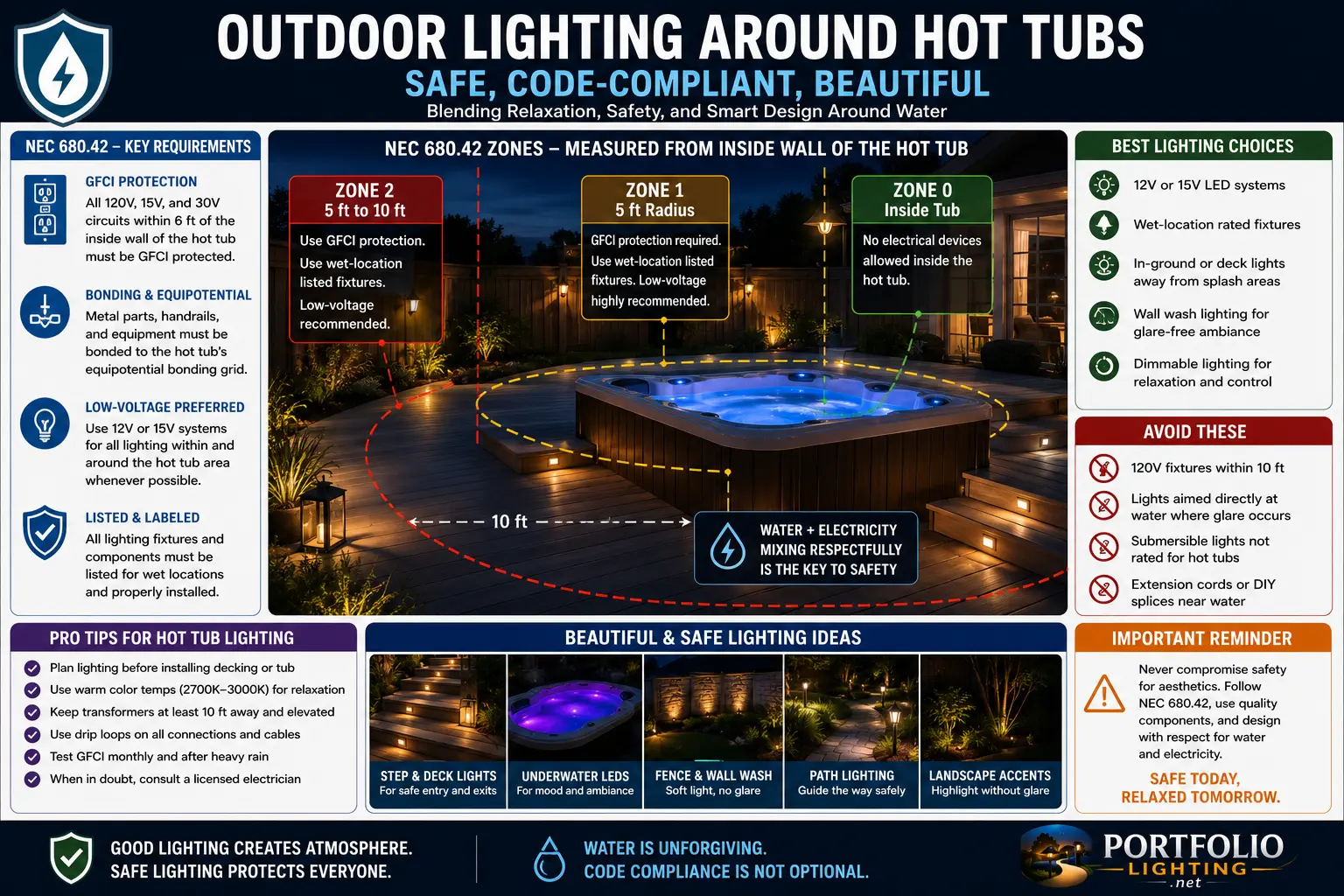
Quick Answer: How to Light Around a Hot Tub Safely
Outdoor lighting around a hot tub should be indirect, low-glare, warm, code-aware and positioned so people can enter and exit safely without placing questionable electrical equipment near water. The best design usually uses shielded step lights, low path lights outside the splash zone, warm wall grazing, privacy-friendly fence lighting and smart dimming scenes instead of bright floodlights aimed at the tub.
The key is to treat the hot tub as a wet-use human zone, not just a patio feature. Bare feet, wet skin, steam, reflected light, privacy concerns, nearby GFCI devices, wet-location ratings and slippery steps all change the lighting plan. A fixture that works fine on a dry patio can be uncomfortable, unsafe or code-problematic when placed near spa water.
Logic Summary: Hot Tub Lighting Has Four Jobs
Most patio lighting is judged by appearance. Hot tub lighting has four simultaneous jobs: safe movement, low-glare comfort, privacy control and electrical risk reduction. If one of those jobs fails, the space can feel bright but unsafe, decorative but annoying, private but hard to navigate, or relaxing but electrically questionable.
Safe movement means the entry path, step edge, robe hook area, towel location, control panel and exit route are visible without shining light into the eyes of someone sitting in the tub. Low-glare comfort means no bare LED chips, bright floodlights or mirror-like water reflections. Privacy control means lighting should not silhouette bathers to neighbors or create a glowing stage effect. Electrical risk reduction means using rated fixtures, protected power, proper enclosures and professional help where water and line voltage are involved.
The strongest design does not add one bright fixture. It layers several low-output fixtures: path reference, step-edge definition, vertical surface glow and a late-night dim scene. That layered approach is safer, calmer and more code-aware than trying to light the entire spa area from one wall pack.
Jump to Section
The Hot Tub Lighting Zone Model
The most useful way to design hot tub lighting is to divide the area into zones. The tub itself is not the only area that needs attention. People approach the tub, remove shoes or sandals, step onto wet surfaces, enter the water, reach for controls, exit while dripping, grab towels, and walk back inside. Each action needs different light.
Zone 1: Water Edge and Entry Point
This is the most sensitive zone. You need enough visibility to see the step, coping, cover lifter, handrail or deck transition, but you do not want bright fixtures shining into eyes from below. Indirect step lighting or low-output shielded path lights are usually better than floodlights.
Zone 2: Walking Path
The path from house to spa should be visible even when the spa scene is dim. Use shielded path lights, recessed step lights or low wall lights. Avoid fixture placement that creates glare at ankle height because wet eyes looking downward are more sensitive to bright points.
Zone 3: Vertical Reference Surfaces
Fence, wall, pergola post and privacy screen lighting helps orientation without overlighting the water. Soft vertical glow often feels more comfortable than trying to light the floor heavily.
Zone 4: Equipment and Service Area
Equipment access needs functional light, but it does not need to run during soaking. Use task lighting that can be switched separately and installed with proper ratings.
Hot Tub Fixture Placement Risk Table
| Fixture Choice | Best Use | Main Risk | Better Design Move |
|---|---|---|---|
| Shielded step lights | Deck steps, platform edges and entry points | Too bright at eye level if aimed outward | Use low-output warm light aimed across the step surface |
| Low path lights | Route from door to spa | Lens visible from waterline | Use capped fixtures outside splash-prone areas |
| Wall sconces | Soft vertical reference on house or privacy wall | Clear glass can create glare and neighbor visibility | Use fully shielded downlight or frosted low-output design |
| String lights | Atmosphere away from water and only when properly rated | Overhead electrical equipment near water | Avoid over-tub runs unless professionally evaluated |
| Floodlights | Temporary service or emergency visibility | Harsh glare on water, privacy loss and overlighting | Replace with layered low-glare lighting |
| In-ground uplights | Accent planting or screen wall behind spa | Beam can hit eyes, windows or steam cloud | Use shields, narrow beams and low output |
Why Glare Is Worse Around Hot Tubs Than Patios
Water changes the glare equation. A hot tub surface reflects bright points, especially when water is moving. Steam can scatter light. Wet decking can create shiny patches. People sitting in the tub are lower than standing adults, so fixtures that seem acceptable from the patio may shine directly into seated eyes.
This is why hot tub lighting should be tested from inside the seating position, not only from the deck. Sit at water height after dark and look toward every fixture. If you see the LED source, reflector, exposed bulb or bright lens, the fixture will likely feel harsher than the wattage suggests.
For glare and light spill design, compare this guide with light trespass laws and property-line foot-candles, fix light trespass, dark-sky compliance versus IDA certification and the dark-sky bedroom light trespass guide.
GFCI, Wet Location and Spa-Area Code Logic
Hot tub areas are electrically sensitive because people are wet, grounded surfaces may be nearby and equipment can be exposed to weather. Lighting around these areas should be approached with the same caution as other water-adjacent outdoor electrical work. Receptacles, equipment circuits, lighting fixtures, junction boxes, switches and controls may all have special requirements depending on location, distance, voltage, listing and local enforcement.
The safest planning method is to separate decorative lighting from spa equipment power. Do not borrow power casually from a spa circuit. Do not hide splices under the tub skirt. Do not place indoor-rated controllers near steam or splash. Do not assume low-voltage fixtures are automatically acceptable just because they are not 120V.
Use the outdoor lighting GFCI requirements guide, outdoor lighting wet-location listing requirements, outdoor lighting junction box requirements and swimming pool lighting clearance code NEC 680 guide as companion code-aware resources.
Outdoor spas and hot tubs already expose lighting systems to elevated moisture levels, but coastal installations face an additional challenge: airborne salt. Fixtures that appear suitable on paper may deteriorate quickly when exposed to corrosive environments. The salt spray exposure compliance guide for coastal lighting explains how environmental conditions influence fixture selection, finish durability, and ongoing maintenance expectations.
Low-Voltage Landscape Lighting Near Hot Tubs
Low-voltage landscape lighting is often the best visual choice near a hot tub because it can provide soft path and plant lighting without harsh glare. But low-voltage still has real installation requirements. Transformers, connectors, cable burial, wet-location fixtures, voltage drop and corrosion still matter.
Keep low-voltage fixtures out of splash-prone abuse zones where possible. Use direct-burial rated connectors in soil, avoid cable routes where spa maintenance panels must be removed, and do not let fixture leads sit where water drains from the tub cover. If a transformer serves both general landscape lights and spa-area lights, make sure late-night dimming or switching does not create confusing dark zones on the exit path.
For deeper low-voltage planning, use Portfolio low-voltage lighting, landscape lighting wire burial depth code, landscape lighting voltage drop, and low-voltage landscape lighting failure points.
Privacy Lighting: Avoid Turning the Hot Tub Into a Stage
A common mistake is lighting the people instead of lighting the space. Bright overhead lights, wall packs and exposed bulbs can silhouette bathers against fences and windows. The more private solution is to illuminate surfaces around the spa: the step, the walkway, the screen wall, the plantings and the towel area.
Warm light aimed downward on a fence or planter can make the space feel enclosed without broadcasting activity to neighbors. Avoid cool white light on steam because it can create a glowing cloud. Avoid strong backlighting behind the tub if neighbors can see the silhouette. Privacy-friendly lighting is low, warm, shielded and layered.
For neighbor and property-line considerations, use outdoor lighting ordinance guide, sustainable outdoor lighting ordinance guide, and dark-sky-friendly fixture selection guide.
Smart Controls and Night Scenes for Hot Tub Lighting
Smart controls work well around hot tubs when they simplify safe scenes instead of adding complexity. A good setup has at least three scenes: entry, soak and service. Entry mode lights the path and steps. Soak mode dims glare and keeps only soft perimeter lighting. Service mode provides brighter task light for cover, chemicals, filters or equipment access.
Motion sensors should be used carefully. A motion light that blasts the spa area during soaking is annoying. A low-output motion cue along the exit path can be helpful. If smart controls include low-voltage control wiring, relays, Class 2 circuits or outdoor controllers, review smart lighting control NEC Article 725 Class 2 guide, smart hub compatibility, Matter and Thread connectivity, and AI security ambient lighting.
Recommended Hot Tub Lighting Layouts
| Layout Type | Best Fixtures | Lighting Goal | Avoid |
|---|---|---|---|
| Deck-mounted hot tub | Step lights, rail lights, shielded path lights | Make level changes visible without glare | Bright overhead floodlights aimed at water |
| Patio slab hot tub | Low wall lights, planter lights, bollards | Define perimeter and towel area | Fixture lenses visible from waterline |
| Privacy screen spa | Warm vertical wall grazing and capped path lights | Create enclosure and orientation | Backlighting people against the screen |
| Pergola hot tub | Indirect post lights, low-output downlights | Soft canopy reference without overhead glare | Unrated string lights directly above water |
| Garden spa path | Warm path lights and shielded plant accents | Safe walk from door to spa | Overlighting plants that reflect into windows |
Common Outdoor Hot Tub Lighting Mistakes
- Using one bright floodlight: it creates glare, privacy loss and harsh reflections.
- Ignoring the seated viewpoint: fixtures must be tested from water height, not just standing height.
- Installing indoor-rated controls outside: steam, splash and condensation can destroy electronics.
- Letting cord ends sit on wet decking: outdoor lighting connections must be protected from water exposure.
- Choosing cool white light: high-CCT light feels harsh and exposes the spa area.
- Overlooking exit safety: the path away from the tub matters more than decorative glow around the tub.
- Assuming low voltage is automatically safe: installation method, transformer, connectors and wet location still matter.
Outdoor Lighting Around Hot Tubs FAQ
What is the safest lighting around a hot tub?
The safest lighting around a hot tub is usually indirect, low-glare lighting placed outside the splash zone, installed with proper wet-location ratings, GFCI protection where required, and no exposed wiring or unlisted fixtures near the water.
Can I put low-voltage landscape lights near a hot tub?
Low-voltage landscape lights may be used around spa areas when they are properly rated, installed safely, kept out of unsafe zones, protected from water exposure and connected through appropriate power equipment. Local code and manufacturer instructions control the final placement.
Should hot tub lighting be bright?
No. Hot tub lighting should usually be soft, warm and indirect. Bright floodlights create glare on water, reduce relaxation, expose privacy and can make wet steps harder to see because of reflection.
What color temperature is best around a hot tub?
Warm light in the 2200K to 2700K range usually feels more relaxing and produces less harsh glare than cool white light. Avoid blue-heavy security-style lighting aimed at the spa or seating area.
Do hot tub lights need GFCI protection?
Many outdoor receptacles, spa equipment circuits and nearby electrical components require GFCI protection. The exact requirement depends on equipment type, location, wiring method and local authority having jurisdiction.
Can string lights go above a hot tub?
String lights above or near hot tubs require extreme caution. They must be listed for the location, installed securely, kept away from water exposure and evaluated for clearance, support, GFCI and manufacturer limitations. Permanent overhead electrical work should be handled by a qualified professional.
Expert-Verified Lighting Guidance
This guide focuses on hot tub lighting layout, glare reduction and safety-aware planning. Local code, spa manufacturer instructions and the authority having jurisdiction control final electrical requirements.