
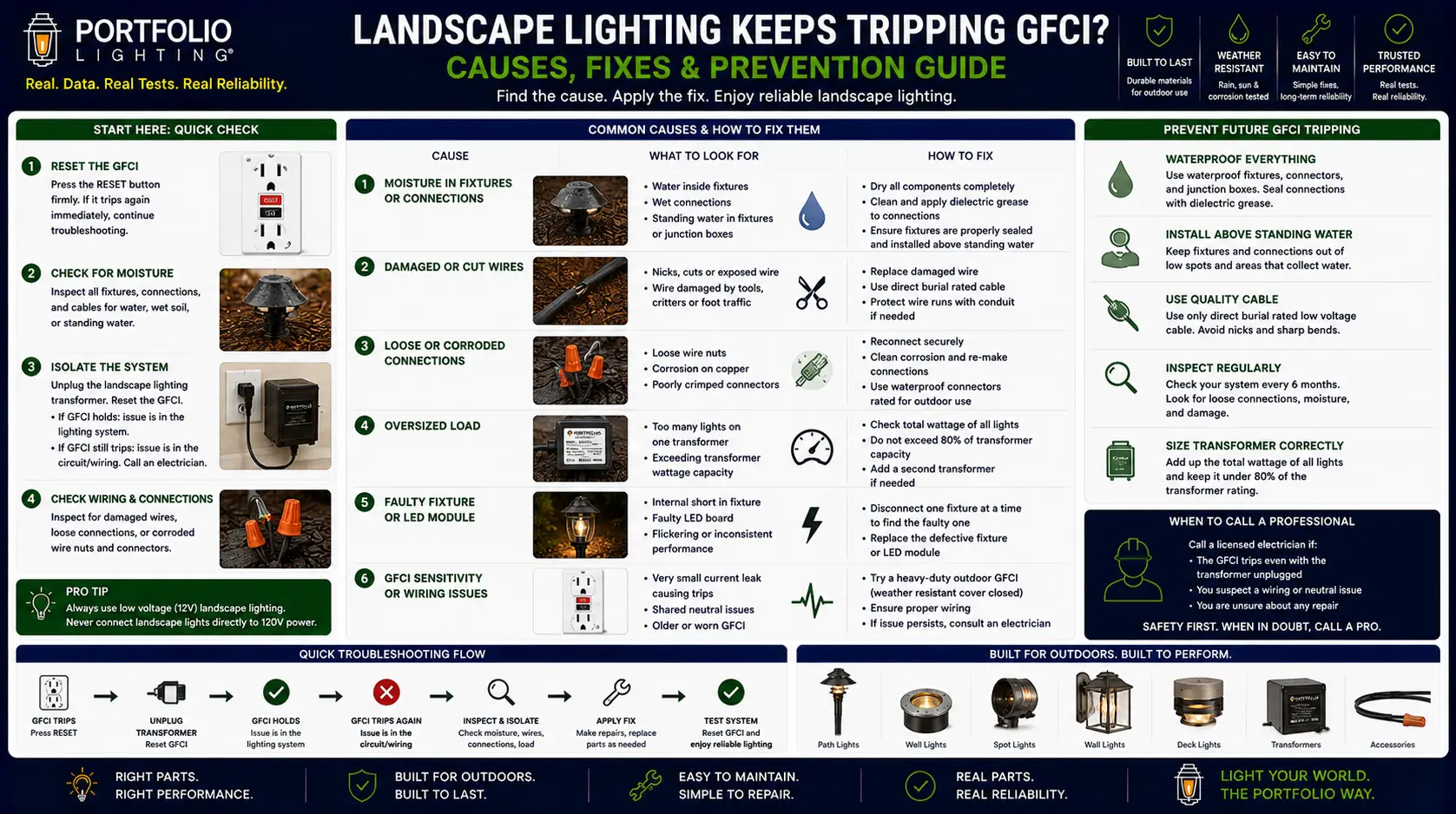
GFCI vs Breaker: Why These Are Completely Different Problems
The single most important thing to understand before diagnosing a GFCI trip is that it has almost nothing to do with the same causes as a breaker trip. If you have read the landscape lights tripping breaker guide or the Portfolio transformer tripping breaker guide, set that knowledge aside for GFCI diagnosis — the mechanisms, causes, and solutions are almost entirely different.
- Triggered by as little as 5 milliamps of unbalanced current
- Detects current flowing through an unintended path to ground
- Can trip even when total load is completely normal and well within capacity
- Most common causes: moisture, damaged wire insulation, failing transformer primary winding, corroded fixture
- Trip mechanism: current imbalance between hot and neutral conductors
- Diagnostic approach: zone isolation, moisture testing, insulation resistance measurement
- Triggered by sustained current exceeding 15,000–20,000 milliamps
- Detects too much total current on the circuit regardless of path
- Caused by too many fixtures, a shorted wire run, or transformer overload
- Most common causes: transformer overload, wire short circuit, overloaded zone
- Trip mechanism: thermal or magnetic overcurrent protection
- Diagnostic approach: calculate total wattage, find wire shorts, reduce load
The NEC 2026 GFCI requirements guide explains the code basis for outdoor GFCI protection and the specific current thresholds involved. Understanding that a GFCI is measuring the difference between current on the hot conductor and current returning on the neutral conductor — and tripping when that difference reaches 5mA — explains why moisture is such a dominant cause. Water provides a current path that bleeds a tiny fraction of circuit current to ground, creating exactly the imbalance the GFCI detects.
Every Cause of GFCI Trips in Low-Voltage Landscape Lighting
Six distinct fault mechanisms cause GFCI trips in residential low-voltage landscape lighting systems. Identifying which mechanism applies to your specific situation determines the repair approach. The most common is moisture — accounting for over 60% of landscape lighting GFCI trips in field experience — but each of the others occurs regularly enough to warrant systematic diagnosis rather than assuming moisture without checking.
The Rain Pattern: Identifying a Moisture-Induced GFCI Fault
Moisture-induced GFCI trips have a distinctive pattern that is unmistakable once you know what to look for. The GFCI trips at dusk activation after rain, irrigation, or heavy dew. The system resets and runs normally after the fixtures dry out over 24 to 48 hours. The pattern repeats with the next moisture event. This cycle is the most reliable diagnostic indicator of a moisture fault source — but it does not tell you which fixture or connector is the problem. The zone isolation method below does.
Why Moisture Causes GFCI Trips Even in Low-Voltage Systems
It is a common misconception that 12V low-voltage landscape lighting systems cannot cause GFCI trips because the voltage is too low to be dangerous. The GFCI does not measure voltage — it measures current balance. A 12V circuit with a ground fault path can produce enough leakage current to trip the GFCI just as easily as a 120V circuit. The voltage at the fixtures is 12V, but the GFCI is monitoring the 120V primary side of the transformer where any ground fault current from the secondary side is reflected as an imbalance.
The most useful question to ask when diagnosing a moisture-pattern GFCI trip is: "Which fixture is the first one activated after rain?" In most systems the fixtures closest to the transformer activate before those at the far end of long wire runs. But the first fixture to develop a water ingress problem is often the lowest-lying one — the fixture installed at the lowest point in a sloped yard, or the one whose housing seal has degraded most from UV exposure. Start your moisture inspection at the lowest fixtures in the system and work upward.
Temporary vs Permanent Moisture Faults
There are two categories of moisture fault in landscape lighting. The first is a temporary fault — water entered a fixture or connector, created a ground fault path, and will stop when the water evaporates. These are addressable by resealing the fixture entry points and replacing damaged connectors. The second is a permanent fault — water has corroded internal components to the point that they no longer provide adequate insulation even when dry. These require fixture or connector replacement. The test is simple: after a moisture-triggered GFCI trip, allow 48 hours of dry weather and test again. If the GFCI holds after the system has thoroughly dried, it is a temporary fault. If it still trips after full drying, it is a permanent fault. See the landscape lighting works sometimes guide for the broader context on intermittent fault diagnosis.
Zone Isolation Method: Finding the Exact Fault Source
The zone isolation method is the systematic approach used by field installers to narrow a GFCI-tripping fault from the entire system down to a specific fixture or connector. It works by progressively removing possible fault sources from the circuit until the GFCI holds, then adding them back one at a time to identify the specific fault source. The method takes 15 to 30 minutes on a typical residential system.
When the Transformer Is the GFCI Fault Source
If the GFCI trips immediately when the transformer is plugged in with no wire runs connected, the fault is definitively in the transformer — not in the landscape fixtures or wiring. This is a transformer primary winding insulation failure and it requires transformer replacement, not repair.
Why Transformer Primary Winding Insulation Fails
The 120V primary winding in a landscape lighting transformer is insulated from the transformer housing and from the 12V secondary winding by varnish-coated wire insulation and potting compound. Over many years of outdoor service — particularly in older magnetic-core transformers like the LTF300WH series — this insulation degrades through thermal cycling, moisture exposure, and simple age. When the insulation fails, current from the 120V primary circuit can flow to the grounded housing, creating a ground fault that the GFCI detects.
The Test That Confirms a Transformer Ground Fault
With the transformer unplugged, disconnect all wire runs from the output terminals. Plug the transformer into the GFCI outlet and press the GFCI reset button. If the GFCI trips within 30 seconds with nothing connected to the output side, the fault is confirmed as internal to the transformer. This test is unambiguous — no secondary-side wiring, connector, or fixture can influence the GFCI with nothing connected to the output terminals.
The transformer testing guide covers the full electrical testing procedure for transformer output voltage and insulation integrity. The transformer master guide covers the full Portfolio transformer model range and replacement paths. The transformer alternatives guide covers compatible replacement options from Portfolio and competing brands.
Wire Damage and Insulation Faults
Wire insulation damage is the second most common cause of GFCI trips in landscape lighting systems after moisture ingress. Unlike moisture faults, wire damage faults do not follow a weather pattern — they trip consistently whenever the system activates regardless of rain or dry conditions. This consistent-trip pattern is the key diagnostic indicator that distinguishes a wire damage fault from a moisture fault.
A GFCI trip does not automatically mean the buried low-voltage wire is shorted. The leakage path may be at the outdoor receptacle, especially if the transformer plug sits under a flat cover, the gasket is compressed unevenly, or the cord exits in a way that funnels water toward the outlet. Before digging up cable, compare the installation against the outdoor lighting receptacle code requirements to rule out the line-voltage side of the system.
Common Wire Damage Locations
- At connector points: The wire is most vulnerable where connectors are installed — the connector pierces the insulation deliberately, and if the wire moves after installation (from ground heaving or animal activity) the insulation damage at the connector point can extend into the conductor insulation itself.
- At landscape edging transitions: Wire that crosses a lawn/bed border repeatedly gets nicked by edging tools. Even a small nick that does not sever the wire creates an insulation breach that causes a ground fault in wet soil.
- Under pavers and stepping stones: Wire buried under pavers is subject to compression from foot traffic and weight that eventually cracks the insulation at the pressure point.
- At ground entry points near fixtures: Where the wire enters the fixture stake or housing there is a stress concentration point where repeated movement causes insulation fatigue.
- Animal damage: Squirrels, dogs, and rodents chew landscape wire. The damage is not always visible on the surface — the wire may look intact from above but have a chew mark 2 to 3 inches below grade.
Finding Wire Damage Without Digging Everything Up
After the zone isolation method identifies which zone contains the fault, and after fixture removal confirms the fault is in the wire run rather than a fixture, systematic inspection of the wire is the next step. The landscape lighting wiring guide covers the wire inspection methodology in detail. The primary technique is visual surface inspection along the wire path followed by a subdivision test — disconnecting the wire run at its midpoint and testing each half separately to narrow the fault location before digging.
For runs where wire damage is suspected but cannot be located visually, a temporary bypass using a new wire run over the surface of the landscaping can confirm that the fault is in the buried wire before committing to digging up the entire run. If the GFCI holds with the surface bypass in place, the fault is confirmed in the buried section and excavation of that specific zone is warranted. The wire gauge guide and the wire gauge database provide specifications for replacement wire selection.
Fault-to-Fix Reference Table
This table maps every GFCI fault source to its diagnostic confirmation test and the specific fix action required. Use it after the zone isolation method has identified which zone and component contains the fault.
| Fault Source | Diagnostic Confirmation | Pattern / Trigger | Fix Action |
|---|---|---|---|
| Moisture in fixture housing | GFCI holds when specific fixture is disconnected and removed from stake | Trips after rain or irrigation. Resolves when system dries out over 24–48 hours. | Dry the fixture housing completely. Reseal all wire entry points with silicone. Replace fixture if seals are irreparably degraded. See parts guide. |
| Moisture in wire connector | GFCI holds after specific corroded connector is removed and wire ends dried | Trips after rain. Green or white corrosion visible on connector contacts when inspected. | Remove connector, dry wire ends, trim back insulation to fresh copper, install new weatherproof connector. See connectors guide. |
| Wire insulation damage | GFCI holds when specific wire segment is replaced with surface bypass wire | Trips consistently regardless of weather. New fault that started after landscaping or lawn work. | Locate damage point using subdivision test. Replace damaged wire segment. Bury at correct depth per burial depth code guide. |
| Transformer primary winding fault | GFCI trips immediately with transformer plugged in and NO wire runs connected | Trips instantly on plug-in. Older transformer 15+ years or known moisture exposure history. | Replace transformer. Existing wire runs and fixtures connect to replacement without modification. See replacement guide and alternatives guide. |
| Degraded fixture insulation | GFCI holds when specific fixture is disconnected. Fault persists even when fixture is dry. | Trips consistently regardless of weather. Fixture is several years old with UV-exposed housing. | Replace the specific fixture. See Portfolio lighting alternatives for compatible replacement fixtures. |
| Corroded stake-to-housing wire | GFCI holds when fixture is removed from stake and stake connection wire is inspected | Specific to path lights with metal stakes. Fault at wire exit point from fixture housing at stake. | Replace the fixture or rewire the stake connection with fresh wire and proper waterproof termination. See replacement stakes guide. |
| GFCI outlet age / sensitivity drift | New GFCI outlet does not trip under identical conditions. All other fault sources eliminated. | GFCI trips even after full system repair. Outlet is 10+ years old. | Replace the GFCI outlet. This is the last resort after all fault sources in the landscape system are eliminated — not the first step. See GFCI requirements guide. |
Prevention: Keeping GFCI Trips From Returning
Most landscape lighting GFCI trips are preventable with periodic maintenance that takes less time than diagnosing and fixing a fault after it occurs. The following maintenance practices address the most common fault development mechanisms before they reach the GFCI-tripping threshold.
Annual Connector Inspection and Replacement
Low-voltage landscape lighting connectors are the highest-maintenance component in any buried landscape system. The wire piercing contacts oxidize over time, and the connector body eventually cracks from UV exposure and freeze-thaw cycles, allowing water infiltration. Inspect every connector annually — look for green or white deposits on the metal contacts, cracks in the plastic body, and any looseness in the fixture connection. Replace any connector showing these signs before it develops into a GFCI-tripping fault. The connectors guide covers inspection criteria and the correct replacement procedure.
Fixture Housing Seal Inspection
Every landscape fixture housing has seals at the wire entry points and at the globe or lens attachment point. UV exposure degrades silicone and rubber seals over time, allowing water infiltration. Inspect fixture seals annually for cracking, hardening, or gaps. Re-seal with silicone sealant rated for outdoor use at any point where the original seal shows degradation. This inspection is especially important for the lowest fixtures in a sloped yard where water accumulates, and for any fixture installed in an irrigation spray pattern.
Surge Protection
Voltage spikes from lightning — even indirect strikes — can damage transformer insulation and fixture internal components in ways that are not immediately apparent but degrade the components to the point where ground fault current develops over the following weeks. Installing a surge protection device at the transformer level provides meaningful protection against this degradation mechanism. The surge protection guide covers the specific surge protector types that are effective for low-voltage landscape lighting systems and how to install them.
Wire Path Documentation and Marking
Wire damage from edging and digging is almost entirely preventable if the wire locations are documented and marked. After installation, photograph the entire yard with the wire runs visible before burial and sketch a wire path map. Update the map whenever new wire is added. Mark wire locations with surface flags when doing any lawn edging or garden work near known wire paths. This single practice prevents the majority of wire damage faults that cause GFCI trips.
Transformer Age Monitoring
A landscape lighting transformer more than 15 years old — particularly a magnetic-core model like the LTF300WH series — is approaching the end of its reliable service life for insulation integrity. Proactively replacing an aging transformer before it develops a primary winding fault is significantly less disruptive than dealing with a GFCI trip, a fault diagnosis, and an emergency replacement. Current-generation toroidal transformers covered in the transformer master guide are more efficient and more resistant to insulation degradation than older magnetic-core designs.
Landscape Lighting GFCI Tripping — FAQ
Why does my landscape lighting keep tripping the GFCI?
Because a ground fault current of 5 milliamps or more is flowing from the circuit to ground through an unintended path. The most common causes are moisture inside a fixture or connector, damaged wire insulation, a failing transformer primary winding, or degraded fixture insulation. A GFCI trip is a safety function detecting a real electrical fault — not a nuisance trip that can be ignored or bypassed.
Is a GFCI trip different from a breaker trip?
Yes — completely different mechanisms. A breaker trips at 15,000 to 20,000 milliamps of overcurrent. A GFCI trips at just 5 milliamps of ground fault current — 3,000 times more sensitive. Your landscape lighting can draw a completely normal load and still trip the GFCI if a tiny fraction of that current is finding a ground path. The breaker tripping guide covers the overcurrent scenario; this guide covers the ground fault scenario. The two should never be confused.
Can moisture cause landscape lighting to trip a GFCI?
Yes — moisture is the leading cause of GFCI trips in landscape lighting, accounting for over 60% of field-diagnosed cases. Water ingress into a fixture housing, connector, or wire splice creates a conductive path between the energized circuit and the grounded fixture metal, producing exactly the current imbalance the GFCI detects. The diagnostic signature is: trips after rain or irrigation, recovers when system dries out, then trips again with the next moisture event. See the landscape lighting not working after rain guide for the detailed moisture fault diagnostic.
How do I find which fixture is tripping my GFCI?
The zone isolation method: disconnect all wire runs from the transformer, reset the GFCI, and test with the transformer alone — if the GFCI trips immediately, the transformer is the fault. If not, reconnect zones one at a time until the GFCI trips to identify the fault zone. Within that zone, disconnect fixtures from the farthest end of the run inward until the GFCI holds — the last-removed fixture is the fault source. The full step-by-step zone isolation procedure is in the diagnostic section above.
Should I replace the GFCI outlet?
Almost never as a first step. The GFCI outlet itself is functioning correctly when it trips — it is detecting a real ground fault in the landscape lighting equipment. Replacing the GFCI does not fix the fault; it removes the protection. The correct approach is to find and eliminate the ground fault using zone isolation, then restore all connections and verify the system does not trip a functional GFCI. Replacing the GFCI outlet is only appropriate as a last resort after all landscape system fault sources have been fully eliminated and the outlet itself is confirmed as the cause — which is rare.
My landscape lights trip the GFCI only after rain — is that a problem?
Yes — even though the system works fine when dry. The rain-pattern GFCI trip means water is periodically creating a ground fault path in a fixture, connector, or wire splice. This fault will worsen over time as moisture degrades insulation further. It will eventually become a permanent fault that trips even when dry. Address the moisture fault source now using the zone isolation method — start by inspecting the lowest-lying fixtures in the yard and any fixture in an irrigation spray zone, as these are the most common locations for moisture ingress. The after-rain guide and the intermittent fault guide both cover this scenario.
Related Troubleshooting and Electrical Code Guides
- Landscape Lights Tripping Breaker
- Portfolio Transformer Tripping Breaker
- Outdoor GFCI Requirements NEC 2026
- Arc Fault and GFCI Code Requirements
- Landscape Lighting Works Sometimes
- Electrical Code Safety Guide
- Landscape Lighting Connectors Guide
- Landscape Lighting Wiring Guide
- Wire Burial Depth Code
- Wire Gauge Guide
- Portfolio Transformer Troubleshooting
- Transformer Master Guide
- How to Test a Transformer
- How to Replace a Transformer
- Transformer Alternatives
- LTF300WH Transformer Guide
- Transformer Wiring Diagram
- Landscape Lighting Zones Guide
- System Diagram
- Surge Protection Guide
- Replacement Stakes Guide
- Contractor Licensing Requirements
- Insurance and Liability Guide
- Wire Gauge Database
- Portfolio Lighting Troubleshooting Hub