
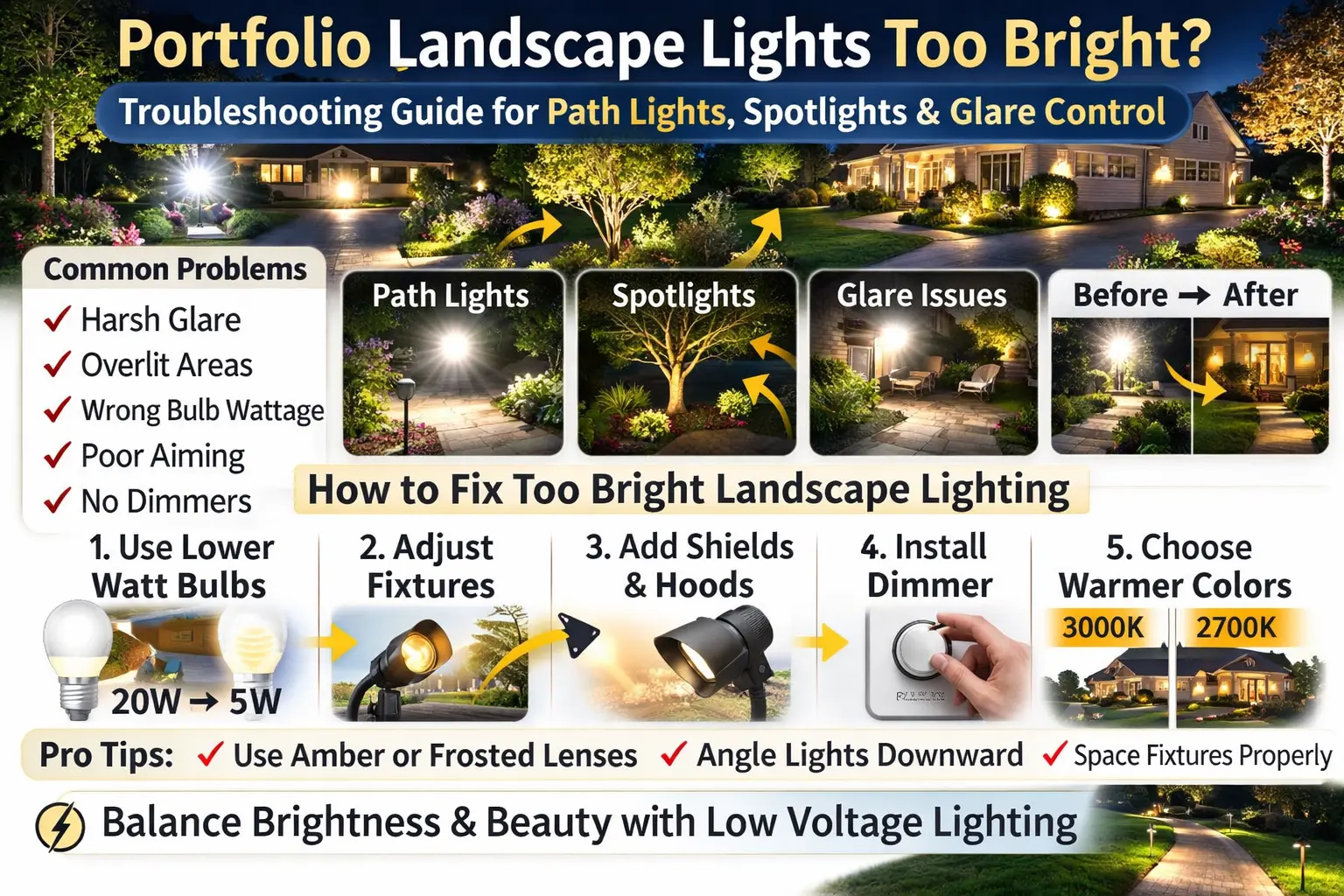
Why Are My Landscape Lights Too Bright? (Quick Answer)
Landscape lights usually look too bright because of high lumen output, cool LED color temperature, narrow beam spread, or poor fixture angle that creates glare. The fastest fix is to switch to a lower-output bulb, use a warmer color, and adjust the fixture angle.
- Blinding glare: fixture angle or exposed bulb
- Harsh white light: color temperature too cool
- Hot spot effect: beam spread too narrow
Brightness Problem Diagnosis Guide
| What You See | Most Likely Cause | What To Do |
|---|---|---|
| Lights feel blinding | Glare or bad angle | Re-aim fixture |
| Light looks harsh and cold | Cool LED (4000K+) | Switch to warm 2700K–3000K |
| Bright hot spot | Narrow beam | Use wider beam spread |
| Walkway too bright | Too many fixtures | Increase spacing |
| Recently got brighter | LED upgrade mismatch | Use lower lumen bulb |
Most brightness problems are caused by glare and placement—not power.
Start Here: Fix Bright Landscape Lights Fast
- Too bright in your eyes → adjust angle first
- Harsh white color → switch to warmer bulb
- Spotlight too intense → use wider beam
- Too many lights → increase spacing
Always adjust the fixture before replacing it.
When landscape lights feel too bright, the real issue is often glare and contrast, not just raw brightness. A fixture can technically be the right wattage and still look unpleasant if the light source is exposed, the beam is too narrow, or the color is too cold for the space.
This page is designed to help you troubleshoot overly bright Portfolio landscape lighting in a practical order. Start with the easiest fixes first: bulb type, color temperature, fixture angle, and placement. Then move into system design issues like beam spread, transformer output, and fixture spacing. If your lights are older Portfolio fixtures, you may also find these pages useful: Portfolio path lights, Portfolio landscape spotlights, Portfolio low voltage lighting, and Portfolio model number lookup.
Understanding how low voltage systems distribute light can help you avoid overly bright fixtures. See how landscape lighting works for a complete system overview.
Quick Fix: Reduce Brightness Fast
- Switch to a lower lumen bulb
- Use a warmer color temperature (2700K–3000K)
- Adjust fixture angle away from eye level
- Increase spacing between fixtures
- Use wider beam spread instead of narrow spot
Most overly bright landscape lighting problems are solved in these first steps.
Why Portfolio Landscape Lights Can Look Too Bright
Brightness complaints usually come from one of five things: too much lumen output, a cool white LED that feels harsh, poor fixture aiming, exposed glare at eye level, or a narrow spotlight effect in a place that needed softer coverage. That is why two fixtures with similar wattage can feel completely different once installed.
Too Much Lumen Output
Modern LED replacement bulbs can be much brighter than older halogen lamps even when the wattage sounds low. A homeowner may swap in a newer bulb thinking it is a smart upgrade and accidentally create a much harsher look along a walkway or entry area.
If your landscape lights are not just too bright but may also be violating HOA or city rules, use the Outdoor Lighting Ordinance Guide to compare your current setup against common limits for lumens, shielding, color temperature, and operating hours.
Cool Color Temperature
Color temperature matters more than many people realize. A cool white light around 4000K to 5000K can look sharp and glaring outdoors, especially in darker yards. A warmer 2700K to 3000K light usually feels more natural and easier on the eyes.
Bad Fixture Placement
Even a reasonable bulb can feel too bright if the fixture is too close to the walking path, too close to seating, or aimed upward at face level. Placement often matters just as much as the light source itself.
Check the Bulb Output and LED Color First
If your Portfolio landscape lights became too bright after a bulb change, start there. This is one of the easiest and most common fixes because the fixture itself may still be fine.
Use a Lower Output Bulb
If a spotlight or path light suddenly feels harsh, try dropping to a lower-output LED or using a bulb designed for softer accent lighting. Many outdoor fixtures do not need maximum brightness to work well. They only need enough light to define edges, highlight features, and improve safe movement.
Switch to a Warmer LED
A warm LED often solves the problem faster than people expect. Cooler lamps can make stone, concrete, and lighter siding look washed out or reflective. Warm bulbs soften the scene and usually create a more upscale look.
Check MR16 or Specialty Lamp Type
Many Portfolio spotlights rely on MR16-style bulbs. Different MR16 replacements vary a lot in brightness, beam spread, and color. If your spotlight feels intense, the fix may simply be a better-matched bulb rather than changing the whole fixture.
If your system uses spotlight bulbs, visit Portfolio MR16 LED replacement bulbs for a closer look at bulb-style troubleshooting and replacement options.
Fix Glare With Better Fixture Angle and Placement
One of the best parts of troubleshooting lights that are too bright is that you can often improve the result without spending much money. Slight fixture changes can completely change how the light feels in the yard.
Aim the Light Away From Eye Level
A fixture that shines directly into your eyes will always feel brighter than it really is. This is especially common with path lights near entries, walkways, and patios. Tilt spotlights away from direct viewing angles and adjust path light placement so the light falls on the ground instead of into the face.
Move Fixtures Farther Off the Walking Line
Some path lights are simply installed too close to the edge of the path. Moving them a little farther into the bed or groundcover can reduce glare and make the lighting feel softer while still illuminating the walkway.
Use Landscape Features to Soften the Effect
Low plantings, mulch beds, stones, and natural screening can help soften direct light. A good outdoor lighting design usually lights surfaces and plants indirectly instead of exposing the bulb source whenever possible.
If your landscape lights feel too bright, the issue may not only be output. It may also be the color temperature. The Landscape Lighting Color Temperature Guide explains why cooler bulbs often look harsher at night, even when wattage stays the same.
Use the Right Beam Spread for the Job
Beam spread is one of the most overlooked reasons a landscape light feels too intense. A narrow beam in the wrong place creates a hot spot. A wider beam usually spreads the light out and makes the effect feel more balanced.
Narrow Beams for Small Accent Targets
Narrow beams work best when you are intentionally highlighting a tree trunk, architectural detail, or narrow vertical surface. If that same bulb gets used near a walkway or entry, it can look sharp and uncomfortable.
Wider Beams for Softer General Illumination
A wider beam often works better for paths, planting beds, low walls, and broader landscaping zones. It reduces the “flashlight” effect and spreads the light more naturally.
If your spotlight feels harsh or creates a hot spot, review landscape lighting beam spread to understand how wider beams create softer, more balanced lighting.
| Problem | Likely Cause | Best First Fix |
|---|---|---|
| Path lights feel blinding when walking past | Fixture too close or bulb visible at eye level | Reposition the fixture and lower output bulb |
| Spotlight creates a harsh hot spot | Narrow beam or overly bright bulb | Use a wider beam or lower lumen lamp |
| Lighting feels cold and harsh | Cool white LED color temperature | Switch to a warmer 2700K to 3000K style bulb |
| Entry area looks washed out | Too many fixtures too close together | Reduce overlap and re-space fixtures |
| Landscape lights are bright but still unattractive | Glare and contrast problem, not just brightness | Adjust aiming and shield the light source |
How to Fix Path Lights That Shine Into Your Eyes
Path lights are supposed to create gentle, useful light at ground level. When they feel too bright, the problem is often visible glare from the lamp, a fixture head that sits too high, or spacing that puts too much light in one short area.
Check the Cap and Lens Design
Some path lights shield the bulb better than others. If the bulb is easily visible from normal walking height, the fixture will often feel brighter than necessary even if the light on the ground is acceptable.
Reduce Overlap
Too many path lights too close together can make a walkway look overlit. Instead of a smooth, comfortable path, you get repeated bright circles that feel distracting. In many yards, fewer fixtures spaced correctly work better than more fixtures crowded together.
Look at the Fixture Height
Taller path lights can project light more widely, but they can also increase visible glare depending on lens and cap design. A lower profile fixture sometimes gives a softer result.
Overlapping light often comes from fixtures being too close together. See landscape lighting spacing guidelines to create a more balanced layout.
For more fixture-specific help, see Portfolio path lights and Portfolio path light replacement.
If your lights feel harsh or uncomfortable, the issue is often glare rather than brightness alone. Learn how glare is measured in the BUG rating guide and how it impacts visibility and comfort.
How to Fix Harsh Spotlights, Uplights, and Accent Lights
Spotlights and uplights are the fixtures most likely to feel too bright because they are designed to create contrast. The goal is not to remove that contrast completely. The goal is to make it controlled and intentional.
Lower the Output Before Replacing the Fixture
A lower-lumen bulb often fixes harsh accent lighting immediately. If the fixture body still works and looks good, that is usually the first move to try.
Change the Aiming Point
If the light is aimed directly at a reflective wall, light-colored stone, or shiny siding, the reflected glare can make the whole area feel too intense. Aim slightly off the most reflective surface or broaden the target area.
Use the Fixture for Accent, Not Flooding
A spotlight that is trying to do the job of a flood light usually feels too intense. If you need broader wash lighting, the fixture type or bulb style may simply be wrong for the effect you want.
Related pages that can help: Portfolio landscape spotlights, Portfolio landscape lighting, and Portfolio low voltage lighting.
When to Replace the Bulb, Accessory, or Entire Fixture
Most brightness problems do not require replacing the full lighting system. In fact, full replacement is usually the last step, not the first.
Replace the Bulb When:
The light became too bright after an LED upgrade, the color temperature feels too cool, or the beam spread is clearly wrong for the location.
Add a Shield or Change the Angle When:
The fixture looks fine on paper but causes glare in real use. Path lights, uplights, and exposed accent fixtures often improve a lot with small aiming changes or glare control.
Replace the Fixture When:
The bulb is not replaceable, the fixture body exposes the light source too much, the lens design is poor for the location, or the overall style simply cannot produce the softer result you want.
If you are working with older Portfolio products, these pages may also help you match the right parts and models: Portfolio model number lookup, Portfolio lighting manuals, and Portfolio parts and accessories.
A Simple Order for Fixing Landscape Lights That Feel Too Bright
If you want the fastest practical checklist, use this order:
- Check whether the bulb or LED was recently changed.
- Switch to a lower-output or warmer color bulb.
- Re-aim the fixture away from direct eye level.
- Adjust spacing if path lights are too crowded.
- Use a wider beam spread for softer coverage.
- Consider a glare shield or different fixture style if needed.
That process solves most overly bright landscape lighting problems without wasting money on unnecessary replacements.
If brightness varies across your system, the issue may be voltage drop rather than bulb output alone.
Portfolio Landscape Lights Too Bright FAQ
Why are my Portfolio landscape lights too bright?
The most common reasons are harsh LED color temperature, too much lumen output, narrow beam spread, exposed glare, or poor fixture placement.
Can I dim low voltage landscape lights?
Sometimes, but many systems improve more by using lower-output bulbs, warmer color temperatures, wider beams, or better aiming instead of trying to dim the transformer directly.
Are brighter path lights better for safety?
No. Too much glare can create harsh contrast and make walking less comfortable. Balanced path lighting is usually better than overly bright lighting.
Should I replace the whole fixture if it is too bright?
Not usually. Start with the bulb, color temperature, beam spread, and aiming angle first. Those changes solve many brightness complaints.