
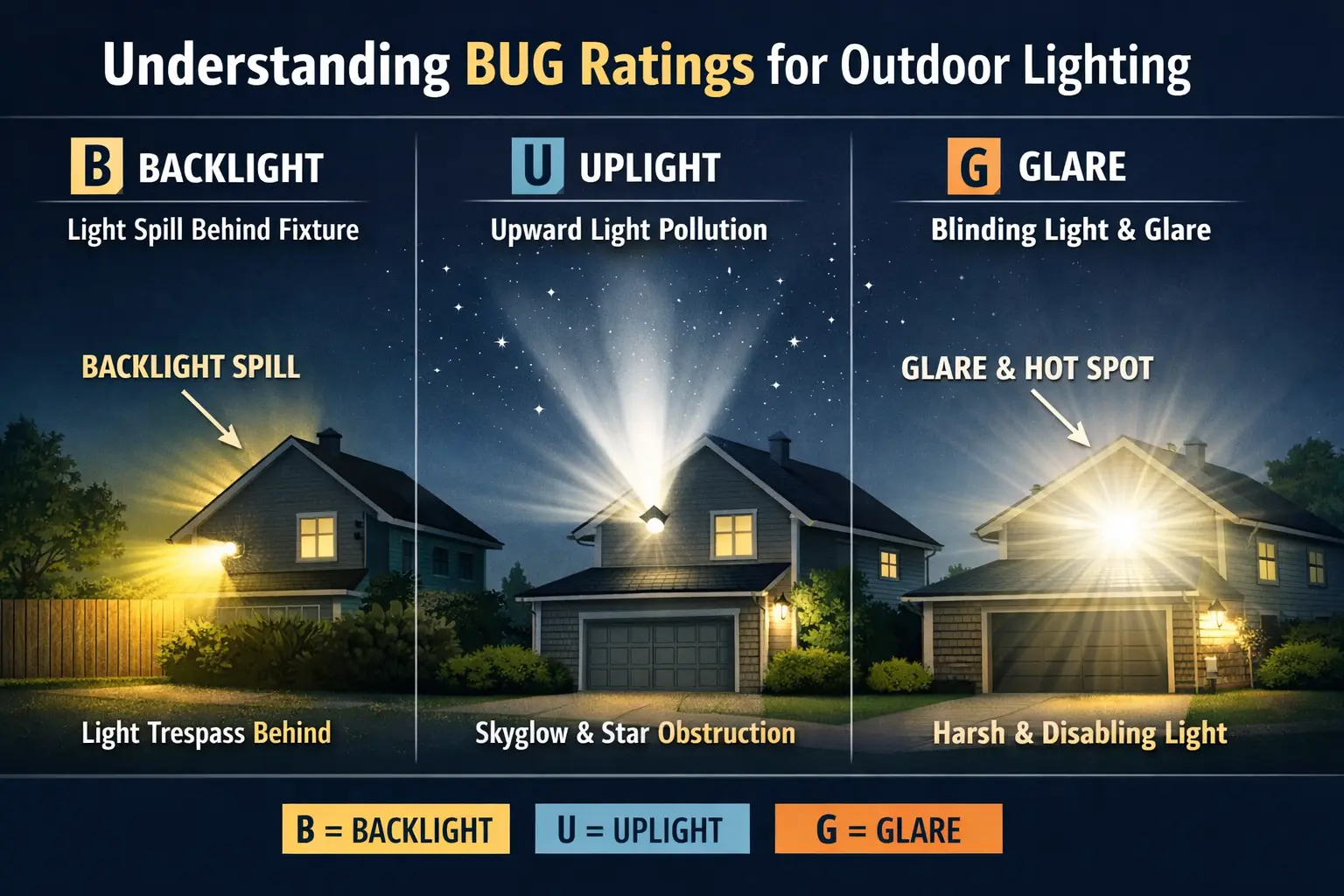
Quick Answer: My 7-Point BUG Rating & Light Contamination Matrix
A fixture's BUG rating is the ultimate field measurement of how much stray, offensive light it spills outside its intended target zone. Standing for Backlight, Uplight, and Glare, this architectural indexing system scores fixtures from 0 to 5. When you shop for outdoor lights, you want the lowest numbers possible—a zero means the beam is perfectly locked down, while a five means it is completely unshielded and pouring light pollution everywhere.
Whenever I audit an outdoor lighting plan or specify commercial-grade fixtures for a home, I crack the hidden BUG metric using these seven specific design rules:
- 1. The "B" (Backlight) Boundary Control: I check the Backlight score to see how much light shoots out behind the fixture wall; a high B-score means light will bleed backwards across property lines and straight through neighboring window glass.
- 2. The "U" (Uplight) Sky Protection: The Uplight score tells me how much stray light escapes vertically into the atmosphere; a U0 rating means the fixture features a true hard-top shield that prevents skyglow completely.
- 3. The "G" (Glare) Eye Safety Limit: I look at the Glare score to measure high-angle light reflecting directly into human eyes; keeping the G-score low is what keeps a driveway light from blinding you as you pull in.
- 4. The 0-to-5 Quality Scaling Scale: I use these numbers like a grading card; every step down toward zero indicates precision internal lenses and deeply recessed diodes that hide the bare light source.
- 5. Deciphering the Spec String (e.g., B1-U0-G1): I always teach people to read the full code sequence on the box; this exact string shows excellent back and glare controls with zero upward light leakage.
- 6. Matching Local Dark Sky Codes: Most strict municipal green zones and HOAs require an absolute U0 or U1 baseline; ignoring these limits means your project won't pass its final building inspection.
- 7. Re-Targeting Beam Optics Internally: Instead of relying on brute bulb wattage, I select low-rating fixtures that use physical reflectors to bounce light directly onto the pavement where feet actually step.
⚠️ CRITICAL RUNNING RISK: Installing high-BUG fixtures on open garage fronts or tall deck corners will spark immediate light trespass friction with the folks next door. Mounting an unrated light source triggers three distinct optical blinding hazards that I break down in our full field-testing charts below.
I’ve seen plenty of folks buy a fixture online just because they liked the look of the metal finish, only to find out it casts an blinding halo across the entire street. In practice, taking thirty seconds to check that three-part alphanumeric code on the spec sheet is what separates a cheap glare trap from a high-end, comfortable lighting design that protects the night sky.
Don't start mounting exterior lights or purchasing hardware blindly. Use my step-by-step fixture shielding guides, photometric breakdown tables, and residential light mapping blueprints detailed further down this page to balance your yard's footprint perfectly.
BUG ratings matter because they convert confusing lighting data into something practical. Instead of guessing whether a fixture is “well shielded,” you can look at the rating and get a better idea of whether it is likely to throw light behind the house, up into the sky, or directly into someone’s eyes.
This is the technical link between your other sustainability pages. The Dark Sky Compliance Guide explains the why. The Outdoor Lighting Ordinance Guide explains the law. This page explains the actual fixture spec that helps you choose better products.
Semantic Logic Summary: What Is a Good BUG Rating?
This is the homeowner version of the engineering language. If you want the simple answer, lower is better.
BUG ratings help explain light control, but color temperature affects how harsh that light feels in the real world. See the Landscape Lighting Color Temperature Guide to understand why warm white lighting is often the better residential choice.
| BUG Component | What It Measures | Target for Homeowners |
|---|---|---|
| Backlight (B) | Light escaping behind the fixture | B0–B1 to help prevent fence spill and window spill |
| Uplight (U) | Light pointing toward the stars | U0 for dark sky compliance and better ordinance alignment |
| Glare (G) | Offensive light in the direct line of sight | G0–G1 to reduce eye strain, complaints, and visible hot spots |
Why BUG Ratings Matter for Homeowners
- Lower glare reduces neighbor complaints
- Lower uplight helps meet dark sky rules
- Lower backlight prevents light trespass
- Better ratings often mean fewer fixtures needed
While BUG ratings were originally designed for commercial lighting, they are now one of the most reliable ways to judge residential fixture quality and compliance potential.
BUG ratings explain how a fixture controls light, but long-term performance also depends on what the fixture is made of. The Durable Landscape Lighting Materials Guide shows why durable housings and stable hardware matter for outdoor lighting that lasts.
What Backlight, Uplight, and Glare Actually Look Like
The easiest way to understand BUG ratings is to see how each type of light behaves in a real environment. The diagram below shows how backlight, uplight, and glare affect a typical residential home.
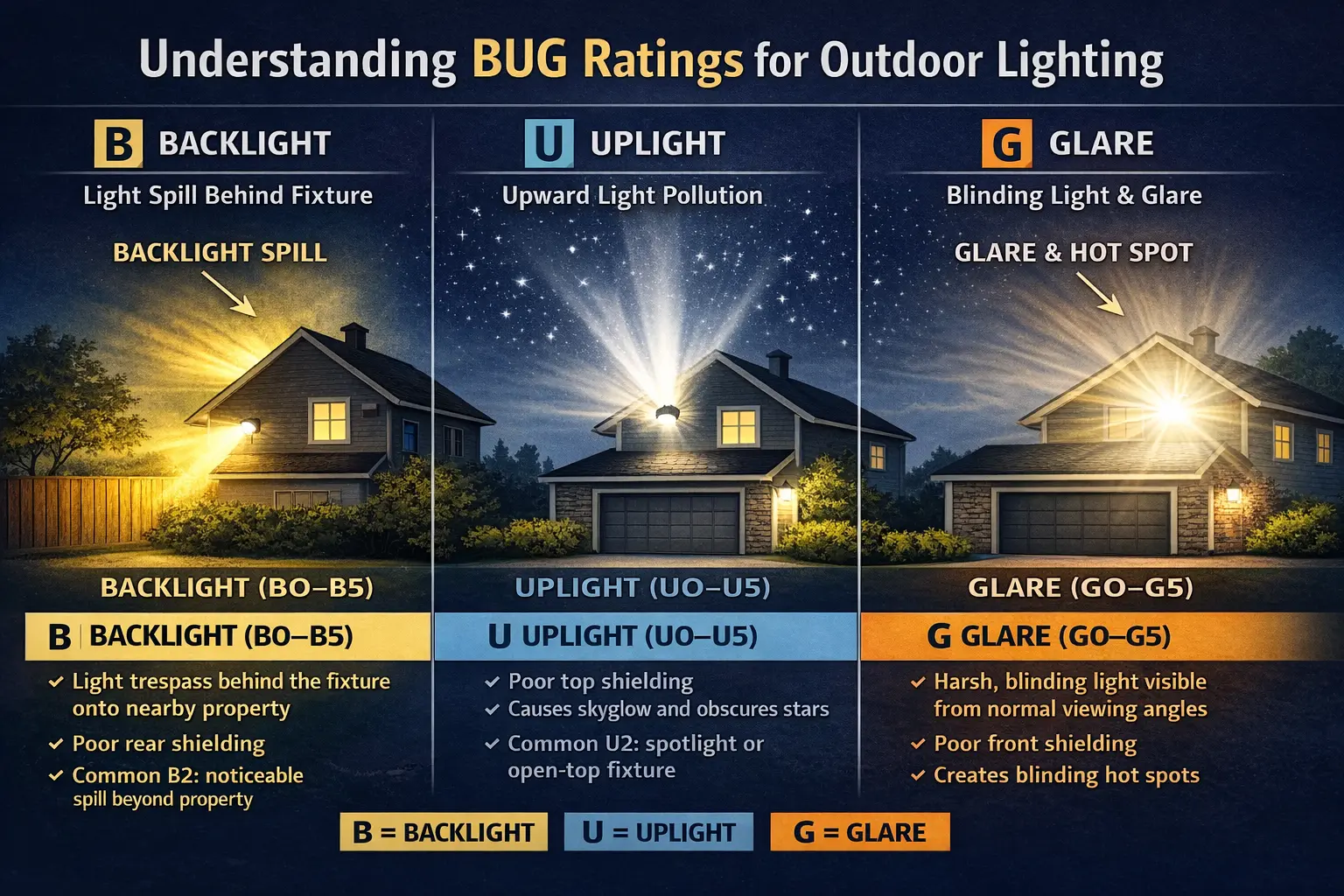
Diagram explanation: This image shows how BUG ratings control outdoor lighting behavior. Backlight spreads light behind the fixture, uplight sends light into the sky, and glare creates harsh brightness visible from normal viewing angles. Lower BUG ratings reduce spill, minimize glare, and improve compliance with modern lighting ordinances.
Backlight spills behind the fixture toward neighboring areas, uplight escapes upward and contributes to sky glow, and glare creates harsh brightness visible from normal viewing angles.
BUG ratings make more sense when you can picture what a shield is actually doing. Backlight, uplight, and glare are not abstract rating categories; they describe where wasted or disruptive light leaves the fixture. A fully shielded design keeps more output below the horizontal plane, while an unshielded globe, post-top, or floodlight can score poorly because light escapes in multiple directions. Use the shielded vs. unshielded outdoor lighting comparison as a visual companion before reading fixture spec sheets or choosing a replacement fixture.
The uplight portion of a BUG rating is directly connected to sky-glow control, but it does not capture every way residential lighting can brighten the night sky. Light can also reflect upward from driveways, walls, patios, water surfaces, and pale landscape materials. For a homeowner-focused explanation of how uplight, reflected light, brightness, and runtime work together, see our night-sky glow reduction guide.
Buy vs. Don’t Buy: How to Use BUG Ratings While Shopping
This is where BUG ratings become useful. You do not need to memorize every engineering detail. You just need to use the numbers to screen out fixtures that are likely to create the same problems you are trying to solve.
Generally safer homeowner logic
- prefer U0 whenever possible for outdoor residential lighting
- prefer low backlight when the fixture is near a property line or window
- prefer low glare when the fixture is visible from the street, sidewalk, or a neighbor’s yard
- be cautious with decorative fixtures that expose the lamp, even if they look attractive in daytime photos
Common red flags
- no BUG information anywhere on the product page or specification sheet
- visible exposed lamp with weak shielding
- marketing language focused only on brightness, not control
- high-output floodlight being used for a small residential task
If you are replacing parts in an existing system, use the Portfolio Parts & Accessories page as your parts hub after you understand the beam-control logic here.
Good BUG Ratings for Common Residential Outdoor Lighting Areas
These are practical homeowner targets, not engineering absolutes. The goal is to choose fixtures that are easier to control and less likely to cause complaints.
| Lighting Area | What Usually Matters Most | Helpful BUG Target | Why |
|---|---|---|---|
| Path lights | Uplight and glare | U0, G0–G1 | Path lights should stay low, calm, and comfortable instead of throwing light upward. |
| Wall lights near doors | Glare and backlight | B0–B1, G0–G1 | These fixtures are often seen directly from the street and can easily create visible hot spots. |
| Flood or security lights | Backlight and glare | Lowest practical B and G | These are the fixtures most likely to create spill, complaints, and ordinance trouble when poorly chosen. |
| Post lights | Uplight and glare | U0 whenever possible | Decorative post lights often look charming but can be some of the worst offenders for exposed-source glare. |
| Deck and step lighting | Glare | Low G | These fixtures are close to eye level in real use and should feel subtle rather than harsh. |
Why U0 Matters So Much in 2026
Among the three BUG components, uplight is the easiest one to understand and one of the most important for modern compliance. A U0 rating means no light is being sent above the horizontal plane. That matters because upward light does not improve visibility where you need it. It just contributes to sky glow and wasted output.
BUG ratings help explain how fixture design affects glare and spill, but fixture control is only part of the story. Our wildlife-friendly outdoor lighting guide connects shielding, color temperature, and runtime decisions to real-world wildlife impact in residential yards.
Many dark-sky frameworks now prioritize targeted, low-level, controlled, warm-colored lighting, and a U0 fixture fits that logic far better than products that still spray light upward or sideways. If you want the broader strategy behind that, read the Dark Sky Compliance Guide.
Where to Find the BUG Rating on a Real Fixture
The BUG rating is usually not front-and-center on retail packaging. That is why homeowners miss it. In many cases, you will find it in one of these places:
- the manufacturer’s specification sheet
- the photometric report
- a downloadable cut sheet or product data sheet
- the commercial section of the manufacturer’s product page
If you are researching an existing Portfolio product or a replacement option, search the exact model number plus one of these phrases: specification sheet, cut sheet, or photometric report.
How BUG Ratings Connect to Real-World Problems
The reason this page matters is that BUG ratings are not abstract. They map directly to problems homeowners actually care about:
- High B: more likely to create spill onto a fence, wall, or nearby window
- High U: more likely to violate dark-sky goals and waste light into the sky
- High G: more likely to create neighbor complaints and visible discomfort from the street
If your current fixtures are already causing conflict, start with how to fix light trespass. If you are trying to compare your choices against a local rule or HOA letter, read the Outdoor Lighting Ordinance Guide.
Best Supporting Pages for Shopping Smarter
Parts & Accessories
Use this page after you understand which beam-control traits you need, especially if you are repairing an existing Portfolio system.
View parts and accessoriesFix Light Trespass
Best if the practical issue is spill onto a neighbor’s property or visible glare from a poorly controlled fixture.
Fix light trespassOutdoor Lighting Ordinance Guide
Best if you are translating city or HOA language into a real-world compliance plan.
Read the ordinance guideDark Sky Compliance Guide
Best if you want the wider framework for responsible lighting, including targeted, low-level, controlled, warm-toned design.
Read the compliance guide2026 BUG Rating FAQ
Is a BUG rating of 0 always best?
For dark sky compliance and residential peace, yes. A rating of 0 means the light is precisely directed only where it is needed. In most homeowner situations, U0 is the most desirable single value because it means zero uplight.
Where do I find the BUG rating on my Portfolio light?
It is usually found on the specification sheet, not always the box. Search for the model number plus “photometric report” or “specification sheet” to see if the manufacturer published the detailed data.
Does a high BUG rating cause light trespass?
Yes, particularly a high B for backlight or a high G for glare. Those are the two ratings most likely to lead to neighbor disputes because they describe spill and harsh visible brightness.
What is the fastest BUG shortcut for homeowners?
Check U first. If a fixture is not U0, it is already a weaker choice for modern dark-sky-oriented residential lighting. Then look at glare and backlight to decide whether the fixture is likely to create complaints.
Final Thoughts on Understanding BUG Ratings
BUG ratings look technical at first, but they become much easier once you tie each letter to a real-world lighting problem. Backlight is spill behind the fixture. Uplight is wasted light into the sky. Glare is the harsh visible source that annoys people and attracts complaints.
For homeowners, the best general rule is simple: look for low numbers, prioritize U0, and avoid fixtures that expose the light source more than necessary. That one shift alone makes it easier to shop for fixtures that are better behaved, more comfortable to live with, and more aligned with modern dark-sky and ordinance expectations.
Editorial Note: This guide is maintained by the PortfolioLighting.net technical team. Our data is based on 2026 IES (Illuminating Engineering Society) standards and Dark Sky International compliance frameworks. We provide this as a free resource to help homeowners understand complex lighting specifications and make better outdoor lighting decisions.