
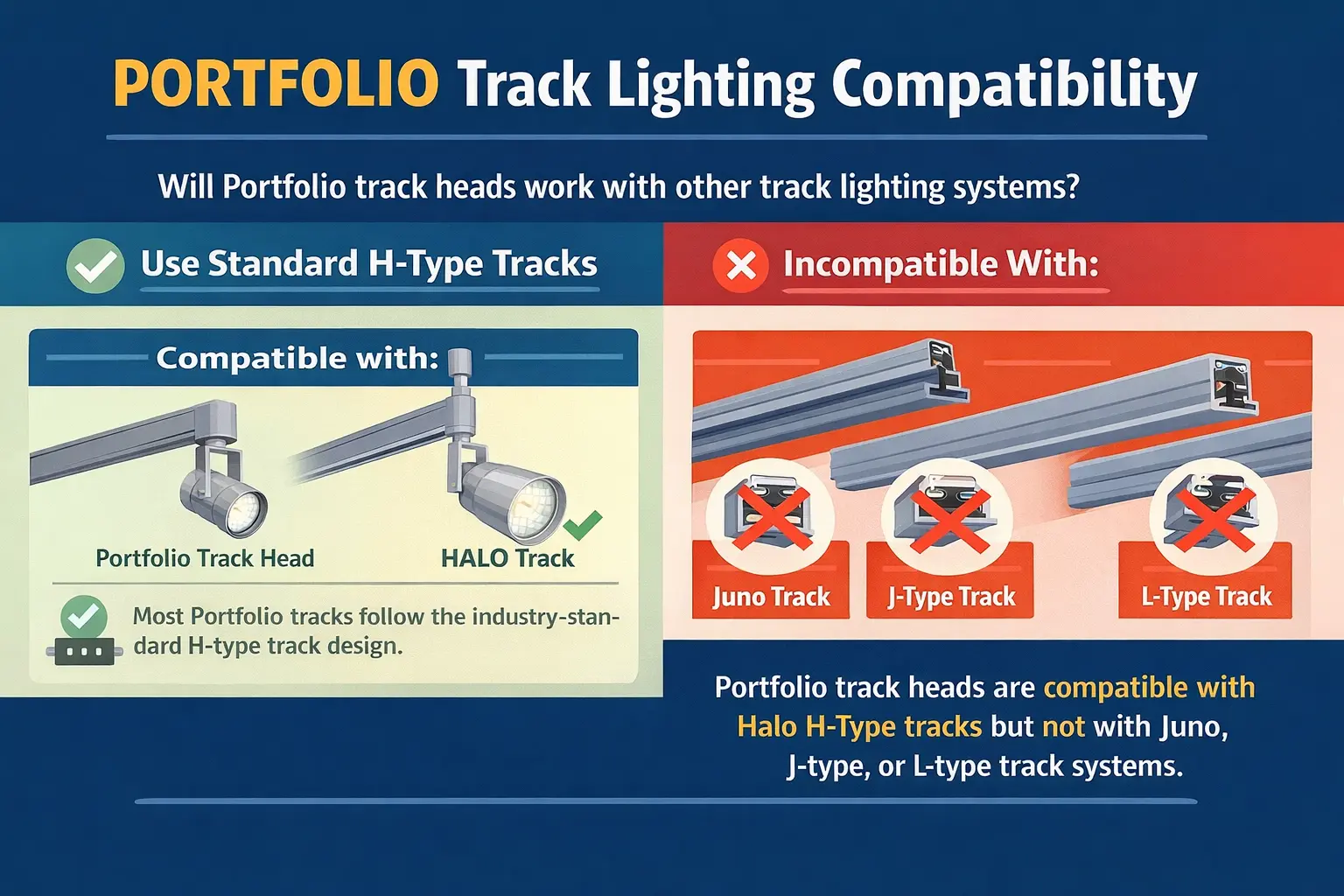
Will Portfolio Track Lighting Parts Fit Together? (Quick Answer)
Portfolio track lighting parts are only compatible when the track type, connector design, and electrical contacts match. Many systems look similar but use different standards, so parts will not fit or work together unless they are designed for the same track.
- Same track type: usually compatible
- Different track type: will not fit
- Mixing brands: only works if standard matches
Most compatibility problems happen when parts look correct but use different internal connection layouts.
If you are unsure what system you have, use the Portfolio model number lookup before buying anything.
If you are still unsure what type of system you have, start with Portfolio track lighting to understand how different track systems work and why compatibility depends on the track type—not just how the fixture looks.
Quick Compatibility Check
| Situation | Will It Work? |
|---|---|
| Same track type | Yes |
| Different track type | No |
| Mixing brands (same standard) | Sometimes |
| Looks similar | Does NOT matter |
Track Lighting Compatibility Logic
| If This Happens | What It Means | What To Do |
|---|---|---|
| Head won’t lock into rail | Wrong track type | Confirm track standard before buying |
| Head fits but no power | Contact mismatch | Check adapter and electrical layout |
| Head feels loose | Adapter mismatch | Use correct connector style |
| Mixing brands fails | Different track standards | Match track type exactly |
| Multiple issues | System mismatch or aging | Consider full replacement |
Compatibility is determined by the connection system—not the visible design of the fixture.
Start Here: Check Compatibility Fast
- If the head won’t fit → check track type
- If it fits but won’t power → check contacts
- If mixing brands → confirm same standard
- If unsure → replace full system
Start by identifying your track system before buying anything.
Track lighting compatibility is determined by the connection system—not the visible design.
The biggest mistake with track lighting is assuming it is all universal. It is not. Track systems can look very similar while still using different electrical contact layouts and adapter designs. That is why compatibility research should happen before you order parts, not after they arrive.
This page works best alongside Portfolio lighting compatibility guide, Portfolio lighting parts and accessories, and Portfolio lighting installation and instructions. If your existing system is already flickering, loose, or not powering correctly, you may also need Portfolio lighting troubleshooting.
If you need a broader overview before matching heads, rails, connectors, or replacement parts, visit our full Portfolio track lighting guide. That page explains the bigger picture so you can understand how Portfolio track systems are designed, what makes one setup different from another, and why compatibility matters before you buy. It is especially helpful if you are still figuring out whether you have the right track style, whether a replacement head is worth buying, or whether your current system should be repaired, upgraded, or replaced.
If you are working with ceiling-mounted fixtures or planning a larger setup, start with Portfolio indoor lighting for an overview of track systems, ceiling lights, and how different indoor lighting types fit together.
Why Portfolio Track Lighting Compatibility Matters So Much
Track lighting feels simple because it is visible and accessible. You can see the rail, see the heads, and imagine that replacing one piece should be easy. But track lighting is really a system, not just a fixture. The head has to fit physically, lock into place correctly, and line up with the electrical contacts inside the track. If any of that is off, the new part may not work even if it looks almost identical.
This is different from swapping a lamp shade or replacing a basic bulb. Track lighting compatibility affects function, safety, appearance, and long-term upgrade flexibility. If you get it right, you can often refresh a room without replacing everything. If you get it wrong, you can waste time, return parts, and still be left with a ceiling system that does not solve the problem.
That is why compatibility is often the real issue behind searches like Portfolio track lighting replacement heads, Portfolio track head fit, or can you mix track lighting brands. Most visitors are not looking for theory. They want to know whether the part they are about to buy will actually work in their ceiling.
What You Need to Match Before Buying Portfolio Track Lighting Parts
Before you order anything, there are a few things you need to confirm. Skipping even one of them is where most compatibility mistakes begin. The good news is that you usually do not need to know every technical detail. You just need to know which details matter.
Start by checking these basics:
- the type of track you currently have
- the adapter style on the existing track head
- whether you are replacing only heads or also the rail
- whether the room already has matching finishes and beam styles you want to preserve
- whether the current system is worth keeping or already feels outdated
Many people focus first on color or finish. They want white, black, bronze, or brushed nickel. That part matters visually, but it should not come first. Fit comes first. A good-looking head that does not match your rail is not a solution.
This is also why your next step may depend on what kind of project you are doing. If the room just needs one replacement head, compatibility is the whole game. If you are reworking the room lighting more broadly, you may also want to compare Portfolio linear lighting, Portfolio adjustable downlights, and Portfolio recessed lighting before automatically staying with the same older track system.
Understanding Track Types Before You Buy Anything
One of the most important compatibility ideas in track lighting is that not all tracks use the same contact layout. You will often hear people refer to H-track, J-track, or L-track. Those labels are not decorative categories. They are shorthand for different track standards. That means heads made for one standard may not fit another even if the size and style look close.
This is where track lighting gets confusing for homeowners. The front side of the fixture rarely tells the full story. From the room view, two track heads can look almost identical. The difference is usually in the adapter that slides and locks into the rail. That hidden connection point is what decides whether the head will actually work.
What matters most about track type
- the head must match the same track standard as the rail
- similar appearance does not equal compatibility
- older systems may be harder to identify without removing a head first
- if you are not sure, do not guess based on product photos alone
| What You Are Comparing | Why It Matters | What to Do First |
|---|---|---|
| Track rail type | Determines which heads can physically and electrically fit | Inspect the rail and current adapter carefully |
| Track head adapter | Controls locking and contact alignment | Remove one existing head for a closer look |
| Brand versus standard | Some cross-brand use is possible only when the standard matches | Confirm standard first, brand second |
| Finish and style | Affects appearance but not core compatibility | Use it only after fit is confirmed |
| System age | Older systems may be harder to match cleanly | Decide whether full replacement is smarter |
If your current track setup is part of a broader indoor refresh, you may also want to compare other room-lighting paths such as ceiling lighting if you add that later, or the current indoor cluster pages like Portfolio LED lighting, Portfolio task lighting, and Portfolio surface mounted downlighting.
Track lighting compatibility is not only about the track rail and head style. The track lighting dimmer compatibility guide explains how LED drivers, low-end trim, and older wall dimmers affect flicker and buzzing.
Can You Mix Portfolio Track Lighting With Other Brands?
Sometimes you can, but this is where people get into trouble. The question is not whether another brand makes a similar-looking head. The real question is whether that head is built for the exact same track standard and connector layout as your existing Portfolio rail.
In other words, track lighting is not universal just because it is sold as track lighting. Some other-brand heads may work with your system if the standard matches. Some will not. Some may technically fit but still leave you with an awkward visual mismatch in beam shape, size, trim style, or finish. That is why compatibility is both a physical question and a design question.
Mixing brands can make sense when:
- you have confirmed the same track standard
- you only need one or two replacements
- the new heads match reasonably well in finish and scale
- you are comfortable with a partial refresh instead of a perfect match
Mixing brands often causes problems when:
- you are guessing based on appearance alone
- the system is older and hard to identify
- you need the whole room to look consistent
- the beam style or light color will obviously differ
Should You Replace Just the Track Heads or Replace the Whole System?
This is often the most practical decision on the page. If your rail is in good shape, the existing layout still works for the room, and you simply want better-looking or better-performing heads, replacing only the heads may be the smartest move. It can refresh the room without turning into a full ceiling project.
On the other hand, if the system is dated, hard to match, visually inconsistent, or already giving you compatibility headaches, a full system replacement may be cleaner and less frustrating. This is especially true when you need several new parts. At a certain point, piecing together older track components becomes more work than it is worth.
Replacing heads usually makes sense when:
- the existing rail is in good condition
- you can confidently identify the track type
- you want a faster cosmetic or functional refresh
- the room layout still works well with track lighting
Replacing the full system often makes sense when:
- the system is difficult to identify
- several heads or connectors are already failing
- you want a more modern, cleaner lighting look
- compatibility uncertainty is turning a simple project into a guessing game
If you are leaning toward repair or parts first, review Portfolio lighting parts and accessories, Portfolio lighting replacement hardware, and where to buy Portfolio lighting replacement parts. If the room may need a broader upgrade, compare the main category page at Portfolio track lighting with adjacent indoor options like Portfolio recessed lighting and Portfolio linear lighting.
How Portfolio Track Lighting Fits Into a Bigger Room-Lighting Plan
Compatibility questions usually show up when someone is trying to solve one immediate problem, like replacing a dead head or extending a short track. But it helps to step back and think about whether track lighting is still the right lighting type for the room overall.
Track lighting is strongest when you want adjustable directional light, flexible aiming, or a clean system that can emphasize different parts of the room. It works especially well in kitchens, home offices, multipurpose rooms, hallways, art walls, and spaces where you want to direct light toward work zones or features.
If your room really needs broad general light instead of directional light, track may not be the ideal long-term answer. In that case, you may be happier comparing it against Portfolio flush mount lighting, Portfolio chandeliers lighting, Portfolio pendant lighting, or Portfolio LED lighting depending on the space. That does not mean track lighting is wrong. It just means compatibility work is easiest when the system still makes sense for the room.
Main Category Page
Use the broader track-lighting page if you are still deciding whether this fixture type belongs in the room at all.
View Track LightingGlobal Compatibility Help
Use the sitewide compatibility guide if your issue is bigger than just track heads and rails.
See Compatibility GuideReplacement Parts Path
Use the parts-and-accessories cluster if you know you are trying to keep the current system going.
Find Parts HelpCommon Portfolio Track Lighting Compatibility Mistakes to Avoid
Most track lighting mistakes are easy to understand once you see the pattern. People focus on what is visible first and what is critical second. They compare finishes, cylinder shapes, and the front look of the head, but they do not compare the adapter. Or they assume one “standard” track head should fit another standard-looking rail. That is usually where the trouble starts.
Common mistakes include:
- buying a head because the front shape looks similar
- ignoring the adapter and lock mechanism
- assuming all track lighting is universal
- mixing brand parts without confirming the same track standard
- forgetting that beam style and light color also affect the final match
- forcing an older system when full replacement would be cleaner
Another common problem is trying to fix a compatibility issue when the real issue is performance. If the head fits but flickers, dims poorly, or behaves inconsistently, you may be dealing with a different kind of problem. In that case, the next stop should be Portfolio lighting troubleshooting, Portfolio LED lights flickering, or Portfolio lighting too dim.
Final Thoughts on Portfolio Track Lighting Compatibility
If you remember one thing from this page, make it this: track lighting compatibility is about the connection, not just the look. A replacement head can be the right color, the right size, and the right price and still be the wrong part if it does not match the track standard and adapter style you already have.
That is why the smartest approach is to identify first, buy second. Study the current rail. Remove one head if needed. Confirm the connector style. Decide whether you are preserving the system or using this as a chance to upgrade the room more cleanly. When you take those steps first, track lighting becomes a lot less frustrating.
Portfolio track lighting can still be a very useful, flexible indoor system. You just get better results when you treat compatibility as the first decision instead of the last.
Portfolio Track Lighting Compatibility FAQ
Are all Portfolio track lighting parts compatible with each other?
No. Compatibility depends on the track type, connector design, and the specific head or accessory you are trying to use. Similar appearance does not guarantee a fit.
Can you mix Portfolio track heads with other brands?
Sometimes, but only when the track standard matches. The most important issue is whether the replacement head is built for the same type of track rail.
How do you know if a track head will fit your existing rail?
You need to confirm the track type, adapter shape, and contact layout first. Removing one existing head for comparison is often the smartest first move.
When is it better to replace the whole track lighting system?
A full replacement often makes more sense when the system is hard to identify, when several parts are failing, or when a cleaner room upgrade is more practical than piecing together older components.