
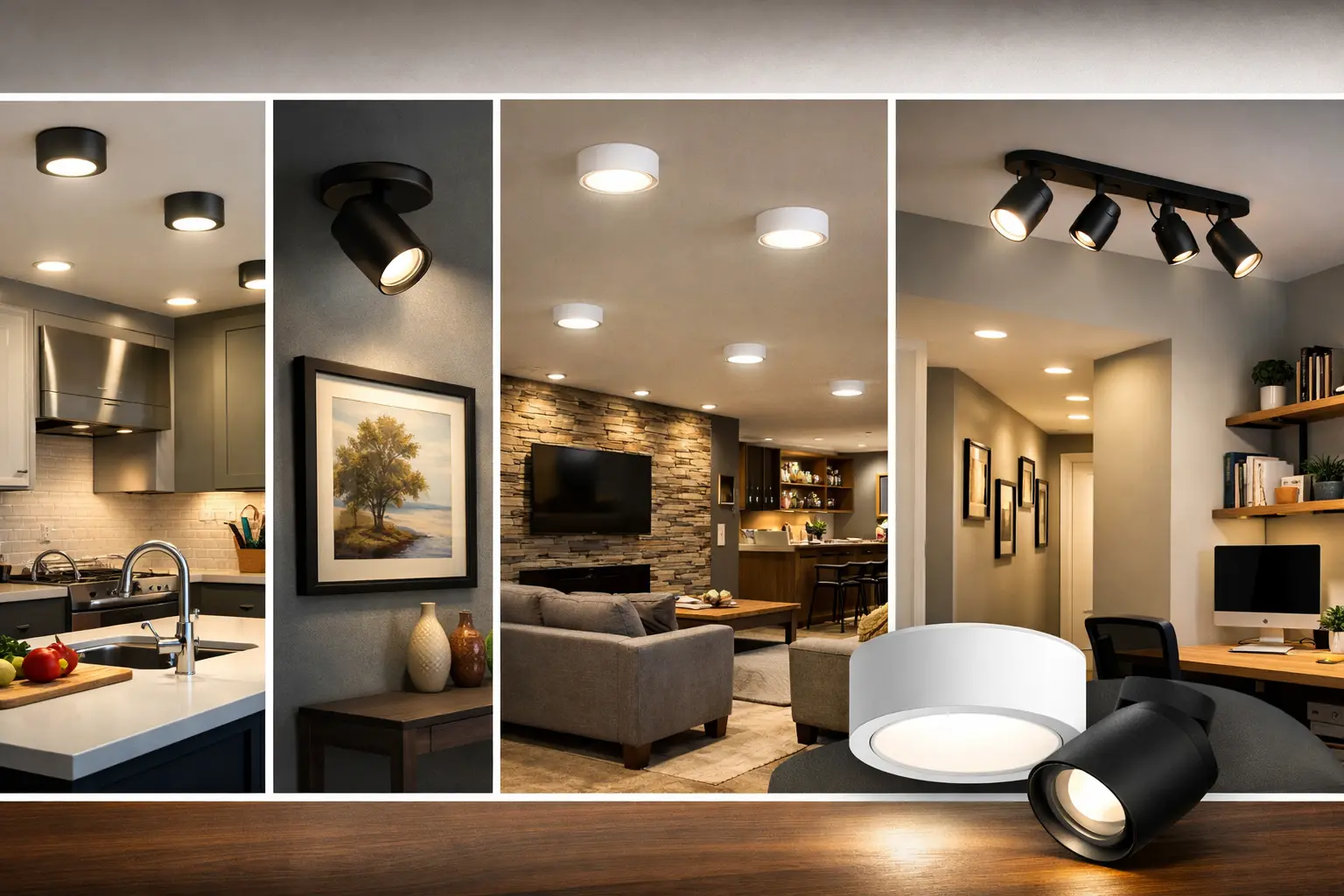
What Are Surface Mounted Downlights? (Quick Answer)
Surface mounted downlights are ceiling light fixtures that attach directly to the ceiling while directing light downward like recessed lighting.
- Best use: ceilings without space for recessed lights
- Main benefit: easy installation
- Common issue: flickering from bulb or dimmer mismatch
Quick Decision: Should You Use Surface Mounted Downlights?
- Use them if: you cannot install recessed lighting
- Use them if: you want easy installation
- Use them if: you want directional light
- Avoid if: you want completely hidden fixtures
If you are comparing different ceiling fixture types, start with Portfolio ceiling lighting to understand how surface mounted, recessed, and flush mount fixtures fit into a complete lighting plan.
Surface Mounted Downlight Decision Guide
| Situation | Best Choice | Why |
|---|---|---|
| No ceiling depth | Surface mounted | No housing required |
| New construction | Recessed lighting | Cleaner look |
| Basement remodel | Surface mounted | Easy install |
| Lights flicker | Check dimmer/LED | Compatibility issue |
| Fixture not working | Check wiring or bulb | Common failure points |
Choosing the right ceiling lighting depends more on installation constraints than style alone.
Start Here: What Are You Trying to Do?
Surface mounted downlighting is usually chosen for one of a few specific reasons. Use the paths below to quickly find the right solution for your situation.
- Cannot install recessed lighting: surface mounted downlights are the best alternative
- Replacing old ceiling fixture: upgrade to a modern directional downlight
- Lights flickering or not working: check bulbs, dimmers, or internal drivers
- Need better task lighting: choose directional or spotlight-style fixtures
- Trying to modernize a room: replace bulky flush mounts with compact downlights
The right choice depends on whether your priority is installation limitations, lighting performance, or fixture style.
Surface mounted downlights install directly on the ceiling surface, but unlike a typical flush mount ceiling light, they are designed to push light downward in a more focused way.
That makes them useful when you want task lighting, directional lighting, or a cleaner modern look without opening up the ceiling for recessed housings.
If your fixture is flickering, damaged, or missing parts, you may not need a full replacement. Most issues can be fixed with the right parts.
- Flickering → replace LED bulb or driver
- Fixture loose → replace mounting bracket
- No light → check wiring or socket
If you are planning a full lighting upgrade instead of a single fixture, use the Portfolio lighting guide, plan and placement to map out fixtures, spacing, and overall lighting strategy.
What Is Surface Mounted Downlighting?
Surface mounted downlighting means the fixture attaches on top of the finished ceiling surface instead of being recessed up inside it. The housing remains visible, but the light is still designed to shine downward in a controlled way. That is the key difference. You are not getting the hidden trim look of recessed lighting, but you are still getting more focused illumination than you usually get from a standard flush mount dome light.
This category sits between recessed lighting and flush mount lighting. Recessed lighting installs inside the ceiling and hides most of the housing. Flush mount lighting sits flat against the ceiling but usually spreads light broadly across the room. Surface mounted downlights stay visible like a surface fixture, yet they are built to aim or direct light down where it is more useful.
If you are replacing an older dome fixture, compare with Portfolio flush mount lighting to see how surface downlights provide a more focused and modern lighting option.
| Lighting Type | Installation | Look |
|---|---|---|
| Recessed lighting | Inside ceiling | Hidden trim |
| Surface mounted downlight | On ceiling surface | Compact visible fixture |
| Flush mount | Flat against ceiling | Broad light spread |
If you like the cleaner modern feel of recessed lighting but cannot or do not want to cut into the ceiling, this type of fixture often gives you a strong middle-ground option.
Surface mounted downlights solve the biggest problem with recessed lighting: ceiling space.
When Surface Mounted Downlights Are the Best Option
Surface mount fixtures really shine when the ceiling itself limits your choices. In apartments and condos, concrete slabs often make recessed lighting difficult or impossible. In basements, limited joist depth, pipes, wiring, or ductwork can make it hard to fit recessed housings. In remodeling projects, cutting open ceilings may not be worth the cost, dust, and repair work. In rental properties, you may want something that installs and removes more easily than a full recessed conversion.
Low-clearance spaces are another strong use case. Surface mounted downlights need much less structural depth than recessed cans, so they work well where every inch matters. That is why this category is so helpful in finished basements, older homes, utility spaces, and remodels where the ceiling structure is already doing a lot of work.
Portfolio has offered many fixtures that fit well into retrofit and remodeling situations because the installation is usually more approachable. If you are still deciding how practical the project is, compare this page with Portfolio lighting installation.
If you are planning lighting for an entire room or home, use the indoor lighting layout guide to position fixtures correctly and avoid uneven or overly bright spaces.
Surface-mounted fixtures work well in lower utility spaces, but taller ceilings often need dedicated high-output lighting. The high bay lighting spacing and beam spread guide explains when industrial fixtures become the better solution.
Types of Portfolio Surface Mounted Downlights
LED Surface Downlights
LED surface downlights are the most common modern option. These fixtures are popular because they are energy efficient, run cooler, last longer, and often come in very slim profiles. Many Portfolio fixtures in this category use integrated LED modules built directly into the housing, which helps keep the fixture compact and clean-looking.
If you are mainly interested in efficiency and low maintenance, this is usually the first style to consider. For related LED guidance, use Portfolio LED lighting.
Directional Surface Downlights
Some surface mounted downlights are directional rather than fixed. These are useful when you want to aim the beam toward artwork, a kitchen counter, an accent wall, shelving, or an architectural detail. They provide more flexibility than a standard flat downlight and can help a room feel more layered and intentional.
If you want a surface fixture with aiming control, compare these with Portfolio adjustable downlights.
Surface Mounted Spotlights
Surface mounted spotlights give you a tighter, more focused beam. They work well for display lighting, reading areas, desk zones, or task-oriented kitchen lighting. These are especially helpful when you want one visible ceiling fixture to do a very specific job instead of trying to light the whole room evenly.
Multi-Light Surface Fixtures
Some fixtures combine multiple directional heads in one ceiling-mounted base. You may see two-light ceiling spots, three-light surface bars, or compact track-style fixtures. The main advantage is coverage. You get directional flexibility across a wider area without installing several separate fixtures. That can work especially well in kitchens, long rooms, offices, and basement spaces where one fixture needs to do more.
Where to Use Surface Mounted Downlights in Your Home
If your goal is focused work or task illumination, compare with Portfolio task lighting to choose fixtures designed specifically for functional lighting zones.
Kitchen
Surface downlights are useful above kitchen islands, prep counters, and sinks because they provide focused task lighting without requiring ceiling cavities for recessed cans. If your kitchen ceiling is finished, shallow, or difficult to modify, this category is an easy way to add stronger work light.
Hallways
In hallways, compact surface downlights help brighten the path without the bulk of larger ceiling fixtures. They look more modern than many old flush mount domes and usually provide a cleaner, more directed light pattern down the corridor.
Basements
Basements are one of the best places for this type of lighting. Many basements cannot support recessed fixtures because of ductwork, pipes, or limited joist depth. Surface mounted downlights offer easy installation, bright LED output, and minimal ceiling depth requirements, which is exactly what many basement projects need.
Bedrooms
In bedrooms, these fixtures can work for reading light, accent lighting, and minimalist modern designs. They are especially useful if you want cleaner ceiling lines than a fan light or oversized flush mount but still need practical illumination.
Home Offices
In a home office, strong downward task lighting matters. Surface mounted downlights can help brighten desk areas, worktables, storage walls, or built-ins. This can be a smart option when you want better focus than general overhead room light provides.
To avoid under-lighting or over-lighting a space, see how many lights you need per room based on room size and lighting goals.
Surface-mounted commercial fixtures often resemble decorative cylinders, but their internal construction may include specification-grade optics, replaceable LED engines, remote drivers, emergency battery equipment, and commercial dimming leads. The Portfolio commercial lighting guide explains how to tell a decorative surface fixture from an architectural product and what to record before replacing the driver, optical assembly, mounting plate, or complete fixture.
How to Install Portfolio Surface Mounted Downlights
One reason homeowners like this category is that installation is often simpler than recessed lighting. You are usually working with a standard ceiling electrical box and a mounting bracket rather than cutting out space for a recessed housing.
Step 1: Turn Off Power
Always shut off power at the breaker panel before touching the fixture wiring. This is the non-negotiable first move.
Step 2: Install the Mounting Bracket
Most Portfolio fixtures include a mounting plate or bracket that attaches to the ceiling electrical box. This bracket supports the fixture body and keeps everything aligned.
Step 3: Connect Wiring
Standard wiring usually includes black for hot, white for neutral, and a ground wire. Make the connections securely and use the hardware provided with the fixture.
Step 4: Attach the Fixture Housing
The fixture body attaches to the bracket using screws, twist locks, or tabs depending on the design. This is where the low-profile look starts coming together.
Step 5: Install Bulbs or Use the Integrated LED Assembly
Some fixtures use replaceable bulbs such as GU10 lamps. Others use integrated LEDs and do not need bulbs installed separately. Once the housing is attached, restore power and test the light.
If your fixture gives you trouble after installation, the best next stop is Portfolio lighting troubleshooting.
Choosing the Right Bulbs for Surface Mounted Downlights
Bulb compatibility matters because surface mounted downlights are often chosen for more focused lighting jobs. The wrong bulb can give you the wrong beam spread, wrong brightness, too much heat, or a poor-looking color temperature.
If your fixture uses built-in LEDs instead of replaceable bulbs, see Portfolio integrated LED lighting to understand lifespan, replacement options, and common failure points.
GU10 Bulbs
GU10 bulbs are common in directional downlights and small ceiling spot fixtures. They are popular because they give you focused beam control, come in LED versions, and are replaceable. If your fixture uses GU10 lamps, that can make future maintenance easier.
MR16 Bulbs
MR16 bulbs are another directional option and are often used where tighter beam control is helpful for accent lighting. These bulbs can work especially well in task and display situations where you want the light aimed more precisely.
Integrated LED Fixtures
Many newer Portfolio fixtures use built-in LED panels or modules. The big benefits are long lifespan, no bulb replacement, and a slim design that suits surface mounted fixtures very well. The tradeoff is that when the LED system eventually fails, repair may involve a driver or module instead of a simple bulb swap.
Common Surface Downlight Problems
- Flickering lights: incompatible dimmer or failing LED driver
- Light not turning on: wiring or bulb issue
- Too dim: incorrect bulb or low lumen output
- Fixture overheating: wrong wattage or poor airflow
Troubleshooting Surface Mounted Downlights
If flickering continues after checking dimmers and wiring, see Portfolio LED lights flickering for deeper troubleshooting steps and compatibility fixes.
Light Not Turning On
If the fixture will not turn on, start with the basics. A bad bulb, loose wiring connection, faulty switch, or tripped breaker are common causes. If the light is part of a larger project or recent installation, a wiring mistake is also possible.
If you want a broader diagnostic mindset, compare this with Portfolio landscape lights not turning on and the more general Portfolio lighting troubleshooting page.
Flickering LED Lights
Flickering is often caused by an incompatible dimmer, loose wiring, or a failing LED driver. Surface fixtures usually run cooler with LED lamps, but poor compatibility can still create annoying flicker, especially when dimming is involved.
Fixture Overheating
Surface mounted fixtures can overheat if the wrong bulb wattage is installed, ventilation is blocked, or the fixture is poorly installed. LED fixtures generally help reduce heat problems, which is one reason they are such a strong fit in this category.
Replacement Parts for Portfolio Downlighting Fixtures
Many visitors land on a page like this because they do not need a whole new fixture yet. They just need the part that failed. Common replacement parts include trim rings, mounting brackets, LED drivers, GU10 bulbs, and replacement shades or covers depending on the fixture style.
You can often find replacement parts and compatible bulbs for older Portfolio fixtures through online marketplaces. Many homeowners search listings like Portfolio lighting replacement parts on eBay when original components are difficult to locate.
For broader parts help, use Portfolio lighting parts and accessories. That is often the best next page if you are trying to match brackets, drivers, trim pieces, or compatible lamp types.
Surface Mounted vs Recessed Lighting
Many homeowners are really choosing between these two categories. Recessed lighting looks cleaner because the housing disappears into the ceiling, but it needs space above the ceiling and usually more installation work. Surface mounted downlighting is easier to install and needs much less ceiling depth, but the fixture body stays visible.
A typical recessed LED can produces 600–900 lumens. A comparable surface mounted LED downlight can match that output without requiring ceiling depth, making it a practical alternative in most remodel situations.
For balanced room lighting, combine directional fixtures with Portfolio ambient lighting to avoid harsh shadows and create a more comfortable overall space.
| Feature | Surface Mounted | Recessed |
|---|---|---|
| Installation | Easy | Requires ceiling cutting |
| Ceiling depth | Minimal | Requires housing space |
| Appearance | Visible fixture | Hidden trim |
| Best for | Remodels, basements, concrete ceilings | New construction or ceilings with open depth |
If your ceiling can handle recessed lighting, it may still be worth comparing with Portfolio recessed lighting. If your main focus is outdoor systems instead of indoor ceiling fixtures, you can also branch into Portfolio landscape lighting.
Final Thoughts on Portfolio Surface Mounted Downlighting
Surface mounted downlights are one of the most practical lighting categories for real-world ceilings. They let you get focused ceiling light without cutting deep holes in the structure, and that makes them especially useful in basements, apartments, remodels, and low-clearance rooms.
If you want a clean modern look, strong task lighting, and a fixture that is usually easier to install than recessed cans, this category is worth serious attention. The key is choosing the right fixture style for the room, the right bulb or LED system for the job, and the right brightness for how the space is actually used.
Portfolio Surface Mounted Downlighting FAQ
Are surface mounted downlights as bright as recessed lights?
Yes. Modern LED surface downlights can provide the same lumen output as recessed fixtures while being easier to install.
Can surface mounted downlights be dimmed?
Many Portfolio fixtures are dimmable when used with compatible LED dimmer switches.
Do surface mounted lights require special wiring?
No. Most connect to a standard ceiling electrical box.
Are surface mounted downlights good for basements?
Yes. They are often the best lighting option when recessed fixtures cannot be installed.