
Why LED Dimming Is Electrically Different From Incandescent Dimming
To understand dimmer compatibility, you need to understand what a dimmer actually does to the electrical signal and why that works differently with LED drivers than it did with incandescent bulbs. The physics explanation is short, and it makes every compatibility rule immediately obvious.
A standard AC dimmer works by chopping the AC voltage waveform — it cuts out portions of each voltage cycle, reducing the average power delivered to the load. A full AC cycle at 60Hz completes in approximately 16.7 milliseconds. A dimmer at 50% brightness is cutting away half of each cycle — delivering power for only about 8 milliseconds out of every 16.7.
An incandescent bulb is a resistive load — it converts electricity to heat, and the filament glows because of that heat. The filament has thermal inertia: it does not cool down and stop glowing during the 8 milliseconds the dimmer cuts away. It stays hot enough to continue producing light across the gap, then heats back up during the next power delivery phase. The human eye perceives this as steady, continuously dimmed light. This is why incandescent dimming is smooth, flicker-free, and works across a wide dimming range on virtually any dimmer.
A Portfolio LED fixture contains an electronic LED driver — a switching power supply that converts the incoming AC power to the regulated DC current the LED array requires. This driver is not a resistive load. It is an active electronic circuit that responds very differently to a chopped AC waveform. The driver samples the incoming voltage, converts it, and regulates the output. When the dimmer cuts the waveform in ways the driver was not designed to handle — particularly the high-voltage spikes created by certain dimming methods — the driver may flicker, buzz, produce limited dimming range, or in the worst case fail. The thermal inertia trick that made incandescent dimming simple does not apply to electronic drivers.
This fundamental difference explains why your old dimmer — which worked perfectly for 20 years with incandescent bulbs — produces problems immediately when connected to Portfolio integrated LED fixtures. The dimmer has not failed. It is doing exactly what it was designed to do. The problem is that what it was designed to do is incompatible with what LED drivers are designed to accept.
The most common version of this call goes: "I just replaced my recessed lights with LED and now they flicker whenever I dim them below about 50%. The electrician said the fixtures are fine. Is something wrong with the LED bulbs?" Nothing is wrong with the fixtures. The dimmer is an old 600-watt incandescent dimmer that has been on the wall for fifteen years. It is delivering a leading-edge chopped waveform that the LED drivers in the new fixtures cannot handle correctly at low levels. A twenty-dollar trailing-edge LED dimmer replacement fixes it immediately and completely.
Driver code matters as much as the dimmer brand. Cooper Portfolio architectural LED fixtures may use driver options such as D010TE or DE010, and those are not always interchangeable with standard residential dimmers. The Portfolio architectural LED catalog guide explains why a wrong driver swap can cause flicker, ghosting, or lights that stay on dim.
Trailing Edge vs Leading Edge: The Core Technical Difference
Every dimmer cuts the AC voltage waveform — the question is which part of the waveform it cuts. This single distinction determines whether a dimmer is compatible with LED drivers or not. Understanding it takes two minutes and makes every compatibility recommendation immediately logical.
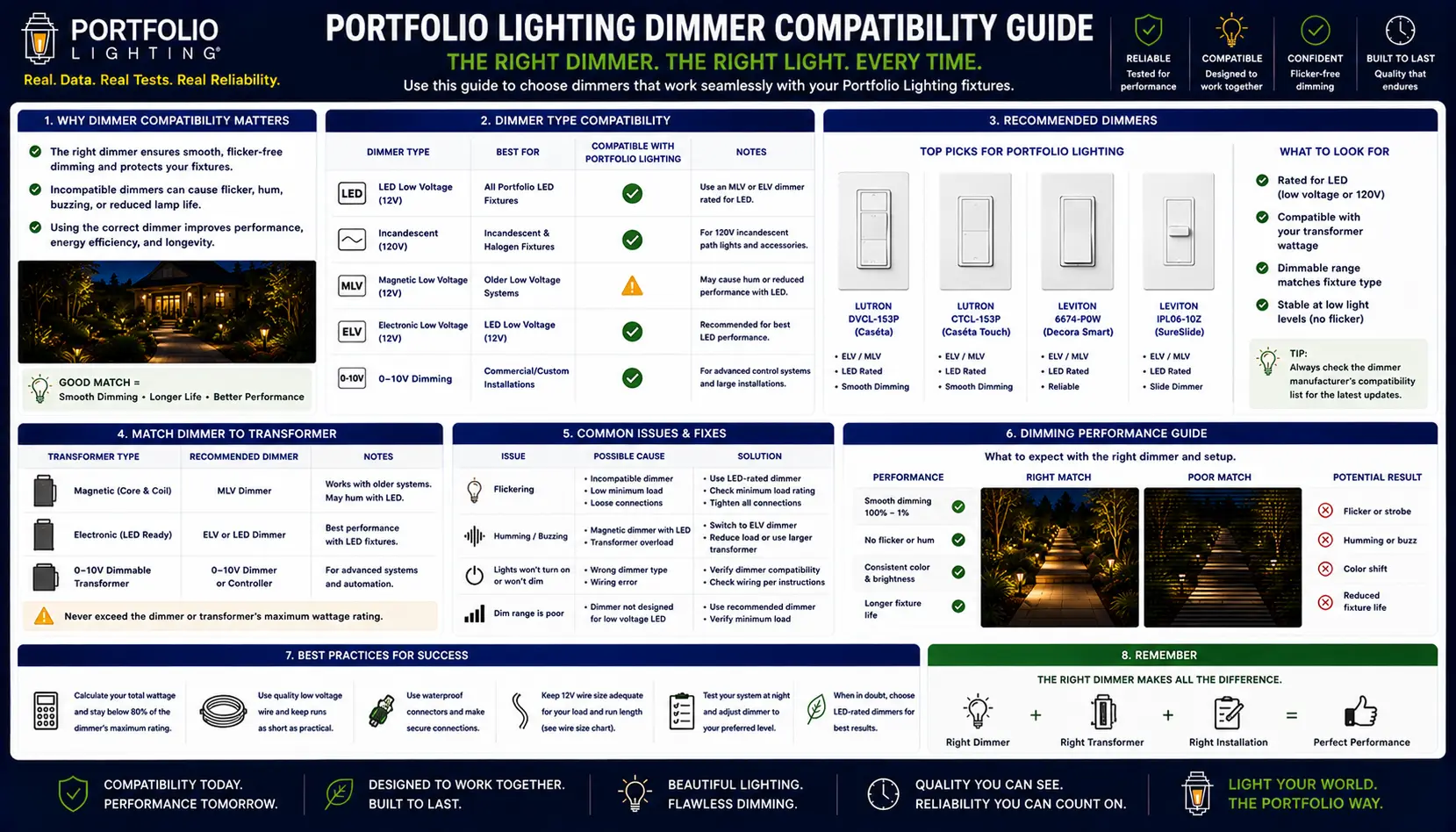
Also called: reverse phase, ELV (electronic low voltage), or simply "LED dimmer." Cuts the trailing end of each AC cycle, creating a smooth voltage reduction without spikes. This dimming signal is compatible with LED driver electronics across the full dimming range.
Trailing edge dimmers are specifically engineered for low-wattage electronic loads — LED fixtures, electronic transformers, and motor loads. They typically have minimum load ratings of 10 watts or less, making them suitable for circuits with only a few LED fixtures.
Also called: forward phase, TRIAC, MLV (magnetic low voltage), or standard incandescent dimmer. Cuts the leading edge of each AC cycle, creating a voltage spike at the point where power is restored. Incandescent filaments smooth this out. LED drivers do not.
Leading edge dimmers have high minimum load ratings (40 to 60 watts or more) designed around the resistance of incandescent bulbs. LED circuits rarely achieve this wattage, producing sub-minimum load operation that causes flickering even if the dimmer type were otherwise compatible.
There is a third category — multi-technology or universal dimmers — that are designed to work with both incandescent/halogen and LED loads. These are trailing edge devices with additional circuitry that allows them to detect load type and adjust their dimming method. They are a practical choice when replacing a dimmer on a circuit that may contain a mix of LED and halogen fixtures, or when you are not certain which load type will be connected in the future. Portfolio energy-efficient LED fixtures are compatible with quality multi-technology dimmers when the minimum load and wattage ratings are matched correctly.
Minimum Load: The Specification That Causes Most LED Dimmer Problems
Most homeowners focus on dimmer type when troubleshooting LED compatibility — but minimum load rating is equally important and more frequently responsible for lingering problems even after an "LED compatible" dimmer has been installed. This specification is printed on every dimmer but rarely understood.
What Minimum Load Means and Why It Matters
Every dimmer requires a minimum amount of connected wattage to operate correctly. This minimum load requirement exists because the dimmer's internal sensing circuit uses the connected load to complete its own operating circuit — at wattages below the minimum, the sensing circuit does not have enough load to function as designed. The result is erratic behavior: flickering, ghost lighting (fixture glows dimly even when the dimmer is at zero), limited dimming range, or inability to turn off completely.
For incandescent dimmers, minimum loads of 40 to 100 watts were never a problem — a single 60-watt incandescent bulb met or exceeded the minimum. For LED dimmers controlling Portfolio recessed LED fixtures, the math changes completely. Four LED recessed fixtures at 6 watts each total only 24 watts. If the LED dimmer has a 25-watt minimum load, those four fixtures are below the minimum — producing exactly the flickering and ghost lighting that appears to be a compatibility problem but is actually a load problem.
Calculating Your Circuit's Actual Load
Before selecting a replacement dimmer, calculate the total wattage of all LED fixtures on the circuit the dimmer controls. This is the sum of every fixture's wattage rating — not lumen output, not the old incandescent equivalent rating, but the actual LED wattage printed on the fixture specification label or in the product documentation.
| Circuit Example | Total LED Load | Required Dimmer Min. Load | Compatible Dimmer Type |
|---|---|---|---|
| 2 × LED recessed at 6W each | 12W total | Must be 10W or less | LED trailing edge dimmer with 10W or lower minimum. Standard LED dimmers at 25W minimum will fail at low dim levels. |
| 4 × LED recessed at 6W each | 24W total | Must be 20W or less | Most quality trailing edge LED dimmers with 10–20W minimum work correctly. Verify spec sheet. |
| 6 × LED recessed at 9W each | 54W total | Any standard LED dimmer | 54W load is above the minimum of almost any LED dimmer. Focus on dimmer type (trailing edge) rather than minimum load. |
| 3 × LED pendants at 8W each | 24W total | Must be 20W or less | Trailing edge LED dimmer with 10–20W minimum. Portfolio pendants typically list dimmer compatibility in product spec sheets. |
| 1 × LED flush mount at 15W | 15W total | Must be 10W or less | Single low-wattage fixture is the most demanding minimum load scenario. Choose a dimmer specifically rated for single-fixture low-wattage LED loads. |
| Mixed: 4 × 6W + 2 × 8W LED | 40W total | Any standard LED dimmer | 40W mixed load is sufficient for most LED trailing edge dimmers. Verify all fixtures on circuit are LED — any remaining halogen on a shared circuit changes the calculation. |
Dimming compatibility cannot be judged only by whether the light turns on and responds to the control. Many drivers produce acceptable current distortion at full output but develop much higher THD near minimum dim, where the input current may arrive in short, irregular pulses. That behavior can cause audible noise, flicker, dropout, or interference with other electronics. The LED driver harmonic distortion compliance guide explains why drivers should be tested at full output, partial output, and minimum stable dimming—not at full load alone.
Neutral Wire Dimmers: Why They Exist and When You Need One
Traditional dimmers — both leading edge and trailing edge — use the load (the fixture) to complete their internal sensing circuit, even when dimmed low. This is called "parasitic power" or "load-borrowing." It works because incandescent bulbs provide enough resistance at any point in the dimming range for this parasitic current to flow without noticeably affecting the light output. LED drivers at very low dim levels may not provide sufficient parasitic current path, which is one mechanism behind ghost lighting and flickering at the low end of the dimming range. Neutral wire dimmers solve this problem by powering their own electronics from the neutral rather than from the load.
Standard Dimmer Wiring (No Neutral)
A standard switch or dimmer installation has two wires at the switch box: a hot (black) wire from the panel and a switched hot (black) wire going to the fixture. There is no neutral wire at the switch. The dimmer connects in series between these two wires — current flows from the panel through the dimmer to the fixture and back through the neutral at the fixture, not through the switch box. This is the standard residential wiring configuration in older homes — single-gang switch boxes with two-wire cable (black + white + bare ground, where the white is used as switched hot).
Neutral Wire Dimmer Wiring
Newer homes built to current NEC requirements run three-wire cable to switch boxes (black + white + red + bare ground), providing a true neutral at the switch location. This neutral allows smart dimmers and neutral-wire LED dimmers to power their own electronics independently — without borrowing current from the load. These dimmers have a distinct wiring connection for the neutral (typically a blue wire on the dimmer) that connects to the white neutral in the box.
Neutral wire dimmers generally provide better LED performance because they do not need to use the fixture as part of their power supply circuit. They can completely cut power to the fixture without any parasitic current flowing through it — eliminating ghost lighting entirely and providing a cleaner off state. For Portfolio mood lighting applications where precise dimming at very low levels creates atmospheric illumination, neutral wire dimmers provide the cleanest performance across the full dimming range.
| Your Wiring Situation | Neutral Available? | Best Dimmer Choice | Notes |
|---|---|---|---|
| Older home, 2-wire cable to switch | No | No-neutral trailing edge LED dimmer | Must be specifically rated for no-neutral installation. Leviton, Lutron, and GE make no-neutral LED-compatible options. Minimum load still applies. |
| Newer home, 3-wire cable to switch | Yes | Neutral-wire trailing edge LED dimmer or smart dimmer | Best performance. Neutral wire available at the switch box (the white wire when a red wire is also present). Widest range of compatible dimmers available. |
| Uncertain — need to verify | Unknown | Check before purchasing | Turn off power at breaker. Remove switch plate. If the box contains 3 wires plus ground (black, white, red, bare), neutral is present. If only 2 wires plus ground (black, white, bare), no neutral — the white is being used as switched hot. |
| Smart home integration desired | Prefer yes | Smart dimmer with neutral | Most smart dimmers perform significantly better with a neutral. No-neutral smart dimmers exist but have more limited LED compatibility. See the smart dimmer section below. |
Dimmability by Portfolio Fixture Type
Not all Portfolio LED fixtures are dimmable — and among those that are, the specific dimmer requirements vary by fixture category. This section maps each Portfolio fixture type to its dimmability status and the dimmer requirements that apply.
Portfolio Integrated LED Fixtures
Portfolio integrated LED fixtures — where the LED array and driver are permanently built into the fixture housing rather than using replaceable bulbs — are the most common source of dimmer compatibility questions. These fixtures have their LED drivers permanently installed, and the driver's dimmer compatibility specifications are fixed at the factory. The fixture's packaging and specification sheet will state whether it is dimmable and, if so, which dimmer types are compatible. Most Portfolio integrated LED recessed lights, flush mounts, and pendants are dimmable, but some lower-cost models at the entry level of the range are non-dimmable — attempting to connect them to a dimmer will not damage them but will produce no dimming effect or will cause buzzing.
Portfolio Recessed Lighting
Portfolio recessed lighting fixtures — both integrated LED and those using replaceable LED bulbs — are typically dimmable when the dimmable version is selected. Recessed fixtures frequently run on multi-fixture circuits where minimum load is the critical specification — six 6-watt LED recessed fixtures on a single dimmer total only 36 watts, which is below the minimum load of many older LED dimmers. Always select a dimmer with a minimum load at or below the total circuit wattage. Portfolio recessed fixtures with integrated LED drivers list compatible dimmer models in their product documentation.
Portfolio Pendant and Chandelier Fixtures
Portfolio pendant fixtures and chandeliers vary widely in dimmability depending on whether they use integrated LED, replaceable LED bulbs, or (in older models) incandescent or halogen lamps. Pendants and chandeliers using replaceable LED bulbs are dimmable only if the specific bulb installed is rated as dimmable — an LED bulb labeled "not dimmable" will produce buzzing or flickering on any dimmer. Integrated LED pendants and chandeliers are dimmable when the product is so labeled. For chandelier applications where dimming to low atmospheric levels is part of the mood lighting design, verify that the minimum dim level meets your requirements — some LED drivers have a minimum dim level of 10 to 20% before they flicker or drop out entirely.
Portfolio Sconces and Wall Lighting
Portfolio wall sconces and wall lighting fixtures are often installed in rooms where dimming is desirable — living rooms, dining rooms, and staircase walls where the layered staircase lighting design benefits from dimming capability in the evening. Most Portfolio sconces with integrated LED or standard LED bulb sockets are compatible with trailing edge LED dimmers when the total circuit wattage is sufficient for the dimmer's minimum load. Sconces on stair walls are often on circuits with relatively low total fixture count — verify minimum load before selecting the dimmer.
Portfolio Under-Cabinet and Strip Lighting
Portfolio under-cabinet lighting, strip lighting, and linear lighting products use LED strip drivers that have specific dimming input requirements. Many LED strip systems use 0-10V dimming or PWM dimming — these are not controlled by standard wall dimmers at all. They require a dimming controller that communicates with the strip driver using the appropriate protocol. Standard TRIAC or trailing edge wall dimmers connected to a 0-10V or PWM strip system will produce erratic results. Always verify the dimming protocol required by the specific strip driver before selecting a control method. For strip lighting used as accent or under-cabinet task lighting, consult the driver specification sheet for the correct dimmer or controller type.
Portfolio Adjustable Downlights
Portfolio adjustable downlights — the aimable gimbal-style recessed fixtures used for accent and task lighting — are typically dimmable integrated LED fixtures. Their wattage is usually higher than standard recessed fixtures (9 to 15 watts each), which helps with minimum load requirements on multi-fixture circuits. The adjustable driver design in these fixtures is generally well-compatible with modern trailing edge LED dimmers. Verify the specific product's dimmer compatibility list in the installation instructions before selecting a wall dimmer.
Full Dimmer Compatibility Reference Table
This table maps every dimmer type, technology, and scenario to its compatibility with Portfolio LED fixtures — with the specific action required for each situation.
Portfolio commercial LED systems may use 0–10V, phase-cut, digital, or non-dimming drivers, and those control methods are not interchangeable. Installing a phase-cut driver on a 0–10V control system—or leaving control leads incorrectly terminated—can cause flicker, limited dimming range, failure to shut off, or repeated driver resets. The Portfolio commercial lighting driver and control guide explains how to decode the original control option before replacing a commercial driver or wall control.
| Dimmer Type / Scenario | Compatible with Portfolio LED? | Common Symptoms if Wrong | Action Required |
|---|---|---|---|
| Old incandescent TRIAC dimmer (600W, no LED mention) | Not Compatible | Flickering below 50%, buzzing, limited range | Replace with trailing edge LED-compatible dimmer. Match minimum load to total circuit LED wattage. |
| Trailing edge LED-compatible dimmer, correctly loaded | Compatible | None — smooth dimming throughout range | No action needed. This is the correct configuration. |
| LED-compatible dimmer but load below minimum | Partial | Ghost lighting, flickering at low levels, won't turn off fully | Replace dimmer with lower minimum load rating. Add load resistor as last resort if wiring limits options. |
| Multi-technology (universal) dimmer, LED load | Compatible | None when load is correctly matched | Verify minimum load. Multi-tech dimmers are trailing edge devices with additional circuitry — generally excellent with LED. |
| Smart dimmer, neutral wire available | Compatible | None when correctly configured | Best option for smart home integration. Verify LED load compatibility list in smart dimmer documentation. |
| Smart dimmer, no neutral wire, older home | Variable | Flickering, limited range, ghost lighting possible | Choose a no-neutral smart dimmer specifically rated for low-wattage LED loads. Performance may be less smooth than neutral-wire version. |
| Dimmer controlling non-dimmable LED fixture | Not Compatible | Buzzing, flickering, or no dimming effect | Replace fixture with dimmable version, or remove dimmer and install standard switch. Non-dimmable drivers cannot be made dimmable by changing the dimmer. |
| Magnetic low voltage (MLV) dimmer with LED | Not Compatible | Severe flickering, possible driver damage | MLV dimmers are leading edge devices designed for magnetic transformers. Replace with trailing edge LED dimmer. |
| Electronic low voltage (ELV) dimmer with LED | Compatible | None — ELV is trailing edge | ELV (electronic low voltage) is the original name for trailing edge dimming. These dimmers are LED-compatible when load is correctly matched. |
| 0-10V controller with standard LED fixtures | Not Compatible | No dimming effect — wall switch function only | 0-10V control requires LED drivers with 0-10V dimming input. Standard household LED fixtures use phase-cut dimming. Use trailing edge wall dimmer instead. |
| Rotary or slider dimmer, unlabeled, unknown age | Unknown | Varies — may work partially or not at all | If LED label is not present on the dimmer faceplate or wallplate, assume it is an incandescent TRIAC type. Replace with labeled LED-compatible trailing edge dimmer. |
Smart Dimmers and Portfolio LED Fixtures
Smart dimmers — wall dimmers with Wi-Fi, Zigbee, Z-Wave, or Matter connectivity that allow app, voice, and automated control — are increasingly the dimmer of choice for homeowners who want portfolio mood lighting, circadian-aware dimming schedules, and integration with smart home platforms. The compatibility considerations are the same as for standard dimmers, plus additional protocol-specific requirements.
Why Smart Dimmers Have Better LED Compatibility in General
Most smart dimmers from major manufacturers (Lutron, Leviton, GE/Enbrighten, Kasa, Sonoff) are designed specifically for LED loads — they use trailing edge dimming technology, have low minimum load ratings, and are engineered to handle the electronic characteristics of LED drivers. Many include auto-calibration features that detect the type of LED load connected and adjust their dimming curve accordingly. This means smart dimmers often provide better LED performance than equivalent non-smart trailing edge dimmers from the same era.
The Portfolio wireless lighting range and broader smart home integration for Portfolio fixtures is discussed in our smart lighting guide. For indoor applications, the dimmer selection principles are the same as for any other room in the home — the smart home platform integration is an additional requirement on top of the fundamental LED compatibility requirements.
Smart Dimmer Platform Compatibility
Smart dimmers connect to smart home platforms through various wireless protocols. The most important consideration for Portfolio LED fixtures is not the wireless protocol but the dimmer's underlying LED compatibility — a Zigbee dimmer with poor LED compatibility will flicker with Portfolio fixtures just as badly as a TRIAC incandescent dimmer. Verify that any smart dimmer you select is rated for trailing edge LED operation with a minimum load at or below your circuit's total LED wattage before considering which smart platform it connects to.
Dimming Schedules for Circadian Health
One of the highest-value uses of a smart dimmer with Portfolio LED fixtures is implementing circadian-aware dimming schedules — automatically reducing light levels and (where the fixture supports it) shifting toward warmer color temperatures in the evening hours before sleep. The same biological principles covered in our circadian landscape lighting guide apply equally to indoor lighting: dimming Portfolio indoor fixtures to 20 to 30% in the two hours before sleep, particularly in rooms visible from bedrooms, reduces melatonin suppression and supports better sleep onset. A smart dimmer that executes this automatically every evening provides the consistency that manual dimming cannot reliably deliver.
For homes with Portfolio motion sensor lighting in hallways and stairways, a smart dimmer that integrates with motion sensor logic can automatically set dim levels based on time of day — full brightness during daylight hours, 10 to 20% during nighttime motion-activated events — providing nighttime safety illumination at melatonin-protective low levels.
Fix Every Dimmer Problem: Symptom-by-Symptom Diagnosis and Fix
These are the specific dimmer-related problems that Portfolio LED fixture owners experience. Each has a specific cause and a specific fix — not a generic recommendation to "check compatibility."
How to Select the Right Dimmer for Portfolio LED Fixtures: The Decision Process
Follow this sequence every time you need to select a dimmer for a Portfolio LED fixture circuit. It takes five minutes and eliminates every common compatibility mistake.
- Verify the fixture is dimmable. Check the fixture packaging or product specification sheet. Look for the word "dimmable" and the statement of dimmer type compatibility. If the fixture is labeled "non-dimmable," stop here — no dimmer will work with it. If it is dimmable, continue.
- Calculate total circuit wattage. Add up the actual LED wattage (not lumen output, not incandescent equivalent) of every fixture on the circuit the dimmer will control. Write this number down — it determines the minimum load requirement for the dimmer you select.
- Check for neutral wire availability. Turn off the circuit breaker for the switch you are replacing. Remove the switch plate and wall box cover. Count the wires in the box: if you see three conductors plus ground (black + white + red + bare), a neutral is present. If you see two conductors plus ground, no neutral is available. This determines whether you can use a neutral-wire dimmer.
- Select dimmer type based on answers above.
- Neutral available: Choose a trailing edge LED dimmer with neutral, or a smart LED dimmer with neutral. Minimum load must be at or below your calculated circuit wattage.
- No neutral: Choose a no-neutral trailing edge LED dimmer specifically rated for your circuit wattage range. Minimum load must be at or below your calculated circuit wattage.
- Check the fixture's listed compatible dimmers. The Portfolio fixture documentation or product page typically lists specific dimmer model numbers that have been tested for compatibility. Using a listed dimmer eliminates guessing — the combination has been verified to work correctly across the full dimming range.
- Verify maximum load rating. The dimmer's maximum rated wattage must be equal to or greater than the total circuit wattage calculated in step 2. Do not exceed 75% of the dimmer's rated maximum for continuous loads.
Related Portfolio Lighting Guides
- Portfolio Lighting Products Overview
- Portfolio Indoor Lighting
- Portfolio Integrated LED Lighting
- Portfolio LED Lighting
- Portfolio Recessed Lighting
- Portfolio Adjustable Downlights
- Portfolio Pendant Lighting
- Portfolio Chandeliers
- Portfolio Wall Sconces
- Portfolio Wall Lighting
- Portfolio Flush Mount Lighting
- Portfolio Under-Cabinet Lighting
- Portfolio Strip Lighting
- Portfolio Linear Lighting
- Portfolio Mood Lighting
- Portfolio Energy-Efficient Lighting
- Portfolio Motion Sensor Lighting
- Portfolio Wireless Lighting
- Portfolio Ambient Lighting
- Portfolio Staircase Lighting Guide
- Portfolio LED Lights Flickering
- Circadian Lighting and Sleep Guide
- Portfolio Lighting Installation Guide
- Portfolio Lighting Troubleshooting Hub
Portfolio Lighting Dimmer Compatibility — FAQ
Why do my Portfolio LED lights flicker on a dimmer?
Portfolio LED lights flicker on a dimmer most commonly because the dimmer is a leading edge (incandescent TRIAC) type that was designed for resistive loads — incandescent and halogen bulbs. Leading edge dimmers cut the front of each AC voltage cycle, creating a high-voltage spike that LED drivers react to unpredictably at low dim levels. The fix is replacing the dimmer with a trailing edge LED-compatible dimmer rated for the total connected LED wattage, with a minimum load specification at or below your actual circuit's wattage. This resolves flickering in the vast majority of cases immediately.
What type of dimmer works best with LED lighting?
Trailing edge dimmers — also called reverse phase, ELV (electronic low voltage), or LED-compatible dimmers — work best with LED lighting. They cut the trailing end of each AC cycle rather than the leading edge, producing a smooth voltage reduction without the spikes that cause LED driver instability. Modern smart dimmers from Lutron, Leviton, GE, and similar manufacturers are trailing edge devices designed specifically for LED loads. The most important secondary specification is minimum load — the dimmer's minimum load rating must be at or below your total connected LED circuit wattage.
Can I use my old incandescent dimmer with Portfolio LED fixtures?
In most cases, no. Old incandescent dimmers use leading edge TRIAC technology designed for resistive loads. When used with LED fixtures, they produce flickering at low dim levels, a limited effective dimming range (typically only 40 to 100%), audible buzzing, and possible inability to turn off completely. The dimmer must be replaced with an LED-compatible trailing edge dimmer. Some newer LED fixtures include drivers tolerant of leading edge dimming — check the fixture's specification sheet for "compatible dimmer types" before assuming replacement is necessary.
What is minimum load and why does it matter for LED dimmers?
Minimum load is the lowest wattage a dimmer requires connected to it in order to function correctly. LED fixtures draw far less wattage than incandescent equivalents — a circuit of four LED downlights at 6 watts each totals only 24 watts. If the dimmer has a 40-watt minimum load and only 24 watts is connected, the dimmer operates below its minimum requirement, producing ghost lighting, flickering, or inability to turn off. LED-compatible dimmers have minimum loads of 10 watts or less. Always calculate total circuit wattage and verify the dimmer's minimum load specification before purchasing.
Do LED dimmers need a neutral wire?
Traditional dimmers do not require a neutral wire — they borrow current through the load to power their sensing circuit. Many modern smart dimmers and some LED-optimized dimmers do require a neutral wire — they use the neutral to power their electronics independently of the load, which eliminates ghost lighting and improves low-level dimming performance. If your switch box does not have a neutral wire, choose a no-neutral smart dimmer or trailing edge LED dimmer specifically rated for no-neutral installations. Do not install a neutral-required dimmer in a no-neutral box — it will malfunction or be damaged.
My Portfolio LED lights glow faintly even when the dimmer is off — what is wrong?
This is called ghost lighting and it is caused by the dimmer's minimum load specification being higher than your actual connected LED wattage. The dimmer uses parasitic current through the load to power its sensing circuit — when this current flows through an LED driver, the driver produces a small amount of light even though it should be off. The fix is replacing the dimmer with one that has a lower minimum load rating — ideally 10 watts or less. This is a load mismatch problem, not a dimmer type problem — even the correct trailing edge LED dimmer will ghost if its minimum load is higher than the circuit's total LED wattage.