
Claims Database Entry
Legal Theory
Premises liability negligence: property owner owed a duty to maintain safe conditions on their property, breached that duty through the non-compliant landscape lighting installation near the pool, the breach caused the electrocution injury, and the injury caused compensable damages. Where the NEC violation is established, the doctrine of negligence per se may apply: violation of a safety statute (NEC as adopted) establishes breach of duty without requiring the plaintiff to separately prove that the condition was unreasonably dangerous. Per Shouse Law Group's California electrocution lawsuit analysis: "Under premises liability laws, property owners and occupiers owe others a duty of care to maintain their property and warn others about any dangerous conditions."
When evaluating lighting products, homeowners often focus on brightness, efficiency, and appearance while overlooking manufacturing quality standards. Product material compliance programs such as RoHS were developed to reduce the use of certain hazardous substances in electronic equipment and lighting components. Our RoHS compliance landscape lighting guide provides an overview of how these standards affect modern fixtures, electronics, and replacement products.
Who Is Sued
- Property owner: Primary defendant — knew or should have known about the hazardous pool-adjacent condition
- Installing contractor: If the non-compliant installation was the contractor's work — negligence, professional malpractice where applicable
- Landscape company: If a landscaping company installed fixtures too close to the pool — negligent installation
- Equipment manufacturer: If a defective product contributed — product liability claim alongside negligence claims
The NEC Violation as Breach Evidence
NEC Article 411.4(2) prohibits landscape luminaires within 10 feet of pools, spas, and fountains. NEC 680.22(B)(4) requires secondary-side GFCI protection for fixtures within 5–10 feet. A correction notice documenting either violation is proof the property owner had actual knowledge of the breach. An open permit is proof they failed to correct it. The IAEI Magazine documentation confirms the specific hazard: "There are many existing low-voltage lighting installations installed after the pool installation inspection has occurred where the luminaires are installed within 3 to 5 feet of the water's edge at or near ground level, which clearly is a violation." See the pool lighting clearance guide and the NEC inspection checklist.
- Correction notice for pool setback violation
- Open permit for landscape lighting work
- Photographs showing fixture within 10 feet of pool
- Absence of secondary-side GFCI documentation
- Inspector's violation report noting pool proximity
- Contractor invoices showing dates of installation near pool
- Expert electrical engineer testimony on code compliance
- Permit issued and closed with final inspection approval
- As-built documentation showing correct setback
- Evidence fixture was moved after original installation without owner's knowledge
- Secondary-side GFCI installed and documented
- Warning signs posted at pool area
- Plaintiff was a trespasser (lower duty of care)
- No causal link between fixture position and specific injury
Legal Theories Available
Breach of express contract: The contractor agreed to install a compliant system and didn't. Per Super Lawyers' construction defect analysis: "A breach of contract occurs when a party fails to comply with the contract's express or implied terms." If the contract specified code-compliant installation and the installation failed inspection, the breach is established.
Breach of implied warranty of workmanship: Courts in most states recognize an implied warranty that construction work will be performed in a workmanlike manner — meaning competently, using proper materials, and complying with applicable codes. Per FindLaw: "Courts say that builders and sellers of new construction are responsible for" the implied warranty of habitability and workmanship. This applies to landscape lighting contractors even without an express warranty provision in the contract.
Negligence: The contractor owed a duty to perform work competently and to code, breached that duty through non-compliant installation, the breach caused specific harm (cost of correction, failed inspection, correction notice fines). Per Super Lawyers: "The contractor's breach of duty caused the construction defect you have identified."
Negligent misrepresentation: Per Super Lawyers: "This is where the contractor or architect asserts something to the homeowner as accurate but has no reason to believe it's true. Negligent misrepresentation often comes up in defective design cases. The contractor presents the design as adequate when the contractor does not actually know if the plan meets safety or building codes."
Documented Case Pattern — Louisiana Breach of Contract
Florida Pre-Suit Notice Requirement
Florida requires a specific pre-litigation procedure before filing a construction defect lawsuit. Per Cueto Law Group: "Sixty days before filing a construction defect action, the claimant must provide written notice to the contractor or liable party about the defect and any known losses incurred because of it. The contractor then has the opportunity to inspect the property defect within 30 days of receiving the homeowner's notice. Following the inspection, the contractor must provide a written response to the claimant within 45 days." This 60-day pre-suit notice is required in Florida — failure to provide it can be used to dismiss or delay the claim. Many other states have similar notice requirements. The landscape lighting contractor abandonment guide in the correction notices guide addresses the parallel path when the contractor becomes unresponsive.
The Unlicensed Contractor Payment Bar — Reversal of the Normal Recovery Framework
In states requiring licensing for landscape lighting work, an unlicensed contractor faces a unique obstacle in any payment dispute: the contract is often void as a matter of law. Per the NY Construction Law documentation: "Failure to comply can render a contract void and leave a contractor without any right to payment, even if the work was done properly and the owner benefited." In California, CSLB Code Section 7031(a) explicitly bars unlicensed contractors from collecting compensation for work requiring a license. The homeowner who hired an unlicensed contractor and received non-compliant work may have both a claim against the contractor AND a defense against any contract counterclaim — both arising from the contractor's unlicensed status. See the code enforcement cases guide for the NY court documentation.
- Written contract specifying code-compliant installation
- Correction notice or failed inspection report
- Second contractor's assessment documenting defects
- Cost of correction documented by licensed contractor
- Photographs of non-compliant conditions
- Contractor's license status (unlicensed = additional claim)
- Contractor's advertising claims ("code compliant")
- Homeowner directed specific installation choices
- Changes made after contractor left site caused violation
- Homeowner failed to pay for required permit pulling
- Contract excluded specific items
- Violation is marginal and non-hazardous
- Homeowner waited too long to complain (SOL)
- Plants died from improper watering, not installation defect
The 811 Call Framework and Private Buried Utilities
811 (Call Before You Dig) is the national notification system that locates utility company infrastructure — gas lines, electric transmission cables, water lines, and telecoms — before excavation. 811 does NOT locate private buried utilities, including homeowner-installed landscape lighting cable. Per Grit Insurance's documented analysis: "Gas lines can sit as shallow as 12 inches, and cable or fiber optic lines are often buried at 6 to 12 inches. There is no depth exemption." Federal law requires 811 calls before any excavation — but only covers utility-company infrastructure.
This creates a specific liability framework for buried landscape lighting cable: the 811 call is necessary and required, but it is not sufficient. The property owner has a separate duty to disclose the existence of private buried utilities (landscape cable) to any excavating contractor. Per the as-built diagram requirements guide: "Before any excavation, provide every contractor with a copy of the landscape lighting as-built diagram" and "require acknowledgment in writing."
Liability Allocation Framework for Utility Strikes
Per Weltman Law's documented excavation damage analysis: "The responsibility for paying for these damages depends on several factors, including contract terms, the nature of the damage, and the contractor's liability insurance." The specific allocation drivers:
- Contractor failed to call 811: Contractor bears significant liability. Robson Forensic documented: "Contractors must take reasonable measures to locate and avoid underground facilities prior to digging and excavating." Failure to call 811 before any excavation is a violation of federal law (Pipeline Safety Improvement Act of 2002) and establishes negligence.
- Property owner had as-built documentation, disclosed it, contractor struck cable anyway: Liability shifts substantially to the contractor. The disclosure converts what was unknown to the contractor into known information they had a duty to avoid.
- Property owner had no documentation, gave no disclosure, contractor struck cable with no warning: Shared liability or reduced contractor liability. Per the 811 subrogation analysis: "What if the correct measures were taken by the property owner, and the contractor accidentally hit a utility line anyway?" This creates a more contested liability question.
Insurance Subrogation in Utility Strike Claims
When a utility strike damages buried landscape lighting cable and the property owner's insurance pays the repair cost, the insurer acquires the owner's right to sue the contractor who caused the damage — this is subrogation. Per Rathbone Group's subrogation analysis: "Did a person/company dig without calling 811 or another appropriate route to locate underground utilities first? There's your liability for the loss of use and/or property that results from digging into the utility." Subrogation claims are pursued by the insurer's specialized attorneys and typically resolve through contractor GL insurance — not out of pocket. GL premium impact of a single utility strike claim: 15–30% increase at renewal. Multiple claims or a severe incident: possible relegation to surplus lines at 2–3× standard rates.
- As-built diagram showing cable location given to contractor pre-excavation
- Written acknowledgment contractor received the diagram
- Surface marking flags showing cable path at time of excavation
- Contractor's failure to call 811
- Contractor ignored markings during excavation
- Photographs of cable location before excavation
- 811 call was made and no utilities were marked in strike area
- No as-built or disclosure from property owner before work began
- Cable burial depth was non-compliant (not 6 inches) creating unreasonable hazard
- Contractor took all reasonable precautions
- Property owner had no knowledge cable existed in that location
The Private Nuisance Theory
Per Nolo's documented analysis: "Like noisiness, light pollution, also known as light trespass, is recognized as a nuisance by courts in most parts of the United States. A nuisance is a type of conduct that disturbs a neighbor's use or enjoyment of property." Private nuisance requires: an unreasonable and substantial interference with the plaintiff's use and enjoyment of their property. Courts assess the severity, continuity, and character of the neighborhood when determining whether the interference is "unreasonable." A landscape uplight that projects bright light onto a neighbor's bedroom window every night is typically found to be an unreasonable interference. A pathway light that barely reaches the property line is not.
Documented Cases from IDA Database
Primary Remedy: Injunctive Relief, Not Damages
Per Ohio Bridge Legal's documented Ohio light trespass analysis: "Civil nuisance action: a court may order the offending party to reduce light intensity, install shields, or modify operating hours." Injunctive relief is the primary remedy most courts award in light trespass cases — requiring the defendant to make specific changes to the lighting rather than paying monetary damages. This reflects the courts' preference for remedying the ongoing nuisance rather than compensating for past harm. Per GavelInsight California documentation: "Abatement (The Goal): The court orders the neighbor to remove, move, or shield the light." Monetary damages — property diminution, sleep disturbance, emotional distress — are available but secondary to injunctive relief as the primary outcome sought and obtained.
The Trespass-to-Land Theory — Less Common but Available
Per LegalClarity's Texas light trespass analysis: "Some plaintiffs pursue trespass claims, arguing that unwanted artificial light constitutes a physical invasion of their property. While Texas courts have been hesitant to recognize light as trespass, there have been cases where continuous, intentional" light projection onto another's property was treated as trespassory. The trespass theory adds a potential punitive damages pathway not available under pure nuisance theory. See the light trespass laws guide for the complete civil and ordinance framework.
- Footcandle measurements showing illuminance at neighbor's windows
- Photographs showing light condition at night
- Medical documentation of sleep disruption
- Local ordinance violation evidence (if applicable)
- Prior complaints documented in writing to defendant
- Neighbor witnesses confirming persistence and severity
- Real estate appraiser testimony on property diminution
- Lighting complies with all applicable ordinances
- Plaintiff is unusually sensitive to standard lighting levels
- Lighting is necessary for security or safety
- Character of neighborhood (commercial area, mixed use)
- Available mitigation refused by plaintiff
- Variance or permit approving the lighting configuration
Three Property Damage Mechanisms
1. Cable fire from non-direct-burial cable in soil. Standard NM-B (Romex) cable buried underground absorbs soil moisture over time, degrading the insulation and creating a fault condition. The fault can generate enough heat to ignite dry organic material in the trench — mulch, leaf litter, root material. The non-direct-burial cable in soil is a code violation (NEC Table 300.5 and the direct-burial cable type requirement) that creates a documented fire hazard. When a fire occurs, the fire investigator will examine the buried cable; finding NM-B instead of direct-burial rated cable establishes the code violation as the proximate cause.
2. Transformer overload fire. A landscape lighting transformer loaded beyond its rated capacity, or with a faulty connection at a DIY-installed splice, can overheat and ignite. The overload condition is a code violation under NEC 411 (maximum 25A output) and the connection quality standard. Transformer fires are typically investigated by the insurer's fire cause and origin expert; if the investigation reveals overload or improper connection, the contractor who created the condition is liable. The GL subrogation claim against the installing contractor is the typical recovery path.
3. Moisture intrusion from improper housing installation. Landscape fixtures that are not properly sealed or that use non-direct-burial connectors in continuously wet locations can allow water intrusion. For above-grade fixtures, improper sealing allows moisture into the housing, which can cause corrosion, arc faults, or short circuits. Property damage from these conditions is typically pursued under the breach of workmanship theory — the contractor failed to install the fixtures per the manufacturer's instructions (NEC 110.3(B) requires installation per listing) and that failure caused the damage.
Insurance Subrogation as the Common Recovery Path
For property damage claims, the homeowner's insurer typically pays the covered portion of the loss and then exercises subrogation rights against the contractor who caused it. Per Rathbone Group's subrogation analysis: "When damage is caused by negligent digging, boring, excavation or other activity, subrogation is the path to recovery." The same principle applies to contractor-caused property damage from improper landscape lighting installation. The insurer's subrogation attorneys are experienced at pursuing recovery from contractor GL insurers — this is a standard claim pattern in the insurance industry.
- Fire investigator report identifying cable type as fire cause
- Photographs of NM-B (non-compliant) cable in trench
- Contractor invoices showing what materials were used
- Code compliance expert confirming violation
- Causal chain from code violation to damage
- Contractor's insurance GL policy covering the claim
- Alternative cause of damage (unrelated electrical event)
- Homeowner modifications after contractor completed work
- Time elapsed since installation (SOL)
- Homeowner-directed changes that created the hazard
- Force majeure (lightning strike, etc.)
The Disclosure Duty Framework
Property sellers in most states are required to disclose known material defects to buyers. Code violations constitute known defects when the seller has received formal notice — either a correction notice, an open permit, or a citation. For landscape lighting, the seller who received a correction notice for a pool setback violation, failed to correct it, and sold the property without disclosing the open permit and uncorrected violation has exposed themselves to:
- Fraudulent concealment claim: Intentional failure to disclose a known material defect
- Negligent non-disclosure: Failure to exercise reasonable care in disclosing known material conditions
- Breach of seller's disclosure duty: Statutory violation of state disclosure laws where landscape lighting violations constitute required disclosure items
The Correction Notice as Constructive Knowledge Documentation
Per Robinson & Henry's Colorado real estate analysis: "You can be sued if the result of unpermitted work injures someone or damages their property." For post-sale claims, the correction notice serves double duty: it proves the seller knew about the violation, and it establishes the physical condition that harmed the buyer (either through injury risk, cost to correct, or marketability impact). When a buyer discovers an open permit and uncorrected landscape lighting violation after closing, the seller's correction notice establishes that they knew. "I didn't know" is unavailable to a seller who received and signed for a correction notice by certified mail. See the complete post-sale disclosure framework in the correction notices guide.
Remedies in Post-Sale Disclosure Claims
- Rescission: In extreme cases, the buyer may be able to rescind the sale entirely and return the property in exchange for a refund
- Cost of correction: The cost to bring the landscape lighting into compliance — retroactive permit fees, correction work, fines accumulated during the uncorrected period
- Diminution in value: Difference between the purchase price and the true market value had the violations been disclosed
- Consequential damages: Any fines that continued to accrue after the buyer's purchase for violations they didn't know they inherited
- Certified mail receipt showing seller received correction notice
- Building department records showing open permit at date of sale
- Seller's disclosure form showing question about open permits was left blank or answered "No"
- Cost of correction incurred by buyer after discovery
- Fines accrued after sale for pre-sale violation
- Title search showing permit search wasn't conducted
- Disclosure form provided, buyer signed accepting "as is"
- Buyer's inspector could have discovered permit issue
- Violation was minor and non-hazardous
- Seller genuinely didn't know correction notice was open
- Buyer's due diligence period gave adequate time for permit search
- Purchase price reflected "as-is" condition
The HOA Enforcement Mechanism
HOA lighting rule violations operate through a distinct enforcement mechanism from municipal code enforcement. The CC&Rs (Covenants, Conditions, and Restrictions) create a contractual framework between the homeowner and the HOA — when a homeowner buys in an HOA community, they agree to be bound by the CC&Rs, which typically include lighting standards, ARC approval requirements for exterior modifications, and enforcement procedures including fines.
When a homeowner installs landscape lighting that violates HOA CC&Rs — wrong fixture style, wrong color temperature, without ARC approval, creating light spill onto neighboring lots — the HOA's enforcement path is: written warning → fine → repeated fine → lien on property → lien enforcement through assessment collection. Per Comfort Experts' documented HOA analysis: "In some cases, you may need to uninstall and replace your lighting, even if it's brand new."
Exposed cords and poorly routed wiring can create unnecessary safety concerns around entrances, sidewalks, driveways, and outdoor gathering spaces. While most seasonal displays operate safely, thoughtful wire management can help reduce tripping hazards and improve overall installation quality. Our hidden holiday lighting wire management guide covers practical approaches for concealing and securing wiring throughout a seasonal display.
Attorney Fee Shifting in HOA Litigation
One of the most consequential aspects of HOA litigation from the homeowner's perspective: CC&Rs and state HOA statutes frequently include attorney fee shifting provisions that require the losing party to pay the winner's legal fees. In an HOA dispute where the HOA wins, the homeowner may owe not just the fines and correction costs but also the HOA's attorney fees — which can exceed the underlying dispute amount for simple lighting violations that are protracted. This fee-shifting dynamic makes HOA lighting disputes economically irrational to litigate unless the homeowner has a strong case, and strongly incentivizes early resolution through ARC approval or correction.
Homeowner Claims Against HOA
The enforcement relationship isn't one-directional. Homeowners have documented successful claims against HOAs for:
- Selective enforcement: The HOA enforced lighting rules against some homeowners but not others similarly situated — selective enforcement violates the CC&Rs and equal protection principles in some states
- Procedural violations: HOA failed to follow its own CC&R procedures for notice, hearing, or fine assessment — violations of the enforcement process itself
- Unreasonable CC&R interpretation: HOA applied CC&R provisions in an unreasonable manner not contemplated by the original document
- Failure to maintain common area lighting: HOA's failure to maintain adequate common area landscape lighting that contributed to an injury
- CC&R provision specifically addressing lighting type/style/brightness
- ARC approval was required and not obtained
- Written warning notices with homeowner receipt confirmation
- Photographs documenting the non-compliant fixture
- Consistent enforcement of same provision against other owners
- Documented fine schedule and proper notice procedures followed
- CC&R provision is ambiguous and doesn't clearly cover this lighting type
- HOA failed to follow its own enforcement procedures
- Selective enforcement — same condition tolerated elsewhere
- ARC approval was sought and HOA failed to respond within required period
- Lighting complies with applicable municipal code
- HOA's interpretation is unreasonable
Statute of Limitations by Claim Type
The statute of limitations (SOL) is the deadline by which a claim must be filed or it is permanently barred. For landscape lighting claims, the SOL depends on both the claim type and the state. Missing the SOL is an absolute bar to recovery — no exception regardless of how strong the underlying claim is.
| Claim Type | Typical SOL | SOL Trigger | Key State Examples | Discovery Rule? |
|---|---|---|---|---|
| Pool Electrocution — Personal Injury | 2–3 years (most states) | Date of injury | CA: 2 yr; FL: 2 yr; TX: 2 yr; NY: 3 yr | Yes — clock starts when victim knew/should have known of injury |
| Pool Electrocution — Wrongful Death | 2 years (most states) | Date of death | CA: 2 yr; FL: 2 yr; TX: 2 yr; NY: 2 yr | Limited — typically from date of death, not discovery |
| Contractor Installation Defect — Breach of Contract | 4–6 years (written contract) | Date of breach (typically discovery of defect) | CA: 4 yr; FL: 5 yr; TX: 4 yr; NY: 6 yr | Yes — latent defect rule in many states extends period |
| Contractor Defect — Negligence | 2–3 years | Date of negligent act OR discovery | CA: 3 yr; FL: 2 yr; TX: 2 yr; NY: 3 yr | Yes — discovery rule commonly applied to latent defects |
| Utility Strike — Property Damage | 3–5 years | Date of strike/damage | CA: 3 yr; FL: 4 yr; TX: 2 yr; NY: 3 yr | Limited — damage typically discoverable at time of occurrence |
| Light Trespass — Private Nuisance | 3–5 years (continuous nuisance rule) | Each day is a new cause of action (continuing nuisance) | Varies significantly by state | Yes — continuing nuisance theory allows suit for recent period even if original installation is old |
| Post-Sale Disclosure — Fraud | 3–6 years (fraud SOL) | Date of discovery of non-disclosure | CA: 3 yr from discovery; FL: 4 yr; TX: 4 yr; NY: 6 yr | Yes — fraud SOL typically runs from discovery, not closing date |
| CA New Home — Construction Defect (10-yr latent) | 10 years (latent defects) | Date of substantial completion | California SB 800 — applies to residential new construction | Limited under SB 800 |
Expert Witnesses in Landscape Lighting Liability Claims
Landscape lighting claims frequently require expert testimony to establish technical elements — particularly code compliance, causation, and damages. Understanding which experts are used in each claim type helps both claimants preparing their cases and property owners understanding what expert evidence may be brought against them.
Electrical Engineer — Code Compliance Expert
The primary expert in pool electrocution, contractor defect, and property damage from improper installation claims. Testifies on: whether the installation complied with NEC Article 411, 680, and other applicable code provisions; whether a specific code violation created the hazard that caused the injury; what a code-compliant installation would have looked like; and in contractor defect cases, what the standard of care for professional landscape lighting installation is. Robson Forensic documents: "Contractors must take reasonable measures to locate and avoid underground facilities prior to digging and excavating" — this standard of care testimony is typical of what an electrical engineering expert provides. Per IAEI Magazine's inspector role documentation, even inspector-level experience can provide expert testimony in code compliance disputes.
Forensic Lighting Designer — Photometric Expert
Required in light trespass and dark sky ordinance enforcement cases where the question is whether the installation produces illuminance levels that violate ordinance limits or constitute an unreasonable nuisance. Testifies on: footcandle measurements and their significance; the photometric characteristics of specific fixtures; what design modifications would bring the installation into compliance; and whether the claimed light trespass is within industry norms for similar installations. The photometric expert can also reverse-engineer historical conditions from photographs taken before a dispute arose — determining what illuminance levels likely existed based on fixture specifications and installation geometry. See the photometric plan reading guide.
Fire Cause and Origin Investigator
Required in property damage claims arising from cable fires or transformer overloads. Determines: what caused the fire; whether the fire origin was in the landscape lighting system; what specific condition created the fire risk; and whether that condition was caused by the installer's work or by a post-installation modification. Critically, the fire investigator examines the cable type found at the origin location — finding NM-B (Romex) rather than direct-burial rated cable is a finding that directly links the code violation to the fire cause. Most property insurance companies deploy their own fire cause and origin investigators before paying claims; their findings either support or undermine the subrogation claim against the contractor.
Real Estate Appraiser — Property Diminution Expert
Required in post-sale disclosure claims and light trespass claims where diminution in property value is claimed as damages. Testifies on: whether the undisclosed code violation or continuing light trespass reduced the market value of the property; by how much; what a willing buyer would have paid with full knowledge of the condition; and whether comparable sales support the claimed diminution. Per Ohio Bridge Legal: "Diminution in Property Value: Compensation for the decrease in the value of your property as a result of the light pollution. This can be difficult to prove but may be possible with expert testimony from a real estate appraiser." The appraiser's paired-sales methodology (comparing sales of similar properties with and without the disputed condition) is the standard approach to property diminution testimony.
Documentation That Wins and Loses Landscape Lighting Claims
Across all seven claim types, the outcome is disproportionately determined by documentation created before the dispute arose. The documentation that wins claims is almost always created during the installation process, not after the dispute begins.
Documentation That Wins Claims (Pre-Dispute)
- Trench photographs before backfilling — time-stamped, GPS-tagged photographs showing cable in open trench with tape measure from soil surface establish burial depth. Wins burial depth disputes in contractor defect claims and establishes compliance in code enforcement defense.
- As-built diagram with field-verified measurements — protects against utility strike liability by enabling disclosure to future excavating contractors; protects against post-sale disclosure liability by documenting what was installed and where. See the as-built diagram guide.
- Closed permit with signed final inspection approval — the strongest single document for property owners. A closed permit with final inspection approval is documented evidence that a licensed government inspector reviewed the installation and found it compliant. Protects against contractor defect claims by establishing that an independent party verified the work, protects against premises liability by establishing that due diligence was performed.
- Pool setback measurement photographs — time-stamped photographs showing tape measure from inside pool shell edge to fixtures with specific measurements labeled. Defeats pool setback violation claims in premises liability and code enforcement cases.
- Contractor's license verification documentation — proof that the contractor held a valid license at the time of installation. Protects property owner from civil liability exposure arising from hiring unlicensed workers. See the contractor licensing guide.
- Written contractor contract with code compliance provision — express contract term requiring code-compliant installation creates the contractual basis for a breach of contract claim when the installation fails inspection. Without the written provision, only implied warranty claims are available.
- 811 call confirmation + written disclosure to contractors — utility strike liability shield. 811 confirmation number plus written notification to all contractors of private buried cable locations with their written acknowledgment.
Documentation That Loses Claims (Or the Absence of It)
- Open correction notice — the single most damaging document in premises liability claims. Proves actual knowledge of a specific code violation. Converts a constructive knowledge argument into an actual knowledge argument.
- Unpermitted installation — discovered by fire investigator, real estate attorney, or code enforcement. Establishes that no independent review occurred, that the owner did not comply with permit requirements, and that they were on notice that their DIY work might not meet code.
- No as-built documentation — creates maximum utility strike liability exposure for every future excavation at the property. Also defeats post-sale disclosure defense.
- Contractor invoice using non-compliant materials — a contractor invoice identifying NM-B cable for outdoor burial, or listing components without listing marks, is evidence of the non-compliance and the contractor's knowledge of what was installed.
- No 811 call confirmation — in a utility strike claim, absence of a documented 811 call is evidence of negligent excavation practice. The Pipeline Safety Act requirement is clear; the documentation of compliance is simple.
In 25 years I've seen claims decided not by the technical merits but by who had the documentation. The property owner with trench photographs from the day of installation — before backfilling — and a closed permit wins the burial depth dispute even if the inspector is convinced the cable was shallow. The property owner without photographs, standing next to a correction notice for shallow burial, loses even if the cable was actually at 7 inches. Documentation is cheap and fast to create during installation. The absence of it is expensive and slow to explain after the dispute begins.
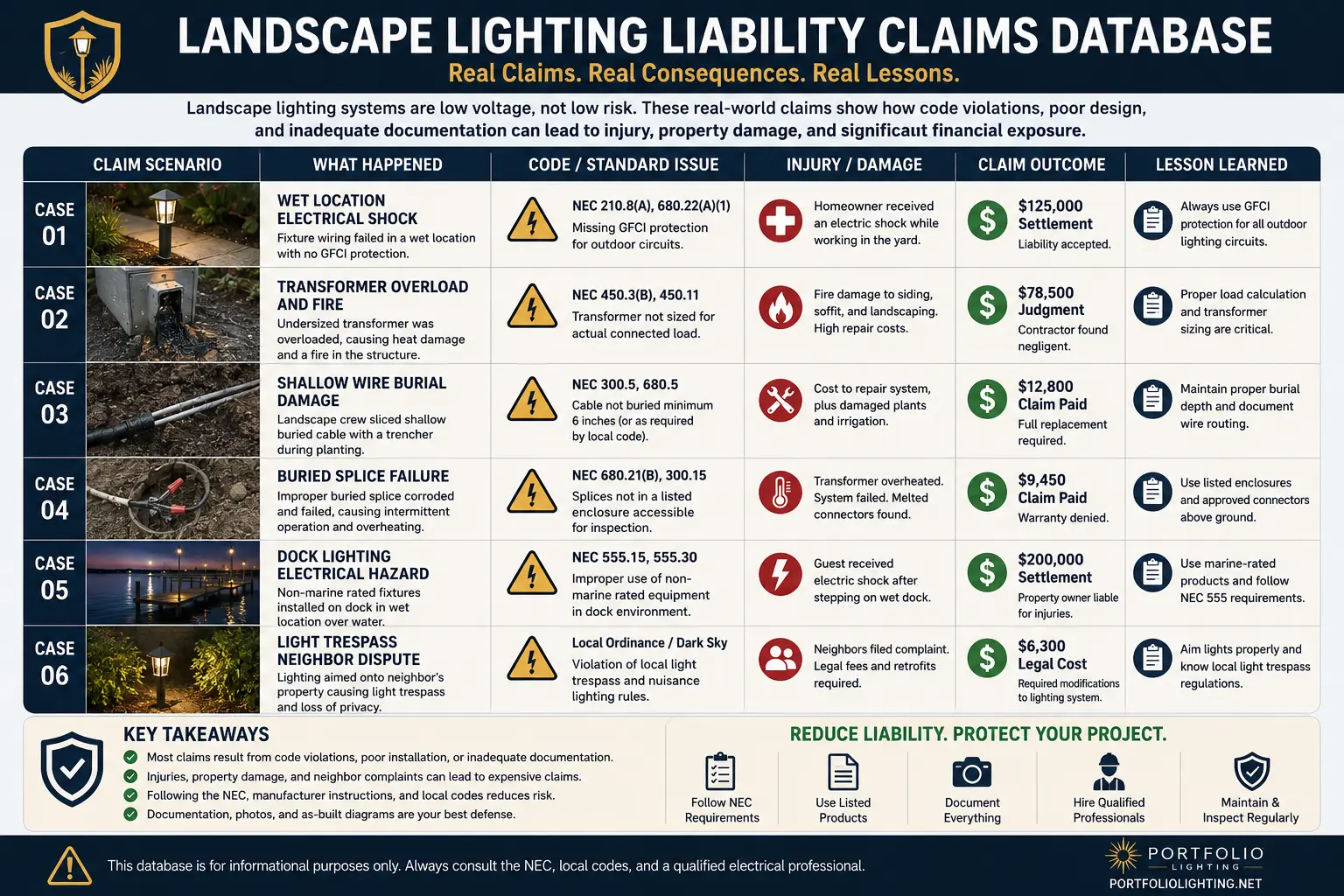
Liability exposure becomes much easier to understand when viewed through actual claim scenarios instead of hypothetical examples. The landscape lighting liability claims database examines documented patterns involving electrical shock allegations, transformer fires, shallow burial damage, neighbor disputes over light trespass, dock incidents, and improper installations near water features. Each case demonstrates how poor documentation, code shortcuts, and overlooked maintenance issues can transform an inexpensive repair into a significant financial event.
Water and electricity create one of the highest-risk combinations found in residential landscape projects. While most illuminated water features operate safely when installed correctly, mistakes involving wet-location equipment, improper wiring methods, or inadequate fault protection can increase liability exposure significantly. Our waterfall lighting code requirements guide explores the safety principles, installation standards, and compliance considerations that help reduce risk around decorative water features.
Poor visibility during power outages can create significant safety concerns, particularly in commercial properties, multifamily developments, hospitality facilities, and public gathering spaces. While decorative lighting improves appearance, emergency illumination is intended to support safe movement during unexpected events. Our emergency backup lighting and egress pathway guide examines the safety principles and code requirements often associated with these life-safety systems.
Liability Claims FAQ
My landscape lighting contractor installed fixtures too close to my pool and the work failed inspection. The contractor is still in business. What are my options?
You have three parallel paths that you should pursue simultaneously rather than sequentially. First: address the building department's correction notice immediately — the pool setback violation creates ongoing liability for you as the property owner. Hire the contractor to make the corrections and pass re-inspection, or (if they won't) hire a second contractor. Do not let the correction notice remain open. Second: send the contractor a written demand letter (certified mail, return receipt requested) stating the specific violation, the cost to correct it, and demanding they return to make corrections at their expense within a specific deadline. This demand letter is the foundation for a subsequent breach of contract claim if they refuse. Third: contact their state licensing board and file a complaint with documentation of the non-compliant work, the failed inspection, and the correction notice. The licensing board complaint creates regulatory pressure and is often more effective at producing contractor cooperation than the civil demand letter alone. If the contractor refuses to correct after the demand letter and you've paid a second contractor to make the corrections, you have a documented breach of contract claim for the cost of the corrections. The correction notice, failed inspection report, second contractor invoice, and your demand letter (with no response) are the core of that claim. For the complete contractor abandonment response, see the correction notices guide.
My neighbor's landscape uplights shine directly into our bedroom windows at night. What can I do legally?
You have multiple paths, roughly in order from lowest cost and effort to highest: (1) Direct conversation with the neighbor — many light trespass situations are resolved when the neighbor simply isn't aware their lights are projecting into your windows. Request they add shields or redirect the fixtures. (2) HOA complaint if applicable — if you're in an HOA community whose CC&Rs address exterior lighting or light trespass, file a complaint with the ARC or HOA board. HOA enforcement is often faster than municipal code enforcement. (3) Municipal code complaint — check whether your jurisdiction has an outdoor lighting ordinance with light trespass limits. Los Angeles limits exterior light sources to 2 footcandles at neighbor's windows; other jurisdictions have similar provisions. A complaint with documented measurements triggers an official investigation. (4) Civil nuisance action — per Nolo's documented analysis: light trespass is recognized as a nuisance in most US jurisdictions. You can bring a private nuisance lawsuit for injunctive relief (court order requiring changes to the lighting) and monetary damages for documented impacts. In California, Small Claims Court handles claims up to $12,500 for individuals — adequate for many light trespass disputes. The primary remedy courts award is injunctive relief — requiring the neighbor to shield, redirect, or remove the lights — rather than large monetary awards. See the light trespass laws guide for the complete civil and ordinance framework.
I purchased a home and just discovered the landscape lighting has an open permit with an uncorrected violation. The previous owner never mentioned it. What are my claims?
You potentially have claims against both the seller (for non-disclosure) and, depending on the circumstances, the real estate professionals involved in the transaction. Against the seller: most states require disclosure of known material defects. An open permit with an active correction notice is a known material defect — the seller received the correction notice, which established their actual knowledge. Failure to disclose it in the seller's disclosure form or in response to buyer's inquiries about permits is a material non-disclosure. Your claims include negligent non-disclosure, fraudulent concealment (if intentional), and breach of disclosure duty. Remedies: cost to correct the violation (retroactive permit fee, correction work, any fines that accrued), attorney fees in some states, and potentially rescission of the sale in severe cases. Against the real estate professionals: if the listing agent or buyer's agent knew about the open permit and failed to disclose it, they have independent liability. Check the closing file for any permit search results — if no permit search was ordered, that is a due diligence failure by someone in the transaction. For the complete post-sale open permit framework, see the correction notices guide and the code enforcement cases guide. Consult a real estate litigation attorney in your state immediately — the fraud SOL typically runs from discovery, but you want to preserve your rights before the correction notice generates additional fines.
Related Liability, Compliance & Code Guides
- Electrical Code Safety Guide
- Insurance & Liability Guide
- Code Enforcement Cases
- Correction Notices Guide
- Light Trespass Laws
- Pool Lighting Clearance
- GFCI Requirements
- As-Built Diagram Requirements
- Contractor Licensing
- State Permit Requirements
- Permit Requirements
- Inspection Failure Codes
- NEC Inspection Checklist
- Final Inspection Checklist
- Photometric Plan Reading
- Dark Sky Compliance
- Wire Burial Depth Code
- NEC 2026 Code Updates
- Grounding & Bonding
- Splice Connection Code
- Transformer Mounting Code
- Wet Location Listing
- Landscape Lighting Guide
- Maintenance Guide