
Quick Answer: Can Landscape Lighting Run on a Generator?
Most low-voltage landscape lighting systems can run from a generator if the transformer is powered from a safe, outdoor-rated source and the total lighting load is well below the generator's continuous wattage rating.
The easiest systems to run during an outage are modern LED systems because the actual load may be low. A 150-watt transformer might only be carrying 40 to 90 watts of LED lighting. That sounds simple, but the generator still needs clean enough power for the transformer, enough headroom for startup load, a safe cord path, and protection from rain.
The Part Most Homeowners Get Wrong
When the power goes out, people usually ask, "How many watts do my lights use?" That is only the first question. The better question is: what is the generator actually powering?
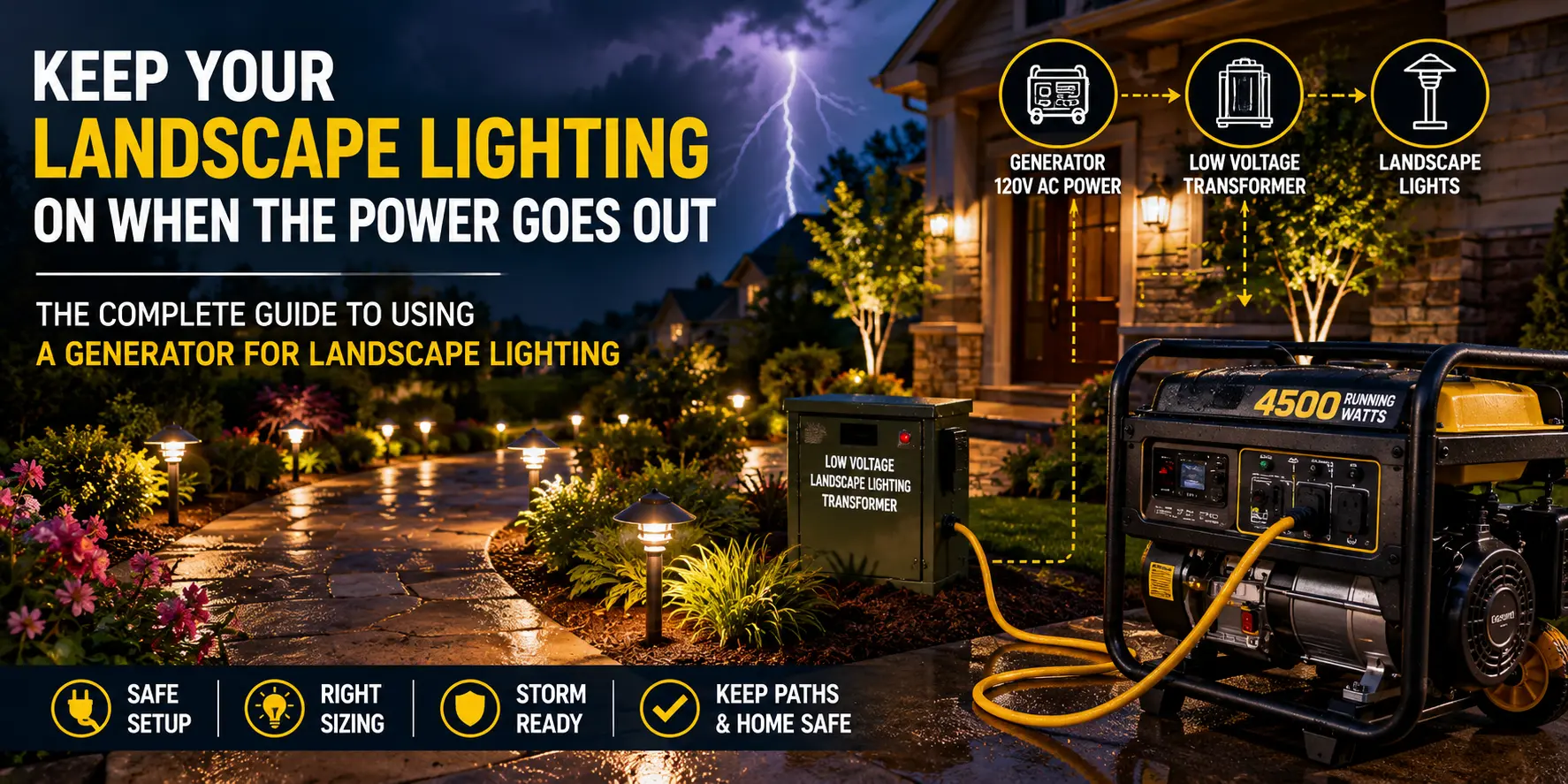
If your low-voltage transformer plugs into an exterior GFCI receptacle, the generator does not power the buried 12-volt cable directly. The generator powers the transformer, and the transformer powers the low-voltage lighting. That distinction matters because the generator sees the transformer as the load, while the landscape cable still behaves like a normal low-voltage system with voltage drop, connector resistance, and fixture load.
If the transformer is hardwired, tied to a timer box, connected through a switch, or part of a whole-house standby generator circuit, the answer changes. A hardwired transformer should not be temporarily powered with improvised cords. That is where a licensed electrician, transfer switch, inlet, or properly installed standby generator circuit becomes the safe path.
Generator Size Calculator for Landscape Lighting
Use this planning calculator to estimate the minimum generator capacity for a low-voltage landscape lighting transformer. It intentionally adds headroom because transformers, cords, and generator voltage can behave differently under storm conditions.
This includes conservative headroom for transformer behavior and generator voltage stability.
For a permanent system, also compare this with your landscape lighting transformer size calculator, voltage drop planning, and wire gauge selection.
Four Backup Power Setups That Actually Make Sense
| Backup Power Setup | Best Use | What Works Well | Main Risk |
|---|---|---|---|
| Whole-house standby generator | Permanent outage coverage | Existing exterior transformer may operate normally if its circuit is on the generator panel. | Loads may shift when larger appliances start. |
| Portable generator with proper inlet/transfer equipment | Temporary home circuit backup | Can power the normal outdoor receptacle circuit when installed correctly. | Improper backfeeding is dangerous and should never be used. |
| Portable generator with outdoor-rated extension cord | Plug-in transformer only | Works for many plug-in low-voltage transformers if the cord is sized correctly and protected from traffic and water. | Undersized cords, wet connections, and exhaust placement. |
| Portable power station | Small LED systems and short outages | Quiet, no exhaust, useful for entrance and walkway lighting. | Runtime may be limited; modified sine wave output can be an issue on some units. |
Emergency Lighting Priority: Do Not Power Everything First
During an outage, the goal is not to make the yard look beautiful. The goal is to make the property usable and safer. Start with the lights that help people move, identify the home, and avoid steps or obstacles.
- Front entry and house numbers: first priority for visitors, emergency responders, and deliveries.
- Walkway and steps: critical if people are moving between the driveway and entry.
- Driveway edge: useful if the outage happens during storms or snow.
- Gate, side yard, or service path: only if it is needed during the outage.
- Decorative uplighting: last priority. Tree uplights and wall washes can usually stay off.
This is one reason zone planning matters. If your system is organized into practical lighting zones, you can power the essential run instead of energizing every decorative fixture. See the low-voltage landscape lighting zones guide for a stronger long-term setup.
How Landscape Lighting Transformers Behave on Generator Power
Generator power is not always as stable as utility power. Small portable generators can sag when a refrigerator, sump pump, or power tool starts. Some inverter generators handle this better than conventional open-frame generators, but the transformer still sees the change.
Magnetic Transformers May Hum More
Older low-voltage transformers with heavy magnetic cores can hum louder when voltage or frequency is unstable. A slight hum is not always a failure, but a sudden harsh buzz, overheating smell, flickering lights, or repeated breaker trips means the setup should be shut down and inspected.
Electronic Transformers and LED Drivers Can Be Pickier
Electronic transformers and LED drivers may be more sensitive to waveform quality. If a power station uses modified sine wave output, some LED systems may flicker, buzz, or refuse to operate correctly. Pure sine wave output is usually the better choice for lighting electronics.
Timers and Photocells Can Behave Strangely
After an outage, digital timers may lose programming and photocells may cycle unexpectedly if they are exposed to temporary work lights or generator lighting. If your system does not turn on after utility power returns, check the timer, photocell, GFCI, and transformer reset before assuming buried cable failed.
Extension Cord Gauge for a Plug-In Transformer
If your transformer is plug-in style and you are powering it temporarily from a portable generator, the extension cord matters. The cord is carrying 120-volt power to the transformer, not 12-volt power to the fixtures. Long, thin cords can create voltage drop before power even reaches the transformer.
| Transformer / Load | Short Cord Under 25 ft | Medium Cord 25–50 ft | Long Cord 50–100 ft | Notes |
|---|---|---|---|---|
| Up to 100W LED load | 14 AWG | 14 AWG | 12 AWG preferred | Use outdoor-rated cord only. |
| 150W transformer | 14 AWG | 12 AWG preferred | 12 AWG | Avoid coiled cords under load. |
| 300W transformer | 12 AWG | 12 AWG | Avoid if possible | Better handled by a proper circuit or inlet. |
| Hardwired transformer | Do not improvise. Use a proper transfer method or licensed electrical solution. | |||
What Not to Do During a Power Outage
Do Not Backfeed
Never connect a generator to a home by using a male-to-male cord or improvised outlet method. This can energize utility lines and injure workers or damage equipment.
Do Not Run the Generator Near Openings
Generator exhaust can enter a home through windows, doors, vents, crawlspaces, and attached garages. Lighting is never worth carbon monoxide risk.
Do Not Bypass GFCI Protection
If an exterior GFCI trips, find the cause. Wet cords, damaged transformer plugs, and flooded receptacles are warnings, not annoyances.
Do Not Power a Flooded Transformer
If the transformer, receptacle, timer, or cord end was submerged or sprayed heavily during a storm, inspect and dry the system before powering it.
Storm Recovery Checklist Before Turning Landscape Lights Back On
After a storm outage, the safest sequence is inspection first, power second. A lighting system can look fine from the patio and still have a wet splice, crushed cable, cracked fixture lens, or tripped GFCI.
- Check the exterior receptacle and confirm the cover is intact.
- Reset the GFCI only once. If it trips again, stop and inspect.
- Look for standing water around the transformer, timer, and cord connections.
- Inspect fixtures that were hit by branches, mulch washout, or flooding.
- Open the transformer door and check for heat smell, corrosion, insect nests, or loose terminal screws.
- Turn on the system with only essential zones first if your setup allows it.
- Walk the far end of the run and look for dim or flickering fixtures that indicate voltage or connection issues.
If lights work in dry weather but fail after rain, use the rain-related landscape lighting troubleshooting guide. If only part of a run works, compare symptoms with the Portfolio lighting troubleshooting hub.
Generator compatibility depends on more than matching watts and volts. Portable generators and small inverters have higher source impedance than utility power, so distorted current drawn by LED drivers can deform the generator’s voltage waveform and cause flicker, buzzing, repeated driver resets, or unstable photocell operation. The LED driver harmonic distortion compliance guide explains how to compare current THD with voltage THD and how to test the generator before assuming the lighting fixtures are defective.
Generator Power vs Battery Power Station
A battery power station can be a cleaner option for small LED lighting loads. It has no exhaust, makes little noise, and can be placed indoors while powering a transformer only if the cord route and receptacle arrangement are safe. The weakness is runtime. A 500Wh power station running a 50W actual lighting load may last roughly eight to ten hours after inverter losses. A 150W load will drain the same unit much faster.
For a small emergency path, a portable power station may be better than starting a gasoline generator. For whole-property lighting plus refrigerators, pumps, and home circuits, a generator or standby system is usually more practical.
What Happens When Utility Power Returns?
The return of utility power can expose problems that were hidden during the outage. Timers may reset to factory settings. Photocells may be confused by temporary lighting. Smart plugs may reconnect slowly. GFCI devices may trip if moisture entered the receptacle while the generator was running.
Before assuming the transformer failed, check the power source, timer program, photocell cover, low-voltage terminals, and the first connector on the run. Many "generator damaged my lights" situations are actually reset timers, wet receptacles, overloaded cords, or a connector that was already failing before the storm.
Related Backup Power and Low-Voltage Planning Guides
- Portfolio lighting transformer troubleshooting
- Portfolio outdoor transformer lighting
- Landscape lighting voltage drop guide
- Landscape lighting wire gauge guide
- How to wire landscape lighting
- Outdoor lighting GFCI requirements
- Landscape lighting electrical code safety guide
- Portfolio low-voltage lighting guide
Generator and Landscape Lighting FAQ
Can I plug my landscape lighting transformer directly into a generator?
If it is a plug-in transformer, the generator has stable output, the cord is outdoor-rated and properly sized, and the connection is protected from water and damage, it may be possible. Hardwired transformers should not be improvised with cords.
Will a generator damage LED landscape lights?
Usually not if the transformer and generator are compatible, but unstable voltage, poor waveform quality, undersized cords, wet connections, or repeated surges can cause flicker, buzzing, tripping, or driver problems.
Can I run only part of my landscape lighting system?
Yes, if your system is split into zones, separate transformers, or switched runs. During an outage, prioritize entry paths, steps, driveway edges, and house numbers before decorative lighting.
Is a power station better than a generator for landscape lighting?
For small LED loads, a pure sine wave power station can be a quiet and clean option. For long outages or larger loads, a generator or standby system usually provides longer runtime.
Final Safety Note
This guide is for planning and troubleshooting low-voltage landscape lighting during an outage. Generator use, transfer switches, hardwired transformers, exterior receptacles, and wet-location electrical equipment can create serious hazards. Follow product instructions, local code, and licensed electrical guidance for permanent or hardwired work.