
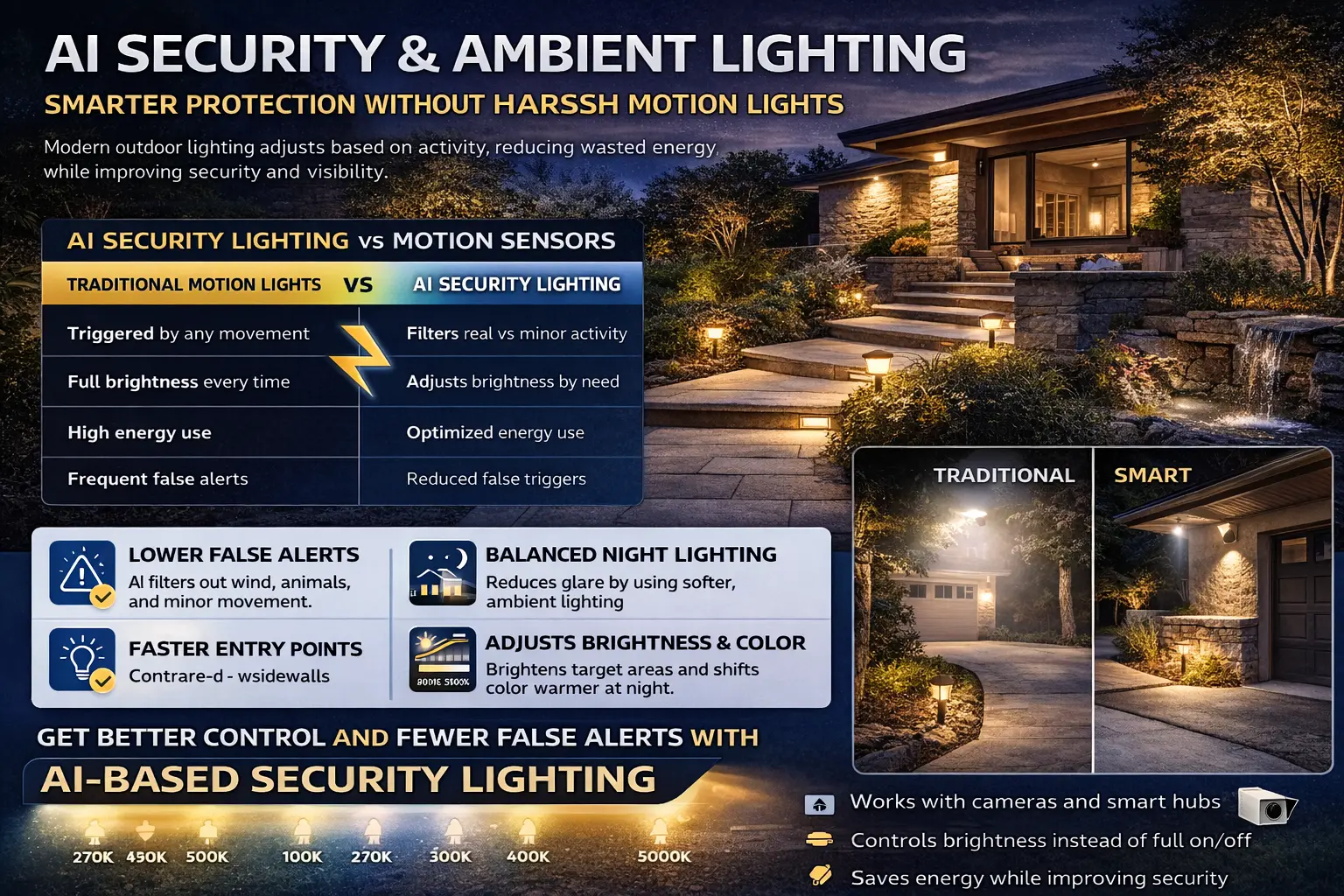
AI security lighting is better than motion sensors because it reduces false triggers, adjusts brightness instead of turning fully on, and improves outdoor visibility without harsh lighting.
Quick Answer
AI security lighting adjusts brightness and activation based on activity, reducing false triggers and energy waste compared to traditional motion sensors.
- Reduces false motion alerts
- Controls brightness instead of full on/off
- Improves visibility without harsh lighting
- Works with cameras and smart hubs
AI outdoor security lighting automatically adjusts brightness, timing, and response zones using smarter control logic, making it more efficient and more useful than traditional all-or-nothing motion lights.
The best outdoor lighting should not blast the entire yard with light. It should respond to activity, highlight the right areas, and stay balanced the rest of the time.
Best Upgrade Options for Smarter Security Lighting
Once you know the goal—fewer false triggers, better brightness control, and more balanced outdoor lighting—the next step is choosing the right type of upgrade. The best option depends on whether you want simple scheduling, better security response, or a more complete outdoor lighting system.
| Best For | Recommended Upgrade Path | Why It Makes Sense | Where to Look |
|---|---|---|---|
| Simple smart control | Outdoor smart plug or controller | Easy way to improve scheduling and automation without rebuilding the whole system | Browse smart control options |
| Security-focused upgrades | Smart lighting with improved response | Better visibility and activity-based lighting around entry points and walkways | View security lighting options |
| Balanced ambient + security setup | Smart outdoor lighting system with zone control | Keeps softer baseline lighting while brightening only the areas that need attention | Compare outdoor lighting systems |
| Older low-voltage system upgrades | Transformer or part replacement | Best option when your current system is outdated, unstable, or limiting control | Find replacement parts and upgrades |
This is a high-value page because it solves two problems at once. Homeowners want better security, but they also want better-looking outdoor lighting. Traditional motion lights usually force them to choose. The property gets brighter, but the result often feels harsh, distracting, and wasteful.
AI-style security and ambient lighting changes that equation. Instead of reacting to every little movement with full brightness, a smarter system can hold softer baseline light levels, brighten only the zones that matter, and reduce the kind of false triggers that make old motion lights so annoying. That makes the page useful to readers searching for better protection and to readers who simply want their house to look more polished after dark.
It also gives this page strong topical authority inside your automation cluster. It naturally links into system design, smart hub compatibility, AI-driven lighting control, and outdoor zoning. That is exactly the kind of structure that gives a newer automation cluster more ranking strength over time.
If you want the bigger picture beyond security lighting alone, see the AI outdoor lighting systems guide. It explains how smarter controllers, sensors, zone planning, and upgrade paths work together across a full outdoor lighting setup.
Security lighting works better when the system can distinguish between an authorized user and an unknown voice. See our voice biometrics outdoor lighting guide for a deeper look at identity-based control.
Some of the strongest AI security lighting setups do not wait until motion is detected at the driveway. Our predictive arrival lighting behavior patterns guide explains how AI can learn when the homeowner typically returns and activate the right exterior zones before arrival.
Security and Ambient Lighting Logic Summary
Security and ambient lighting should work together, not compete with each other. The system should provide visibility when it matters most while still keeping the space comfortable, balanced, and usable the rest of the time.
While security lighting focuses on visibility and coverage, ambient lighting plays a role in how a space feels throughout the evening. Some systems combine both by using softer lighting during normal conditions and shifting when needed. For the comfort and timing side of this balance, see circadian outdoor lighting.
- Security lighting should improve visibility without over-lighting the property
- Ambient lighting should support comfort while leaving room for higher-alert responses
- Layered zones make it easier to shift between normal and security-focused modes
- The best systems combine coverage, timing, and reliability into one plan
Security lighting does not need to feel harsh or overexposed to remain effective. Our AI wellness lighting schedule guide explains how layered ambient lighting, predictive dimming logic, and biologically sensitive automation schedules can maintain visibility and pathway safety while reducing visual fatigue and unnecessary nighttime glare around the property.
AI Security Lighting vs Motion Sensors
AI lighting systems reduce false alerts and control brightness, while traditional motion lights only turn fully on or off based on basic movement detection.
| Traditional Motion Lights | AI Security Lighting |
|---|---|
| Triggered by any movement | Filters real vs minor activity |
| Full brightness every time | Adjusts brightness by need |
| High energy use | Optimized energy use |
| Frequent false alerts | Reduced false triggers |
That difference is what makes AI-style security lighting much more attractive in 2026. It feels less primitive. It protects the property better, but it also keeps the house from looking like a parking lot every time something moves near the driveway or side yard.
Security and ambient lighting become much more useful when spoken commands can trigger the right mode without complicated setup. A phrase like “set alert lighting” or “make the backyard softer” depends on a control layer that can interpret meaning and map it to the right scene. That system is explained in AI voice lighting logic.
For broader help with fixture types, layout ideas, and system planning, use the Portfolio landscape lighting hub. It is a good next step if you are thinking beyond security and want the whole property to feel more balanced after dark.
Bottom line: motion lights react to movement, but AI-style lighting responds to real activity and adjusts how the light is used.
Which Option Is Better for Most Homes?
AI-style security lighting is the better choice for most homes because it reduces false alerts, improves visibility, and avoids harsh lighting.
- Use motion lights → for basic, low-cost setups
- Use AI-style lighting → for better control and fewer false triggers
- Best upgrade → combine ambient lighting with activity-based brightness
Why Motion Lights Trigger Too Often
- Wind movement
- Animals
- Shadows or passing cars
AI-based systems reduce these triggers by adjusting sensitivity and response instead of reacting to every small movement. That matters because false triggers do more than waste energy. They make homeowners tune the system out. Once outdoor lighting becomes annoying, people stop trusting it as a useful security feature.
A better system should react differently to a branch moving in the wind than it reacts to someone entering a gate path, driveway edge, or rear access point. That is the kind of layered response AI-style lighting is much better at delivering.
Security-focused AI lighting becomes even more useful when it can recognize system stress before an outage affects visibility. Moisture, wiring degradation, and transformer heat can all reduce reliability during the exact conditions when outdoor security lighting matters most. For a deeper technical look at early fault detection, read AI predictive maintenance for outdoor lighting.
Balancing Security With Outdoor Lighting Design
Security lighting should not overpower the property. Modern systems use lower baseline lighting and increase brightness only when needed.
- Soft lighting during low activity
- Brighter zones when movement is detected
- Reduced glare and light pollution
Homeowners are not just looking for brighter lights; they want a system that protects the property without creating harsh, overlit spaces. That broader approach makes this far more useful than typical “best motion light” guides focused on a single problem.
If your existing system is too limited or unreliable for a smarter lighting upgrade, compare Portfolio lighting alternatives to see which replacement paths offer better control, stronger reliability, and a cleaner long-term upgrade option.
Outdoor Lighting That Adjusts Throughout the Night
Some systems shift brightness and color temperature over time, using brighter white light earlier in the evening and softer, warmer light later at night.
This helps reduce glare, improve comfort, and limit unnecessary light exposure. It also makes the property feel calmer late at night without losing the visibility benefits of a layered ambient system.
For many homes, that means the brightest and coolest security response does not need to be the default setting all night long. Instead, the system can settle into softer background lighting and increase only when conditions justify it.
How Security Zones Improve Outdoor Lighting
Instead of lighting the entire yard, modern systems divide the space into zones.
- Entry points (doors, gates)
- Walkways
- Backyard activity areas
Each zone can respond differently, improving both security and energy use. This is where modern systems start to feel genuinely useful instead of merely automated. A walkway zone should not necessarily respond the same way as a driveway edge or rear gate. A patio should not need the same response profile as a service-side passage or fence line.
How to Set Up AI Security Lighting
- Identify key areas that need lighting
- Choose a smart controller or hub
- Set baseline lighting levels
- Adjust brightness triggers for activity
That setup process sounds simple, but it becomes much stronger when it is tied to your broader outdoor system. If you are building from scratch or upgrading a mixed system, pair this page with AI outdoor lighting systems guide first. If you are connecting older hardware to smarter automation, use smart hub compatibility guide. If the goal is a more complete ambient + automation layout, use AI automated landscape lighting.
Why This Approach Is Better Than Basic Motion Flooding
Traditional motion-light logic is blunt. It is either dark or fully bright. That can be useful in narrow cases, but it is rarely the best long-term outdoor experience. Most homeowners want something more balanced. They want the house to stay readable, the walkways to feel safer, and the property to look intentional at night instead of constantly overreacting.
AI-style security lighting is better because it treats security and visibility as part of the same design problem. That makes it more practical, more comfortable, and much easier to integrate with ambient lighting goals across the rest of the property.
If you are mixing older fixtures, replacement parts, or different system components, the Portfolio lighting compatibility guide can help you check whether the parts and control path still work together before you invest more in upgrades.
Security lighting often fails because of excessive glare rather than lack of brightness. The BUG rating guide explains how to reduce glare while maintaining visibility.
Quick Question & Answer
Are AI security lights better than motion sensors?
Yes, AI lighting reduces false alerts and adjusts brightness based on activity instead of reacting to all motion.
How do you stop motion lights from turning on all the time?
Use systems that adjust sensitivity and brightness instead of relying on basic motion detection.
Can outdoor security lighting look good and still work well?
Yes. Modern security lighting uses lower baseline illumination and brighter responses only where needed, so the property stays attractive instead of harshly overlit.
Best Related Automation Pages
Build the Bigger System
Use the main automation pillar page to connect security lighting with broader outdoor control.
AI Outdoor Lighting SystemsAutomate the Landscape
Move from simple motion logic into broader ambient and automated outdoor lighting behavior.
AI Automated Landscape LightingConnect the Hardware
Make sure your hubs, plugs, and controllers can actually work with the system you already own.
Smart Hub Compatibility GuideAI Security & Ambient Lighting FAQ
Are AI security lights better than motion sensors?
Yes. AI security lighting reduces false alerts and adjusts brightness based on activity instead of reacting to every movement with full brightness.
How do you stop motion lights from turning on all the time?
Use systems that adjust sensitivity, brightness, and response zones instead of relying on basic all-or-nothing motion detection.
What causes false triggers in outdoor motion lighting?
False triggers often come from wind, small animals, passing cars, shadows, and movement outside the area that actually needs security coverage.
Can AI security lighting work with smart hubs?
Yes. Many AI-style outdoor lighting systems can be connected to smart hubs, controllers, and broader automation setups for sunset schedules, routines, and zone-based responses.
Does AI security lighting save energy?
Yes. These systems reduce wasted runtime by holding lower baseline light levels and increasing brightness only when activity or conditions actually justify it.
Final Note
The best outdoor security lighting no longer has to look harsh to work well. A smarter system can hold softer ambient light, brighten the right zones when activity happens, and reduce the false-trigger problems that make older motion lights feel crude and wasteful. That is why AI security and ambient lighting has strong Top 1 potential as both a ranking topic and a conversion topic inside a modern automation cluster.