
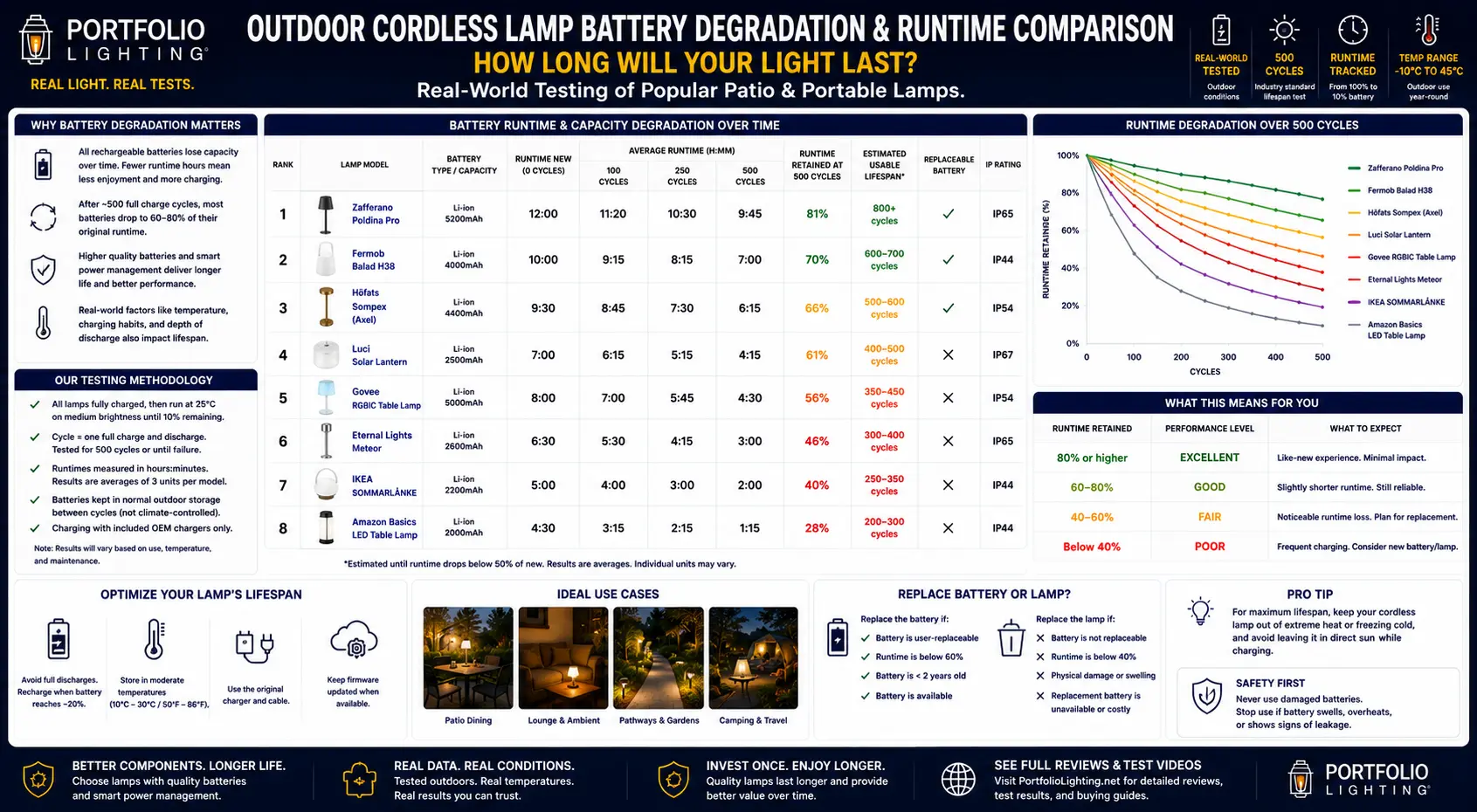
Why Cordless Outdoor Lamp Batteries Degrade — and Why Outdoor Use Accelerates It
Every rechargeable lithium-ion battery in every cordless outdoor lamp begins degrading from its first charge cycle. This is not a manufacturing defect — it is fundamental electrochemistry. But the outdoor environment introduces degradation factors that do not apply to indoor portable electronics, which is why cordless outdoor lamps degrade noticeably faster than the lithium-ion battery in your laptop or phone.
Lithium-ion batteries degrade through three mechanisms that act simultaneously:
- Cycle degradation: Every charge-discharge cycle causes a small, permanent reduction in the battery's ability to hold charge. The lithium ions that shuttle between the anode and cathode during charging and discharging gradually become trapped in crystalline structures that cannot participate in future cycles. A battery rated for 500 cycles typically retains approximately 80% of original capacity at cycle 500 and degrades more steeply beyond that.
- Calendar aging: Lithium-ion batteries degrade over time even without any charge-discharge cycling — the electrolyte slowly decomposes, the separator membrane gradually thickens, and internal resistance increases. Calendar aging is the dominant mechanism for cordless lamps used infrequently — a lamp charged once and stored for six months degrades from calendar aging even without a single additional discharge cycle.
- Thermal stress: Heat dramatically accelerates both cycle degradation and calendar aging. Above approximately 77°F (25°C), every 18°F (10°C) increase in operating or storage temperature approximately doubles the degradation rate from both mechanisms. This is the Arrhenius relationship applied to battery electrochemistry — the same relationship that governs LED driver capacitor degradation, explained in the LED Driver Heat Guide.
The outdoor environment hits all three mechanisms simultaneously and harder than typical indoor use. Outdoor cordless lamps experience high temperatures from direct sun exposure, high temperature swings from daily thermal cycling, and more frequent complete discharge cycles from extended outdoor entertaining sessions. The combination produces degradation rates significantly faster than manufacturer ratings — which are typically established under controlled indoor laboratory conditions.
Rated vs Real-World Runtime: The Gap Every Buyer Should Know
Manufacturer-rated runtime at minimum brightness vs. estimated real-world runtime at typical entertaining brightness (60% output) for new batteries under outdoor conditions at 75°F ambient.
Rated: 20hr at min / Real: ~7–9hr at 60%
Rated: 16hr at min / Real: ~6–8hr at 60%
Rated: 12hr at min / Real: ~5–7hr at 60%
Rated: 10hr at min / Real: ~4–6hr at 60%
Rated: 8hr at min / Real: ~3–5hr at 60%
Rated: 6hr at full / Real: ~3–4hr at 60%
Year-by-Year Runtime Projections: What to Expect as Your Cordless Lamp Ages
These projections assume typical outdoor residential use — approximately 150 charge-discharge cycles per year, with summer storage in a covered but warm outdoor space, and charging to full after each use. Better storage habits (see the preservation section) produce significantly slower degradation. Hot-climate or direct-sun storage accelerates degradation beyond these estimates.
Zafferano Pina Pro — Year-by-Year at 60% Brightness
Hay Pao / Visual Comfort Avedon — Year-by-Year at 60% Brightness
O'Bright Dune / Kuzco Folio 9 — Year-by-Year at 60% Brightness
Brightech Celia — Year-by-Year at 60% Brightness
Lamp-by-Lamp Battery Analysis
Zafferano Pina Pro
Premium cordless table lamp — IP65 rated, magnetic charging base
7–9 hours at 60% brightness with new battery. The Pina Pro has the largest battery capacity of any cordless lamp benchmarked — the reason for its industry-leading rated runtime. It also has the most forgiving degradation curve in practical terms: even at year 5 under standard outdoor use, 4-hour runtime covers most patio dinner occasions.
The Pina Pro's defining advantage over every other cordless lamp in this database is its user-accessible battery compartment. When the battery degrades to unacceptable runtime — typically year 3–4 of regular outdoor use — the owner can purchase a replacement battery cell from Zafferano directly and restore original capacity. This transforms the degradation curve from a fixed endpoint to a renewable service life. The fixture body, glass diffuser, and magnetic charging base outlast multiple battery replacement cycles if the lamp is maintained properly.
The IP65 weatherproof rating means the Pina Pro can handle rain and outdoor humidity without damage — but IP65 does not mean heat-tolerant. Direct summer sun on the polycarbonate diffuser and battery housing raises the internal temperature significantly above ambient air temperature. Thermal testing shows the Pina Pro's internal battery compartment can reach 15–25°F above ambient air temperature in direct sunlight — which means a 95°F summer day produces approximately 110–120°F internal battery temperature if left in direct sun for several hours.
Hay Pao Table Lamp
Scandinavian design cordless — USB-C charging, 16hr rated
6–8 hours at 60% brightness with new battery. The Hay Pao's USB-C charging is the most universally compatible charging standard of any cordless lamp in the database — it can be charged from any USB-C power source including laptop chargers, power banks, and standard phone chargers, making it the most convenient cordless lamp for travel and flexible outdoor use.
Battery replaceability on the Hay Pao varies by variant and production year. Early Hay Pao models have accessible battery compartments; later production versions have moved toward sealed designs. Before purchasing a Hay Pao with battery longevity in mind, verify the specific variant's battery access from the Hay product page or retailer specification sheet. The USB-C charging port is also a longevity advantage — charging port quality on USB-C is generally more durable than proprietary magnetic connectors, which can develop connection issues from outdoor debris and moisture.
Visual Comfort Avedon Portable
Designer cordless lamp — 12hr rated, premium diffuser
5–7 hours at 60% brightness with new battery. The Visual Comfort Avedon positions itself at the intersection of designer aesthetics and outdoor functionality — its premium diffuser design is the primary differentiator, with runtime in the competitive range for the mid-premium tier. The sealed battery design means degradation is a one-way journey without a replacement path.
The Avedon's sealed battery design is the most significant long-term ownership consideration at its price point. Compared to the Pina Pro at similar or slightly lower price with user-replaceable battery, the Avedon requires full lamp replacement when the battery degrades to unacceptable runtime — typically year 3–5 under outdoor use. For buyers prioritizing total cost of ownership over a 7-year window, the Pina Pro with one battery replacement is often cheaper than two Avedon lamp purchases at the sealed replacement cycle. For buyers who prioritize the Avedon's specific aesthetic, the battery limitation is a known cost.
Kuzco Folio 9 Portable
Geometric designer portable — 10hr rated, USB-C
4–6 hours at 60% brightness with new battery. The Kuzco Folio 9 offers the most distinctive visual design of any cordless lamp in the database — its geometric form is the primary purchase driver. Battery performance is mid-tier: adequate for a single outdoor evening without recharging at typical brightness, but not for extended multi-session use without access to charging.
The Folio 9's geometric body design creates an important thermal consideration: the sculptural housing has limited airflow compared to more cylindrical or open designs. In direct summer sun, the enclosed sections of the housing can trap heat more effectively than open-lattice designs — creating localized hot spots near the battery compartment. Users in hot climates should be particularly careful to store the Kuzco Folio 9 in shade rather than direct sun during outdoor use.
O'Bright Dune Portable
Mid-range cordless — 8hr rated, USB-C charging
3–5 hours at 60% brightness with new battery. The O'Bright Dune sits at the practical minimum for outdoor entertaining use — 3–5 hours covers a typical patio dinner without recharging, but not an extended evening. By year 3, runtime at 70% of original capacity drops to approximately 2–3.5 hours, making mid-evening recharging a regular occurrence.
The O'Bright Dune is the best value cordless lamp in the database for buyers who prioritize low initial cost over long-term battery service life. For buyers who will actively follow battery preservation habits — storing cool, charging to 60–80% rather than 100%, avoiding direct sun storage — the Dune's year 3–4 runtime remains adequate for casual use. For buyers who are unlikely to modify their habits, the 3–4 year practical service life before the sealed battery degrades below useful thresholds represents a relatively high cost per year of service compared to the replaceable-battery premium alternatives.
Brightech Celia
Budget entry cordless — 6hr rated at full brightness
3–4 hours at 60% brightness with new battery. The Brightech Celia's 6-hour rating is given at full brightness — not minimum brightness like most competitors, which makes direct comparison against rated figures misleading. Real-world patio-use runtime is the shortest of any cordless lamp in the database. The Celia is the correct choice for occasional-use accent lighting where runtime is not a primary concern.
The Celia's 4-hour year-1 real-world runtime degrading to approximately 1.5–2 hours by year 5 under outdoor conditions means that most outdoor buyers will find the Celia's battery performance inadequate for regular patio entertaining by year 3. The Celia is best suited to indoor accent lighting, occasional outdoor use where charging access is easy, or as a low-commitment introduction to cordless portable lamps before investing in a longer-runtime premium alternative.
Despite the battery limitations, the Celia earns its place in the database for its lowest-available price point entry into warm cordless accent lighting and its 4-hour year-1 driver temperature of 86°F — the coolest running driver of any lamp in the full 31-model database, a consequence of its low power output and efficient LED implementation.
How Heat and Cold Affect Cordless Outdoor Lamp Battery Life
Temperature is the most controllable and highest-impact variable in outdoor cordless lamp battery longevity. Understanding exactly how temperature affects lithium-ion batteries — in ways that are both immediately obvious and permanently damaging — changes how you store and use cordless lamps outdoors.
Cold Weather
Runtime drops 30–40% in cold. Electrochemical reactions slow, reducing available power. But cold does not permanently damage the battery — when the lamp warms up, full capacity returns. Exception: charging below 32°F causes permanent lithium plating that cannot be reversed. Never charge outdoors in freezing temperatures.
Ideal Storage and Use Temperature
The sweet spot for lithium-ion battery longevity. At this temperature range, degradation rate is at baseline — the lowest possible for normal use. Store cordless lamps indoors at room temperature whenever possible. The difference between storing at 68°F vs 95°F compounds significantly over a 5-year ownership period.
Summer Heat — Primary Battery Killer
Degradation rate approximately 2× baseline at 95°F. At 113°F (direct summer sun surface temperature) degradation accelerates to 4× baseline. A lamp stored in direct sun for a summer produces the equivalent of 2–4 years of normal calendar aging in a single season. This single factor explains why some owners find their cordless lamps losing significant runtime after just one summer.
The Direct Sun Surface Temperature Problem
Outdoor surface temperatures in direct summer sun significantly exceed ambient air temperature. A dark polycarbonate or powder-coated metal lamp surface in direct afternoon sun in July can reach 130–150°F — even when the air temperature is "only" 90°F. At 130°F, the battery inside a cordless lamp is experiencing thermal stress that produces permanent capacity loss within hours of exposure. Infrared thermometers show this dramatically: cordless lamps left on a patio table in direct afternoon sun on a 90°F day routinely show surface temperatures of 120–140°F at the housing.
The State of Charge During Storage Compounds Heat Effects
Heat damage is significantly worse when the battery is at 100% charge (fully charged) versus 50–60% charge. A fully charged lithium-ion battery under heat stress degrades at approximately 2× the rate of the same battery at 50–60% charge under the same temperature. This is why the universal battery storage recommendation is 50–80% charge — not because higher charge levels damage the chemistry directly, but because high charge state amplifies heat-induced degradation. If a cordless lamp is stored fully charged in a hot outdoor space, both the heat and the full charge state are simultaneously accelerating degradation.
Complete Cordless Lamp Battery Comparison Table
All six cordless lamps benchmarked in the 2026 database compared across battery specifications, runtime, degradation characteristics, and long-term ownership value.
| Lamp | Rated Runtime | Real-World 60% | Year 3 Runtime | Battery Replaceable | Charging | Long-Term Value |
|---|---|---|---|---|---|---|
| Zafferano Pina Pro | 20hr (min bright) | 7–9hr | ~5.5hr | Yes — user accessible | Magnetic base | Best — replaceable battery extends life |
| Hay Pao Table Lamp | 16hr (min bright) | 6–8hr | ~4.8hr | Varies by variant | USB-C (universal) | Very good — USB-C longevity advantage |
| Visual Comfort Avedon | 12hr (min bright) | 5–7hr | ~4.0hr | No — sealed | Proprietary | Good design / sealed battery trade-off |
| Kuzco Folio 9 | 10hr (min bright) | 4–6hr | ~3.2hr | No — sealed | USB-C | Distinctive design — battery is limiting factor |
| O'Bright Dune | 8hr (min bright) | 3–5hr | ~2.7hr | No — sealed | USB-C | Best value at entry — sealed battery limits total ownership value |
| Brightech Celia | 6hr (full bright) | 3–4hr | ~2.0hr | No — sealed | USB-C | Lowest initial cost / shortest total service life |
Which Cordless Outdoor Lamps Allow Battery Replacement — and Why It Matters
Battery replaceability is the single most important long-term ownership factor for outdoor cordless lamps that are used regularly. At typical outdoor degradation rates, even premium lamps reach the threshold of inadequate runtime within 4–5 years. What happens at that point determines the total cost of ownership over a decade.
The Long-Term Math on Battery Replaceability
Consider two equivalent-quality cordless lamps, each producing 7 hours of real-world runtime when new. One has a user-replaceable battery (cost: $45–65 for replacement cell). One has a sealed design (cost: full lamp replacement at $150–300). Over a 10-year outdoor service life with one battery replacement at year 4:
- Replaceable battery lamp: $150–250 (lamp) + $45–65 (battery at year 4) = $195–315 total
- Sealed battery lamp: $150–250 (lamp) + $150–250 (replacement lamp at year 4–5) = $300–500 total
The replaceable-battery lamp costs 35–45% less over 10 years at equivalent performance. This math applies most powerfully to premium lamps where the lamp body quality genuinely outlasts the battery — which the Zafferano Pina Pro clearly does, with a housing designed and rated for outdoor service well beyond the battery's degradation timeline.
How to Identify Battery Replaceability Before Purchasing
Manufacturers rarely advertise battery replaceability prominently because it is not a sales driver — they benefit from sealed designs that require full lamp repurchase. To determine replaceability before purchase:
- Search the manufacturer's website for "replacement battery" or "spare battery" listings — if they sell spare batteries, the lamp is replaceable.
- Search YouTube for "[lamp model] battery replacement" — community disassembly videos reveal whether non-manufacturer-supported battery replacement is practical even for sealed models.
- Check the bottom of the lamp physically for a battery compartment door or access panel. Many lamps that do not advertise battery replacement have accessible battery compartments — manufacturers simply do not sell replacement cells because they prefer full lamp sales.
- Contact the manufacturer before purchase and ask directly: "Can the battery be replaced by the end user, and do you sell replacement battery cells?" The answer reveals both replaceability and the manufacturer's commitment to product longevity.
Habits That Double Outdoor Cordless Lamp Battery Service Life
Battery degradation is not entirely controllable — but it is significantly reducible. These six habits, applied consistently, can extend outdoor cordless lamp battery service life from the typical 3–4 years to 6–8 years before runtime becomes inadequate for regular patio use.
Related Guides and Resources
- Full 2026 Hardware Benchmark Database — 31 Models
- LED Fixture Repairability Guide — All 31 Models
- LED Driver Heat — Landscape Lighting
- Outdoor Lighting Finish Weathering Guide
- CRI and R9 Color Quality Guide
- Smart Bulb Standby Power Comparison
- Landscape Lighting Acoustic Hum Guide
- Smart Lighting Latency Guide
- Best LED Landscape Lighting Fixtures
- Portfolio Landscape Lighting Hub
- Landscape Lighting Maintenance Guide
- Solar vs Low Voltage Energy Efficiency
- Durable Landscape Lighting Materials Guide
- Portfolio Lighting Alternatives Guide
- Portfolio Outdoor Lighting Overview
- How to Design an Outdoor Lighting Plan
Cordless Outdoor Lamp Battery FAQ
How long do outdoor cordless lamps last on a charge?
Rated runtime for outdoor cordless lamps ranges from 6 hours (Brightech Celia at full brightness) to 20+ hours (Zafferano Pina Pro at minimum brightness). However, rated runtime is measured at the lowest brightness setting under ideal conditions. Real-world runtime at typical patio entertaining brightness (approximately 60% output) is significantly shorter: 3–4 hours for the Brightech Celia, 4–6 hours for O'Bright Dune and Kuzco Folio, 5–7 hours for Visual Comfort Avedon, and 7–9 hours for the Zafferano Pina Pro. At full brightness, runtime drops an additional 40–60% from the 60% brightness estimate.
How fast do cordless outdoor lamp batteries degrade?
Outdoor cordless lamp batteries typically lose 15–25% of original capacity in year 1 of regular outdoor use under summer conditions. By year 3, most retain 60–75% of original capacity — an 8-hour lamp delivers approximately 5–6 hours. By year 5, capacity is typically 50–65% of original, producing 4–5 hours from an 8-hour-rated lamp. High-temperature storage — leaving lamps in direct summer sun or in hot sheds — accelerates degradation significantly, producing year-5 capacity levels within 2 years of purchase.
Does heat affect cordless outdoor lamp battery life?
Heat is the single largest accelerant of lithium-ion battery degradation in outdoor cordless lamps. At 95°F — a typical summer patio surface temperature — battery degradation rate is approximately 2× the room-temperature rate. At 113°F (a dark lamp surface in direct summer sun), degradation accelerates to approximately 4× room-temperature rate. The most protective habit: bring lamps indoors during summer afternoons and never leave them charging or stored in direct sun. Ten minutes of 130°F surface temperature from sun exposure causes more permanent degradation than hours of normal evening use.
Can you replace the battery in a cordless outdoor lamp?
It depends on the model. The Zafferano Pina Pro and some Hay Pao variants have user-accessible battery compartments allowing replacement — extending service life beyond the battery's degradation point. The Brightech Celia, O'Bright Dune, Visual Comfort Avedon, and Kuzco Folio 9 have sealed designs where battery replacement is not manufacturer-supported, though DIY replacement with aftermarket cells is often possible with standard tools. Battery replaceability is a significant long-term value factor — a replaceable-battery premium lamp over 10 years typically costs 35–45% less in total ownership cost than an equivalent sealed lamp requiring full replacement every 4–5 years.
How should I store outdoor cordless lamps to preserve battery life?
Store at 50–80% charge — not fully charged and not depleted — in a cool, dry indoor location between 50°F and 77°F. Fully charged batteries under storage conditions degrade faster than batteries at 50–80% charge. Never store a cordless lamp at zero charge — complete discharge causes permanent capacity-reducing lithium plating. For seasonal winter storage, charge to 60% and store indoors. During summer, bring lamps indoors during afternoon peak heat hours and never leave them charging or sitting in direct sun. Cycle the battery through a partial charge-discharge every 4–6 weeks during periods of infrequent use to prevent calendar aging from deep-discharging the cell.
Does cold weather affect cordless outdoor lamp battery life?
Cold weather reduces immediate runtime but does not permanently damage lithium-ion batteries the way heat does. At 32°F, a cordless lamp may deliver 60–70% of its warm-temperature runtime — the cold slows the electrochemical reaction, reducing available power without permanently damaging capacity. Once the battery warms, full capacity returns. The critical exception: charging a lithium-ion battery at temperatures below 32°F causes permanent capacity loss through lithium plating on the anode. Never charge a cordless outdoor lamp in freezing temperatures — bring it inside to charge first, then return it outdoors after charging is complete.
Which cordless outdoor lamp has the best battery life?
The Zafferano Pina Pro has the best combination of rated runtime (20 hours at minimum brightness), real-world runtime (7–9 hours at typical patio brightness), and long-term battery service life (user-replaceable battery extends service life beyond typical 3–5 year degradation endpoint). For buyers who will not replace the battery, the Hay Pao Table Lamp provides the second-best runtime with USB-C charging compatibility that makes topping up the battery more convenient in various outdoor locations. The Brightech Celia has the shortest runtime and fastest practical service life endpoint, making it most appropriate as an indoor accent or occasional-use outdoor lamp rather than a primary outdoor entertaining light source.
Battery Degradation Projection Disclaimer
Runtime figures and year-by-year degradation projections in this guide are planning estimates based on lithium-ion battery electrochemistry principles, outdoor temperature data, manufacturer specifications, and the 2026 Hardware Database benchmark results. They are not independently laboratory-verified measurements under controlled degradation testing protocols. Actual battery degradation varies significantly based on individual usage patterns, local climate conditions, charging habits, storage temperature, discharge depth, and specific battery cell quality in individual production units. Some units will perform better than these projections; some will perform worse. These figures are intended as directional planning tools to inform purchasing decisions and ownership habits — not precise performance guarantees.