
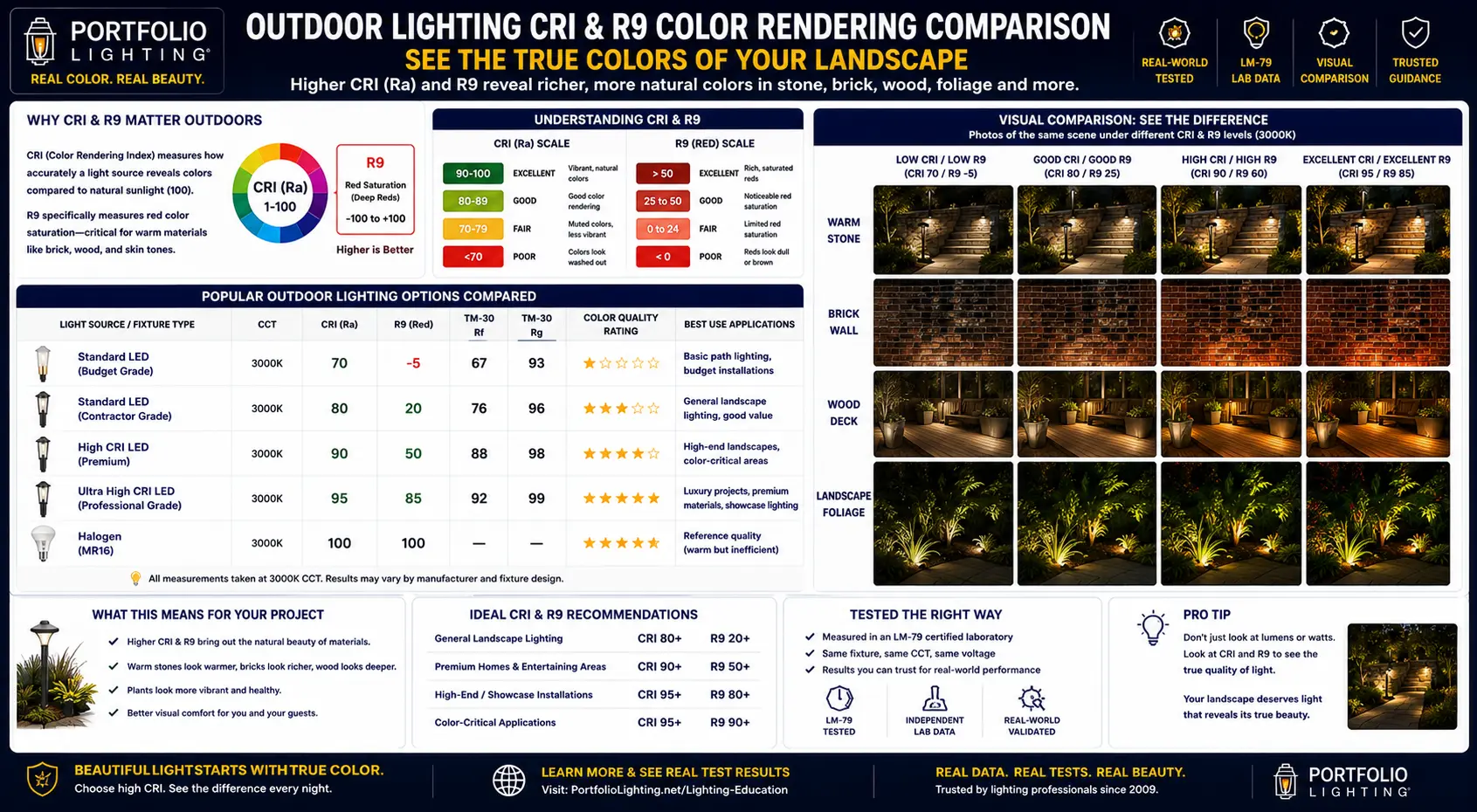
🎨 Color Quality Alert: Buying an LED fixture based solely on a high "CRI 90" box label can completely ruin the look of your yard, turning rich brickwork and cedar siding into a flat, sickly gray. Before you install a single bulb that makes your masonry look washed out, use my 7-Point Color Rendering & R9 Saturation Protocol just below to see exactly how manufacturers hide color blind spots.
Quick Answer: My 7-Point Color Rendering & R9 Saturation Protocol
Relying blindly on a standard Color Rendering Index (CRI) score is the biggest mistake you can make when lighting a home's exterior features. While the lighting industry loves to treat CRI as a universal accuracy metric, the math behind it is built on a massive flaw: it completely ignores the deep, rich reds that make natural wood, brick, stone, and autumn leaves actually look beautiful at night.
Whenever I test a new fixture run or design a high-end landscape layout, I look past the basic marketing labels and judge light quality using these seven field rules:
- 1. The Flawed 8-Sample Baseline (R1-R8): Standard CRI only tests how a light reflects off eight pastel, desaturated interior shades; a fixture can score a high CRI 90 while completely failing to render rich, organic tones.
- 2. The Saturated Red Blind Spot (R9): Saturated red is completely missing from the standard index calculations; if an LED diode has a weak R9 value, it will turn warm brickwork and natural wood grain into a cold, muddy brown.
- 3. The Tale of Two "CRI 90" Fixtures: I frequently see two identical-looking lamps produce totally different yards; one might have an R9 rating of 20 (dull reds), while the other hits an R9 of 75+ (vibrant, rich masonry).
- 4. Matching Earth-Tone Textures: For brick, cedar, terracotta, and warm flagstone pathways, I always mandate a dedicated high R9 value over a basic total CRI number to preserve the natural architectural warmth.
- 5. Foliage and Leaf Depth Dynamics: Weak color quality chokes out the deep crimsons and subtle rust tones in Japanese maples and autumn gardens, turning beautiful landscape investments into flat silhouettes.
- 6. Isolating the Color Temperature Loop: Color accuracy shifts drastically depending on whether you run a warm 2700K baseline or a cool 4000K bulb; the color profile must match your underlying surface material.
- 7. Auditing Factory Specification Sheets: I never trust the retail box font; I always dig straight into the manufacturer's engineering spec sheets to verify the true R9 spectral distribution graph before ordering.
⚠️ CRITICAL DESIGN RISK: Installing low-R9 bulbs across a home with heavy brick accents or expensive cedar trim will cause the facade to look washed out and cheap. Ignoring this spectral data results in three severe visual failures that I have mapped out across my side-by-side color charts below.
In my years troubleshooting lighting setups, I've seen homeowners spend thousands on premium stone masonry only to completely flatten the look of it at night by using cheap, color-blind LED fixtures. Taking the extra minute to check the true R9 saturated value alongside the total CRI rating is what makes your outdoor lighting look intentional, high-end, and completely true to life.
Don't guess on your bulb types or select fixtures blindly. Use my step-by-step color-matching guides, spectral breakdown tables, and masonry lighting blueprints detailed further down this page to find the exact fixture for your project surfaces.
What R9 Is and Why It Matters More Than CRI for Outdoor Landscape Lighting
R9 is the color rendering score for saturated red — the 9th extended test sample, not included in the standard CRI calculation. This means a manufacturer can truthfully claim CRI 90 on a fixture with an R9 of 5. That fixture will make warm red-orange outdoor materials look gray and lifeless under nighttime illumination.
The warm materials that define most residential outdoor landscapes are dominated by red-orange spectral reflectance. Each of these materials requires adequate R9 to render accurately at night:
- Red and orange brick: Iron oxide pigments absorb blue and green light and reflect almost exclusively in the red-orange spectrum. Low R9 makes red brick read as brownish-gray concrete — not the warm fired-clay color it shows in daylight.
- Cedar and redwood: Natural cedar's warm reddish-brown comes from aromatic oils that reflect primarily in the red-orange spectrum. Low R9 flattens cedar to a generic brown indistinguishable from pine or spruce at night.
- Travertine and warm limestone: The golden-amber undertones in travertine come from iron mineral deposits — red-orange reflectance. Low R9 renders travertine as pale gray-beige, visually identical to concrete under the fixture.
- Terra cotta and clay: The characteristic orange-red of terra cotta is completely R9-dependent for accurate nighttime rendering — it either glows warm or looks flat brown based almost entirely on R9.
- Warm flowers and autumn plantings: Red and orange blooms, marigolds, heuchera, and warm ornamental grasses all require R9 above 60 to look as vivid at night as they do in full daylight.
What Your R9 Score Means for Warm Outdoor Materials
The practical consequence is significant: a homeowner who invests in beautiful warm-toned landscaping materials — travertine coping, cedar siding, red brick columns, warm-toned plantings — and then illuminates them with CRI 80 or low-R9 LED fixtures has effectively paid for materials that look their worst exactly when the landscape lighting is on. The lighting runs every evening; the warm colors visible in daylight disappear under the fixture at night. CRI 90+ with R9 70+ is the specification that preserves the material investment after dark.
CRI 80 vs CRI 90 vs CRI 95: The Visible Difference on Warm Outdoor Materials
What each CRI tier produces on warm outdoor residential materials — not theoretical descriptions but what you observe standing in the yard at night.
Acceptable — Not for Warm Materials
- Red brick appears brownish-gray
- Cedar and redwood lose warm tone
- Travertine reads like concrete
- Warm mulch looks flat dark brown
- Red and orange flowers lose vibrancy
- R9 can be as low as 0–20 at CRI 80
- Correct for: driveways, security, utility lighting
Good — Minimum for Quality Residential
- Warm tones visible and generally accurate
- Brick reads as warm red-brown
- Cedar retains characteristic warmth
- Stone looks warm rather than cold gray
- R9 typically 50–75 depending on manufacturer
- Right choice for most residential landscape lighting
- Always verify R9 — not all CRI 90 is equal
Excellent — Premium Standard
- Near-daylight color accuracy on all materials
- Brick, cedar, stone look exactly as in sunlight
- Plant colors fully vivid and botanically accurate
- R9 typically 80–95
- Required for architectural lighting and premium residential
- Ketra platform achieves this at warm CCT
- Premium tier — fixtures specifying CRI 95+ at 2700K cost more
CRI and R9 Requirements by Outdoor Material Type
Different outdoor materials have different sensitivity to CRI and R9 deficiency. This gives you the minimum color quality specification for every common outdoor residential material so you can match light quality to the specific surfaces being illuminated.
🧱 Red and Orange Brick
The most R9-sensitive common outdoor material. Iron oxide pigments in red brick reflect almost exclusively in the red-orange spectrum. Low R9 makes red brick appear as brownish-gray concrete. The difference between R9 20 and R9 70 on red brick is dramatic and immediately visible without any technical equipment.
CRI 90+ / R9 70+ required🌲 Cedar, Redwood, Warm-Toned Wood
Natural cedar and redwood owe their characteristic color to red-orange aromatic oils in the wood grain. CRI 80 makes cedar look like generic brown wood. CRI 90+ with R9 60+ restores the distinctive warm reddish tone that distinguishes premium cedar siding from commodity lumber under nighttime illumination.
CRI 90+ / R9 60+ required🪨 Travertine and Warm Limestone
Travertine's golden-amber undertones come from iron mineral deposits — red-orange spectrum reflectance. Without adequate R9, travertine appears as pale gray-beige identical to concrete. With R9 70+, travertine glows with the warm amber character that makes it a premium landscape material worth the investment.
CRI 90+ / R9 70+ required🏺 Terra Cotta and Clay
Terra cotta's orange-red is the purest expression of R9 sensitivity in outdoor materials. Low R9 makes terra cotta pots, tile, and architectural features appear dull brown-orange — losing the vivid warmth that defines the material. Most critical for Mediterranean, Spanish Colonial, and Southwestern design styles.
CRI 90+ / R9 65+ required🌺 Red and Orange Flowers and Plantings
Garden plants with warm colors — roses, marigolds, geraniums, dahlias, heuchera, autumn ornamental grasses — lose their visual impact completely under low-R9 lighting. Nighttime garden illumination for warm-colored plantings requires R9 60+ to preserve the design intent of the planting scheme you invested in during the day.
CRI 90+ / R9 60+ required🪨 Warm Sandstone and Flagstone
Warm-toned sandstone and flagstone with iron mineral staining are moderately R9-sensitive. Cool gray granites and bluestone are less sensitive because they reflect across a broader spectrum. For warm sandstone and buff flagstone, R9 55+ preserves warm character. Cool gray or blue-gray stone — standard CRI 90 is typically adequate.
CRI 90+ / R9 55+🌳 Green and Blue-Green Foliage
Dark green and blue-green plants are primarily sensitive to green-blue spectrum reflectance. They are less affected by R9 deficiency than warm-colored plants. CRI 90 is recommended for quality garden lighting on green foliage but the critical CRI component is R5 (green rendering), not R9. Most CRI 90+ fixtures perform well on green foliage without additional R9 specification.
CRI 90+ / Standard R9 acceptable🏗 Concrete, Bluestone, Cool-Gray Masonry
Cool-gray masonry has low R9 sensitivity because its color is driven by the full visible spectrum. CRI 90 without specific R9 targeting is acceptable for illuminating these materials. CRI 80 is adequate for purely functional illumination of cool gray surfaces — though overall scene quality still benefits from CRI 90+ for the warm materials, people, and objects sharing the same space.
CRI 90+ / R9 50+ acceptableR9 Rankings: All 31 Benchmarked Fixtures and Devices
R9 estimates from the 2026 Hardware Database based on light source type, spectral category data, and manufacturer technical documentation. Not manufacturer-certified laboratory measurements. The most complete R9 comparison available for these fixture categories at warm CCT (2700K–3000K), white mode operation.
Color quality affects more than how plants, stone, and wood look at night. The circadian outdoor lighting color guide explains how spectrum, timing, and brightness can influence nighttime comfort and biological rhythm.
At warm CCT — industry leading
AC-LED driverless — warm output
Tunable white at 2700K
E26 lamp — bulb determines R9
E26 lamp — specify CRI 90+ bulb
Outdoor integrated LED
E26 lamp variants
White mode only — RGB mode much lower
White mode at 2700K
Cordless — warm ambient mode
Budget cordless — lower driver quality
Complete Fixture Color Quality Reference Table — All 31 Models
CRI and R9 estimates for all 31 benchmarked 2026 models at warm CCT white mode. E26-lamped fixtures (*): CRI and R9 are determined by the bulb installed, not the fixture. Transformers and dimmers: CRI/R9 are not applicable — the connected fixture determines color quality.
| Fixture / Device | Type | CRI | R9 Est. | Warm Material Verdict |
|---|---|---|---|---|
| Ketra Tunable Platform | Smart Arch. | 95+ | 90–95 | All warm materials — best in class |
| Modern Forms Alabaster Sconce | Wall Sconce | 90+ | 70–85 | Stone, wood, warm masonry — excellent |
| WAC dweLED Longboard | Linear Tunable | 90+ | 65–80 | Wood, stone, warm materials — excellent |
| Hinkley Clear Lantern Series | Outdoor Lantern | 90+* | 65–80* | Brick, cedar, warm stone — lamp dependent |
| Savoy House Lancaster Wall | Outdoor Wall | 90+* | 65–80* | Brick, cedar, warm stone — lamp dependent |
| Kichler Hatteras Bay | Outdoor Pendant | 90+* | 65–78* | Warm materials, plantings — lamp dependent |
| Sea Gull Hudson Street | Outdoor Pendant | 90+* | 65–78* | Warm materials, plantings — lamp dependent |
| HomeGnome Travertine Pendant | Indoor Pendant | 90+ | 60–75 | Stone, wood — excellent for kitchen island |
| Morsale Linear Travertine | Chandelier | 90+ | 60–75 | Stone, wood surfaces — good |
| Morsale Marble Sconce | Wall Sconce | 90+ | 60–70 | Stone, wood, warm finishes |
| Savoy House Judi Chandelier | Chandelier | 90+ | 58–70 | Moderate warm rendering |
| WAC dweLED Brocade | Outdoor Integrated | 90+ | 58–70 | Moderate warm rendering — covered outdoor |
| Kichler Tenon Collection | Decorative | 90+* | 55–70* | Specify CRI 90+ R9 70+ bulb |
| Capital Leland Chandelier | Chandelier | 90+* | 55–70* | Moderate warm rendering — lamp dependent |
| Maxim Cora Pendant | Pendant | 90+* | 55–70* | Moderate warm rendering — lamp dependent |
| Generation Hanks Pendant | Pendant | 90+* | 55–70* | Moderate warm rendering — lamp dependent |
| Alora Furrow Pendant | Pendant | 90+ | 55–68 | Acceptable — varies by SKU |
| AiDot Linkind Matter (white mode) | Smart Bulb | 90+ | 55–75 | Acceptable warm rendering — white mode only |
| Philips WiZ A19 (white mode) | Smart Bulb | 90+ | 55–70 | Acceptable warm rendering — white mode only |
| U-tec Bright A19 (warm white) | Smart Bulb | 90+ | 55–70 | Acceptable warm rendering |
| Lutron Diva / Caséta | Smart Dimmer | N/A | N/A | Control only — connected fixture determines CRI/R9 |
| Portfolio 0805279 / 0010915 | Transformer | N/A | N/A | Power supply — connected fixtures determine CRI/R9 |
| Zafferano Pina Pro | Cordless | 90+ | 55–65 | Acceptable warm ambient accent |
| Visual Comfort Avedon | Cordless | 90+ | 55–70 | Acceptable warm accent |
| Kuzco Folio 9 / Hay Pao | Cordless | 90+ | 55–70 | Acceptable warm accent |
| Brightech Celia / O'Bright Dune | Cordless Budget | 85–90 | 40–55 | Marginal on warm materials — ambient use only |
| Nordalight Scandinavian | Mixed | 90+ | 55–68 | Acceptable — varies by variant |
How Color Temperature Interacts With CRI and R9 for Outdoor Lighting
CRI and R9 do not operate independently of color temperature. The same fixture produces different effective warm color rendering at 2700K versus 4000K — and for outdoor landscape lighting this interaction is critical before specifying any fixture.
Why 2700K–3000K Is the Correct Range for Warm Outdoor Materials
Warm color temperatures (2700K–3000K) produce light with a spectral distribution that emphasizes orange and red wavelengths — the same wavelengths that dominate warm outdoor materials. When a high-R9 light source at 2700K illuminates warm brick or cedar, the spectral emphasis of the light reinforces the warm material colors, producing vivid, saturated results. At 4000K or higher, even a CRI 90+ R9 70 fixture produces less vivid warm color rendering because the fundamental spectral balance shifts toward blue-green and away from the red-orange that warm materials reflect.
The 2700K Standard for Outdoor Landscape Lighting
2700K is the standard color temperature for residential outdoor landscape lighting and the correct specification for any position illuminating warm stone, brick, cedar, or warm-colored plantings. Some designers prefer 3000K for a slightly crisper appearance while maintaining good warm rendering. Color temperatures above 3500K are generally inappropriate for residential landscape lighting and will produce noticeably inferior warm color rendering on warm outdoor materials regardless of how high the stated CRI and R9 values are.
Tunable White Fixtures and Warm Material Rendering
Tunable white fixtures like the WAC dweLED Longboard and Ketra platform can shift between warm and cool color temperatures. For outdoor warm material illumination, lock these fixtures at their warmest available CCT setting — typically 2700K. Mixing color temperatures across a landscape (some fixtures at 2700K, others at 4000K) creates visual inconsistency that undermines design intent regardless of individual fixture CRI quality.
For the circadian and biological reasons to prefer warm outdoor lighting beyond color quality alone, see the Circadian Landscape Lighting Guide and the Biological Impact of Outdoor Light Color.
How to Find High-CRI / High-R9 LED Landscape Lights Before You Buy
High CRI and high R9 are not prominently advertised because they cost money to achieve and most buyers do not know to ask. These are the specific steps that identify genuinely high-quality color rendering fixtures before purchasing.
Related Guides and Resources
- Full 2026 Hardware Benchmark Database — 31 Models
- Best LED Landscape Lighting Fixtures
- LED Fixture Repairability Guide
- Smart Bulb Standby Power Comparison
- LED Driver Heat Guide
- Outdoor Lighting Finish Weathering Guide
- Smart Lighting Latency Guide
- Landscape Lighting Acoustic Hum Guide
- CRI 95 vs CRI 80: The Real Cost
- Landscape Lighting Color Temperature Guide
- Circadian Landscape Lighting Guide
- Flicker Factor Clean Power Guide
- Retrofitting Portfolio Fixtures for Human-Centric Lighting
- Dark Sky Compliance Guide
- Biological Impact of Outdoor Light Color
- Portfolio Landscape Lighting Hub
Outdoor Lighting CRI and R9 FAQ
What is CRI in outdoor lighting?
CRI (Color Rendering Index) is a scale from 0 to 100 measuring how accurately a light source renders object colors compared to natural sunlight. A score of 100 is perfect. Outdoor lighting with CRI 80 or below makes warm materials like brick, cedar, travertine, and warm stone appear grayish and flat. CRI 90+ is the minimum standard for quality outdoor lighting where material color accuracy matters. The critical limitation: the standard CRI calculation does not include saturated red (R9), so two CRI 90 fixtures can look completely different on warm outdoor materials. Always verify R9, not just CRI, for outdoor landscape lighting specification.
What is R9 and why does it matter for landscape lighting?
R9 is the color rendering score for saturated red — the 9th extended color sample, not included in the standard CRI calculation. Two fixtures can both score CRI 90 while having R9 values of 20 and 75. The R9 20 source makes warm red-orange materials like brick, cedar, autumn leaves, and terracotta look cold, gray, and flat. The R9 75 source renders those same materials with vivid, accurate warmth. For outdoor landscape lighting on warm natural materials, R9 above 50 is the minimum and R9 above 70 is the premium residential target. R9 is the number that determines whether your warm landscaping materials look their best at night.
What CRI do I need for landscape lighting?
CRI 90 or higher is the recommended minimum for landscape lighting illuminating warm natural materials. CRI 80 produces visibly inferior color rendering on warm materials — browns and reds appear grayish or greenish. CRI 90+ with R9 above 50 is the quality standard for residential landscape lighting. CRI 90+ with R9 above 70 is the premium target for installations where the vivid color of stone, wood, and brick is central to the design intent and justifies the material investment. For driveways, security areas, and purely functional outdoor illumination, CRI 80 is adequate.
Why does my landscape lighting make brick look gray?
Brick appears gray or desaturated under landscape lighting when the light source has low R9 — poor rendering of saturated red wavelengths. The warm red-orange tones in brick require a light source with adequate R9 to accurately reproduce them at night. A fixture with CRI 80 and R9 of 20 makes warm red brick look flat brownish-gray. Replacing the bulb with a CRI 90+, R9 70+, 2700K LED A19 immediately restores warm brick color — typically for $8–15 per lamp, making this the highest-ROI lighting improvement available for most existing E26-lamped landscape lighting installations.
Is CRI 80 good enough for outdoor lighting?
CRI 80 is adequate for security lighting, driveways, and purely functional outdoor areas where color accuracy is not a design priority. It is not adequate for landscape lighting that illuminates warm architectural materials, wood, stone, brick, or designed garden plantings. The difference between CRI 80 and CRI 90 is clearly visible on warm outdoor materials — particularly at 2700K, the standard landscape lighting color temperature. CRI 90+ is the minimum for any residential landscape lighting position where the warm material color matters to the design intent.
What color temperature is best for landscape lighting?
2700K–3000K is the standard for residential landscape lighting. At these color temperatures, high-CRI and high-R9 light sources render warm stone, brick, wood, and plants with vivid accuracy and a comfortable, inviting character. Color temperatures above 4000K are inappropriate for most residential landscape lighting — they make warm materials look cold and institutional at night, create harsh outdoor environments, and cause circadian disruption from evening blue light exposure regardless of CRI and R9 values.
How do I improve the CRI and R9 of an existing outdoor lighting fixture?
For E26-lamped fixtures: replace the lamp with a CRI 90+, R9 70+, 2700K LED A19 or PAR. Immediate improvement on warm materials at $8–15 per bulb — no other hardware changes required. For integrated LED fixtures with non-replaceable lamps: CRI and R9 are fixed by the fixture design and cannot be improved without replacing the fixture. For smart bulbs: operate in white mode at 2700K rather than RGB color mode. White mode at 2700K produces significantly better R9 on warm outdoor materials than any color-mixed RGB scene on the same bulb, because the RGB red channel is not spectrally matched to natural warm-light red rendering.
CRI and R9 Estimate Disclaimer
CRI and R9 values in this guide are field-planning estimates based on light source type, lamp category spectral data, and manufacturer technical documentation available as of 2026. They are not manufacturer-certified measurements performed under controlled laboratory conditions per ANSI/IES TM-30 or CIE 13.3 test protocols. Actual CRI and R9 values vary by specific product batch, operating temperature, color temperature setting, and product aging. Always request the photometric data sheet, IES file, or spectral power distribution (SPD) data from the manufacturer when CRI and R9 accuracy is critical to a lighting specification or purchasing decision.