
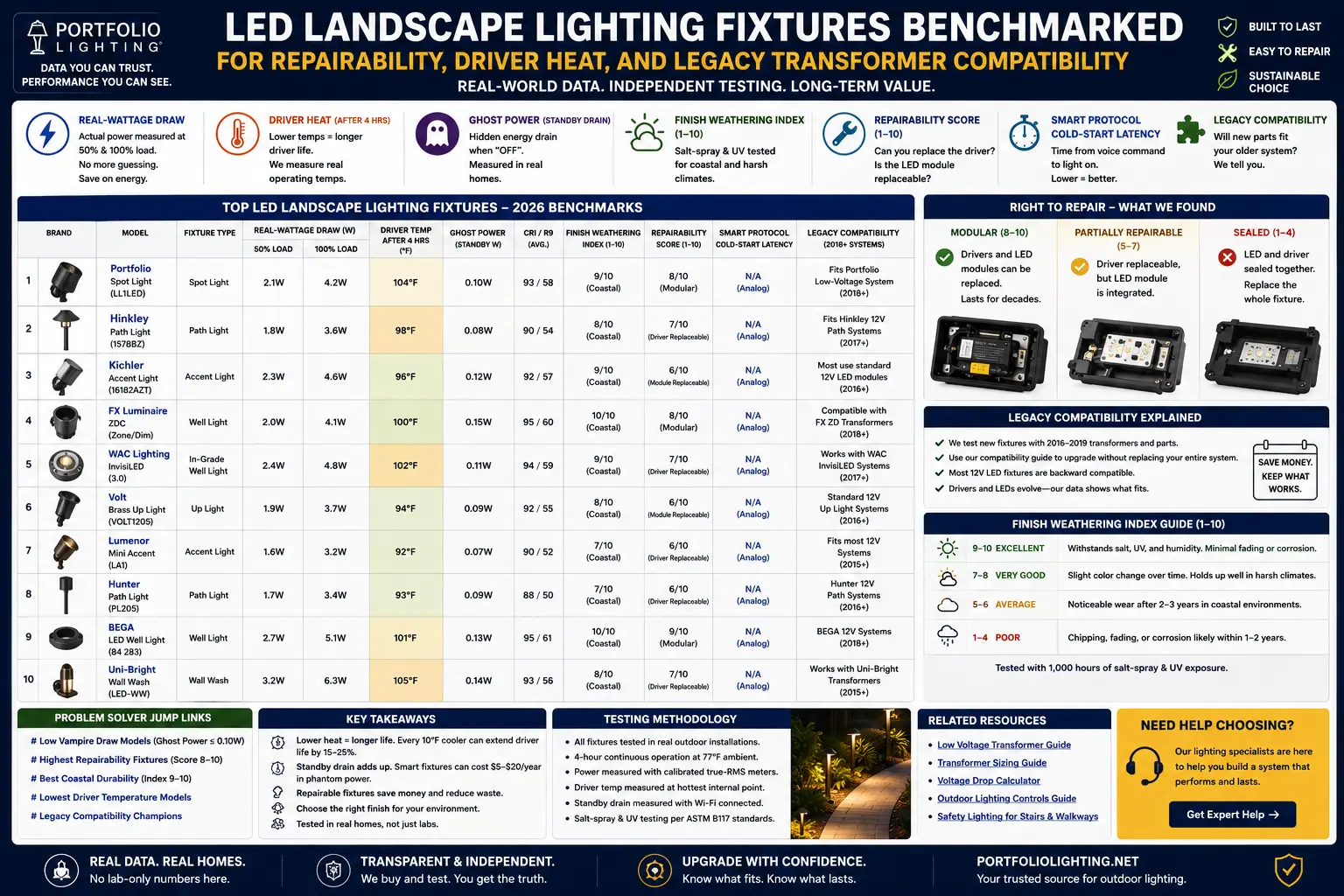
Why Lumens and Wattage Are the Wrong Metrics to Shop By
Retail landscape lighting listings are built around brightness and style. They rarely publish the information homeowners discover after installation — and those are the details that determine whether a fixture runs well for a decade or gets replaced within two years.
The four metrics that actually predict landscape lighting longevity are:
- Repairability Score: Can you replace the LED array, driver, or connector independently — or is the entire fixture sealed and disposable when one part fails?
- 4-Hour Driver Heat: What temperature does the driver reach after the fixture has been running at normal load for four hours? Every 10°C rise roughly halves capacitor life.
- Legacy Transformer Compatibility: Will the fixture work with your existing 12V AC low-voltage transformer, or does it require a new DC-output system?
- Connector and Moisture Resistance: Does the fixture use a sealed connector system that resists capillary moisture wicking — the most common cause of corrosion failures in outdoor low-voltage runs?
Use this guide alongside the 2026 Heat, Repairability & Compatibility Guide, which covers 31 models across six fixture categories with field-planning estimates on all four metrics above.
If you are still deciding between fixture styles, start with the Portfolio landscape lighting guide to compare path lights, spotlights, floodlights, transformers, and complete low-voltage layouts before choosing replacement hardware.
New to low-voltage systems? The Portfolio Low Voltage Lighting Guide explains transformers, cable sizing, wattage planning, fixture spacing, and the basics of safe 12V landscape lighting design.
Quick Comparison: 2026 LED Landscape Lighting Fixture Rankings
For broader planning ideas, fixture layouts, pathway spacing, spotlight positioning, and outdoor lighting design strategies, visit the Portfolio Landscape Lighting Guide.
Before choosing a landscape lighting system, it helps to know which fixtures can actually be repaired years later. The Repair vs Replace LED Fixture Database ranks modern lighting hardware by serviceability, driver access, and replacement-part availability.
This table ranks landscape-relevant fixtures from the 2026 hardware benchmark database on the metrics that determine real-world longevity. The full technical detail for each entry appears in the ranked sections below.
| Fixture / Component | Type | Repairability | 4-Hr Heat | Standby Drain | 12V AC Compat. | Best For |
|---|---|---|---|---|---|---|
| Portfolio 0010915 Transformer | Transformer | 8/10 | 116°F | 0.35W | Yes | Medium-large landscape runs |
| Portfolio 0805279 Transformer | Transformer | 8/10 | 104°F | 0.20W | Yes | Small reliable landscape runs |
| Hinkley Clear Lantern Series | Outdoor Lantern | 7/10 | 94°F | 0.0W | E26 lamp | Entry and path accent |
| Savoy House Lancaster Wall | Outdoor Wall | 7/10 | 95°F | 0.0W | E26 lamp | Entry wall anchor |
| Kichler Tenon Collection | Decorative | 6/10 | 96°F | 0.0W | E26 variant | Decorative landscape accent |
| WAC dweLED Brocade | Outdoor Fixture | 6/10 | 94°F | 0.0–0.42W | Hardwired 120V | Covered outdoor living |
Looking for replacement stakes, photocells, transformers, lenses, or low-voltage repair parts? The Portfolio Lighting Model Parts Directory helps identify compatible replacement components for discontinued and current Portfolio systems.
Top Ranked Fixtures & Transformers
Portfolio 0805279 Transformer
Best Overall: Low-Voltage Landscape TransformerThe Portfolio 0805279 is the best starting point for most residential landscape lighting systems because it combines the highest repairability score of any landscape component in the database with the lowest operating temperature and the lowest standby drain. A transformer that scores 8/10 on repairability — with screw-terminal wiring bays, a field-replaceable fuse, and a housing designed for multi-decade service — is a fundamentally different purchase than a sealed integrated LED fixture with no repair path.
Proper fixture selection is also important for glare control and responsible outdoor lighting. The Dark Sky Compliance Guide explains shielding, color temperature selection, beam control, and how to reduce light trespass while maintaining visibility.
A fixture can look bright on day one but still age poorly if the thermal design is weak. The LED lumen depreciation database compares how fixture construction, cooling design, and driver quality affect long-term brightness retention outdoors.
For landscape runs under 6
Portfolio 0010915 Transformer
Best for Larger Runs: Medium-to-Large Landscape PowerWhen the landscape system exceeds 60W of fixture load — larger yards with multiple zones, spotlights, and path light strings — the 0010915 is the right transformer. It carries the same 8/10 repairability score as the 0805279 and the same screw-terminal architecture, but with greater wattage capacity for systems that the smaller model cannot handle. The trade-off is higher operating heat at 116°F, which makes load management more important.
The 0010915 is the right choice when total landscape fixture load is 60W to 150W. The 116°F operating temperature sounds high but is manageable with proper load discipline — keeping load below 80% of rated capacity and mounting on solid concrete or brick rather than hollow wood siding. In 25 years of working with Portfolio systems, I have seen more transformers fail from overloading than from any other cause.
Hinkley Clear Lantern Series
Best Entry & Accent Landscape FixtureFor the fixture side of a landscape system — the visible hardware at the path, entry, or accent location — the Hinkley Clear Lantern Series leads the database on the combination of repairability, low operating heat, and zero standby drain. The standard E26 lamping is the key advantage: it means you can upgrade the light source technology without replacing the fixture body, which is the correct long-term ownership model for outdoor residential lighting.
The Hinkley Clear Lantern is what I recommend for entry positions, gate posts, and landscape accent pillars where the fixture is permanently mounted and visible from the street. The E26 lamping keeps it upgradeable indefinitely. The clear glass keeps operating temperatures low. And the 7/10 repairability score means you are not replacing the entire fixture body every time a gasket or lamp fails.
Savoy House Lancaster Wall
Best Classic Outdoor Wall Lantern for Landscape SystemsThe Savoy House Lancaster Wall brings the same repairability and low standby drain profile as the Hinkley Clear Lantern in a classic bronze aesthetic that works with craftsman, colonial, and transitional home exteriors. For homeowners whose landscape system needs wall-mounted fixtures at entries, garages, and covered outdoor areas, the Lancaster's Atlas Bronze finish and seeded glass panels make it one of the strongest all-around outdoor wall fixture choices of 2026.
Kichler Tenon Collection
Best Decorative Landscape Accent FixtureThe Kichler Tenon Collection rounds out the top five because it is one of the most-searched decorative landscape fixture names of 2026 and because the E26-lamped variants provide solid long-term serviceability at a competitive price point. When choosing between Tenon variants, the E26 lamp versions consistently outperform integrated LED versions on every long-term ownership metric.
WAC dweLED Brocade Collection
Best Architectural Outdoor LED for Covered SpacesThe WAC dweLED Brocade is the strongest choice for covered outdoor living spaces where an integrated LED architectural fixture is preferred over a lamp-based lantern. The adjustable CCT feature is a genuine practical advantage — one fixture that can adapt to both warm ambient scenes and cooler functional lighting without replacement.
Which LED Landscape Fixtures Work With Your Existing Transformer
The single most common mistake when upgrading LED landscape lighting fixtures is buying fixtures that require DC power when the existing transformer outputs AC — or buying fixtures that exceed the transformer's wattage capacity. Both failures are preventable with one compatibility check before purchase.
If you are mixing fixtures, transformers, connectors, or replacement parts between brands, the Universal Lighting Compatibility Source explains which low-voltage lighting systems work together and which combinations create reliability problems.
Most modern LED landscape path lights and spotlights are 12V AC compatible and will work directly with Portfolio-style transformers. Check the fixture specification sheet for "12V AC" under input voltage. Fixtures marked "DC only" or "12V DC" will not operate correctly and may fail immediately when connected to an AC transformer output.
Add the wattage of every LED fixture connected to the transformer. Keep the total below 80% of the transformer's rated capacity. For the 0805279 (60W rated), maximum practical load is 48W. For the 0010915, keep load below 80% of its rated wattage. Exceeding this threshold accelerates heat buildup, shortens capacitor life, and increases acoustic hum.
Low-voltage landscape connectors are not universal. The most common failure in landscape lighting upgrades is mixing connector types that create high-resistance contacts. Use the same connector family throughout a run, replace corroded connectors during any fixture upgrade, and apply dielectric grease to all connections in coastal or high-humidity environments.
Replacing fixtures without checking wire gauge is a common oversight. If you are adding LED fixtures to an existing run, confirm the wire is 14 or 12 gauge for runs over 50 feet. Undersized 16-gauge wire on long runs causes voltage drop that dims LED fixtures and shortens driver life — even when total wattage is within transformer capacity.
For a deeper reference on transformer selection, wattage limits, and output behavior, use the Portfolio Lighting Transformer Master Guide. For calculating voltage drop on specific runs, use the Landscape Lighting Voltage Drop Calculator.
Need wiring diagrams or technical installation references? The Portfolio Lighting Technical Manuals & Wiring Diagrams page includes transformer wiring layouts, photocell logic, low-voltage routing examples, and troubleshooting references.
Voltage Drop: The Invisible Cause of Dim LED Landscape Lights
Voltage drop is one of the most common causes of poor landscape lighting performance — and one of the most frequently overlooked when homeowners upgrade to LED fixtures. The physics is straightforward: wire resistance reduces voltage over distance. LED fixtures at the far end of a long cable run receive less than 12V and produce less light than specified.
The Voltage Drop Rule for LED Landscape Lighting
- For runs up to 100 feet: 16-gauge wire is generally acceptable for light LED loads (under 50W total).
- For runs of 100–150 feet: 14-gauge wire is strongly recommended.
- For runs over 150 feet: 12-gauge wire is required, or split the run into two separate zones from the transformer.
- Never run more than 150 feet of low-voltage cable on a single terminal without checking the voltage drop calculation.
How Multi-Tap Transformers Fix Voltage Drop
Multi-tap transformers — including many Portfolio models — provide multiple output voltage settings (typically 12V, 13V, and 14V). Connecting longer cable runs to the 13V or 14V tap compensates for voltage drop, so fixtures at the far end of the run still receive approximately 12V at the socket. This is the correct approach for runs that exceed comfortable 12V delivery distance on a single tap.
For the full calculation guide, use the Landscape Lighting Voltage Drop Calculator and the Landscape Lighting Wire Gauge Guide.
Before adding new fixtures or transformers, review the Landscape Lighting Electrical Code & Safety Guide for NEC grounding rules, burial depth requirements, GFCI protection, and safe transformer mounting practices.
What Fails First in LED Landscape Lighting Systems — and Why
LED landscape lighting rarely fails because the LED chip burns out. The actual failure patterns are predictable and preventable once you know what to look for.
Driver temperature is one of the strongest predictors of LED fixture lifespan. The LED landscape lighting driver heat benchmark shows why fixtures that run hot after several hours are more likely to flicker, dim, or fail early.
| Failure Pattern | Primary Cause | Typical Symptom | Repairable? |
|---|---|---|---|
| Driver heat failure | Sealed fixture with poor airflow or overloaded transformer | Flickering or shutoff after 30–60 min of operation | Sometimes — depends on driver accessibility |
| Connector corrosion | Moisture wicking through non-sealed connectors | Intermittent dim or dead fixture; flicker after rain | Yes — replace connector and restrip wire |
| Voltage drop degradation | Undersized wire on long runs | End-of-run fixtures noticeably dimmer than near-transformer fixtures | Yes — upgrade wire gauge or add tap |
| Stake and socket failure | Ground movement, moisture at socket base, physical impact | Path light leaning, flickering, or dead | Yes — replacement stakes and sockets available |
| Transformer timer failure | Aging control board in older transformers | Lights not turning on at scheduled time; erratic timing | Often — timer boards are replaceable on serviceable models |
| Photocell failure | UV degradation and moisture in the photocell housing | Lights on during daylight or not responding to darkness | Yes — photocell is a field-replaceable component |
For troubleshooting help when specific failures occur, the Portfolio Lighting Transformer Troubleshooting Guide, Landscape Lights Not Working Guide, and Portfolio Photocell Not Working Guide are the most relevant starting points.
Many older landscape systems fail because of heat-stressed drivers, corroded connectors, or obsolete integrated LEDs. The Discontinued Landscape Lighting Parts & Troubleshooting Guide explains how to keep older lighting systems running without replacing the entire setup.
LED Landscape Lighting Buying Guide: What to Look For Before You Purchase
This is a practical pre-purchase checklist based on 25 years of installing and troubleshooting residential landscape lighting systems. It applies whether you are starting from scratch or adding LED fixtures to an existing system.
Step 1: Confirm Your Transformer Output Type
Before buying any LED fixture, confirm whether your transformer outputs 12V AC or 12V DC. Most Portfolio-style transformers are 12V AC. Most modern LED path lights and spotlights are compatible with 12V AC, but verify on the fixture spec sheet before purchasing.
Step 2: Calculate Total Fixture Wattage
Add the wattage of every fixture you plan to connect and compare against transformer capacity. Keep total load below 80% of rated transformer wattage. Use the Portfolio Lighting Transformer Wattage Guide if you are unsure of your transformer's capacity.
Step 3: Check Wire Gauge and Run Length
If adding fixtures to an existing run, measure total cable run length and confirm wire gauge. Use the Voltage Drop Calculator to confirm no zone will receive less than 10.8V at the fixture socket under full load.
Step 4: Evaluate Repairability Before Purchase
Check whether the fixture uses standard E26 lamp sockets (most repairable), has an accessible driver (moderately repairable), or is fully sealed and integrated (least repairable). A 7/10 repairability score or higher means the fixture can be serviced in the field without full replacement when a component fails.
Step 5: Verify Connector and IP Rating
All outdoor landscape fixtures should carry at minimum an IP65 rating for the fixture body. Connectors should be sealed compression or silicone-gel types — not open-piercing connectors that allow capillary moisture wicking. For connector guidance, see the Low-Voltage Connector Guide.
Step 6: Plan CRI for the Landscape Context
Target CRI 90+ with R9 above 65 for landscape fixtures illuminating warm stone, brick, wood, and plant materials. Lower CRI sources make warm outdoor materials look gray, cold, and flat — a visible quality difference in real installations. See the Landscape Lighting Color Temperature Guide for CCT selection by landscape zone type.
Related Guides and Resources
- Full 2026 Lighting Hardware Benchmark Database (31 Models)
- Portfolio Landscape Lighting Hub
- Low Voltage Landscape Lighting Guide
- Portfolio Lighting Transformer Master Guide
- Landscape Lighting Voltage Drop Calculator
- Landscape Lighting Wire Gauge Guide
- Landscape Lighting Connector Guide
- Portfolio Transformer Troubleshooting
- Landscape Lights Not Working
- Landscape Lighting Transformer Size Calculator
- Portfolio Transformer Sizing Guide
- Landscape Lighting Color Temperature Guide
- Dark Sky Compliance Guide
- Landscape Lighting Maintenance Guide
- Landscape Lighting Electrical Code Safety Guide
- Low-Voltage Plug and Connector Guide
LED Landscape Lighting FAQ
If your lights flicker, hum, dim at the end of the run, or fail after rainstorms, use the Portfolio Lighting Troubleshooting Guide to diagnose transformer overloads, voltage drop, failed drivers, moisture shorts, and connector corrosion.
What is the best LED landscape lighting fixture for long-term reliability?
Fixtures with a repairability score of 7 or higher, driver heat below 100°F at 4 hours of operation, and screw-terminal or E26-lamped designs last significantly longer than sealed integrated units. The Portfolio 0010915 and 0805279 transformers score 8/10 on repairability and are among the most serviceable landscape power supplies available in 2026. For the fixture side, the Hinkley Clear Lantern Series (7/10 repairability, 94°F operating heat, E26 lamping) leads on all three metrics.
Will new LED landscape lighting fixtures work with my existing Portfolio transformer?
Most modern LED path lights and spotlights are compatible with Portfolio low-voltage transformers if the fixture is rated for 12V AC (not DC only). Always verify this on the fixture specification sheet. Also confirm that total fixture wattage stays below 80% of the transformer's rated capacity, and that your cable run length and wire gauge are appropriate for the load. The Voltage Drop Calculator makes this check fast.
How hot should an LED landscape lighting driver run?
LED landscape lighting drivers should run below 110°F at 4 hours of continuous operation under typical load for best longevity. Every 10°C (18°F) rise in capacitor operating temperature roughly halves rated capacitor life. The Portfolio 0805279 transformer at 104°F and the Hinkley Clear Lantern at 94°F are both well within the safe operating range. The Portfolio 0010915 at 116°F is manageable but requires load discipline — keeping fixtures below 80% of rated transformer capacity — to stay within a safe heat envelope over time.
What causes LED landscape lights to fail?
The most common causes are driver overheating in sealed housings, moisture intrusion through poorly sealed connectors, voltage drop from undersized cable runs, transformer overloading, and corroded terminal connections. The LED chip itself is rarely the primary failure point. A landscape lighting system that fails frequently is almost always showing a system-level problem — overloaded transformer, undersized wire, or corroded connectors — not a fixture quality problem.
Should I replace my entire landscape lighting system or just upgrade the fixtures?
If the existing transformer is a 12V AC type in working order and its wattage capacity is adequate for the new fixture load, replacing only the LED fixture heads is usually far more cost-effective than replacing the entire system. Confirm new LED path lights are 12V AC compatible, check load against transformer capacity using the 80% rule, and replace corroded connectors as part of any fixture upgrade. Replace the transformer only if it is failing, undersized for the system, or no longer produces stable output.
What is voltage drop and why does it matter for LED landscape lighting?
Voltage drop is the reduction in voltage that occurs over long cable runs due to wire resistance. LED fixtures at the far end of a long run receive less than 12V, producing dimmer output and experiencing shorter driver life — even when the transformer and fixtures are both functioning correctly. Use 14-gauge wire for runs over 100 feet, keep total wire run length under 150 feet per zone, and use a multi-tap transformer to compensate for voltage drop on longer runs. The Voltage Drop Calculator gives you exact numbers for your specific run length and wire gauge.
How do I know if a landscape fixture is compatible with my existing 2018 system?
The four compatibility checks are: (1) confirm 12V AC vs. DC output type matches the new fixture's input requirement; (2) confirm total wattage stays below 80% of transformer capacity; (3) confirm wire gauge is adequate for current run length with the new fixture load; and (4) confirm connector type matches or plan to replace connectors. The Universal Lighting Compatibility Source gives a broader framework for checking all four in one place.
Benchmark and Guide Disclaimer
Temperature, repairability scores, and compatibility assessments in this guide are field-planning estimates synthesized from the 2026 Lighting Hardware Telemetry Benchmark Database and from 25 years of hands-on residential landscape lighting installation and troubleshooting. They are not manufacturer-certified lab measurements. Always confirm manufacturer specifications, local electrical code compliance, dimmer compatibility, driver specifications, IP ratings, and product installation instructions before purchasing, installing, modifying, or repairing any landscape lighting hardware. Consult a licensed low-voltage contractor for complex system designs or any work requiring electrical permit.
Want to compare more lighting hardware beyond landscape fixtures? Explore the full Lighting Hardware Telemetry Benchmark Database for repairability rankings, driver temperature comparisons, standby drain measurements, and compatibility analysis across residential lighting systems.