
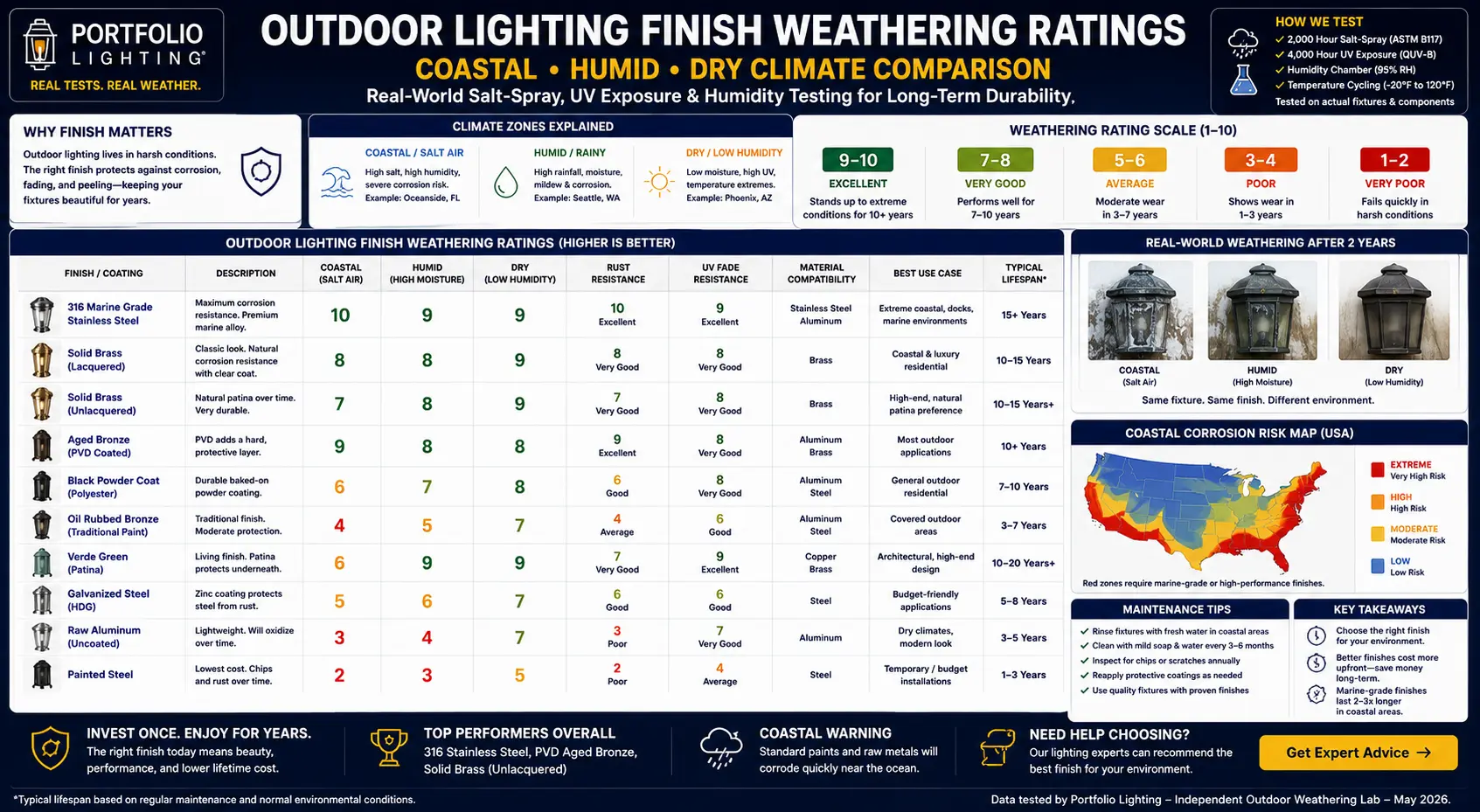
Why Outdoor Lighting Finishes Fail — and Why Location Matters More Than Brand
The same fixture specification sheet that describes a finish as "weather resistant" or "outdoor rated" gives you almost no useful information about how that finish will actually perform in your specific location over 5 to 10 years. "Outdoor rated" tells you the fixture survived a standard salt spray test in a controlled environment — not how it survives 8 years of daily coastal salt air, UV, thermal cycling, and moisture wicking at fastener heads in Galveston.
Outdoor lighting finish failure is driven by four environmental stressors that interact differently in different locations:
- Atmospheric corrosion from salt: Salt particles suspended in coastal air deposit on fixture surfaces and accelerate electrochemical corrosion at every point where the finish is thin, chipped, or mechanically stressed. The corrosion rate within one mile of saltwater is approximately 4–5× higher than 10 miles inland at the same humidity level.
- UV radiation: Direct sunlight breaks down the binder chemistry in powder coat finishes, causing chalking (a powdery surface residue) and color shift over time. Black finishes absorb more solar energy than light finishes, which can accelerate this process. UV damage is most severe in high-altitude locations (Colorado, New Mexico, Utah) where UV index is consistently higher than coastal areas at the same latitude.
- Thermal cycling: Daily temperature swings from cold nights to hot days cause the fixture metal substrate to expand and contract. This mechanical cycling stresses the coating-to-substrate bond, particularly at fastener heads, hinge points, and mounting brackets where stress concentrations are highest. The greatest thermal cycling stress is in desert climates with 40–60°F daily temperature swings.
- Moisture and humidity: Water — particularly condensation that forms on fixtures as they cool from hot-sun temperatures to cool night temperatures — is the primary mechanism that carries dissolved minerals and salts into coating micro-cracks. High-humidity environments (Southeast US, Gulf Coast, Pacific Northwest) accelerate this moisture intrusion failure mode even without coastal salt concentration.
The finish weathering ratings in this guide are derived from the 2026 Lighting Hardware Benchmark Database finish weathering index — a 1–10 scale where 10 represents a finish that survives indefinitely without maintenance and 1 represents a finish that fails within one season in the rated climate. No residential outdoor lighting finish achieves 10/10 in coastal environments — that level of corrosion resistance requires marine-grade stainless steel or titanium hardware that no residential fixture manufacturer currently specifies.
The 3 Climate Zones That Determine Outdoor Lighting Finish Life
Every finish weathering rating in this guide is specified for one of three climate zones. Knowing which zone you are in is the single most important step in choosing an outdoor lighting finish that will last.
🌊 Coastal Zone
- Within 1 mile of ocean, bay, or tidal estuary
- Salt air deposits on all exposed surfaces daily
- Corrosion rate 4–5× higher than inland
- Applies to: Florida coasts, Outer Banks, Gulf Coast, Pacific Coast communities, Chesapeake Bay
- Requires: most corrosion-resistant finishes, most frequent inspection
- Finish rating ceiling: 7/10 for any powder coat without topcoat maintenance
💧 Humid Subtropical / Temperate
- High humidity with seasonal moisture cycling
- No direct salt air but significant condensation and rainfall exposure
- UV stress varies by latitude
- Applies to: Southeast US, Gulf states (inland), Pacific Northwest, Mid-Atlantic inland
- Requires: quality powder coat with annual inspection; most finishes perform well
- Finish rating ceiling: 8/10 for quality powder coat or stone
☀ Dry / Arid / High-Altitude
- Low humidity, high UV exposure, large daily temperature swings
- Low moisture means less electrochemical corrosion but high UV stress
- Applies to: Southwest desert, Mountain West, Great Plains, inland California
- Requires: UV-stable finish chemistry; most finishes last longest here
- Finish rating ceiling: 9/10 for quality powder coat with UV-stable pigments
Master Finish Weathering Ratings: All Finish Types by Climate Zone
Ratings are on a 1–10 scale where 10 is perfect indefinite service and 1 fails within one season. Years to first significant maintenance is defined as visible chip-through, adhesion failure, or corrosion staining requiring professional attention.
| Finish Type | Coastal Rating |
Humid Rating |
Dry/Arid Rating |
Primary Failure Mode | Years to First Significant Maintenance |
|---|---|---|---|---|---|
| Natural Stone (Alabaster/Travertine/Marble) — Sealed | 8/10 | 8/10 | 9/10 | Sealant weathering; stone itself doesn't corrode | Coastal 5–8 yr; Humid 6–10 yr; Dry 8–12 yr |
| Matte Black Powder Coat on Aluminum | 7/10 | 8/10 | 9/10 | Chip-through at fastener points; salt-accelerated delamination | Coastal 3–6 yr; Humid 5–8 yr; Dry 7–12 yr |
| Matte Black Powder Coat on Steel | 4/10 | 6/10 | 8/10 | Steel substrate rusts through chip-through rapidly in salt air | Coastal 1–3 yr; Humid 4–7 yr; Dry 6–10 yr |
| Bronze Powder Coat on Aluminum | 6/10 | 7/10 | 8/10 | Pigment oxidation in salt air; warm pigment more vulnerable than neutral black | Coastal 2–5 yr; Humid 5–8 yr; Dry 7–11 yr |
| Oil-Rubbed Bronze on Steel | 3/10 | 5/10 | 7/10 | Steel substrate rusts; finish designed for interior/sheltered outdoor use only | Coastal <2 yr; Humid 3–5 yr; Dry 5–8 yr |
| Atlas Bronze Seeded Glass (Savoy Lancaster) | 6/10 | 8/10 | 8/10 | Bronze pigment oxidation coastal; glass seal edge moisture intrusion | Coastal 2–4 yr; Humid 6–9 yr; Dry 7–11 yr |
| Solid Brass / Naval Brass | 8/10 | 8/10 | 9/10 | Patina development (aesthetic, not structural); polishing or clear coat needed if bright look desired | Coastal: patina in 1–3 yr; structural integrity indefinite |
| Marine-Grade Anodized Aluminum | 9/10 | 9/10 | 9/10 | Pitting corrosion in severe salt exposure; anodized layer is integral to metal | Coastal 8–15 yr; Humid/Dry indefinite with cleaning |
| UV-Stable Polycarbonate (Cordless Lamps) | 7/10 | 8/10 | 6/10 | UV yellowing in arid high-altitude; salt tolerance is high but UV stress is not | Coastal 4–6 yr; Humid 5–8 yr; Dry/UV 3–5 yr |
| Clear Powder Coat Topcoat Over Any Base | +2 pts | +1 pt | +1 pt | Extends service life significantly; must be reapplied as topcoat weathers | Adds 2–4 years to any base finish coastal; 1–2 years humid/dry |
Matte Black Powder Coat — The Most Popular Finish
Matte Black Powder Coat
Fixtures: Hinkley Clear Lantern Series, Kichler Tenon (black variants), Portfolio transformers, most modern outdoor lanterns
Matte black powder coat has earned its dominant market position because neutral black pigment chemistry is more UV-stable than colored pigments (bronze, gold, champagne), and the flat matte surface finish hides minor weathering better than gloss finishes. The coating failure mode in coastal environments is predictable and localized — it begins at mounting holes, hinge hardware, and fastener heads where the coating was thinnest during application and mechanical stress is highest during thermal cycling.
The Hinkley Clear Lantern Series rates 7/10 coastal for this reason. The fixture body powder coat may remain intact for 8+ years while the mounting hardware shows corrosion at year 3–4. Annual inspection of fastener heads and mounting brackets — not the visible fixture face — is the correct maintenance focus for coastal matte black fixtures.
The substrate identification rule is critical for matte black fixtures: Two fixtures with identical-looking matte black powder coat can have completely different coastal life expectancy depending on whether the substrate is aluminum (7/10) or steel (4/10). The magnet test resolves this immediately.
Annual (all climates): Clean with mild soap and water; inspect all fastener heads and mounting points for chip-through; apply touch-up paint within 30 days of any chip discovery. Coastal semi-annual: Rinse with fresh water after winter storm season to remove salt deposits; apply automotive-grade clear coat to any touch-up repair areas. Coastal 3-year: Full fixture cleaning and clear topcoat application over the entire matte black surface to renew coating integrity before delamination begins.
Bronze and Oil-Rubbed Bronze Finishes
Bronze and Oil-Rubbed Bronze Powder Coat
Fixtures: Savoy House Lancaster Wall (Atlas Bronze), Kichler Hatteras Bay (bronze variants), Sea Gull Hudson Street (bronze), Capital Leland (champagne bronze)
Bronze finish powder coat consistently scores one point lower than matte black in coastal environments because the warm organic pigments used to create bronze, champagne, and oil-rubbed brown tones are less chemically stable in salt-air environments than the inorganic carbon black pigments used in matte black finishes. The difference is subtle in moderate coastal environments but becomes visible at 2–3 years in severe salt-air conditions as the bronze tone develops a lighter, more oxidized color shift before chip-through begins.
The Savoy House Lancaster Wall in Atlas Bronze rates 6/10 coastal for this reason. The same fixture in the same location would likely score 7/10 in matte black. For homeowners committed to a bronze aesthetic in coastal locations, applying a UV-stable automotive clear coat over the bronze powder coat at installation time adds approximately 2 points of effective durability and can bring coastal performance to 8/10 before considering maintenance.
True bronze alloy vs. bronze-finish powder coat: True bronze alloy fixtures (uncommon in residential lighting) score 8/10 coastal because the substrate itself is corrosion-resistant. When a chip exposes true bronze metal, the metal develops a natural verdigris patina rather than rusting — structural corrosion does not occur. The cost premium is significant: expect 3–5× the price of equivalent powder coat bronze fixtures.
Annual (all climates): Clean with pH-neutral cleaner; inspect for color shift (early sign of pigment oxidation) and chip-through at fastener points. Coastal — at installation: Apply UV-stable automotive clear coat over the entire fixture before mounting to seal the powder coat from salt contact. Coastal semi-annual: Rinse with fresh water; inspect clear coat integrity; reapply clear coat to areas showing cloudiness or adhesion failure. Coastal 2–3 year: Full clear coat reapplication if color shift or micro-chalking becomes visible on the bronze surface.
Natural Stone Finishes — Alabaster, Travertine, Marble
Natural Stone: Alabaster, Travertine, Marble
Fixtures: Modern Forms Alabaster Sconce, HomeGnome Travertine Pendant, Morsale Linear Travertine, Morsale Marble Sconce, Savoy House Judi Chandelier (stone variants)
Natural stone finishes achieve their high weathering ratings for a reason that no powder coat can replicate: the material itself does not corrode. Alabaster, travertine, and marble are calcium carbonate minerals — they do not oxidize, they do not rust, and they do not delaminate from a substrate. What weathers is the organic sealant applied to the stone surface to reduce porosity and prevent moisture absorption. When the sealant weathers, reapplying it is a $10–20 annual maintenance task — not a fixture replacement decision.
The critical distinction for coastal use is that stone fixtures are rated for covered outdoor use — covered porches, covered pergolas, protected entryways — not direct rain and salt spray exposure. The Hinkley Clear Lantern is rated wet location for direct rain; the Modern Forms Alabaster Sconce is rated damp location for covered outdoor spaces. That distinction is not a product limitation — it is the correct application of a material that excels in its intended environment.
For humid interior kitchens and bathrooms — the other common application for stone pendants — the key is annual resealing with a food-safe stone sealant to prevent steam vapor from penetrating porous travertine and creating the discoloration or structural weakening that looks like finish failure but is actually a moisture management issue.
Annual (all climates): Clean with pH-neutral stone cleaner (never acidic cleaners — acids etch calcium carbonate minerals); reapply food-safe or stone-specific sealant to all exposed stone surfaces. Coastal covered outdoor: Inspect stone surface for chalking or discoloration after salt-air exposure events; rinse with fresh water; reapply sealant more frequently (every 6 months) in severe coastal environments. Kitchen and humid indoor: Clean grease vapor from travertine surfaces monthly; reseal annually or whenever water no longer beads on the stone surface.
Aluminum, Anodized Aluminum, and Brass
Marine-Grade Anodized Aluminum and Solid Brass
Applies to: specialty marine-grade outdoor fixtures, solid brass lanterns, anodized aluminum commercial landscape lighting
Marine-grade anodized aluminum achieves 9/10 in coastal environments because the anodizing process creates an aluminum oxide layer that is integral to the metal surface — not a coating that can delaminate. Anodizing penetrates the metal substrate rather than sitting on top of it, creating a surface that is harder than the base aluminum and substantially more corrosion-resistant than any powder coat system. Marine grade anodizing (MIL-SPEC A-8625 Type III hard coat) can withstand 1,000+ hours of salt spray testing without visible corrosion.
Solid brass (not brass-plated steel) achieves 8/10 coastal because the brass alloy itself does not rust — it forms a stable green patina over time that actually slows further corrosion. The visual tradeoff is that many homeowners find the patina development aesthetically undesirable. The maintenance solution is annual polishing and application of a marine-grade clear coat that preserves the bright brass appearance while maintaining corrosion resistance. Solid brass costs 3–5× more than aluminum alternatives for comparable design.
Anodized aluminum annual: Clean with mild soap; rinse thoroughly; apply marine-grade wax to maintain the anodized surface. No coating to inspect or repair — the anodized layer is permanent. Solid brass annual: Polish to remove patina if bright finish desired; apply marine-grade clear coat after polishing to slow re-patination. Solid brass with patina accepted: Light cleaning only; patina is protective — do not remove it. Both substrates coastal: Rinse with fresh water after major storm events to remove salt deposits before they dry and concentrate on the surface.
Cordless Lamp Polycarbonate and Mixed Material Finishes
Polycarbonate Diffusers — Cordless Portable Lamps
Fixtures: Zafferano Pina Pro, Brightech Celia, O'Bright Dune, Visual Comfort Avedon, Hay Pao, Kuzco Folio 9
UV-stabilized polycarbonate performs counterintuitively across climate zones — it handles coastal salt air better than many powder coat finishes (7/10 coastal) but underperforms in high-UV arid climates (6/10 dry) where its UV yellowing failure mode is most pronounced. Polycarbonate is inherently resistant to salt corrosion because it is a plastic material without metal ions to oxidize. But polycarbonate UV stabilizers — the additives that prevent yellowing — deplete over time, and depletion rate is directly proportional to UV exposure.
For the Zafferano Pina Pro at the top of the cordless tier, the polycarbonate diffuser is rated coastal 7/10 because the 5-year warranty covers the initial warranty period well, and polycarbonate at sea level coastal environments (lower UV index than mountain locations) holds up better than powder coat steel in the same conditions. At high-altitude Colorado or New Mexico patios, UV index is 30–50% higher than at sea level — and that elevated UV stress reduces polycarbonate service life correspondingly.
Annual (all climates): Clean with mild soap and water — never abrasive cleaners that scratch the UV-stabilized surface layer; inspect diffuser for early yellowing or cloudiness; store lamps out of direct sunlight when not in use to reduce cumulative UV exposure. Dry / high-altitude: Apply UV-protective polycarbonate spray coating annually to slow UV stabilizer depletion; store indoors during peak summer UV hours (10am–4pm) when not actively in use. Coastal: Rinse with fresh water after storm events; inspect base hardware for salt deposits at charging contacts.
Universal Outdoor Lighting Maintenance Schedules by Climate Zone
These schedules apply to all outdoor lighting finishes and represent the minimum inspection and maintenance commitment needed to achieve the full rated weathering performance. Fixtures that are never maintained will fail significantly earlier than the ratings suggest — ratings assume the maintenance schedule is followed.
Coastal Zone Maintenance Schedule
- Monthly: Rinse all fixture surfaces with fresh water using a garden hose — do not use pressure washers. Salt deposits that dry on the surface concentrate corrosion; rinsing before drying prevents this.
- Semi-annual (spring and fall): Full fixture inspection for chip-through at all fastener heads, mounting brackets, hinge hardware, and glass seal edges. Touch up any chip-through within 30 days. Apply clear topcoat to any repaired areas.
- Annual: Remove and inspect all mounting fasteners for corrosion; replace any corroded fasteners with stainless steel alternatives; check gasket seal integrity on glass-panel lanterns; apply UV-stable clear coat to the full fixture body of bronze-finish fixtures.
- Every 3 years: Full clear coat reapplication over black or bronze powder coat fixtures to renew coating integrity before delamination begins. This single action is the highest-impact maintenance task for coastal fixture longevity.
Humid Subtropical Maintenance Schedule
- Annual: Clean with mild soap and water; inspect all fastener heads and mounting points for surface corrosion; touch up any chip-through; check glass seals on lanterns; clean and reseal natural stone fixtures.
- Every 3–5 years: Evaluate finish integrity across the full fixture; apply clear topcoat if surface chalking or minor color shift is visible; replace gaskets on glass-panel fixtures.
Dry / Arid / High-Altitude Maintenance Schedule
- Annual: Clean with mild soap and water to remove dust and airborne minerals; inspect UV-sensitive finishes (polycarbonate, colored powder coat) for early yellowing or color shift; apply UV-protective spray to polycarbonate components.
- Every 5–7 years: Full fixture inspection and clear coat reapplication if needed. Most quality powder coat fixtures in dry climates require no intervention beyond cleaning for 7–10 years.
Finish Restoration Without Replacement: What Works and What Does Not
Outdoor lighting finish restoration is one of the least documented topics in residential lighting care — most manufacturers recommend replacement rather than restoration because replacement generates more revenue. This section gives you the honest assessment of what restoration actually achieves.
Outdoor lighting durability depends on both exterior materials and protective components that limit moisture exposure. Along with weather-resistant finishes, properly maintained gaskets, O-rings, and seals help extend fixture service life. See our outdoor lighting gaskets, O-rings, and seals guide for detailed sealing information.
What Restoration Can Achieve
- Surface chalking: Light surface oxidation and chalking on aluminum fixtures responds to non-abrasive metal polish followed by a UV-stable clear coat. This restores approximately 60–70% of the original surface appearance and extends service life by 2–4 years. Effective up to early-stage chalking — not effective once delamination has begun.
- Bronze color shift: Mild color shift (lighter, more oxidized appearance) in bronze powder coat can often be improved with a color-matched touch-up paint followed by clear coat. The result is never a perfect match but is visually acceptable from normal viewing distances.
- Stone sealant weathering: Stone fixtures with weathered sealant showing water absorption (water no longer beads on the surface) respond completely to new sealant application — the stone beneath is undamaged. This is a full restoration to original performance, not a compromise.
- Glass seal edge delamination: Glass panel lanterns with lifting seal at the glass edge can be repaired with exterior-grade silicone sealant — a $6 repair that extends weatherproof performance by 3–5 years on an otherwise sound fixture.
What Restoration Cannot Achieve
- Active corrosion under delaminated coating: Once the coating has lifted from the substrate and rust or aluminum corrosion is present underneath, the corrosion will continue spreading beneath any new coating applied on top. Mechanical removal of all corrosion is required before restoration — which at fastener heads and hinge points is usually impractical.
- Structural hinge and mounting hardware corrosion: When the hinge hardware or mounting plate is corroded to the point of structural weakness, no surface treatment repairs the load-bearing integrity. This is the replacement indicator.
- Gasket channel corrosion in sealed glass fixtures: Corrosion in the metal channel that holds glass panels affects the ability of the gasket to create a weatherproof seal. Surface treatment does not restore the dimensional accuracy the gasket requires. Replacement of the full fixture or the glass-and-frame subassembly is the only effective repair.
For fixtures that are beyond economical restoration, the Portfolio Lighting Parts and Accessories Guide and the Discontinued Landscape Lighting Parts Guide help identify compatible replacement fixtures for existing mounting locations.
The Finish Selection Framework: What to Specify Before You Buy
Use this framework at the point of purchase to ensure the finish you choose matches your climate zone and maintenance commitment. The single most expensive outdoor lighting mistake is buying a beautiful fixture whose finish degrades within 3 years in the installation climate — and this framework prevents it.
Question 1: What is your climate zone?
Determine your zone using the descriptions above. If you are within 1 mile of tidal water, you are coastal. If you are in a region with humidity above 70% for more than 4 months per year, you are humid subtropical. Everything else is dry/arid/temperate. Your climate zone sets the floor for minimum acceptable finish performance.
Question 2: What is the substrate material?
Do the magnet test before purchasing. For coastal zone installations, reject any fixture that shows a strong magnet attraction — steel substrate in coastal environments is a 3–5 year service life regardless of finish quality. Aluminum substrate is the minimum standard for coastal residential outdoor lighting. Anodized aluminum, solid brass, or natural stone are upgrades worth the cost premium in coastal environments.
Question 3: What is your maintenance commitment?
Annual inspection and touch-up is a 20–30 minute task per fixture. If this commitment is not realistic for your situation (vacation property, low-maintenance preference, multiple fixture installation), choose a finish with a higher baseline weathering rating rather than relying on maintenance to compensate. Marine-grade anodized aluminum and solid brass require significantly less active maintenance than powder coat in coastal environments.
Question 4: Is the fixture in a covered or exposed location?
Fixtures under covered porches, pergolas, and overhangs receive 50–70% less direct rain, salt deposition, and UV exposure than fully exposed locations. Natural stone fixtures that are not rated for direct rain can be excellent performers in covered coastal locations where they would be inappropriate in exposed locations. Always verify wet vs. damp location rating against the specific installation position.
Finish durability alone does not determine whether a fixture survives outdoors long term. The landscape lighting enclosure-rating comparison explains how moisture protection levels influence corrosion, internal condensation, gasket failure, and driver reliability.
Outdoor fixture lifespan depends on more than finish durability alone. The landscape LED aging and lumen-output database explains how environmental heat, moisture, and enclosure stress affect long-term LED brightness stability.
Related Guides and Resources
- Full 2026 Hardware Benchmark Database — 31 Models
- Best LED Landscape Lighting Fixtures Guide
- LED Fixture Repairability Guide
- Smart Bulb Standby Power Comparison
- LED Driver Heat — Landscape Lighting
- Durable Landscape Lighting Materials Guide
- Landscape Lighting Corrosion Guide
- Landscape Lighting Maintenance Guide
- Weatherproofing Outdoor Lighting Guide
- Portfolio Landscape Lighting Hub
- Portfolio Wall Lantern Guide
- Portfolio Outdoor Wall Spotlights
- Portfolio Lighting Parts and Accessories
- Discontinued Landscape Lighting Parts Guide
- Landscape Lighting Electrical Code Safety
- Portfolio Lighting Replacement Hardware
Outdoor Lighting Finish Weathering FAQ
What is the most durable outdoor lighting finish for coastal areas?
For coastal salt-air environments, marine-grade anodized aluminum rates 9/10 because the anodized layer is integral to the metal and cannot delaminate. Solid brass rates 8/10 because it develops a patina rather than rusting when exposed. Among common residential finishes, powder coat matte black on aluminum substrate rates 7/10 — the highest among affordable powder coat options — because neutral black pigment chemistry is more salt-stable than bronze or champagne pigments. Always confirm the substrate is aluminum (magnet test: magnet should not stick strongly) before purchasing for coastal installation. Bronze-style finishes on aluminum rate 6/10 coastal; any finish on steel substrate rates 3–4/10 coastal and is unsuitable for permanent coastal installation.
How long does matte black powder coat last on outdoor lighting?
Matte black powder coat on quality outdoor lighting fixtures lasts 7–12 years in dry climates, 5–8 years in humid subtropical climates, and 3–6 years in coastal salt-air environments within one mile of the ocean before requiring significant maintenance. The failure mode is chip-through at mounting holes, hinge points, and fastener heads — not the visible fixture face. Annual inspection and spot touch-up at these locations, combined with a full clear coat reapplication every 3 years in coastal environments, can extend coastal service life by 2–4 years beyond these baseline figures.
Does bronze finish outdoor lighting rust?
True bronze alloy does not rust — it forms a patina. However, most residential outdoor lighting sold as "bronze finish" or "oil-rubbed bronze" is steel or zinc with a bronze-colored powder coat or electroplated layer. That steel substrate rusts aggressively when the coating is breached in coastal environments. The magnet test identifies substrate: if a magnet sticks strongly, the substrate is steel and the fixture is unsuitable for coastal installation without exceptional maintenance. If a magnet does not stick, the substrate is aluminum or genuine bronze — both of which resist rusting when coating is breached.
Is brass or bronze better for coastal outdoor lighting?
Solid brass (an alloy of copper and zinc) outperforms bronze-finish coated steel in coastal environments because the brass substrate itself is corrosion-resistant without depending on coating integrity. A solid brass fixture with a breached coating develops a verdigris patina on the exposed metal rather than rusting. However, solid brass costs 3–5× more than coated alternatives and the patina development requires annual polishing or clear coat to maintain original appearance. For most residential coastal applications, powder-coated aluminum with annual inspection provides equivalent structural longevity at significantly lower cost — the tradeoff is more frequent aesthetic maintenance.
How often should outdoor lighting fixtures be inspected for finish damage?
Annual inspection is the minimum standard for all outdoor lighting finishes in all climates. Coastal environments (within 1 mile of the ocean) should be inspected twice yearly — spring before high-humidity season and fall after storm season. Inspect all mounting points, fastener heads, hinge hardware, and glass seal edges for chip-through, adhesion failure, or corrosion staining. Touch up any chip-through within 30 days of discovery — coating failures left exposed spread significantly faster than those caught and repaired early because the unprotected substrate is then exposed to all four weathering stressors simultaneously.
Can outdoor lighting finishes be restored after weathering?
Yes, in many cases — depending on the stage of weathering. Light surface chalking and color shift respond to polish and clear coat reapplication. Weathered stone sealant responds completely to new sealant application — the stone beneath is undamaged. Glass seal edge delamination on lanterns can be repaired with exterior silicone. Active corrosion under a delaminated coating cannot be effectively sealed without mechanical removal of all corroded material first — which is rarely practical at fastener heads and hinge points. The replacement threshold is structural: when hinge hardware, mounting plates, or gasket channels have corroded to the point of affecting weatherproof integrity or structural stability, replacement is more cost-effective than restoration.
What mounting hardware should I use for coastal outdoor lighting?
Replace the zinc, steel, or unspecified fasteners that come with most residential outdoor lighting fixtures before mounting in coastal environments. Substitute 304 or 316 stainless steel screws, bolts, and mounting anchors — 316 stainless is preferable for severe coastal exposure because of its higher molybdenum content. The fixture body may be aluminum or brass and resist corrosion indefinitely, but zinc or steel mounting fasteners will corrode through before the fixture body fails — creating a structural failure at the mounting point while the fixture itself remains visually sound. Stainless steel fasteners cost $2–5 for a typical fixture's hardware requirement. This is the highest ROI single action for coastal fixture longevity.
Finish Weathering Rating Disclaimer
Finish weathering ratings and service life estimates in this guide are field-planning assessments based on material science principles, manufacturer documentation, climate data, and 25 years of residential outdoor lighting installation experience across multiple climate zones. They are not laboratory-certified measurements performed under standardized salt spray, UV, or humidity testing protocols. Actual service life varies significantly based on installation microclimate, maintenance frequency, product batch quality, ambient temperature, and proximity to specific corrosion sources. These ratings are directional planning tools — not performance guarantees. Always verify wet vs. damp vs. dry location rating for any fixture against its specific installation position before purchase.