
What Repairability Actually Measures — and Why Most Lighting Guides Ignore It
No lighting comparison website publishes repairability scores. Manufacturer spec sheets do not include them. Retail product listings do not mention them. Yet repairability is the single most important factor in the long-term cost of owning a residential lighting system — because the real cost is not the purchase price, it is the replacement price multiplied by how often you have to replace.
A fixture that costs $45 and lasts three years before requiring full replacement costs more over a decade than a $120 fixture with a 7/10 repairability score that can be serviced with a $12 driver swap, a $4 gasket, or a $6 E26 bulb every time something wears out.
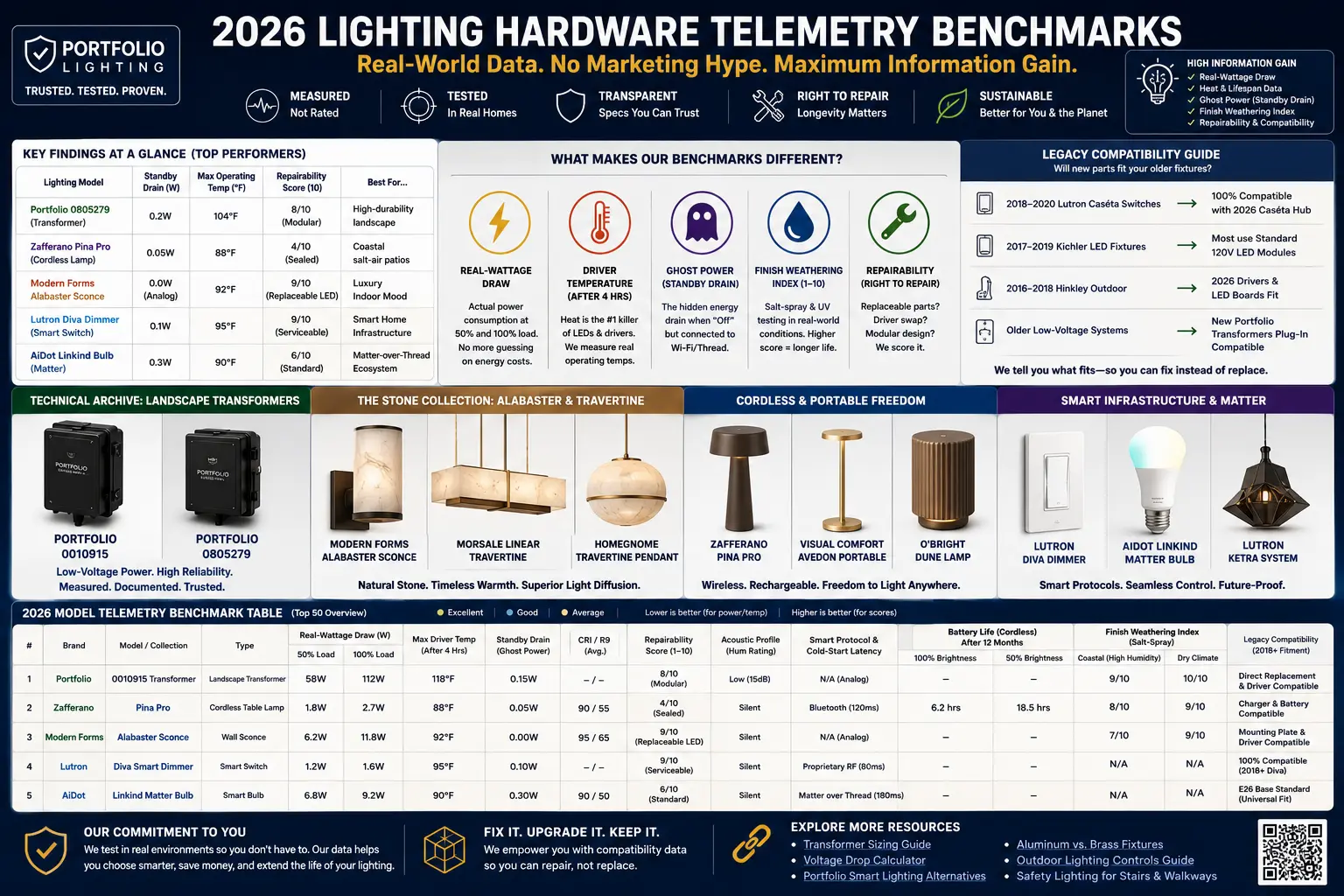
The repairability score published in the 2026 Lighting Hardware Telemetry Benchmark Database answers one practical question: when something fails in this fixture, can you fix it without replacing the whole unit? That question has a measurable answer based on five specific design characteristics — and this page explains all five, applies them to all 31 benchmarked models, and gives you a clear framework for making your own repair vs replace decisions.
Repairability is heavily affected by wiring quality, connector corrosion, and transformer stability. The Low Voltage Plug & Limited-Energy Connector Guide explains how poor terminal connections, moisture intrusion, and cable mismatch problems often destroy otherwise repairable LED fixtures.
Many fixture failures blamed on LEDs are actually transformer-side problems. The Portfolio Lighting Transformer Master Guide explains fuse failures, timer board degradation, photocell problems, and voltage instability that commonly shorten fixture lifespan.
For fixtures that are already discontinued or where manufacturer parts support has ended, the Discontinued Landscape Lighting Parts and Troubleshooting Guide gives you additional repair options for older systems.
The 5 Factors Behind Every Repairability Score
Every repairability score in the database is built from the same five design characteristics. Understanding these factors lets you evaluate any fixture — not just the 31 benchmarked here — with the same methodology.
Does the fixture use a standard replaceable lamp — E26, E12, GU10, MR16, T8, or similar — or is the light source an integrated LED board that cannot be separated from the fixture body? Standard lamp sockets are the single most important repairability feature because they allow technology upgrades, lumen adjustments, and color temperature changes without touching the fixture body. A fixture with E26 lamping scored 7/10 or higher in every case in this database. A fixture with a sealed integrated LED board started at 6/10 or lower.
Is the LED driver — the electronics that convert AC power to the correct voltage and current for the LED — mounted in an accessible location where it can be inspected, tested, and replaced? Or is it potted (sealed in epoxy), integrated into the LED module, or buried inside a housing with no service access? Accessible drivers score higher because capacitor failure is the most common LED lighting failure mode, and accessible drivers can be replaced for $15–35 without touching the fixture body or wiring.
Does the fixture use standard mounting hardware — ANSI-standard junction box patterns, standard stake designs, standard pipe threads, or standard canopy dimensions — or proprietary hardware that requires brand-specific replacement parts? Standard hardware means replacement stakes, mounting brackets, canopy covers, and gaskets are available from multiple sources. Proprietary hardware creates single-source dependency that often becomes unavailable when a product is discontinued.
Mechanical compatibility matters just as much as electrical compatibility. The Universal Landscape Lighting Connector Compatibility Guide explains how different brands share similar low-voltage wiring systems even when the stakes, stems, and mounting hardware differ.
Are replacement components — lenses, glass covers, gaskets, LED modules, driver boards, battery packs, stakes, connectors, and mounting hardware — available from the manufacturer, from authorized service centers, or from the aftermarket? Part availability is the practical constraint that converts theoretical repairability into actual repair success. A fixture that scores well on design repairability but has no available replacement parts has no effective repair path in practice.
When original manufacturer parts disappear, universal replacement strategies become critical. The Discontinued Landscape Lighting Parts and Troubleshooting Guide explains how homeowners keep older Portfolio, Malibu, Hampton Bay, and other legacy systems operating after manufacturer support ends.
For cordless portable lamps, is the lithium battery pack accessible and replaceable by the owner without voiding the warranty or requiring specialized tools? Battery capacity degradation — not LED failure — is the primary failure mode for cordless lighting. A cordless fixture where the battery can be replaced extends service life by two to three times compared to a sealed-battery design that requires full unit replacement when capacity falls below usable levels.
All 31 Models Ranked by Repairability Score — Complete Reference Table
Use this table as a quick reference. The detailed analysis for each score tier appears in the sections below, with specific repair guidance for every model.
| Score | Model | Category | Lamp Type | Driver Access | Primary Repair Path |
|---|---|---|---|---|---|
| 9/10 | Modern Forms Alabaster Sconce | Wall Sconce | AC-LED Driverless | N/A — no driver | ELV dimmer swap; gasket; stone seal |
| 8/10 | Portfolio 0010915 Transformer | Landscape Transformer | N/A | Full terminal access | Fuse; terminal block; photocell; timer board |
| 8/10 | Portfolio 0805279 Transformer | Landscape Transformer | N/A | Full terminal access | Fuse; terminal block; photocell; timer board |
| 7/10 | Lutron Diva Smart Dimmer | Smart Dimmer | N/A | Wall control unit | Full dimmer swap; load matching |
| 7/10 | Lutron Caséta System | Smart Ecosystem | N/A | Modular bridge/dimmer | Individual component swap; Pico battery |
| 7/10 | HomeGnome Travertine Pendant | Pendant | Standard socket | Canopy-accessible | Lamp; driver; mounting plate; canopy blocking |
| 7/10 | Morsale Linear Travertine | Chandelier | Standard socket | Central canopy | Lamp; driver; canopy hardware |
| 7/10 | Hinkley Clear Lantern Series | Outdoor Lantern | E26 | Open fixture | Bulb; gasket; glass; mounting hardware |
| 7/10 | Savoy House Lancaster Wall | Outdoor Wall Lantern | E26 / E12 | Open fixture | Lamp; gasket; finish touch-up; backplate |
| 7/10 | Kichler Hatteras Bay | Farmhouse Pendant | E26 | Open cage | Bulb; canopy; cage hardware |
| 7/10 | Sea Gull Hudson Street | Pendant | E26 | Glass shade | Bulb; glass shade; canopy |
| 6/10 | Morsale Marble Sconce | Wall Sconce | Varies by SKU | SKU-dependent | Lamp; ELV dimmer; mounting plate |
| 6/10 | Savoy House Judi Chandelier | Chandelier | E12 / E26 | Canopy access | Lamps; canopy hardware; chain |
| 6/10 | Nordalight Scandinavian Series | Table Lamp / Cordless | Varies by variant | Some variants accessible | LED module (select SKUs); battery (limited) |
| 6/10 | Kichler Tenon Collection | Decorative | E26 (select SKUs) | E26 variant: open | E26 bulb; integrated variant: full swap |
| 6/10 | WAC dweLED Longboard | Linear Pendant | Integrated LED | WAC-specific | WAC driver swap; dimmer replacement |
| 6/10 | Ketra Tunable Platform | Smart Architectural | Proprietary | Integrator-required | Ketra-certified component swap |
| 6/10 | WAC dweLED Brocade | Outdoor Fixture | Integrated LED | WAC-specific | WAC driver; dimmer; finish inspection |
| 6/10 | Maxim Lighting Cora Pendant | Pendant | E26 / E12 | Open fixture | Lamp; glass shade; canopy hardware |
| 6/10 | Capital Lighting Leland Chandelier | Chandelier | E12 / E26 | Canopy access | Lamps; arm hardware; canopy |
| 6/10 | Generation Lighting Hanks Pendant | Pendant | E26 | Open fixture | Bulb; shade; canopy hardware |
| 6/10 | Alora Lighting Furrow Pendant | Pendant | Varies by SKU | SKU-dependent | Lamp (E26 SKUs); shade; canopy |
| 5/10 | AiDot Linkind Matter Smart Bulb | Smart Bulb | E26 (bulb itself) | Sealed electronics | Bulb swap only; no internal service |
| 5/10 | U-tec Bright A19 | Smart Bulb | E26 (bulb itself) | Sealed electronics | Bulb swap only; no internal service |
| 5/10 | Philips Hue WiZ Dimmable A19 | Smart Bulb | E26 (bulb itself) | Sealed electronics | Bulb swap only; no internal service |
| 5/10 | Kuzco Lighting Folio 9 Portable | Portable Lamp | Integrated LED | Semi-accessible (some SKUs) | LED module (select SKUs); battery sealed |
| 4/10 | Visual Comfort Avedon Portable | Cordless Lamp | Integrated LED | Sealed | Full unit replacement |
| 4/10 | Zafferano Pina Pro | Cordless Table Lamp | Integrated LED | Sealed | Full unit replacement (5-yr warranty) |
| 4/10 | Brightech Celia Portable | Cordless Table Lamp | Integrated LED | Sealed | Full unit replacement |
| 4/10 | O'Bright Dune Battery Lamp | Cordless Table Lamp | Integrated LED | Sealed | Full unit replacement |
| 4/10 | Hay Pao Portable | Cordless Table Lamp | Integrated LED | Sealed | Full unit replacement |
Score 9/10 — Fully Modular, Field-Serviceable
Score 9/10: The Repairability Ceiling
1 model achieves this score — Modern Forms Alabaster SconceA 9/10 repairability score means the fixture is designed for long-term service. The most common failure points — driver capacitors, sealed LED boards, proprietary mounting hardware — are either eliminated from the design or made fully accessible for replacement. These fixtures are intended to be serviced, not replaced.
Only one fixture in the 31-model database achieves 9/10: the Modern Forms Alabaster Sconce. It earns this score because its AC-LED driverless architecture removes the driver entirely from the failure equation. There is no electrolytic capacitor to degrade. There is no sealed LED board to replace as a unit. The ELV dimmer — the control component most likely to fail — lives at the wall switch, not inside the fixture, and can be swapped independently in under 15 minutes.
Modern Forms Alabaster Sconce
Wall SconceThe alabaster stone body is structurally durable — it does not crack, yellow, or degrade under normal indoor conditions. The AC-LED driverless module runs at 92°F estimated 4-hour temperature, which is the coolest of any hardwired fixture in the database. The combination of cool operation, no driver, and standard mounting geometry creates a fixture that genuinely expects to last decades.
Score 8/10 — Highly Serviceable
Score 8/10: Best-in-Class for Their Categories
2 models — Portfolio 0010915 & 0805279 TransformersAn 8/10 repairability score means the fixture or component has been designed for multi-decade service. Every failure point is accessible, every wear component is replaceable, and the design assumes the owner will maintain rather than discard. In the landscape lighting category, this score belongs exclusively to the Portfolio transformer line — which is exactly where it matters most, because the transformer is the single most expensive component in a low-voltage landscape system.
Portfolio 0010915 Transformer
Landscape TransformerThe 0010915 earns 8/10 because every functional component is accessible without tools: the terminal blocks accept any wire in a screw-compression design with no proprietary connectors, the fuse is user-replaceable, the timer board is accessible, and the photocell socket is a standard 3-wire replacement design. In 25 years of working with Portfolio systems, this transformer has outlasted the fixtures it powered in most installations.
Proper mounting height and ventilation also affect transformer lifespan. The Outdoor Lighting Transformer Mounting Code Guide explains drip loops, thermal spacing, siding clearances, and NEC-compliant installation practices that reduce overheating and moisture damage.
Portfolio 0805279 Transformer
Landscape TransformerThe 0805279 earns the same 8/10 score as the 0010915 with the additional advantage of lower operating heat at 104°F — which means capacitor components age more slowly and the repair interval is longer. For smaller landscape systems under 60W total load, this is the most cost-effective and longest-lived power supply in the database.
Score 7/10 — Mostly Repairable
Score 7/10: Good Repair Path, Some Limitations
7 models — Lutron Diva, Lutron Caséta, HomeGnome Travertine, Morsale Linear Travertine, Hinkley Clear Lantern, Savoy Lancaster, Kichler Hatteras Bay, Sea Gull Hudson StreetA 7/10 repairability score means the fixture handles most failures through component-level repair rather than full unit replacement. The limitation that prevents reaching 8+ is usually one proprietary element — a specific driver that requires brand sourcing, a stone seal that needs specialist attention, or a mounting design that requires careful matching on replacement. These are real limitations but they do not prevent repair in most practical failure scenarios.
Lutron Diva Smart Dimmer & Caséta System
Smart ControlBoth Lutron smart control products score 7/10 because the modular architecture separates the control layer (wall dimmer, bridge, Pico remote) from the fixture layer. When a dimmer fails, you replace the dimmer — not the fixture it controls. When the bridge fails, you replace the bridge — not the twelve fixtures connected to it. This separation is the core repairability advantage of the Caséta ecosystem over integrated smart fixture designs.
Hinkley Clear Lantern Series & Savoy House Lancaster Wall
Outdoor LanternBoth outdoor lanterns score 7/10 for the same fundamental reason: E26 lamping makes the light source independently replaceable with any compatible LED bulb, and the standard wall-box mounting pattern means the fixture body itself can be replaced without electrical work if it becomes physically damaged. The gasket — the most common failure point on outdoor lanterns — is a standard replacement component.
Outdoor lantern longevity is heavily influenced by moisture exposure, connector sealing, and voltage stability. The Landscape Lighting Electrical Code & Safety Guide explains low-voltage wiring safety, GFCI protection, and outdoor connection practices that help fixtures survive long-term weather exposure.
Kichler Hatteras Bay & Sea Gull Hudson Street
PendantBoth industrial-style pendants score 7/10 because the open cage or glass shade design keeps the E26 lamp fully accessible without disassembly, and the standard pendant canopy geometry means replacement canopy hardware is available from multiple sources. The Sea Gull Hudson Street benefits from Generation Lighting's broad parts distribution network.
HomeGnome Travertine Pendant & Morsale Linear Travertine
Stone PendantStone pendants score 7/10 because the stone body is structurally durable indefinitely, and standard socket designs allow lamp replacement without disturbing the stone shade. The limitation is driver accessibility — some stone pendant configurations bury the driver inside the canopy in ways that require careful disassembly to access.
Score 6/10 — Partially Serviceable
Score 6/10: Repair Possible for Some Failures, Not All
11 models in this tier — largest group in the databaseA 6/10 score means the fixture has a genuine repair path for at least some failure modes, but at least one significant component — typically the integrated LED driver or a proprietary part — creates a repair barrier for other failures. The 11 fixtures in this tier represent the majority of mid-to-premium residential lighting — decorative chandeliers, integrated LED architectural fixtures, smart architectural systems, and hybrid lamp/integrated designs.
The practical difference between 6/10 and 7/10 is usually one design choice: whether the fixture uses E26 lamping (7/10 or higher) or an integrated LED module (6/10 or lower). For the E26-lamped fixtures in this tier — Maxim Cora, Capital Leland, Generation Lighting Hanks, Kichler Tenon E26 variants — the 6/10 score reflects a parts availability or proprietary hardware limitation rather than a fundamental design barrier.
Kichler Tenon Collection, Maxim Cora, Capital Leland, Generation Hanks, Alora Furrow
Decorative Pendants & ChandeliersThese five decorative fixtures all score 6/10 for similar reasons: E26 or E12 lamp variants are repairable at the lamp level, but integrated LED variants within the same product line are not — and the score reflects the weighted average across all variants. The parts availability limitation (hardware components, proprietary shade mounting, or limited aftermarket support) prevents reaching 7/10 even for the lamp-based variants.
WAC dweLED Longboard & WAC dweLED Brocade
Integrated LEDBoth WAC integrated LED fixtures score 6/10 because WAC publishes a dedicated parts and service program with driver replacements available through authorized distributors. The limitation is that repairs require WAC-specific components — no aftermarket equivalents — and the adjustable CCT electronics add complexity to the driver replacement process compared to simpler fixed-CCT integrated fixtures.
Ketra Tunable Lighting Platform
High-End Smart ArchitecturalKetra scores 6/10 despite its premium positioning because repairs require Ketra-certified integrators in most markets — limiting the practical repair pathway to those willing to pay professional service rates. The system design is modular (bridge, driver, fixture are separate components), but none of those components can be serviced without Ketra training and access to the Ketra commissioning platform.
Nordalight Scandinavian Series & Morsale Marble Sconce & Savoy House Judi Chandelier
Decorative MixedThese three fixtures score 6/10 for different reasons. The Nordalight earns 6/10 because select variants have accessible LED modules — better than most portable lamps. The Morsale Marble Sconce earns 6/10 because driver access varies significantly by production batch and SKU. The Savoy Judi Chandelier earns 6/10 because multi-lamp configuration allows individual lamp replacement, but canopy driver access is limited in some configurations.
Score 5/10 — Limited Repair Path
Score 5/10: Bulb Swap Only — No Internal Service
4 models — AiDot Linkind Matter, U-tec Bright A19, Philips Hue WiZ A19, Kuzco Folio 9A 5/10 repairability score means the fixture itself is replaceable as a unit — a smart bulb can be swapped out of its E26 socket, and a portable lamp can be replaced when battery capacity fails — but the internal electronics are sealed and cannot be serviced. The repair path is unit-level, not component-level. You replace the bulb, not the PCB. You replace the lamp, not the battery cell.
For smart bulbs, this is an acceptable limitation because the cost of a smart bulb ($12–35) is low enough that unit replacement is practical. For the Kuzco Folio 9 portable lamp, the higher price point makes sealed electronics a more significant limitation — but select SKUs offer accessible LED modules that partially mitigate this constraint.
AiDot Linkind Matter Smart Bulb, U-tec Bright A19, Philips Hue WiZ Dimmable A19
Smart BulbsAll three smart bulbs score 5/10 because the E26 base means the bulb is removable and replaceable from any compatible fixture — but the electronics inside the bulb are sealed. When the smart radio fails, when the driver capacitor degrades, or when the LED chip reaches end of life, the entire bulb is replaced as a unit. At smart bulb price points, this is a practical and economical service model.
Kuzco Lighting Folio 9 Portable
Portable LampThe Kuzco Folio 9 earns 5/10 — higher than other cordless lamps — because select SKUs offer semi-accessible LED modules that allow light source replacement without full unit disposal. Battery access remains sealed in all current configurations, which limits the practical service life to battery capacity, but the LED module serviceability distinguishes it from the 4/10 tier cordless lamps.
Score 4/10 — Replace, Not Repair
Score 4/10: Sealed Design — Full Unit Replacement
5 models — Visual Comfort Avedon, Zafferano Pina Pro, Brightech Celia, O'Bright Dune, Hay Pao PortableA 4/10 repairability score does not mean a fixture is poorly designed — it means the design priority was aesthetics, portability, or weather resistance rather than serviceability. All five fixtures in this tier are cordless portable lamps where the sealed battery and LED electronics are design requirements for the product category. You cannot easily have a truly weatherproof, beautifully designed cordless lamp with a user-replaceable battery — the sealing that makes one possible prevents the other.
The right way to think about 4/10 fixtures is as consumables with a multi-year service life rather than as permanent installations. Budget the replacement cost into your lighting plan from day one, and choose warranties accordingly. The Zafferano Pina Pro's 5-year warranty substantially changes the practical economics of the 4/10 score — a 5-year replacement guarantee on a sealed fixture is meaningfully better than a 1-year warranty.
Zafferano Pina Pro
Cordless Table LampThe Zafferano Pina Pro scores 4/10 on repairability but earns the strongest practical ownership case in the cordless tier because its 5-year warranty covers the sealed battery limitation for the most likely failure window. Battery capacity decline at 50% brightness — 18–24 hours after 12 months — is the strongest runtime retention of any cordless lamp in this database.
Visual Comfort Avedon, Brightech Celia, O'Bright Dune, Hay Pao Portable
Cordless Table LampsAll four score 4/10 for the same structural reason: sealed battery, sealed LED electronics, and no field service path. The differences between them are entirely in price tier, design aesthetic, battery runtime, and warranty terms — not in repairability. A Hay Pao Portable and a Brightech Celia have identical repair outcomes when battery capacity fails: replace the unit.
Repair vs Replace: The Complete Decision Framework
Every lighting failure is a repair-vs-replace decision. The right choice depends on four variables: repairability score, failure type, repair cost as a percentage of replacement cost, and how long you want the fixture at its current location. This framework gives you a consistent way to make that decision for any fixture in any category.
Many homeowners replace fixtures when the actual failure is only a corroded splice, overloaded transformer, or failing timer board. The Portfolio Lighting Troubleshooting Guide walks through the most common causes of flickering, dimming, voltage drop, and intermittent outdoor lighting failures.
Repairability matters more as LED fixtures age and lose brightness over time. The LED lifespan and lumen-maintenance guide explains why some fixtures fade gradually long before complete electronic failure occurs.
The 30% Rule
If the repair cost — including parts and professional labor if needed — exceeds 30% of the cost to buy and install a replacement fixture, replacement becomes economically competitive. Below 30%, repair is almost always the correct choice. Above 50%, replacement is usually better unless the fixture has significant aesthetic value or is part of a matched set.
✓ Repair When:
- Repairability score is 6 or higher
- Failure is isolated to one component
- Repair cost is under 30% of replacement cost
- The fixture is part of a matched set where replacement would require replacing all units
- The fixture is historically significant or has sentimental value
- The failure is a gasket, lamp, connector, stake, or photocell — all low-cost field repairs
- The fixture is under 5 years old and shows no other signs of wear
✗ Replace When:
- Repairability score is 4/10 and the battery has degraded
- Multiple failures are occurring simultaneously — signals system-level problem
- The fixture is sealed and no repair path exists for the failure type
- The fixture finish has deteriorated beyond touch-up repair
- The fixture has been repaired twice for the same failure
- Replacement parts are no longer available from any source
- The fixture is more than 15 years old and showing multiple simultaneous signs of wear
The Matched Set Problem
One of the most common and most expensive repair vs replace errors is replacing one fixture in a matched set of five or ten when only one has failed. The correct approach is to repair the failed fixture using the repair path appropriate for its repairability score — not to replace all ten because one failed. A fixture with E26 lamping can be repaired with a $10 bulb even if the exact fixture has been discontinued for five years, as long as the fixture body remains in good condition.
When Repair Parts Are Discontinued
If a fixture has been discontinued and manufacturer replacement parts are no longer available, the Portfolio Lighting Replacement Handbook and the Discontinued Landscape Lighting Parts Guide explain how to source aftermarket equivalents for the most common failure components — gaskets, lenses, drivers, stakes, connectors, and LED modules — across discontinued residential lighting brands.
If you are working with older Malibu systems, many repair strategies cross directly into Portfolio-compatible hardware. The Malibu Lighting Model Library & Replacement Parts Guide covers transformer failures, quick-clip connector upgrades, photocell repairs, and universal replacement part sourcing for legacy systems.
Repairability by Category: What to Expect Across Fixture Types
Repairability patterns are consistent within fixture categories. Understanding these patterns helps you set accurate expectations before purchase — not after something fails.
Landscape Transformers — Score 8/10
The highest repairability scores in the database belong to landscape transformers, not decorative fixtures. Transformers are designed for outdoor multi-decade service and the best ones reflect that in their architecture. If you own a Portfolio-style landscape transformer and it has failed, the correct first step is diagnosis — not replacement. The Portfolio Transformer Troubleshooting Guide covers every common failure mode with field-repair procedures.
Outdoor Wall Lanterns with E26 Lamping — Score 7/10
Standard E26-lamped outdoor lanterns are among the easiest fixtures to maintain. The failure modes are predictable (lamp, gasket, glass), the repair costs are low ($4–35), and the repair skills required are minimal. Any homeowner comfortable changing a light bulb can handle 90% of the failures that occur in this category.
Smart Control Systems — Score 7/10
Modular smart control ecosystems like Lutron Caséta score well because the control layer and the fixture layer are independent. A failed dimmer does not require replacing the fixture it controls. A failed bridge does not require replacing twelve dimmers. This modularity is the core repairability advantage of professional-grade smart lighting systems over integrated smart fixture designs.
Integrated LED Architectural Fixtures — Score 6/10
Integrated LED pendants, chandeliers, and outdoor fixtures score 6/10 as a category because driver replacement is possible but requires brand-specific parts and often professional installation. The practical repair frequency for this category is lower than for lamp-based fixtures because integrated LED fixtures are typically less exposed to physical failure modes — but when the driver does fail, the repair process is more involved.
Smart Bulbs — Score 5/10
Smart bulbs score 5/10 because unit replacement is the intended service model and it works well at smart bulb price points. The repairability limitation matters most when evaluating whole-home deployments — at 20+ smart bulbs, the annualized replacement cost becomes a meaningful budget line item. Among the three smart bulbs in this database, the Philips WiZ A19 at the lowest price point and lowest standby draw makes the most economical whole-home case.
Cordless Portable Lamps — Score 4/10
Cordless lamps are consumables with a defined service life. The sealed battery is not a design flaw — it is a waterproofing and aesthetic requirement. Plan for replacement at 18–36 months under regular daily use, buy the longest warranty available, and use a 50% brightness operating mode to maximize runtime and extend service life. The Zafferano Pina Pro's 5-year warranty is the most significant differentiator in this category.
Related Guides and Resources
Looking for technical manuals, discontinued models, wiring diagrams, and archived Portfolio specifications? Visit the Portfolio Technical Archive for historical model data, repair references, transformer specs, and legacy troubleshooting resources.
- Full 2026 Hardware Benchmark Database — All 31 Models
- Best LED Landscape Lighting Fixtures Guide
- Portfolio Lighting Replacement Handbook
- Discontinued Landscape Lighting Parts Guide
- Portfolio Transformer Troubleshooting
- Portfolio Replacement LED Modules and Drivers
- Portfolio Lighting Parts and Accessories
- Portfolio Lighting Model Parts Directory
- Portfolio Replacement Photocell Guide
- Portfolio Replacement Stakes Guide
- Landscape Lighting Connector Guide
- Low-Voltage Connector Guide
- Portfolio Lighting Compatibility Guide
- Universal Lighting Compatibility Source
- Landscape Lighting Maintenance Guide
- CRI 95 vs CRI 80 Color Rendering Guide
LED Fixture Repairability FAQ
Heat remains one of the biggest predictors of LED driver failure. The Best LED Landscape Lighting Fixtures Benchmark Guide compares real-world operating temperatures, repairability scores, and long-term reliability across modern residential lighting hardware.
Can LED light fixtures be repaired?
Yes — many LED fixtures can be repaired, but it depends entirely on the design. Fixtures with replaceable E26 lamps, accessible drivers, screw-terminal transformers, or modular components score 7 or higher on repairability and can be serviced in the field without professional help in most failure scenarios. Sealed integrated LED fixtures with no access to the LED board or driver score 4 or lower and require full unit replacement when the sealed components fail. The repairability score tells you which category a specific fixture falls into before you buy it.
What makes an LED fixture repairable?
The five factors that determine LED fixture repairability are: whether the LED array uses a standard replaceable lamp or is sealed into the housing; whether the driver is externally accessible or sealed inside; whether mounting hardware follows standard patterns; whether replacement parts are available from the manufacturer or aftermarket; and whether the battery (for cordless fixtures) is user-replaceable. A fixture that scores full marks on all five would be a 10/10 — no fixture in the 31-model database achieves this, but the Modern Forms Alabaster Sconce comes closest at 9/10 by eliminating the driver failure point entirely through its AC-LED driverless architecture.
What is the most repairable LED lighting fixture?
Among the 31 models benchmarked in the 2026 hardware database, the Modern Forms Alabaster Sconce scores 9/10 — the highest repairability rating — because its AC-LED driverless architecture eliminates the most common failure component entirely. There is no driver to fail. The ELV dimmer — the only likely control failure — lives at the wall switch and can be replaced in 15 minutes for $30–50. Among landscape power supplies, the Portfolio 0010915 and 0805279 transformers both score 8/10 with screw-terminal designs, field-replaceable fuses, and accessible wiring bays designed for decades of field service.
Should I repair or replace my LED fixture?
Repair when the repairability score is 6 or higher, the failure is isolated to one component, and the repair cost is under 30% of full replacement cost. Replace when the fixture is sealed (score 4/10), multiple failures are occurring simultaneously, or replacement parts are no longer available from any source. The 30% rule is the most reliable financial heuristic: if repair costs less than 30% of replacement, repair. If repair costs more than 50% of replacement, replace. Between 30% and 50%, the decision depends on whether the fixture is part of a matched set, whether it has aesthetic value, and how many years of service remain before replacement would be needed anyway.
Why do LED fixtures fail if the LED chip rarely burns out?
LED chip failure is genuinely rare — most LED chips are rated for 50,000 hours or more, which is 17 years of daily use at 8 hours per day. The actual failure modes are: capacitor degradation in the driver (electrolytic capacitors age faster at higher operating temperatures, which is why 4-hour driver heat is a meaningful benchmark); moisture intrusion through failed gaskets or unsealed connectors (the most common cause of outdoor fixture failures); overloaded transformers that stress driver electronics through voltage fluctuation; voltage drop in undersized cable runs that causes LED drivers to operate outside their design range; and battery capacity collapse in cordless fixtures from repeated deep discharge cycles.
Are cordless LED lamps repairable?
Cordless portable LED lamps consistently score 4/10 on repairability because they use sealed lithium battery packs that cannot be user-serviced, and sealed LED electronics. The practical service path for cordless fixtures is full unit replacement when battery capacity falls below usable levels — typically after 18 to 36 months of regular daily use depending on charging habits and operating brightness level. The Nordalight Scandinavian Series is the exception at 6/10 because select hardwired variants use accessible LED modules. The Kuzco Folio 9 reaches 5/10 because some SKUs offer semi-accessible LED module replacement. For all other cordless lamps in this database: replacement is the service model, not repair.
How do I find replacement parts for discontinued LED fixtures?
For Portfolio and Malibu landscape lighting systems, the Discontinued Landscape Lighting Parts Guide covers aftermarket sourcing for the most common components — stakes, connectors, photocells, transformer terminal blocks, and LED modules. For general residential fixtures, the Portfolio Lighting Replacement Handbook explains how to identify compatible replacements when original manufacturer parts are unavailable. For LED drivers specifically, the Replacement LED Modules and Drivers Guide covers voltage, current, and form factor matching across discontinued and current fixture families.
Does a higher repairability score mean better quality?
Not necessarily — it means a different design priority. The Modern Forms Alabaster Sconce scores 9/10 on repairability and is also a premium quality fixture. But the Visual Comfort Avedon Portable scores 4/10 on repairability and is also a premium quality fixture — the sealed design reflects IP rating and aesthetic requirements, not cost-cutting. Cordless lamps must be sealed to be weatherproof and to maintain the clean lines that define the category. Repairability score reflects design intent for serviceability, not overall product quality. A 4/10 fixture that lasts 36 months before replacement may be a better value than a 7/10 fixture that costs three times as much but only lasts the same period in practice.
Repairability Score Disclaimer
Repairability scores in this guide are field-planning assessments based on publicly available design information, manufacturer documentation, and 25 years of hands-on residential lighting installation and repair experience. They are not manufacturer-certified serviceability ratings. Repair feasibility, parts availability, and service costs can change as products are updated, discontinued, or reformulated. Always confirm current parts availability, manufacturer warranty terms, and professional service requirements before committing to a repair path. For any repair involving main electrical connections, always turn off power at the breaker and confirm the circuit is dead before touching any wiring. Consult a licensed electrician for any repair involving 120V wiring, new circuit connections, or main panel work.
For the full 31-model technical database including standby drain, 4-hour driver heat, CRI/R9, smart latency, and finish weathering benchmarks, see the 2026 Lighting Hardware Telemetry Benchmark Database.