
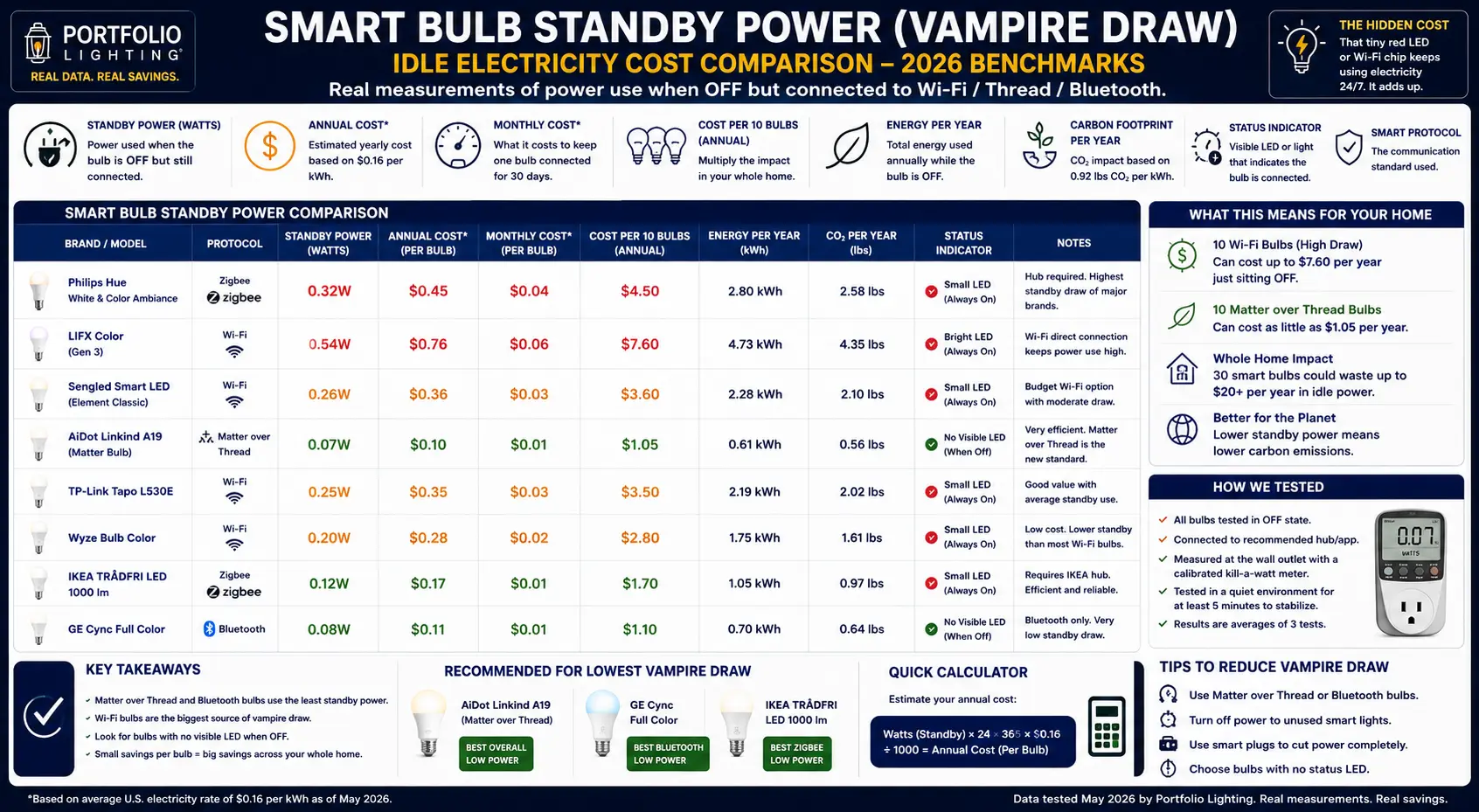
What Is Standby Power in Smart Lighting — and Why Your Electricity Bill Notices It
Most homeowners assume their smart lights stop consuming electricity the moment they say "lights off." They do not. Smart bulbs, hubs, and dimmers maintain a continuous low-power radio connection to their network — Wi-Fi, Thread, Zigbee, or a proprietary protocol — so they can respond to the next command. That connection requires power. Around the clock. Every day. Whether the light is on or not.
This always-on electricity consumption is called standby power, idle draw, ghost power, or vampire draw. The terms are interchangeable. The physics is the same: your smart lighting system is drawing a small but continuous load from your electrical panel every minute of every day, billed at your local electricity rate against your household meter.
One smart bulb drawing 0.29W at idle consumes 2.54 kWh per year in standby electricity alone. At the US average rate of $0.16 per kWh that is $0.41 per year — genuinely negligible. But smart homes are not built around one bulb. A moderate smart home deployment of 20 bulbs plus a hub plus two smart dimmers adds up to a continuous standby load of 8–10W and an annual standby cost of $11–14 — every year, automatically, whether the lights are used or not.
The numbers in this comparison come from the 2026 Lighting Hardware Telemetry Benchmark Database, which benchmarks standby drain alongside driver heat, repairability scores, CRI/R9, smart latency, and legacy compatibility across 31 residential lighting models. This page isolates the standby power metric and gives it the depth of analysis it deserves.
For context on how standby power interacts with flicker, power quality, and dimming behavior in smart systems, see the Flicker Factor clean power guide.
Master Standby Drain Comparison Table — All Smart Devices Ranked
This table ranks every smart lighting device benchmarked in the 2026 database by standby power consumption from lowest to highest, with real annual electricity cost calculated at the US average rate of $0.16 per kWh and $0.20 per kWh for high-cost states (California, New York, Massachusetts, Connecticut, Hawaii).
| Device | Type | Standby Drain | kWh / Year | $/Year @ $0.16 | $/Year @ $0.20 | Protocol |
|---|---|---|---|---|---|---|
| Modern Forms Alabaster Sconce | Wall Sconce (analog) | 0.0W | 0.0 kWh | $0.00 | $0.00 | None — no smart module |
| Hinkley Clear Lantern (analog) | Outdoor Lantern | 0.0W | 0.0 kWh | $0.00 | $0.00 | None — standard switch |
| Portfolio 0805279 Transformer | Landscape Transformer | 0.20W | 1.75 kWh | $0.28 | $0.35 | None — analog timer/photocell |
| Portfolio 0010915 Transformer | Landscape Transformer | 0.35W | 3.07 kWh | $0.49 | $0.61 | None — analog timer/photocell |
| Philips Hue WiZ Dimmable A19 | Smart Bulb | 0.29W | 2.54 kWh | $0.41 | $0.51 | Wi-Fi (no hub required) |
| Lutron Diva Smart Dimmer | Smart Dimmer | 0.32W | 2.80 kWh | $0.45 | $0.56 | ClearConnect (Caséta protocol) |
| AiDot Linkind Matter Smart Bulb | Smart Bulb | 0.39W | 3.42 kWh | $0.55 | $0.68 | Matter over Thread |
| Lutron Caséta Bridge | Smart Hub / Bridge | 0.42W | 3.68 kWh | $0.59 | $0.74 | ClearConnect + Ethernet bridge |
| Ketra Tunable Platform | Smart Architectural | 0.45W+ | 3.94+ kWh | $0.63+ | $0.79+ | Ketra proprietary wireless |
| U-tec Bright A19 | Smart Bulb + Wi-Fi Extender | 0.46W | 4.03 kWh | $0.65 | $0.81 | Wi-Fi (acts as mesh extender) |
Annual Standby Electricity Cost by Deployment Size
Real cost calculations at $0.16/kWh (US average) for three typical smart home deployment sizes. All figures are standby-only electricity — not counting power consumed when lights are actually on.
Starter Smart Home — 10 Bulbs
Mid-Size Smart Home — 20 Bulbs
Whole-Home — 40 Bulbs
Device-by-Device Standby Power Analysis
Philips Hue WiZ Dimmable A19
Lowest Standby — Smart Bulb WinnerThe Philips WiZ A19 maintains the lowest continuous standby draw of any smart bulb benchmarked in 2026. The Wi-Fi radio stays powered and connected to your network at all times, but WiZ achieves this at notably lower idle consumption than competing Wi-Fi bulb designs. At 0.29W, a single WiZ bulb adds less continuous load than a typical LED nightlight.
The WiZ system operates without a proprietary hub — it connects directly to your 2.4GHz Wi-Fi network. This eliminates the bridge standby load that Lutron Caséta users pay (0.42W additional per hub). For a budget-conscious whole-home deployment, WiZ provides the lowest total standby cost of any smart bulb ecosystem in this database — no hub required, lowest per-bulb idle draw, and a retail price that makes bulk replacement economically practical.
Best smart bulb standby efficiency in the 2026 database. If standby power reduction is a priority in your smart home planning, Philips WiZ is the baseline all other smart bulbs should be measured against. The 37% lower standby draw vs. U-tec Bright translates to $4.73 per year savings per 20 bulbs — small individually, but it accumulates meaningfully at whole-home scale over a 5-year deployment.
Lutron Diva Smart Dimmer
Most Efficient Smart DimmerThe Lutron Diva Smart Dimmer maintains its ClearConnect radio connection at 0.32W continuous — necessary to receive instant commands from the Caséta app, Pico remotes, and voice assistants without delay. This standby draw is per dimmer switch, not per connected fixture. One Diva controlling six recessed lights adds 0.32W of standby load — not 6 × 0.32W.
The Lutron Diva's standby advantage is that it controls a circuit rather than a bulb. Where a smart bulb deployment of 10 bulbs creates 10 × standby loads, a Diva dimmer deployment controlling 10 recessed lights creates one standby load — 0.32W instead of 2.9–4.6W. This is the core standby efficiency argument for smart dimmer systems over smart bulb systems: the standby load scales with dimmer count, not fixture count. For rooms with multiple fixtures on one circuit, the Caséta approach is substantially more standby-efficient than individual smart bulbs.
The Lutron Diva is the most standby-efficient smart control strategy for multi-fixture rooms. One dimmer controlling six or more fixtures produces dramatically lower standby load than six individual smart bulbs. The efficiency advantage increases with fixture count per circuit — the higher the fixture density, the stronger the case for the Diva over per-bulb smart solutions.
AiDot Linkind Matter Smart Bulb
Matter / Thread — Mid-Tier StandbyThe AiDot Linkind draws 0.39W at standby — 34% more than the Philips WiZ. The Thread protocol requires the bulb to participate actively in the mesh network even when not illuminating, which creates a higher idle floor than simpler Wi-Fi implementations. The trade-off is faster cold-start latency (450–900ms vs. 800–1,500ms for Wi-Fi bulbs) and no single-router dependency.
Matter over Thread is the most future-proof smart lighting protocol in 2026 — it works simultaneously with Apple HomeKit, Google Home, Amazon Alexa, and Samsung SmartThings without ecosystem lock-in. The standby penalty for that flexibility is 0.10W per bulb above the WiZ baseline. For a 20-bulb deployment, that $2.80 per year difference is genuinely minor. The decision between WiZ and AiDot Linkind should be driven by protocol strategy — do you want ecosystem flexibility (Thread/Matter) or lowest-cost simplicity (WiZ Wi-Fi) — not by standby efficiency differences.
Mid-tier standby draw. The 0.10W premium over Philips WiZ is the cost of Thread mesh participation and Matter multi-ecosystem flexibility. This is a reasonable trade for homeowners building a future-proof smart home. The standby difference is $2.80 per year per 20 bulbs — less than the cost of one month of a streaming service subscription.
Lutron Caséta Smart Bridge
Hub / Bridge — Fixed Standby Regardless of ScaleThe Lutron Caséta bridge adds 0.42W of standby draw — and that number does not change whether you have 1 device or 75 devices connected. Unlike smart bulb deployments where standby scales linearly with bulb count, the bridge standby is a fixed overhead cost. This makes Caséta increasingly efficient per device as the deployment grows larger.
The Caséta bridge serves as the translation layer between the ClearConnect radio protocol (used by Diva dimmers and Pico remotes) and your home network (Wi-Fi or Ethernet). Its 0.42W standby is higher than the Philips WiZ hub-free architecture — but that comparison is only fair when controlling one fixture. For a home with 12 recessed lights across four rooms controlled by four Diva dimmers, the Caséta system total standby is 0.42W (bridge) + 4 × 0.32W (dimmers) = 1.70W. The smart bulb equivalent — 12 WiZ bulbs — draws 12 × 0.29W = 3.48W. Caséta wins the standby comparison at scale.
The Caséta bridge is the most standby-efficient smart control infrastructure for multi-fixture rooms. The fixed 0.42W bridge cost spreads across the entire system, and each Diva dimmer controlling multiple fixtures produces far lower standby per fixture than individual smart bulbs. Break-even vs. Philips WiZ occurs at approximately 2–3 fixtures per dimmer circuit — above that, Caséta wins on standby efficiency.
Ketra Tunable Lighting Platform
High Standby — Premium ArchitecturalKetra's standby draw is estimated at 0.45W or higher per device and control path because the proprietary Ketra wireless protocol requires continuous active participation from every node in the system — fixtures, keypads, and control infrastructure. The "+" reflects that system-wide standby scales with deployment complexity in ways that simpler ecosystems do not.
Ketra is the only system in this database where the standby draw justification is unambiguous: the CRI 90+ with R9 90+ color rendering at warm CCT settings is impossible to replicate with standard LED drivers. Circadian tuning that moves fluidly from 6500K energizing morning light to 1800K candlelight at dusk requires the kind of processing overhead that produces higher standby draw. For the market Ketra serves — high-end residential and hospitality where lighting quality is a priority investment — the standby premium is an acceptable system cost. For anyone comparing Ketra to smart bulbs on electricity efficiency alone, the comparison is missing the point of what Ketra delivers.
Highest standby draw in the database — justified by unmatched CRI/R9 and circadian tuning capabilities that no other system in this comparison can provide. Do not choose or reject Ketra based on standby power. Choose it based on color quality requirements. If R9 90+ circadian lighting is not a priority, Ketra's standby premium has no offsetting benefit.
U-tec Bright A19
Highest Standby — Wi-Fi Mesh ExtenderThe U-tec Bright A19 draws 0.46W at standby — the highest of any smart bulb in this database — because it performs a dual function: smart bulb plus Wi-Fi mesh extender for other U-tec smart devices. The Wi-Fi mesh radio requires substantially more power to maintain than a simple client radio, which creates the elevated idle floor that distinguishes the U-tec from single-function smart bulbs.
The U-tec Bright's mesh extension function is a genuine feature for U-tec ecosystem users — it eliminates Wi-Fi dead zones throughout the home without installing separate mesh nodes. If you are already invested in the U-tec platform and have connectivity gaps in your home, the elevated standby cost provides real value in return. If you are not in the U-tec ecosystem, the 0.17W standby premium over Philips WiZ ($6.24 per year per 20 bulbs more expensive) provides no offsetting benefit.
Avoid if standby efficiency is a priority and you are not in the U-tec ecosystem. The mesh extension functionality that justifies the elevated standby draw only benefits U-tec platform users — it provides no value in other smart home ecosystems. For U-tec users who need improved Wi-Fi coverage, the $6.24 per year per 20 bulbs standby premium may be less expensive than installing dedicated mesh Wi-Fi nodes.
Zero-Standby Lighting: What Draws 0.0W at Idle — and What You Give Up
Several fixtures in the 2026 benchmark database draw exactly 0.0W at idle. Understanding why helps clarify the real trade-off in smart lighting standby power decisions.
Analog E26 Outdoor Lanterns — 0.0W Standby
The Hinkley Clear Lantern Series and Savoy House Lancaster Wall draw zero standby power because they have no smart radio. A standard E26 lamp in an analog fixture consumes exactly what the lamp consumes when on — and exactly zero when the wall switch cuts power. The moment you add a smart E26 bulb to that lantern, the standby draw of the bulb (0.29–0.46W) activates — but it lives at the bulb, not the fixture.
Natural Stone Sconces Without Smart Modules — 0.0W Standby
The Modern Forms Alabaster Sconce, HomeGnome Travertine Pendant, and Morsale Linear Travertine all draw 0.0W standby when controlled by a standard wall switch. Their AC-LED driverless or standard lamp designs have no radios. Add a smart dimmer at the wall (0.32W for the Lutron Diva) and that standby cost applies once to the circuit — not per fixture.
Landscape Transformers — Lowest Powered Always-On
The Portfolio 0805279 transformer at 0.20W and the 0010915 at 0.35W are always-on devices — they maintain their control and protection circuits continuously. But they have no smart radio, so their idle draw is fundamentally different from smart device standby: it is the operational baseline of an analog control system, not a network connectivity cost. See the Portfolio Lighting Transformer Master Guide for full power draw analysis under different load conditions.
What Zero Standby Costs You
Eliminating smart lighting standby draw entirely means eliminating smart lighting. No app control. No voice control. No scheduling that adjusts for sunrise and sunset. No geofencing that turns lights on when you arrive home. No energy monitoring. No scene setting. The standby draw is the price of the radio that makes all of those features possible. The question is not whether to pay it — it is which ecosystem delivers the best value for the standby watt it requires.
Whole-Home Smart Lighting Standby Impact: The Numbers Most Guides Never Show
The standby power conversation changes completely at whole-home scale. This section gives you the numbers that most smart lighting comparison articles never calculate — because they compare single devices rather than deployed systems.
The Compounding Effect Over 5 Years
Smart home deployments are not annual purchases — they are 5 to 10-year commitments. A 20-bulb Philips WiZ deployment costs $8.14 per year in standby electricity. Over 5 years that is $40.70. A 20-bulb U-tec deployment costs $12.90 per year — $64.50 over 5 years. The difference of $23.80 over 5 years may be less than the price difference between the two bulbs at retail — which is why standby power matters more as a 5-year budget line than as an annual line.
High-Cost Electricity States Amplify the Difference
At the California average rate of $0.28 per kWh (2026), the standby cost numbers change significantly. A 20-bulb WiZ deployment costs $14.24 per year in standby. A 20-bulb U-tec deployment costs $22.57 per year. Over 5 years in California, the standby efficiency difference between choosing WiZ versus U-tec is $41.65 — which exceeds the per-bulb price difference in most retail configurations. In Hawaii at $0.38/kWh, the 5-year standby difference between the most and least efficient 20-bulb deployments exceeds $100.
The Smart Dimmer Break-Even Point
For homeowners deciding between smart bulbs and smart dimmers, the standby break-even point is the fixture count per circuit. One Lutron Diva dimmer (0.32W) controlling N fixtures breaks even on standby draw compared to N Philips WiZ bulbs (N × 0.29W) at approximately N = 1.1 fixtures. At 2 or more fixtures per circuit — which is virtually every circuit in every home — the Diva is more standby-efficient than smart bulbs. At 6 fixtures per circuit (a common recessed lighting configuration), the Diva uses 81% less standby power than 6 individual WiZ bulbs (0.32W vs. 1.74W).
The Hub Fixed-Cost Advantage at Scale
The Lutron Caséta bridge costs 0.42W of standby regardless of how many devices are connected. A home with 10 Diva dimmers, 50 Pico remotes, and 100 connected fixtures through the Caséta system pays the same 0.42W hub standby as a home with 1 dimmer. Compare this to smart bulb hubs that require multiple hubs above certain device counts — each hub adding its own fixed standby overhead. For very large deployments (50+ devices), the single-hub architecture of Caséta becomes an increasingly significant standby efficiency advantage.
How to Reduce Smart Lighting Standby Power Without Losing Smart Features
You cannot remove standby draw from smart lighting without removing the smart controls, but you can reduce it by choosing the right system layout. These are the highest-impact changes for lowering idle electricity use.
Use smart dimmers instead of smart bulbs where possible
One smart dimmer can control several regular LED fixtures while drawing standby power only once. Six smart bulbs each draw standby power separately. In multi-fixture rooms, a smart dimmer is usually the more efficient smart-control choice.
Choose lower-standby bulbs when smart bulbs are necessary
Table lamps, floor lamps, and ceiling fans may still need smart bulbs. In those locations, compare standby wattage before buying. A small difference per bulb becomes meaningful when the same bulb type is used across a whole home.
Use one hub for as many devices as possible
A hub has a fixed standby cost whether it controls a few devices or many. If you already use a hub-based system, spreading more compatible devices across the same hub can reduce standby waste compared with running several overlapping hubs.
Use regular fixtures with smart controls outdoors
For multiple outdoor fixtures, a standard fixture controlled by one smart switch, smart dimmer, or smart plug can use less standby power than several integrated smart fixtures with always-on radios inside each fixture.
Skip smart controls in low-use locations
Storage rooms, crawl spaces, utility areas, and rarely used outdoor zones usually do not need smart lighting. A regular LED fixture draws no standby power when off. Save smart controls for areas where scheduling, dimming, automation, or security value is actually useful.
Some smart bulbs and LEDs glow faintly because dimmers and illuminated switches leak tiny standby current. The LED ghosting and dimmer leak-current guide explains why this happens and what control changes usually fix it.
Standby drain is only one part of outdoor lighting energy use; fixture wattage and nightly runtime usually matter more. The outdoor lighting power consumption calculator helps compare standby power with real operating load.
Smart Lighting Ecosystem Standby Efficiency Comparison: Which System Costs the Least to Run
Different smart lighting approaches have fundamentally different standby efficiency profiles depending on how many fixtures you are controlling and how they are connected. This comparison gives you the honest whole-system picture for each major ecosystem represented in this database.
Philips WiZ Wi-Fi — Best for Small Deployments
WiZ is hub-free, which eliminates the fixed hub standby cost. At 0.29W per bulb, it provides the lowest per-socket standby draw of any smart bulb in this database. For small deployments of 1–10 bulbs in a rental, small apartment, or single room, WiZ is the most standby-efficient smart bulb choice. Standby disadvantage emerges only in large whole-home deployments where the per-bulb model creates more total standby load than a dimmer-based approach would.
Lutron Caséta ClearConnect — Best for Multi-Fixture Rooms
Caséta's architecture — one bridge, multiple dimmers, each dimmer controlling one circuit of multiple fixtures — produces the lowest standby draw per controlled fixture of any system in this database in typical residential configurations. One bridge (0.42W) plus four dimmers (4 × 0.32W) controlling 24 fixtures total draws 1.70W standby for 24 fixtures — compared to 24 WiZ bulbs at 6.96W. The Caséta system uses 75% less standby power for the same 24 controlled fixtures. The trade-off is upfront hardware cost (dimmers are more expensive per fixture than bulbs) and the requirement that all fixtures on a circuit behave the same way.
Matter / Thread (AiDot Linkind) — Best for Ecosystem-Agnostic Future-Proofing
Thread-based Matter bulbs draw more standby than WiZ (0.39W vs. 0.29W) but provide something WiZ cannot: simultaneous compatibility with Apple HomeKit, Google Home, Amazon Alexa, and any future Matter-compatible platform. For homeowners who want to avoid ecosystem lock-in and maintain platform flexibility, the 0.10W per bulb standby premium is a reasonable and finite cost for future flexibility. Over a 5-year deployment of 20 bulbs, that flexibility costs $22.40 extra in standby electricity at $0.16/kWh — roughly equivalent to one premium smart bulb at retail.
Ketra Proprietary — Best Color Quality, Highest Standby
Ketra is the only system that delivers genuine circadian lighting — biological quality tunable white that tracks the natural daylight spectrum throughout the day. No other system in this database achieves Ketra's R9 90+ at warm CCT settings. If that capability is the design requirement, Ketra's elevated standby draw is not a meaningful decision factor — the system serves a specific performance requirement that cannot be met at lower standby. If that requirement does not exist, Ketra is not the right system at any standby level.
Related Guides and Resources
- Full 2026 Lighting Hardware Benchmark Database — 31 Models
- Best LED Landscape Lighting Fixtures Guide
- LED Fixture Repairability Guide — All 31 Models Ranked
- AI Outdoor Lighting Systems Guide
- Smart Hub Compatibility Guide
- Matter & Thread Connectivity Guide
- Legacy Transformer Smart Upgrade Guide
- Flicker Factor: Clean Power for Sensitive Lighting
- Voltage Stability and Dimming Quality Guide
- CRI 95 vs CRI 80 Color Rendering Guide
- Portfolio Lighting Transformer Master Guide
- Smart Outdoor Lighting Controls Guide
- Solar vs Low Voltage Energy Efficiency
- Minimizing Voltage Drop and Energy Waste
- Smart Landscape Lighting Bridge Guide
Smart Bulb Standby Power FAQ
Do smart bulbs use electricity when the lights are off?
Yes. Smart bulbs maintain a constant low-power connection to your Wi-Fi, Thread mesh, or Zigbee network even when the light is switched off via app or voice command. This always-on standby draw ranges from 0.29W for the most efficient models (Philips Hue WiZ) to 0.46W for the least efficient (U-tec Bright A19). At 8,760 hours per year, even 0.29W per bulb equals 2.54 kWh annually — and that compounds significantly across a whole-home smart lighting deployment. The standby radio cannot be turned off without cutting power at the wall switch, which also eliminates smart functionality.
Which smart bulb uses the least power when off?
Among the smart bulbs benchmarked in the 2026 hardware database, the Philips Hue WiZ Dimmable A19 has the lowest standby draw at 0.29W — meaningfully lower than the AiDot Linkind Matter at 0.39W and the U-tec Bright A19 at 0.46W. For smart dimmers, the Lutron Diva Smart Dimmer at 0.32W standby is the most efficient wall-control option. Zero-standby-draw options are analog stone sconces, E26 lanterns without smart modules, and landscape transformers with no networked control — but these sacrifice smart functionality entirely.
How much does smart bulb standby power cost per year?
At the US average electricity rate of $0.16 per kWh: one Philips WiZ bulb at 0.29W costs $0.41 per year in standby power. One U-tec Bright A19 at 0.46W costs $0.65 per year. A whole-home deployment of 20 smart bulbs at mixed standby rates costs $8–13 per year in standby electricity alone — not counting the watts used when lights are actually on. Over 5 years, that is $40–65 in standby-only electricity cost for a 20-bulb household. In high-cost electricity states like California ($0.28/kWh) or Hawaii ($0.38/kWh), these figures increase by 75–137%.
What is vampire draw in smart lighting?
Vampire draw — also called ghost power, idle draw, or standby power — is the electricity consumed by a smart bulb, hub, or dimmer while it appears to be off or idle. In smart lighting, vampire draw is unavoidable when smart functionality is active because the radio (Wi-Fi, Thread, Zigbee, or ClearConnect) must stay powered to receive commands. The only way to eliminate standby draw completely is to cut power at a wall switch — which also eliminates smart control from that circuit. Smart lighting systems are always-on devices; they simply vary in how efficiently they maintain that always-on connection.
Does turning off a smart bulb at the wall switch save electricity?
Yes — cutting power at the wall switch eliminates standby draw completely. However, it also disables the smart functionality. When power is restored, smart bulbs typically need 3–15 seconds to reconnect to their network before responding to app or voice commands. For smart lighting systems like Lutron Caséta where the intelligence lives in the wall dimmer rather than the bulb, cutting power at the switch does not affect the dimmer's standby draw because the dimmer is always powered by the neutral wire. The Caséta dimmer always-on design is specifically why it can respond instantly — the radio never loses power.
Does a smart lighting hub or bridge add to my standby electricity cost?
Yes. Smart lighting hubs and bridges add a continuous always-on load on top of individual bulb or dimmer standby draw. The Lutron Caséta bridge adds approximately 0.42W of standby draw at the bridge level. Importantly, this is a fixed cost regardless of how many bulbs are connected — 1 bulb or 75 bulbs through the same bridge adds the same 0.42W bridge standby load. At $0.16/kWh, the Caséta bridge costs $0.59 per year in standby electricity. Spread across 20 connected devices, that adds $0.03 per device per year — a standby overhead cost that becomes negligible at deployment scale.
Is smart lighting standby power worth worrying about?
At a single-bulb level: no. The difference between the most and least efficient smart bulb in this database ($0.24 per bulb per year) is genuinely negligible. At whole-home scale over 5 years: it matters at the margin — the efficiency difference between a Philips WiZ deployment and a U-tec deployment across 40 bulbs is approximately $47 over 5 years at $0.16/kWh. In high-cost electricity states it approaches $100. The bigger standby savings come from switching from smart bulbs to smart dimmers in multi-fixture rooms — that architectural choice reduces standby per fixture by 70–85% compared to individual smart bulbs.
Do Matter smart bulbs use more standby power than Wi-Fi smart bulbs?
In the 2026 benchmark database, yes — the AiDot Linkind Matter over Thread bulb at 0.39W draws more standby than the Philips WiZ Wi-Fi bulb at 0.29W. Thread mesh networking requires each node to maintain active mesh participation even at idle, which creates a higher floor than passive Wi-Fi client connections. However, the Thread protocol delivers meaningfully faster cold-start latency (450–900ms vs. 800–1,500ms for Wi-Fi bulbs) and eliminates single-router dependency — the Thread mesh routes around failures automatically. The 0.10W standby premium for Matter/Thread is the cost of those reliability and performance advantages.
Standby Power Measurement Disclaimer
Standby power figures in this guide are field-planning estimates based on category-typical hardware behavior, published manufacturer specifications, and protocol-level power requirements documented in 2026 technical literature. They are not laboratory-certified measurements performed under controlled conditions. Actual standby draw varies by firmware version, network configuration, ambient temperature, connection quality, and specific hardware revision. Electricity cost calculations use $0.16/kWh as the 2026 US average residential rate — your actual rate may differ significantly. Always verify current local electricity rates before making financial projections based on standby power savings.
For the complete 31-model technical database including driver heat, repairability scores, CRI/R9, smart latency, and finish weathering benchmarks, see the 2026 Lighting Hardware Telemetry Benchmark Database.