
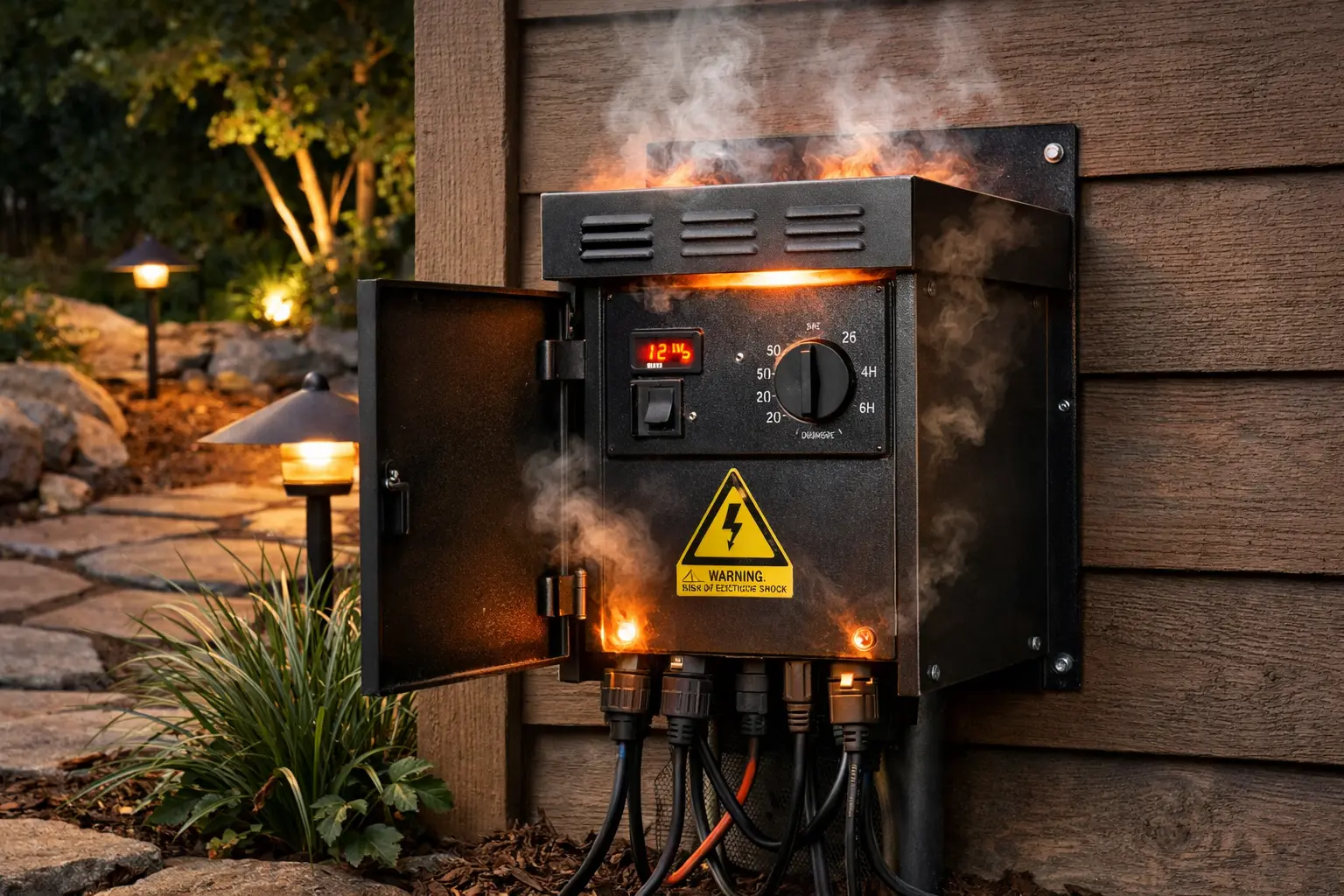
Is a Hot Transformer Normal or Dangerous? (Quick Answer)
A warm transformer is normal, but a very hot transformer can indicate overload, poor ventilation, wiring problems, or internal failure. The key is how hot it gets and whether the system behaves normally.
- Warm to the touch: normal operation
- Very hot: possible overload or airflow issue
- Hot + shutdown, buzzing, or smell: serious problem
Transformer Heat Diagnosis Guide
| What You Feel / See | What It Means | What To Do |
|---|---|---|
| Warm, lights normal | Normal operation | Monitor only |
| Hot after adding lights | Overload or undersized transformer | Check total load |
| Very hot + dim lights | Electrical stress | Inspect wiring and load |
| Hot + shutdown/reset | Overload protection triggered | Reduce load or inspect system |
| Hot + buzzing or smell | Possible internal failure | Replace transformer |
Heat alone is not the problem—heat combined with symptoms tells you what is wrong.
Start Here: What Should You Do Next?
- Warm and stable → no action needed
- Hot after system expansion → check load
- Hot in enclosed space → improve airflow
- Hot + shutdown or buzzing → inspect immediately
Always diagnose the cause before replacing the transformer.
A warm transformer is not automatically a bad transformer. The problem starts when the heat seems excessive, the system behaves inconsistently, or the transformer keeps getting hotter than expected under a normal lighting load.
This page works best alongside Portfolio lighting transformer troubleshooting, Portfolio transformer not working, Portfolio transformer reset, Portfolio transformer timer not working, and Portfolio transformer sizing guide. If the heat issue seems tied to weak lights or inconsistent output farther down the run, you may also need landscape lighting voltage drop.
What Is Normal Heat and What Is Not
This is the most important place to start because many visitors go straight from “this feels warm” to “the transformer is bad.” That is not always true. A low voltage transformer does real electrical work whenever the lighting system is on, so some heat is completely normal. If the unit is outdoors in warm weather, mounted in a box, or running for hours at a time, it may feel noticeably warm even when everything is functioning the way it should.
What matters is the pattern. A transformer that simply feels warm during normal evening operation is different from one that becomes painfully hot, smells burnt, hums loudly, repeatedly trips protection, shuts down after running a while, or seems much hotter than it used to feel under the same conditions. Those are the moments when you stop thinking about normal operating warmth and start thinking about load, wiring, airflow, or transformer failure.
The easiest way to think about it is this: heat by itself is not the diagnosis. Heat plus symptoms is where the real troubleshooting starts. If the lights still run normally, the case is warm but stable, and nothing else seems off, the transformer may be doing its job. If the heat comes with weak output, resets, buzzing, or erratic timing, that combination points to a system problem worth chasing down.
If you are unsure whether your transformer is overheating or operating normally, check Portfolio outdoor transformer manuals for model-specific operating details and load guidance.
For the GLA-200-12WF-1, overheating should be evaluated against a practical 160-watt operating ceiling rather than only the 200-watt nameplate. Direct sun, blocked ventilation, loose terminal screws, high ambient temperature, and overloaded runs can all raise internal heat enough to shorten timer-board, photocell, and insulation life. The GLA-200-12WF-1 load and heat diagnosis guide shows what to measure before deciding that the transformer must be replaced.
Most Common Reasons a Transformer Gets Too Hot
- Too many lights connected (overload)
- Poor airflow around the transformer
- Loose or damaged wiring
- Voltage drop causing stress on the system
- Aging or failing transformer components
Why Portfolio Transformers Get Hot
There are a handful of common reasons a Portfolio transformer gets hotter than expected. Some are minor. Some point to a system that has quietly drifted beyond what the transformer was originally meant to support. The most common cause is load. If too many fixtures are connected, if the actual wattage has changed over time, or if the system was already close to the transformer's comfort zone, the unit may run hotter than it should.
Poor airflow is another common reason. Transformers do not cool well when they are crowded into tight spaces, blocked by debris, exposed to direct heat buildup, or mounted where air cannot move around them. Outdoor lighting transformers are often treated like something you install and forget, but the mounting location still matters.
Wiring issues also matter. Loose connections, damaged cable, shorting, and older connectors can all create electrical stress that shows up as excess heat at the transformer. And of course, sometimes the transformer itself is just aging poorly. If the unit has been outdoors for years, internal wear can make it run hotter even if the lighting layout has not changed much.
Electrical stress from surges can contribute to overheating issues. Learn how to protect your system with the landscape lighting surge protection guide.
Common reasons a Portfolio transformer runs hot
- too many fixtures on the transformer
- an undersized transformer for the actual load
- poor ventilation or heat trapped around the unit
- damaged cable, loose wiring, or bad connections
- a failing timer or internal electrical component
- aging transformer hardware
- system expansion without rechecking transformer capacity
If your system has recently changed, that is one of the biggest clues. Added path lights, new spotlights, upgraded LED components, or changes to the wiring layout can all affect how hard the transformer has to work. That is why pages like Portfolio transformer sizing guide and Portfolio outdoor transformer lighting are especially relevant here.
First Checks to Make Before Replacing Anything
Before you decide the transformer needs replacement, slow the process down and make a few basic checks. A lot of transformer-related mistakes happen because homeowners replace the unit first and only later realize the real issue was system load, bad wiring, or a timer setting problem.
Start with these checks:
- confirm how many fixtures are currently connected
- look for obvious wiring damage or loose connections
- check whether the transformer is mounted in a cramped or blocked location
- notice whether the hot condition appears only after long run times
- listen for unusual buzzing or humming
- check whether the lights cut out, dim, or flicker when the transformer gets hotter
- confirm whether the timer, photocell, or controls are behaving normally
This is also a good point to think about whether the system has slowly changed. Many outdoor lighting systems start simple, then pick up a few more path lights, a spotlight or two, maybe a new deck light run, and eventually the original transformer is supporting more than anyone remembers. That kind of gradual expansion is one of the most common reasons a transformer that used to seem fine now feels hotter than expected.
Overheating is often caused by loose or high-resistance connections. Use our terminal block troubleshooting guide to inspect the output lugs and wiring.
How Load and Transformer Sizing Affect Temperature
If there is one concept that solves a surprising number of hot-transformer questions, it is load. A transformer can only comfortably support so much connected lighting. When the total system demand gets too close to the transformer's limit, heat often becomes one of the first warning signs.
That is why this page should work closely with your Portfolio transformer sizing guide. This hot-transformer page handles the troubleshooting question. The sizing page handles the planning math and capacity thinking that often explains why the transformer feels too warm in the first place.
| Situation | What It Often Means | Best Next Step |
|---|---|---|
| Transformer is warm but lights run normally | Could be normal operating heat | Monitor load and airflow |
| Transformer gets hotter after adding fixtures | System may be near or beyond ideal capacity | Recheck sizing and total load |
| Transformer is hot and lights dim or shut off | Possible overload or failing unit | Inspect load, reset behavior, and wiring |
| Transformer is hot with buzzing or unusual smell | Potential failure or unsafe condition | Stop guessing and inspect immediately |
| Only the end of the run looks weak | Voltage drop may be part of the problem | Check cable and run design |
A transformer that is too small for the job may still work for a while, but it often runs hotter and ages faster. That is why a hot case is sometimes less about today’s symptom and more about a long-term mismatch between transformer size and outdoor lighting demand. If you are working with path lights, landscape spotlights, deck lighting, and other added fixtures on one unit, load balance matters more than many homeowners expect.
When Replacement Is the Smarter Move
Not every hot transformer needs immediate replacement, but some clearly do. If you have already checked the system load, made sure ventilation is reasonable, inspected the wiring, and the transformer still gets excessively hot or behaves unreliably, replacement starts to make more sense.
The same is true if the unit is old, repeatedly trips out, smells burnt, or no longer feels trustworthy around a system that is otherwise in decent shape. At that point, the question is less “can I keep nursing this along?” and more “is this now the weak point in the system?”
Replacement often makes sense when:
- the transformer repeatedly overheats after the rest of the system has been checked
- the unit is undersized for the present fixture count
- resetting only solves the problem temporarily
- the housing smells burnt or internal failure seems likely
- the timer or controls are also becoming unreliable
- the system has grown and you need a larger or better-supported unit anyway
If that sounds like your situation, the next useful pages are Portfolio transformer replacement, how to replace a landscape lighting transformer, and where to buy Portfolio lighting replacement parts. Those pages are better once you have already decided the unit itself is the problem.
Final Thoughts on a Portfolio Transformer Getting Hot
The best way to handle a hot Portfolio transformer is not to panic and not to ignore it. Some warmth is part of normal operation. Excessive heat paired with odd behavior is not. The real job is to separate one from the other so you know whether you are dealing with a normal transformer under load, an undersized unit, a wiring issue, or a transformer that is genuinely on its way out.
Start with the simple questions. Has the system expanded? Is the unit getting enough airflow? Are the lights behaving normally? Has the timer or reset become unreliable? Once you answer those, the hot-transformer problem usually becomes much easier to classify.
And if the answer turns out to be replacement, that is still useful progress. It means you are making the change for the right reason instead of guessing. A transformer should support the landscape-lighting system quietly and consistently. If heat is now the main thing you notice, it is worth taking seriously.
Portfolio Transformer Getting Hot FAQ
Is it normal for a Portfolio transformer to feel warm or hot?
Some warmth is normal because a low voltage transformer handles electrical load while the lighting system is running. The concern starts when the transformer feels excessively hot, smells unusual, shuts off, or behaves inconsistently.
Why would a Portfolio transformer get too hot?
Common causes include too much fixture load, poor ventilation, bad wiring, internal transformer wear, short circuits, timer issues, or a system that has expanded beyond what the transformer can comfortably support.
Should you replace a hot Portfolio transformer right away?
Not always. First confirm whether the heat level is truly abnormal and whether the real cause is overload, wiring, or poor airflow. Replacement makes sense when the transformer is failing, undersized, damaged, or repeatedly overheating after the rest of the system has been checked.
What pages help if a hot transformer is part of a bigger system problem?
Helpful next pages include Portfolio transformer troubleshooting, Portfolio transformer not working, Portfolio transformer timer not working, landscape lighting voltage drop, and the Portfolio transformer sizing guide.