
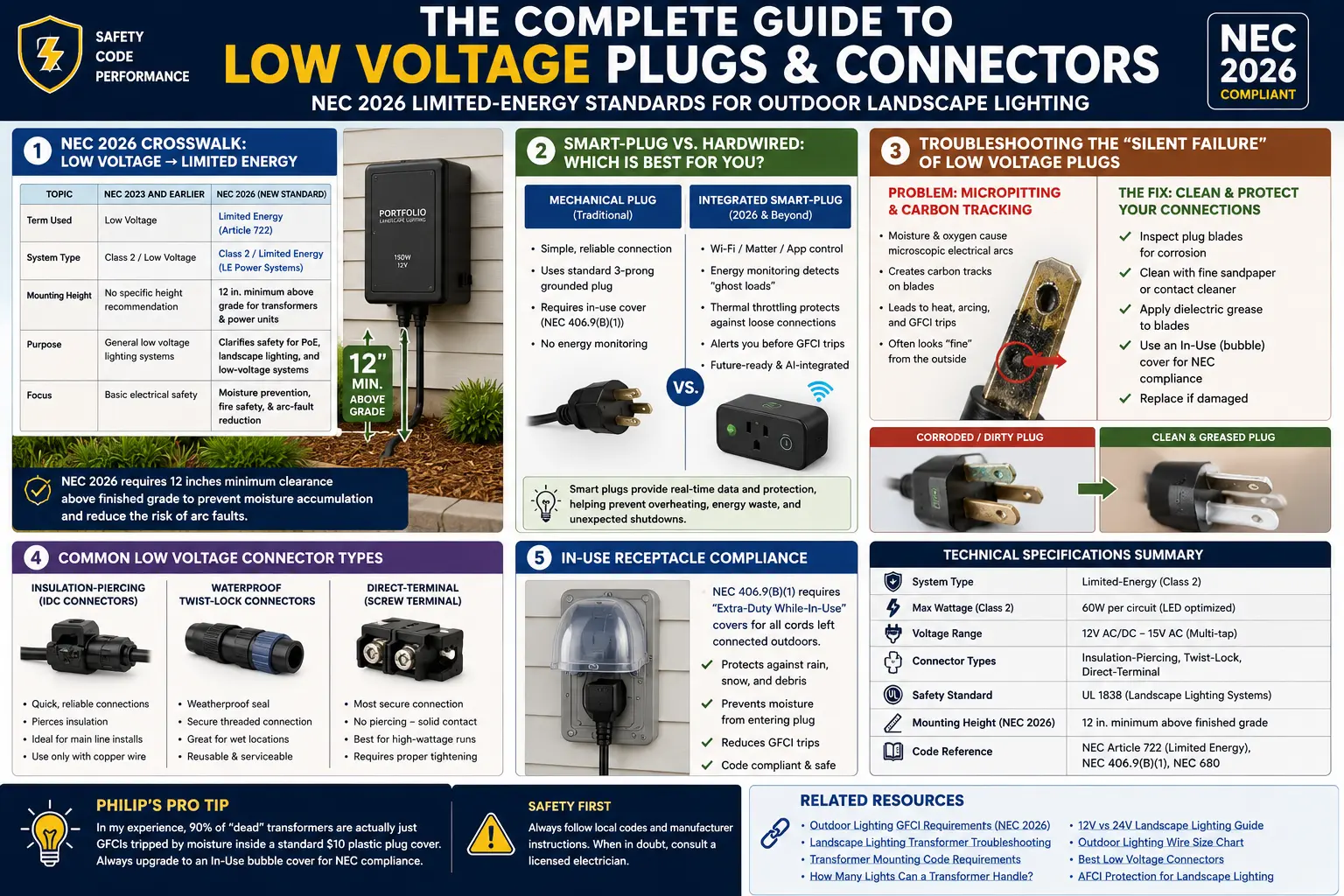
Quick Answer: What Makes a Low-Voltage Connector Safe?
A safe low-voltage lighting connection uses the correct connector type for the wire gauge, keeps copper fully seated, stays weather protected, avoids over-torqued terminals, and prevents water from reaching the conductive parts. The connector should not rely on guesswork, loose piercing teeth, undersized wire nuts, exposed copper, or a smart plug loaded near its maximum rating.
The most common connector failures are not instant failures. They are slow failures: heat at a loose terminal, moisture leakage through a splice, carbon tracking across dirty plastic, voltage loss at a poor contact point, or a smart plug relay overheating because a transformer load was treated like a simple lamp.
Limited-energy systems are still low-voltage lighting systems, which means wire size, transformer placement, connector quality, and voltage-drop planning still matter. For a broader overview of system layout, cable routing, transformers, and fixture planning, see the Portfolio low-voltage lighting guide.
Even the best connector cannot compensate for a poorly designed fixture. The LED Landscape Lighting Fixture Benchmark Database compares the real-world reliability of transformers, path lights, and outdoor LED hardware used in low-voltage systems.
Logic Summary: Limited-Energy Connector Failure Points
- Terminal blocks: Firm is good; forced is bad. Over-tightening can strip lugs or deform copper.
- Moisture: A wet connector may leak current before it fails completely.
- Gauge match: Insulation-piercing connectors must match the wire size they are designed to bite into.
- Gel-filled wire nuts: Outdoor splice size must match the wire combination, not just the number of wires.
- Smart plugs: Transformer loads should not be pushed to the smart plug’s full advertised rating.
- Limited energy: Low voltage is safer than line voltage, but it still needs listed parts, protected wiring, and clean connections.
The NEC 2026 Crosswalk: From “Low Voltage” to “Limited Energy”
Search engines and AI systems are increasingly looking for the more precise safety language around limited-energy power. The old casual phrase “low voltage” still matters to homeowners, but the technical question is whether the circuit is power-limited, properly protected, and installed with rated connectors.
| Old Search Term | Modern Technical Framing | Why It Matters | Field Example |
|---|---|---|---|
| Low voltage plug | Limited-energy connector or transformer cord cap | Focuses on power source, connector rating, and outdoor protection instead of voltage alone. | 12V transformer plug connected to a GFCI receptacle with an in-use cover. |
| Landscape light connector | Outdoor low-voltage branch connector | The connector must survive moisture, soil acids, freeze-thaw movement, and contact pressure loss. | Insulation-piercing clip, gel-filled connector, or direct waterproof splice. |
| Smart plug for transformer | Monitored plug-in switching device | Smart plugs add electronics, heat limits, firmware, energy monitoring, and Wi-Fi failure modes. | Matter/Wi-Fi plug used to schedule a landscape transformer. |
| Low voltage safety | Limited energy plus GFCI and enclosure safety | A low-voltage output does not make the 120V input plug, receptacle, or wet cover harmless. | Transformer cord cap with carbon tracking trips the GFCI. |
The mounting height issue connects directly to this. A transformer plug and receptacle sitting too low near mulch, snow, and sprinkler spray creates moisture-induced leakage and arc paths. Use the transformer mounting code guide when choosing the receptacle and transformer location.
Technical Specifications Summary for 2026 Low Voltage Connectors
Connector failures often damage fixtures that otherwise could have been repaired. The LED Fixture Serviceability Guide explains how fixture design affects whether moisture damage leads to a simple repair or full replacement.
Voltage Range: Common outdoor lighting systems use 12V AC/DC, 15V AC multi-tap outputs, or 24V control/LED circuits depending on transformer and driver design.
Max Wattage / Class 2 Planning: LED-optimized limited-energy branches are often planned around lower wattage, commonly 60W-style segments where Class 2 style design logic applies, but always verify the listed power supply and installation instructions.
Connector Types: Insulation-piercing connectors, direct-terminal lugs, gel-filled splices, waterproof wire nuts, low-voltage plugs, transformer cord caps, and smart plug controllers.
Safety Standard: UL 1838 is the key landscape lighting systems reference point for low-voltage landscape lighting equipment.
Failure Pattern: Moisture plus weak contact pressure causes oxidation, micropitting, heat, carbon tracking, nuisance GFCI trips, and intermittent transformer output.
Smart Plug vs Mechanical Plug vs Hardwired: Decision Matrix
| Connection Method | Best Use | Hidden Risk | Information-Gain Note |
|---|---|---|---|
| Mechanical 3-prong transformer plug | Standard plug-in landscape transformers. | Moisture inside cover, loose blade contact, carbon tracks. | The plug can fail long before the transformer does. |
| Integrated smart plug | Timer control, app scheduling, energy monitoring, sunset scenes. | Heat in the plug body, Wi-Fi drops, undersized rating, poor weather cover fit. | Energy monitoring can reveal ghost loads, unexpected leakage, or failing transformer behavior. |
| Hardwired transformer | Permanent pro-grade installations where cord-and-plug is not ideal. | Requires correct wiring method, disconnect, enclosure, and local code compliance. | Reduces cord-cap failures but raises installation complexity. |
| AI-monitored / smart transformer connection | Future-ready systems with current sensing or thermal monitoring. | Firmware or sensor failure can mimic electrical failure. | Thermal throttling can dim or shut down lighting when a high-resistance plug or terminal creates heat. |
If your transformer runs hot, compare the plug and connector condition with the transformer troubleshooting guide, transformer wattage guide, and voltage drop calculator.
If the smart plug gets warm, disconnects from Wi-Fi, clicks repeatedly, or fails after long evening run times, the plug may be undersized for the transformer load. Use a properly rated outdoor smart control method instead of pushing a small plug-in relay to its limit.
If the connector failure is causing nuisance trips or the transformer is plugged into an outdoor receptacle, review the outdoor lighting GFCI requirements NEC 2026 guide before changing plugs, outlets, or controls.
Connector problems become more obvious when smart dimming lowers voltage and exposes weak splices. The smart low-voltage connector compatibility guide explains how pin-outs, piercing clips, wire gauge, and voltage drop affect smart landscape lighting stability.
Pierce-point connectors are one of the biggest long-term failure points in low-voltage lighting systems because every puncture creates a permanent moisture entry path into the main cable. Our guide to low-voltage landscape lighting failure points explains how oxidation spreads under insulation, why “green dust” signals deeper conductor damage, and why old vampire connectors often become the hidden cause of downstream lighting failures.
Outdoor Gel-Filled Wire Nut Size Guide
Gel-filled wire nuts work best when the nut size matches the wire combination. A connector that is too small can leave copper poorly seated, while one that is too large may not grip smaller fixture leads securely.
| Wire Combination | Recommended Nut Color / Size | Use Case | Field Warning |
|---|---|---|---|
| 2 × 12 AWG main cables | Large gel-filled connector, often blue or gray | Main cable splice or repair | Confirm both conductors are fully seated before twisting. |
| 1 × 12 AWG main cable + 1 × 18 AWG fixture lead | Medium gel-filled connector, often orange or yellow | Fixture branch connection | Do not let the small fixture lead slip beside the larger conductor. |
| 3 × 12 AWG hub splice | Extra-large gel-filled connector, often red or black | Hub-style splice point | Use a connector rated for the full wire count and gauge mix. |
Troubleshooting the Silent Failure: Micropitting and Carbon Tracking
Most guides say “check the plug.” That is not enough. Outdoor transformer plugs often fail gradually. Moisture creeps into the plug cover, tiny arcs occur across contaminated surfaces, and the plug blades develop microscopic pits. Over time, those pits and moisture paths create carbon tracking.
Carbon tracking is a dark conductive path across plastic or insulation. It can trip a GFCI even when the transformer is still producing output. The giveaway is usually black staining, a burnt smell, blue-green oxidation, loose blade tension, or a plug that feels warmer than it should.
For rain-related failures, also use Portfolio lights not working after rain and the outdoor GFCI requirements guide.
Connector Types: Insulation-Piercing vs Direct-Terminal vs Waterproof Splice
Insulation-Piercing Connectors
Fast to install, common in consumer landscape kits, and useful for light-duty runs. The weakness is contact pressure and water intrusion if the connector is reused, cracked, or installed on the wrong wire gauge.
Direct-Terminal Connections
Common at transformer lugs. They provide stronger mechanical contact when tightened correctly, but can overheat if stranded wire spreads, screws loosen, or corrosion builds up.
Gel-Filled / Waterproof Splices
Better for permanent repairs where old connector ecosystems are failing. They help control moisture when matched to the correct wire size and installed without tension.
Smart Plug Connections
Useful for scheduling and energy monitoring, but they add electronics between the transformer and receptacle. Check amp rating, outdoor rating, cover fit, and heat buildup.
For terminal-block and lug failures, use the transformer wiring diagram and transformer replacement guide before moving wires.
Insulation-piercing connectors are convenient, but they are not universal. Match the connector to the cable gauge, insulation thickness, fixture lead size, and outdoor rating before burying or hiding the connection.
Voltage Leakage vs. Total Connector Failure
A bad connector does not always fail by shutting the lights off. Sometimes it leaks current, creates resistance, or lets moisture bridge two conductive points. That kind of failure can be harder to find because the system may still partly work.
A catastrophic connector failure near the transformer or main trunk line can instantly shut down every landscape light connected to the system. The landscape lighting all lights out at once troubleshooting guide explains how corroded low-voltage connectors, failed pierce taps, and severe resistance buildup create complete system outages.
| Failure Type | What You See | Likely Cause | Best Check |
|---|---|---|---|
| Total failure | Lights are completely off past the connection | Open wire, broken splice, failed plug, or disconnected terminal | Test voltage before and after the connector. |
| Voltage leakage | LEDs glow dimly, flicker, or behave strangely when “off” | Moisture, contamination, smart controller leakage, or partial conductive path | Inspect for water, corrosion, carbon tracking, and controller backfeed. |
| High resistance | Lights are dim, warm connector, color shift, or intermittent operation | Loose lug, undersized contact, damaged copper, or weak piercing connector | Measure voltage under load and feel for unusual heat after power is off. |
One of the most common causes of a dead landscape lighting zone is a failed connector hidden somewhere along that branch of the system. The landscape lighting one-zone troubleshooting guide explains how corroded pierce connectors, loose wire taps, and oxidized low-voltage splices silently interrupt power to entire sections of outdoor lighting.
Dielectric Grease: Helpful Barrier, Not a Repair for Burned Plugs
A small film of dielectric grease can slow oxidation on outdoor plug blades and low-voltage connectors. It is especially useful in damp, sprinkler-exposed, or freeze-thaw areas where metal surfaces develop blue-green oxidation.
But dielectric grease is not a cure for bad contact pressure. If a plug blade is pitted, loose, overheated, or carbon tracked, grease may hide the symptom while the failure continues. Replace damaged connectors and then protect the new connection.
After the first 24 hours of operation, turn the system off and recheck the terminal connection. Copper can settle slightly after heat cycling, especially if stranded wire was compressed under a lug. A quick recheck can prevent a loose, high-resistance connection from turning into heat, flicker, or voltage loss later.
Acoustic hum is often tied to unstable drivers, overloaded transformers, or incompatible dimming systems. The outdoor LED hum troubleshooting guide compares the most common causes of buzzing in low-voltage landscape lighting.
Field Checklist: Inspecting a Limited-Energy Lighting Connection
- [ ] Transformer plug blades are clean, tight, and not pitted.
- [ ] Outdoor receptacle is GFCI-protected and weather-resistant.
- [ ] The in-use cover closes fully around the plug and cord.
- [ ] Smart plug, if used, is outdoor-rated and fits fully inside the cover.
- [ ] No black carbon path, burnt smell, green oxidation, or melted plastic is visible.
- [ ] Low-voltage connectors match the cable gauge and are not reused after cracking.
- [ ] Waterproof splices are positioned so water does not run directly into the joint.
- [ ] Transformer load is checked against capacity using transformer sizing guidance.
- [ ] Long runs are checked with the landscape lighting voltage drop calculator.
Low Voltage Plug and Limited-Energy Connector FAQ
Is a low-voltage plug the same as a limited-energy connector?
Not exactly. “Low-voltage plug” is the homeowner search term. “Limited-energy connector” is the better technical framing because it considers the power source, available energy, connector rating, weather protection, and installation environment.
Can I use a smart plug on a landscape lighting transformer?
Yes, only if the smart plug is rated for outdoor use, fits inside the in-use cover, handles the transformer load, and does not overheat. Energy monitoring can be useful for detecting abnormal transformer behavior.
Why does my GFCI trip when the transformer plug looks fine?
The plug may have hidden moisture, microscopic arcing, carbon tracking, or leakage through the cover or cord cap. Also inspect downstream low-voltage connectors, cable nicks, and rain-exposed fixtures.
Should I replace old insulation-piercing connectors?
If they are cracked, corroded, loose, reused multiple times, or installed on the wrong cable size, replacement with a better waterproof splice is usually the cleaner repair path.
Can a low-voltage connector fail without the lights going completely out?
Yes. A connector can leak current, create high resistance, or allow moisture across conductive parts before it fully fails. Symptoms can include dim LED glow, flicker, color shift, intermittent operation, or a connector that feels warm after the system has been running.
Can I use any insulation-piercing connector on any landscape wire?
No. The connector must match the wire gauge and insulation thickness. A connector designed for larger 12/2 cable may not bite properly into smaller 16/2 kit wire, which can create weak contact, arcing, heat, or intermittent light output.
Should I tighten transformer terminal screws as much as possible?
No. Terminal screws should be snug, not forced. Over-tightening can strip the lug, deform copper, or create a connection that loosens after heat cycling. Recheck the connection after the first day of operation.
Electrical Safety Disclaimer
This guide is for homeowner education and planning. Always follow product labels, listing instructions, local code, and the authority having jurisdiction. Hire a licensed electrician for receptacle replacement, repeated GFCI trips, damaged cords, burned plugs, pool or spa areas, hardwired transformers, or any installation you are not comfortable performing safely.