
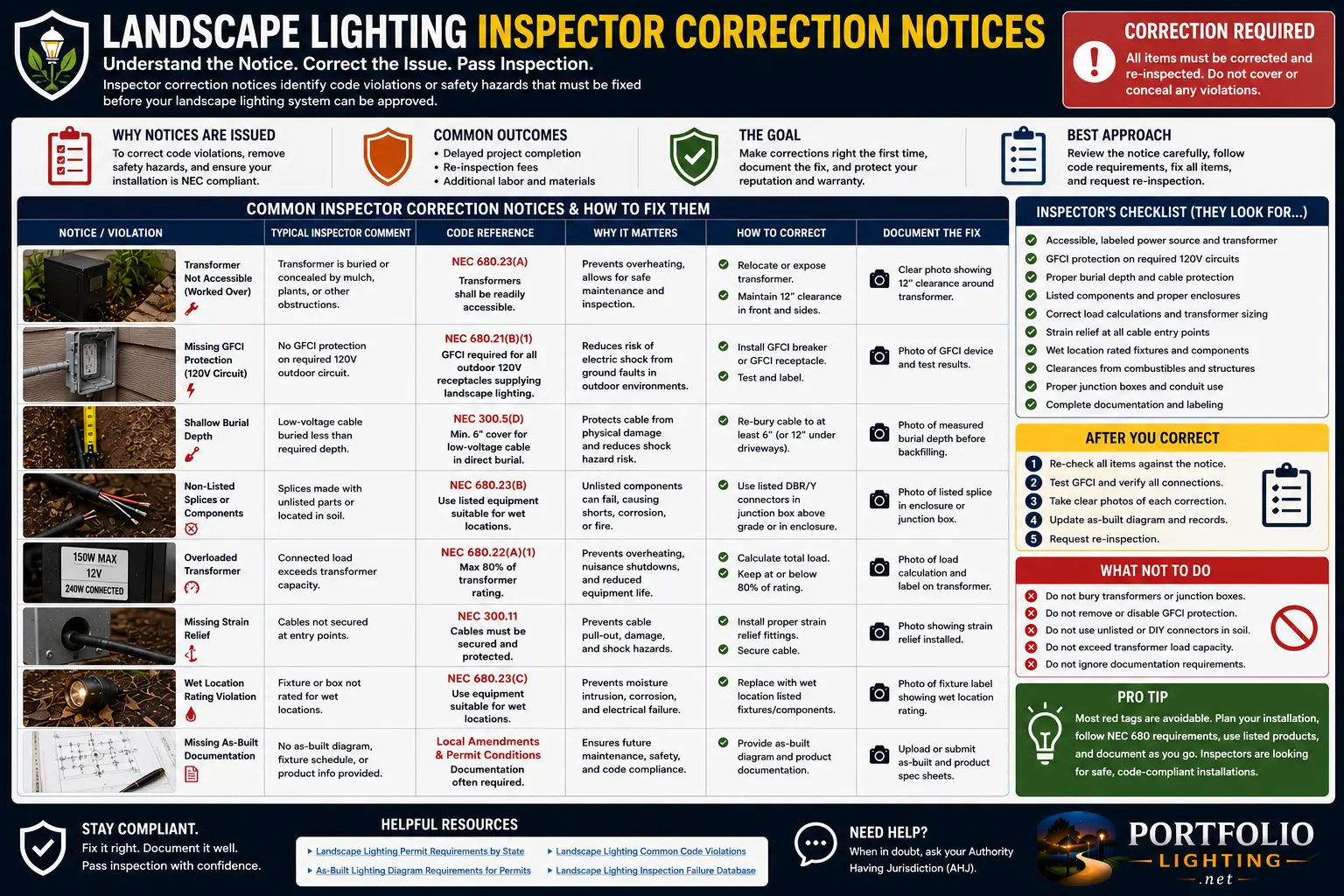
The First 72 Hours: What to Do Immediately After Receiving a Correction Notice
The actions you take in the first 72 hours after receiving a landscape lighting correction notice determine whether this is a minor administrative task or an escalating legal problem. Most correction notice situations are resolved in the first 72 hours by doing four things in sequence.
The "Notice Goes to the Address, Not the Person" Doctrine — Why This Changes Everything
This is the most consequential and least-understood aspect of inspection failure law for landscape lighting. Understanding it prevents the most expensive mistake property owners make after a contractor performs non-compliant work.
The Legal Principle
When a building department issues a correction notice for code violations found at a property, the notice attaches to the property — not to any specific person. The building department's enforcement jurisdiction is over the property and its compliance status, not over any individual person's contractual obligations. This means:
- The correction notice is addressed to the property owner of record (or the permit holder, depending on who pulled the permit) — not to the contractor who did the work
- If the contractor who created the violation is no longer reachable, no longer in business, or simply refuses to cooperate, the property owner's obligation to the building department is unchanged
- The building department will not — and legally cannot — investigate and resolve a private contract dispute between the owner and contractor; that is a civil matter
- The building department's only concern is that the code violation at the property address is corrected and verified by re-inspection before the permit is closed
The Mike Holt forum documents this from an inspector's perspective: "The correction notice goes to the address and not a person. If the EC were to walk away after doing his due diligance to try and get in, and if something were to happen the onus would be on the HO." The additional point from the same thread: "As a general rule, the owner of a property is responsible for its safety."
What This Means When a Contractor Did Bad Work
When a contractor installs non-compliant landscape lighting, fails inspection, and then becomes unresponsive — the property owner is in the most difficult position the correction notice framework creates. The owner typically:
- Has already paid the contractor fully or substantially
- Cannot force the contractor to return through the building department's mechanism
- Must resolve the correction notice with the building department regardless of the contractor dispute
- Must pay a second contractor to make the corrections if the original contractor won't
- Must then pursue the original contractor separately for reimbursement through bond claims and civil action
Per LegalClarity's contractor permit responsibility guide: "Ignoring known unpermitted work leaves you exposed to insurance denials, disclosure liability when you sell, and escalating fines if the building department discovers the violation on its own." The correction notice is the building department's formal documentation of a known violation — once you've received it, "I didn't know" is no longer available as a defense for future discovery.
Contractor vs Homeowner Responsibility Matrix
The responsibility split between contractor and homeowner for correction notice compliance depends on who pulled the permit, what the contract said, and whether the contractor is still responsive. This matrix maps the common scenarios.
| Scenario | Who Is Responsible to the Building Dept? | Who Should Bear the Cost? | Practical Path |
|---|---|---|---|
| Contractor pulled permit, did work, failed inspection, is responsive | Permit holder (contractor) is named respondent; owner is secondarily responsible as property owner | Contractor — their work failed; corrections are their contractual obligation | Contact contractor immediately, confirm they will schedule corrections and re-inspection before deadline. Get timeline in writing. |
| Contractor pulled permit, did work, failed inspection, is unresponsive | Owner — building department enforcement is against the property address; unresponsive contractor does not relieve owner obligation | Contractor — through bond claim, licensing board complaint, and civil action | Hire second contractor immediately to make corrections. File bond claim and licensing board complaint in parallel. Document all communication attempts with original contractor. See contractor abandonment section below. |
| Owner pulled permit, hired contractor, contractor did non-compliant work | Owner — you are the permit holder; you are the named respondent on the correction notice | Shared — owner bears immediate financial obligation; recovery from contractor through civil action | Owner must make corrections and close permit. Per Build Strong Construction: "If a property owner pulls permits while hiring someone else to perform work, the homeowner may assume more legal liability." Pursue contractor through civil action for reimbursement after corrections are complete. |
| Owner did own work under homeowner permit, work failed inspection | Owner — completely | Owner — completely | Make corrections personally or hire a contractor. Request re-inspection. No recovery path — this is owner's own work. |
| Contractor completed work but did not close permit; homeowner discovers open permit at property sale | Owner — the permit and its open status follow the property, not the contractor | Contractor who left permit open — pursue through licensing board and civil action; but owner must resolve first | Owner must close the permit through re-inspection, corrections if needed, and final sign-off. Per PropLogix: Florida law allows "a property owner to close expired or open permits by hiring a new contractor if needed." Pursue original contractor for cost recovery after resolution. |
How to Request a Deadline Extension — What It Must Contain
An extension request is not a request to avoid fixing the problem — it is a formal request for additional time to fix it properly. Done correctly, extension requests are routinely granted. Done incorrectly — or filed after the deadline — they are routinely denied.
The Universal Rule: File Before the Deadline
Extension requests must be filed before the stated compliance deadline, not after. Oregon Administrative Rules OAR 918-271-0030 is typical of most states: "If corrections cannot reasonably be made within the specified time in section (1) of this rule, or an interpretation or written appeal has been requested, the permit holder shall contact the inspecting jurisdiction and request an extension of time to a specified date or until deficiency is resolved." The key phrase: "contact the inspecting jurisdiction" — before the deadline, not after.
Prince George's County Maryland's standard notice form (representative of most jurisdictions) states: "All requests for extensions or waiver must be made in writing to the Code Official." The written requirement is standard. A phone call requesting an extension is not sufficient in most jurisdictions — the request must be in writing, creating a record of the request and any granted extension.
What a Valid Extension Request Must Include
An effective extension request contains six elements that together demonstrate you are actively engaged and have a concrete plan:
- Property address and permit number — identifies the specific permit and correction notice being referenced
- Date of original inspection and correction notice — establishes the timeline baseline
- Original compliance deadline — shows you know the deadline and are acting before it
- The reason the deadline cannot be met — specific, not vague. "The cable burial depth correction requires re-excavating approximately 180 feet of cable run, and the contractor cannot schedule the excavation crew until [specific date]" is a valid reason. "The work will take more time" is not. The California DTSC extension request form (representative of formal requirements) specifically asks for "a detailed explanation of why the owner or operator could not have reasonably anticipated or controlled the circumstances necessitating the extension."
- The specific extended deadline requested — not "some additional time" but "we request an extension to [specific date]" with a realistic timeline based on the actual work required
- Evidence of active progress — contractor contact confirmation, materials ordered, permits applied for if new permits are needed, scheduling confirmation from a licensed contractor
The Best Extension Request Opener: Begin the letter with acknowledgment of the violation and a statement of your compliance intent: "We have received the correction notice dated [date] for permit [number] and acknowledge the violations cited. We are actively working to achieve compliance and respectfully request an extension of the compliance deadline from [original date] to [requested date] for the following reason..." This opening signals engagement, not avoidance, and frames the request professionally. Renix Electric documents what inspectors respond to: "Inspectors often look more favorably on owners who are clearly engaged and working with licensed professionals." An extension request from a property owner who has already hired a contractor for corrections will be received more favorably than one from an owner who appears to be doing nothing.
Written Dispute Responses: How to Challenge a Code Interpretation in Writing
When you believe a correction notice item is based on an incorrect code interpretation — the inspector applied the wrong section, measured from the wrong reference point, or cited a requirement that doesn't apply to your installation configuration — the dispute must be made in writing to the Building Official, not to the field inspector.
The Correct Target: Building Official, Not the Inspector
Code interpretation disputes go to the Building Official — the head of the building department and the person with final authority over code interpretation in the jurisdiction. The field inspector is not authorized to reverse their own determination; only the Building Official can do that. Per NEC 90.4: "The authority having jurisdiction for enforcement of the Code has the responsibility for making interpretations of the rules." The AHJ is the Building Official, who may delegate to inspectors but retains interpretive authority.
The Reliable Lien Search guide documents the process: "Handle Disputes Professionally: If you disagree with the violation notice or the required corrective actions, seek advice from a real estate attorney or a code enforcement expert to resolve the issue through appropriate channels." The appropriate channel is the Building Official in writing, referencing the specific NEC section, the specific condition found, and the specific reason the section doesn't apply or was applied incorrectly.
What a Dispute Response Must Include
A dispute response that succeeds contains: the specific NEC section cited on the notice; the text of that section (quote the actual code language — do not paraphrase); the specific reason the section doesn't apply or was misapplied; your factual evidence (photographs, measurements, manufacturer documentation); and a specific request — either withdrawal of the item or a site meeting to resolve the factual dispute. See the inspection failure codes guide for the specific NEC section language for each common landscape lighting violation.
When the Contractor Abandons the Project: Four Parallel Actions
The landscape lighting contractor who installs a non-compliant system, fails inspection, and then stops responding to calls is one of the most legally complex situations a property owner faces. The correct response runs four parallel tracks simultaneously — not sequentially.
Track 1: Make the Corrections Regardless
The correction notice deadline does not pause while you pursue the contractor. Hire a second licensed contractor to make the corrections and schedule the re-inspection before the deadline. Get the permit closed. This is the only action that stops the escalation sequence from continuing. Once the permit is closed, the correction notice is resolved and no further fines or penalties will accrue. Everything else is recovery — recovering money from the original contractor for the cost of the second contractor.
Track 2: File a Complaint with the Licensing Board
In states with electrical or low-voltage contractor licensing requirements, the licensing board has a formal complaint process for contractors who perform non-compliant work and fail to correct it. Per LegalClarity: "If the contractor who signed the permit failed to get the inspection or final approval, you have grounds to report them to the relevant state licensing board." A licensing board complaint can result in: formal investigation; license suspension or revocation; and in some states, a requirement that the contractor pay restitution to the property owner. The licensing board complaint is the most effective leverage tool available because the contractor's license is their livelihood.
File the complaint with specific documentation: the permit number, the correction notice, your written communications to the contractor, and the cost of the second contractor's corrections. See the contractor licensing guide for how to locate and contact the relevant licensing board in your state.
Track 3: Make a Claim Against the Contractor's Bond
Licensed contractors are required to carry surety bonds as a condition of their license. A surety bond is specifically designed to provide recovery funds when a licensed contractor fails to perform work properly. A bond claim typically requires: a written demand to the contractor (certified mail) stating the specific non-compliance and the cost of correction; documentation of the non-compliance (correction notice, inspection report); and a claim filed with the surety company if the contractor doesn't respond. Bond claim amounts are limited to the bond amount — typically $5,000–25,000 for residential contractor bonds — but this covers the cost of most landscape lighting correction work. Contact your state's contractor licensing board or the contractor's license information to identify the bonding company.
Track 4: Send a Formal Demand Letter
A formal demand letter sent via certified mail (return receipt requested) to the contractor documents your demand and creates the legal foundation for subsequent civil action if needed. The demand letter should state: the specific work performed; the correction notice details; the deadline; your demand that the contractor return and make corrections by a specific date; notice that you will hire a second contractor and pursue recovery of those costs if they don't respond; and notice of your intent to file licensing board and bond claims. This letter is most effective when sent within the first 72 hours — before the deadline passes, when the contractor still has the opportunity to avoid the consequences.
The landscape lighting contractor abandonment pattern plays out identically in the cases I've been asked to help resolve. Original contractor installs the system, calls for final inspection, fails for burial depth. Sends homeowner the failure notice. Goes silent. Homeowner waits two weeks trying to reach them. Calls me at week three, deadline is in two days. We excavate representative sections, rebury the non-compliant runs, pass re-inspection the next day. Total cost for my work: $600–900. Original contractor's bond: $10,000. Licensing board complaint filed with documentation: three weeks later the licensing board contacts the original contractor. In two of three cases I've tracked, the original contractor settled with the homeowner for most of my re-work cost rather than face a licensing board hearing. The sequence — make corrections fast, file the complaint the same day — is the right strategy. Don't wait to file the complaint until after corrections are made. File it the same day you hire the second contractor.
The Escalation Sequence: What Happens Step by Step If You Ignore a Correction Notice
Ignoring a correction notice triggers a predictable escalation sequence. Understanding the sequence — and what triggers each step — is what makes early action so clearly the right choice compared to any delay strategy.
A landscape lighting correction that costs $300–600 to fix (re-excavating and re-burying a cable run, replacing a non-GFCI outlet) during the original correction period can cost $1,500–4,000+ by the time an open permit is discovered at property sale and must be resolved retroactively — including: retroactive permit fee with penalty multiplier; code compliance under current NEC edition (which may require additional work beyond the original violation); re-inspection (which may require re-excavation of buried work); real estate attorney costs if there is a sale dispute; and the delay cost of a stalled closing. The $300 fix that costs $4,000 when left for two years is the most common story in the open permit world.
Open Permits and Property Title: The Sale-Killer No One Sees Coming
An open landscape lighting permit — from a correction notice never resolved, a final inspection never called, or a permit pulled but never closed — creates a problem that shows up at property sale when everyone assumed everything was fine.
What "Open Permit" Means in a Property Sale Context
A permit is "open" in the building department's records when work was authorized but the final inspection was never completed and signed off. An open permit is not a lien — it does not appear on a standard title search. Per Lowndes Law Group: "Permits are often an overlooked component of real estate transactions. So-called 'open' permits can cause headaches for owners who are selling or financing their property. While title searches disclose encumbrances such as liens, mortgages, easements and restrictions, they do not disclose open permits, which must be independently searched at the local government."
This distinction — open permits are not disclosed by a standard title search — is what makes them dangerous. A property can pass through multiple title searches without an open permit being discovered, because title searchers are looking for recorded liens and encumbrances, not building department records. Open permits only appear when someone specifically conducts a permit search at the local building department.
Who Discovers Open Permits at Sale and When
- Buyer's real estate attorney or agent — in Florida (where open permit law is well-developed), it's common practice to order a permit search alongside the title search; in other states the practice is less consistent
- Title company — some title companies routinely conduct permit searches; others don't; per Optima Properties: "Title companies can close the sale on a property with an open permit on it, and most will never even conduct an open permit search"
- Buyer's home inspector — may check permit history for recent work on the property as part of the inspection
- Lender — some lenders require permit verification for financed properties, particularly on recently permitted work
Sale Delay
Buyer demands open permit be closed before proceeding. Seller must resolve — which requires correcting all violations, passing inspection, and obtaining final sign-off. Timeline: days to weeks for simple corrections; months for complex issues or expired permits requiring retroactive permitting.
Price Reduction Demand
Buyer uses the open permit as leverage to demand a price reduction as credit for the cost and inconvenience of resolving it post-closing. Even where the buyer agrees to close with the open permit, they commonly demand a seller credit of 1.5–3x the estimated resolution cost.
Code Update Compliance
When a permit expires and must be re-opened retroactively, the work must comply with the current NEC edition — not the edition in effect when the work was originally done. For landscape lighting, the most common issue: a system that was compliant under the 2017 NEC may need modifications to comply with the 2023 NEC's updated requirements.
Disclosure Liability
If a seller knew about an open permit (because they received the correction notice) and did not disclose it to the buyer, the buyer has a legal claim for non-disclosure of a known defect. Per BOSS Construction: "In cases of residential real estate, a new owner may bring lawsuits against any of the professionals involved for failing to disclose a property defect." The correction notice you received is documented proof you knew.
Title Insurance: Why Open Permits Are Explicitly Excluded from Coverage
One of the most common assumptions property owners make is that title insurance will protect them from open permit problems. It won't — and the exclusion is written explicitly into every standard title insurance policy.
The Standard Title Insurance Exclusion
Per Marketplace Title's analysis of standard ALTA Owner's Title Insurance policies: "The owner's title insurance policy contains an express exclusion of coverage for claims 'that arise by reason of… [a]ny law, ordinance, permit, or governmental regulation (including those relating to building and zoning) restricting, regulating, prohibiting, or relating to… the character, dimensions, or location of any improvement erected on the Land… or the effect of any violation of these laws, ordinances, or governmental regulations'; unless 'a notice… is recorded in the Public Records setting forth the violation.'"
This exclusion means: title insurance does not cover any claim arising from building codes, permits, or ordinances — including open permit issues, code violations, and correction notices. The exception (recorded notice) applies only to violations that are formally recorded in the public property records — not to building department database records, which are generally not recorded encumbrances.
Per Supreme Title: "Remember, permits are NOT covered under your title insurance." And per the Space Coast real estate analysis: "Other title companies may choose not to perform lien searches, instead placing an exception on Schedule B of the Owner's Policy." This means some title policies specifically list open permits as exceptions to coverage — making the exclusion even more explicit.
The Practical Implication
If you purchase a property with an open landscape lighting permit that is later discovered to require significant corrective work, your title insurance will not cover the cost. If you sell a property with an undisclosed open permit and the buyer makes a claim after closing, your title insurance will not cover your defense or liability. Open permit resolution costs are entirely out-of-pocket for whoever is responsible for them at the time of discovery.
Homeowner's Insurance and Open Correction Notices: The Coverage You Think You Have
Homeowner's insurance provides no direct coverage for correction notices or open permit fines — these are regulatory compliance costs, not insured events. But the indirect insurance implication is far more significant and far less understood.
Direct Coverage: Not Covered
Homeowner's insurance policies cover sudden and accidental losses — fire, theft, wind damage, liability for injuries on the property. They do not cover fines and penalties from government agencies, the cost of bringing non-compliant work into code compliance, or the cost of excavating and re-installing non-compliant landscape cable. These are regulatory compliance costs that fall entirely outside the scope of any standard homeowner's policy.
The Indirect Coverage Risk: Claim Denial for Known Defects
The more significant insurance implication is what an unresolved correction notice does to your coverage for claims related to the non-compliant installation. Insurance policies exclude coverage for intentional acts and known defects. A correction notice on file with the building department is documented evidence that you had constructive knowledge of a specific code violation at your property. If that code violation subsequently contributes to a claim — for example, a landscape fixture installed too close to a pool per the uncorrected violation strikes someone in the water — the insurer may deny the claim on the grounds that the violation was a known defect that you failed to correct.
The Broward County violation guide makes this clear: "Failing to act within that period can lead to additional notices, fines, or a hearing before a special magistrate or similar authority." The broader insurance principle: "An uncorrected code violation notice on record can be interpreted as constructive notice of a known defect — which is a basis for coverage denial." While this is most significant for pool-adjacent violation notices (where the safety risk is most direct), the principle applies to any unresolved code violation that creates an ongoing safety risk. Resolving correction notices promptly is not just a compliance task — it is a risk management task that protects your insurance coverage.
How to Close a Permit After Corrections Are Made
Closing the permit — obtaining the final inspection sign-off that officially records the work as code-compliant — is the only action that definitively resolves a correction notice and removes the open permit status from the building department's records.
The Permit Closeout Sequence
- Complete all corrections. Every item on the correction notice must be addressed. Do not schedule re-inspection with outstanding items remaining — the inspector will find them and the permit will remain open with an additional correction notice.
- Run through the pre-inspection checklist before calling for re-inspection. The NEC inspection checklist covers every item the inspector will verify. The inspection failure codes guide covers the specific correction required for each common violation. Verify compliance with every item before scheduling.
- Schedule re-inspection through the jurisdiction's scheduling system. Most jurisdictions use online scheduling portals; some use phone scheduling. Reference the original permit number and state that this is a re-inspection for correction notice items. Pay the re-inspection fee at scheduling if required.
- Be available for the inspection. For underground inspection of previously buried cable, the inspector may need access to probe the cable or verify section depth. Be present or have an authorized representative present.
- Obtain the final sign-off in writing. After a successful final inspection, the inspector signs off on the permit. Obtain a copy of the signed permit card or the jurisdiction's electronic confirmation of final approval. This document is your proof that the permit is closed. Store it with your property documentation — it will be needed if an open permit question arises at future sale.
- Verify the permit status in the building department's records. After the inspector signs off, confirm that the permit status in the building department's online system (if available) has changed from "Open" to "Closed" or "Final." Some jurisdictions update records immediately; others take 1–5 business days. If the record still shows open after a week, contact the building department to request confirmation of closure.
Per Engineer Fix: "Obtaining the final signed-off permit confirms the electrical work meets all governmental standards, allowing the building project to proceed." For landscape lighting specifically, obtaining final sign-off eliminates the open permit status, resolves the correction notice, and creates the documentation you need for property sale, insurance claims, and future contractor reference.
Three Sample Letters for the Most Common Correction Notice Responses
These template letters cover the three situations where a written response to the building department is required or strategically important. Customize each with your specific details. Send all by certified mail or through the building department's documented submission method.
Letter 1: Deadline Extension Request
Dear Building Official / Code Compliance Office:
I am the property owner / permit holder for the above-referenced permit at [PROPERTY ADDRESS]. I received a correction notice dated [NOTICE DATE] citing violations of [LIST NEC SECTIONS] with a compliance deadline of [DEADLINE DATE].
I acknowledge the violations cited and am actively working to achieve compliance. I respectfully request an extension of the compliance deadline from [ORIGINAL DEADLINE] to [REQUESTED EXTENDED DATE] for the following reason(s):
[Specific reason — e.g., "The cable burial depth correction for Item 1 (Table 300.5 Column 5) requires re-excavating approximately 180 feet of buried cable run. The licensed landscape contractor I have engaged, [CONTRACTOR NAME], license number [LICENSE NO.], is scheduled to complete this work on [SPECIFIC DATE], after which I will immediately schedule re-inspection."]
Evidence of active progress: [e.g., "Attached: confirmation email from contractor dated [DATE] confirming scheduled work date."]
I intend to complete all corrections and schedule re-inspection no later than [DATE]. Please confirm receipt of this extension request and advise whether the extension is granted.
Respectfully,
[YOUR NAME]
[PHONE AND EMAIL]
[DATE]
Letter 2: Code Interpretation Dispute to Building Official
Dear Building Official:
I am the property owner / permit holder for permit [NUMBER] at [ADDRESS]. I received a correction notice dated [DATE], Item [N] of which cites [NEC SECTION] for the following condition: [QUOTE INSPECTOR'S CONDITION DESCRIPTION].
I respectfully request the Building Official's review of the application of this code section to my specific installation, for the following reason:
[Specific code argument — e.g., "NEC Table 300.5, Column 5 requires a minimum burial depth of 6 inches below finished grade. The inspector's notation states depth was measured at approximately 3 inches. However, the measurement was taken from the top of the existing 4-inch mulch layer, not from the soil surface as the NEC requires. The soil surface depth, measured at the same probe points, is 7 inches — exceeding the 6-inch minimum. Attached photographs taken on [DATE] show a tape measure from the soil surface to the cable jacket confirming 7-inch depth at three points along the cited cable run."]
I request either: (a) withdrawal of this correction notice item if the Building Official agrees with my code interpretation; or (b) a joint site visit with the inspector to re-measure from the soil surface reference point. I am available at [PHONE/EMAIL] to schedule a site visit at the Building Official's convenience.
Respectfully,
[YOUR NAME]
[DATE]
Letter 3: Compliance Confirmation and Re-Inspection Request
Dear Building Inspections Department:
All corrections required by the correction notice dated [NOTICE DATE] for permit [NUMBER] at [ADDRESS] have been completed as follows:
[Item-by-item correction summary, e.g.:
"Item 1 (Table 300.5 Column 5 — burial depth): Cable run along north garden bed has been re-excavated and re-installed at minimum 7 inches below soil grade. Trench remained open pending inspection request. Photographs available.
"Item 2 (NEC 210.8(A)(3) — GFCI protection): Existing outdoor receptacle at transformer location replaced with GFCI-rated duplex outlet. TEST/RESET function verified operational."]
I request re-inspection at the earliest available date. The trench for Item 1 remains open for inspector verification of burial depth. Re-inspection fee of $[AMOUNT] will be paid at scheduling / has been paid online (confirmation number [NUMBER]).
Please contact me at [PHONE/EMAIL] to schedule. I am available [AVAILABLE DATES/TIMES].
Respectfully,
[YOUR NAME]
[DATE]
Correction Notice FAQ
I received a correction notice addressed to a previous owner's contractor, but I now own the property. Am I responsible for resolving it?
Yes — open permits and correction notices follow the property, not the person. Per Optima Properties: "Open permits remain with the property, despite any change in ownership. Failure to uncover any open permits prior to closing means that these permits become the responsibility of the new owner." If you purchased a property and discovered an existing open landscape lighting permit after closing, you are now responsible for resolving it. Your recourse against the previous owner is through the real estate disclosure framework — if they knew about the open permit and didn't disclose it, you have a potential non-disclosure claim against the seller (or their agent). Consult a real estate attorney for the specific claim, but simultaneously begin resolving the permit with the building department — waiting for the legal claim to resolve before addressing the permit allows the open permit to continue aging and accumulating consequences. Florida's statute is particularly progressive: Florida law allows "a property owner to close expired or open permits by hiring a new contractor if needed" and clarifies that "the new contractor is only liable for their own work" — meaning you can hire a fresh contractor to close the permit without taking on liability for the original non-compliant work.
My landscape lighting correction notice is from three years ago and the original contractor is out of business. The permit has expired. What's the process now?
An expired permit with outstanding violations requires retroactive permitting — the most expensive and most complex resolution path. The general sequence: (1) Contact the building department and explain the situation; ask about their process for resolving expired permits with outstanding violations; (2) Obtain a new permit application for the existing installation; the new permit will typically be subject to the current NEC edition, not the edition in effect when the original work was done; (3) The new permit fee will likely be the standard permit fee plus a penalty multiplier for retroactive permitting — typically 1.5–3x the normal fee; (4) Have the existing installation inspected under the new permit; any violations under the current code must be corrected; (5) Pass final inspection and close the new permit. The good news: Florida's statute (F.S. Section 553.79(3)) provides a path for administratively closing permits more than 6 years old when no safety hazard is present — and other states have similar provisions. For buried landscape lighting cable, unless there is an active safety hazard (pool proximity violation, for example), some jurisdictions will exercise discretion in the process. Contact the building department directly and explain the circumstances — inspectors "often look more favorably on owners who are clearly engaged and working with licensed professionals," even when the situation is complex.
My buyer's attorney found an open landscape lighting permit during the sale due diligence. How do I handle this at closing?
An open permit discovered during sale due diligence has three possible resolutions, in order of simplicity: (1) Seller resolves the permit before closing — makes any required corrections, passes re-inspection, obtains final sign-off, and provides documentation of the closed permit at closing. This is the cleanest resolution. Timeline depends on what corrections are required. (2) Seller provides a monetary credit at closing sufficient to cover the buyer's cost of resolving the permit post-closing. The credit amount is typically negotiated based on an estimate from a licensed contractor for the correction work plus permit fees. Per BOSS Construction: "Resolving open permits typically involves completing the outstanding work, obtaining final inspections, and closing out the permits with the local building department." (3) Buyer accepts the open permit and agrees to resolve it after closing — typically with a seller credit and an agreed-upon resolution timeline. This is the riskiest path for the buyer because, as noted above, "requirements to remedy an open permit can include fines, fees, and completion of pending work and removal of work that does not meet building requirements." Buyers should be strongly advised to demand resolution before closing rather than accepting the open permit as their future problem. The seller's best position: resolve proactively before going to market to avoid the discovery entirely.
Related Code, Compliance & Permit Guides
- Electrical Code Safety Guide
- Inspection Failure Codes Guide
- NEC Inspection Checklist
- Permit Requirements Guide
- State Permit Requirements
- Contractor Licensing
- Insurance & Liability Guide
- As-Built Diagram Requirements
- GFCI Requirements Guide
- Wire Burial Depth Code
- Transformer Mounting Code
- Grounding & Bonding
- NEC 2026 Code Updates
- Splice Connection Code
- Pool Lighting Clearance
- Load Calculation Code
- Junction Box Requirements
- Wet Location Listing
- Arc Fault & GFCI Code
- NEC 300.5 Calculators
- Photometric Plan Reading
- Voltage Drop Code
- Landscape Lighting Guide
- Maintenance Guide