
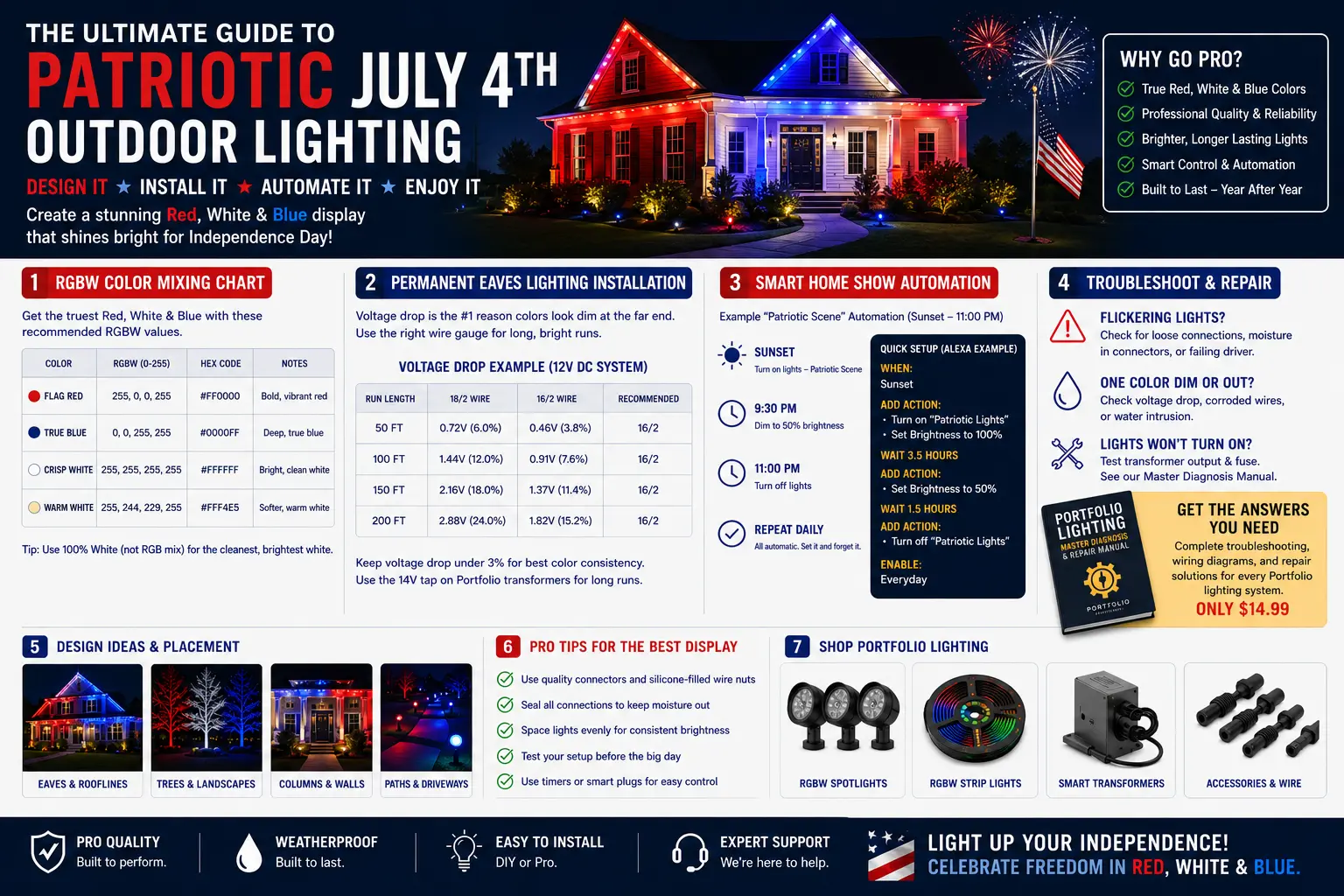
Quick Answer: How Do You Make July 4th Outdoor Lights Actually Look Good?
The best patriotic outdoor lighting displays use RGBW fixtures with a dedicated white LED channel, balanced red and royal blue color zones, stable low-voltage power, and controlled brightness after dark. Most disappointing July 4th setups fail because cheap RGB lights create purple-looking white, long roofline runs suffer voltage drop, or poorly planned animations look chaotic from the street.
For the cleanest red, white, and blue appearance, use:
- True RGBW lighting instead of RGB-only strips
- Dedicated white LEDs for crisp patriotic white
- Power injection or shorter zones on 100+ foot eaves runs
- Slow fade or static scenes instead of aggressive strobe effects
- Warm white pathway lighting near stairs and walking areas for safety
The strongest July 4th lighting displays are not necessarily the brightest. The best systems use clean color separation, stable voltage, smart automation timing, and thoughtful placement so the home looks sharp from the street, in photographs, and late at night.
Most July 4th lighting articles stop at “hang red, white, and blue lights.” That is not enough if you want the display to look sharp from the street, work reliably through heat and rain, and avoid the classic RGB problem where white looks blue and red fades at the end of a long run.
For the broader outdoor foundation, start with the Portfolio outdoor lighting guide and the Portfolio landscape lighting guide. This page narrows that system knowledge into patriotic lighting: color control, permanent eaves planning, voltage drop, automation, and troubleshooting.
RGBW Color-Mixing Chart for Red, White & Blue Outdoor Lights
Here is the detail big-box retailers usually skip: white is the hardest July 4th color to make correctly. Basic RGB fixtures create white by blending red, green, and blue. That often looks icy, purple, or uneven outdoors. RGBW fixtures include a separate white LED channel, which gives a cleaner patriotic look.
Not all LEDs produce the same quality white light outdoors. The outdoor lighting color rendering guide explains why CRI and R9 values affect how flags, brick, wood, plants, and landscaping actually appear at night.
| Scene Color | Best Visual Target | Hex / RGB Starting Point | RGBW Slider Starting Point | Specialist Notes |
|---|---|---|---|---|
| Flag Red | Deep, saturated red without orange | #BF0A30 / RGB 191, 10, 48 | R 100%, G 0–5%, B 0–8%, W 0% | Keep green almost off. Too much green pushes red toward orange or coral. |
| Crisp Flag White | Clean white, not blue, not yellow | #FFFFFF / RGB 255, 255, 255 | R 0%, G 0%, B 0%, W 85–100% | Use the dedicated white channel. Avoid RGB-mixed white if the fixture supports W. |
| Warm Patriotic White | Softer porch or pathway white | #FFF1D6 / RGB 255, 241, 214 | W 70–90%, R 5–12%, G 2–6%, B 0% | Best near seating areas where pure white feels too sharp. |
| Royal Blue | Strong blue that does not look purple | #002868 / RGB 0, 40, 104 | R 0%, G 8–18%, B 100%, W 0% | A touch of green can prevent blue from looking violet on warm stone or brick. |
| Firework Accent | Short sparkle or pulse accent | #FFD166 / RGB 255, 209, 102 | W 70%, R 35%, G 20%, B 0% | Use briefly. Too much gold can overpower the red-white-blue theme. |
Before You Buy Red, White, and Blue Outdoor Lights
Most July 4th lighting mistakes start with buying the wrong type of color-changing fixture. A basic RGB strip may advertise red, white, and blue, but that does not mean it can produce a clean flag red or a true white channel.
The difference is simple: better fixtures produce color with the right LED channels, while cheaper fixtures try to fake the color through software mixing. That is why two “red” lights can look completely different on the same house.
Best Outdoor Layouts for a Patriotic July 4th Display
The strongest displays separate zones instead of scattering colors randomly. Think of the home as a stage: roofline, entry, walkway, landscape beds, trees, columns, and driveway edges each need a role.
Clean Three-Zone Layout
- Roofline: alternating red, white, and blue pixels or larger blocks of color.
- Path and driveway: soft white or alternating red and blue markers for safe walking.
- Landscape uplights: red and blue on trees or architectural walls, with white near the entry.
For full layout planning, use the outdoor lighting plan guide, the outdoor lighting ideas and examples page, and the landscape lighting layout design guide. Those pages help you decide where light should go before you assign patriotic colors.
Why White Belongs Near the Entry
Red and blue are great for impact, but they are not ideal for recognizing steps, faces, food, or obstacles. Keep at least one clean white zone near the entry, porch, or main walking path. If your white light is too harsh, switch from crisp white to warm patriotic white instead of lowering visibility too far.
Permanent Eaves Lighting: Voltage Drop Math for 100+ Foot Patriotic Runs
Permanent eaves lighting is one of the biggest outdoor lighting trends because it can handle July 4th, Christmas, Halloween, game day, security scenes, and everyday accent lighting from one roofline system. The hidden problem is voltage drop. Long runs cause the end of the line to look weaker, and red LEDs are often the first color homeowners notice fading.
Before designing a long run, compare the basics in Portfolio low-voltage lighting, landscape lighting voltage drop, and the landscape lighting transformer size calculator.
For runs over 100 feet, you often need to run a parallel 14/2 landscape wire from the transformer or power supply and inject power near the end of the LED track. This helps prevent the red LEDs from fading and keeps the blue and white channels crisp across the entire roofline.
| Roofline Run | 18/2 Cable Behavior | 16/2 Cable Behavior | Best Practice | Holiday Symptom If Ignored |
|---|---|---|---|---|
| 25–50 ft | Usually acceptable for small RGB runs | Very stable for most residential setups | Single feed may work if load is modest | Minor brightness loss, usually not obvious |
| 50–75 ft | Borderline when many pixels are bright white | Better stability and less color drift | Use 16/2 or split zones | White may look dull and blue/red may shift unevenly |
| 75–100 ft | Not ideal for full-bright RGBW scenes | Possible, but power injection is often smarter | Split the run or inject power near the far end | Red LEDs fade, white gets weak, end of line looks “tired” |
| 100+ ft | Avoid for high-output patriotic scenes | Use only with careful planning | Use multiple zones, controller outputs, or power injection | Color mismatch across the roofline and flicker during animations |
Why Red LEDs Often Look Dim at the End of the Run
Red channels can show voltage problems clearly because the color is expected to look saturated and bold. When voltage falls, the far-end red can look dull, pinkish, or uneven. If this happens, shorten the run, increase wire size, reduce brightness, inject power, or break the display into zones.
For cable planning details, see landscape lighting wire gauge and landscape lighting wiring guide.
Smart Home Patriotic Scene Automation
A strong July 4th display should not depend on someone remembering to turn it on. Use a sunset routine with a responsible cutoff time. The best setup depends on whether your system is controlled by a smart plug, RGB controller, smart transformer, or hub.
Simple Automation Logic Flow
Alexa or Google Home Quick Script
Voice command: “Turn on Patriotic Outdoor.”
Scene behavior: roofline shifts to red-white-blue, pathway stays warm white, uplights switch to red and blue, and the transformer or controller shuts the scene off automatically before late-night glare becomes a neighbor problem.
For smart-home compatibility, compare AI outdoor lighting systems, AI automated landscape lighting, smart hub compatibility, AI voice lighting logic, and AI holiday theming logic.
July 4th Lighting Etiquette: Keep It Patriotic Without Becoming a Nuisance
A patriotic display can look great without running at full brightness all night. In a residential neighborhood, the best scenes are usually static red, white, and blue or slow fading transitions. Fast flashing, high-frequency strobe effects, and rapid color bursts can become annoying to neighbors and may be uncomfortable for people with light sensitivity.
The best outdoor lighting scene should still respect windows, bedrooms, sidewalks, drivers, pets, and nearby properties. A clean patriotic display is memorable because it looks intentional, not because it is the brightest house on the block.
How to Fix Flickering Patriotic Landscape Lights Before July 4th
Color-changing spotlights, RGB path lights, and roofline pixels are more sensitive than simple white path lights. When the system flickers, blinks, shifts color, or fails after rain, the cause is usually one of five problems: weak transformer output, moisture in a connector, voltage drop, a failing LED driver, or overloaded control channels.
Holiday Failure Pattern Table
| Symptom | Likely Cause | Fast Check | Repair Direction |
|---|---|---|---|
| Red looks weak at the end of a run | Voltage drop or undersized cable | Measure voltage at the first and last fixture while the scene is running | Shorten the run, increase wire size, add power injection, or split zones |
| White looks blue or purple | RGB-mixed white or color channel bleed | Switch to dedicated W channel if available | Use RGBW fixtures or adjust red/blue sliders separately |
| Lights blink during animated scenes | Controller overload or weak power supply | Lower brightness to 50% and retest | Reduce load, use stronger controller output, or divide zones |
| Fixtures fail after rain | Moisture in lead wire, splice, or fixture body | Inspect connectors, corrosion, and wet splices | Replace bad connectors and dry or replace water-damaged fixtures |
| Transformer hums or gets hot | Overload, poor connection, or failing transformer | Compare load to transformer rating and check terminals | Reduce load or troubleshoot transformer output |
If the system is already acting up, start with Portfolio LED lights flickering, landscape lights flickering, and Portfolio lighting transformer troubleshooting. If the lights are dead instead of flickering, compare Portfolio landscape lights not working.
Need the Model and Repair Specs?
If your July 4th display depends on older Portfolio fixtures, discontinued transformers, replacement drivers, or compatible parts, the Portfolio Lighting Master Model & Replacement Handbook is the faster way to identify what you have before buying the wrong parts.
Patriotic July 4th Outdoor Lighting Checklist
- ☐ Use RGBW lights where possible so white comes from a real white LED channel.
- ☐ Keep red, white, and blue zones separated enough that colors do not blend into purple.
- ☐ Test the display from the street, not just from five feet away.
- ☐ Check long roofline runs for voltage drop before relying on full-bright white scenes.
- ☐ Use 16/2 cable, shorter zones, or power injection for 75–100+ foot permanent runs.
- ☐ Keep pathway and entry areas bright enough for safety, even when decorative zones are dimmed.
- ☐ Set a sunset routine and an automatic cutoff time.
- ☐ Inspect connectors and splices before the holiday, especially after rain.
- ☐ Lower animation speed if the display feels chaotic or causes glare.
- ☐ Save the patriotic scene as a reusable annual preset instead of rebuilding it every year.
Best Places to Use Red, White, and Blue Lighting
Roofline and Eaves
Best for the “wow” effect. Use permanent track lights or pixel-style RGBW systems with voltage planning.
Driveway Edges
Use alternating red and blue markers, but keep enough white near walking areas for safety.
Landscape Beds
Use red and blue uplights on shrubs, stone, walls, and trees. Keep color brightness below glare level.
Entry and Porch
Use crisp or warm white so guests can see faces, steps, railings, and door hardware clearly.
For driveway and garden planning, see the driveway landscape lighting guide and garden landscape lighting guide.
Patriotic July 4th Outdoor Lighting FAQ
What is the best outdoor lighting setup for July 4th?
The best setup uses RGBW roofline or landscape lighting with saturated red, true white, and royal blue, plus a sunset automation routine and enough white pathway light for safety.
Why does my white July 4th lighting look blue?
Most RGB-only lights fake white by mixing red, green, and blue. Outdoors, that often looks icy blue or purple. RGBW fixtures with a dedicated white channel create a cleaner flag-white appearance.
Can I leave patriotic outdoor lights on all night?
You can, but it is usually better to dim decorative zones late at night or shut them off automatically. Keep only safety lighting active where people actually walk.
Do long permanent eaves lighting runs need power injection?
Many 75–100+ foot RGBW roofline runs benefit from power injection, larger wire, or divided lighting zones. Without it, the far end of the run may look dim or shift color.
What causes color-changing landscape lights to flicker?
Common causes include voltage drop, wet connectors, overloaded transformer output, failing LED drivers, and poor splices. Test the transformer and connectors before replacing every fixture.
Seasonal outdoor lighting is not limited to summer displays. The Halloween landscape lighting guide explains how to create dramatic fall outdoor scenes using RGB uplighting, pathway lighting, shadows, and safe low-voltage effects.
Safety and Electrical Note
Outdoor lighting systems must be installed with weather-rated equipment, proper low-voltage cable, protected connections, and safe routing. If you are working near line voltage, damaged transformers, wet boxes, pool equipment, or uncertain wiring, stop and call a qualified electrician.